Content note. Some broadcasts on this page call whole groups "scum", "hooligans" or "lumpens", and one Radio Hanoi item addresses Black American soldiers by race. They are shown as issued, as evidence of what listeners were told. Showing a transcript is not endorsing it.
What was Cold War radio propaganda?
Cold War radio propaganda was state-run or state-funded broadcasting meant to shape what listeners believed, aimed at home audiences through domestic stations and at foreign ones through international services. This page applies one test to every station: who paid, who was addressed, which technique carried the message, and what the record shows.
What does the collection hold on Cold War radio?
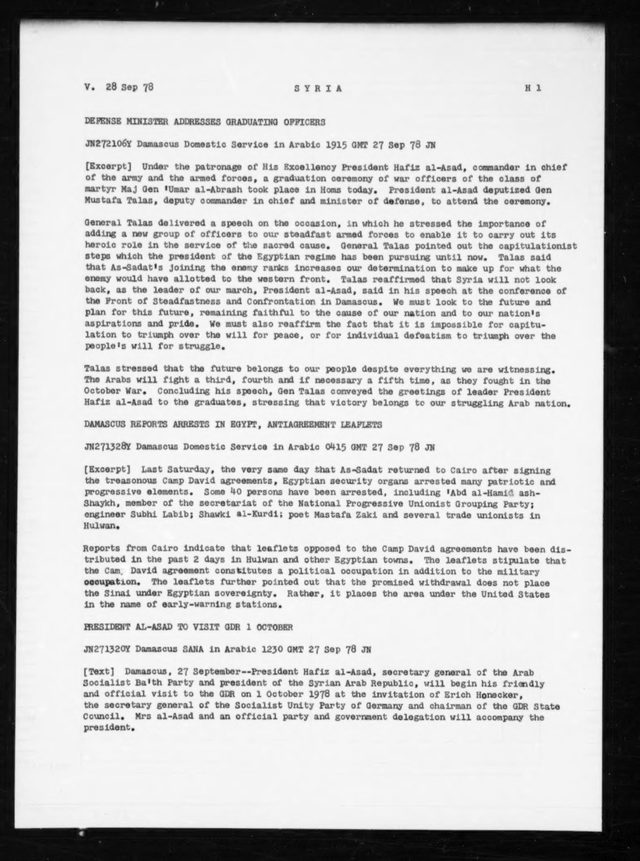
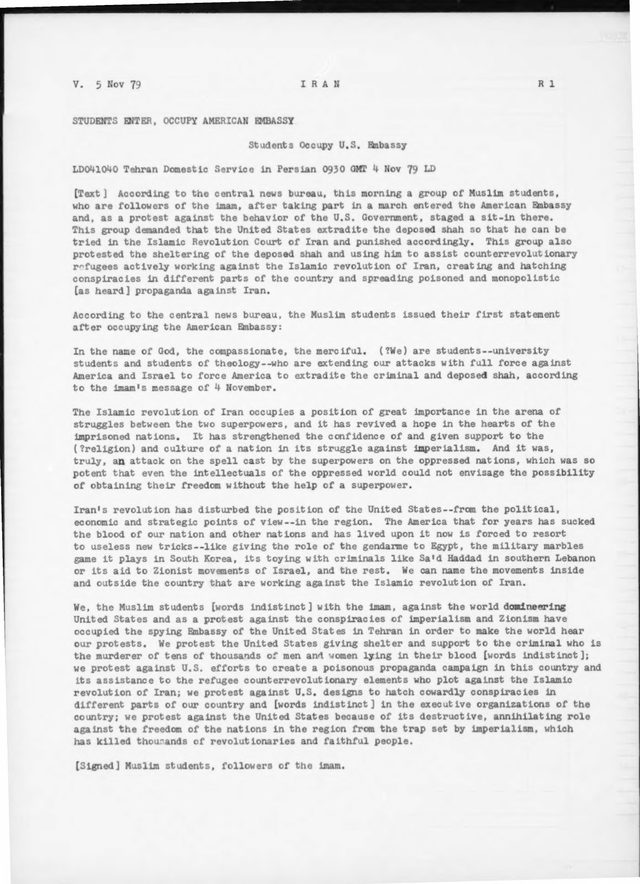
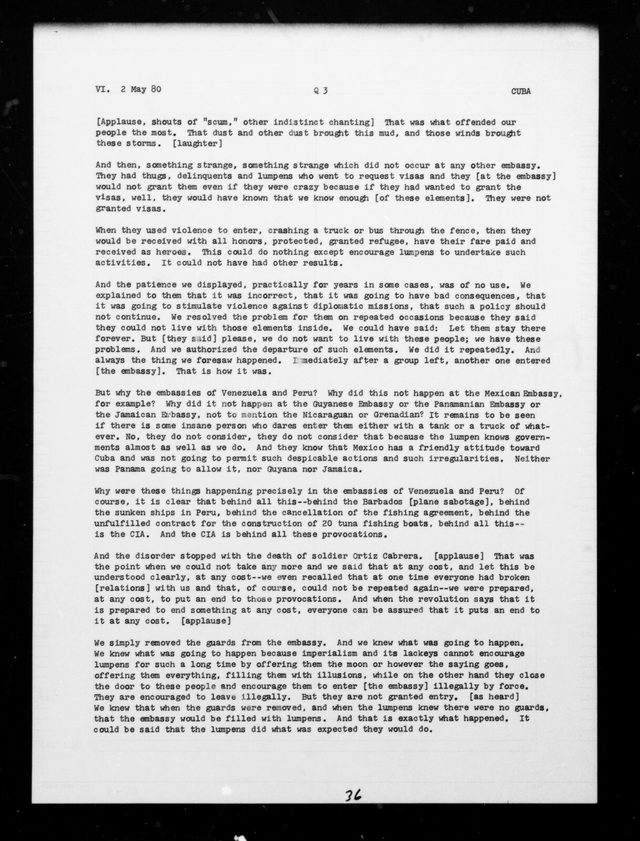
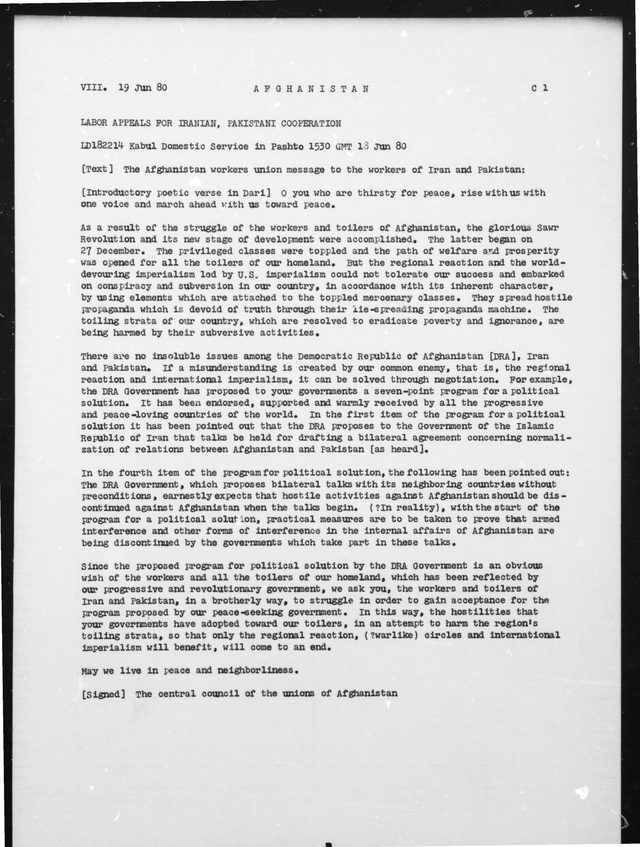
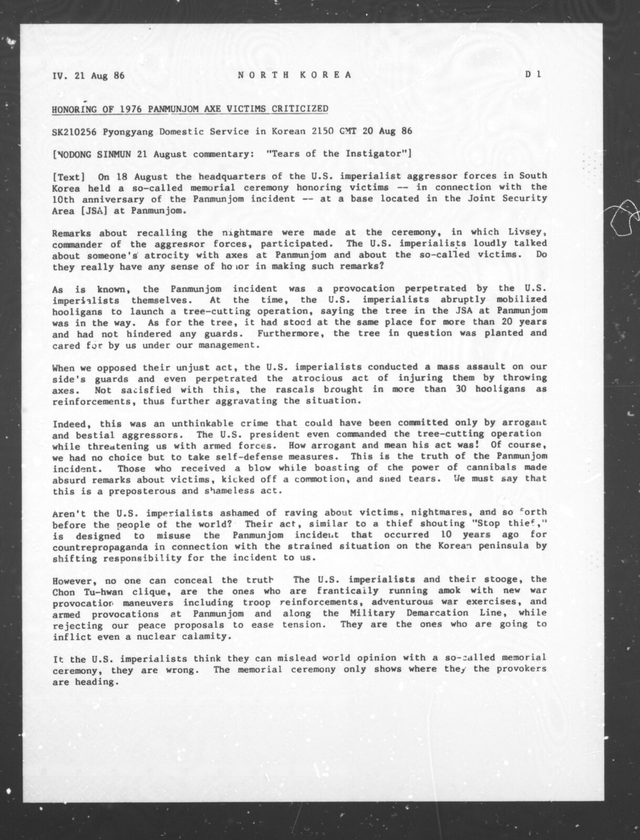
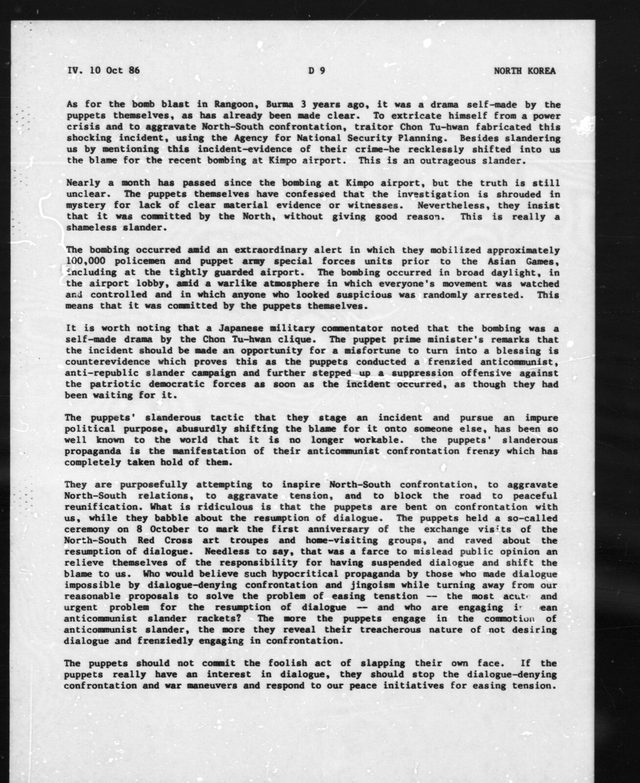
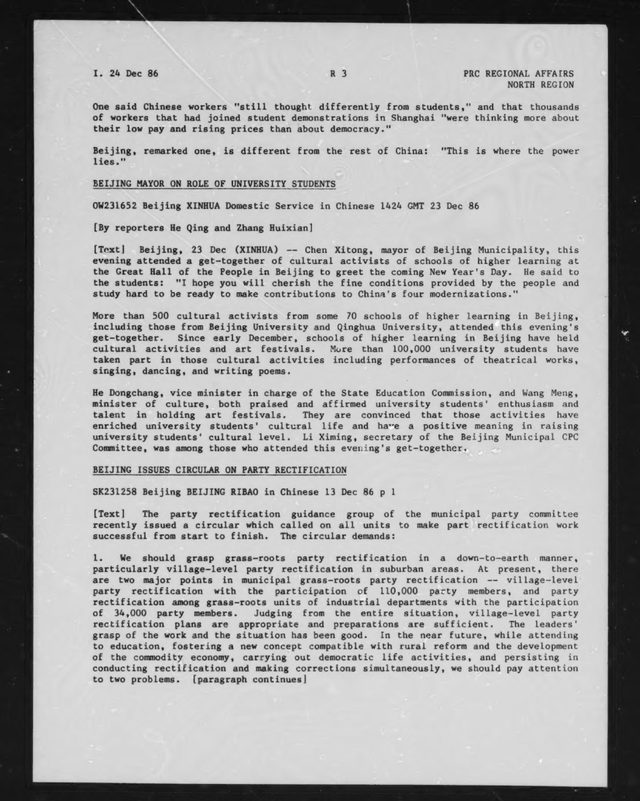
The collection tags 25 objects as medium "broadcast" in the Cold War era, from 1964 to 1991, issued by 18 countries (counts made from the entry files in examples/entries/ by script). Of the 25, 20 are U.S. Foreign Broadcast Information Service (FBIS) Daily Report pages: transcripts that a U.S. agency made of foreign radio. That shapes the sample, which is mostly state radio as monitored by Washington. It does not hold a recording or transcript of a Radio Free Europe or Radio Liberty programme, so for those stations the page shows their fundraising, not their output. It also holds four Voice of America and USIS radio posters, one internal Radio Swan history and two Radio Free Europe appeals (the Truth Dollar and a transit advertisement). For the wider period, see Cold War propaganda.
What was Radio Free Europe, and who paid for it?
Radio Free Europe began broadcasting to Czechoslovakia on 4 July 1950. Radio Liberation, later Radio Liberty, began broadcasting to the Soviet Union on 1 March 1953. Both were presented in the United States as the work of private citizens. The case study The Crusade for Freedom documents that most of their money came from secret CIA budgets until Senator Clifford Case said so in the Senate on 25 January 1971, after which Congress funded them openly.
Explain moreShow less
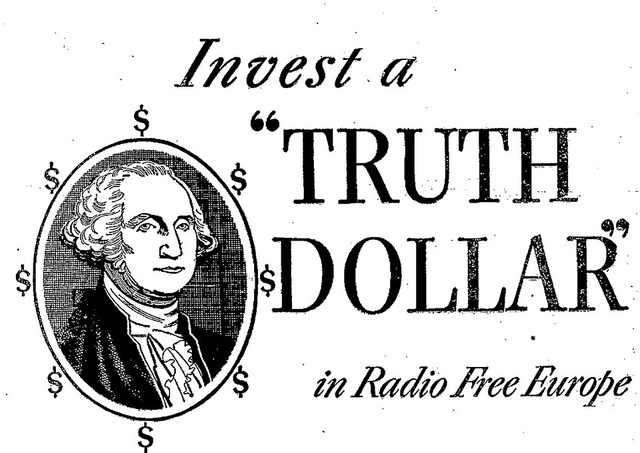
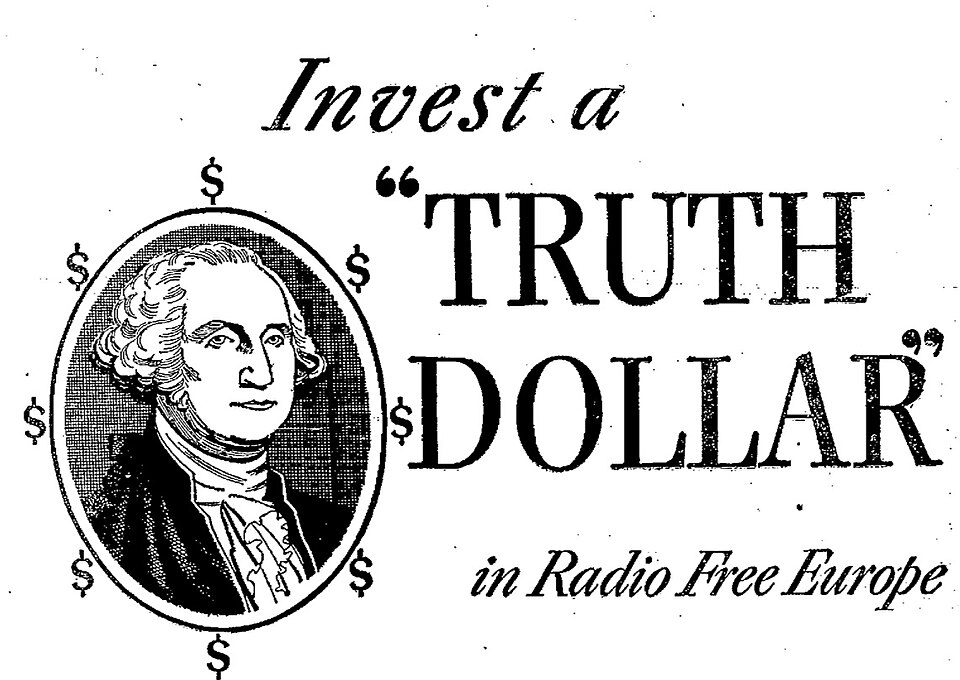
The 1954 "Truth Dollar" advertisement asks Americans to fund the station and sets George Washington's portrait inside a banknote frame. The entry tags it narrative laundering, glittering generalities and transfer: "Truth" stands where a statement of who funded the station could have been, and Washington lends the founding era's prestige to the appeal. Read the technique: narrative laundering.
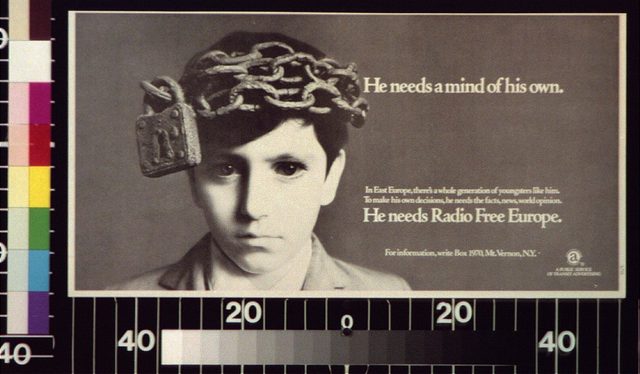
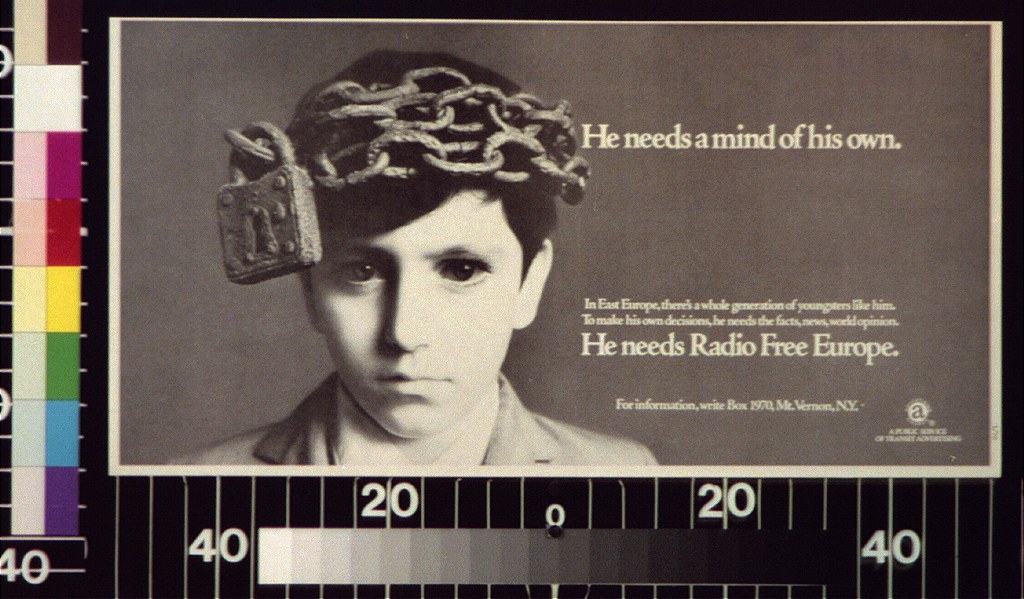
A transit advertisement from about 1970, held by the Library of Congress, pairs a child bound in a chain with the line "He needs Radio Free Europe". The entry tags transfer and narrative laundering: the stigma of captivity attaches to the child, and the Advertising Council's public-service label presents the broadcaster as a civic cause without naming its main funder. It dates from the year before the funding became public.
What did the Voice of America say about itself?
The Voice of America (VOA) was an openly government-run service. The collection's four VOA and USIS radio posters were distributed in Asia by the U.S. Information Agency and its predecessor and are held by the National Archives. They are schedule notices as much as persuasion, and each names its sponsor.
Explain moreShow less
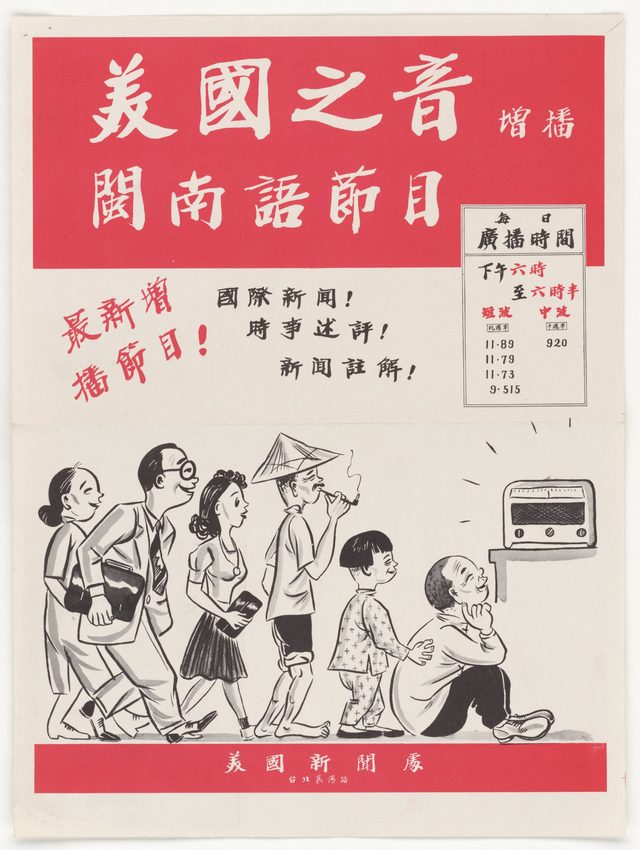
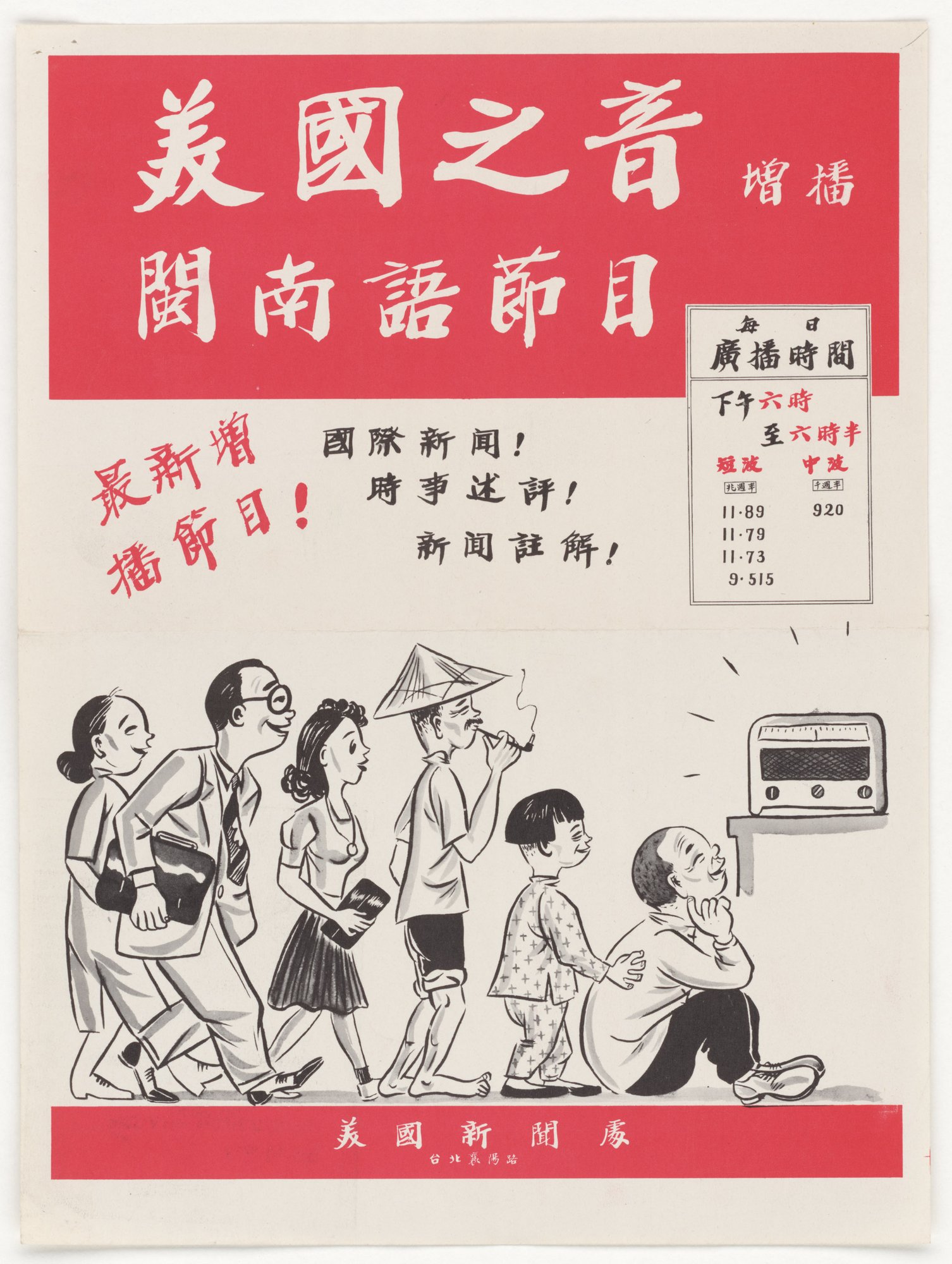
The April 1951 Taipei sheet announces added programmes in Southern Min (Hokkien) with a daily time and frequencies. The entry tags bandwagon: a queue of different listeners walking toward one set implies that everyone tunes in. Read the technique: bandwagon.
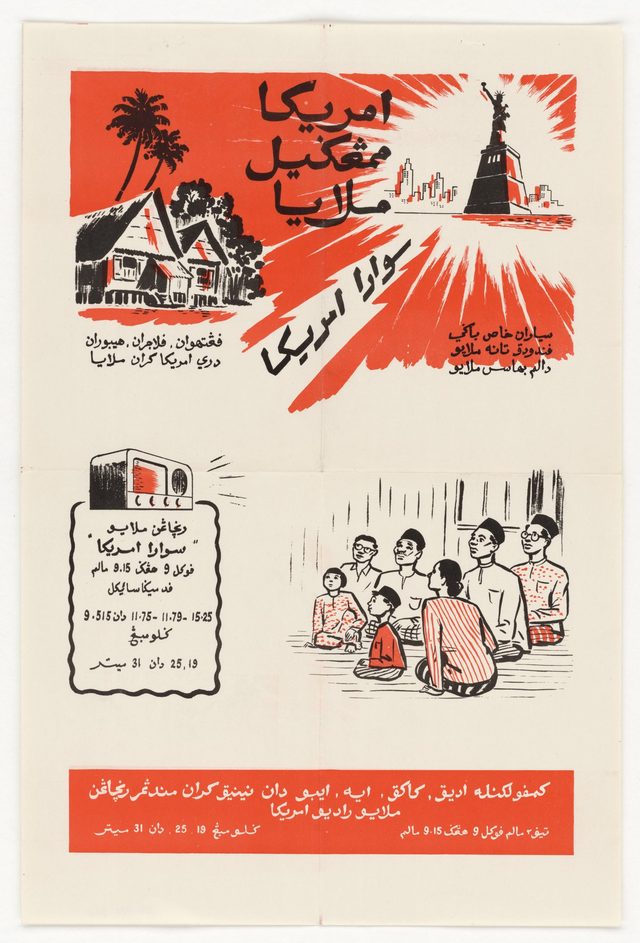
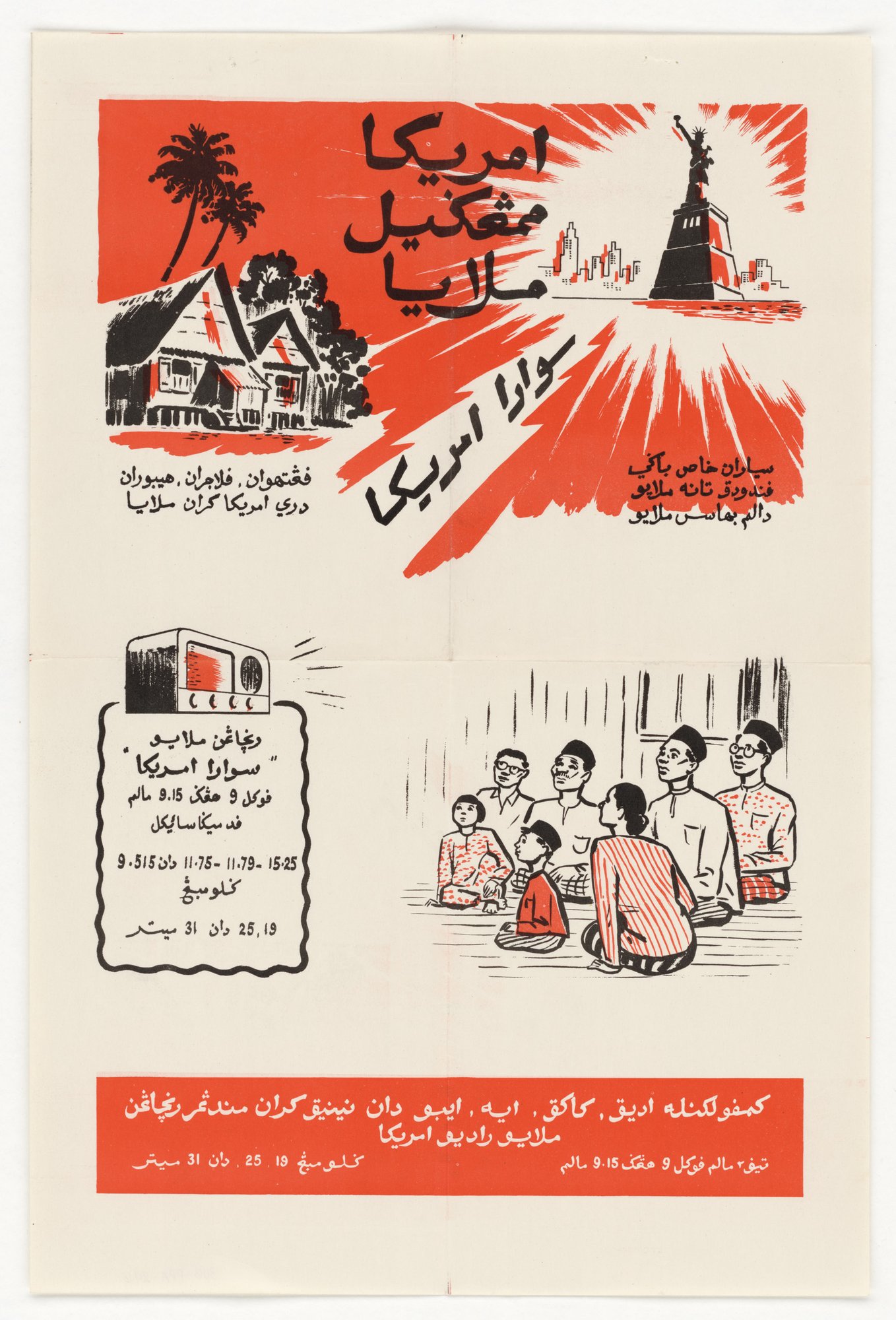
The August 1951 Malay poster in Jawi script places American imagery beside a Malayan home and lists broadcasts on the 19, 25 and 31 metre bands. The entry tags transfer and plain folks, and notes that its reading of the Jawi text is approximate. Read the technique: transfer.
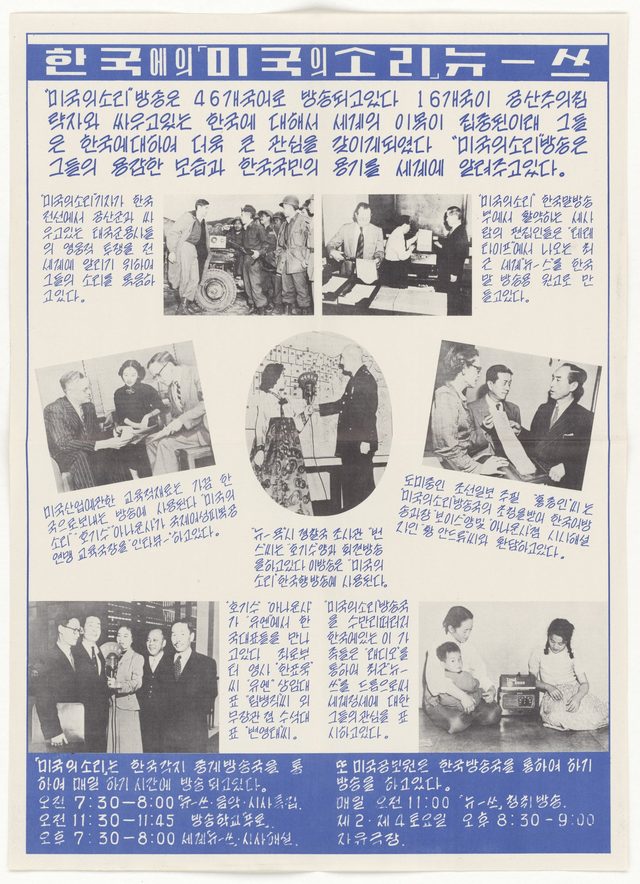
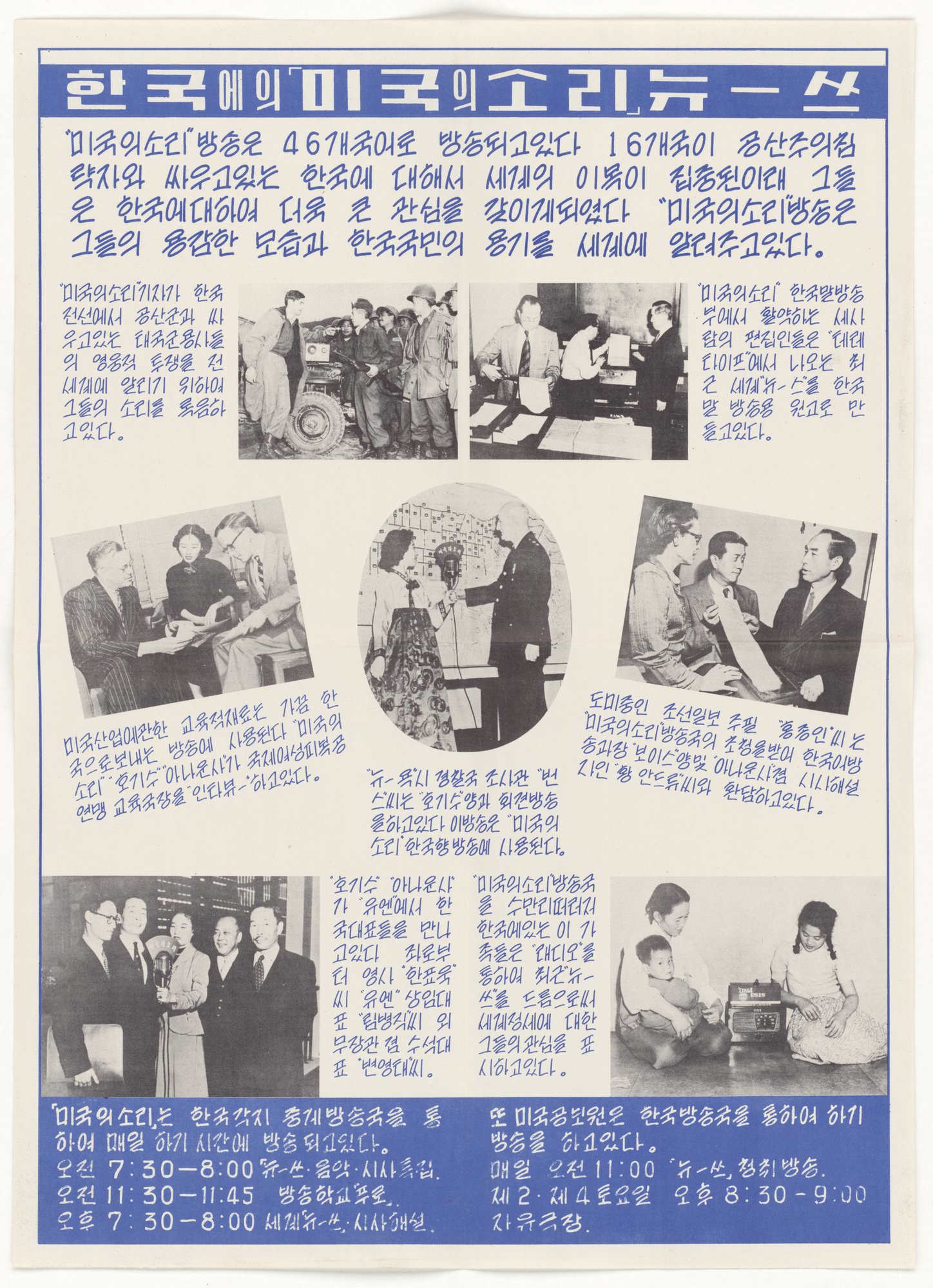
The May 1953 Korean sheet was printed during the Korean War. It shows staff at work and a family at a USIS-marked radio, and it calls the opposing side "Communist aggressors", which the entry tags name-calling beside transfer.
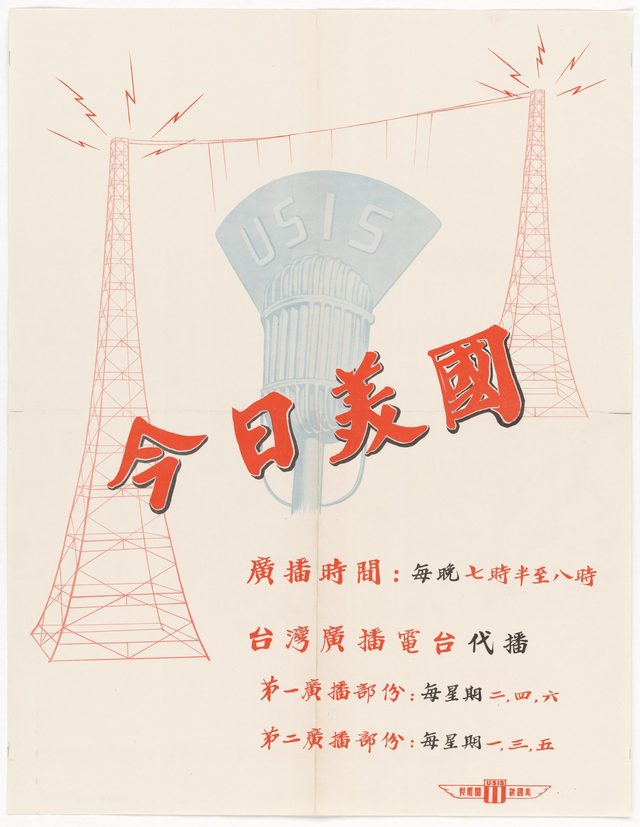
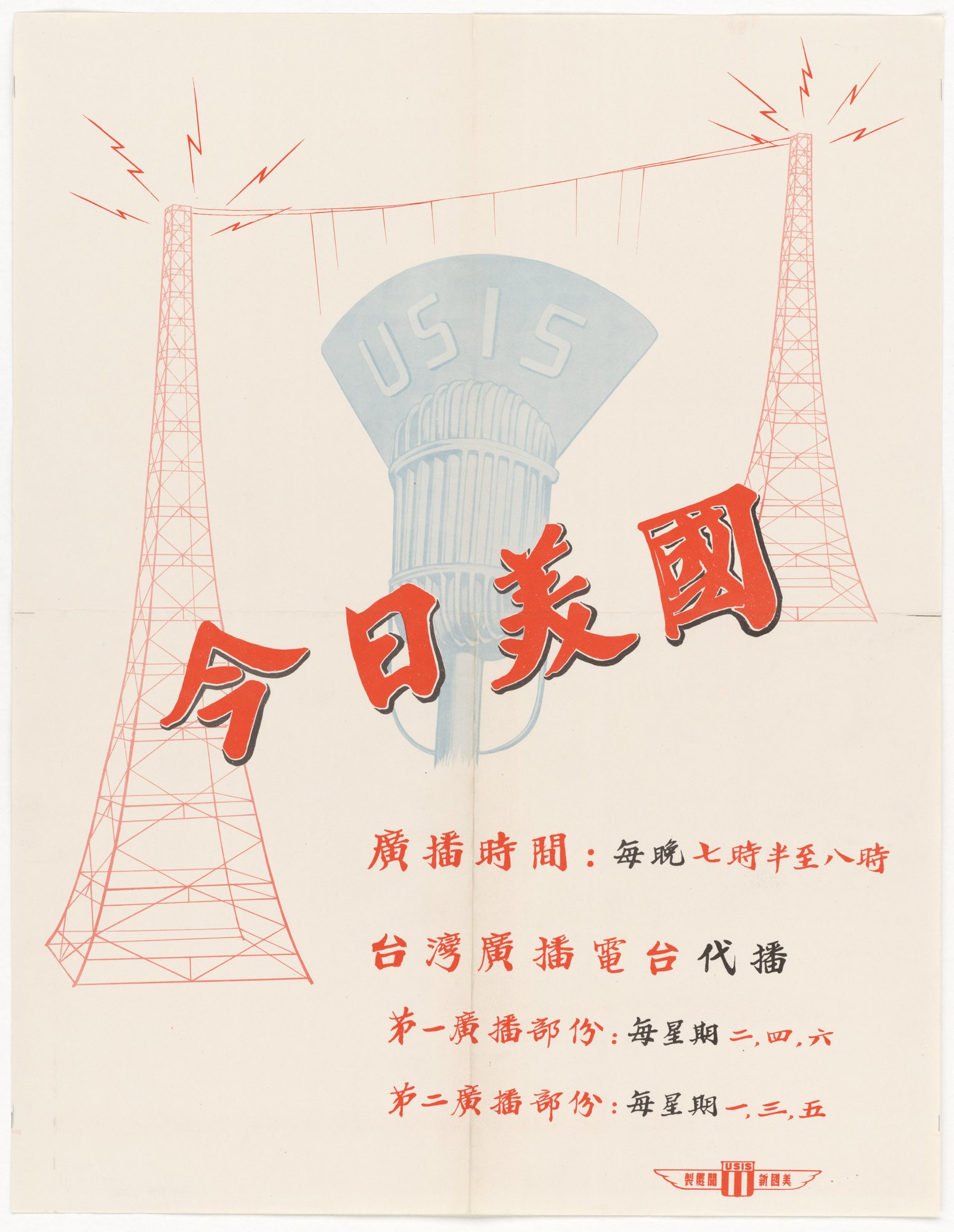
The March 1952 Taiwan sheet announces a nightly programme, "America Today", relayed by the Taiwan Broadcasting Station. The entry calls it chiefly a schedule notice, with transfer as its only persuasive device.
What was Radio Swan?
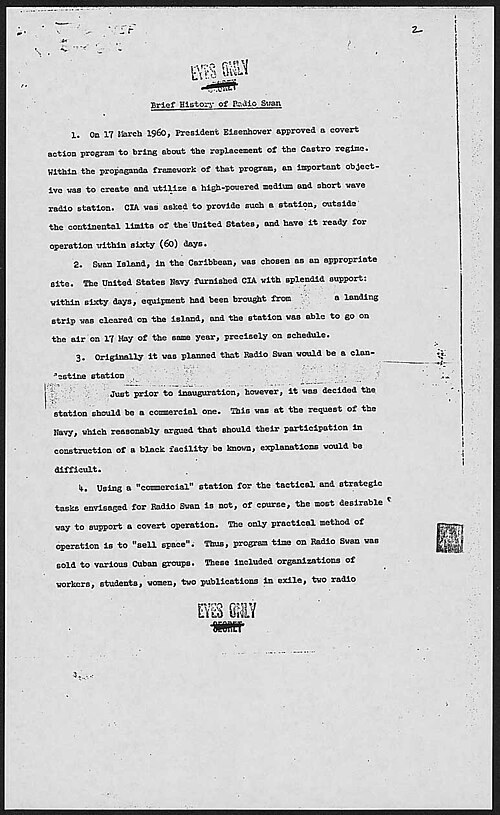
Radio Swan went on the air on 17 May 1960 from Great Swan Island, broadcasting in Spanish to Cuba. The case study The Cuba-United States radio war records that it was owned on paper by a shipping company that owned no ships and was in fact a CIA operation. It broadcast coded messages before the Bay of Pigs invasion.
Explain moreShow less
The page is an internal U.S. government annex in the John F. Kennedy Presidential Library. Its numbered paragraphs say the programme was approved on 17 March 1960, was first planned as clandestine, was made "commercial" at the Navy's request and "sold space" to Cuban groups. The entry tags narrative laundering and notes that the sponsor here was concealed, whereas Radio and TV Martí, begun in 1985, are labelled as U.S. government broadcasts. The same technique definition applies to both. A page that falls under the same definition from the Eastern side is Havana's answer to Radio Martí, below.
How did Moscow and its allies use state radio?
The Soviet and Warsaw Pact items in the collection are domestic and external state broadcasts, preserved because FBIS monitors transcribed them. They are not a sample of everything those stations aired. Each caption below describes one page and nothing more.
Explain moreShow less
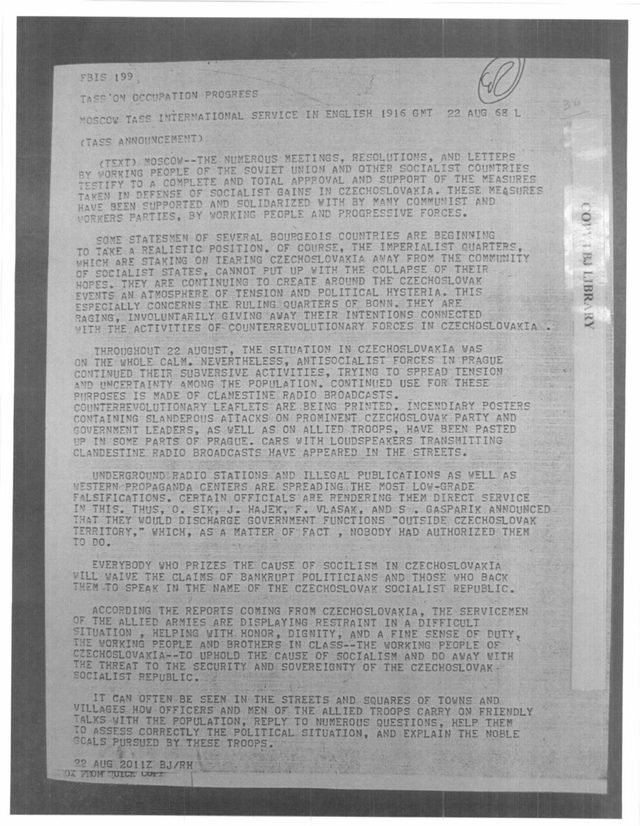
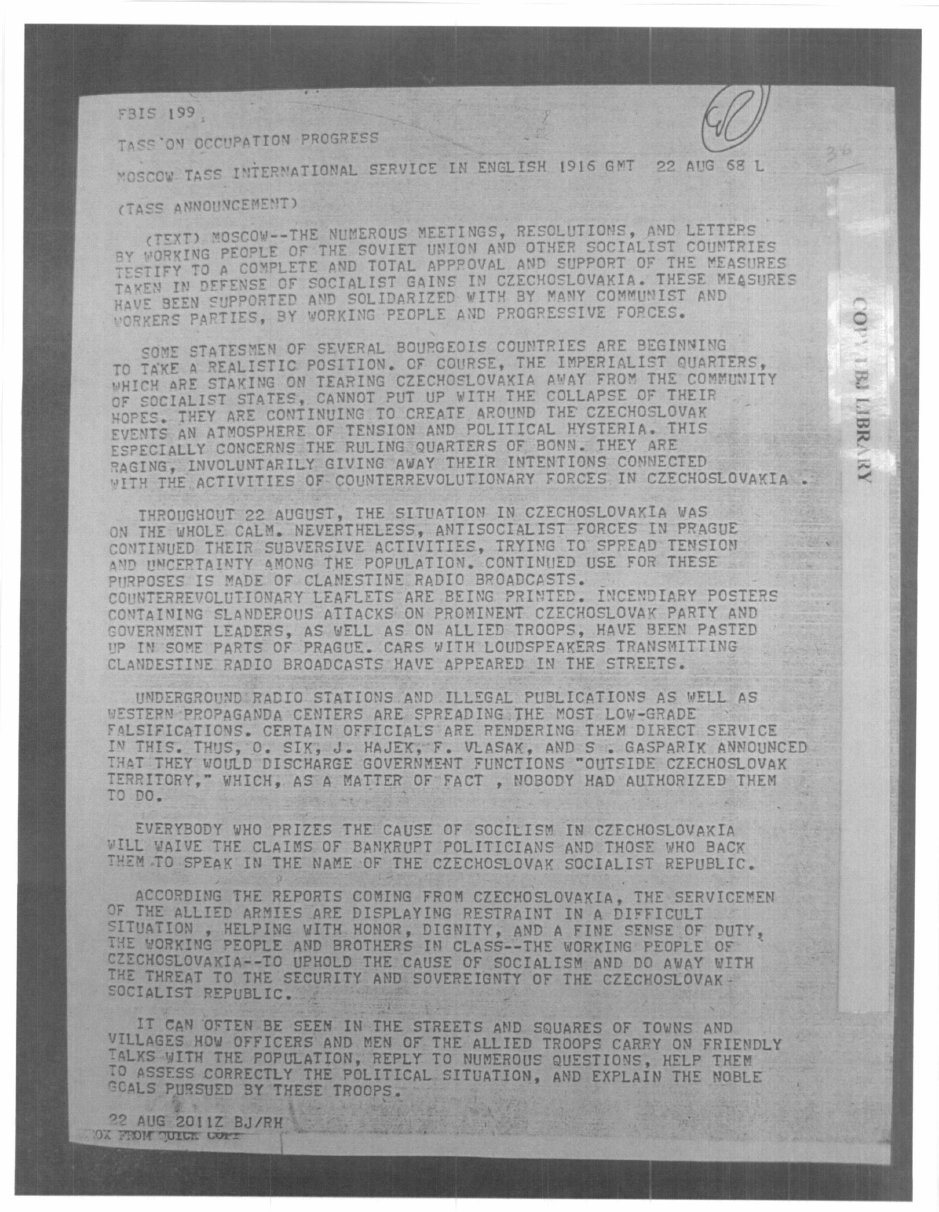
The TASS text of 22 August 1968, the second day of the Warsaw Pact invasion of Czechoslovakia, calls the troops "allied" and their entry "measures taken in defense of socialist gains". It cites "numerous meetings, resolutions, and letters" as "complete and total approval". The entry tags name-calling, bandwagon and euphemism. Read the technique: name-calling.
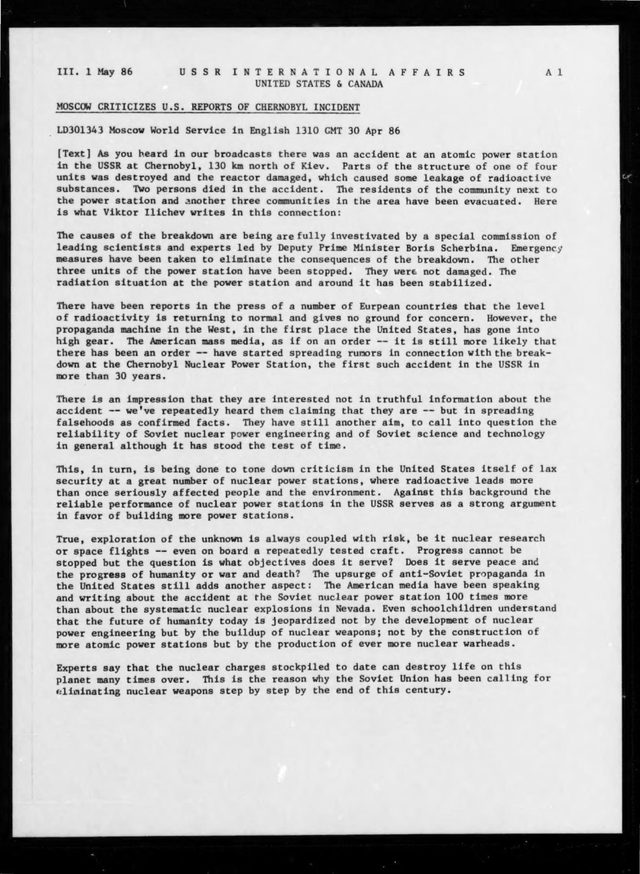
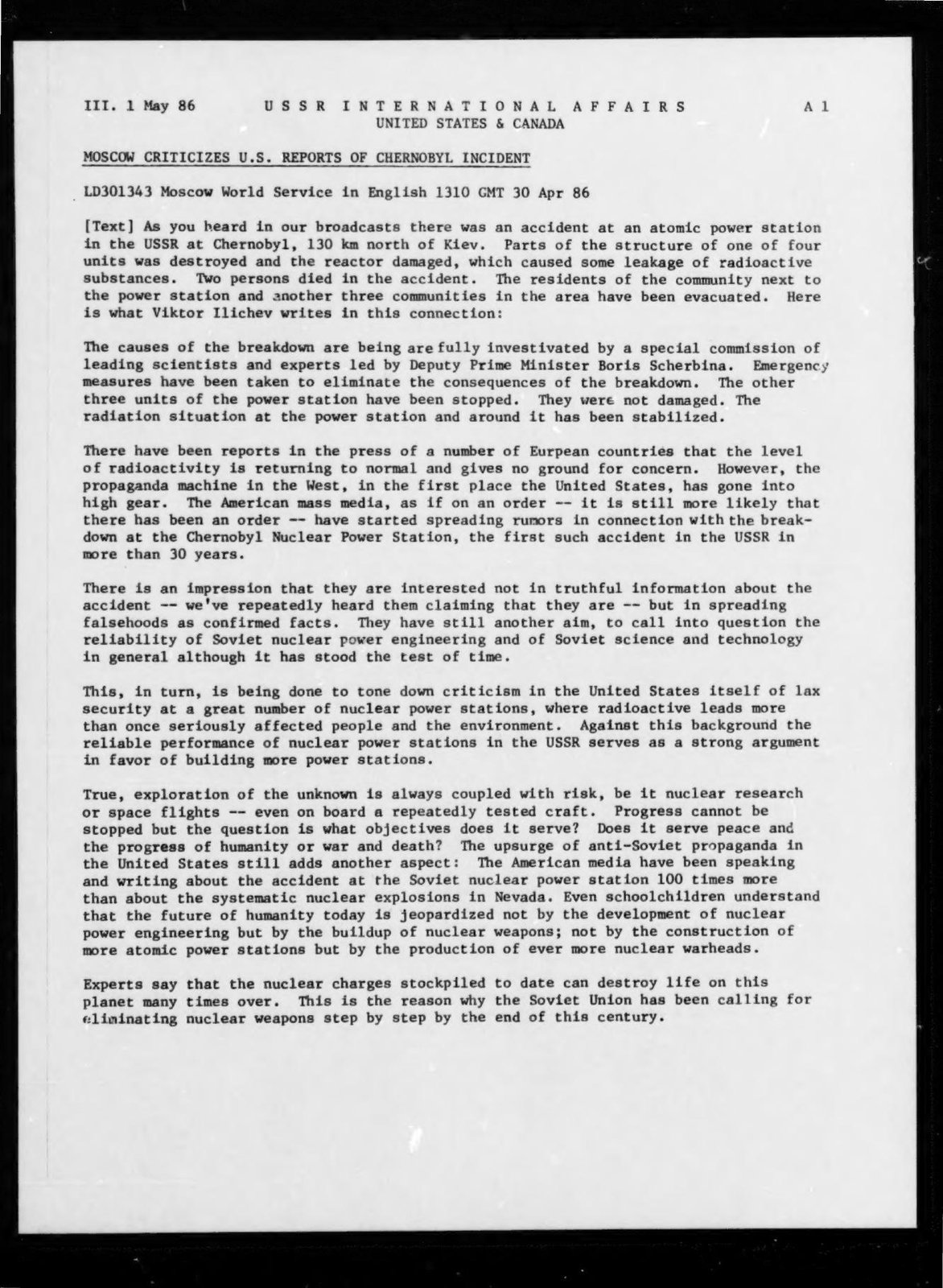
A Radio Moscow English broadcast of 30 April 1986 gives a short account of the Chernobyl accident, then accuses the U.S. press of "spreading rumors". The entry tags limited hangout, whataboutism, red herring and gaslighting, and records that the Soviet Union said nothing until Swedish monitors detected fallout. It also records that unconfirmed claims of thousands of deaths circulated in some Western media and were not borne out. Read the technique: limited hangout.
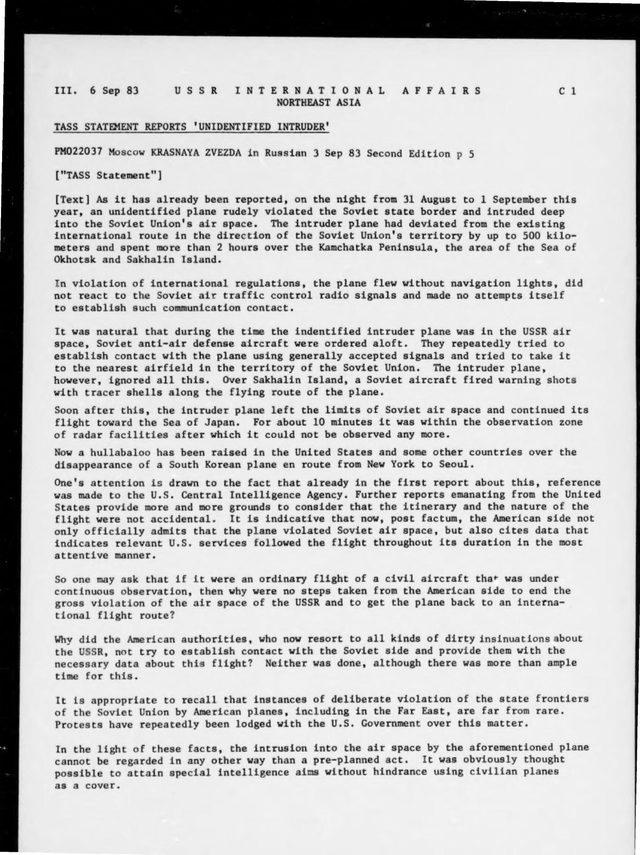
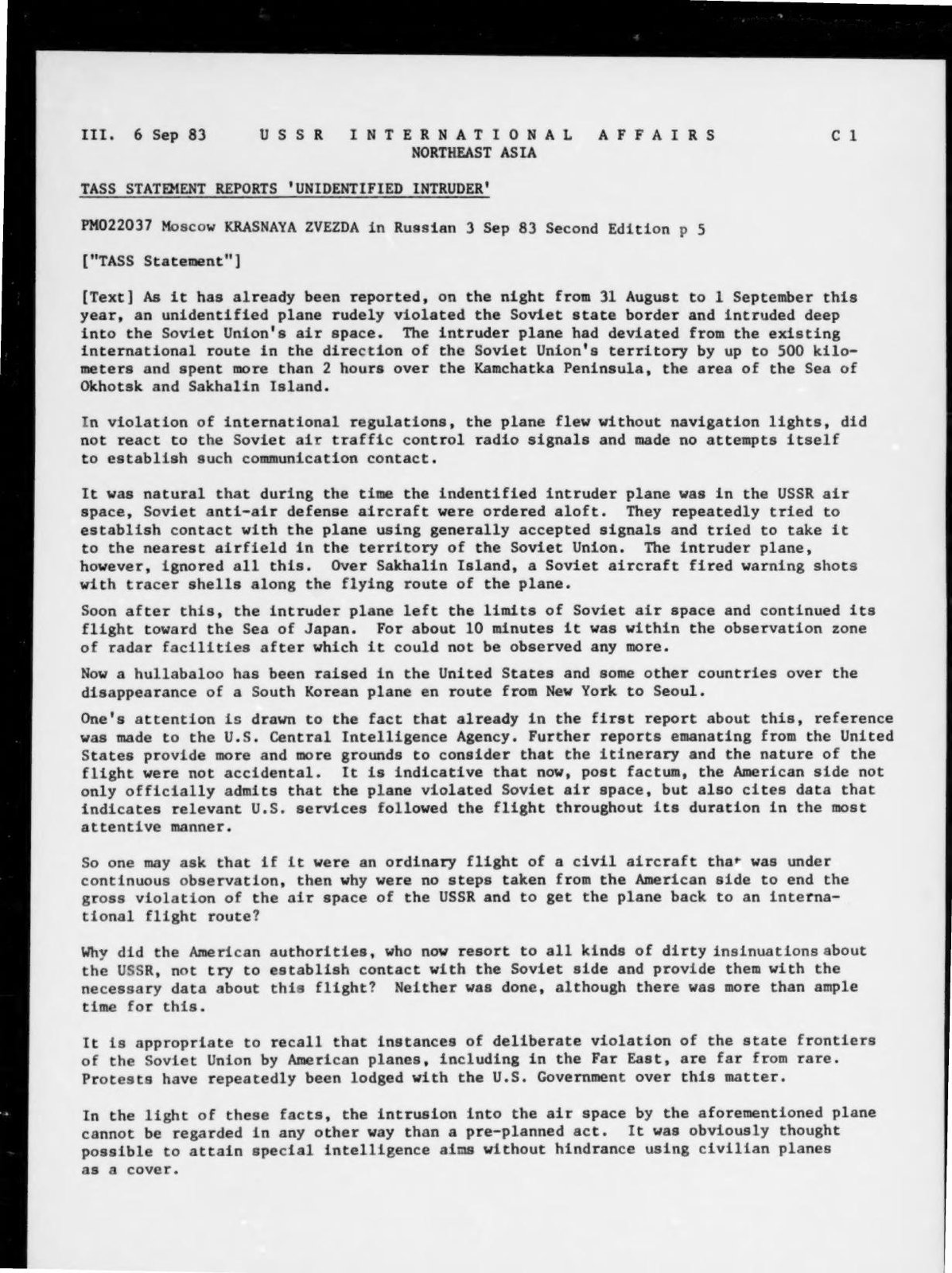
The TASS statement on Korean Air Lines Flight 007, as translated by FBIS, speaks of an "unidentified plane" and "warning shots" and omits the destruction of the aircraft and the deaths of its 269 passengers and crew. The entry tags card stacking, whataboutism, red herring and gaslighting, and cites the 1993 ICAO report on the flight.
How did the Warsaw Pact states use radio in a crisis?
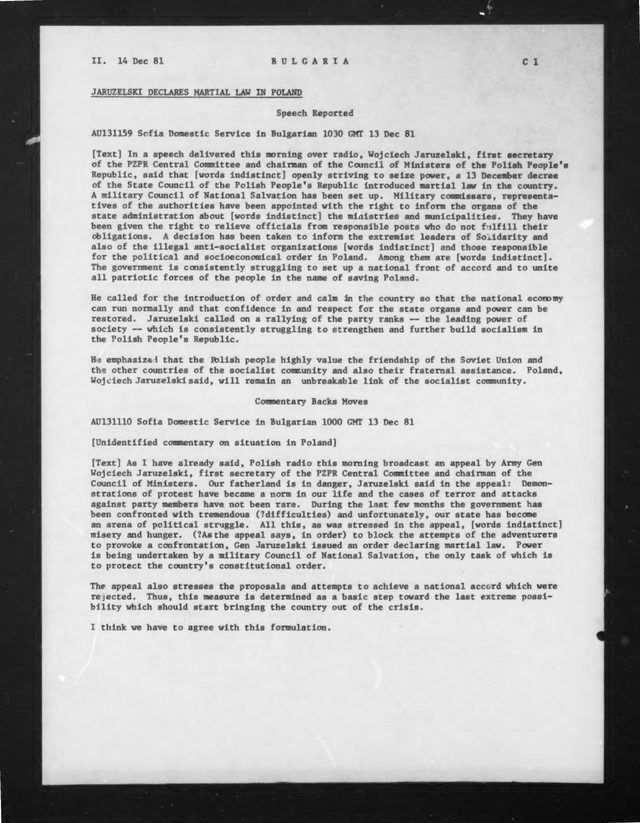
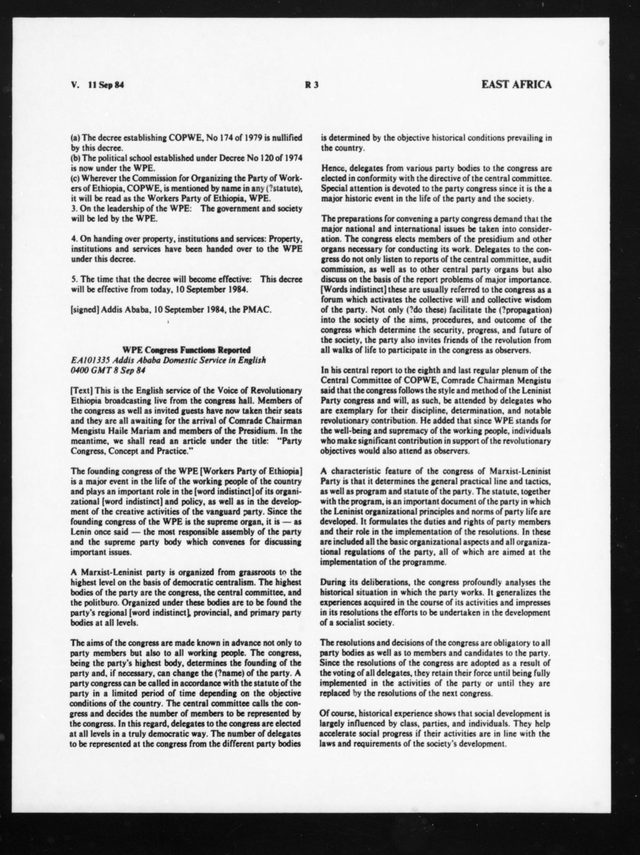
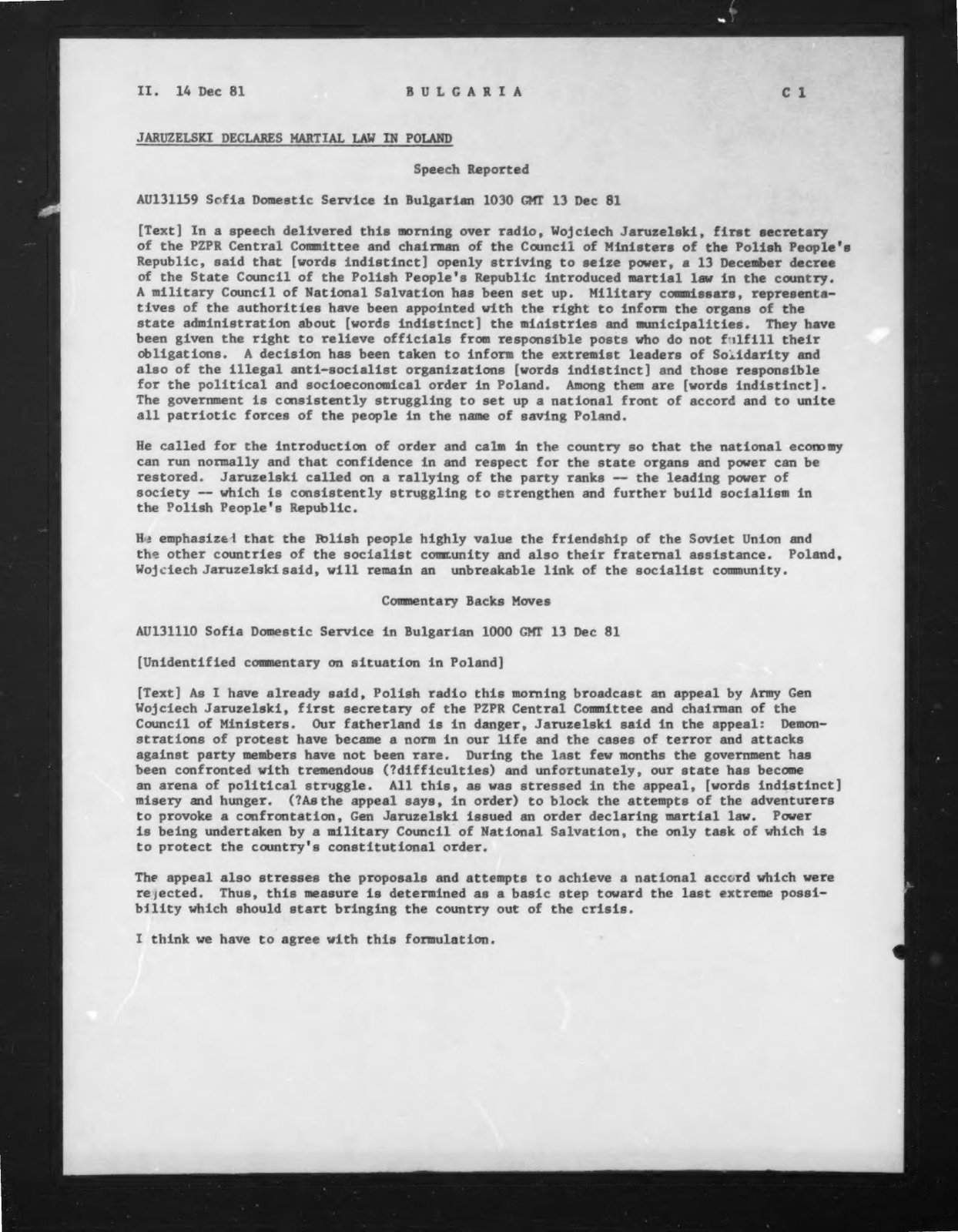
Bulgarian state radio on 13 December 1981 relayed the Polish authorities' account of martial law, naming Solidarity's "extremist leaders", and one announcer ended with his own endorsement. The entry tags name-calling and card stacking and notes that the page omits the arrests and the suspension of Solidarity.
Explain moreShow less
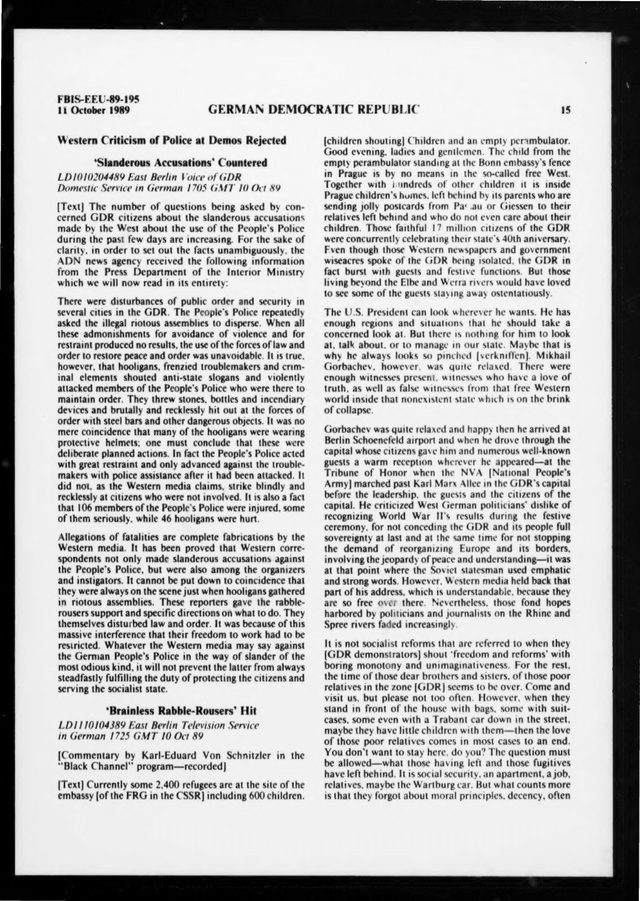
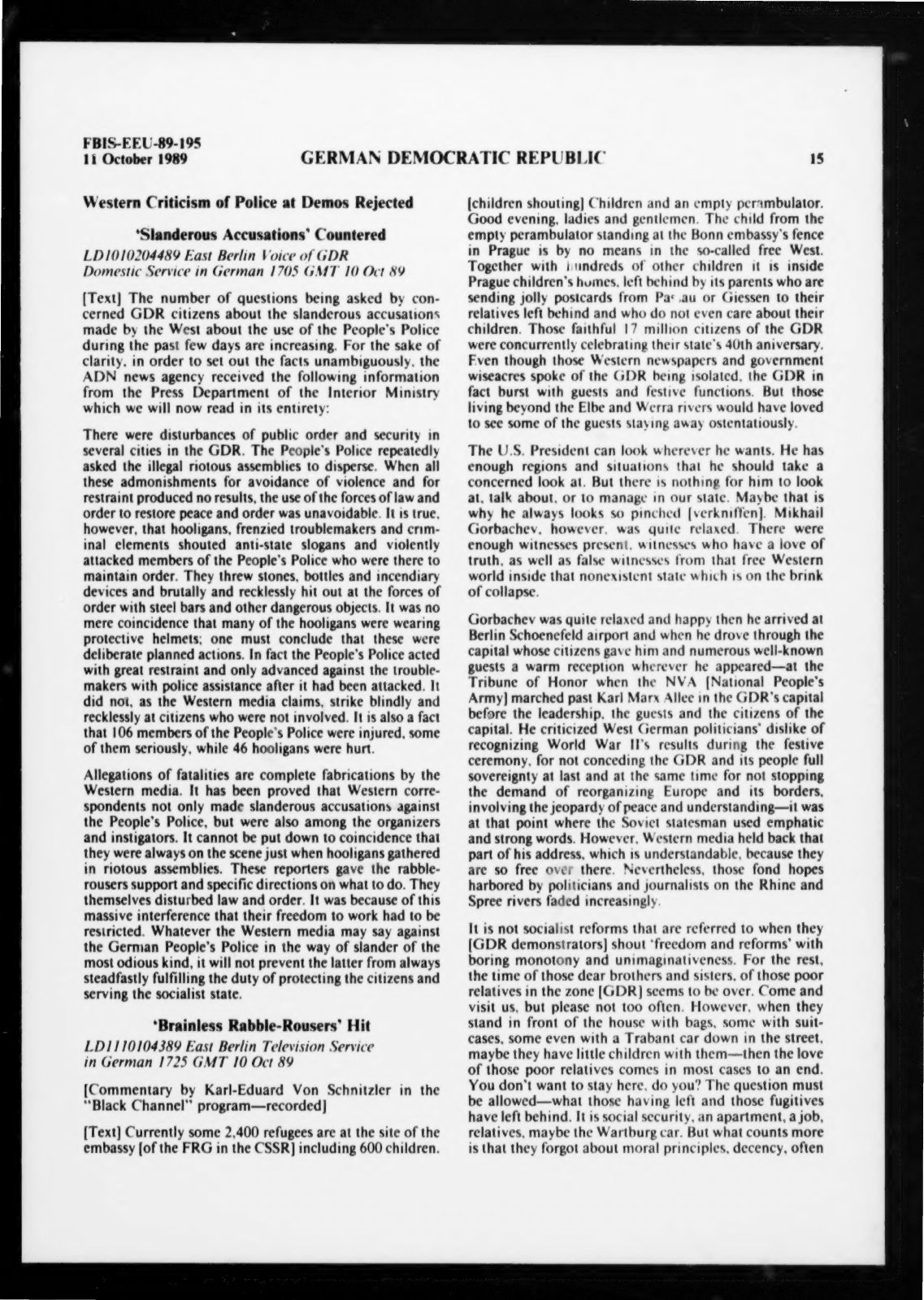
On 10 October 1989 the Voice of GDR read out an Interior Ministry statement calling demonstrators "hooligans" and "criminal elements", and the "Black Channel" commentary by Karl-Eduard von Schnitzler called emigrants "fugitives". The entry tags name-calling, scapegoating and ad hominem. It notes that the injury figures are the ministry's own and not independently confirmed.
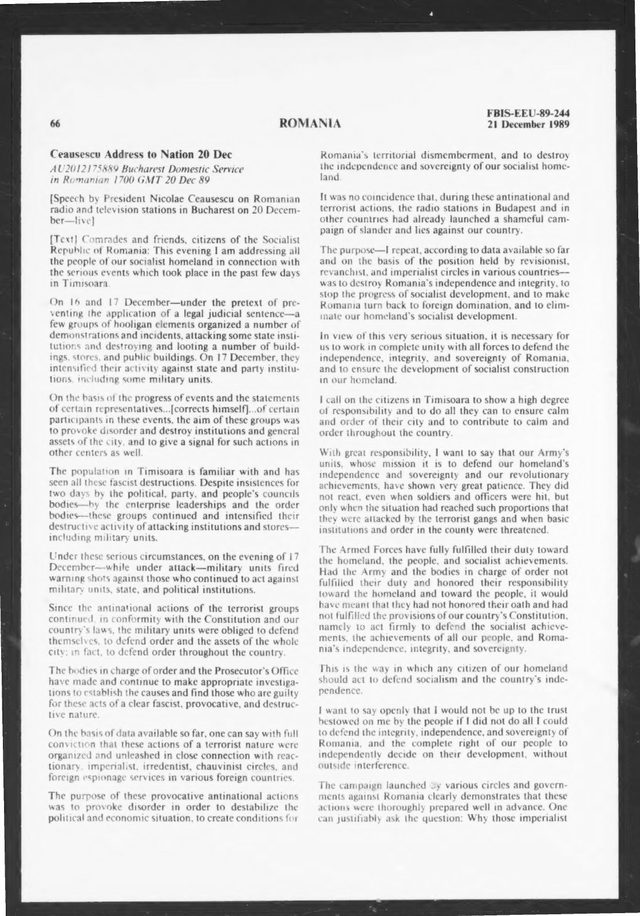
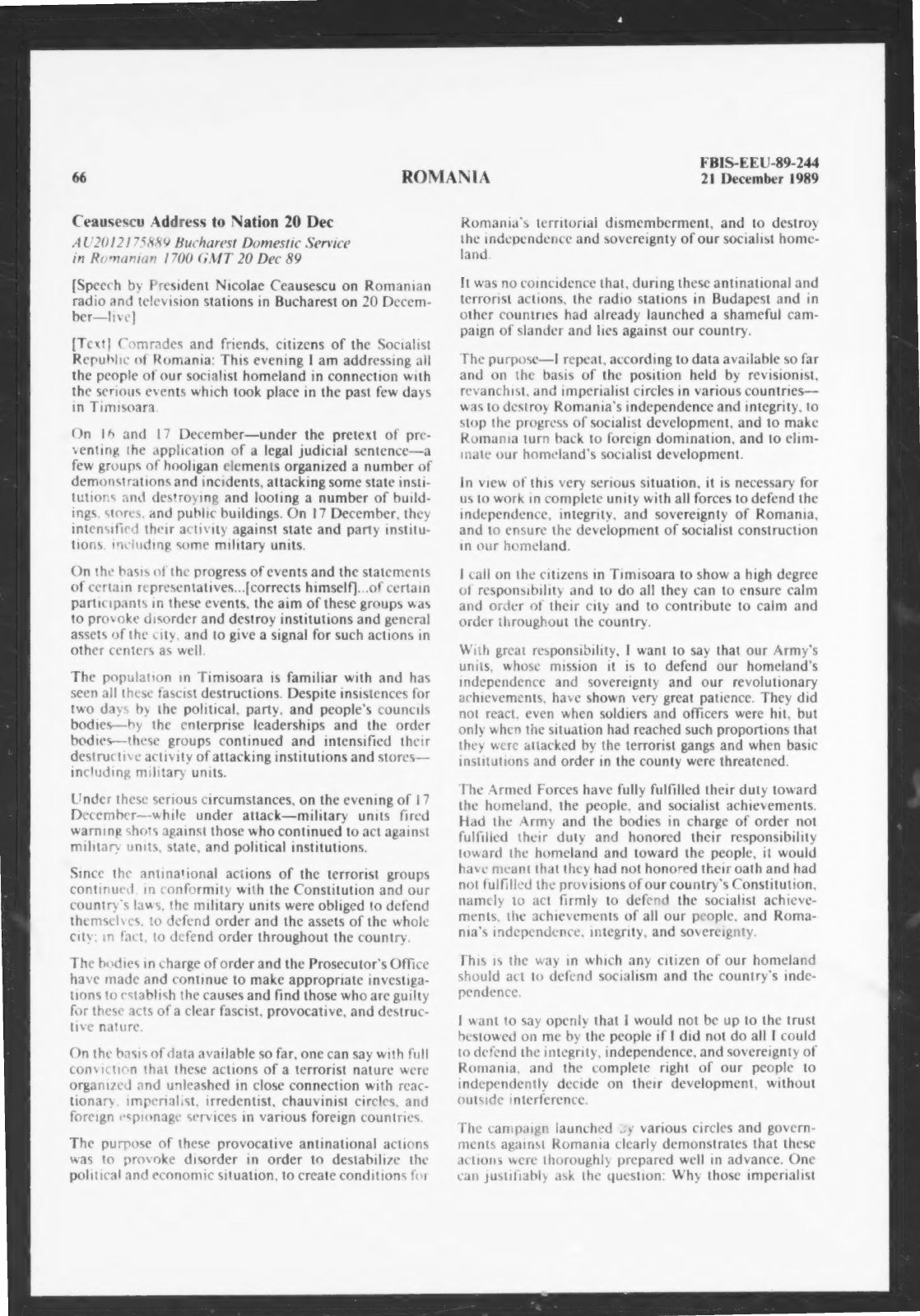
Nicolae Ceausescu's broadcast of 20 December 1989 labels demonstrators "hooligan elements" and "terrorist gangs" and describes the army's fire as "warning shots". The entry records that later Romanian investigations counted dozens of deaths in Timisoara.
How did Hanoi and Havana address Americans by radio?
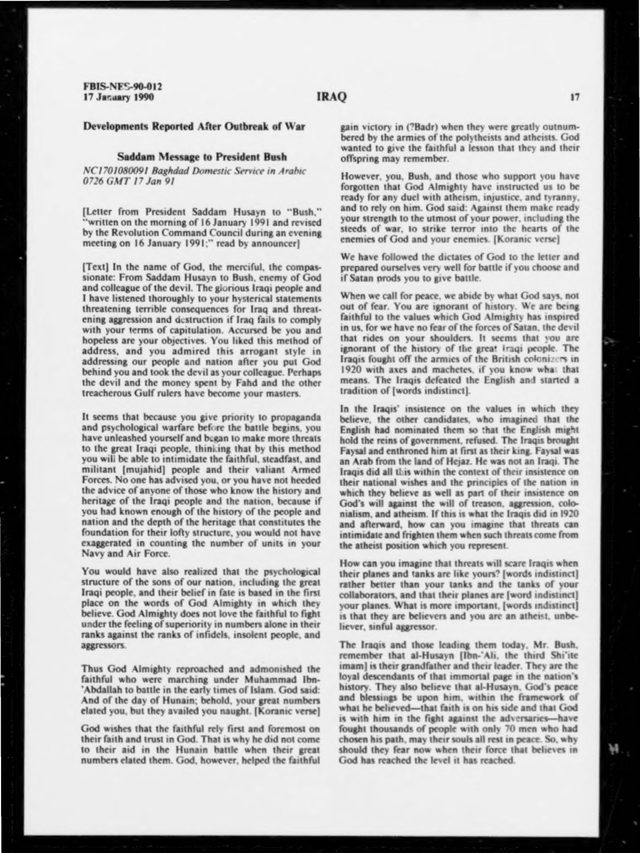
Radio Hanoi, Vietnam's state radio, started an English-language programme for U.S. troops in 1965, as the case study Chieu Hoi and Radio Hanoi records. That page sets it beside the leaflets and loudspeakers Saigon and Washington aimed at the other side. See also Vietnam War propaganda.
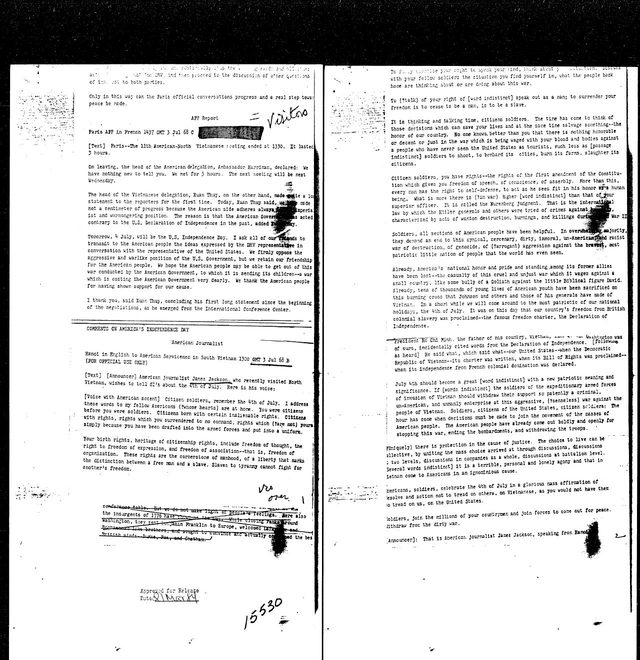
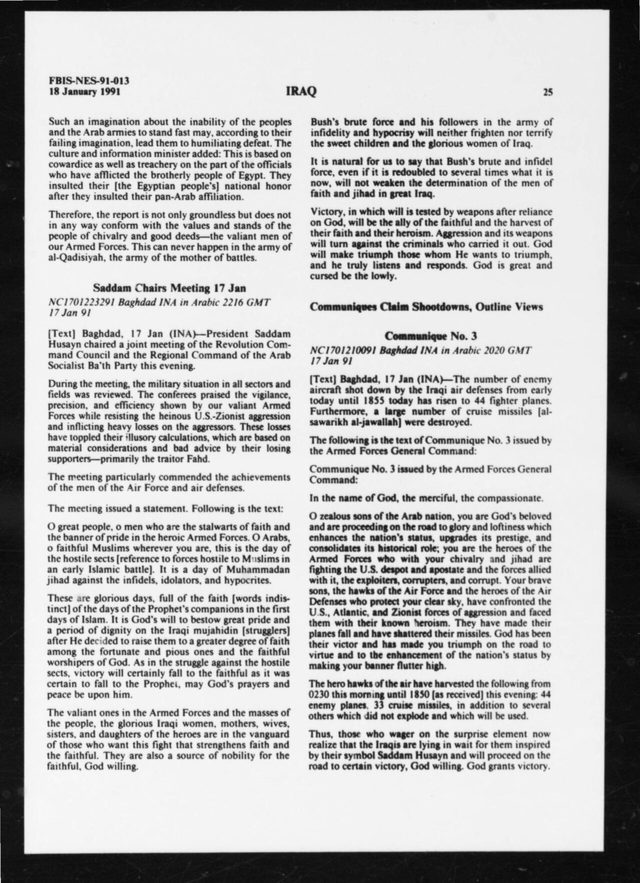
Content note: Wartime broadcast text urging U.S. troops to refuse orders, with accusations of genocide and racism against the U.S. government. This object is shown as it was published. Why 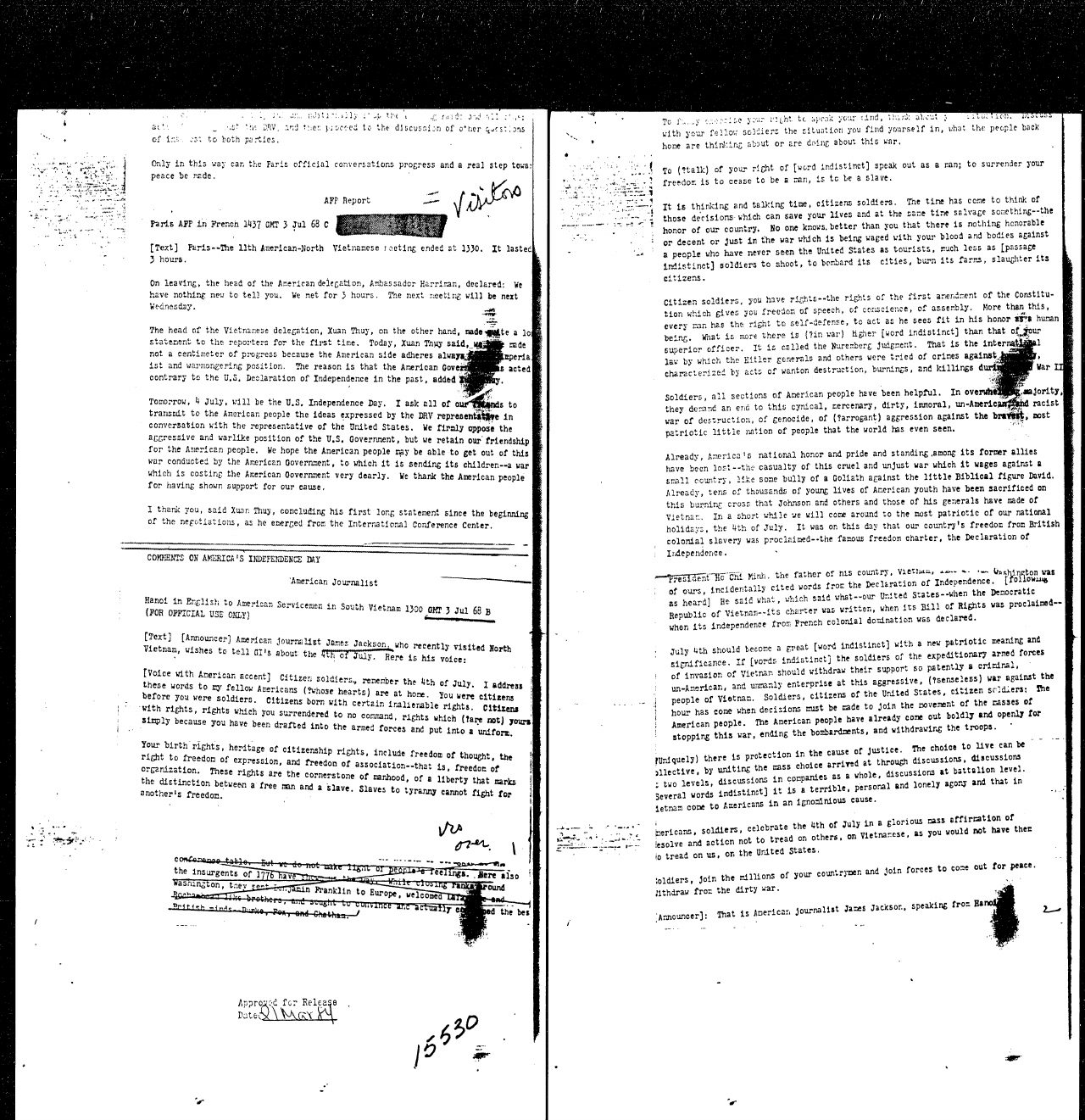
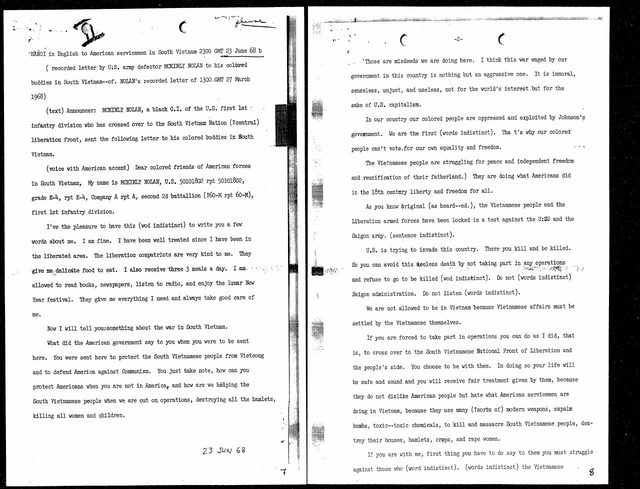
Content note: Wartime broadcast text addressed to Black U.S. soldiers by race, using period terms such as 'colored', and alleging atrocities. This object is shown as it was published. Why 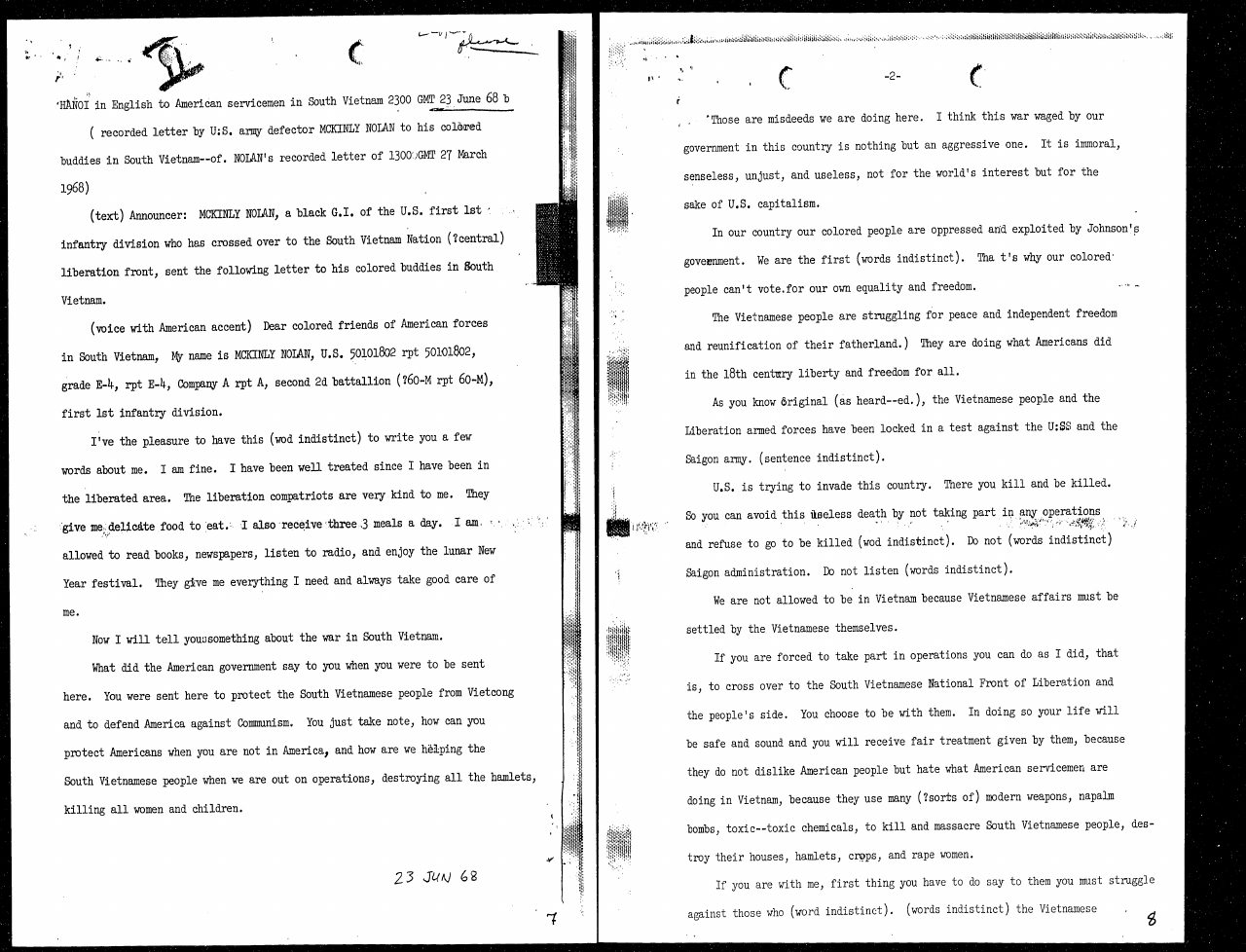
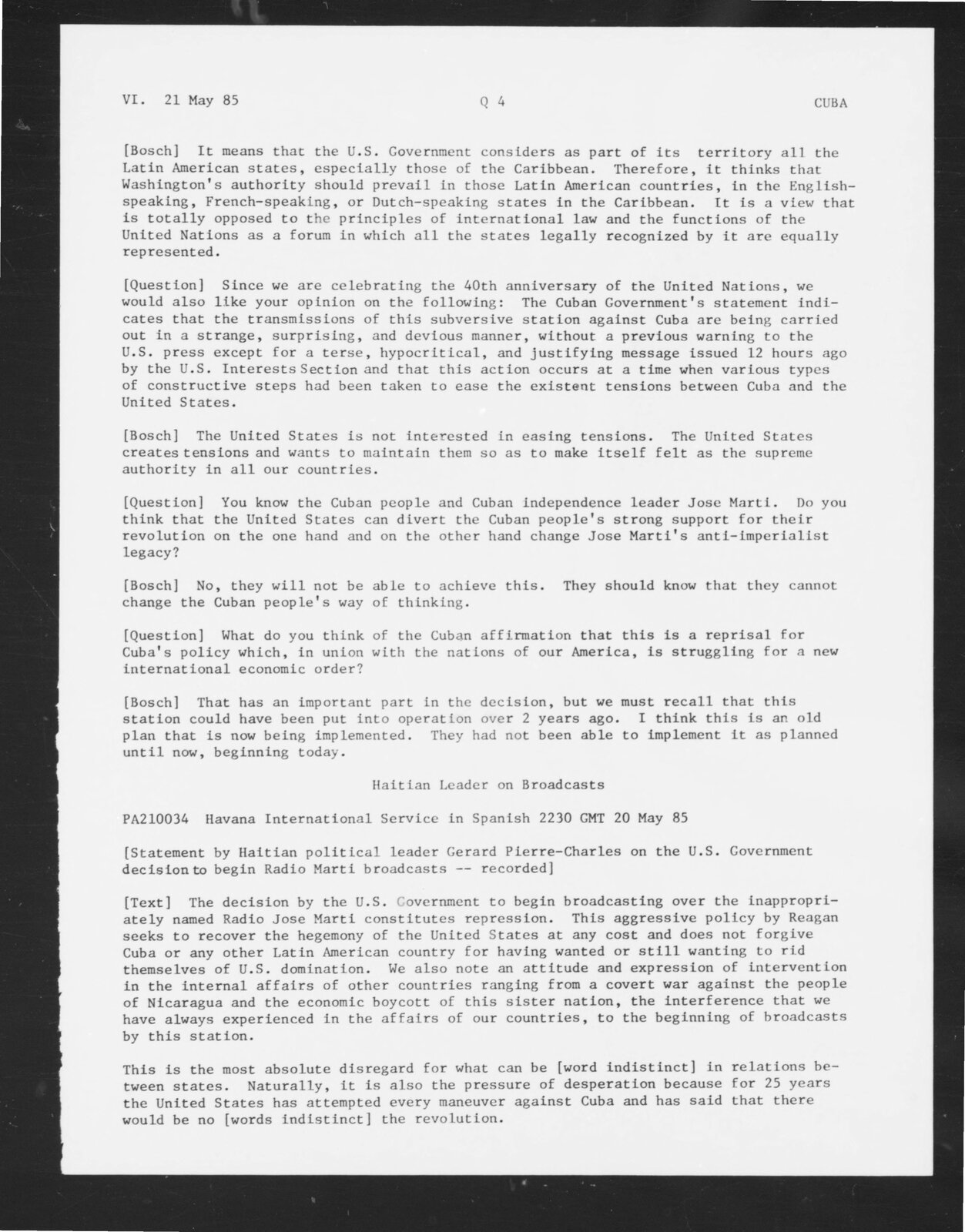
Explain moreShow less
A broadcast of 3 July 1968 introduces a self-described American journalist who tells "citizen soldiers" that the First Amendment and the Declaration of Independence support refusing the war. The entry tags testimonial and transfer: an American voice as witness, and the authority of a U.S. founding text.
A broadcast of 23 June 1968 reads a recorded letter from a named U.S. soldier said to have crossed to the National Liberation Front, addressed to Black soldiers. The entry tags testimonial and notes that nothing in the transcript verifies the speaker's circumstances.
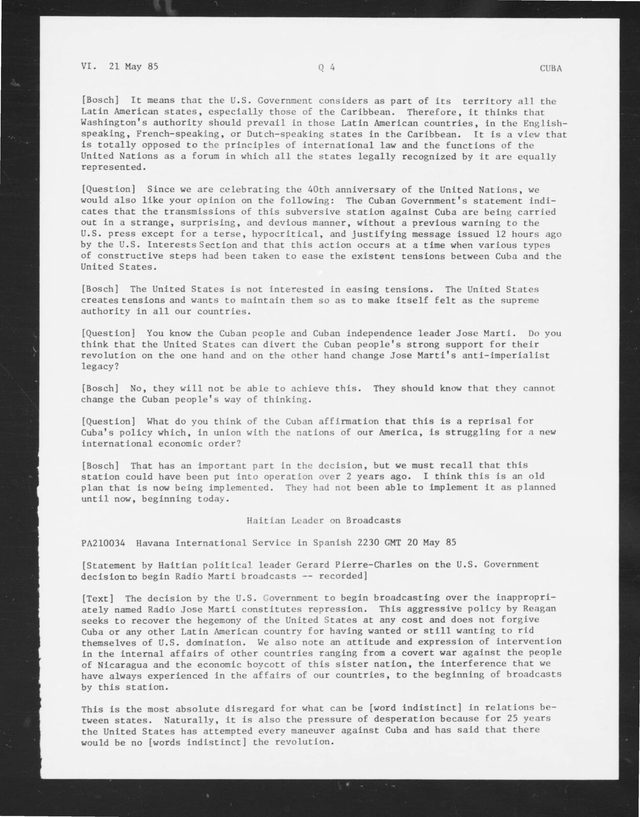
When Radio Martí began on 20 May 1985, Havana International Service answered with foreign figures who called the station "subversive". The entry tags testimonial and name-calling, and records that the U.S. station is itself an official government outlet.
Was radio jammed, and by whom?
Jamming blocked a message rather than making one. The case study Cold War radio jamming dates Soviet jamming of Western broadcasts from 1948, records the UN General Assembly's condemnation in 1950, and notes that Radio Free Europe and Radio Liberty were jammed almost continuously until 21 November 1988, when RFE/RL's monitoring station reported that it had stopped. It also records British jamming of Athens Radio during the Cyprus Emergency and Cuban jamming of Radio and TV Martí, so the test applies on both sides. Audience research by Radio Liberty found jamming reduced listening but did not stop it; the researchers had an interest in the result.
How do the two sides compare under the same test?
The last row matters. The collection holds Western material about stations and Eastern material from stations, so the technique tallies above describe the sample, not the two blocs. In the 25 Cold War broadcast objects, name-calling is tagged 15 times and card stacking 8 (script count), and a different sample could shift both figures. The record does not support saying either bloc lied more.
Explain moreShow less
| Question | Western stations | Eastern stations |
|---|---|---|
| Open sponsor | Voice of America, Radio and TV Martí | Radio Moscow, TASS, Radio Hanoi, Havana International |
| Concealed sponsor | Radio Free Europe and Radio Liberty to 1971, Radio Swan | None identified in the collection's broadcast set |
| Techniques tagged | Narrative laundering, transfer, bandwagon | Name-calling, card stacking, scapegoating, gaslighting |
| What the collection holds | Posters, ads, one internal memo | Monitored transcripts |
The differences in scale and intent are on the record too. Radio Swan supported a covert invasion; Radio Free Europe and Radio Liberty broadcast to the Soviet bloc for decades from stations funded mainly by the U.S. government through the CIA, as the Crusade for Freedom case study records; Soviet jamming was the largest network of its kind. Each is documented on its case-study page, and none is set against another here.
What to look for in a radio transcript or poster
- The sponsor. A ministry, an agency, a committee or a company that covers for one.
- The audience. Home listeners, a foreign nation, or an enemy's soldiers.
- The source of the text. A station's own words, a monitor's translation, or a summary.
- The check. What later records, such as the ICAO report or Case's Senate statement, say about the claim.
Browse Cold War broadcasts
The grid below shows the 25 Cold War broadcast objects and seven related items (the four Voice of America and USIS posters, the Radio Swan memo and the two Radio Free Europe appeals). Each opens an object page with the holding institution, a link to the original record, a transcription of any text and the rights basis for hosting. For related pages, see propaganda leaflets, psychological operations, disinformation, Soviet propaganda posters and American propaganda posters.
Sources and further reading
Sources and rights
Objects on this page come from the Library of Congress, the U.S.
Objects on this page come from the Library of Congress, the U.S. National Archives, the John F. Kennedy Presidential Library, the Internet Archive's FBIS and Government Publishing Office microfiche collections and Wikimedia Commons. FBIS pages are U.S. federal government works. Each object page gives its own rights basis. Transcriptions are verbatim.