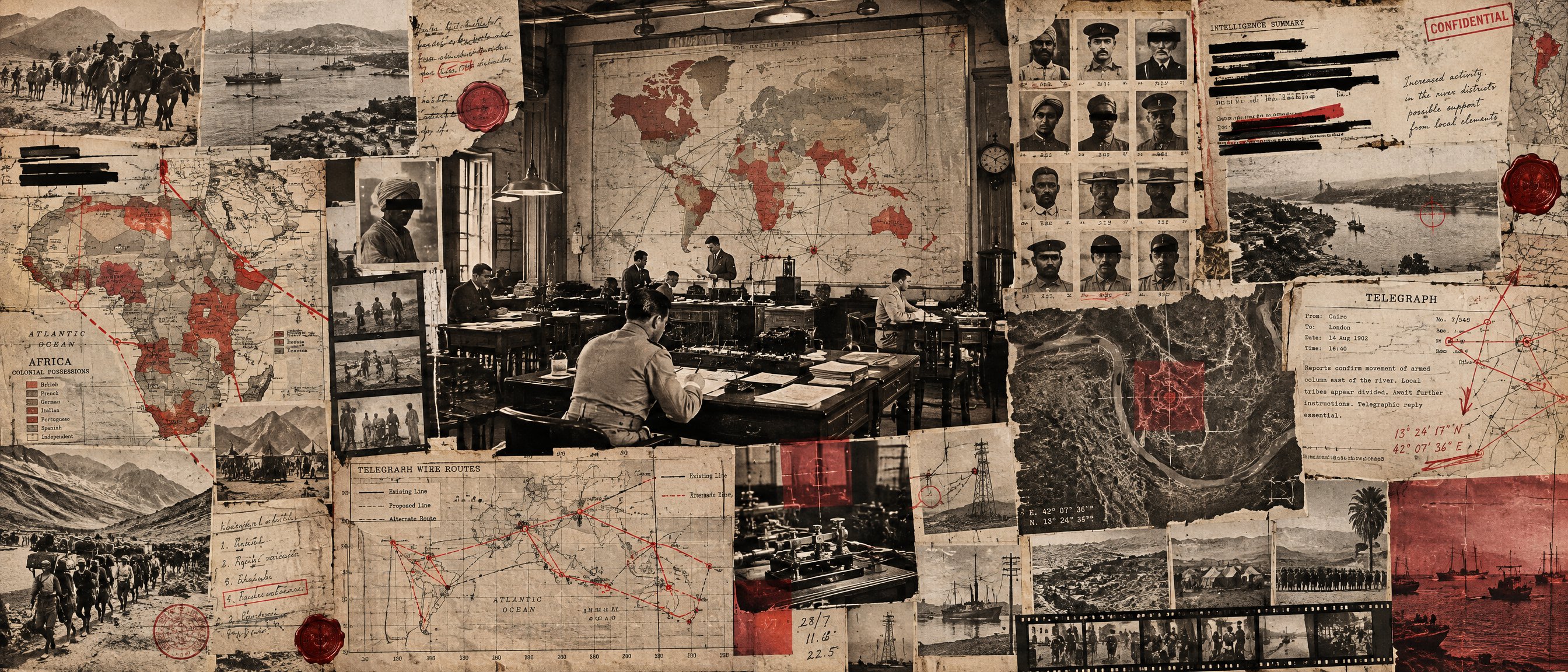
Content note. This page quotes a German order to shoot every Herero inside the colony's border, and colonial-era labels for the Nama ("Hottentotten", "Hottentots") that are now regarded as slurs. It shows a photo postcard of prisoners and a published photograph of German soldiers packing Herero skulls for shipment to Berlin.
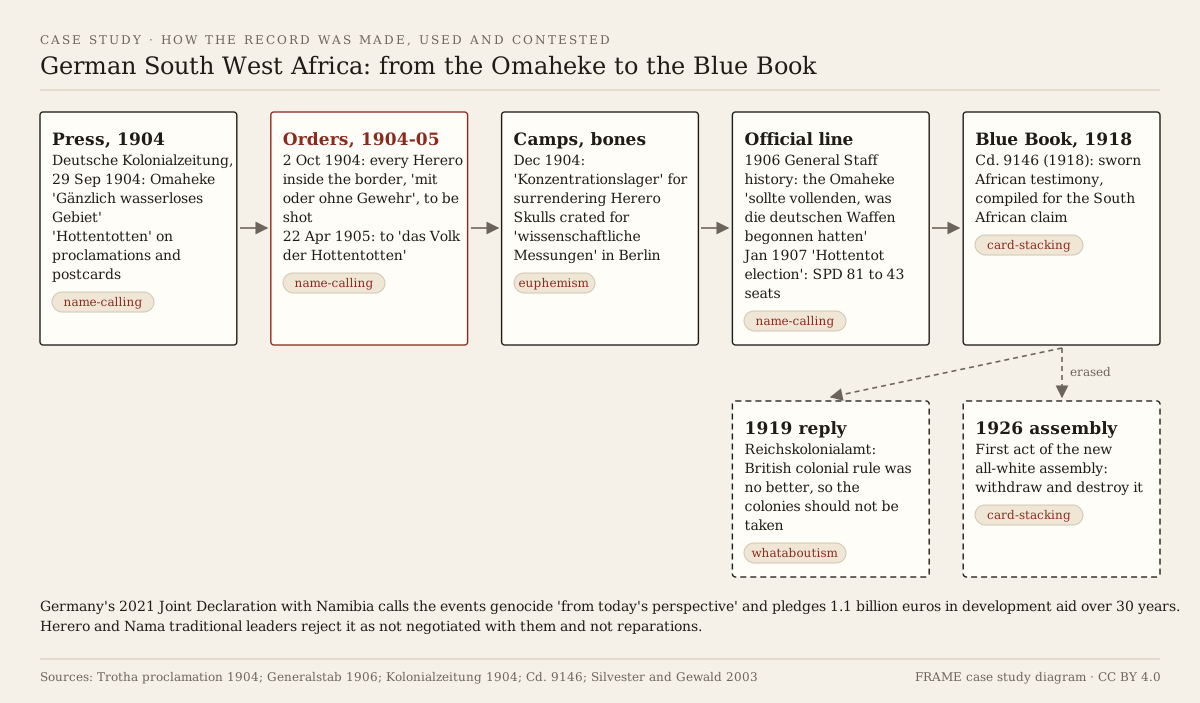
In one line: German forces destroyed most of the Herero and about half of the Nama between 1904 and 1908 while the colonial press, the General Staff and a Reichstag election campaign told the story at home; in 1918 South African officials documented those events in a British Blue Book that also served their claim to the territory, Germany answered with a counter-accusation, and in 1926 the territory's new settler assembly had the Blue Book destroyed.
What happened
- January 1904: the uprising. Herero fighters under Samuel Maharero attacked farms, stores and posts from about 12 January. About 123 people were killed in the first days, most of them German men. A written order attributed to Maharero told fighters to spare women and children, missionaries, the English, Boers and several other groups; some researchers think the letter was written after the fighting began (SAHO).
- 11-12 August 1904: Waterberg (Ohamakari). German columns under Lieutenant-General Lothar von Trotha attacked the Herero at the Waterberg. Most of the Herero, with their cattle, fled east into the Omaheke, a dry sandveld. German troops followed and held the waterholes on its edge.
- 29 September 1904: the colonial lobby's paper. The Deutsche Kolonialzeitung, organ of the Deutsche Kolonialgesellschaft (German Colonial Society), printed a map titled "Omaheke (Sandfeld) (Gänzlich wasserloses Gebiet)" ("entirely waterless area"), with a line marked "Grenze des absoluten Durstfelds" and German positions along it. The article, printed "Ohne Verantwortung der Gesellschaft" (without the Society's responsibility), asks readers impatient for "durchschlagende Erfolge" to trust "unsere braven Truppen", describes the Herero's "verschlagenen Kriegsführung" (cunning warfare), and says their losses of people and cattle during the flight were "wahrscheinlich übrigens noch weit bedeutender" than the German side could yet see.
- 2 October 1904: the proclamation. At Osombo-Windimbe, Trotha issued a proclamation to the Herero, signed "Der große General des mächtigen Deutschen Kaisers". Its central sentence reads: "Innerhalb der Deutschen Grenze wird jeder Herero mit oder ohne Gewehr, mit oder ohne Vieh erschossen, ich nehme keine Weiber und keine Kinder mehr auf, treibe sie zu ihrem Volke zurück oder lasse auch auf sie schießen." An order read to the troops with it said that shooting at women and children meant shooting over them to make them flee. In German scholarship it is called the Vernichtungsbefehl (annihilation order) (GHDI).
- October 1904 onward: the Nama. Nama groups led by Hendrik Witbooi and others took up arms. On 22 April 1905 Trotha issued a proclamation "an das Volk der Hottentotten", threatening that Nama who did not surrender would be shot and asking, in English translation, "where are the Herero today?" Fighting continued into 1908 (Journal of Namibian Studies; SAHO).
- December 1904: the order lifted, the camps begun. After lobbying by Chancellor Bernhard von Bülow, Wilhelm II ordered the proclamation lifted (8-9 December). Instructions of 11 December used the word Konzentrationslager for holding surrendering Herero. Camps were set up at Swakopmund, Windhoek, Lüderitz and elsewhere; prisoners, including women and children, were classed as Kriegsgefangene (prisoners of war) and put to forced labour. Roughly half of the camp prisoners died. The camp on Shark Island (Haifischinsel) at Lüderitz, used mainly for Nama prisoners, had the highest death rate; the Nama leader Cornelius Fredericks died there in 1907.
- Skulls for Berlin. Skulls of dead prisoners were sent to German institutes for "race" research. A published photograph shows soldiers crating skulls; its printed caption (below) says Herero women stripped the flesh from them with glass shards so that they could be shipped to the Pathological Institute in Berlin "zu wissenschaftlichen Messungen". The Charité in Berlin returned 20 skulls to Namibia in 2011; further returns followed.
- Postcards. Commercial photo postcards of prisoners circulated in Germany. The one shown below, published by Franz Spenker in Hamburg, is titled "Kriegsgefangene Hottentotten". The Bundesarchiv dates the photograph to about 1897-99 (it may show prisoners from an earlier Nama rising) and the colouring to probably after 1904, so it shows the genre and its labels, not a scene from 1904-08.
- 1906-1907: the official history. The General Staff's military history section published Die Kämpfe der deutschen Truppen in Südwestafrika (Berlin: Mittler). Volume 1 (1906), on the Herero campaign, describes the pursuit into the sandveld and states (p. 211): "Die wasserlose Omaheke sollte vollenden, was die deutschen Waffen begonnen hatten: Die Vernichtung des Hererovolkes."
- Toll. Missionary estimates put the pre-war Herero population at about 80,000; a 1911 census counted about 15,000. About half of an estimated 20,000 Nama died (SAHO). Historians give ranges, not exact counts.
- December 1906 to February 1907: the "Hottentot election". On 13 December 1906 the SPD, the Centre and smaller opposition groups voted down a supplementary budget for the war, 177 to 168. Bülow dissolved the Reichstag the same day. The campaign for the election of 25 January 1907 was fought over the colonial war and the Nama rising, and the vote became known as the Hottentottenwahlen. Nationalist and colonial campaigners portrayed the parties that had voted against the budget as disloyal to the nation. A "Bülow bloc" of conservative and liberal parties won; the SPD fell from 81 seats to 43 (DHM; de.wikipedia). In 1907 the colonial department became the Reichskolonialamt under Bernhard Dernburg.
- 1915-1918: the Blue Book. South African forces occupied the colony in 1915. The military Administrator's Office in Windhuk compiled the Report on the Natives of South-West Africa and their Treatment by Germany, dated January 1918 and presented to the British Parliament in August 1918 as command paper Cd. 9146. Part I was framed by Major T. L. O'Reilly, military magistrate at Omaruru, from what he called "voluntary statements made on oath by surviving chiefs, headmen, and prominent leaders". The Administrator, E. H. M. Gorges, wrote in the preface that "to publish all the information obtained would form too bulky a volume". Silvester and Gewald write that the report was compiled to justify the 1915 invasion and keep the territory out of German hands, and that it "served to scuttle any attempt by Germany to retain control over Namibia". South Africa received the territory as a League of Nations mandate in 1920.
- 1919: the German reply. The Reichskolonialamt published Die Behandlung der einheimischen Bevölkerung in den kolonialen Besitzungen Deutschlands und Englands. Eine Erwiderung auf das englische Blaubuch vom August 1918 (Berlin: Engelmann), in German and English. According to a study in The International History Review, it argued that violence was normal conduct for colonial powers and that taking Germany's colonies was therefore unjust; British officials found some of its material "embarrassingly true".
- 1926: the record withdrawn. The first act of the new all-white Legislative Assembly of South West Africa was a motion to withdraw and destroy the Blue Book, which had offended the territory's German community. Copies in the territory and in South Africa were destroyed, and the book was withdrawn from libraries across the British Empire. Silvester and Gewald describe the aim as reconciling the German and South African settler communities, who then governed the territory together. Their annotated reprint, Words Cannot Be Found (Brill, 2003), put the text back into circulation.
- 2004-2021: Germany's statements. On 14 August 2004, at Ohamakari, Development Minister Heidemarie Wieczorek-Zeul said, in translation, that the atrocities "would today be termed genocide", and asked forgiveness. In May 2021 the German and Namibian governments' envoys initialled a Joint Declaration saying the atrocities "culminated in events that, from today's perspective, would be called genocide", with 1.1 billion euros for reconstruction and development over 30 years, described as a gesture of reconciliation rather than reparations.
How it works
- Name-calling: "Hottentotten" is the label on Trotha's 1905 proclamation, on the Spenker postcard and in the name of the 1907 election. It sorts the Nama into one colonial category before anything is said about any person or act. In the election, according to the Deutsches Historisches Museum, nationalist and colonial campaigners cast the parties that had voted against the war budget as disloyal to the nation.
- Euphemism / doublespeak: the skull caption files remains taken from "gehängten oder gefallenen Hereros", cleaned by Herero women with broken glass, under "wissenschaftlichen Messungen". The postcard's "Kriegsgefangene" covers women and children, and the December 1904 instructions describe the camps in terms of holding and upkeep for a population of which roughly half died in them. The plain acts (hanging, forced labour, death in custody) sit behind administrative and scientific words.
- Card stacking: the 1918 Blue Book gathered real sworn African testimony about German rule, but it was selected and published by the occupying power while the territory's future was being decided, and it asked no comparable questions about South African or British rule. Its own preface says the material was selected. The 1926 destruction order worked the same technique in the other direction: removing the main published body of African testimony left the settler communities' shared account as the one in circulation.
- Whataboutism: the 1919 Reichskolonialamt reply answered the charge of German colonial violence with a charge of British colonial violence and concluded that the colonies should not be taken. Some of its counter-charges were accurate. What fits the definition is the use: the reply's case against confiscation rested on "they did it too" rather than on the Herero and Nama evidence itself.
- Not tagged. The General Staff history is not a euphemism: it states the aim and the result plainly, as a military achievement. It is included as the state's own record. No press quotations from January 1904 were checked for this page, so the settler-danger framing of the uprising is not tagged Fear appeal here.
Then and now
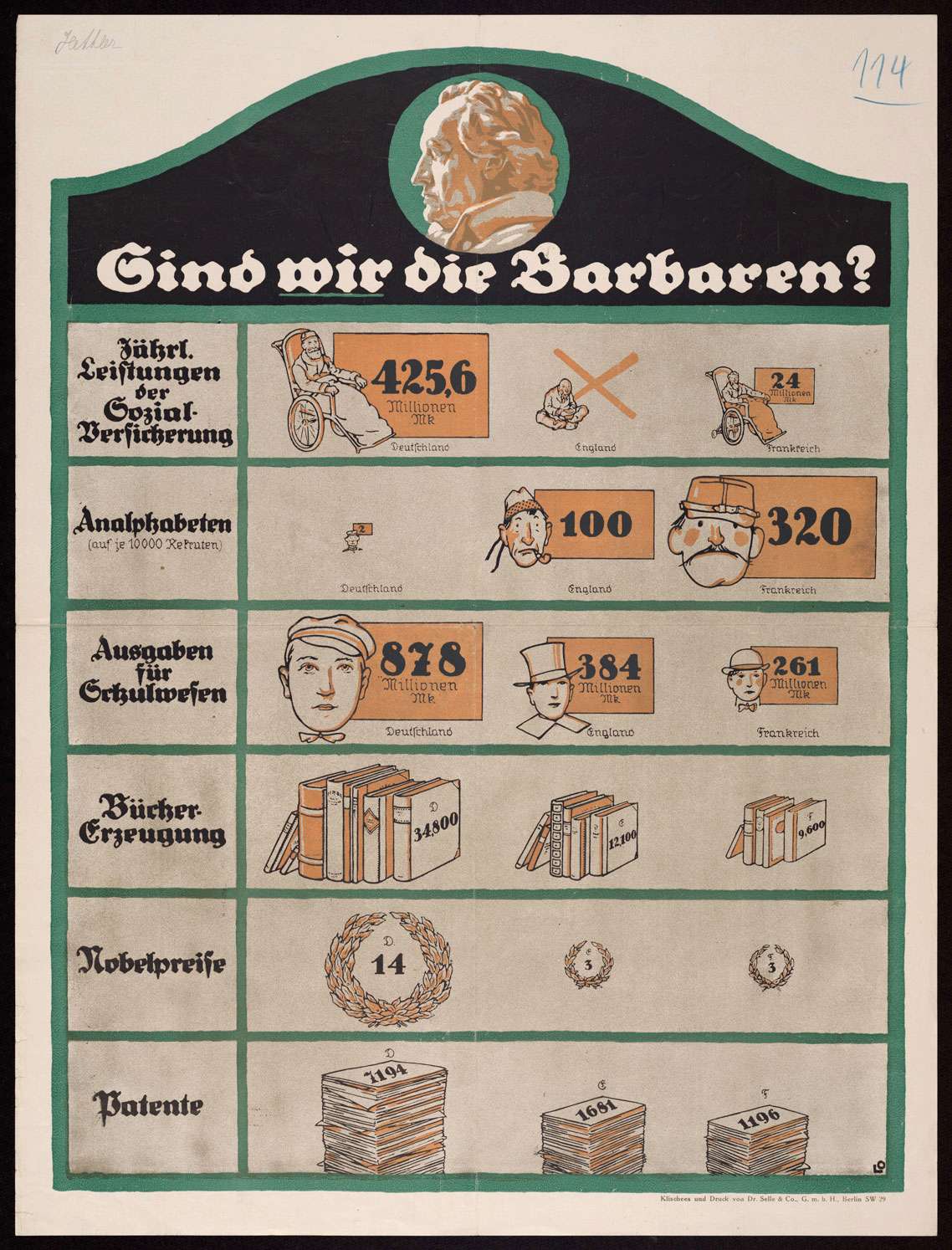
Sind wir die Barbaren? (Are We the Barbarians?), Louis Oppenheim for the German government, 1916. Public domain.
In 1916 Germany answered the Allied charge of German barbarism with a statistical chart comparing Germany with Britain and France. The 1919 Reichskolonialamt reply used the same answer-with-a-comparison move against the Blue Book, three years later and about colonies. The difference in scale is large: the 1916 chart answered a wartime slogan, while the 1919 reply answered sworn testimony about the deaths of most of a people. The British poster Remember Belgium — Enlist To-Day is the other half of the pairing: a real atrocity used by a rival state for its own war aims, as the Blue Book used a real genocide for a territorial claim.
The history was used again later. In the 1920s German colonial revisionists called the Allied verdict on German colonial rule the koloniale Schuldlüge ("colonial guilt lie", the title of a 1924 book by Heinrich Schnee, the last governor of German East Africa). Historians including Jürgen Zimmerer have argued for a line of continuity from Namibia to Nazi policy; others, among them Robert Gerwarth and Stephan Malinowski, dispute how direct that line is. For record destruction and state denial in another case, see The Armenian genocide, 1915-1923: the wartime 'internal enemy' frame, the rival record, and a century of state denial.
Positions on the record
- German Empire, 1904-1914. The proclamation, the General Staff history and the colonial press describe annihilation and the desert's role in their own words. The Kaiser lifted the proclamation in December 1904; the camps followed. The government campaigned in 1907 on continuing the war.
- Weimar-era Germany. The 1919 reply and later colonial revisionism rejected the Allied case that Germany was unfit to hold colonies, by pointing to British and other colonial practice.
- South Africa and Britain, 1918-1926. The Blue Book presented German atrocities, drawn from sworn African testimony, as grounds for keeping the territory. After the mandate, the South African-run territory destroyed the report to win over German settlers. Each act served its government's aims at the time; the testimony itself is still the main early African record of the events and is used by later historians.
- Federal Republic of Germany. The 2004 speech and the 2021 declaration accept the events as genocide "from today's perspective". The German government's stated position is that the 1948 Genocide Convention does not apply retroactively and that the 1.1 billion euros are development support, not legal reparations.
- Namibian government. Its envoy initialled the declaration in 2021. In October 2022 Vice-President Nangolo Mbumba said the amount, the recognition, the question of reparations and the inclusion of descendants abroad needed revision.
- Herero and Nama leaders. The Ovaherero Traditional Authority and the Nama Traditional Leaders Association rejected the declaration as negotiated without them and as not reparations. In 2023 they asked Namibia's High Court to declare it unlawful, citing a National Assembly motion of 2006. A February 2023 communication from UN special rapporteurs found the process lacked meaningful participation by the affected peoples. Amnesty International called in October 2025 for reparatory justice.
- Scholarly record. Historians (Zimmerer, Gewald, Sarkin, Silvester, Hull and others) treat the destruction of the Herero and Nama as genocide. The 1985 Whitaker report to the UN human-rights sub-commission listed the German treatment of the Herero in 1904 as a genocide. Open questions in the literature concern exact numbers, how far responsibility reached above Trotha (Sarkin argues it reached Wilhelm II), and the continuity debate. They do not concern whether the killing, the desert, the camps and the skull collection happened.
- Not shown on this page. Contemporary German press coverage of January 1904 and the text of the 1926 assembly motion were not checked for this page; they are described here only through the cited secondary sources.
Same-method test
The British concentration camps of the Second Boer War (1900-1902) held Boer women and children and, in separate camps, Black Africans. More than 26,000 Boer internees and at least 14,000 Black African internees died. British officials described the camps as places of refuge; Emily Hobhouse's 1901 report described the disease and deaths in them. Administrative wording in place of deaths in custody would be tagged Euphemism / doublespeak here exactly as the German camp language is. A German or Boer government report on those camps, compiled to support a claim to British territory and silent on the compiling state's own practice, would be tagged Card stacking the same way as the 1918 Blue Book. The two cases differ in the scale and intent the record shows: the Herero proclamation ordered a people shot or driven out, which the Boer War record does not show.
How to spot it
- Ask who compiled a record, when, and what the compiler stood to gain. A true record can also be a territorial claim; the two questions have separate answers.
- Check what the record does not ask. A report on one power's colonial rule, written by another colonial power, can be accurate on its subject and still leave out the comparison.
- When an accusation is answered with "and you", check whether the reply ever deals with the first evidence. A true counter-charge does not answer the original one.
- Watch for records withdrawn "for reconciliation". Ask whose reconciliation, and whose testimony leaves circulation.
- Read captions and administrative words literally: "prisoners of war" for children, "measurements" for skulls from hanged men, "accommodation" for camps with half their inmates dead.
Images
| Image | Source | Licence |
|---|---|---|
| Mechanism diagram (above) | Drawn for FRAME from the sources below (make_diagrams_atrocity.py) |
CC BY 4.0, FRAME |
| Deutsche Kolonialzeitung no. 39, 29 Sep 1904, p. 383 | Wikimedia Commons, from the Bundesarchiv online exhibition | Public domain (1904, anonymous; PD in the US, published before 1931) |
| Postcard "Kriegsgefangene Hottentotten", Franz Spenker, Hamburg | Wikimedia Commons, Bundesarchiv, Bild 146-2003-0005 | CC BY-SA 3.0 DE, Bundesarchiv, Bild 146-2003-0005 / unknown author |
| Trotha and staff at Hamakari, 1904, from the General Staff history (1906) | Wikimedia Commons | Public domain (1906; PD in the US, published before 1931) |
| "Eine Kiste mit Hereroschädeln" | Wikimedia Commons | Public domain (anonymous, before 1931) |
| 1918 Blue Book cover, Cd. 9146 | Wikimedia Commons | Public domain (UK Crown copyright expired) |
| Sind wir die Barbaren? (1916) | FRAME gallery | Public domain |


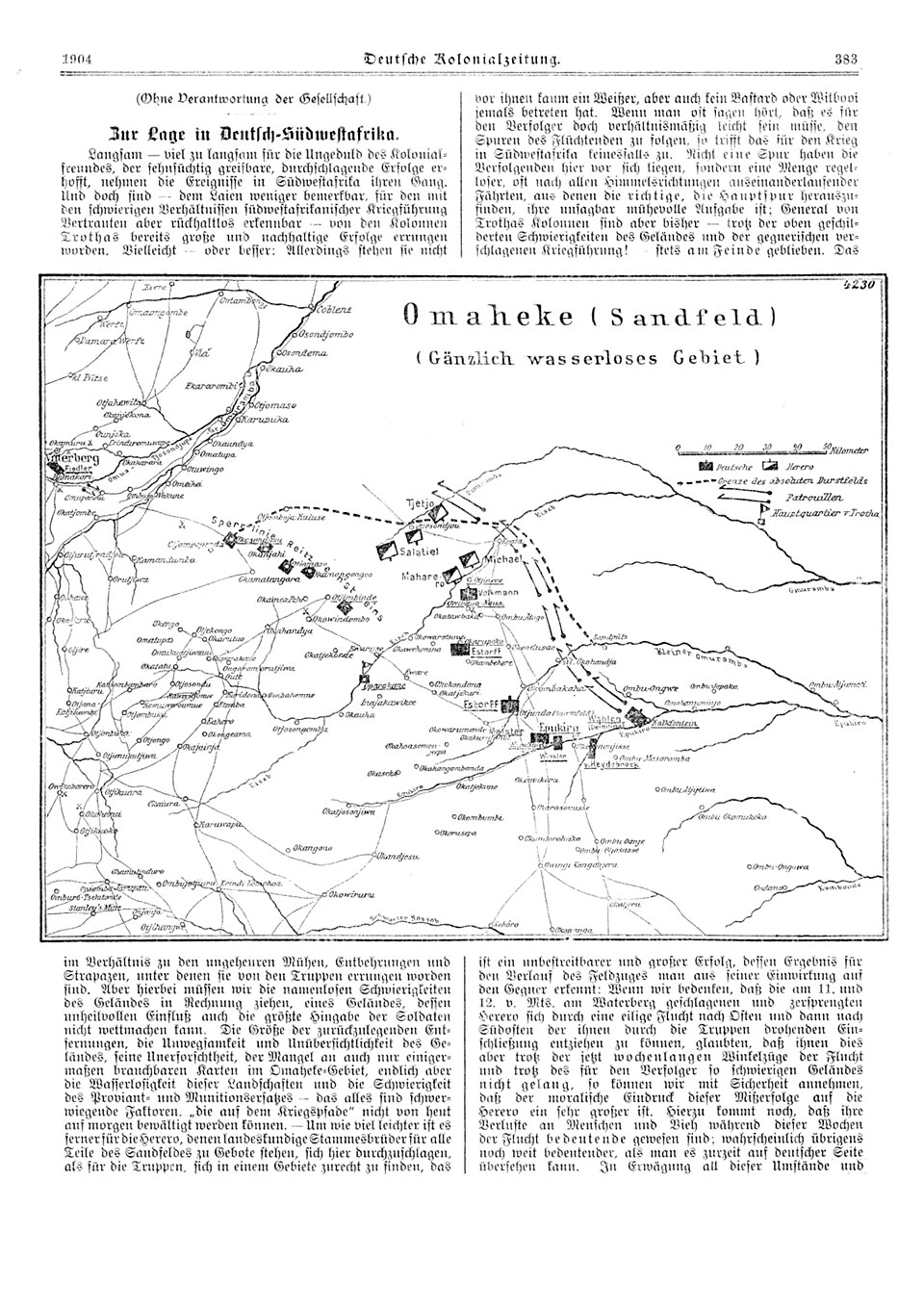
"Zur Lage in Deutsch-Südwestafrika", Deutsche Kolonialzeitung no. 39, 29 September 1904, p. 383, published by the Deutsche Kolonialgesellschaft. Public domain, via Wikimedia Commons (from the Bundesarchiv's online exhibition). Shown because it is the colonial lobby's own account of the pursuit, three days before the proclamation, with the Omaheke labelled "Gänzlich wasserloses Gebiet".
Content note: Colonial-era postcard of prisoners, captioned in the dehumanising language of the period. This object is shown as it was published. Why 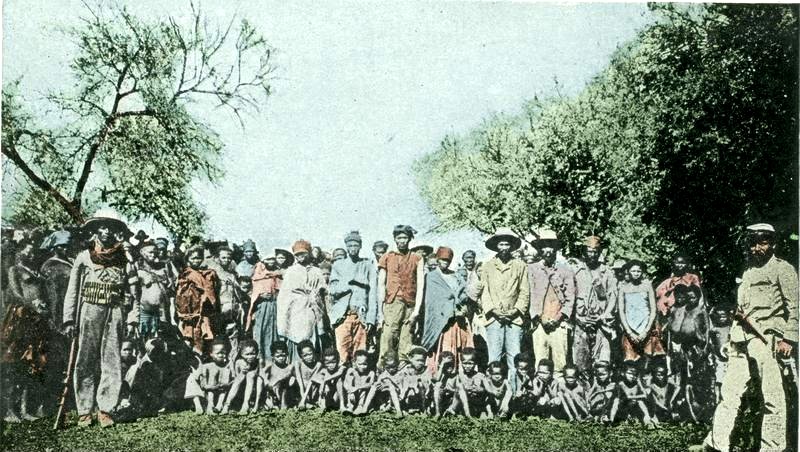
Postcard "Kriegsgefangene Hottentotten, Deutsch-Süd-West-Afrika", Franz Spenker, Hamburg. Bundesarchiv, Bild 146-2003-0005 / unknown author / CC BY-SA 3.0 DE. The Bundesarchiv dates the photograph to about 1897-99 and the colouring to probably after 1904. Shown as an example of the commercial prisoner postcard and its label, not as a scene from 1904-08.
Content note: Photograph of soldiers packing a crate of human skulls. This object is shown as it was published. Why 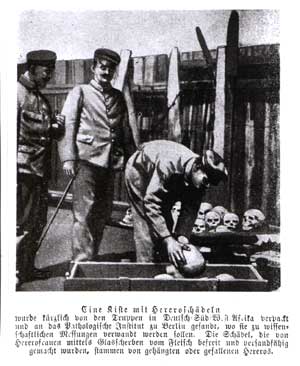
"Eine Kiste mit Hereroschädeln", photograph with printed caption, unknown author, dated 1910 on Commons (original publication not verified). Public domain, via Wikimedia Commons. The caption reads in full: "Eine Kiste mit Hereroschädeln wurde kürzlich von den Truppen in Deutsch-Süd-West-Afrika verpackt und an das Pathologische Institut zu Berlin gesandt, wo sie zu wissenschaftlichen Messungen verwandt werden sollen. Die Schädel, die von Hererofrauen mittels Glasscherben vom Fleisch befreit und versandfähig gemacht wurden, stammen von gehängten oder gefallenen Hereros." Shown as published, because the caption is the evidence.
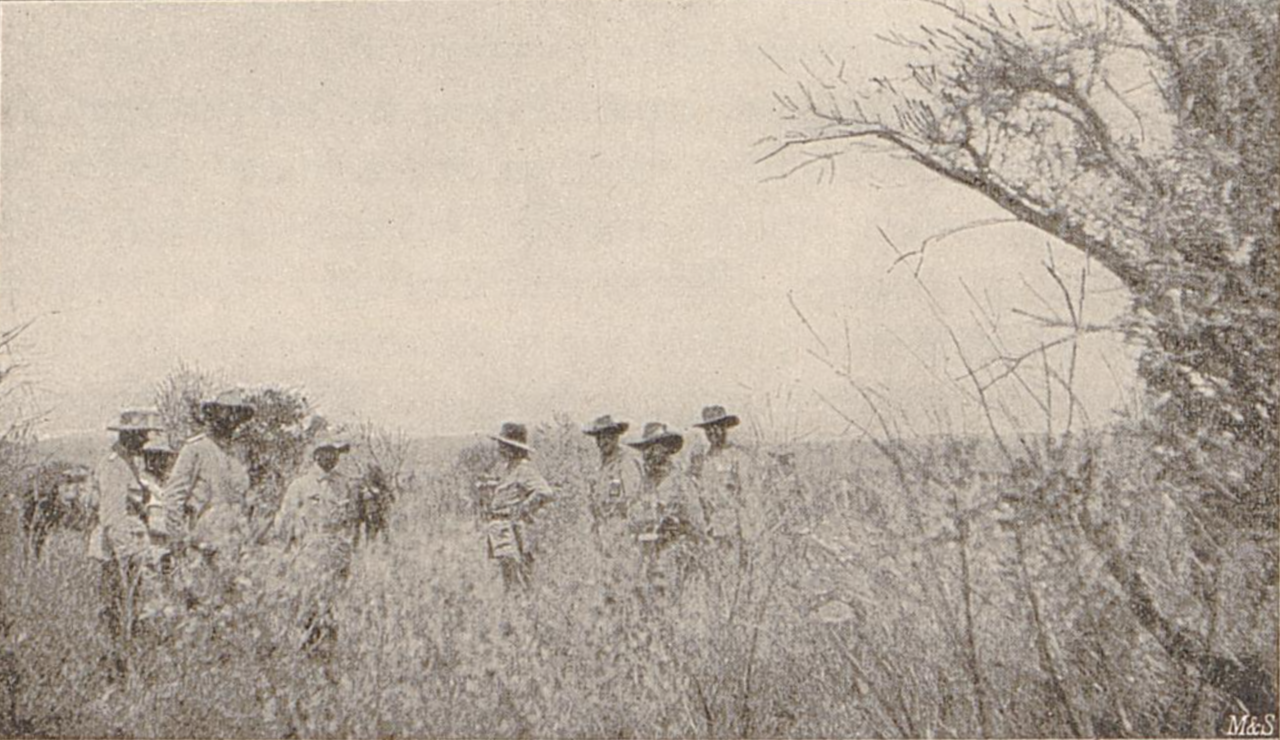
General von Trotha and his staff at Hamakari (Waterberg), August 1904, as printed in the General Staff's Die Kämpfe der deutschen Truppen in Südwestafrika, vol. 1 (1906). Public domain, via Wikimedia Commons. Shown because it comes from the official history that describes the Omaheke as completing the annihilation.
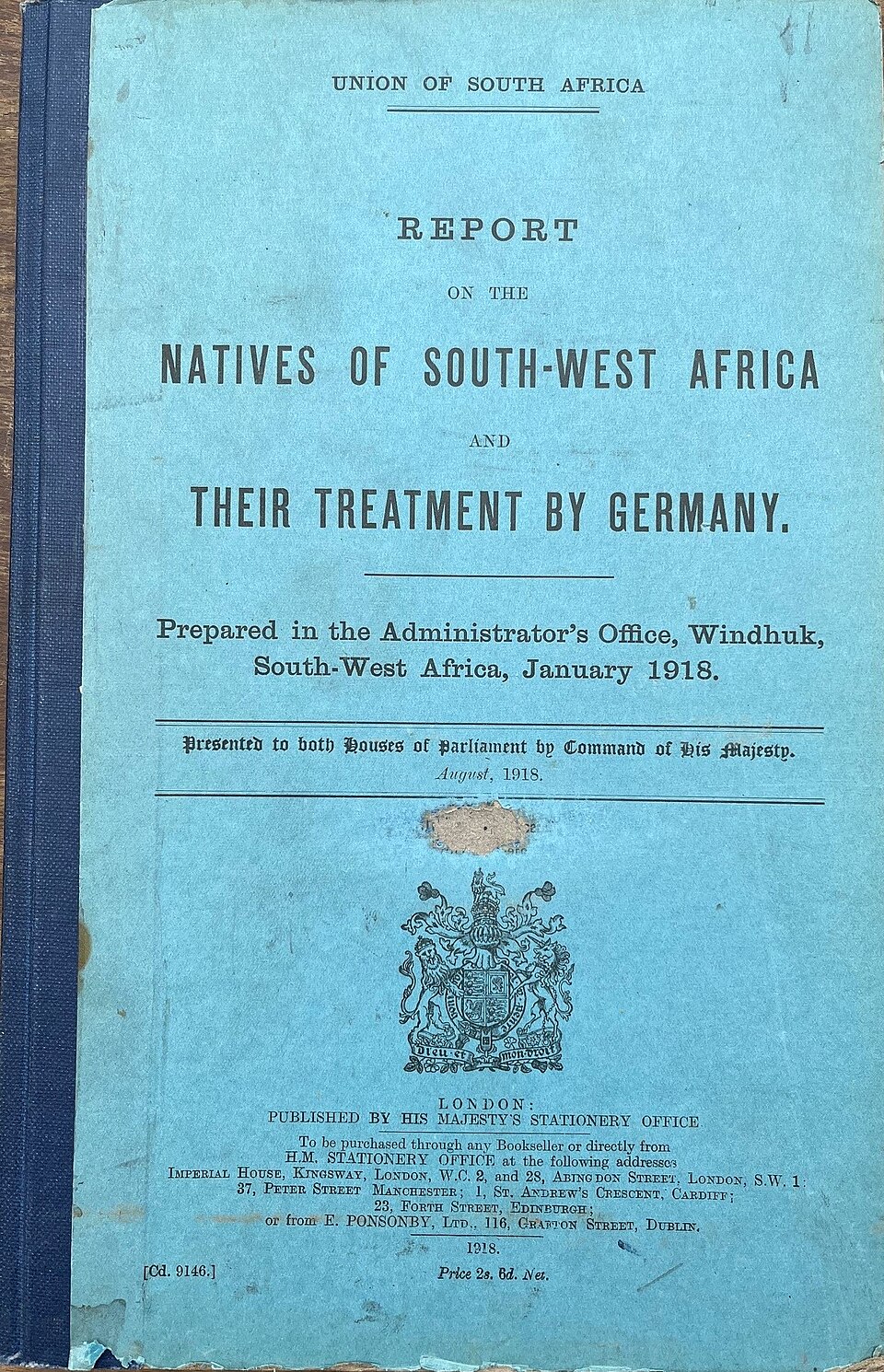
Cover of the Report on the Natives of South-West Africa and their Treatment by Germany, prepared in the Administrator's Office, Windhuk, January 1918, presented to Parliament August 1918 (Cd. 9146), HMSO. Public domain, via Wikimedia Commons. Shown because it is the document the 1926 assembly ordered destroyed.
Image gaps
- The well-known photograph of Herero prisoners in chains. A copy is on Commons (File:Herero_and_Nama_prisoners.jpg), but its only source is a Der Spiegel article, with no photographer, archive or publication date, so its US status is unclear. Not used. Could be filled from the Bundesarchiv or the National Archives of Namibia with a documented original.
- Page 211 of the General Staff history and the text of Trotha's proclamation. Both are public domain by age. Scans exist (the Bremen digital colonial library; the Bundesarchiv), but neither site could be reached from the build environment. Can be filled.
- Interior pages and photographs of the Blue Book, and the 1919 German reply. Both are public domain by age and have online scans (Internet Archive), which could not be reached. Can be filled.
- 1907 election leaflets and caricatures. None were found on Commons. Period satirical magazines are public domain, so this could be filled with further research.
- Shark Island, 1905-07. Commons holds modern photos of the site. One older skull photo there is captioned "Shark Island ... circa 1903", before the camp existed, so it was not used.
Sources
- Lothar von Trotha's proclamation of 2 October 1904, German text and English translation, German History in Documents and Images (English)
- Großer Generalstab, Die Kämpfe der deutschen Truppen in Südwestafrika, vol. 1, Der Feldzug gegen die Hereros (Berlin: Mittler, 1906), digital copy, SuUB Bremen
- Deutsche Kolonialzeitung no. 39, 29 September 1904, "Zur Lage in Deutsch-Südwestafrika", with transcription (Wikimedia Commons)
- Report on the Natives of South-West Africa and their Treatment by Germany, Cd. 9146 (1918), Internet Archive
- Reichskolonialamt, Die Behandlung der einheimischen Bevölkerung in den kolonialen Besitzungen Deutschlands und Englands (1919), Internet Archive and SuUB Bremen record
- Bundesarchiv, Bild 146-2003-0005, postcard "Kriegsgefangene Hottentotten" (Wikimedia Commons record)
- "Met Duizend Groete": Jacob Marenke's letter to Lothar von Trotha, 8 May 1905, responding to the "Proklamation an das Volk der Hottentotten" of 22 April 1905, Journal of Namibian Studies
- Jeremy Silvester and Jan-Bart Gewald, Words Cannot Be Found: German Colonial Rule in Namibia. An Annotated Reprint of the 1918 Blue Book (Brill, 2003), PDF via South African History Online
- H-Net review of Words Cannot Be Found
- "Composing the Blue Book: The Use of Oral Sources to Narrate German South-West Africa", The Oral History Review 50:1
- "Delegitimating Empire: German and British Representations of Colonial Violence, 1918-19", The International History Review 42:4
- "'Streams of blood and streams of money': new perspectives on the annihilation of the Herero and Nama peoples of Namibia, 1904-1908", Kronos 34 (2008)
- South African History Online: Herero Revolt 1904-1907 and timeline of the war and genocide
- Deutsches Historisches Museum: "Der Reichstag und die 'Hottentottenwahl' von 1907"
- Reichstagswahl 1907 (de.wikipedia) and 1907 German federal election (en.wikipedia)
- Konzentrationslager (historischer Begriff) (de.wikipedia)
- EHNE: "Massacre of the Herero and Nama: a colonial laboratory for genocide?"
- Charité: restitution of Namibian skulls, 2011
- Larissa Förster, "Die Entschuldigung von Heidemarie Wieczorek-Zeul in Namibia" (2004)
- ECCHR: "The 'reconciliation agreement': a lost opportunity"
- German Practice in International Law: "Reconciliation Without Reparation: The German-Namibian Joint Declaration" (2023)
- D+C: "No real reconciliation for the Ovaherero and Nama"
- The Conversation: "Germany's genocide in Namibia: deal between the two governments falls short of delivering justice"
- Amnesty International, October 2025: "Namibia: Germany must deliver reparatory justice for its brutal colonial past"
- Journal of the International Institute (University of Michigan): "The First Genocide of the 20th Century and its Postcolonial Afterlives: Germany and the Namibian Ovaherero"
- Benjamin Whitaker, Revised and updated report on the question of the prevention and punishment of the crime of genocide, UN doc. E/CN.4/Sub.2/1985/6
- Heinrich Schnee (de.wikipedia), author of Die koloniale Schuldlüge (1924)
- Robert Gerwarth and Stephan Malinowski, "Hannah Arendt's Ghosts: Reflections on the Disputable Path from Windhoek to Auschwitz", Central European History 42 (2009)
- Herero and Nama genocide reparations (en.wikipedia): 2021 declaration, 2022 Namibian revision demands, 2023 UN and court steps
- Second Boer War concentration camps (en.wikipedia), including Emily Hobhouse's 1901 report