Content note. This page describes young children, some as young as six, being separated from their parents for months or years at a time, and the conscription of older evacuees into the Volkssturm as the war collapsed in 1944-45. It does not include graphic material.
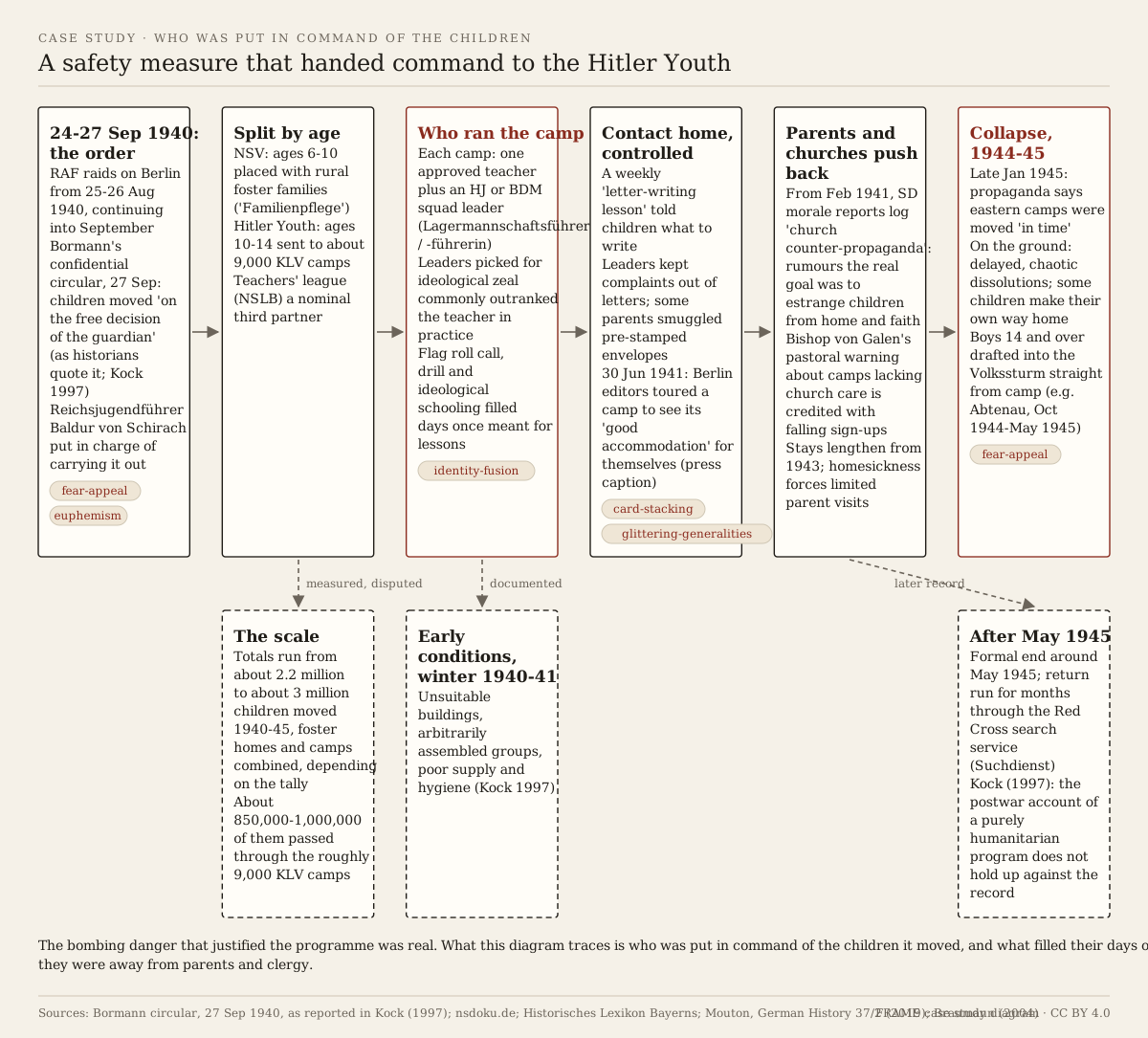
In one line: after the RAF bombed Berlin in late summer 1940, Hitler ordered children moved out of threatened cities "on the free decision of the guardian," and the public presentation stayed one of child welfare throughout the war, but the roughly 9,000 resulting KLV camps for ten- to fourteen-year-olds were run day to day by Hitler Youth and League of German Girls squad leaders rather than by parents, clergy or, in practice, most teachers, which let the regime keep and intensify ideological formation on children it had removed from home for months or years — a conflict with parents and churches that is itself well documented, and a program that fed its own older evacuees into the last-ditch Volkssturm as it collapsed in 1944-45.
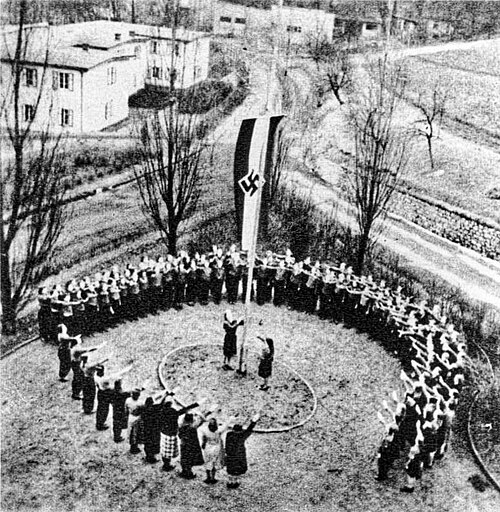
"Kinderlandverschickung, Flaggenappell im KLV-Lager": the camp girls' unit of a KLV camp lined up for flag roll call. Undated (file catalogued 1983). Bundesarchiv, Bild 146-1983-056-13, CC BY-SA 3.0 DE.
What happened
The September 1940 order
- Night of 25-26 August 1940. RAF Bomber Command raids Berlin for the first time, in response to a Luftwaffe bomb falling on London; further raids on Berlin and other German cities follow through September.
- 27 September 1940. Martin Bormann, head of the Party Chancellery, issues a confidential circular recording that, "on the Führer's order," children from areas hit by repeated night raids — Hamburg and Berlin above all — are to be sent to other parts of the Reich. As historians who have used the circular record its wording, the move rested "on the free decision of the guardian" (auf freiwillige Meldung der Erziehungsberechtigten; Kock 1997). Hitler puts Reichsjugendführer Baldur von Schirach in charge of carrying it out. The programme, the "Erweiterte Kinderlandverschickung" (Extended Children's Country Evacuation, EKLV or KLV), starts accepting children from 3 October 1940, building on a smaller, peacetime Kinderlandverschickung tradition of countryside stays for city children's health that dated back decades.
- The three-way split. Implementation is shared: the National Socialist People's Welfare (NSV) places children aged roughly six to ten with rural foster families (Familienpflege), usually with their mothers or in small groups; the Hitler Youth (The Hitler Youth: from a party wing to a legal duty, 1926-1945) takes charge of children aged roughly ten to fourteen, sent class by class to purpose-run KLV camps; the National Socialist Teachers League (NSLB) supplies the schooling component and is a nominal third partner. Both the HJ and the League of German Girls (The Bund Deutscher Mädel: raising Nazi Germany's girls for the Volk) run camps for their respective sex. This page covers the evacuation programme itself; for the youth organisations' own structure, ideology and history, see those two pages.
Who actually ran the camps
- Nominal structure. Overall responsibility for each camp sat with one Nazi-vetted teacher and one Hitler Youth or BDM squad leader (Lagermannschaftsführer or Lagermädelführerin), assigned by the HJ leadership for each group of roughly 30 to 45 children. HJ and BDM squad leaders were picked for demonstrated ideological commitment, not teaching experience.
- In practice. Sources on the ground describe recurring conflict between camp teachers and HJ squad leaders over who was actually in charge, with the Hitler Youth side commonly prevailing; at many camps the accompanying teachers came to play a limited role, reduced to formal schooling for part of the day while the HJ leadership ran the rest of camp life — physical training, ideological instruction, drill and ritual, including regular flag roll calls (Flaggenappell).
- Early conditions. The winter of 1940-41 was marked, in the documentary record, by unsuitable buildings, arbitrarily thrown-together Lagermannschaften, poor supply and often miserable hygiene (Kock 1997; jugend1918-1945.de).
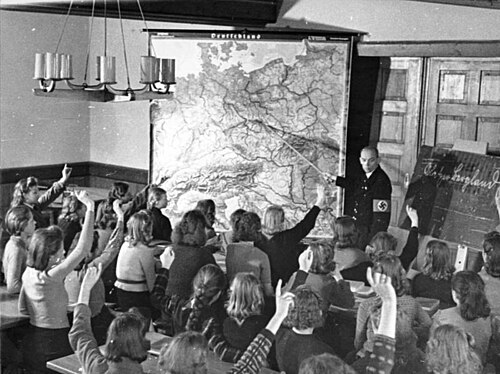
"Schlesien, Berliner Kinder im KLV-Lager": Berlin children evacuated to a KLV camp near Hassitz bei Glatz, Silesia, photographed during a geography lesson. October 1940, one of the programme's first months. Photographer Schwahn. Bundesarchiv, Bild 183-L16351, CC BY-SA 3.0 DE.
Contact with home, controlled
- Camps held a weekly "letter-writing lesson," in which children were told what to write home; leaders worked to keep any complaint about camp conditions out of the letters that reached parents. Some parents are recorded giving their children pre-stamped, pre-addressed envelopes so a letter could bypass the camp's own outgoing mail and any informal check on its contents.
- The regime also used staged access for the press. A Bundesarchiv-catalogued photograph from 30 June 1941, captioned by the wartime picture service, records a visit by Berlin newspaper editors "to convince themselves of the good accommodation of the evacuated Berlin children in the K.-L.-V. camps" — ball games staged in "the beautiful garden of the youth hostel."
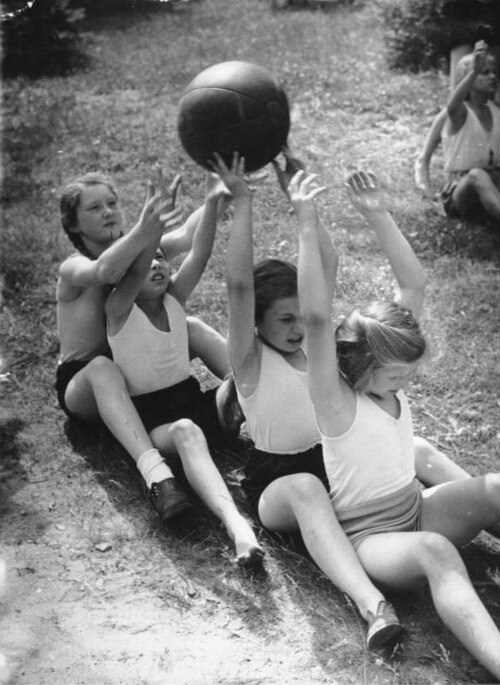
"Wir besuchen unsere landverschickten Kinder" ("We visit our evacuated children"): the wartime picture service's own caption records that Berlin newspaper editors were brought to see "the good accommodation of the evacuated Berlin children in the K.-L.-V. camps," here during "ball gymnastics" in a youth hostel garden. 30 June 1941. Photographer Eisenhart. Bundesarchiv, Bild 183-B03553, CC BY-SA 3.0 DE.
- As the war went on, KLV stays lengthened: from 1943 many children were away for a year or more rather than a single term, and rising homesickness — missing mothers especially — eventually forced camp administrators to permit limited parental visits, a concession the programme's early planning had not built in.
Parents and churches push back
- From February 1941, internal Security Service (SD) morale reports record what they call "church counter-propaganda": rumours circulating that the real state goal of the "free" EKLV was not child safety but to estrange children from their parents and deliver a religionless upbringing.
- Bishop Clemens August Graf von Galen of Münster — already known for his 1941 sermons denouncing the killing of people with disabilities under the "euthanasia" programme — issued a pastoral warning that children in the camps lacked any church-religious care; that warning is credited in the record with a measurable drop in EKLV sign-ups. The Protestant churches' side of the same conflict is the subject of a dedicated study, Georg Braumann's Evangelische Kirche und Erweiterte Kinderlandverschickung (2004).
- On paper, religious instruction and Sunday church attendance remained part of the curriculum for the relevant grades. In practice, no teacher could be compelled to hold religious instruction, and a camp leadership unsympathetic to the churches could simply schedule attractive competing activities for Sunday mornings — a gap between formal provision and what a hostile Hitler Youth leader chose to allow that recurs through the record.
- Scholarship on the programme's reception describes it as, in Michelle Mouton's words, "an arena of struggle between the Nazi state and German parents over children's experience" (Mouton, German History 37/2, 2019): every family in a threatened city had to decide whether to hand a child over, and evacuation was in practice compulsory in many heavily bombed areas even where it was not compulsory in law.
Scale
- Totals depend on what is counted and when. The Munich documentation centre (nsdoku.de) and related sources give roughly 2.2 million children and adolescents placed in foster families or KLV camps between 1940 and 1945; other tallies, including a wartime Hitler Youth internal estimate from 1943, run to about 2.5-3 million. Of these, historians put roughly 850,000 to 1,000,000 children specifically through the approximately 9,000 KLV camps set up for the ten-to-fourteen age group; the remainder went through NSV foster placements.
Collapse, 1944-45
- As the war turned, KLV camps in the east sat in the path of the advancing front. Nazi propaganda in late January 1945 claimed that camps in eastern reception areas had been evacuated "in time" and relocated to safer ground. On the ground, eyewitness accounts describe dissolutions that were delayed and hastily carried out, sometimes because no transport was available and sometimes because fighting had already cut off the route home; in some cases children made their own way back to their parents alone or in small groups.
- Older boys were drawn directly into the war's last mobilisation. The Volkssturm, formed by decree on 25 September 1944, conscripted men aged 16 to 60 not already serving; despite a nominal 16-plus floor, younger teenagers, including Deutsches Jungvolk members, were also pushed or volunteered into service in the war's final months. A documented case is the KLV camp at Abtenau (Austria), which operated from October 1944 to May 1945 jointly with a local school: all students aged 14 and over were drafted into the Volkssturm directly from the camp. More broadly, historians note that a disproportionate share of boys who passed through the Hitler Youth and KLV camp system went on to volunteer for, or be pushed toward, Waffen-SS and Volkssturm service in 1944-45.
- The programme had no clean end date; it wound down around May 1945 as the war itself ended. Reunifying children with parents took months longer, coordinated through the Red Cross search service (Suchdienst); Bavaria's remaining KLV camps, for instance, were placed under youth-welfare administration in summer 1945 specifically to organise the return of the children still in them.
How it works
- Euphemism / doublespeak: "Kinderlandverschickung" — sending children to the countryside — and its 1940 extension were presented, from Bormann's circular onward, as an act resting on the "free decision of the guardian," a matter of child welfare and air-raid safety. The same order that used that language handed operational control of the resulting camps to the Hitler Youth, not to parents, teachers or local welfare officials.
- Fear appeal: the trigger and the continuing justification for the whole programme was a real, immediate danger — Allied bombing of German cities — which made handing a child over to Hitler Youth command feel like the safer choice, and which the regime never needed to invent.
- Card stacking: the weekly coached "letter-writing lesson," camp leaders' effort to keep complaints out of mail home, and the 30 June 1941 press visit staged to show "good accommodation" all selected what reached parents and the public in favour of reassurance. The same pattern recurs in the false claim of an orderly, timely evacuation of eastern camps in January 1945.
- Identity fusion: removing children from parental and church influence for months or years, and filling their days with flag ceremonies, drill and Hitler Youth ritual rather than family or parish life, worked to fold individual children into the regime's Volksgemeinschaft through its own youth movement rather than through the institutions — family, church, school — that would ordinarily have done that work.
- Glittering generalities: contemporary propaganda framed the whole enterprise in warm, unfalsifiable terms — a 1940-41 poster issued by the NSDAP's Gau Baden welfare office, for instance, promised children were "in der treuen Obhut der Mutter Deutschland" ("in the faithful care of Mother Germany") — language that stands in for, and obscures, the actual chain of command: an HJ or BDM squad leader, not a mother.
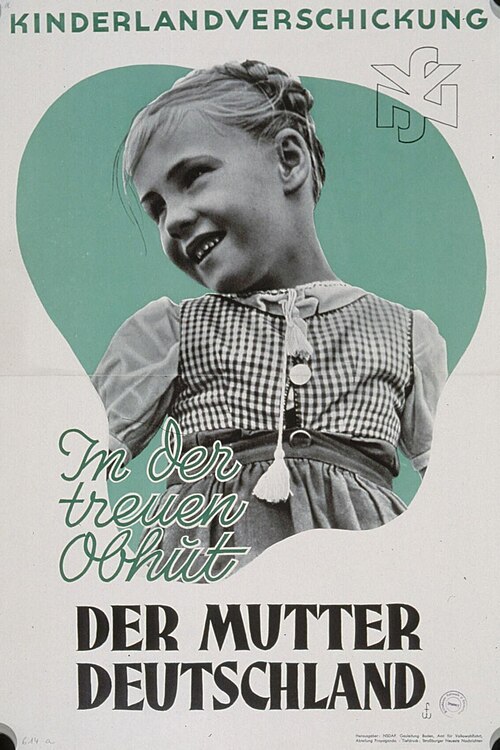
"Kinderlandverschickung. In der treuen Obhut der Mutter Deutschland" ("Kinderlandverschickung. In the faithful care of Mother Germany"), issued by the NSDAP's Gau Baden welfare and propaganda office (whose remit after 1940 covered annexed Alsace), printed via the Strasbourg paper Neueste Nachrichten. Bibliothèque nationale de France (Bibliothèque nationale et universitaire de Strasbourg copy), gallica.bnf.fr. Public domain (PD-France, anonymous institutional work).
Then and now
The clearest living version of the same method is not German. Since Russia's full-scale invasion of Ukraine in February 2022, Russian authorities have moved thousands of Ukrainian children from occupied territory into Russia and Russian-controlled Crimea, publicly framed as evacuation, recreational "summer camps" or adoption into caring families. A February 2023 Yale School of Public Health Humanitarian Research Lab report, produced for the U.S. State Department-backed Conflict Observatory, identified at least 43 facilities holding at least 6,000 Ukrainian children since the invasion; most are described as recreational camps children were taken to for ostensible vacations, some engage in pro-Russia re-education, some provide military training, and some have suspended children's return to their Ukrainian parents. Ukrainian government estimates of children moved or displaced run far higher, into the tens of thousands, though verified figures are lower and disputed. On 17 March 2023 the International Criminal Court issued arrest warrants for President Vladimir Putin and Russia's Commissioner for Children's Rights, Maria Lvova-Belova, for the war crimes of unlawful deportation and unlawful transfer of children from occupied Ukraine.
The mechanism is the same shape as the KLV: a welfare or safety label ("evacuation," "summer camp," "recreation") covers the removal of children from parents and community for an extended, open-ended period, during which they are placed under an ideologically motivated authority — not their own family, school or clergy — that runs political re-education and, in some documented cases, military training, and that in some cases has resisted returning children when parents sought them back. The differences are real and matter: the KLV moved German children within Germany and returned most of them to their own families and country by design once the immediate danger passed or the war ended; the 2022- programme moves Ukrainian children across an international and contested border, into a country its own government is at war with, and has in some cases placed children for adoption by Russian citizens — a transfer of nationality and custody the KLV never attempted. The KLV also operated at a larger scale (millions of children) than the confirmed 2022- figures, though the true scale of the Ukrainian programme is not established.
Positions on the record
- The regime's stated position, at the time. The Bormann circular and the programme's public presentation throughout the war described the EKLV as resting on parents' free choice and existing to protect children from bombing; official language never referred to Hitler Youth command of the camps as its purpose, and press material (the 30 June 1941 visit, the poster language quoted above) emphasised good, caring conditions.
- Postwar accounts by former officials. After 1945, participants in running the programme, including surviving Nazi officials, generally described it in memory and testimony as a purely humanitarian air-protection measure — the "legend" Gerhard Kock's 1997 monograph, "Der Führer sorgt für unsere Kinder…": die Kinderlandverschickung im Zweiten Weltkrieg, sets out to test and to reject, arguing from the documentary record that propagandistic, ideological and power-political motives were present alongside the genuine, life-saving evacuation of children from bombed cities.
- The churches, at the time. SD morale reports from February 1941 onward record clergy and lay rumour describing the programme's underlying purpose as estranging children from home and faith; Bishop von Galen's pastoral warning made the same concern public and is credited with reducing sign-ups.
- What is documented. The 27 September 1940 order and Schirach's appointment; the NSV/HJ/NSLB division of responsibility; the dual teacher-plus-HJ-leader camp structure and the recurring pattern of HJ leaders prevailing over teachers; the coached letter-writing sessions and the staged press visit; the SD reports of church "counter-propaganda" and von Galen's warning; the chaotic 1944-45 dissolution and the Abtenau camp's direct feed into the Volkssturm.
- What is contested or not established here. Total participation figures vary by around a million depending on the source and what is counted (foster placements, camp placements, or both); how far the "free decision" language reflected real parental choice versus social and political pressure varied by locality and by how directly a city was threatened, and this page does not attempt a single national figure for how many families felt they had no real choice; the exact split of older KLV-camp boys who went into the Waffen-SS versus the Volkssturm versus neither is not established by a single source used here.
Same-method test
The method scored here is specific: a child-welfare or safety label covers the transfer of day-to-day authority over children to the regime's own ideological youth cadre, for an extended and often open-ended period, away from parents and clergy. Other twentieth-century states used the same shape of move for different declared purposes.
- Soviet Union, from 1943. The Suvorov Military Schools, established by a Council of People's Commissars resolution of August 1943 and opened that December, were framed compassionately: they existed above all to give a home and an education to boys orphaned or displaced by the war, particularly sons of fallen or serving soldiers. In practice they were full-time, live-in military boarding schools for boys aged roughly 14 to 18 (nine were founded in the newly liberated western USSR alone), delivering intensive military training and Soviet political education under uniformed instructors rather than surviving family. Shared with the KLV: a genuine wartime welfare need (bombed-out or orphaned children) used to justify placing children under a movement's own cadre for years rather than months. Differences: the Suvorov schools were multi-year, formally military-track institutions built to outlast the war, chiefly for boys who had in fact lost their families, not a temporary safety measure for children who mostly still had parents to return to; they continue to operate in Russia today.
- China, 1968-1978. The "Up to the Mountains, Down to the Countryside" movement (shangshan xiaxiang) mobilised an estimated 16 to 17 million urban teenagers and young adults, officially to be "re-educated by the poor and lower-middle peasants," away from their families and urban schooling, often for years at a time, enforced in practice through household-registration (hukou) controls that made return difficult. Later assessment, including by Chinese officials, holds that curbing urban unemployment was a major unstated function of the campaign alongside its stated ideological purpose. Shared with the KLV: a stated, values-laden justification (revolutionary duty, rather than safety) that removed young people from family and community for state-directed formation, with an unstated practical function running alongside it. Differences: the sent-down youth were older (mid-teens to twenties, not six to fourteen), the programme ran for a decade rather than under five years, it targeted an entire generational cohort by policy rather than responding to an acute physical danger, and it was not, on the same evidence, organised around residential camps under a youth-movement cadre in the way the KLV and the Suvorov schools were.
None of these is equivalent to the KLV. What distinguishes the KLV is the combination of a real, acute physical danger as the public justification; camps run day to day by a rival youth organisation rather than the family, church or ordinary school system that a stated child-welfare purpose would suggest; and a mail and press regime built to keep that arrangement looking benign to parents and the wider public while it continued.
How to spot it
- Ask who is actually put in charge of a "protective" programme's day-to-day running — parents, teachers and clergy, or the sponsoring movement's own cadre.
- Check whether children's letters or messages home are written freely, or drafted and reviewed in a supervised session first.
- Watch the gap between a programme's stated, limited duration and how long children actually stay once the arrangement is renewed rather than ended.
- Ask whether a stated right (religious practice, contact with family) survives on paper but is crowded out in the daily schedule that a hostile local leader controls.
- Watch what happens to a "welfare" programme's oldest cohort when the state needs labour, soldiers or workers — a child-safety measure that quietly turns into a pipeline for conscription or unpaid work is a tell, whether the transition takes months (the KLV, 1944-45) or is built in from the start (sent-down youth).
Images
| Image | Source | Licence |
|---|---|---|
| Mechanism diagram (above) | Drawn for FRAME from this page's sourced facts (make_diagrams.py) |
CC BY 4.0, FRAME |
| "Flaggenappell im KLV-Lager" (flag roll call, undated) | Wikimedia Commons, Bundesarchiv, Bild 146-1983-056-13 | CC BY-SA 3.0 DE |
| Berlin children at a KLV camp, Silesia, October 1940 | Wikimedia Commons, Bundesarchiv, Bild 183-L16351, photographer Schwahn | CC BY-SA 3.0 DE |
| "Wir besuchen unsere landverschickten Kinder" — press visit to a KLV camp, 30 June 1941 | Wikimedia Commons, Bundesarchiv, Bild 183-B03553, photographer Eisenhart | CC BY-SA 3.0 DE |
| "In der treuen Obhut der Mutter Deutschland" poster, Gau Baden welfare/propaganda office, c. 1940-41 | Wikimedia Commons, Bibliothèque nationale de France (via gallica.bnf.fr) | Public domain (PD-France) |


Image gaps
- The Bormann circular of 27 September 1940 itself. No openly licensed scan of the original document was located from this environment; its wording is used here as historians (chiefly Kock 1997) quote and summarise it, not as a directly reproduced primary source. Identified and worth pursuing from the Bundesarchiv's own holdings.
- A KLV camp classroom or "letter-writing lesson" in session. Commons holds general KLV camp-life photographs (playing ball, water games) but none specifically captioned as a letter-writing or censorship session; identified and licence-checked, download not attempted because no clearly captioned example was found — fillable if one turns up.
- The Abtenau KLV camp or a Volkssturm induction directly tied to a named KLV camp. Documented in eyewitness and local-history accounts (Ernst-Moritz-Arndt-Gymnasium Osnabrück's KLV history pages), but no openly licensed photograph specific to that event was located. Fillable from regional archives.
- A 1944-45 photograph of a chaotic camp evacuation or return. Not located with a clear open licence from this environment; most surviving images of the collapse phase are in family or municipal archives without a stated free licence.
- Higher-resolution copies of the Bundesarchiv photographs used here. The versions hosted on Commons and used on this page were fetched at reduced (500px-wide) resolution because of a network rate limit encountered while building this page; full-resolution versions (up to roughly 800px on the longest side, per the Bundesarchiv's own scans) are available on Commons at the file pages linked above.
Sources
- Bormann, Martin. Confidential circular on the "Erweiterte Kinderlandverschickung," 27 September 1940, as quoted and analysed in Kock (1997) below.
- Kock, Gerhard. "Der Führer sorgt für unsere Kinder…": die Kinderlandverschickung im Zweiten Weltkrieg. Paderborn/Munich: Schöningh, 1997.
- Mouton, Michelle. "The Kinderlandverschickung: Childhood Memories of War Re-Examined." German History 37, no. 2 (2019): 186-204. Oxford Academic
- Braumann, Georg. Evangelische Kirche und Erweiterte Kinderlandverschickung. In Dokumente und Berichte zur Erweiterten Kinderlandverschickung: 1940-1945, vol. 2. Bochum: Projekt Verlag, 2004.
- NS-Dokumentationszentrum München. "Kinderlandverschickung".
- Historisches Lexikon Bayerns. "Kinderlandverschickung".
- Jugend 1918-1945 (Bundeszentrale für politische Bildung education portal). "Kinderlandverschickung (KLV)".
- Deutsches Historisches Museum, LeMO. "Kinderlandverschickung".
- Ernst-Moritz-Arndt-Gymnasium Osnabrück, school local-history project. "Kinderlandverschickung 1941-1945" and "KLV-Lager Abtenau" (Volkssturm conscription of KLV boys aged 14 and over).
- Volkssturm decree, 25 September 1944; on the wartime mobilisation of teenagers generally, see the English-language overview at Wikipedia, "Volkssturm" (background only; not relied on for KLV-specific facts).
- Suvorov Military Schools: founding Council of People's Commissars resolution, August 1943; overview at Encyclopedia of Ukraine, "Suvorov army cadet schools".
- Down to the Countryside Movement ("Up to the Mountains, Down to the Countryside," shangshan xiaxiang), 1968-1978: overview and figures at Dartmouth Library digital collection, "Down to the Countryside Movement" and Alpha History, "Down to the Countryside".
- Humanitarian Research Lab, Yale School of Public Health, for the Conflict Observatory. Russia's Systematic Program for the Re-education and Adoption of Ukraine's Children, February 2023. ReliefWeb copy.
- International Criminal Court. "Situation in Ukraine: ICC judges issue arrest warrants against Vladimir Vladimirovich Putin and Maria Alekseyevna Lvova-Belova," 17 March 2023. icc-cpi.int.
- U.S. Department of State. "The Kremlin's War Against Ukraine's Children".