Content note. This page describes propaganda and organised activity aimed mainly at children and teenagers (age 10-21), including the legal exclusion of Jewish girls from a youth movement and internal reports describing pressure on girls and families to take part. It quotes the movement's own racial and maternal language as evidence of the method, not as this archive's description of anyone.
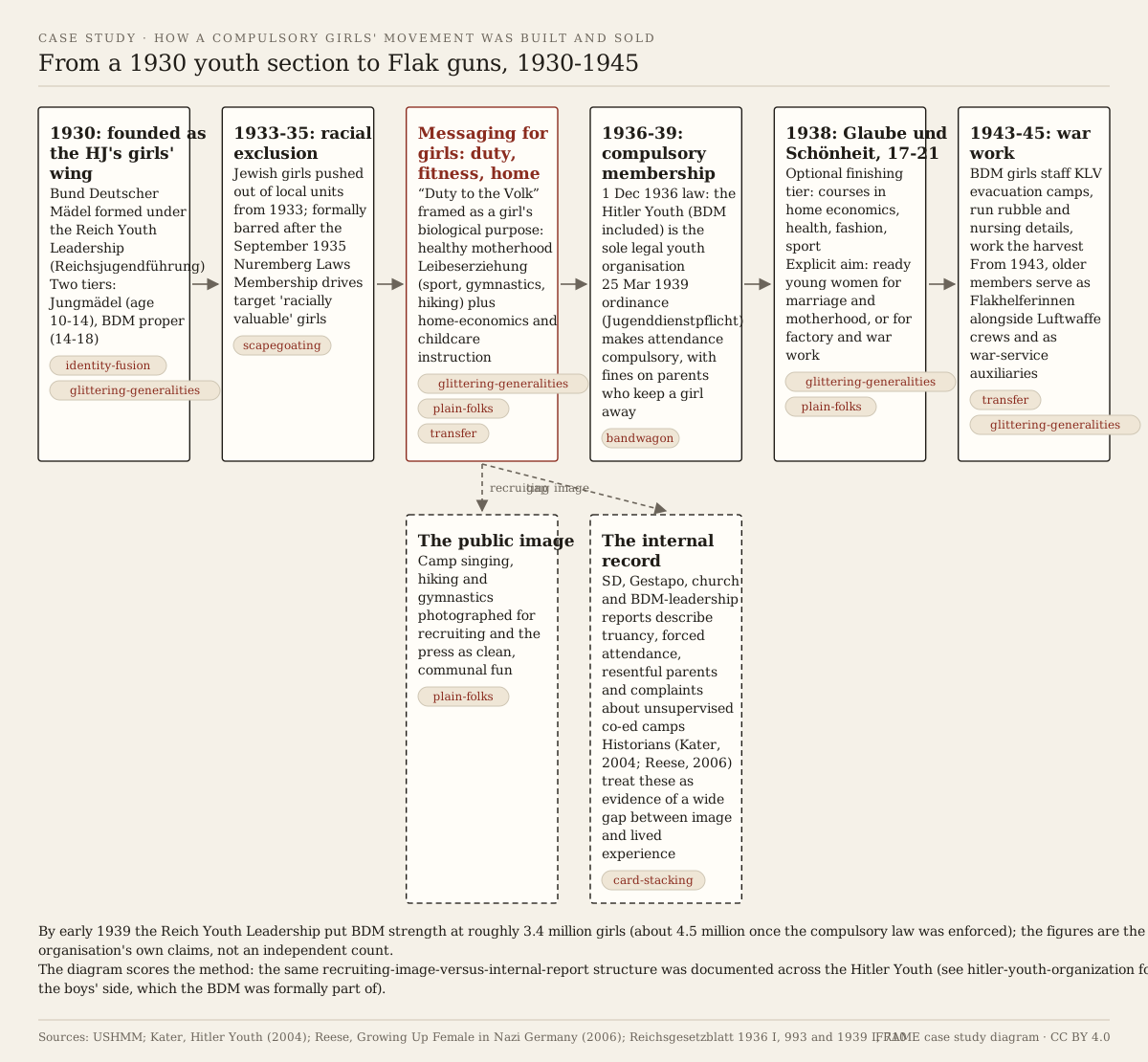
In one line: founded in 1930 as the Hitler Youth's girls' wing, the Bund Deutscher Mädel (BDM) grew from a voluntary club into the sole legal channel for raising German girls after a 1936 law and a 1939 compulsory-service ordinance, teaching every member from age ten that her worth lay in racial-biological duty, physical fitness and domestic and maternal skill, selling that message through camp and hiking photographs while its own leadership's internal reports recorded truancy, coerced attendance and parental complaint, and by 1943-45 was feeding its older members into war work, including anti-aircraft (Flak) crews.
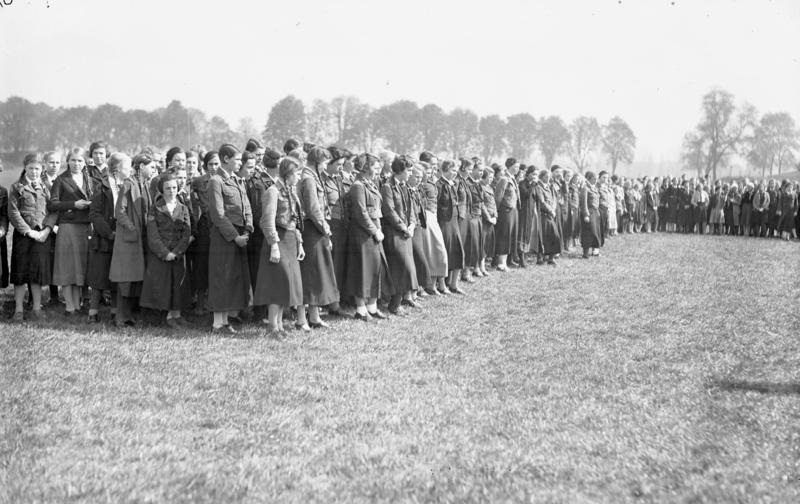
BDM members lined up for Appell (roll call), undated. Bundesarchiv, Bild 133-067, CC BY-SA 3.0 DE.
What happened
Founding and structure, 1930-1933
- 1930. The Bund Deutscher Mädel is formed as the girls' section of the Hitlerjugend (Hitler Youth), inside the Reich Youth Leadership headed by Baldur von Schirach. Membership is organised by age: the Jungmädel (Jungmädelbund, JM) for girls roughly 10-14, and the BDM proper for 14-18.
- 30 January 1933. Hitler becomes chancellor. Within months, non-Nazi and confessional girls' and youth groups (Protestant, Catholic and socialist) are pressured to dissolve or merge into the Hitler Youth structure; by 1936 the BDM is effectively the only girls' youth organisation the state permits to operate openly.
- 1933-35. Jewish girls are pushed out of local units from 1933; after the Nuremberg Laws of September 1935 (the Reich Citizenship Law and the Law for the Protection of German Blood and German Honour) bar them from the "German-blooded" national community the BDM claimed to serve, their exclusion becomes a formal legal bar rather than local practice.
Messaging: duty, fitness, home
- BDM instruction and its own press (the movement's magazine, Das Deutsche Mädel, launched 1933) frame a girl's purpose as racial-biological: bearing healthy children for the Volk is presented as a duty on a level with a soldier's, not a private choice.
- Leibeserziehung (physical education) — gymnastics, athletics, swimming, hiking — is taught as preparation for that duty: a fit body was presented as the precondition for fit motherhood, not as sport for its own sake.
- Home-economics instruction (cooking, sewing, childcare, budgeting) is compulsory in BDM meetings, training members as future homemakers even while the organisation was also, from 1936, encouraging some to take up nursing, farm labour or clerical work in the state's service.
- Academic ambition and "intellectualism" are discouraged in BDM literature in favour of "character," community feeling (Gemeinschaft) and obedience to leaders and the Führer.
1936-39: from voluntary club to compulsory service
- 1 December 1936. The "Gesetz über die Hitler-Jugend" (Hitler Youth Law) declares the Hitler Youth, BDM included, the sole legally recognised youth organisation in Germany, standing alongside home and school as an instrument of state education. This does not yet force every girl to attend, but removes any legal competitor.
- 25 March 1939. A supplementary decree makes actual service compulsory (Jugenddienstpflicht): parents who kept a daughter out of BDM meetings could be fined. The Reich Youth Leadership's own figures, cited in the secondary literature (Kater, 2004), put BDM and Jungmädel strength at roughly 3.4 million by early 1939 and considerably higher once the ordinance was enforced; these are the organisation's own membership claims, not an independently audited count.
1938: Glaube und Schönheit
- 15 January 1938. The Reich Youth Leadership creates "Glaube und Schönheit" (Faith and Beauty), an optional bridging society for young women aged 17-21 who had finished regular BDM service. It runs courses in gymnastics and sport, home economics, health and hygiene, needlework and fashion, and culture, working with the German Labour Front's leisure office and the state fashion bureau. Its stated purpose is explicit: to prepare members either for marriage and motherhood or for a working role in the Volksgemeinschaft, including nursing and, as the war approached, war-relevant labour.
The public image and the internal record
- BDM camps (Lager), hiking trips (Fahrten), sports festivals and solstice bonfires (Sonnwendfeiern) were extensively photographed for recruitment, the party press and the Reich's own newsreels, presented as healthy, communal, chaperoned fun.
- Historians working from BDM leadership's own files, and from Sicherheitsdienst (SD), Gestapo and church reports of the period, describe a different picture behind that image: falling enthusiasm and rising truancy by the later 1930s, coerced or resentful attendance once the 1939 ordinance made it compulsory, social pressure on families who tried to opt out, and repeated complaints — from parents, clergy and BDM's own regional leaders — about inadequate supervision at mixed camps and hiking trips (Kater, 2004; Reese, 2006). Contemporary mockery of the initials as "Bund Deutscher Milchkühe" ("League of German Milk Cows") circulated as popular sarcasm about the domestic-and-maternal message.
War work, 1939-1945
- From the war's start, BDM members were organised into the Kriegshilfsdienst (War Help Service): helping run Kinderlandverschickung (KLV) camps that evacuated urban children, working the harvest, clearing bomb damage, and serving as nurses' aides.
- From 1943, as manpower shortages deepened, older BDM and Hitler Youth members were mobilised as Flakhelferinnen and Flakhelfer — auxiliary crew on anti-aircraft (Flak) batteries, operating searchlights, sound-locating equipment and range-finding instruments alongside regular Luftwaffe personnel. By the war's last year, BDM-trained girls were also drawn into rubble clearance, postal and rail auxiliary work, and, in the collapse of 1945, into last-ditch civil-defence roles.
How it works
- Identity fusion: BDM messaging fuses a girl's personal identity with the biological survival of the Volk: her body and future motherhood are framed as belonging to the national community before they belong to her. The oath and ritual language used at induction and camp ceremonies (flag salutes, torchlight and solstice rites) work to bind personal loyalty to the movement and, through it, to Hitler.
- Glittering generalities: "duty to the Volk," "community" (Gemeinschaft), and "Faith and Beauty" are virtue words offered with no testable content — the page's own sources never specify what "faith" in the tier's name refers to, or how "beauty" is measured, only that girls who complete the courses are said to embody both.
- Plain folks: camp singing, hiking, gymnastics displays and campfire scenes are the imagery the movement chose to publish — ordinary-looking, communal, unthreatening — while the compulsory-attendance law and the SD's own reports of coerced participation stayed out of the recruiting picture.
- Transfer: uniforms, the party's flags and insignia, and the borrowed authority of state law (the 1936 and 1939 measures) lend the movement's domestic and racial instruction the weight of official, patriotic duty rather than one youth club's opinion.
- Bandwagon: membership figures in the millions, publicised by the Reich Youth Leadership itself, were used to present joining as what every German girl already did, folding the 1939 legal compulsion into an appearance of near-universal voluntary enthusiasm.
- Card stacking: the published record (camp photography, Das Deutsche Mädel, newsreels) is one-sided by omission — it shows the wholesome side of camp and hiking life and leaves out the truancy, coercion and supervision complaints that the movement's own internal reports and outside observers recorded at the same time.
- Scapegoating: Jewish girls' exclusion, informal from 1933 and formal after the September 1935 Nuremberg Laws, defines the "German girl" the BDM served by excluding a named group from it.
- Euphemism / doublespeak: wartime labour mobilisation was framed as "help" and "service" — Kriegshilfsdienst ("war help service"), Jugenddienstpflicht ("youth service duty") — rather than as conscription, softening compulsory, state-directed labour under a vocabulary of voluntary assistance.
The BDM was formally the Hitler Youth's girls' section; its parent organisation's own recruitment, oath culture and paramilitary style for boys are covered separately in The Hitler Youth: from a party wing to a legal duty, 1926-1945, which this page does not repeat.
Then and now
A documented modern parallel with the same recruiting-image-versus-lived-coercion structure is Russia's Yunarmiya ("Youth Army"), a state-sponsored military-patriotic youth movement founded in 2015-16 under the Ministry of Defence, open to both boys and girls from about age eight. Its public image runs on the same materials the BDM used — uniformed group photographs, flag ceremonies, camp and drill activities presented as wholesome national service — while Russian and international reporting has documented school administrators pressuring pupils to join, attendance quotas set for schools, and parents describing enrolment as effectively compulsory even though membership is formally voluntary. What's the same: a state youth movement recruiting through wholesome group imagery while schools apply pressure that blurs the line between voluntary and compulsory. What's different: Yunarmiya is co-educational and organised around military drill and patriotic history rather than a separate girls' organisation built on racial-biological motherhood doctrine; it operates alongside compulsory state schooling rather than under a law abolishing all competing youth groups; and no formal legal exclusion by ethnicity exists in its charter, unlike the BDM's codified bar on Jewish members.
Positions on the record
- The organisation's own rationale. BDM and Reich Youth Leadership publications presented the movement as preparing girls for their "natural" role as healthy mothers and homemakers of the Volksgemeinschaft, while Glaube und Schönheit's own stated purpose (1938) was to equip young women for either marriage and motherhood or productive work in the nation's service — framed throughout as fulfilment, not restriction.
- Contemporary critics. Catholic and Protestant clergy objected publicly and in private correspondence through the 1930s to the compulsory character of Hitler Youth membership and to inadequate supervision at co-educational camps; some parents lodged formal complaints recorded in local and church archives. These objections are documented in the secondary literature (Kater, 2004) rather than being this page's own finding.
- Later historians. Michael Kater's Hitler Youth (Harvard University Press, 2004) and Dagmar Reese's Growing Up Female in Nazi Germany (University of Michigan Press, 2006) both draw on Reich Youth Leadership, SD and Gestapo files to argue that enthusiasm for the BDM was real for some members, especially in its early voluntary years, but that coercion, monitoring and truancy grew markedly once the 1936 and 1939 laws removed the option not to join, and that the movement's own leadership was aware of the gap between its public image and daily compliance.
- This archive's reading. Documented: the founding date and structure, the 1935, 1936 and 1939 legal measures, the Glaube und Schönheit tier and its stated purpose, and the wartime shift to Kriegshilfsdienst and Flakhelferinnen roles. Approximate and organisation-reported: the precise national membership figures, which come from the Reich Youth Leadership's own records rather than an independent census.
Same-method test
The method scored here is a state or party building a youth organisation that fuses girls' personal identity with a larger cause, trains their bodies and domestic skills toward an ideologically defined female role, and sells that training through wholesome group imagery. The same method, aimed at the same age and sex, appears under very different ideologies:
- Soviet Union: the Komsomol and Soviet gender-role propaganda, 1920s-1980s. The Communist Youth League (Komsomol, founded 1918) was co-educational rather than sex-segregated, and its messaging to young women framed the ideal "New Soviet Woman" as a worker-mother who combined paid labour and fizkultura (physical-culture) parades with childbearing, under a class-based rather than racial doctrine. Shared: mass youth-movement membership drives, physical training presented as service to the state, virtue language about duty to a larger community, and camp and parade photography built for recruitment. Different: Komsomol was formally co-ed rather than a girls-only wing; its ideal combined production and motherhood rather than making motherhood the primary duty; and its exclusions ran along class and political lines (denying membership to children of "class enemies"), not race.
- Maoist China: the Communist Youth League and "iron girls," 1950s-1970s. Communist Youth League messaging to young women, especially in the Great Leap Forward and the "iron girls" (tiegu-niang) campaigns from the 1960s Dazhai movement, used the slogan "the times have changed, men and women are the same" to put young women into traditionally male manual and industrial labour, publicised through the same kind of group-labour photography the BDM used for camp life. Shared: state-organised mobilisation of teenage girls and young women, framed as revolutionary duty, sold through images of collective, wholesome effort. Different: the Chinese campaigns explicitly denied rather than emphasised gender difference, pushing girls toward heavy manual labour instead of domestic and maternal training, and the doctrine was class-revolutionary, not racial-biological.
None of these is equivalent to the BDM. What marks the BDM is the combination of an explicitly racial-biological definition of a girl's duty, a girls-only organisation built as the formal wing of a boys' paramilitary youth movement, and two successive laws (1936, 1939) that made membership first the only legal option and then compulsory in fact.
How to spot it
- Look for language that turns a personal choice (motherhood, career, appearance) into a stated "duty" owed to a larger community, and ask who defined that duty and who is excluded from owing it.
- Check whether a youth movement's own published imagery (camp, uniform, group activity) is the only record available, or whether internal reports, complaints or outside oversight exist and say something different.
- Watch for a law that starts by removing competing organisations ("the sole legal body") well before a second measure makes membership formally compulsory — the first step often arrives with far less public notice than the second.
- Ask whether "voluntary" service language (help, duty, service) is doing the work of hiding a legal or social penalty for not participating.
Images
| Image | Source | Licence |
|---|---|---|
| Mechanism diagram (above) | Drawn for FRAME from this page's sourced facts (make_diagrams_youth_bdm.py) |
CC BY 4.0, FRAME |
| BDM members lined up for Appell (roll call) | Wikimedia Commons, Bundesarchiv, Bild 133-067 | CC BY-SA 3.0 DE |
| Reichsführerinnenschule des BDM, Potsdam | Wikimedia Commons, Bundesarchiv, Bild 102-17036 / Georg Pahl | CC BY-SA 3.0 DE |
| HJ and BDM members at a Sonnwendfeuer (solstice bonfire) | Wikimedia Commons, Bundesarchiv, Bild 133-068 | CC BY-SA 3.0 DE |


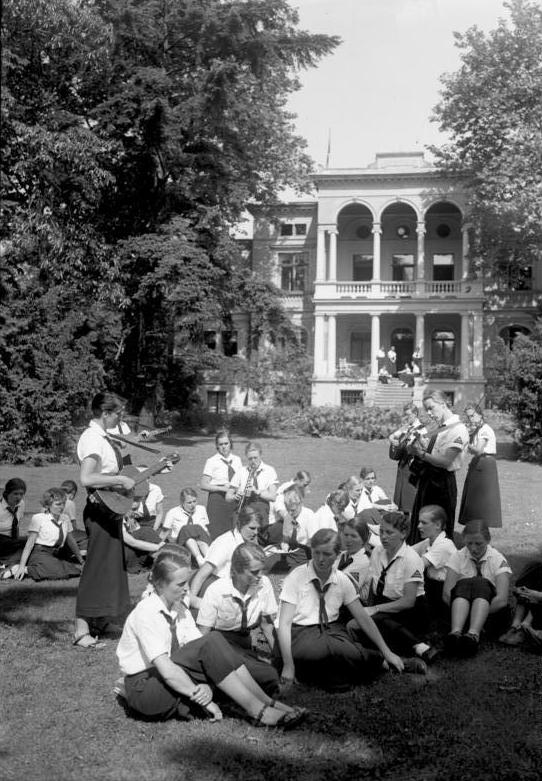
BDM leadership-school (Reichsführerinnenschule) trainees, Potsdam. Bundesarchiv, Bild 102-17036 / Georg Pahl, CC BY-SA 3.0 DE.
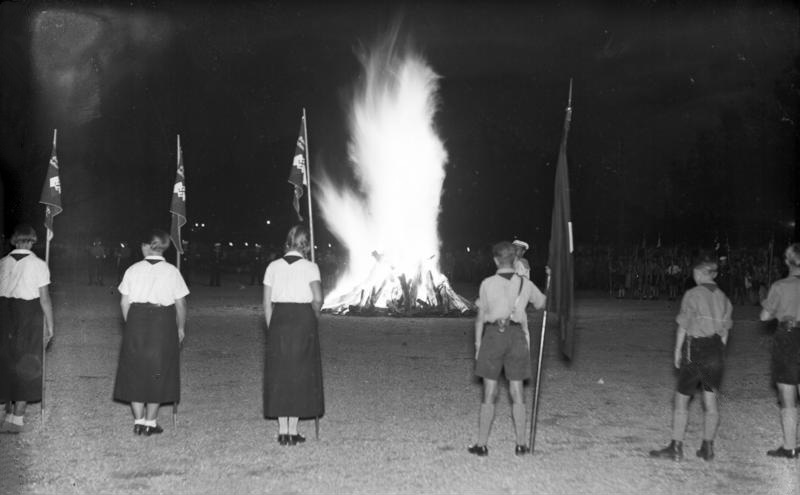
HJ and BDM members at a Sonnwendfeuer (summer-solstice bonfire), the kind of camp ritual photographed for the movement's wholesome public image. Bundesarchiv, Bild 133-068, CC BY-SA 3.0 DE.
Image gaps
- A Glaube und Schönheit activity photograph. No openly licensed Wikimedia Commons image specifically captioned for the 17-21 "Faith and Beauty" tier (as opposed to general BDM activities) was found; this tier is documented here from text sources only.
- Bundesarchiv Bild 183-J02938 (Berlin, Nähstube des BDM — a BDM sewing room, domestic-training imagery). Identified and licence-checked (CC BY-SA 3.0 DE, no restriction flag), but the download from Wikimedia Commons failed repeatedly from the build environment — fillable.
- Bundesarchiv Bild 146-1975-069-35 (Kriegsdienstpflicht, BdM bei Nachbarschaftshilfe — wartime compulsory-service neighbourhood-help image). Identified and licence-checked (CC BY-SA 3.0 DE, no restriction flag), but the download failed repeatedly from the build environment — fillable.
- Bundesarchiv Bild 101I-674-7757-18 (Flakhelferin am Horchgerät — a BDM-age girl operating anti-aircraft listening equipment). Identified and licence-checked (CC BY-SA 3.0 DE, no restriction flag), but the download failed repeatedly from the build environment — fillable.
- Bundesarchiv Bild 133-130 (Worms, Jungmädelbund, Werbung — a recruitment/advertising image for the 10-14 age tier). Identified and licence-checked (CC BY-SA 3.0 DE, no restriction flag), but the download failed repeatedly from the build environment — fillable.
- Bundesarchiv Bild 183-2000-0110-500 (BDM, Gymnastikvorführung — a gymnastics display, direct evidence of the fitness-for-motherhood messaging). Not included: Wikimedia Commons flags this file with a Nazi-symbols restriction template, and this archive's image rule rejects any file carrying a restriction flag.
- A page or cover of Das Deutsche Mädel, the BDM's own magazine. No openly licensed scan with a clear rights status was found.
Sources
- Reichsgesetzblatt 1936 I, p. 993, "Gesetz über die Hitler-Jugend" (Hitler Youth Law), 1 December 1936.
- Reichsgesetzblatt 1939 I, p. 710, first ordinance implementing the Hitler Youth Law (Jugenddienstpflicht), 25 March 1939.
- Reichsgesetzblatt 1935 I, pp. 1146, 1333, the Reich Citizenship Law and the Law for the Protection of German Blood and German Honour, 15 September 1935.
- Michael H. Kater, Hitler Youth, Harvard University Press, 2004.
- Dagmar Reese, Growing Up Female in Nazi Germany, University of Michigan Press, 2006 (English translation of Straff, aber nicht stramm — herb, aber nicht derb, 1989).
- Jill Stephenson, Women in Nazi Germany, Routledge/Pearson, 2001.
- Gisela Miller-Kipp (ed.), "Auch Du gehörst dem Führer": Die Geschichte der Hitler-Jugend und der Bund Deutscher Mädel in Quellen und Dokumenten, Juventa, 2001.
- U.S. Holocaust Memorial Museum, Holocaust Encyclopedia, entries on Nazi youth organisations and the Hitler Youth Law.
- Wikimedia Commons, Bundesarchiv Bild 133-067, 102-17036, 133-068 and related files (search: "Bund Deutscher Mädel", "BDM", "Jungmädel", Bundesarchiv collection), each page giving the CC BY-SA 3.0 DE licence and attribution used above.