Content note. This page quotes a government's own justification for suspending constitutional rights and for mass arrests carried out under it, and describes the intimidation of elected legislators inside the chamber where they voted. The quotations are evidence of the method, not an endorsement of it.
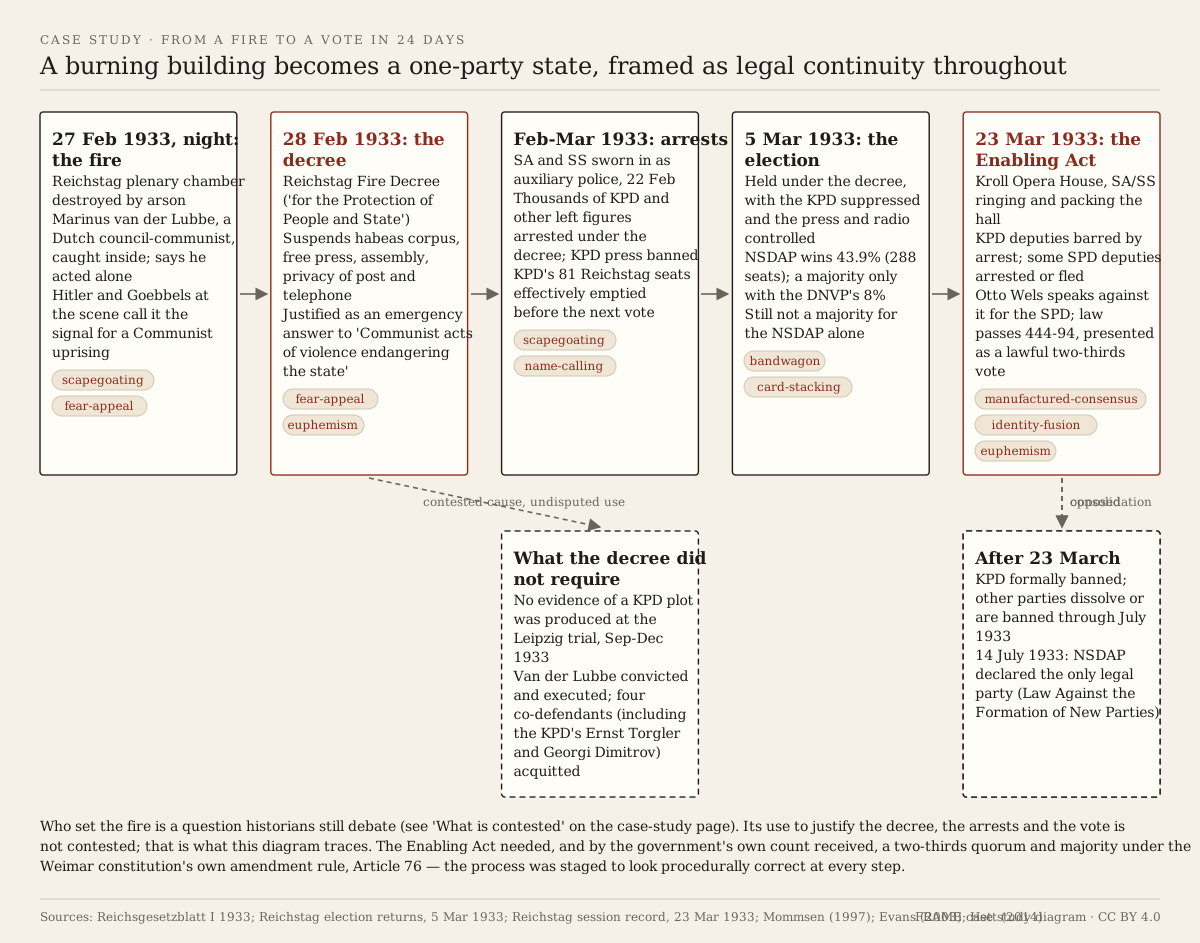
In one line: In 24 days a fire in an empty parliament building was turned, through an emergency decree, mass arrests, an election and a stage-managed floor vote, into the legal transfer of the Reichstag's own lawmaking power to Hitler's cabinet — with every step presented to the public as constitutional and orderly.
What happened
- 27 February 1933, night. Fire destroys the Reichstag's plenary chamber. Firefighters find and arrest Marinus van der Lubbe, a 24-year-old Dutch council-communist, inside the building; he says repeatedly, then and at trial, that he acted alone, as a protest against the condition of the German working class. Hermann Göring, at the scene as Prussian interior minister, and Hitler, who arrived soon after, immediately call it the start of a Communist uprising. Goebbels's diary that night records Hitler saying it is "a sign from heaven."
- 28 February 1933. Reich President Paul von Hindenburg signs the "Verordnung des Reichspräsidenten zum Schutz von Volk und Staat" (Decree of the Reich President for the Protection of People and State), drafted overnight by the interior ministry and cabinet and issued under Article 48 of the Weimar constitution, which allowed emergency decrees. Its preamble states it is issued "as a defensive measure against Communist acts of violence endangering the state." It suspends, "until further notice," the constitutional guarantees of personal liberty, free expression of opinion, freedom of the press, the right of assembly and association, the privacy of post, telegraph and telephone communications, and protections against home searches, and against limits on property. A second clause lets the Reich government take over the powers of a state government, which is later used against Prussia's SPD-led administration.
- 28 February - early March 1933. Prussian police, backed from 22 February by tens of thousands of SA, SS and Stahlhelm men sworn in as auxiliary police, arrest KPD and other left-wing officials, editors and deputies under the decree's suspension of habeas corpus. Historians' counts for the first days and weeks vary by source and region; Richard Evans cites about 10,000 arrests in Prussia alone in the first weeks, and other regional counts run higher over the following months. The KPD's newspapers are banned outright; SPD papers are banned for varying periods. The party is not yet formally outlawed, but its 81 Reichstag seats from the November 1932 election are, in practice, emptied by arrest or flight.
- 5 March 1933. The already-scheduled Reichstag election goes ahead under the decree, with the KPD suppressed, SPD meetings broken up by police and SA violence, and radio and much of the press under government influence. The NSDAP wins 43.9% (288 of 647 seats) — its best result yet, but still not a majority on its own. With its coalition partner the DNVP's 8%, the government has a bare majority; a two-thirds majority, needed for constitutional change, requires more.
- 9-23 March 1933. The government excludes the KPD's elected deputies from the incoming Reichstag by decree and arrest rather than by a formal ban (the party is banned outright only from 31 March). Some SPD deputies are also arrested in these weeks or go into hiding; the surviving SPD caucus of 120 votes as a bloc. The chamber itself, damaged by the fire, is replaced for this and subsequent sessions by the Kroll Opera House across the Königsplatz.
- 23 March 1933. The Reichstag meets at the Kroll Opera House to vote on the "Gesetz zur Behebung der Not von Volk und Reich" (Law to Remedy the Distress of People and Reich), known as the Enabling Act. SA and SS men line the approach and stand inside and around the hall; deputies and observers describe a hostile, jeering crowd of brownshirts chanting outside as SPD members arrived. The act would let the cabinet enact laws, including ones departing from the constitution, without the Reichstag or the president's countersignature, for four years. Reaching the two-thirds majority the constitution's own Article 76 required for such a change depended on the KPD's 81 seats being absent from the total counted, a procedural move the Reichstag's presidium agreed to that day.
- 23 March 1933, the vote. Otto Wels, SPD chairman, is the only party leader to speak against the bill, in a speech interrupted by jeers. Contemporary and later published versions of the speech, translated from the Reichstag's own shorthand record, include the line: "You can take our lives and our freedom, but you cannot take our honour" ("Freiheit und Leben kann man uns nehmen, die Ehre nicht"), and: "We German Social Democrats pledge ourselves solemnly to the principles of humanity and justice, of freedom and socialism. No enabling law can give you power to destroy ideas which are eternal and indestructible." Hitler replies from the podium with a personal attack on Wels and the SPD. The Centre Party votes yes after Hitler gives its leader, Ludwig Kaas, a written assurance (not honoured) about the president's continuing role. Every party present except the SPD votes yes; the result is 444 to 94, with the KPD's seats not counted toward the total at all. The act is published the next day and is renewed twice before Hitler dispenses with the formality after 1937.
- March-July 1933. Using the Enabling Act, the government dissolves trade unions (2 May), bans the SPD (22 June) and pressures the remaining parties, including its own coalition partner, into dissolving themselves; the Centre Party dissolves on 5 July. The "Law Against the Formation of New Parties" of 14 July 1933 makes the NSDAP the only legal party in Germany. Each step is enacted by decree under the Enabling Act's own procedure and published in the Reichsgesetzblatt like ordinary law.
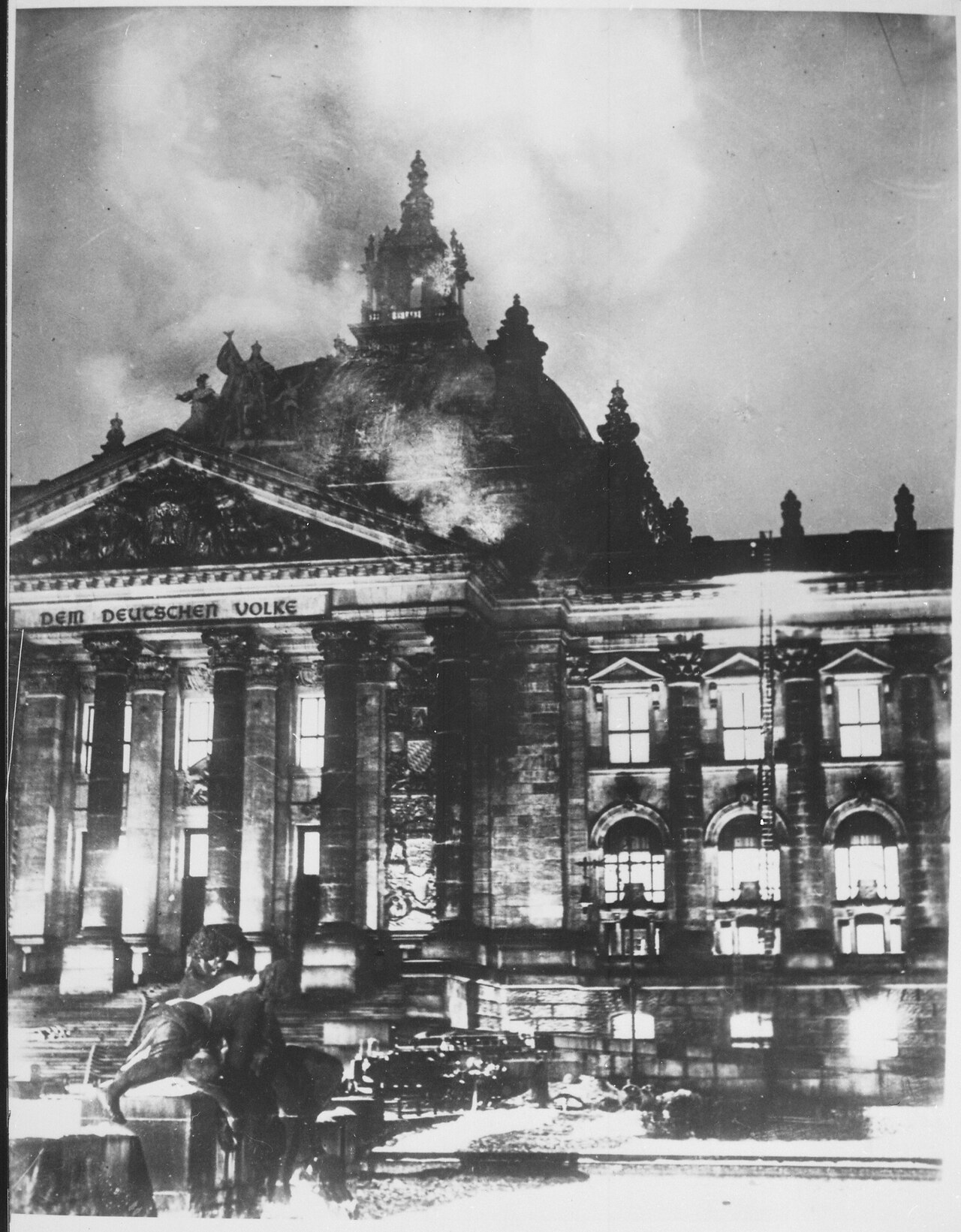
Firefighters at the burning Reichstag, February 1933. Photo credited to Acme, distributed via the wartime US Office of War Information and now held by the U.S. National Archives (NARA, Record Group 208, NAID 535790), public domain as a US federal government work. The original 1940s caption's own framing is quoted in the image title; it reflects how the event was already being described by 1933's contemporaries and by wartime American information services, not a claim this page verifies independently — see "What is contested" below.
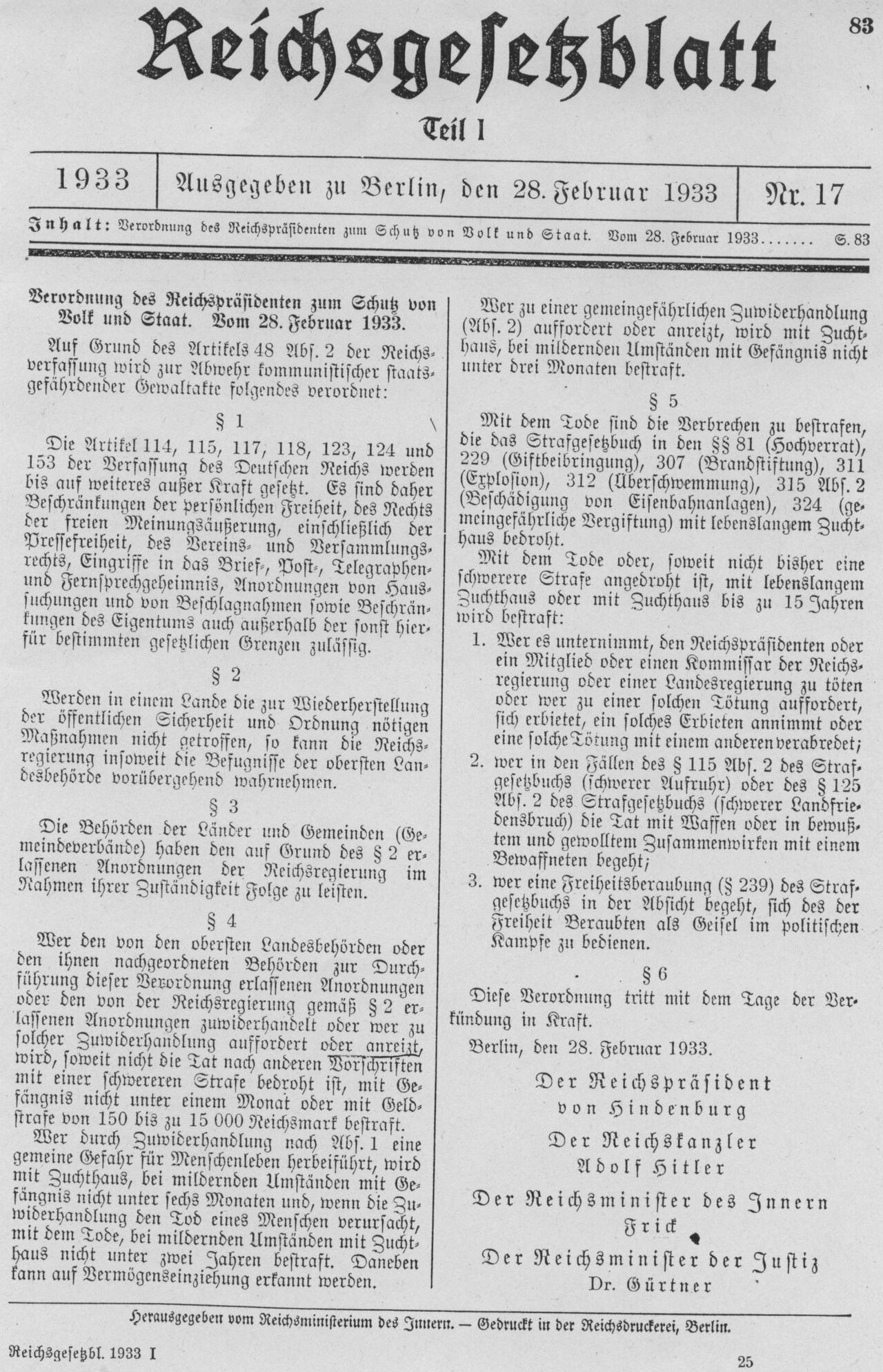
The Reichstag Fire Decree as published in the Reichsgesetzblatt (Reich Law Gazette) I 1933, p. 83. Scan by Wikimedia contributor Erzer; public domain under German copyright law (§ 5(1) UrhG) as an official government enactment.
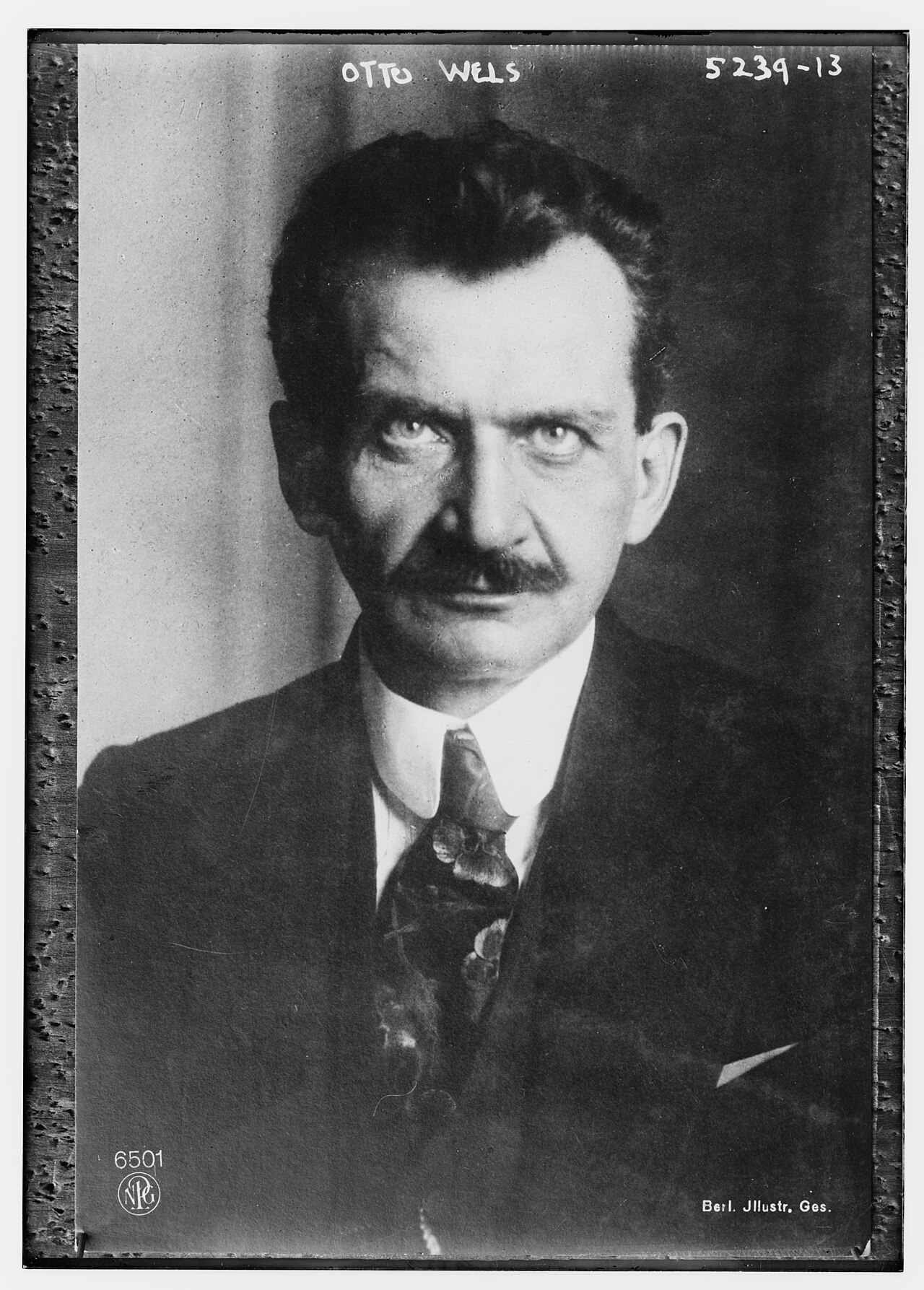
Otto Wels, chairman of the Social Democratic Party, photographed in 1915 — not from 1933, but the clearest openly licensed portrait available; see "Image gaps" below. Library of Congress, George Grantham Bain Collection (LCCN 2014710959); no known restrictions on publication.
How it works
- Scapegoating: within hours of a fire whose cause was still unknown, the government named a diffuse political enemy, "Communism," as its author, and the decree's preamble recites "Communist acts of violence endangering the state" as the justification for suspending rights for the whole population. The claim of an imminent KPD-led uprising was never supported by evidence produced at the Leipzig trial that followed (see "What is contested").
- Fear appeal: the decree and the surrounding press campaign offered one remedy, emergency powers and mass arrest, against an unquantified, undated threat ("Communist acts of violence"), with no comparison to the actual scale of KPD capability in early 1933 and no sunset date beyond "until further notice."
- Card stacking: the 5 March election and the 23 March vote count were each presented as an ordinary majority result. What the public tally left out: the election was fought with the KPD's press banned and its meetings broken up, and the two-thirds majority on 23 March was reached only because the KPD's 81 seats, and some SPD seats emptied by arrest, were excluded from the base the fraction was calculated against.
- Manufactured consensus: a 444-94 vote, with every party but the SPD in favour, was presented as the Reichstag's considered judgment. It was produced by first removing the KPD's deputies from the chamber, then surrounding the remaining deputies with SA and SS men inside and outside the hall, and then extracting a public assurance from the Centre Party's leader in exchange for its votes.
- Identity fusion: Hitler's reply to Wels recast the SPD's specific, documented objection (a defence of constitutional and civil-liberties principle, stated on the floor) as disloyalty to the nation's recovery; voting no was framed as standing with Germany's danger rather than with its remedy, which is why every other party, including ones that had opposed the NSDAP for years, voted yes.
- Bandwagon: the government's own account, before and after 23 March, presented the scale of arrests, the SA's numbers in the street, and the near-unanimous vote itself as proof that the nation stood behind the measure, collapsing a result manufactured by exclusion and intimidation into a display of popular will.
- Euphemism / doublespeak: the Enabling Act's official name, "Law to Remedy the Distress of People and Reich," described a transfer of the legislature's own lawmaking power to the cabinet as economic and administrative relief; the decree's "until further notice" softened an open-ended suspension of habeas corpus, press freedom and the privacy of communications into a temporary administrative pause.
- Name-calling: KPD officials and, more broadly, the political left were labelled with the undifferentiated term "Communist" in the decree and the following press campaign, a category that did the work of an accusation without a charge naming any specific person's specific act.
Then and now
The same shape, a violent or disruptive event used within hours to justify emergency powers against a named political enemy, recurs across systems that otherwise share nothing else. In the United States, the federal response to 11 September 2001 produced the USA PATRIOT Act (signed 26 October 2001, 45 days after the attacks, not 24), expanding surveillance and detention powers that Congress itself revisited and narrowed in 2015 (the USA FREEDOM Act) — a legislature that kept sitting, an opposition that kept voting no, and courts that reviewed the government's detention powers in cases such as Hamdi v. Rumsfeld (2004) and Boumediene v. Bush (2008).
The differences are large and should not be collapsed. The September 2001 attacks were unambiguously carried out by a named organisation, al-Qaeda, which publicly claimed responsibility; no comparable evidence tied the KPD to the Reichstag fire. The PATRIOT Act passed a Congress in which every party remained legal, contested elections continued on schedule, and the law was subject to sunset clauses, court challenge and later amendment. The Enabling Act abolished the Reichstag's own power to check the executive for four years, was followed within four months by the bans and forced dissolutions of every other party, and was never subjected to a free vote again. Same technique, Fear appeal and emergency power following a shock event named to a target, at a wholly different order of consequence and with wholly different institutional guardrails in place.
Positions on the record
- The government's position, February-March 1933. The decree's own preamble states it as "a defensive measure against Communist acts of violence endangering the state." Hitler's Reichstag speech introducing the Enabling Act on 23 March framed it as the necessary instrument for national recovery and presented the SPD's coming "no" vote as obstruction of that recovery.
- The counter-position on the record, 23 March 1933. Otto Wels's floor speech for the SPD is the last public opposition speech in the Reichstag before the one-party state: "Freiheit und Leben kann man uns nehmen, die Ehre nicht" ("You can take our lives and our freedom, but not our honour"), and his statement that Social Democracy pledged itself to "the principles of humanity and justice, of freedom and socialism," which "no enabling law can give you power to destroy."
- What is documented. The texts and dates of the decree, the arrest campaign and its use of the decree's suspension of habeas corpus, the 5 March election results, the exclusion of the KPD's seats from the 23 March count, the presence of SA and SS men in and around the Kroll Opera House, the Centre Party's written assurance from Hitler, the 444-94 vote, and the string of bans and forced dissolutions that followed through 14 July 1933.
- What is contested. Who set the Reichstag fire. Van der Lubbe was convicted and executed (10 January 1934) after confessing and maintaining throughout that he acted alone; his four KPD and Comintern co-defendants, including Ernst Torgler and Georgi Dimitrov, were acquitted at the Leipzig trial for lack of evidence of a wider plot. A minority position, associated with the wartime "Brown Book" published by Communist and exile circles and later argued by some historians (notably Fritz Tobias's 1962 investigative journalism, and challenged in turn by others), holds that the SA itself set the fire as a pretext, van der Lubbe's role notwithstanding. Benjamin Carter Hett's Burning the Reichstag (2014) reopened the question with new archival and forensic evidence and leans toward SA involvement being plausible, without treating it as settled; Hans Mommsen's earlier research (1964, revised 2001) and most postwar West German historiography concluded van der Lubbe most likely acted alone. FRAME does not resolve this question here. What is not contested is that the government publicly attributed the fire to a KPD conspiracy within hours, before any investigation could have established a cause, and used that attribution, regardless of who set the fire, to justify the decree and the arrests that followed it.
- Not ruled on here. Whether the underlying Weimar-era political conflict between the NSDAP, the KPD and the SPD made some version of confrontation likely regardless of the fire; the political and economic arguments of 1930-33 Germany generally. This page scores how the fire was framed and used, not who was right about Weimar's crisis.
Same-method test
The same tag, Fear appeal and emergency power following a shock event attributed to a named political enemy, applies with very different institutional outcomes to India's Emergency: 'India is Indira' and the censored press, where Indira Gandhi's government declared a state of emergency in June 1975 citing internal disturbance, suspended civil liberties and jailed opposition leaders and press critics for 21 months — until the government itself called an election in 1977, lost it, and the Emergency ended by ballot rather than by force. It also applies, at a far smaller scale and with the system's checks intact, to the United States' own post-9/11 legislation described above. In each case a real or claimed emergency was used to justify a suspension of ordinary constraints on power; the outcome depended entirely on whether independent courts, a free press, competitive elections and other parties survived the emergency to check it afterward. In Germany after 23 March 1933 none of them did.
How to spot it
- Ask how soon the blame arrived, and how much investigation it could have rested on. A named political enemy identified within hours of an unexplained event, before evidence is gathered, is a claim about politics, not yet a finding of fact.
- Check what the emergency measure actually removes, and for how long. "Until further notice" or an act with no fixed term is a different thing from a dated, reviewable state of emergency.
- Look at who counts the votes and who is missing from the room. A large majority produced by first removing the opposition's seats from the total, or by policing the chamber itself, is not the same fact as a large majority freely reached.
- Watch for a "no" vote being recast as disloyalty to the emergency response rather than disagreement about the remedy; that reframing is the tell of Identity fusion.
- Ask what checked the power afterward: an election the government could lose, a court that could rule against it, a press that could still report, other parties that stayed legal. Their survival, or their disappearance within months, is the difference between an emergency and a seizure of power.
Images
| Image | Source | Licence |
|---|---|---|
| Mechanism diagram (above) | Drawn for FRAME from the sources below (make_diagrams_rtp_reichstag.py) |
CC BY 4.0, FRAME |
| Firefighters at the burning Reichstag, February 1933 | Wikimedia Commons, U.S. National Archives (NARA, RG 208, NAID 535790), photo credited to Acme, distributed by the wartime U.S. Office of War Information | Public domain (U.S. federal government work) |
| Reichstag Fire Decree, Reichsgesetzblatt I 1933, p. 83 | Wikimedia Commons, scan by Wikimedia contributor Erzer | Public domain under German copyright law (§ 5(1) UrhG), official enactment |
| Otto Wels, 1915 | Wikimedia Commons, Library of Congress, George Grantham Bain Collection, LCCN 2014710959 | Public domain, no known restrictions (published before 1931) |


Image gaps
- The Kroll Opera House session itself, 23 March 1933. Photographs of the chamber with SA men visible inside and outside are held by the German Bundesarchiv and widely reproduced, but Bundesarchiv images that are not already confirmed CC BY-SA 3.0 DE releases, and other German press-agency photographs of this date, carry unclear U.S. copyright status under the URAA restoration rule described in FRAME's other 1933-45 Germany case studies. Not hosted here pending a confirmed-licence source; cite and link instead: Bundesarchiv Bild-database search "Kroll-Oper 1933" and Heinrich Hoffmann Photo Archive holdings.
- A photograph of Otto Wels in 1933, or of him delivering the 23 March speech. No openly licensed 1933 photograph of Wels was found; the 1915 Bain News Service portrait above is used instead, with the date difference stated in its caption. Contemporary 1933 press photographs of Wels exist but carry the same unclear U.S. copyright status as other German press photographs of the period.
- Marinus van der Lubbe. Police and press photographs of van der Lubbe from 1933 (arrest and trial) are held by German and Dutch archives; none with a confirmed open licence was found from the environment used to build this page.
- The SA/SS auxiliary police sworn in from 22 February 1933, and street scenes of arrests in early March 1933. No openly licensed photographs found; most circulating images are Bundesarchiv or press-agency holdings with the same unclear U.S. status.
- The interior of the burned-out Reichstag plenary chamber. Widely reproduced photographs exist (including in the Commons category "Reichstag fire") but with mixed and, for several files, explicitly unclear licensing; the NARA/OWI exterior photograph used above was the clearest confirmed-public-domain option located.
Sources
- "Verordnung des Reichspräsidenten zum Schutz von Volk und Staat," 28 February 1933, Reichsgesetzblatt I 1933, p. 83: scan via Wikimedia Commons; English translation and discussion in Jeremy Noakes and Geoffrey Pridham, eds., Nazism 1919-1945, Volume 1: The Rise to Power (University of Exeter Press, 1983).
- "Gesetz zur Behebung der Not von Volk und Reich" (Enabling Act), 24 March 1933, Reichsgesetzblatt I 1933, p. 141.
- Reichstag session record (stenographic protocol), 23 March 1933, including Otto Wels's speech and Hitler's reply: German text and widely cited English translation via the German Bundestag's own historical materials and the German History in Documents and Images (GHDI) project, germanhistorydocs.org.
- Reichstag election results, 5 March 1933: figures as compiled in Richard J. Evans, The Coming of the Third Reich (Penguin, 2003), and standard German electoral-history references (Statistisches Reichsamt).
- Fritz Tobias, Der Reichstagsbrand: Legende und Wirklichkeit (Grote, 1962; English translation The Reichstag Fire, Putnam, 1964).
- Hans Mommsen, "The Reichstag Fire and Its Political Consequences," in From Weimar to Auschwitz (Princeton University Press, 1991; German original 1964, revised 2001).
- Benjamin Carter Hett, Burning the Reichstag: An Investigation into the Third Reich's Enduring Mystery (Oxford University Press, 2014).
- Richard J. Evans, The Coming of the Third Reich (Allen Lane / Penguin, 2003), chapters on the fire, the decree, the March 1933 election and the Enabling Act.
- Ian Kershaw, Hitler: 1889-1936 Hubris (W. W. Norton, 1998), chapters 13-14.
- Karl Dietrich Bracher, Die Auflösung der Weimarer Republik (Ring-Verlag, 1955; English-language treatment in Bracher, The German Dictatorship, Praeger, 1970).
- William L. Shirer, The Rise and Fall of the Third Reich (Simon & Schuster, 1960), for the widely quoted English rendering of Wels's floor speech, cross-checked here against the Reichstag's own stenographic record via GHDI.
- Peter Longerich, Goebbels: A Biography (Random House, 2015), for Goebbels's diary entry on the night of the fire.
- International Military Tribunal, Nuremberg, trial record (1945-46), for postwar testimony touching on the fire's origin, including affidavits discussed in Hett (2014).
- U.S. National Archives and Records Administration, Record Group 208 (Office of War Information), photograph NAID 535790, via Wikimedia Commons.
- Library of Congress, George Grantham Bain Collection, LCCN 2014710959 (Otto Wels), via Wikimedia Commons.
- For the same-method test: Government of India, Emergency proclamation, 25-26 June 1975, and Shah Commission of Inquiry reports (1978); USA PATRIOT Act, Pub. L. 107-56 (26 October 2001); USA FREEDOM Act, Pub. L. 114-23 (2015); Hamdi v. Rumsfeld, 542 U.S. 507 (2004); Boumediene v. Bush, 553 U.S. 723 (2008).