Content note. This page quotes slurs used against Rohingya and other Muslims in Myanmar ("kalar", "Bengali" used as a label of foreignness) and a post comparing them to Jews under Hitler. One photograph shows the bodies of Hindu villagers at a mass grave. The words are quoted as evidence of the method.
In one line: for six years, a state label that recast the Rohingya as foreigners, monks' sermons warning that Buddhists would be "swallowed", and a covert military operation that ran hate content through celebrity and news pages on Facebook prepared a Buddhist majority to see a Muslim minority as an invading threat, before the 2017 military operations that drove more than 700,000 Rohingya into Bangladesh.
What happened
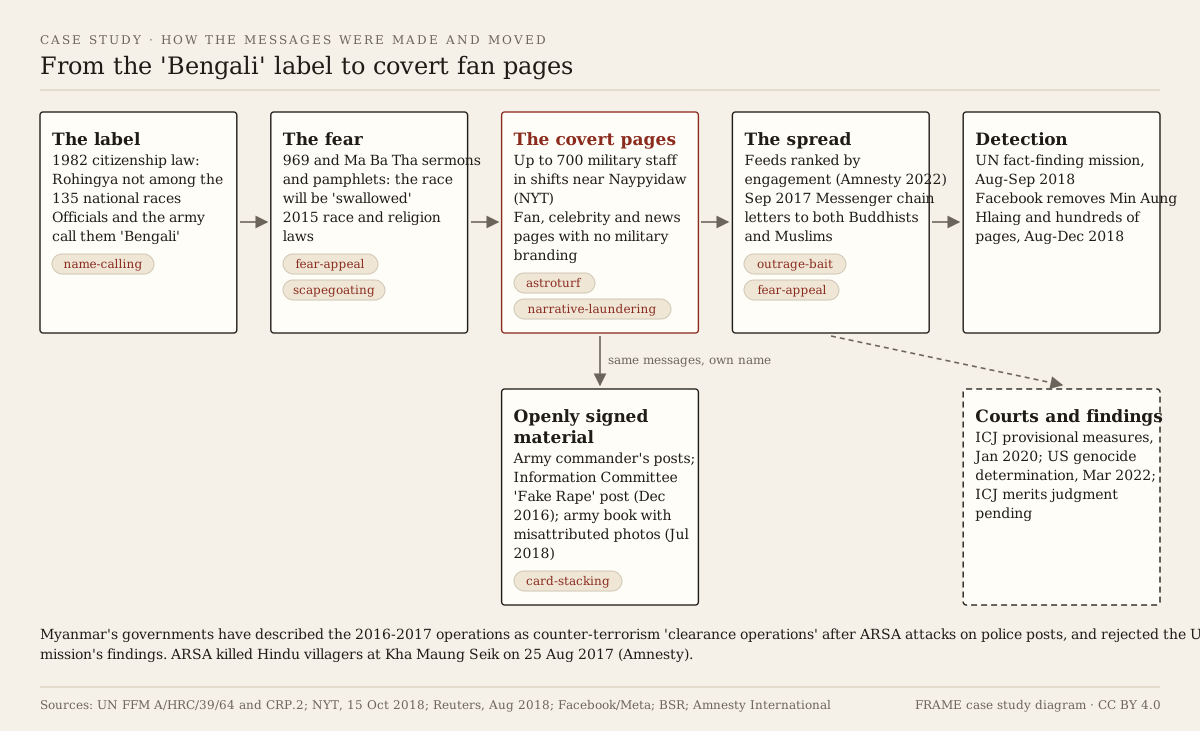
- 1982. Myanmar's Citizenship Law bases full citizenship mainly on membership of the "national races" held to have settled before 1824. The Rohingya are not on the later official list of 135 national races. Officials, the army and much of the press call them "Bengali", meaning migrants from Bangladesh. The Rohingya reject the term.
- June and October 2012. After the rape and murder of a Rakhine Buddhist woman in late May, attributed to Muslim men, a mob kills ten Muslim bus passengers at Toungup. Violence between Rakhine Buddhists and Rohingya spreads. By the end of the year more than 140,000 people, most of them Rohingya, are displaced into camps. In July 2012 President Thein Sein tells UNHCR's chief that the Rohingya should be placed in camps or resettled in a third country.
- 2012-2013. The 969 movement. Ashin Wirathu, a Mandalay monk jailed in 2003 for inciting anti-Muslim violence and released in a 2012 amnesty, tours the country urging Buddhists to buy only from Buddhists and marry only Buddhists. He tells Time in 2013: "You can be full of kindness and love, but you cannot sleep next to a mad dog." Nationalist sermons and pamphlets, some circulating since the 1980s, describe Muslims as seeking to "swallow" Myanmar's race and religion (Foxeus, 2022). The Ministry of Immigration and Population's motto reads: "The earth will not swallow a race to extinction but another race will" (Human Rights Watch, 2020).
- June 2013. Ma Ba Tha. Monks form the Committee for the Protection of Race and Religion, known as Ma Ba Tha, with the stated aim of defending Buddhism against Islamisation. It drafts four "race and religion" laws covering birth spacing, religious conversion, the marriage of Buddhist women to non-Buddhist men, and monogamy. President Thein Sein signs them between May and August 2015, before the November election. In January 2015 Wirathu publicly calls the UN human-rights rapporteur Yanghee Lee a "whore" after she criticises the draft laws.
- 2014. The census does not let respondents record themselves as Rohingya. In July, Wirathu shares on Facebook an accusation that two Muslim teashop owners in Mandalay raped a Buddhist employee. Riots follow; one Buddhist and one Muslim are killed, a curfew is imposed and Facebook access is briefly restricted. The complaint is later found to have been fabricated.
- 9 October 2016. A new Rohingya armed group, later known as the Arakan Rohingya Salvation Army (ARSA), attacks border police posts and kills nine officers. The army responds with "clearance operations" in northern Rakhine State.
- 26 December 2016. The State Counsellor's Information Committee, the office of Aung San Suu Kyi, answers reports of rape by soldiers with a post headed by an image reading "Fake Rape". It says an investigation commission interviewed two women whose accounts conflicted.
- 25 August 2017. ARSA attacks about 30 police posts and an army base; 12 security personnel are killed. The same day, ARSA fighters kill Hindu villagers at Kha Maung Seik; Amnesty International puts the toll at up to 99, including 23 children at Ah Nauk Kha Maung Seik. The army launches clearance operations across northern Rakhine. MSF surveys estimate that at least 6,700 Rohingya died violently between 25 August and 24 September, including at least 730 children under five. The UN fact-finding mission later calls an estimate of 10,000 deaths conservative. More than 700,000 Rohingya flee to Bangladesh.
- 1 September 2017. Commander-in-chief Min Aung Hlaing posts on Facebook that "the Bengali problem was a long-standing one which has become an unfinished job". The UN mission later cites the statement in its assessment of intent.
- September 2017. The chain letters. Chain messages on Facebook Messenger warn Buddhists that Muslims will attack on 11 September, and warn Muslims that Buddhist nationalists will attack them on the same day. Myanmar civil-society groups write in April 2018 that the messages spread nationwide and caused widespread fear and at least three violent incidents, and that it took days to get Facebook to act. The New York Times later reports that the military's intelligence arm was behind this campaign and that its aim was to make both communities feel they needed military protection.
- 2013-2018. The covert pages. According to the Times (Paul Mozur, 15 October 2018), as many as 700 military personnel worked in shifts at bases near Naypyidaw. They built pages about pop stars, models and national heroes to gather followers, then used those pages and troll accounts to post anti-Rohingya content, false stories and inflammatory comments.
- March-August 2018. UN mission chair Marzuki Darusman says social media had a "determining role" in Myanmar. Facebook bans Wirathu's account in January 2018 and designates Ma Ba Tha and two other monks as hate figures and organisations in mid-2018. On 15 August Reuters' "Hatebook" investigation, which also finds that Facebook had two Burmese-speaking reviewers in early 2015, reports more than 1,000 anti-Rohingya posts still on the platform, including "We must fight them the way Hitler did the Jews, damn kalars!" Facebook says it has been "too slow to prevent misinformation and hate".
- 27 August 2018. Facebook removes 18 accounts, one Instagram account and 52 pages followed by almost 12 million people, including Min Aung Hlaing and the military's Myawady television network, citing the UN mission. It says part of the network used seemingly independent news and opinion pages to covertly push the military's messages.
- July-August 2018. The army's book. The military's Department of Public Relations and Psychological Warfare publishes Myanmar Politics and the Tatmadaw: Part I, which calls the Rohingya "Bengalis". Reuters examines eight photos presented as historical and finds three misattributed: one captioned as Buddhists killed by "Bengalis" in the 1940s came from Bangladesh's 1971 war, one showed Rwandan refugees in Tanzania in 1996, and one captioned as Bengalis entering Myanmar showed people leaving it.
- September 2018. The UN Independent International Fact-Finding Mission (A/HRC/39/64, with the detailed A/HRC/39/CRP.2) calls for Min Aung Hlaing and five other generals to be investigated and prosecuted for genocide in northern Rakhine, and for crimes against humanity and war crimes. Its hate-speech chapter finds that "Facebook has been a useful instrument for those seeking to spread hate, in a context where, for most users, Facebook is the Internet."
- October-December 2018. Facebook removes 13 pages and 10 accounts with 1.35 million followers (15 October), then 425 pages, 17 groups, 135 accounts and 15 Instagram accounts (18 December), all described as seemingly independent entertainment, beauty, news and lifestyle pages linked to the military. In November it publishes a BSR human-rights impact assessment and says: "we weren't doing enough to help prevent our platform from being used to foment division and incite offline violence."
- Afterwards. After the February 2021 coup, Facebook bans the military from its platforms. The junta drops sedition charges against Wirathu in September 2021 and gives him a state honour in January 2023. Amnesty's "The Social Atrocity" (September 2022), drawing on the Facebook Papers, finds that Facebook's engagement-based algorithms "proactively amplified and promoted" anti-Rohingya content.
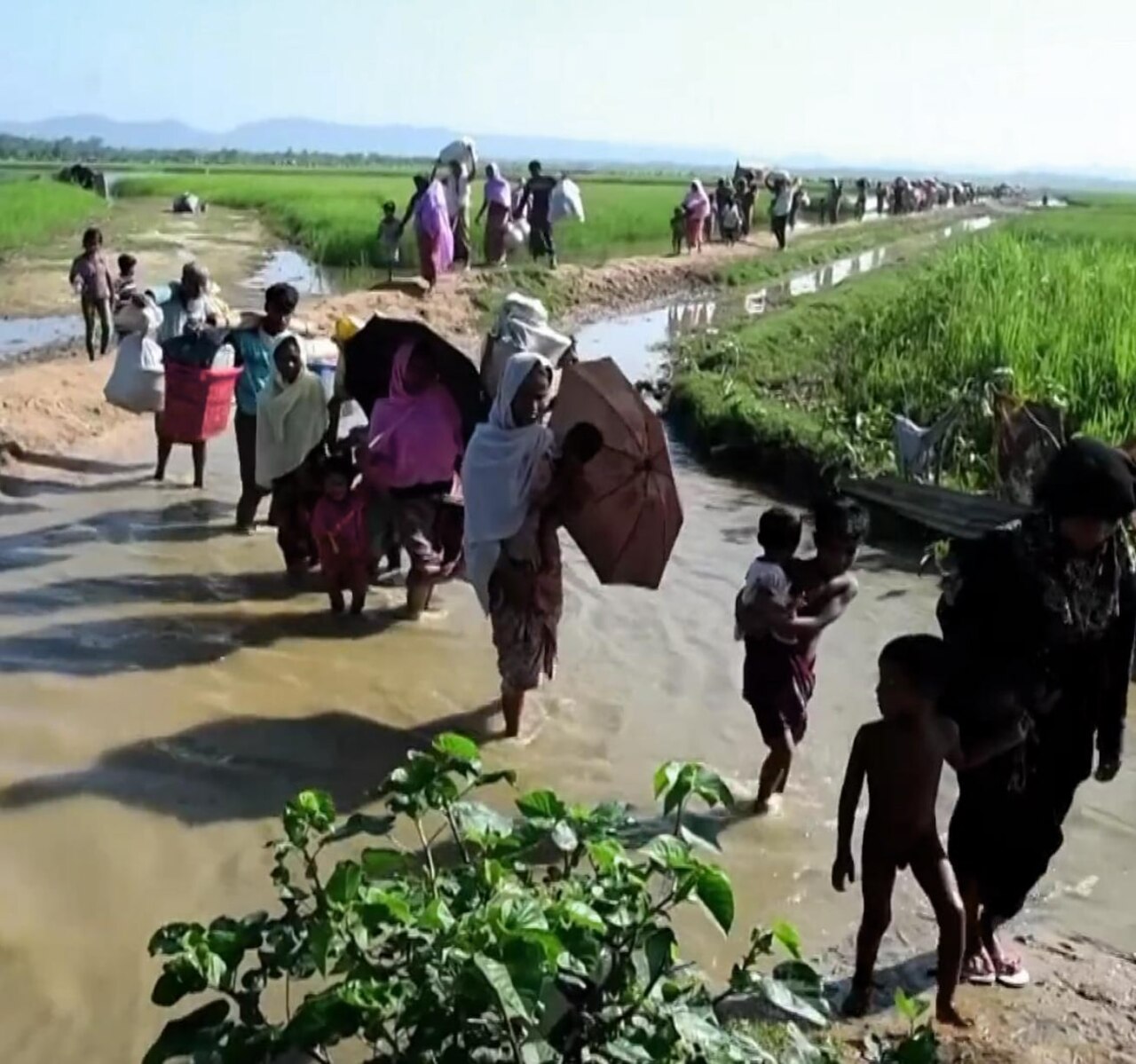
Rohingya refugees crossing paddy fields into Bangladesh, 2017. Still from a Voice of America video by Zlatica Hoke. Public domain (U.S. government work), via Wikimedia Commons. Shown because this is the exodus the messaging preceded.
How it works
- Name-calling: "Bengali" does the work of an argument about citizenship. Used by the army commander, the army's book and state media, it says the Rohingya are foreign before any evidence is weighed; Reuters notes the book uses it "to imply they are illegal immigrants". On Facebook the slur "kalar" marked the same people as outsiders.
- Fear appeal: the recurring message is imminent loss: the race will be "swallowed", Muslim men will take Buddhist women, a jihad will begin on 11 September. Each comes with one protector, whether Ma Ba Tha's laws, the monks or the army. The 2017 chain letters sent a matching warning to each community, and the Times reports the aim was to make both look to the military for protection.
- Scapegoating: Foxeus describes the 969 and Ma Ba Tha sermons as a moral panic that followed political and economic liberalisation after 2011. The boycott call, the Mandalay rape rumour and the Islamisation theme place a range of anxieties on one bounded group.
- Astroturfing: the celebrity and fan pages were not what they claimed to be. They were run by military personnel in shifts, and Facebook removed them for "coordinated inauthentic behaviour".
- Narrative laundering: military messages were routed through pages that looked like entertainment, beauty and news outlets, so readers did not see where the message came from. Facebook's own wording was "seemingly independent news and opinion Pages to covertly push the messages of the Myanmar military."
- Outrage bait: rape accusations, desecration stories and troll comments are the kind of item that draws angry engagement. Amnesty's 2022 analysis of Meta's internal documents finds that engagement-ranked feeds pushed such content further. The Mandalay rumour went from one Facebook page to a street riot within days.
- Card stacking: the army's 2018 book built a one-way history from selected photographs, three of which Reuters traced to other countries and wars. The Information Committee's "Fake Rape" post rested a general denial on two conflicting interviews.
Then and now
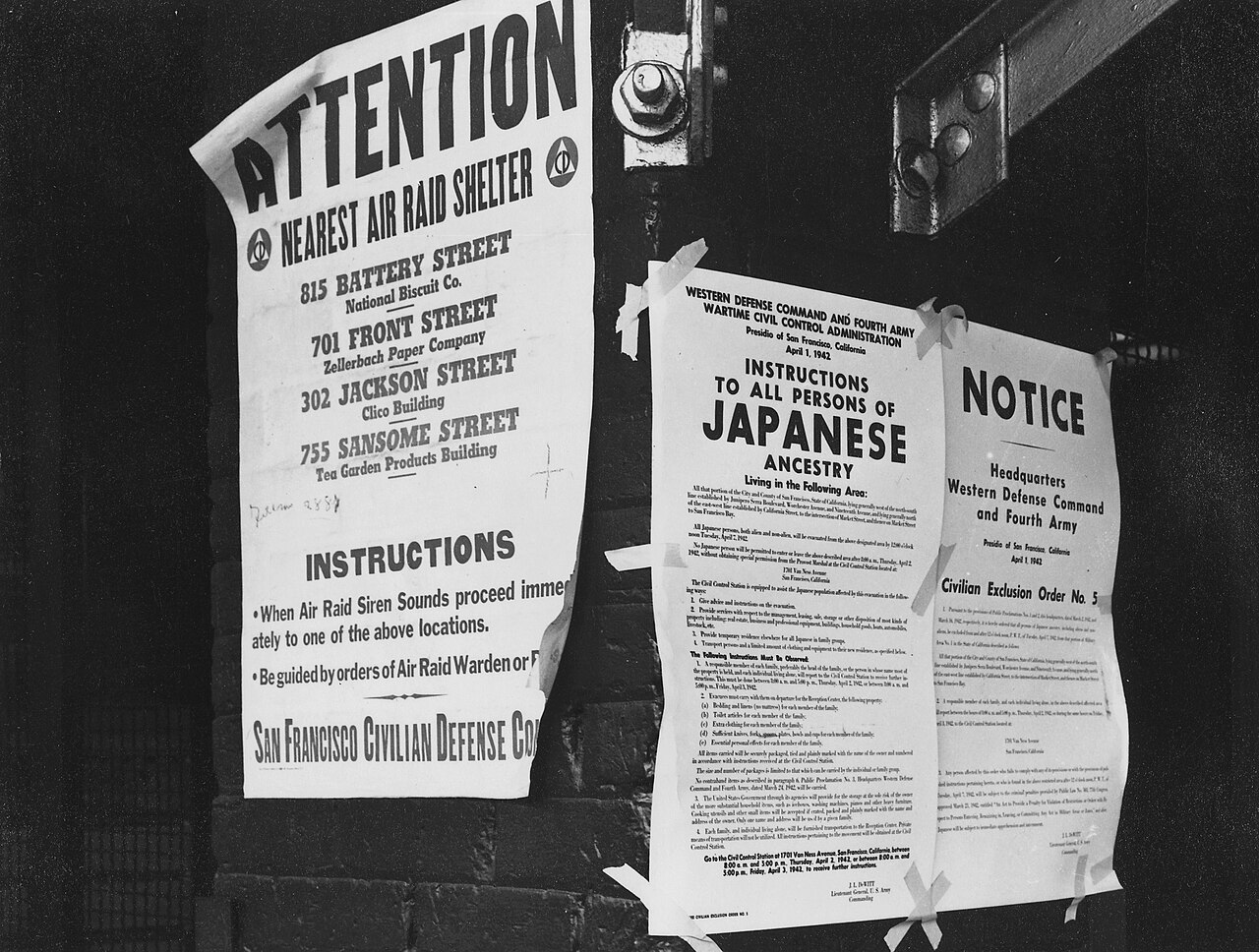
'Instructions to All Persons of Japanese Ancestry' (exclusion order posted in San Francisco), U.S. Army Western Defense Command, 1942. Photo by Dorothea Lange. Public domain.
The 1942 exclusion order addressed "all persons of Japanese ancestry, both alien and non-alien", so an official word blurred the line between citizen and foreigner for the people being removed. Myanmar's "Bengali" does something similar: an official label treats people born in Rakhine as migrants. The differences are plain. The U.S. order led to mass detention of about 120,000 people, and the U.S. later apologised and paid redress. The Myanmar campaign preceded mass killing and the flight of more than 700,000 people, and Myanmar's governments have not accepted the findings.
The closest method parallel is Kangura, Radio Rwanda and RTLM: Hutu Power propaganda before and during the genocide against the Tutsi, 1990-1994: an out-group recast as invaders, fear of their plans, and a mass medium that reached most households. In Rwanda the medium was a radio station owned by named people. In Myanmar much of it was a foreign-owned platform whose ranking system decided reach, and which removed the covert pages in 2018.
Content note: Aerial photograph of a burned village. This object is shown as it was published. Why 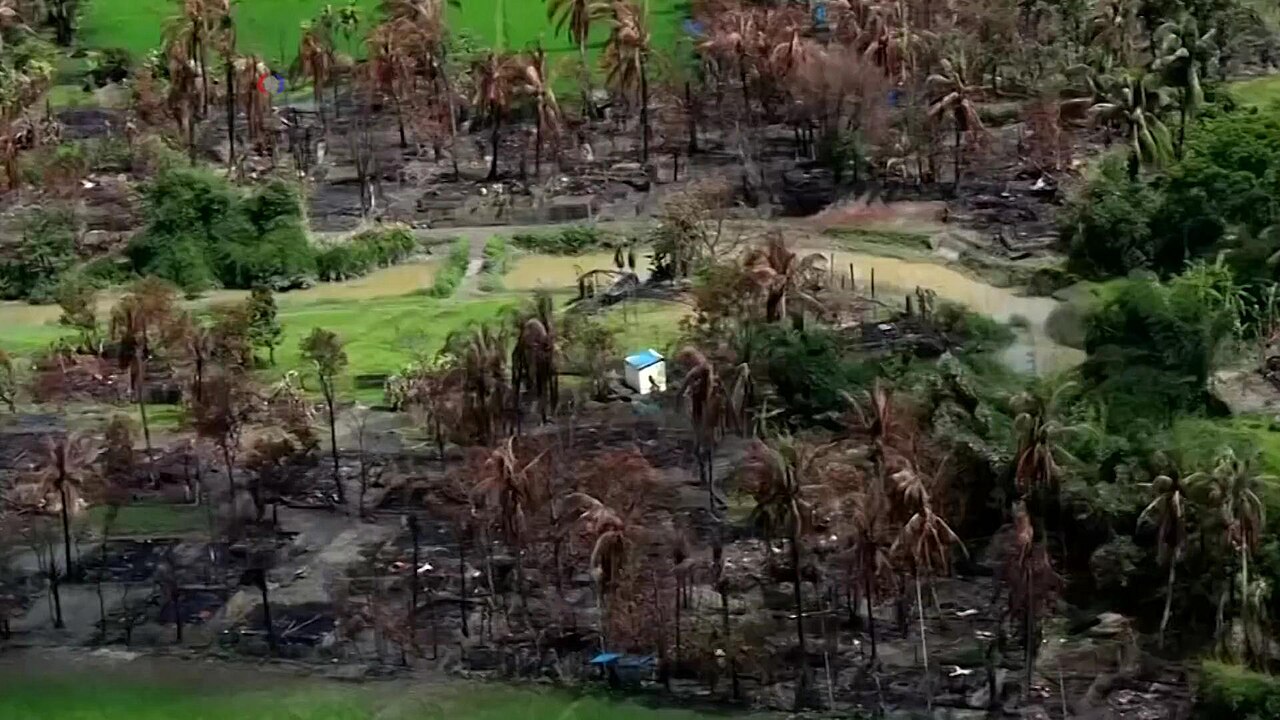
Aerial view of a burned Rohingya village in Rakhine State, September 2017. Still from a Voice of America video by Zlatica Hoke. Public domain (U.S. government work), via Wikimedia Commons.
Positions on the record
- Myanmar's governments, then and now. The civilian government and the army described the 2016 and 2017 operations as lawful counter-terrorism "clearance operations" after ARSA attacks. An army investigation team reported in November 2017 that it found no wrongdoing by its forces. In January 2018 the army admitted that soldiers killed ten Rohingya men at Inn Din; seven soldiers were sentenced and released early, and the two Reuters reporters who exposed the killings were jailed. In September 2017 Aung San Suu Kyi's office said global concern was fed by "a huge iceberg of misinformation". The government rejected the UN mission; spokesman Zaw Htay said, "We didn't allow the FFM to enter into Myanmar, that's why we don't agree and accept any resolutions."
- At the ICJ (December 2019). Aung San Suu Kyi called The Gambia's case "incomplete and misleading", said the operations answered an armed conflict started by ARSA, and said: "It cannot be ruled out that disproportionate force was used by members of the defence services in some cases," adding "genocidal intent cannot be the only hypothesis." She did not use the word Rohingya.
- ARSA. ARSA described its 2017 attacks as defensive and has denied killing Hindu villagers. Amnesty's evidence, including survivor testimony and the graves opened in September 2017, attributes the Kha Maung Seik killings to ARSA.
- What courts and official bodies have found. The UN mission found that genocidal intent could be inferred and named six generals. The ICJ ordered Myanmar, unanimously, to prevent genocidal acts and preserve evidence (23 January 2020), and rejected Myanmar's preliminary objections in July 2022. Merits hearings ran from 12 to 29 January 2026; as of this page's date the judgment is pending. The US State Department determined on 21 March 2022 that members of the military committed genocide and crimes against humanity.
- Facebook / Meta. Meta accepts that it did not do enough before 2018 and that it acted slowly. It told Amnesty it could not discuss the period before 2017 because of pending litigation. Amnesty reports that Meta has not provided a remedy to Rohingya survivors.
- Scale difference. ARSA's attacks killed 12 security personnel on 25 August 2017 and up to 99 Hindu villagers. The military operations that followed killed at least 6,700 Rohingya in one month by MSF's count, and drove out more than 700,000. The record does not support treating these as equivalent.
- Not shown. Facebook's public statements name the military as the operator of the covert pages but do not attribute the September 2017 chain letters; that attribution rests on the Times' sources. How far the pages changed any individual's actions is not measured in the sources.
Content note: Photograph at a mass-grave site. This object is shown as it was published. Why 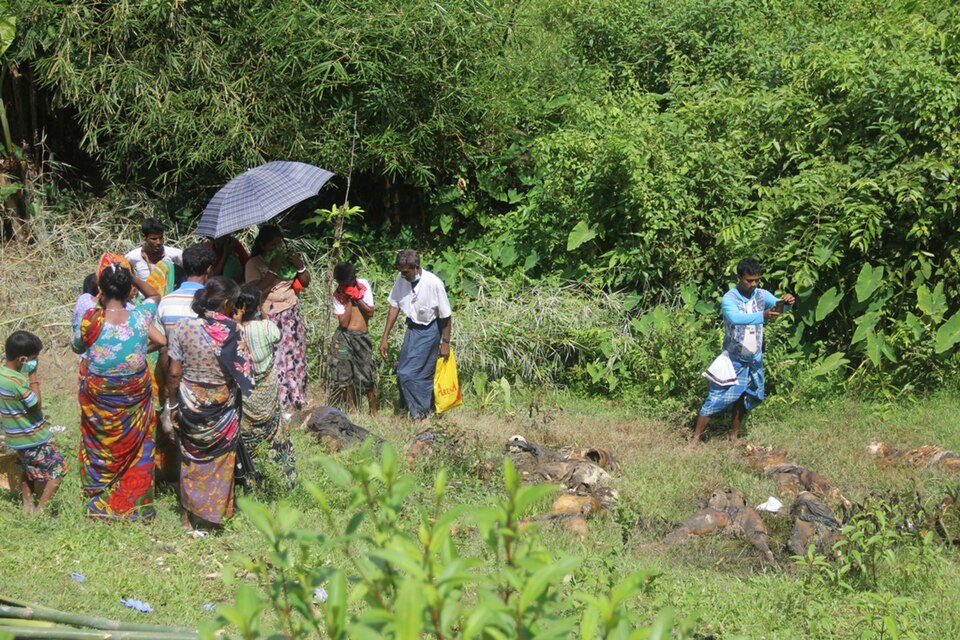
Hindu villagers in northern Rakhine State identify family members at a mass grave, 27 September 2017; Amnesty International attributes the killings of 25 August 2017 to ARSA. Photo by Moe Zaw and Sithu Naing, Voice of America. Public domain (U.S. government work), via Wikimedia Commons.
Same-method test
- Misattributed photos on the other side. On 29 August 2017 Turkey's deputy prime minister Mehmet Şimşek posted photos presented as new killings of Rohingya; one had been taken in Aceh, Indonesia, in 2003. He deleted the post and issued a correction. The method is the same one the army's book used, and would be scored the same way, though its reach and consequences were far smaller.
- Another country, same platform. In Sri Lanka in March 2018, rumours and hate posts on Facebook preceded anti-Muslim riots in which at least three people died. Facebook apologised in May 2020 after an Article One assessment found its content may have contributed to offline violence and that it had few Sinhala-language reviewers.
- A democracy's covert pages. Reuters reported in June 2024 that the U.S. military ran fake accounts posing as Filipinos under the hashtag #Chinaangvirus to discourage use of China's Sinovac vaccine in 2020-2021. Personas that are not who they claim to be would be tagged Astroturfing here whatever the flag or the cause.
How to spot it
- Check whether a page's label names a person's origin or a legal status that is actually disputed. A word that settles a disputed status for you ("Bengali" for people born in Rakhine) is doing work the evidence has not done.
- A fan page or news page that suddenly carries political warnings is worth checking: who runs it, when it was created, and whether its admins are in the country it claims.
- A forwarded warning that an attack is coming on a named date, from a sender you do not know, is a classic chain-letter format. Ask whether anyone independent has reported the threat before passing it on.
- Reverse-search a dramatic photo before sharing it. The army's book and a foreign minister's post both used pictures from other decades and countries.
Images
| Image | Source | Licence |
|---|---|---|
| Mechanism diagram (above) | Drawn for FRAME from the sources below (make_diagrams_atrocity.py) |
CC BY 4.0, FRAME |
| Rohingya refugees crossing into Bangladesh (2017) | Wikimedia Commons, Voice of America | Public domain (U.S. government work) |
| Aerial view of a burned Rohingya village (Sep 2017) | Wikimedia Commons, Voice of America | Public domain (U.S. government work) |
| Hindu villagers at the Kha Maung Seik grave (Sep 2017) | Wikimedia Commons, Voice of America | Public domain (U.S. government work) |
| Instructions to All Persons of Japanese Ancestry (1942) | FRAME gallery | Public domain (U.S. government work) |


Image gaps
- The covert Facebook pages and the chain letters. Not included: Facebook removed the pages, the screenshots published by the Times and Reuters are copyrighted, and the pages carry personal data. Not fillable from open sources.
- The army's book and the "Fake Rape" post. The book is a Myanmar government publication without an open licence, and Reuters' side-by-side comparisons are copyrighted. Could be filled only if an openly licensed scan appears.
- Wirathu, 969 stickers and Ma Ba Tha rallies. CC-licensed photos may exist on Wikimedia Commons, but Commons searches were rate-limited from the build environment and none could be checked. This gap can likely be filled.
Sources
- UN Independent International Fact-Finding Mission on Myanmar, report A/HRC/39/64 (Sept 2018)
- UN Fact-Finding Mission, detailed findings A/HRC/39/CRP.2 (18 Sept 2018)
- ICJ, The Gambia v. Myanmar, case page; order on provisional measures, 23 Jan 2020; conclusion of merits hearings, 29 Jan 2026
- Aung San Suu Kyi's ICJ statement, full transcript (Al Jazeera, 12 Dec 2019); UN News, 11 Dec 2019
- US State Department, Burma genocide determination (21 Mar 2022); Secretary Blinken's remarks
- Facebook, "Removing Myanmar Military Officials From Facebook" (27 Aug 2018, with October and December updates); Facebook, "Update on Myanmar" (15 Aug 2018); Facebook, "An Update on the Situation in Myanmar" (Feb 2021)
- BSR, Human Rights Impact Assessment: Facebook in Myanmar (Nov 2018); Facebook newsroom on the assessment
- Myanmar civil society organisations, open letter to Mark Zuckerberg (5 Apr 2018)
- Library of Congress, "Burma: Four Race and Religion Protection Laws Adopted" (14 Sept 2015)
- Burma Campaign UK, "Myanmar's 1982 Citizenship Law and Rohingya"
- Paul Mozur, "A Genocide Incited on Facebook, With Posts From Myanmar's Military", New York Times, 15 Oct 2018; Privacy International summary
- Steve Stecklow, "Hatebook", Reuters, 15 Aug 2018
- Reuters on the army's book, as republished by Malaysiakini (Aug 2018); BuzzFeed News summary
- CNBC, Facebook removals of 15 Oct 2018; Al Jazeera, removals of 18 Dec 2018
- Amnesty International, "The Social Atrocity: Meta and the right to remedy for the Rohingya" (Sept 2022); press release
- Amnesty International, ARSA massacre of Hindus (22 May 2018)
- MSF, "at least 6,700 Rohingya were killed" (Dec 2017)
- Human Rights Watch, "The Government Could Have Stopped This" (Aug 2012); HRW, "An Open Prison without End" (Oct 2020)
- Niklas Foxeus, "Buddhist Nationalist Sermons in Myanmar", Journal of Contemporary Asia (2022)
- Time, "The Face of Buddhist Terror" (2013); CNN on the Yanghee Lee remarks (22 Jan 2015); Time, Facebook removes Wirathu's page (2018); Bangkok Post, Facebook blacklists Ma Ba Tha (June 2018)
- Al Jazeera, Wirathu freed (7 Sept 2021); France 24, Wirathu honoured (3 Jan 2023)
- RFA, Mandalay riots (2 July 2014); Al Jazeera, "Rape used as a weapon in Myanmar to ignite fear" (2015)
- Genocide Watch, the Information Committee's "Fake Rape" post (Jan 2017)
- Opinio Juris, the fact-finding mission and Facebook, including Min Aung Hlaing's post (7 Sept 2018); Time, "determining role" (Mar 2018)
- Al Jazeera, ARSA explainer (13 Sept 2017); Al Jazeera, Myanmar rejects the UN findings (29 Aug 2018)
- The National, "iceberg of misinformation" (Sept 2017); France 24 Observers, misattributed Rohingya images (13 Sept 2017)
- IIMM, ICJ The Gambia v. Myanmar; The Business Standard, judgment expected (2026)
- Same-method test: Al Jazeera, Facebook apologises for Sri Lanka riots (13 May 2020); The Diplomat (May 2020); Military.com on the Reuters Pentagon report (14 June 2024); Al Jazeera (14 June 2024)