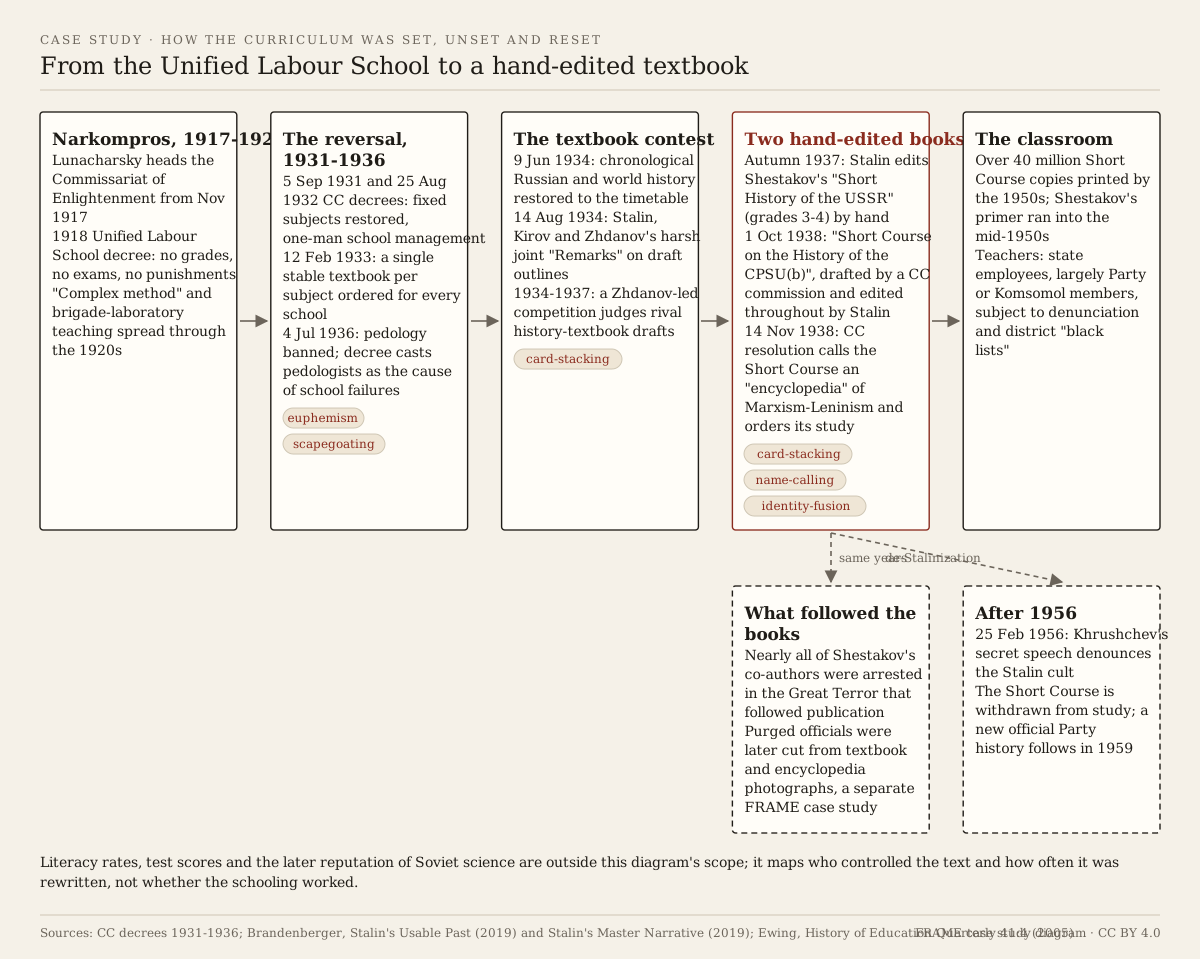
In one line: the Bolsheviks first let educators experiment with exam-free, grade-free schooling under Anatoly Lunacharsky's Commissariat of Enlightenment; a run of Central Committee decrees from 1931 to 1936 reversed that experiment, ordered a single stable textbook for every subject, and banned the child-study discipline that had rivalled the classroom teacher's authority; the two textbooks that resulted, Andrei Shestakov's 1937 primer and the 1938 Short Course on the History of the CPSU(b), were both personally edited by Stalin and made compulsory reading, while the teachers who taught from them worked as vetted state employees who could be denounced and removed.
What happened
Narkompros and the progressive experiment, 1917-1929
- November 1917. Within days of the October Revolution, the first Council of People's Commissars (Sovnarkom) names Anatoly Lunacharsky, a Bolshevik intellectual and former émigré, as head of the new People's Commissariat of Enlightenment (Narkompros), which absorbs the old Imperial Ministry of Public Education. Lunacharsky briefly resigns eight days into the post, on hearing an unconfirmed report that fighting for Moscow had damaged the Kremlin's historic cathedrals, then withdraws the resignation two days later once the report proves overstated.
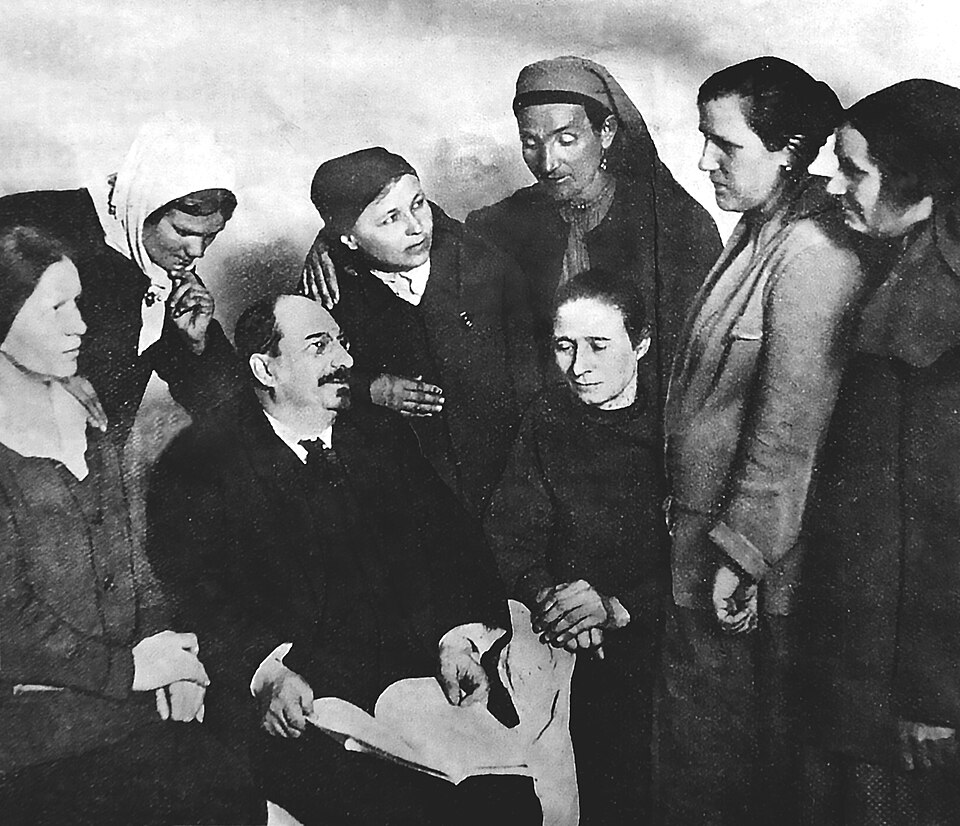
Anatoly Lunacharsky, People's Commissar for Education, photographed among a group of women; captioned in the source as taken at the 13th All-Russian Congress of Soviets of the RSFSR, April 1927. Published in the magazine Projector, 30 April 1927; photographer unknown. Wikimedia Commons; public domain (published before 1931).

- 16 October 1918. Narkompros issues the "Declaration on the Unified Labour School" and the accompanying "Statute of the Unified Labour School", covering the RSFSR. The new school is free, co-educational, secular and compulsory for children aged 8 to 17. Entrance, advancement and graduation examinations are abolished, along with compulsory homework and all forms of corporal or other punishment. Instruction is meant to be organised around productive labour rather than separate academic subjects.
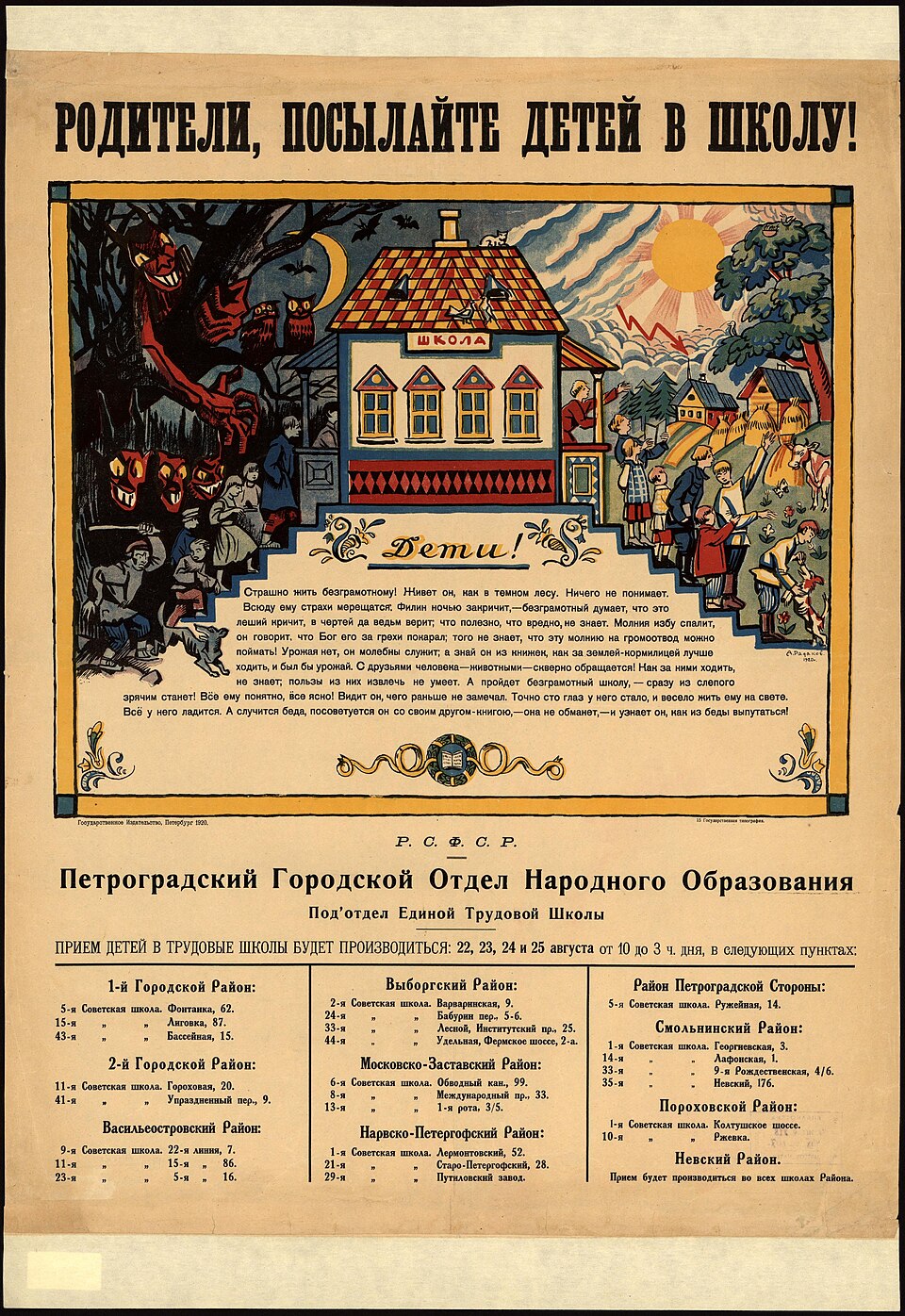
"Parents, send your children to school!" (Roditeli, posylaite detei v shkolu!), Petrograd, 1920: illustrated poster by Aleksei Radakov, with a notice from the Petrograd City Department of People's Education (sub-department of the Unified Labour School) listing enrolment points for 22-25 August. Gosizdat, Petrograd. Russian State Library, via Wikimedia Commons; public domain (published before 1931).

- Through the 1920s. Experimental pedagogy spreads: the "complex method" teaches reading, arithmetic and science through thematic projects on labour, nature and society rather than as separate subjects; the "brigade-laboratory method" has groups of pupils work and get graded together rather than individually, on the Dalton Plan model imported from the United States and Britain. In the summer of 1928 the American philosopher and educational reformer John Dewey visits Soviet schools at Lunacharsky's invitation and reports favourably on them.
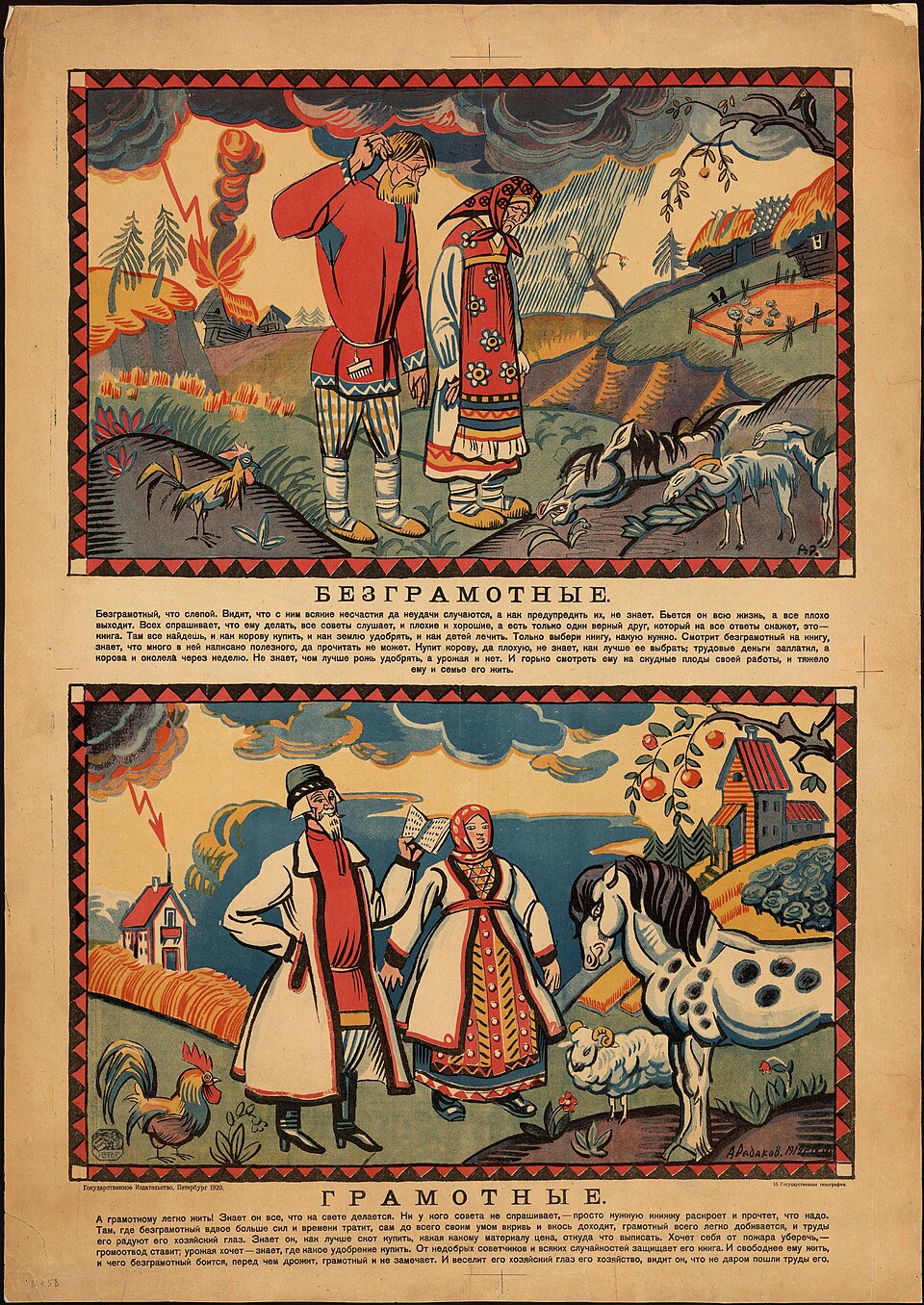
"The Illiterate / The Literate" (Bezgramotnye / Gramotnye), 1920: two-panel literacy-campaign poster by Aleksei Radakov, Gosizdat, Petrograd. Russian State Library, via Wikimedia Commons; public domain (published before 1931).

The reversal, 1931-1936
- 5 September 1931. A Central Committee decree "On the Primary and Secondary School" criticises Soviet schools for failing to give pupils a "sufficient" grounding in core subjects, and calls for fixed subject timetables and single-person management (edinonachalie) of each school, replacing the collegial and experimental arrangements of the 1920s. The decree itself states that no one teaching method, including the brigade-laboratory method, should be treated as the sole correct one, but the laboratory-brigade method loses its central place over the following year regardless.
- 25 August 1932. A further Central Committee decree, "On Curricula and Regime in Primary and Secondary Schools," restores lecture-based, subject-by-subject teaching, systematic individual homework and individual grading in place of group work.
- 12 February 1933. A Central Committee decree "On the Nature and Content of Textbooks for Elementary and Secondary Schools" orders that stable, single approved textbooks be prepared for Russian language, mathematics, geography, physics, chemistry and the natural sciences, ending the plurality of locally produced texts and disposable workbooks that had characterised the 1920s complex-method classroom.
- 9 June 1934. A joint Central Committee and Council of People's Commissars decree, "On the Teaching of Civic History in the Schools of the USSR," restores chronological, narrative history teaching in place of the 1920s "social studies" complex method, and orders new textbooks written to a fixed syllabus for elementary and secondary grades.
- 14 August 1934. The Central Committee approves and publishes a set of harshly critical "Remarks" on the draft outlines submitted for new textbooks on the "History of the USSR" and "Modern History", signed by Stalin, Sergei Kirov and Andrei Zhdanov. The Remarks fault the drafts as abstract and schematic and call for a lively, event-and-personality-driven narrative -- a direct instance of the top Party leadership setting the content of a school history textbook before a single copy had been written.
- 1934-1937. A commission led by Zhdanov judges a national competition for the winning school history textbook. A submission from a comparatively obscure team of historians led by Andrei Shestakov, intended for the third and fourth grades, wins over entries from more established authors.
- 4 July 1936. A Central Committee decree, "On Pedological Perversions in the System of the Peoples' Commissariats of Enlightenment," abolishes pedology, the Soviet child-study discipline that had used psychological and intelligence tests (many adapted from British and American originals) to sort pupils and diagnose "difficult" children. The decree blames pedologists' methods for a decline in school discipline and casts the ordinary classroom teacher, whose independent authority the pedological services had displaced, as the one now restored to a correct occupational role. Pedological services and their testing are closed nationwide; the historian E. Thomas Ewing (2005) frames the campaign as a "reinstatement" of the teacher as the Soviet school's central figure.
Two hand-edited textbooks
- Autumn 1937. Soviet publishers release Andrei Shestakov's Short History of the USSR, the textbook for third- and fourth-grade pupils that had won the 1934-1937 competition. Stalin edits the book's proofs by hand before publication, according to the historian David Brandenberger's critical edition of the manuscript, Stalin's Usable Past (2019); his edits push the narrative toward a Russocentric account of state-building, giving a more positive treatment to tsarist rulers such as Ivan IV and Peter I than the class-struggle framing of the 1920s had allowed, while keeping a place for the Bolshevik revolutionary story. The book runs to million-copy print runs into the mid-1950s and is used in public schools and in adult "political literacy" courses for parents. Nearly all of Shestakov's co-authors are later arrested in the Great Terror that follows the book's publication; Shestakov himself is not.
- 1 October 1938. History of the Communist Party of the Soviet Union (Bolsheviks): Short Course is published, after serialisation in Pravda beginning that September. Formally the work of a Central Committee commission, the book is extensively edited throughout by Stalin, and the historians David Brandenberger and Mikhail Zelenov's critical edition, Stalin's Master Narrative (2019), documents his handwritten revisions across the manuscript; the section of Chapter 4 titled "On Dialectical and Historical Materialism" is Stalin's own composition.
- 14 November 1938. The Central Committee issues a resolution declaring the Short Course and its philosophical chapter "an encyclopedia of fundamental knowledge in the field of Marxism-Leninism," and directs that its systematic study be organised across the Soviet Union, in party and Komsomol circles, in the armed forces, and in secondary and higher education. The Short Course becomes the standard reference for Soviet history teaching at senior school level as well as the core party-education text, and remains in that role until 1956. Estimates for its circulation, gathered by later historians of Soviet publishing, put it above 40 million copies in more than a dozen languages by the time it was withdrawn.
Teachers as vetted state employees
- Teaching posts in the Soviet system were state civil-service appointments, filled and removed through district education departments (gorono and raiono, the city and district education offices) and, at the more senior levels covered by the pre-revolutionary system's replacements, through Party bodies. Party or Komsomol membership was the norm rather than a formal legal requirement for a teaching career: at the Institute of Red Professors, which trained the ideological teaching cadre, only seven of 69 instructors were non-Party members in 1929.
- Denunciation of individual teachers by colleagues, parents or pupils for "ideologically harmful" teaching was an ordinary feature of Soviet school life; the historian Eugene Matusov's autobiographical account of Soviet schooling and later teaching, published in Dialogic Pedagogy (2018), describes a colleague warning him that he had been placed on his district's informal "black list" as "politically disloyal" after a school administrator judged his teaching ideologically suspect.
- The sociologist Kirill Maslinsky's history of Soviet school codes of conduct, published in Russian Education & Society (2016), periodises Soviet classroom regulation in stages running from the 1920s rejection of any fixed code, through the 1931-1935 return of government resolutions on discipline, to the 1943 "Code for Students," a formal rulebook for pupils that stood, largely unchanged, until the mid-1950s. Contemporary reporting on Soviet schooling also describes the 1943 reintroduction of school uniforms and, from 1943 to 1954, separate schooling for boys and girls in Soviet cities, both part of the same wartime turn toward visibly disciplined, state-run schooling.
The photographic and textbook record
- Officials purged in the show trials and the Great Terror were removed not only from photographs but from the textbooks, atlases and encyclopedias already in print; the mechanism by which Soviet censorship and state publishers retouched, replaced or withdrew printed material after a political fall is covered in this archive's separate case study, Glavlit and the retouched photographic record, rather than repeated here.
De-Stalinization, briefly
- 25 February 1956. At a closed session of the 20th Party Congress, First Secretary Nikita Khrushchev delivers the speech "On the Cult of Personality and Its Consequences," denouncing Stalin's purges and the personality cult built around him. The speech is read aloud to Party and Komsomol meetings across the Soviet Union in the following weeks, though it is not published domestically until 1989.
- 1956 onward. The Short Course is withdrawn from compulsory study; the historiographical framework it had fixed for eighteen years, including its account of Stalin's own role, is now itself treated as a distortion requiring correction. A new official multi-volume history of the Party is prepared under Khrushchev's Central Committee, appearing from 1959, replacing the 1938 text's role as the standard reference. This archive's sources do not establish a precise date on which Shestakov's 1937 primer stopped being used in schools, only that later Soviet school history textbooks superseded it during the same general period.
How it works
- Card stacking: both the 1937 and the 1938 textbooks assemble a chain of true, selected facts, the state-building achievements of tsarist rulers alongside the Bolshevik revolutionary narrative in Shestakov's case, a chronological march toward Stalin's leadership in the Short Course, while events and people that complicate that chain (the actual roles of leaders later purged, rival currents within the Party) are cut. A pupil working only from the assigned textbook can draw one conclusion from the material actually in front of them.
- Name-calling: the Short Course and the Soviet press built around it use fixed, damning labels for defeated political rivals, described in the source texts as a "Trotskyite-Bukharinite gang" of "spies, wreckers and murderers." Printed in a textbook studied by tens of millions of pupils and party members, the label substitutes for an argument that most readers had no independent way to check.
- Euphemism / doublespeak: the decrees that reversed 1920s progressive pedagogy describe a wholesale policy change in administrative language, "perversions" to be corrected, curricula to be "stabilised," rather than naming it as a retreat from an earlier official programme; the 1936 pedology decree frames closing an entire discipline and its testing services as "restoring" teachers' rights rather than as an act of central control.
- Scapegoating: the 1936 decree assigns the blame for indiscipline and poor attainment in Soviet schools to pedologists and their "pseudo-scientific" methods, rather than to the system that had commissioned pedological services in the first place; the arrest of nearly all of Shestakov's co-authors after their textbook was approved and published shows the same logic applied to the textbook-writing process itself, where deviation from the leader's judgement became chargeable only after the fact.
- Identity fusion: both hand-edited textbooks braid the history of the Soviet state into the person of its current leader. Brandenberger's research on Stalin's editing of the Shestakov text finds him steering the narrative toward Russian state continuity and away from an internationalist class-struggle account; the Short Course's chapter on dialectical and historical materialism, written by Stalin himself and declared the Central Committee's authoritative statement of Marxist-Leninist theory, asks pupils and party members to learn the state's founding ideas and the leader's own text as one and the same thing.
The structural point connecting these techniques is that each depended on removing alternatives from the classroom: the single stable textbook eliminated competing accounts before they could be compared, the pedology ban removed an independent professional check on how children were assessed, and the personal editing of both textbooks let one reader fix the content that tens of millions of others would later have to reproduce on an exam.
Then and now
State control of a single national history textbook has not ended with the Soviet Union. In 2023 the Russian government introduced a newly written, single mandatory history textbook for grades 10 and 11, replacing the several competing textbooks schools had previously chosen among; contemporaneous wire reporting identified Vladimir Medinsky, a presidential aide and former culture minister, as a lead author, and described the book as covering Russia's 2022 invasion of Ukraine in terms drawn from the state's own framing of the war. The same year, India's National Council of Educational Research and Training revised its nationally used school textbooks, removing or shortening chapters covering the Mughal emperors, the 2002 Gujarat riots and parts of the theory of evolution, changes the government described as reducing pupils' workload and critics read as reshaping the historical record along nationalist lines.
- A single mandated text, not a banned one. All three cases work through a state-approved textbook that every classroom must use, rather than through banning or burning books outside the state's own list, the mechanism covered on this archive's The 1933 book burnings and Nazi control of publishing page.
- Scale and duration differ sharply. The Soviet single-textbook system ran for decades, under a state that also controlled printing, distribution and teacher employment. The 2023 revisions are recent enough that neither their duration nor a comparable teacher-vetting apparatus is established here.
- The label of authorship is not always hidden. Medinsky's authorship of the 2023 Russian textbook was reported by name at the time; the Short Course's authorship, by contrast, was formally credited to a Central Committee commission and did not publicly name Stalin as its principal editor until historians gained access to the manuscript decades later.
Positions on the record
- The Soviet authorities' stated position. The 1931 and 1932 decrees present the return to fixed subjects and individual grading as corrections needed because pupils were leaving school without a "sufficient" grounding in core knowledge, not as a reversal of policy. The 1936 pedology decree presents itself as protecting Soviet children from "pseudo-scientific" testing and as restoring the ordinary teacher's rightful authority. The 14 November 1938 Central Committee resolution describes the Short Course as a scientific "encyclopedia" of Marxist-Leninist knowledge rather than as one man's edited account of the Party's history.
- Historians' position. Sheila Fitzpatrick's studies of Narkompros and Soviet education policy describe the 1930s reversal as a return to centralised, disciplinary schooling that served the state's need for trained, reliable cadres over the 1920s reformers' pedagogical aims. E. Thomas Ewing reads the 1936 pedology campaign as using teachers as both witnesses against, and replacements for, the discipline it abolished. Brandenberger and Zelenov's critical editions of the two hand-edited textbooks argue that Stalin's edits were not corrections toward greater accuracy but a deliberate reshaping of the historical narrative around continuity of the state and his own place in it, and note that the process offered no lasting protection to the historians who wrote a version he had approved.
- This archive's reading. The sequence of decrees, the named authors of the two textbooks, Stalin's documented handwritten edits to both, the 1938 resolution's own wording, and the arrests of Shestakov's co-authors are each independently documented in the sources used here. A comprehensive count of how many individual textbook passages were rewritten after each political fall, or a rigorous measure of what Soviet pupils actually learned or believed as a result, is not established here and is outside this page's scope; the page records who controlled the text and how often central authority rewrote it, not a judgement on Soviet educational outcomes.
Same-method test
Centralised, state-authored school curricula and textbooks used to fix a single official history are documented for other twentieth-century one-party states. Scored by the same definitions:
- Nazi Germany. From 1934 a Reich Ministry of Science, Education and National Education, under Bernhard Rust, centralised curriculum-setting across the previously federal German states, and school textbooks were brought into line with National Socialist doctrine, including newly mandated "racial science" content. Teachers came under pressure to join the National Socialist Teachers League, founded in 1929 and expanded into a mass organisation after 1933. This archive's sibling case study on Nazi school curriculum control covers the decrees, textbook programme and teacher-vetting apparatus in full; the parallel with the Soviet case is the same basic mechanism, a single ministry setting one approved curriculum and textbook set for every classroom in the country, run under a different single-party ideology.
- Maoist China. Chinese schools were closed for large parts of 1966 to 1968 as the Cultural Revolution began, and the campus wall poster and press campaign that supplied the movement's opening labels and targets is covered on this archive's Big-character posters: how the opening labels of China's Cultural Revolution did the work of charges (1966-68) page; that page's sources (MacFarquhar and Schoenhals, 2006; Walder, 2014) describe schools and their staff as an early target of the campaign's search for "capitalist roaders," with teachers denounced, humiliated in struggle sessions and in some cases killed, well beyond anything the Soviet teacher-vetting system of the 1930s did to individual teachers as a matter of routine. This archive's sibling case study on Maoist school curriculum control covers the pre- and post-1966 textbook and curriculum programme in full.
- Scale and mechanism compared. All three states moved from a plural or locally variable curriculum to a single centrally approved one, and all three used the classroom as a vehicle for a leader-centred historical narrative. The scale of the human cost attached to enforcing each system differed enormously, from the routine denunciation and career risk documented for Soviet teachers to the mass violence documented for Chinese teachers during the Cultural Revolution's early phase; this page does not attempt to rank the three systems against each other, only to note that the same basic mechanism, one state-approved text replacing a plural one, recurs across them.
How to spot it
- When a textbook or curriculum is described as being made "stable," "unified" or "single" for a subject, ask what other accounts existed before the change and what happened to them.
- Look for evidence that a specific senior political figure, rather than a named subject-matter author writing independently, had editorial authority over a school textbook's content, and ask whether that authority was disclosed to readers at the time or only established later.
- When a professional discipline inside a school system (testing, counselling, curriculum design) is abolished by a single decree, check whether the decree explains the closure in terms of restoring some other role's authority; that is often a sign the change is about control rather than the stated pedagogical problem.
- Ask whether teachers in the system can be removed or professionally penalised for content or approach, not only for misconduct; a teaching corps that can be blacklisted for what it teaches is not free to depart from an assigned text even where none is formally required.
Images
| Image | Source | Licence |
|---|---|---|
| Mechanism diagram (above) | Drawn for FRAME from the page's sourced facts (make_diagrams_youth_curriculum_soviet.py) |
CC BY 4.0, FRAME |
| Anatoly Lunacharsky, 1927 | Wikimedia Commons, from Projector, 30 April 1927; photographer unknown | Public domain (published before 1931) |
| "Parents, send your children to school!", poster by Aleksei Radakov, Petrograd, 1920 | Wikimedia Commons, Russian State Library | Public domain (published before 1931) |
| "The Illiterate / The Literate", poster by Aleksei Radakov, Petrograd, 1920 | Wikimedia Commons, Russian State Library | Public domain (published before 1931) |
Image gaps
- A cover or page of Shestakov's 1937 Short History of the USSR or the 1938 Short Course. No search of Wikimedia Commons in this pass returned a digitised page or cover under an open licence; both books remain widely reproduced in copyright scholarly editions (Brandenberger's and Brandenberger/Zelenov's critical editions) rather than as openly licensed scans.
- A 1920s or 1930s Soviet classroom photograph. Not sourced in this pass; Commons searches for this material were rate-limited before a confirmed, openly licensed candidate could be selected. Fillable on a later pass.
Sources
- Sheila Fitzpatrick, The Commissariat of Enlightenment: Soviet Organization of Education and the Arts under Lunacharsky, October 1917-1921 (Cambridge University Press, 1970).
- Sheila Fitzpatrick, Education and Social Mobility in the Soviet Union, 1921-1934 (Cambridge University Press, 1979).
- "Unified Labor School" (Decree on the Unified Labour School, 16 October 1918), Seventeen Moments in Soviet History.
- Central Committee of the All-Union Communist Party (Bolsheviks), decree "On the Primary and Secondary School," 5 September 1931.
- Central Committee of the All-Union Communist Party (Bolsheviks), decree "On Curricula and Regime in Primary and Secondary Schools," 25 August 1932.
- Central Committee of the All-Union Communist Party (Bolsheviks), decree "On the Nature and Content of Textbooks for Elementary and Secondary Schools," 12 February 1933.
- Central Committee of the CPSU(b) and Council of People's Commissars of the USSR, decree "On the Teaching of Civic History in the Schools of the USSR," 9 June 1934.
- I. V. Stalin, S. M. Kirov and A. A. Zhdanov, "Remarks on the Summary of a Textbook on the History of the USSR" and "Remarks on the Summary of a Textbook of Modern History," approved by the Central Committee, 14 August 1934.
- Central Committee of the All-Union Communist Party (Bolsheviks), decree "On Pedological Perversions in the System of the Peoples' Commissariats of Enlightenment," 4 July 1936.
- E. Thomas Ewing, "Restoring Teachers to Their Rights: Soviet Education and the 1936 Denunciation of Pedology," History of Education Quarterly, 41:4 (2005), 471-493; abstract at Cambridge Core.
- David Brandenberger, Stalin's Usable Past: A Critical Edition of the 1937 Short History of the USSR (Stanford University Press, 2019); summary at Jordan Russia Center, "Was the Stalin Era's Most Influential History Textbook an Imperial Narrative?".
- David Brandenberger, "'Basically, It's a History of the Russian State': Russocentrism, Etatism, and the Ukrainian Question in Stalin's Editing of the 1937 Short History of the USSR," Nationalities Papers, at Cambridge Core.
- David Brandenberger and Mikhail Zelenov (eds.), Stalin's Master Narrative: A Critical Edition of the History of the Communist Party of the Soviet Union (Bolsheviks), Short Course (Yale University Press, 2019).
- Central Committee of the All-Union Communist Party (Bolsheviks), resolution declaring the Short Course and its philosophical chapter authoritative and ordering its nationwide study, 14 November 1938.
- Kirill Maslinsky, "Codes of Conduct in the Soviet School System. Part 1: The Teacher as the Mouthpiece of the State," Russian Education & Society, 58:5-6 (2016); abstract at Taylor & Francis Online.
- Eugene Matusov, "Ideological and Real Socialism of My Soviet Childhood, Schooling, and Teaching: Multi-Consciousness," Dialogic Pedagogy: A Journal for Studies of Dialogic Education, 6 (2018); full text at dpj.pitt.edu.
- Nikita Khrushchev, "On the Cult of Personality and Its Consequences," closed session, 20th Congress of the CPSU, 25 February 1956.
- This archive's related case study on the retouching of the Soviet photographic and printed record: Glavlit and the retouched photographic record.