In one line: from 1922 the Soviet censorship office Glavlit controlled what could be printed, and over the following decades people who fell from power were cropped, painted or cut out of photographs, encyclopedias and books, so that published versions of real events showed only the figures still in favour.
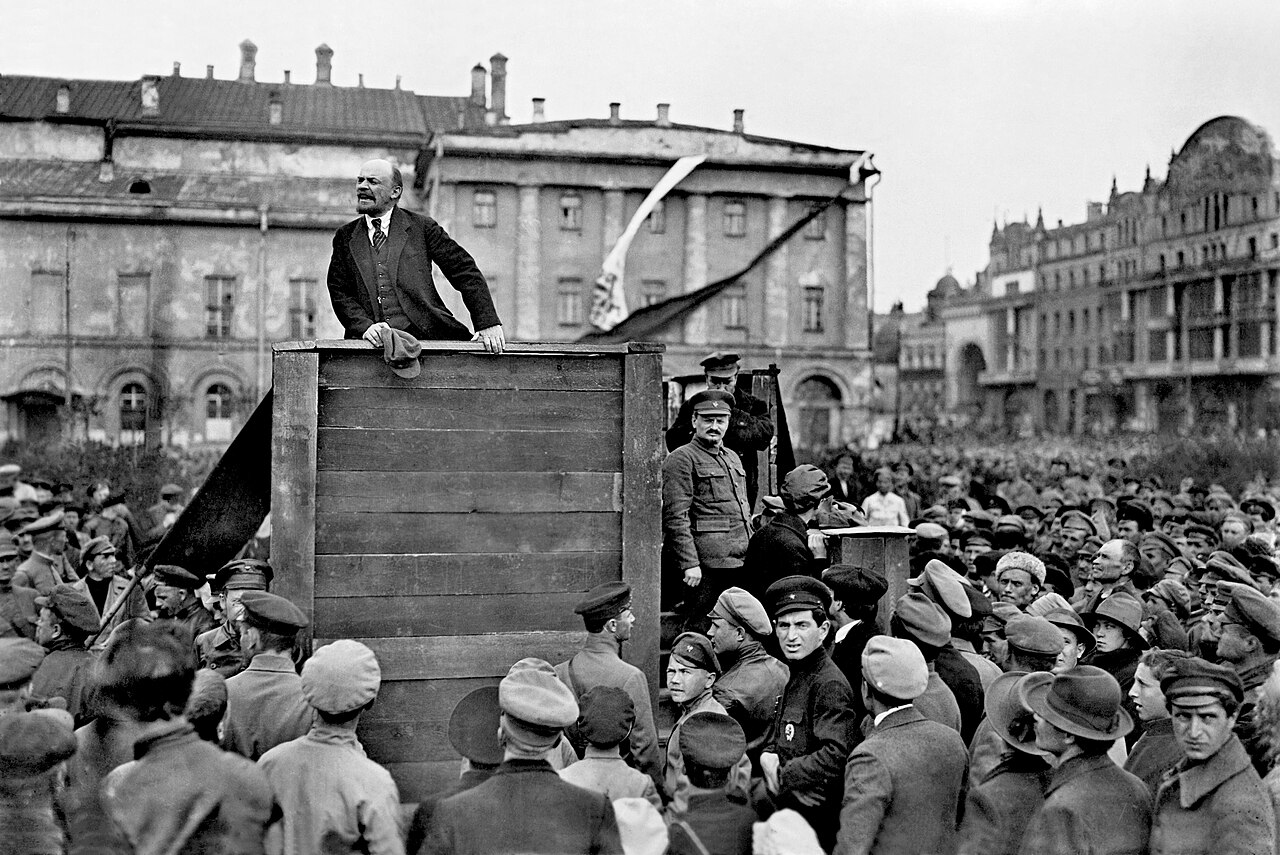
Lenin addresses troops leaving for the Polish front, Sverdlov Square, Moscow, 5 May 1920. Trotsky, in uniform, and Kamenev stand on the steps to the right of the platform. Photograph by G. P. Goldshtein. Public domain (published before 1931), via Wikimedia Commons.
What happened
The legal frame
- 9 November 1917 (27 October, Old Style). Two days after the Bolsheviks take power in Petrograd, the Council of People's Commissars (Sovnarkom) issues the Decree on the Press, signed by Lenin. It allows the closure of publications that call for resistance or disobedience to the new government. It describes itself as "temporary extraordinary measures" and says it is "of a temporary nature and will be removed by a special decree just as soon as normal conditions are reestablished" (translation in Seventeen Moments in Soviet History).
- 6 June 1922. A Sovnarkom decree creates the Main Administration for Literary and Publishing Affairs (Glavlit), under the People's Commissariat of Enlightenment. It was signed by Alexei Rykov on behalf of Lenin, who was ill. Glavlit becomes the central body for prior review of printed matter: newspapers, books, journals and later other media.
- What could not be printed. A later published statute on censorship, which replaced the June 1922 document, forbids the issue or distribution of any works that "(a) contain agitation or propaganda against Soviet power or the dictatorship of the proletariat; (b) divulge state secrets; (c) arouse nationalist or religious fanaticism; (d) are of a pornographic character."
- The list. Censors worked from an internal list of information that could not be published in the open press (the perechen). Leonid Vladimirov, a Soviet journalist who defected to Britain in 1966, described it in Index on Censorship in 1972 as the "Index of Information Not to Be Published in the Open Press", a volume of over 300 pages that censors called "the Talmud". He wrote that the Index did not deal with the political evaluation of texts.
- Closed collections. Libraries and archives kept restricted "special storage" sections (spetskhran). Material the state deemed ideologically harmful was moved there from open shelves. Readers needed permission, usually from the "First Department" at their workplace, to use them.
The photographic record
- 5 May 1920. In Sverdlov Square (now Theatre Square), Moscow, in front of the Bolshoi Theatre, Lenin addresses Red Army troops leaving for the Polish front. The photographer G. P. Goldshtein records Leon Trotsky, then People's Commissar for Military and Naval Affairs, and Lev Kamenev, a Politburo member, standing on the steps at the right of the platform.
- 1927 to 1940. Trotsky is expelled from the party in 1927, deported in 1929 and killed in Mexico in August 1940 by the Soviet agent Ramón Mercader. Kamenev is convicted at the first Moscow show trial, officially the case of the "Trotskyite-Zinovievite Terrorist Center", and shot on 25 August 1936. (He and his co-defendants were formally cleared by the Soviet government in 1988.)
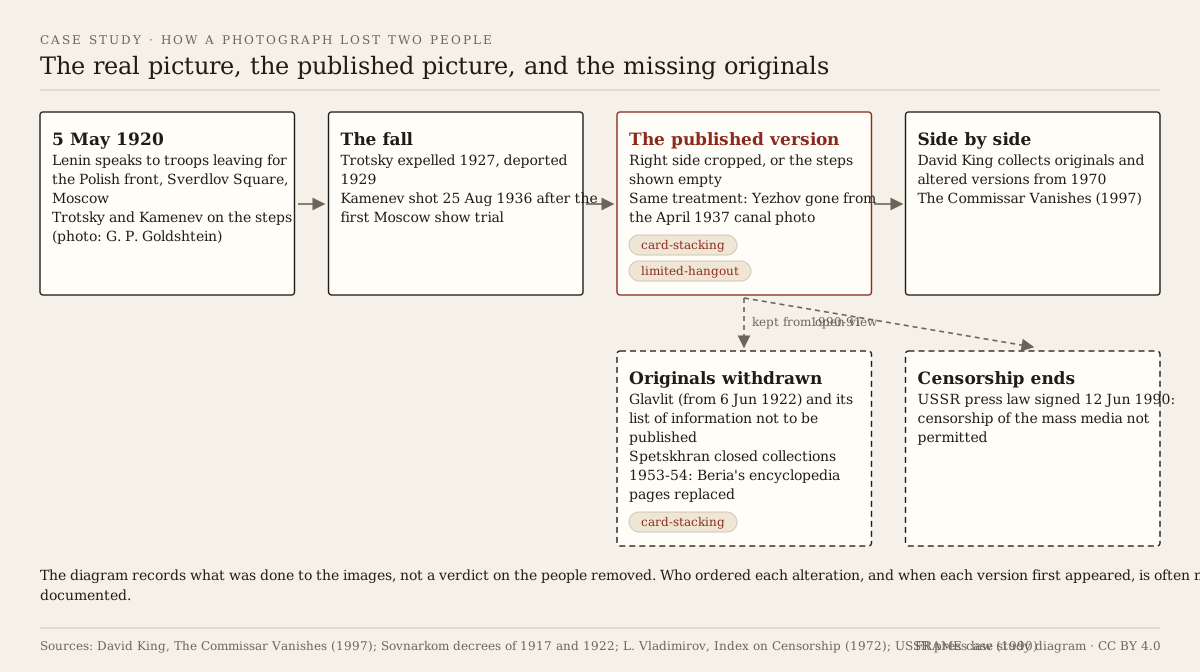
- The two versions. Soviet reproductions of Goldshtein's photograph either cropped the right side or used a retouched version in which the steps are empty. David King's The Commissar Vanishes reproduces both versions side by side. Secondary accounts give different dates for the first appearance of the retouched version, some placing it in the Stalin years and some in a 1967 book of Lenin photographs; this page does not fix one.
- April 1937. Nikolai Yezhov, People's Commissar for Internal Affairs since September 1936, is photographed walking with Stalin, Kliment Voroshilov and Vyacheslav Molotov beside the Moscow-Volga canal. Yezhov is arrested on 10 April 1939 and shot on 4 February 1940. A later version of the photograph shows the group without him. This pair gave King's book its title.
- Ink in the owner's copy. Aleksandr Rodchenko and Varvara Stepanova's photo album Ten Years of Uzbekistan (1934) portrayed regional officials, many of whom were purged soon after. Rodchenko's own copy has their faces blacked out in India ink (Rauner Special Collections Library, Dartmouth, 2014; King).
- 1953 to 1954. After Lavrentiy Beria, Minister of Internal Affairs, is arrested in June 1953 and executed in December 1953, subscribers to the second edition of the Great Soviet Encyclopedia receive a notice from the encyclopedia's publisher. It recommends removing pages 21 to 24 of Volume 5, and the portrait of Beria between pages 22 and 23, with scissors or a razor blade, and pasting in enclosed replacement pages. Accounts of the replacement list expanded entries on F. W. Bergholz, an 18th-century courtier, and the Bering Sea; some also list Bishop Berkeley. The University of California library had received the replacement by April 1954.
The response and the end
- Samizdat. Texts that could not pass Glavlit circulated in typed and retyped copies. The word comes from the poet Nikolai Glazkov, who in the 1940s put "Samsebyaizdat" ("myself-by-myself publishers") on home-made books of his poems. From 30 April 1968 the samizdat bulletin A Chronicle of Current Events recorded political trials and arrests that the official press did not report.
- 1970. The British designer David King, visiting Moscow, finds that Trotsky's image has been removed from Soviet photographs and starts collecting originals and altered versions from Soviet and Western sources.
- 12 June 1990. Mikhail Gorbachev signs the USSR Law "On the Press and Other Mass Media", in force from 1 August 1990. Article 1 states that censorship of the mass media is not permitted. Glavlit is replaced by GUOT, the Main Administration for Safeguarding State Secrets in the Press and Other Mass Media, which issues its own list of information forbidden for publication.
- 1991. GUOT, the last Union-level censorship body, ceases to exist with the Soviet central government; the sources used here do not fix an exact date.
- 1997. King publishes The Commissar Vanishes: The Falsification of Photographs and Art in Stalin's Russia (Canongate in the UK; Metropolitan Books/Henry Holt in the US). In June 2016 Tate completes the acquisition of the David King Collection, more than 150,000 photographs, books, magazines and objects.
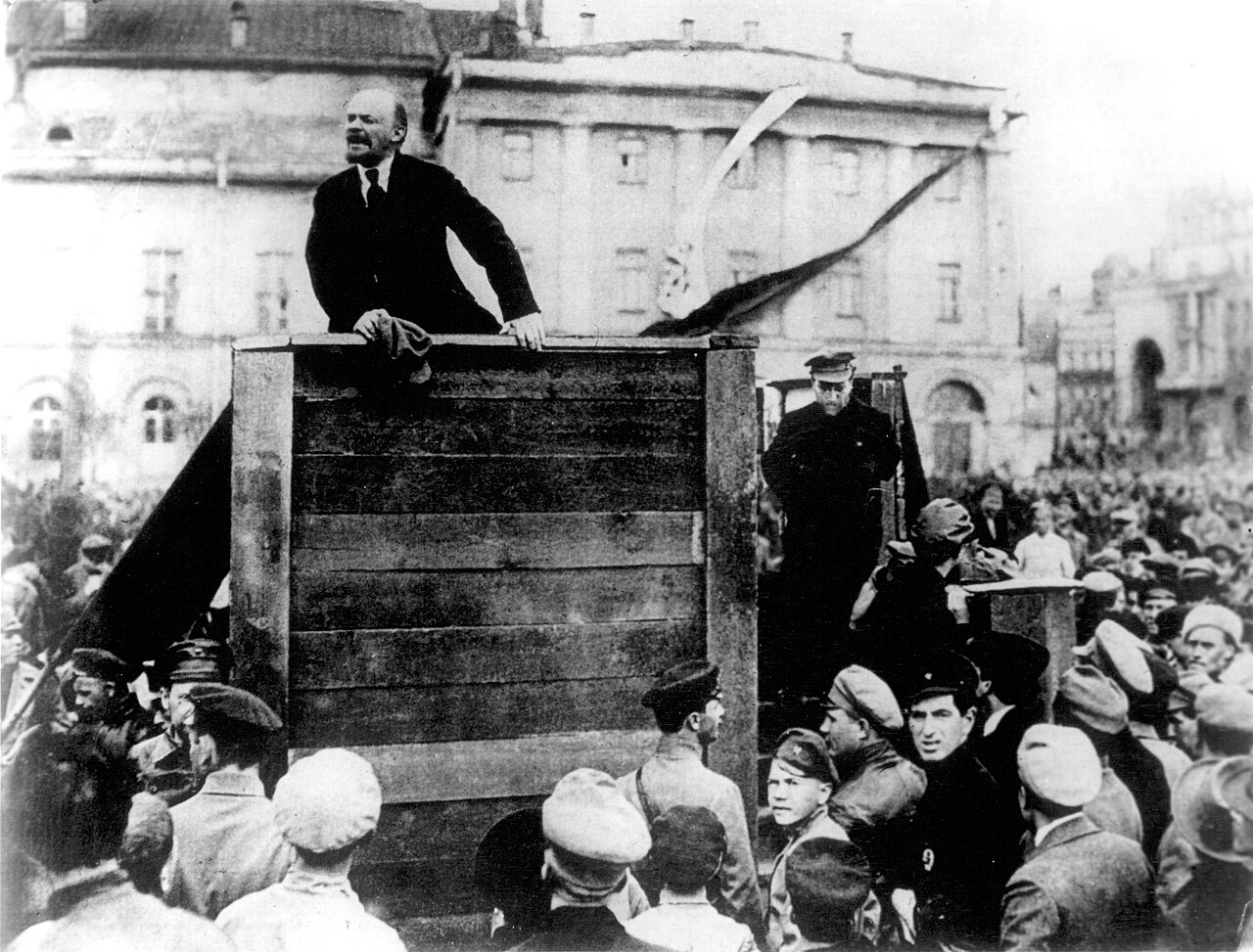
The retouched version of Goldshtein's photograph: the steps to the right of the platform show no Trotsky and no Kamenev. Print from the Spaarnestad Photo archive (SFA001018178); retoucher and first publication date unknown. Public domain per Wikimedia Commons (PD-US, PD-anon-70-EU).
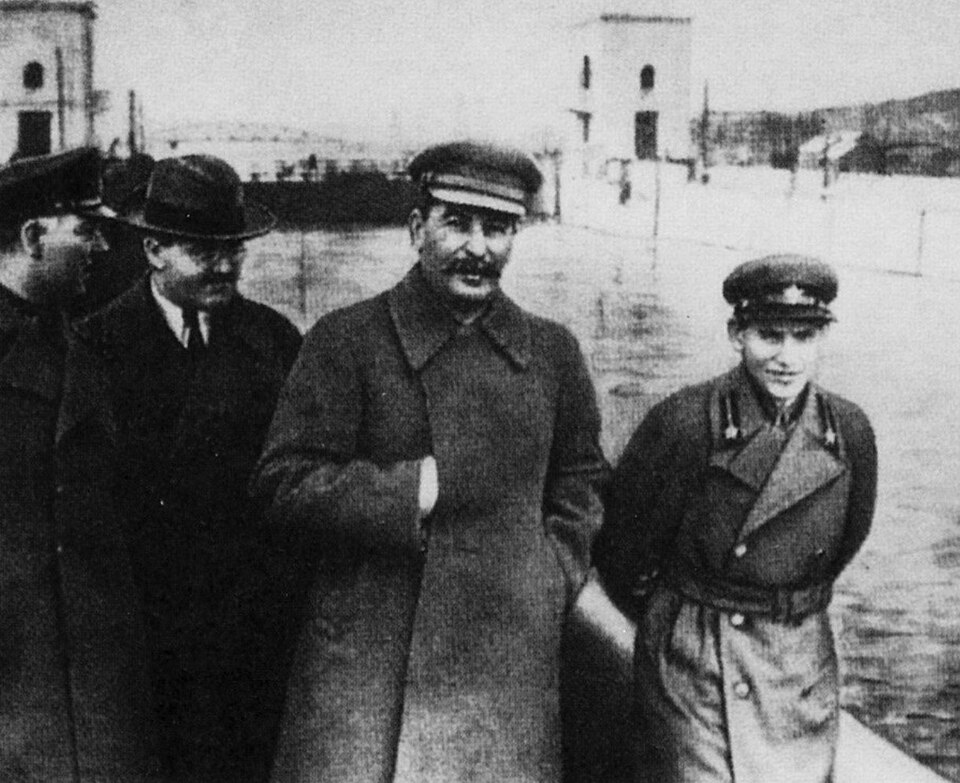
April 1937: from left, Kliment Voroshilov, Vyacheslav Molotov, Joseph Stalin and Nikolai Yezhov beside the Moscow-Volga canal. Photographer unknown. Public domain per Wikimedia Commons (PD-Russia-1996: public domain in Russia on 1 January 1996, so not restored in the US).
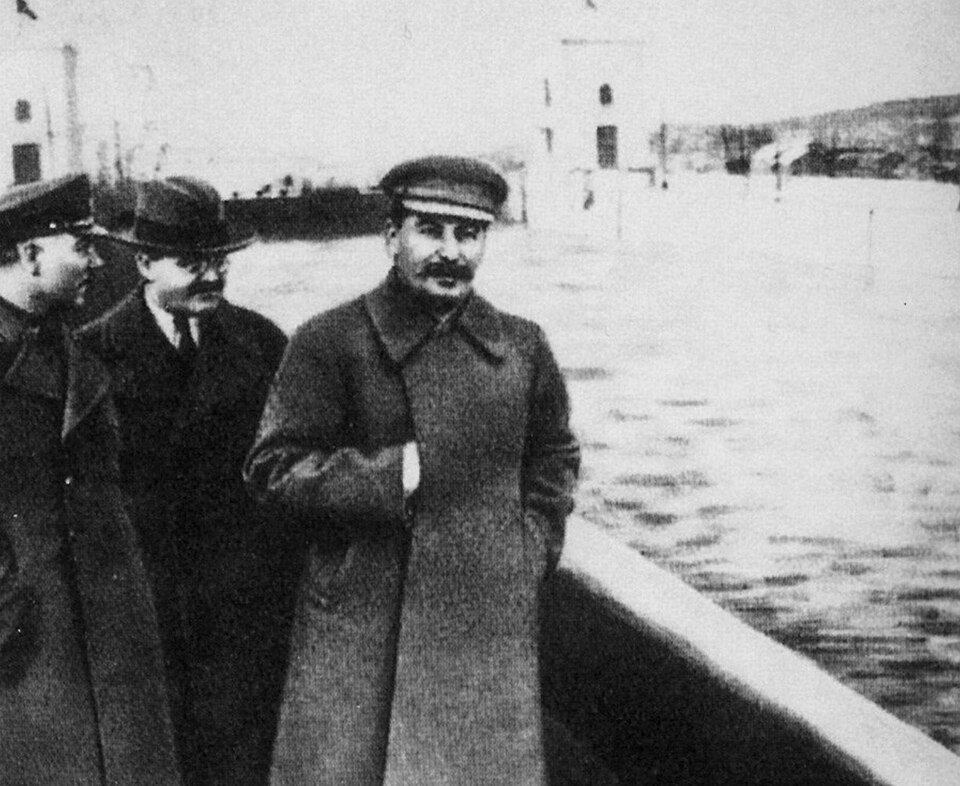
The altered version: Yezhov is gone and the canal water and embankment are continued where he stood. Photographer and retoucher unknown. Public domain per Wikimedia Commons (PD-Russia-1996). Commons files both versions under the title "Volga-Don Canal"; this page follows King in placing the scene at the Moscow-Volga canal.
How it works
Censorship is not itself a technique id in FRAME's taxonomy; the tags below describe the published record that the censorship left behind.
- Card stacking: the retouched Lenin photograph keeps everything else in Goldshtein's frame (the speaker, the platform, the crowd, the date) and removes two people. A reader can then draw only one conclusion from the published pile: that Trotsky and Kamenev were not beside Lenin on 5 May 1920. The Yezhov version works the same way. The Great Soviet Encyclopedia replacement pages fill the space the Beria entry took up, so the volume shows no gap.
- Limited hangout: the altered photograph is a real record of a real event, released as the official account while the fuller record (the unaltered print, the negatives, and books that showed it) is withdrawn to closed collections or kept out of print. The survivable part of the truth, that Lenin spoke to the troops that day, is what is published, and it stands in for the account in which Trotsky and Kamenev were there. The fit is partial: a limited hangout is usually a disclosure made under pressure, and here the partial version was simply the only one on open sale.
The structural point is that each of these edits depends on control of the whole chain. A retouched print is only persuasive if the original is not also in circulation. The Glavlit list, the spetskhran and the encyclopedia's replacement pages are the parts of the system that removed the originals from open access; the retoucher's work is the visible end of it.
Then and now
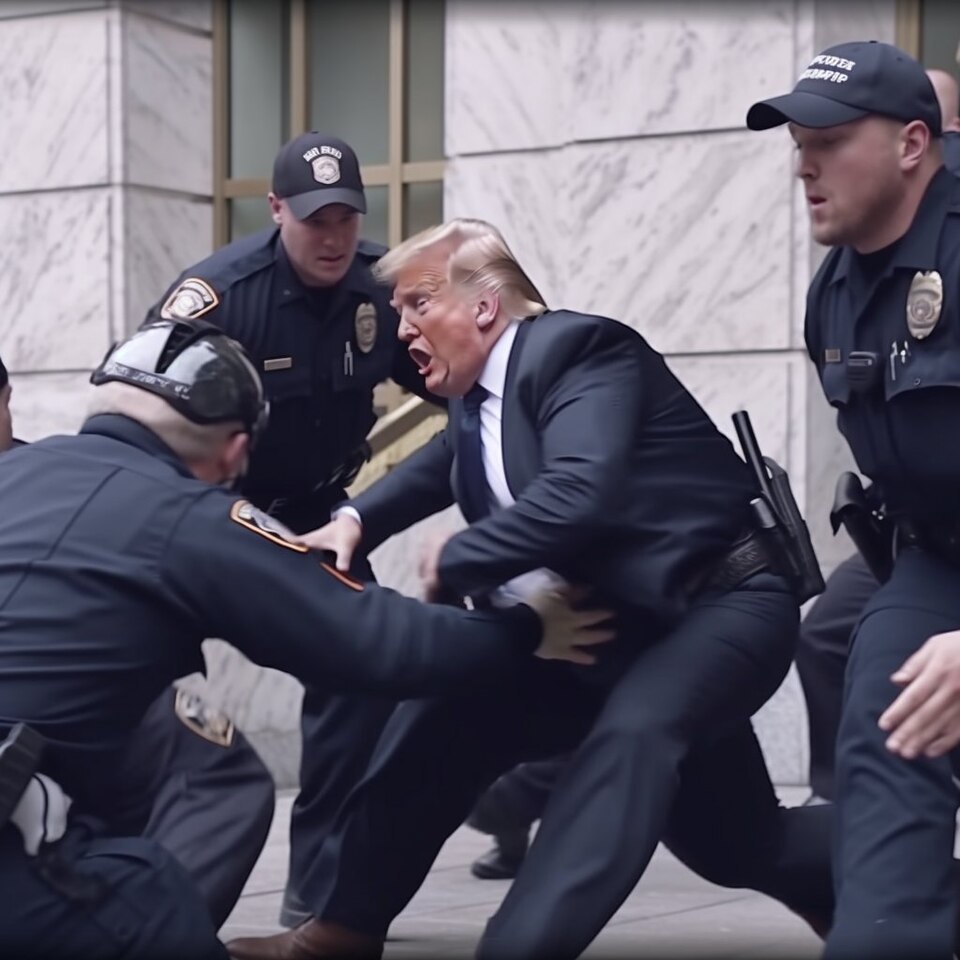
AI-generated image of Donald Trump being arrested, Midjourney image posted by Eliot Higgins, 20 March 2023. Public domain on Wikimedia Commons (AI output without human authorship).
Both cases produce an image that shows a political scene differently from how it happened, and both depend on the viewer not seeing what sits outside the frame. The differences are larger than the similarity:
- Subtraction against fabrication. The Soviet retouchers removed people from real photographs of real events. The 2023 image shows an arrest that did not happen; it was generated, not edited.
- Who made it and with what reach. The Soviet alterations were carried out by state publishers under a censorship system that controlled which versions were printed, and the originals were withdrawn from open access for decades. The 2023 images were made by one private user, who said in his own post that he was making them; they spread without that label, and the facts of the actual indictment were reported openly within days.
- Scale and duration. The Soviet practice ran across encyclopedias, schoolbooks, albums and libraries for decades. The 2023 images circulated for a short period on open platforms where the originals and the correction were available.
The technique page Synthetic media and the gallery entry AI-generated image from the Springfield pet-eating claim cover other recent altered or generated images.
Positions on the record
- The Soviet authorities' stated position. The 1917 decree presents press closures as temporary measures against a "counter-revolutionary" press, to be lifted "as soon as normal conditions are reestablished". The censorship statutes present Glavlit's work as protecting state secrets and preventing agitation against Soviet power, nationalist or religious fanaticism, and pornography. No published Soviet statement in the sources used here gives a rationale for altering specific photographs; the practice was not announced.
- Critics' position. David King, dissident writers and later historians state that the alterations falsified the historical record so that published history matched the current leadership, and that removing books to spetskhran served the same end. King's book presents the paired originals and altered versions as evidence.
- This archive's reading. The existence of altered versions of the photographs described here is documented by the surviving originals and their published alterations, and the encyclopedia replacement is documented by the pages libraries received. Who ordered each individual alteration, and when each version first appeared, is often not documented in the sources used here. No count of altered images across the Soviet period is established here. The political judgements made about Trotsky, Kamenev, Yezhov or Beria are outside this page's scope; it records what was done to the images and texts.
Same-method test
Removing a person from a published photograph after a political fall is recorded for other governments too. Scored by the same definitions:
- Czechoslovakia, 1948 and after. In February 1948 Klement Gottwald addressed a crowd from a balcony in Prague's Old Town Square. The photograph of the scene showed Vladimír Clementis beside him; Clementis had put his own fur hat on Gottwald's head. Clementis was executed in 1952 after the Slánský trial, and later versions of the photograph show Gottwald without him. Milan Kundera opens The Book of Laughter and Forgetting (1979) with this photograph: "Nothing remains of Clementis but the fur hat on Gottwald's head." Scale: one government, one well-documented photograph and its reuse in official propaganda; the method matches the Soviet one closely.
- China, 1976. Official photographs of Mao Zedong's funeral in September 1976, published in People's Daily, showed Jiang Qing, Zhang Chunqiao, Yao Wenyuan and Wang Hongwen among the leaders in the front row. After their arrest in October 1976, later publications of the funeral photographs show the row without them. Scale: a small number of widely reproduced images, done within weeks of the arrests.
- Nazi Germany, 1937. In June 1937 Heinrich Hoffmann, Hitler's photographer, photographed Hitler and Joseph Goebbels visiting Leni Riefenstahl's new villa in Berlin-Dahlem. The Metropolitan Museum of Art holds two prints from the visit: in one Goebbels is present, and in the other, found in Hoffmann's archive, he has been retouched out. The Met's catalogue text offers two possible reasons without choosing between them: concern that the picture would feed rumours linking Goebbels and Riefenstahl, or a newspaper's wish to show the Riefenstahl family with Hitler alone. Scale: one print, with no documented state programme behind it, so it matches the method but not the system.
The Soviet case differs from all three in scale and duration: it combined a standing censorship office, a published list of forbidden information, closed library collections and repeated alteration of the same images over several decades. Any government that removed people from the published photographic record after their political fall would be scored the same way here.
How to spot it
- When a well-known historical photograph appears in more than one version, compare the edges, steps, backgrounds and spacing between figures. Gaps, repeated textures and figures that no longer line up are where removals usually show.
- Look for the earliest published version, not the most reproduced one, and check where it came from: a foreign press print, an archive negative, or a later official album.
- In reference works, check for pages that were replaced or pasted in. Unusual expansion of neighbouring entries, or a missing plate, can mark a removed article.
- When a library catalogue lists a book that is not on open shelves, ask whether it was held in a restricted collection, and when it was released.
Images
| Image | Source | Licence |
|---|---|---|
| Mechanism diagram (above) | Drawn for FRAME from the page's sourced facts (make_diagrams.py) |
CC BY 4.0, FRAME |
| Lenin in Sverdlov Square, 5 May 1920, with Trotsky and Kamenev (G. P. Goldshtein) | Wikimedia Commons | Public domain (Commons licence tag PD-Russia-expired: published before 1 January 1931) |
| The same photograph, retouched, without Trotsky and Kamenev | Wikimedia Commons, Spaarnestad Photo | Public domain (Commons licence tags PD-US and PD-anon-70-EU) |
| Voroshilov, Molotov, Stalin and Yezhov at the canal, April 1937 | Wikimedia Commons | Public domain (Commons licence tag PD-Russia-1996) |
| The same photograph without Yezhov | Wikimedia Commons | Public domain (Commons licence tag PD-Russia-1996) |
| AI-generated image of Trump being arrested (2023) | FRAME gallery | Public domain (AI output without human authorship) |


Image gaps
- The Glavlit list of information not to be published (perechen). Commons holds scans of the 1976 and 1987 editions, but its only licence reason is Russian (PD-RU-exempt, official documents); the US status is unclear, so they are not hosted here.
- A 1920s Glavlit imprint or stamp. The only pre-1931 example found on Commons, a 1927 Crimean earthquake-relief postcard with a printed Glavlit number, is a dealer's scan with a "NOT FOR COPY" watermark across it, so it is not used.
- The Great Soviet Encyclopedia replacement pages and the Beria portrait (1953-1954). No openly licensed scan was found.
- Rodchenko's inked-over copy of Ten Years of Uzbekistan (1934). Reproduced by Dartmouth's Rauner Library and in King's book; no openly licensed copy was found.
- Paired pages from The Commissar Vanishes (1997). King's layouts and his collection's prints, now at Tate, are in copyright.
- The Gottwald balcony photograph (1948) with and without Clementis, and the 1976 Mao funeral photographs. Not hosted: Commons searches were rate-limited in this pass and no copy with a clear US public-domain reason was confirmed.
- The Hoffmann prints of Hitler at Riefenstahl's villa (1937). Viewable on the Metropolitan Museum's website; no openly licensed copies were found, and the US status of German material from 1937 is unclear.
Sources
- Decree on the Press, Council of People's Commissars, 27 October (9 November) 1917, signed by V. I. Lenin. English translation in Seventeen Moments in Soviet History, "Decree on the Press".
- Decree of the Council of People's Commissars establishing the Main Administration for Literary and Publishing Affairs (Glavlit), 6 June 1922.
- Seventeen Moments in Soviet History, "The Last Published Statute on Censorship" (translation of the statute text with the four prohibited categories).
- Leonid Vladimirov, "Glavlit: How the Soviet Censor Works", Index on Censorship, vol. 1, no. 3-4 (Autumn/Winter 1972).
- Law of the USSR "On the Press and Other Mass Media", 12 June 1990, in force 1 August 1990; Christian Science Monitor, 29 June 1990, "New Soviet press law".
- David King, The Commissar Vanishes: The Falsification of Photographs and Art in Stalin's Russia (Canongate / Metropolitan Books, 1997).
- Tate, "Traces of Human Tragedy: The David King Collection" (acquisition completed June 2016).
- Rauner Special Collections Library, Dartmouth College, "10 Let Uzbekistan", February 2014.
- Great Soviet Encyclopedia, 2nd edition, Volume 5, and the publisher's replacement notice to subscribers (1953-1954), as described in the encyclopedia's publication history.
- Milan Kundera, The Book of Laughter and Forgetting (1979), part one; quotation from Aaron Asher's English translation (1996).
- The Metropolitan Museum of Art, prints from Heinrich Hoffmann's series of Hitler and Goebbels at Leni Riefenstahl's villa, 1937: with Goebbels and without Goebbels; Mia Fineman, Faking It: Manipulated Photography before Photoshop (Metropolitan Museum of Art, 2012).
- A Chronicle of Current Events, No. 1, 30 April 1968.