Content note: this page quotes a fabricated account of Hitler's death and describes the propaganda use of a real Red Army atrocity (Nemmersdorf, October 1944). Nemmersdorf itself, and the wider ministry that ran the Wehrmachtbericht's parent press and radio system, are covered in more detail on The Reich Ministry of Public Enlightenment and Propaganda, 1933-1945; this page focuses on the daily military communiqué itself and on the broadcasts that ended it.
In one line: through 1944 the Wehrmacht High Command's daily communiqué described a collapsing war with a widening vocabulary of euphemism — "straightening the front," "disengaging movements," "planned withdrawal" — while the party kept promising final victory (Endsieg); by early 1945 that language had visibly parted company with a war the public could see for itself out of their own windows, and it outlived Hitler only in Grand Admiral Karl Dönitz's 1 May 1945 broadcast announcing his death as a hero's death "at the head of his troops," and in the OKW's own last report, filed on 9 May 1945 after the war had already ended.
What happened
The instrument. The Wehrmachtbericht was the Wehrmacht High Command's daily communiqué, broadcast on German state radio (Großdeutscher Rundfunk) and printed in the press, reporting the military situation on every front. It ran without a break from the invasion of Poland on 1 September 1939 to 9 May 1945. It was drafted by a propaganda department attached to the Wehrmachtführungsstab (the OKW operations staff) under Generaloberst Alfred Jodl, fed by material from the Wehrmacht's own propaganda companies (Propagandakompanien), and administered throughout the war by Hasso von Wedel's Wehrmacht propaganda branch — the same organisation, agreed between Goebbels and Wilhelm Keitel in 1938, that supplied front reporting to the wider civilian propaganda system described on The Reich Ministry of Public Enlightenment and Propaganda, 1933-1945. The historian Erich Murawski's 1962 study of the communiqué, published by the West German Federal Archives, reproduces its full text from 1 July 1944 to 9 May 1945 — precisely the collapse this page covers.
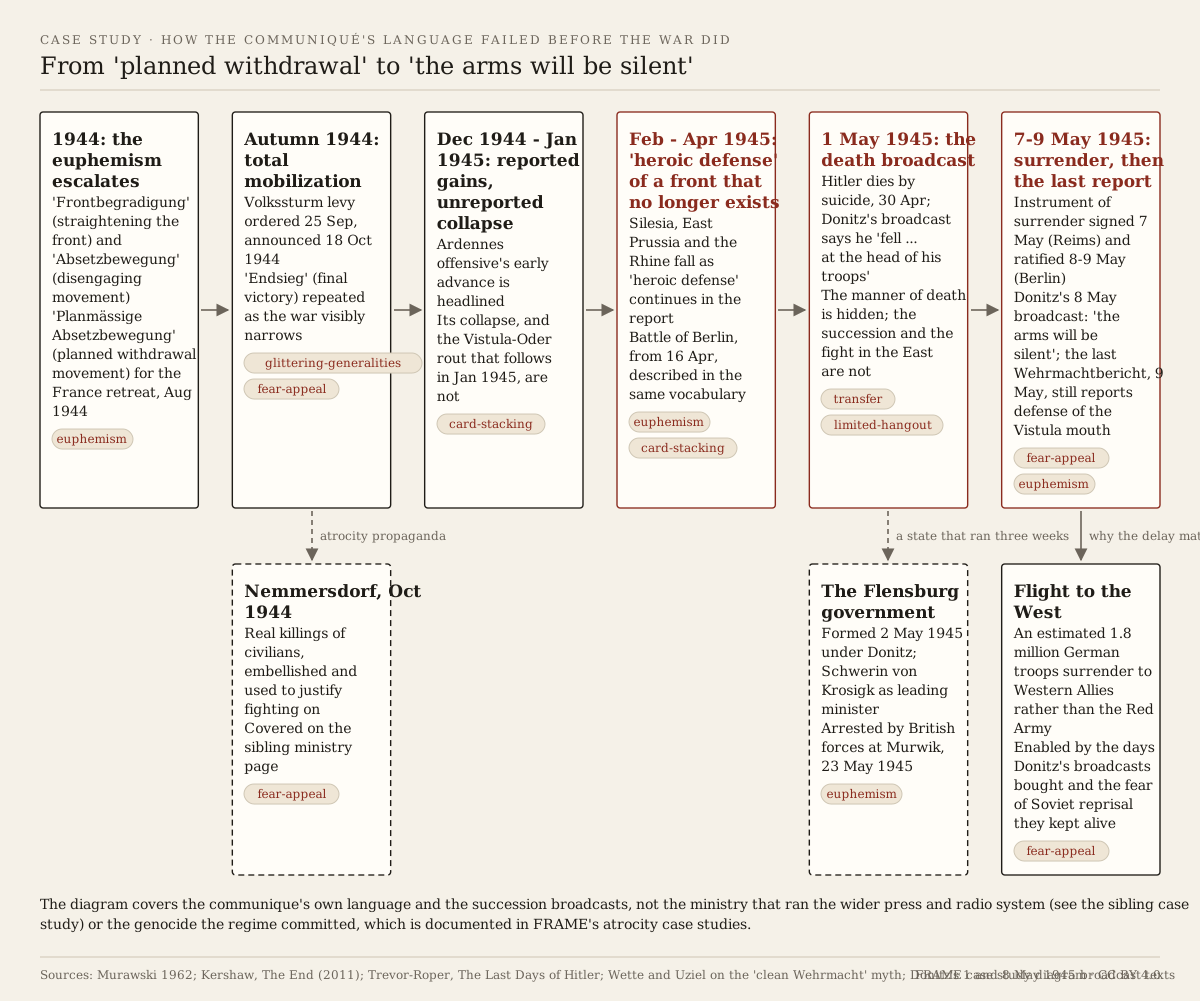
1944: the vocabulary of retreat widens. By late 1943 the communiqué and the wider press had already adopted "Frontbegradigung" ("straightening the front") and "Absetzbewegung" ("disengaging movement") for retreats — established usage covered on The Reich Ministry of Public Enlightenment and Propaganda, 1933-1945. Through 1944, as the Wehrmacht lost France after the Allied landings of 6 June and was driven out of most of the Soviet Union following the Red Army's Operation Bagration (June-August), a further phrase spread in military and press usage: "planmässige Absetzbewegung" ("planned withdrawal movement"), documented in soldiers' own wartime diaries of the retreat from France in August 1944. The doctrinal language of mobile "elastic defense" — controlled, counter-attacking withdrawal in depth, a real Wehrmacht tactic from the First World War onward — increasingly described operations in which German commanders no longer had the reserves, fuel or Hitler's permission to conduct it; Hitler's repeated stand-fast orders through 1944 overrode commanders, including Walter Model and Heinz Guderian, who argued for exactly this kind of controlled withdrawal (Kershaw, The End, 2011).
Autumn 1944: total mobilization, final victory. On 25 September 1944 Hitler ordered the Volkssturm, a levée en masse conscripting men aged 16 to 60 not already serving; the order was announced publicly on 16 October and launched two days later, a date chosen to evoke the 1813 rising against Napoleonic rule. Propaganda for it, like the rest of the regime's public language that autumn, kept using "Endsieg" ("final victory") as the war's stated destination even as German territory itself came under direct threat for the first time. On 21 October 1944 Red Army troops briefly took the East Prussian village of Nemmersdorf; the ministry's propaganda used the real killings of civilians there, embellished, to argue that Soviet victory meant annihilation — the fear-appeal campaign covered in full on The Reich Ministry of Public Enlightenment and Propaganda, 1933-1945.
December 1944 - January 1945: a headline, then a silence. The Ardennes offensive, opened 16 December 1944, gave the communiqué a rare late-war chance to report an advance, and it did so prominently. Its collapse by late January, and the near-simultaneous shattering of the Eastern front in the Vistula-Oder offensive (12 January 1945), which carried Soviet forces from central Poland to within about 70 kilometres of Berlin in under three weeks, received nothing like the same prominence: the pattern of what the communiqué chose to headline and what it left to pass in general phrases about "heavy fighting" had become, by this point, the story.
February - April 1945: "heroic defense" of ground already lost. As Silesia, East Prussia, and the Rhine (crossed by the Allies at Remagen on 7 March) fell in succession, and as the Ruhr was encircled in April, the communiqué continued to describe German formations as conducting "heroic defense" (heldenhafte Verteidigung) of positions that were, in several documented cases, already overrun or bypassed by the time the report aired. The Battle of Berlin opened on 16 April with the Soviet assault on the Seelow Heights; by 21 April Soviet artillery was reaching the city centre. The gap between the communiqué's language and what refugees, bombed-out city-dwellers and front-line soldiers could see for themselves is the throughline Ian Kershaw traces across The End: Germany, 1944-45 (2011): belief in the regime's own war reporting fell fastest, and earliest, in the places where it least matched what people could check against their own eyes.
30 April - 1 May 1945: the death, and the broadcast. Adolf Hitler shot himself in his Reich Chancellery bunker in Berlin on the afternoon of 30 April 1945, after taking cyanide; his wife Eva Braun, married to him the previous day, also died by cyanide. General Hans Krebs informed the Soviet commander Georgy Zhukov of the death privately on the morning of 1 May. That evening, at around 9:40pm, an announcer on Reichssender Hamburg's Flensburg relay — by then effectively the regime's last operating shortwave transmitter — interrupted a programme of Wagner and Bruckner to read a statement: "It is reported from the Führer's headquarters that our Führer, Adolf Hitler, fighting to the last breath against Bolshevism, fell for Germany this afternoon in his operational headquarters in the Reich Chancellery." Grand Admiral Karl Dönitz then broadcast his own address, announcing that Hitler had named him his successor and declaring that his task was to save the German people "from destruction by Bolshevists." Every element of the account beyond the fact of death was false: Hitler had died the previous afternoon, by suicide, in a bunker, not "fighting" anywhere. The historian Hugh Trevor-Roper, assigned by British Army intelligence to establish what had actually happened, published his findings as The Last Days of Hitler (1947), using captured documents and witness interrogations to demonstrate the suicide and the falsity of the broadcast account — a book that remains, with later corroborating research, the standard account, though Trevor-Roper's own reconstruction of some details has itself been revised by subsequent historians working from further-declassified material. The BBC Monitoring Service at Caversham Park, recording German broadcasts as a matter of course, was reportedly the first in Britain to hear the announcement.
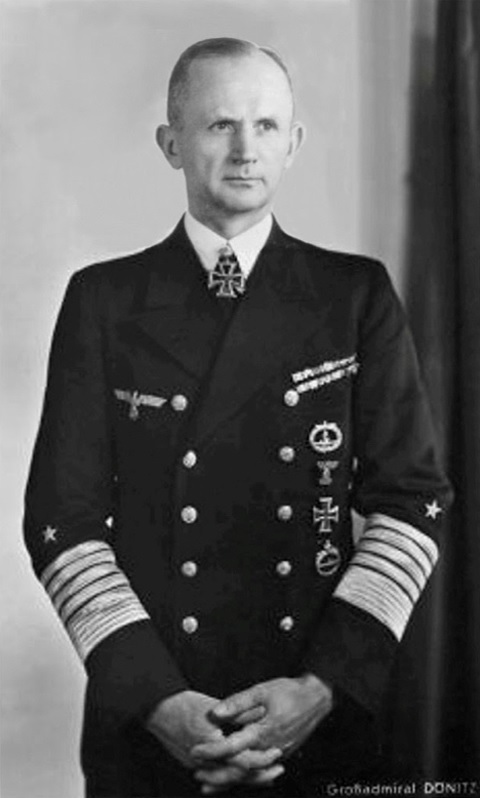
Grand Admiral Karl Dönitz, portrait, April 1943; he became head of state on Hitler's death and spoke in the 1 May 1945 broadcast. Photo: Heinrich Hoffmann, Bundesarchiv, Bild 146-1976-127-06A, via Wikimedia Commons. CC BY-SA 3.0 DE.

2-23 May 1945: the Flensburg government. Dönitz formed a rump government at the Mürwik naval academy near Flensburg on 2 May 1945, with Lutz Graf Schwerin von Krosigk as leading minister; Goebbels, named Reich Chancellor in Hitler's testament, had killed himself along with his wife on 1 May after their children's deaths (see The Reich Ministry of Public Enlightenment and Propaganda, 1933-1945 for the ministry's end). On 4 May, German forces in northwest Germany, the Netherlands and Denmark surrendered to Field Marshal Montgomery at Lüneburg Heath. On the night of 6-7 May, General Alfred Jodl signed an unconditional surrender of all German forces at Reims, effective from 23:01 Central European Time on 8 May; a further, near-identical instrument was signed by Wilhelm Keitel for the OKW in Berlin-Karlshorst in the early hours of 9 May, at Soviet insistence, backdated in its heading to 8 May. Dönitz broadcast the surrender to the German public on 8 May: "German men and women: when I addressed the German nation on May 1 telling it that the Führer had appointed me his successor, I said that my foremost task was to save the lives of the German people... I ordered the German High Command during the night of May 6-7 to sign the unconditional surrender for all fronts... On May 8 at 23 hours the arms will be silent." The decision to announce the death and negotiate the surrender in stages, rather than collapse at once, is credited by several historians with buying the days in which an estimated 1.8 million German soldiers on the Eastern front were able to retreat and surrender to British and American forces rather than to the Red Army.
9 May 1945: the last report. At 20:03 on 9 May, Reichssender Flensburg broadcast the final Wehrmachtbericht of the war: "We bring today the last Wehrmacht report of this war... From the headquarters of the Grand Admiral, 9 May 1945. The High Command of the Wehrmacht announces..." Its opening line described German divisions as having, the previous day, "still" been defending the mouth of the Vistula and the Frische Nehrung — heroic defense reported after the surrender that ended the war had already been signed. Historians Wolfram Wette and Daniel Uziel identify this final communiqué as a founding document of the postwar "clean Wehrmacht" myth: the claim, sustained by veterans' organisations and much popular memory for decades afterward, that the army had fought honourably to the end and had no part in the regime's crimes.
23 May 1945. British troops of the Cheshire Regiment stormed the Mürwik naval school and arrested the Flensburg government's remaining members, including Jodl; twelve "Grade 1" prisoners were taken. With that arrest, the OKW, and with it the institution that had issued the Wehrmachtbericht, ceased to exist.
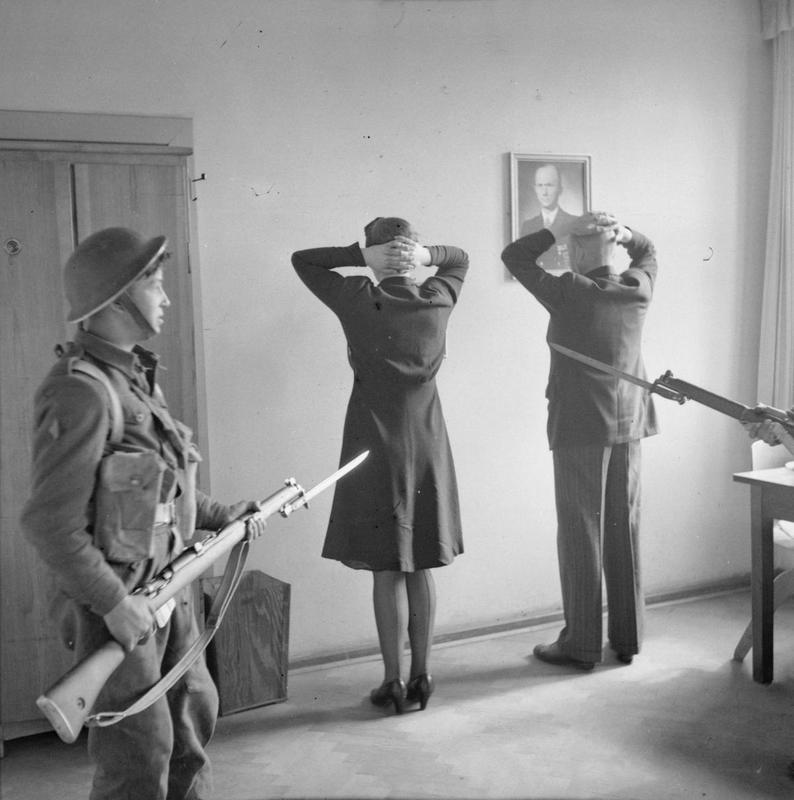
British troops guard detainees at Mürwik, Flensburg, 23 May 1945, during the arrest of the Dönitz government; a portrait of Dönitz hangs on the wall. Imperial War Museum, BU 6693, via Wikimedia Commons. Public domain.

How it works
- Euphemism / doublespeak: "Frontbegradigung," "Absetzbewegung" and "planmässige Absetzbewegung" replaced retreat with the vocabulary of a plan; the language of "elastic defense" persisted for operations that had lost the reserves and the freedom of movement the doctrine requires; "heroic defense" outlived the positions it described, down to the very last report on 9 May.
- Glittering generalities: "Endsieg" — final victory — supplied a destination with no operational content behind it, repeated through the Volkssturm's mobilisation of teenagers and old men in autumn 1944 into a war that, by any concrete measure the communiqué itself was reporting, was already lost.
- Fear appeal: from the Nemmersdorf campaign of October 1944 through both of Dönitz's May broadcasts — saving the German people "from destruction by Bolshevists" was still the regime's stated reason for fighting on the day it announced Hitler's death, and remained the stated reason for the days it took to negotiate a staged surrender rather than an immediate one.
- Transfer: "fighting to the last breath... fell for Germany... at the head of his troops" borrowed the dignity of an ordinary soldier's combat death and pasted it onto a suicide in a bunker, at the one moment the fabrication was most useful — the moment authority had to pass to a successor.
- Limited hangout: the 1 May broadcast released the one fact that could no longer be concealed, that Hitler was dead, while withholding the manner of death and using the release to buy time and continued legitimacy for a government whose only remaining purpose, by its own broadcasts, was managing the terms and pace of total defeat.
- Card stacking: the Ardennes offensive's opening advance was headlined; its collapse, and the much larger Vistula-Oder catastrophe that followed within days, were not given comparable prominence — the same selective ordering the ministry applied to the Katyn story on The Reich Ministry of Public Enlightenment and Propaganda, 1933-1945, turned here on the war's own trajectory.
Colour. The Wehrmachtbericht was white propaganda throughout: an openly attributed OKW communiqué, broadcast on state radio under its own name, never disguised as anything else. What changed across 1944-45 was not its source but its relationship to fact — the same openly sourced instrument that had been substantially accurate about early victories became, without ever changing its declared identity, substantially unreliable about the war's last year.
Then and now
The same drift — a military press growing more euphemistic as the war it describes is more plainly lost — is documented in the Confederate press during the final months of the American Civil War, whose wartime illustrated papers and portraiture are covered from a different angle on Union and Confederate print, 1861-1865. As Ulysses S. Grant's Petersburg campaign wore down Robert E. Lee's Army of Northern Virginia through the winter of 1864-65, Richmond's newspapers described a shrinking, starving, increasingly desertion-riddled force in the language of "successful" defense and "strategic" movement, and continued to promise eventual Confederate victory into the war's final weeks; when the government evacuated Richmond on 2-3 April 1865, the city's own presses had given their readers little preparation for the scale of what was happening. The historian J. Cutler Andrews's standard study, The South Reports the Civil War (1970), traces this pattern across the Confederate wartime press as a whole, driven less by central direction — the Confederacy ran no equivalent of the OKW's single daily communiqué — than by editors' own patriotic commitment and, as the war narrowed, by the same shrinking pool of good news to report.
The differences are substantial. The Confederate press was privately owned and never spoke with one official voice the way a single daily OKW communiqué did; its euphemism was a pattern across many editors' choices rather than one institution's evolving house style, and no Confederate broadcast played out an equivalent of the Dönitz succession, since Jefferson Davis was captured in flight rather than handing power to a successor who announced the war's end on the record. What is comparable is the mechanism: a military press that keeps its vocabulary of controlled, purposeful action running well past the point where the action it describes has become simple collapse, because changing that vocabulary means admitting the war is lost before the government itself is ready to say so.
Positions on the record
- The OKW's own rationale. The Wehrmachtbericht was never presented as anything but an official communiqué; its implicit claim was that a report issued daily, in the same authoritative register, by the High Command itself needed no other justification for the language it chose. Dönitz's own broadcasts, on 1 and 8 May 1945, framed his actions throughout as intended to save German lives, presenting the delay in ending the war and the continued fighting in the East as means to that end rather than as an extension of the war for its own sake.
- Contemporaries' scepticism. Allied and neutral monitoring services, including the BBC Monitoring Service at Caversham Park, tracked the communiqué's language as a standing source of intelligence throughout the war, on the working assumption that shifts in its vocabulary tracked the military situation even when its explicit claims did not. Inside Germany, the same erosion of trust that the SD's secret morale reports recorded after Stalingrad (see The Reich Ministry of Public Enlightenment and Propaganda, 1933-1945) continued, though the reports themselves had been discontinued by mid-1944, before the period this page covers in most depth.
- Scholarship. Ian Kershaw's The End: Germany, 1944-45 (2011) is the standard account of the regime's terminal phase and the widening gap between its public language and the war it described. Erich Murawski's Der deutsche Wehrmachtbericht 1939-1945 (Bundesarchiv, 1962) remains the primary documentary edition of the communiqué's full text, including every report from 1 July 1944 to 9 May 1945. Hugh Trevor-Roper's The Last Days of Hitler (1947) established, against the false broadcast account, that Hitler died by suicide; the book is treated here as a foundational but dated work whose specific reconstructions (for example of the exact sequence and timing inside the bunker) have been refined by later historians working from material declassified after 1947, notably in studies drawing on Soviet-held interrogation records not available to Trevor-Roper. Wolfram Wette (The Wehrmacht: History, Myth, Reality, 2002/2006) and Daniel Uziel (The Propaganda Warriors, 2008) trace how the communiqué's own account of its final days, especially the 9 May report, fed the postwar "clean Wehrmacht" myth.
- What is documented. The dates and text of the 1 and 8 May 1945 broadcasts; the dates of the Reims and Berlin-Karlshorst surrender signings; the date, time and opening lines of the last Wehrmachtbericht; the formation and 23 May arrest of the Flensburg government; the specific euphemisms "Frontbegradigung," "Absetzbewegung" and "planmässige Absetzbewegung" in wartime usage.
- What is contested. The precise minute-by-minute sequence inside the bunker on 30 April, and some details of how quickly and by what channel word of Hitler's death reached Dönitz before the broadcast; the exact number of soldiers who reached the West rather than Soviet captivity as a direct result of the staged surrender, commonly given as an estimated 1.8 million but stated in the sources this page draws on without a published methodology behind the figure.
- Not ruled on here. Whether Dönitz personally believed the "hero's death" account he broadcast or knew it to be false at the time; the wider question, addressed on The Reich Ministry of Public Enlightenment and Propaganda, 1933-1945, of how much of German public support for the war by this stage rested on belief in official reporting as opposed to coercion, habituated loyalty or simple absence of alternatives.
Same-method test
The same test — did a collapsing regime's own information apparatus keep issuing purposeful, controlled-sounding language past the point where the events it described had become simple defeat, and did that apparatus itself manage the transition to an admission of loss — applies to the Guomindang press during the last two years of the Chinese Civil War, covered in full on Propaganda of the Chinese Civil War, 1945-1949: land reform, surrender leaflets and the fall of the mainland. As the Nationalist government lost Manchuria, then the Huaihai campaign, then Nanjing and the mainland through 1948-49, its press ran an anti-communist "bandit-suppression" line and pointed to its 1947 constitution and 1948 currency reform as proof of reform and resolve; after the retreat to Taiwan in December 1949, its propaganda described the move not as defeat but as a temporary repositioning under the slogan "反攻大陆" ("counter-attack the mainland"), a claim to eventual reconquest that outlived the war by decades. Euphemism / doublespeak scores in the framing of retreat as repositioning in both cases; Fear appeal scores in the Guomindang's anti-communist "bandit" framing much as it scores in the Wehrmachtbericht's anti-Bolshevik language.
The differences are significant. The Wehrmachtbericht was a single daily institutional voice that named the war lost, in stages, on the record, within days of its regime's actual military defeat; the Guomindang's apparatus never broadcast an admission of final defeat at all, framed the 1949 retreat as indefinitely provisional, and the government it served continued to exist, govern Taiwan and claim to be the legitimate government of China for decades afterward — there was no Guomindang equivalent of a Dönitz broadcast or a 9 May "last report." Where the Wehrmachtbericht's collapse ran to its conclusion in three weeks, the Guomindang's retreat framing never formally concluded at all.
How to spot it
- Track the vocabulary of a military communiqué over time, not just its claims on any single day. A word for "withdrawal" that changes every few months, each time sounding a little more like a plan and a little less like a retreat, is itself the signal.
- Compare what a daily report chooses to headline against what it lets pass in general language. A silence about a defeat, sitting next to a headline about an advance in the same theatre days earlier, is a form of card-stacking even when nothing in the report is an outright lie.
- Watch for how a regime discloses bad news it can no longer hide entirely. A partial admission, timed and framed to protect what remains of its authority, is not the same as an honest account — ask what the admission is being used to buy, and from whom.
- Ask whether the goal a regime states for continuing to fight has changed. When "victory" quietly becomes "saving you from what the enemy will do to you," the communiqué has stopped describing a plan to win and started managing the terms of a losing endgame.
- Note who is left standing to write the last chapter. The institution that issues a war's final communiqué gets to shape how that war is first remembered, which is exactly what the Wehrmachtbericht's own 9 May report did for the "clean Wehrmacht" myth.
Images
| Image | Source | Licence |
|---|---|---|
| Mechanism diagram (above) | Drawn for FRAME from this page's sourced facts (make_diagrams_fall_wehrmachtbericht.py) |
CC BY 4.0, FRAME |
| Grand Admiral Karl Dönitz, portrait, April 1943 | Wikimedia Commons, Bundesarchiv, Bild 146-1976-127-06A, photo: Heinrich Hoffmann | CC BY-SA 3.0 DE |
| Arrest of the Flensburg government at Mürwik, 23 May 1945 (General Jodl among those detained; a portrait of Dönitz visible in the background) | Wikimedia Commons, Imperial War Museum (BU 6693) | Public domain |
Image gaps
- The German Instrument of Surrender, 7-8 May 1945 (the signed pages). Identified and licence-checked: Wikimedia Commons hosts scans of the National Archives and Records Administration original (catalog.archives.gov/id/6943512), tagged public domain as a U.S. federal government work. Downloads of the full-resolution file from this build environment were repeatedly rate-limited by the Wikimedia CDN ("Too many requests" / "use thumbnail sizes"; thumbnail requests for this specific file also failed). This gap can be filled on a future run from an environment without that rate limit.
- A photograph of the Wehrmachtbericht being read on air, or of the Reichssender Flensburg/Hamburg studio in 1945. No openly licensed photograph of the broadcast itself was found; radio studio interiors from this period are not well represented in openly licensed archives.
- The Lüneburg Heath surrender signing, 4 May 1945. Period photographs exist (Imperial War Museum collection) but a specific openly licensed file was not verified for hosting within the time available for this page. Could be filled from a further Commons or IWM search.
- Erich Murawski's 1962 documentary volume, or a period printed Wehrmachtbericht text. No openly licensed scan was found; the Bundesarchiv edition is a copyrighted modern publication, not an open-access primary source.
Sources
- Erich Murawski, Der deutsche Wehrmachtbericht 1939-1945: ein Beitrag zur Untersuchung der geistigen Kriegführung, mit einer Dokumentation der Wehrmachtberichte vom 1.7.1944 bis 9.5.1945 (Schriften des Bundesarchivs, Bd. 9, Boldt, 1962; 2nd ed.)
- Ian Kershaw, The End: Germany, 1944-45 (Allen Lane / Penguin, 2011)
- Hugh Trevor-Roper, The Last Days of Hitler (Macmillan, 1947; many later editions)
- Wolfram Wette, The Wehrmacht: History, Myth, Reality (Harvard University Press, 2006; German original 2002)
- Daniel Uziel, The Propaganda Warriors: The Wehrmacht and the Consolidation of the German Home Front (Peter Lang, 2008)
- Last Wehrmacht report, 9 May 1945, Reichssender Flensburg (audio, Internet Archive); May 9, 1945 Deutscher Rundfunk, "Letzter Wehrmachtsbericht" (audio, Internet Archive)
- Karl Dönitz, broadcast to the German nation, 1 May 1945 (text, discussion); Jewish Virtual Library, "Doenitz Announces Hitler's Death"
- Karl Dönitz, broadcast informing the German people of unconditional surrender, 8 May 1945 (text); Jewish Virtual Library, "Final Communique of the German High Command"
- German Instrument of Surrender, 7 May 1945 (Wikisource); Definitive German Instrument of Surrender, 8 May 1945 (Wikisource); National Archives catalog record for the signed instrument
- Flensburg Government (overview, formation 2 May, dissolution/arrest 23 May 1945); National WWII Museum, "Nazi Germany's Last Leader: Admiral Karl Dönitz"
- Volkssturm formation and announcement, 25 September - 18 October 1944
- J. Cutler Andrews, The South Reports the Civil War (Princeton University Press, 1970), for the Confederate-press comparison in "Then and now"
- Werner Löffler, Mein Kriegstagebuch 1944-1945: Unsere Absetzbewegung aus Frankreich nach der Landung der Alliierten (Verlag Rockstuhl), a soldier's wartime diary whose title uses "Absetzbewegung" for the August 1944 retreat from France, cited here as evidence of the term's contemporary currency
- This page's parent institution, the Reich Ministry of Public Enlightenment and Propaganda, and the Nemmersdorf and Frontbegradigung/Absetzbewegung material it documents in more depth: The Reich Ministry of Public Enlightenment and Propaganda, 1933-1945