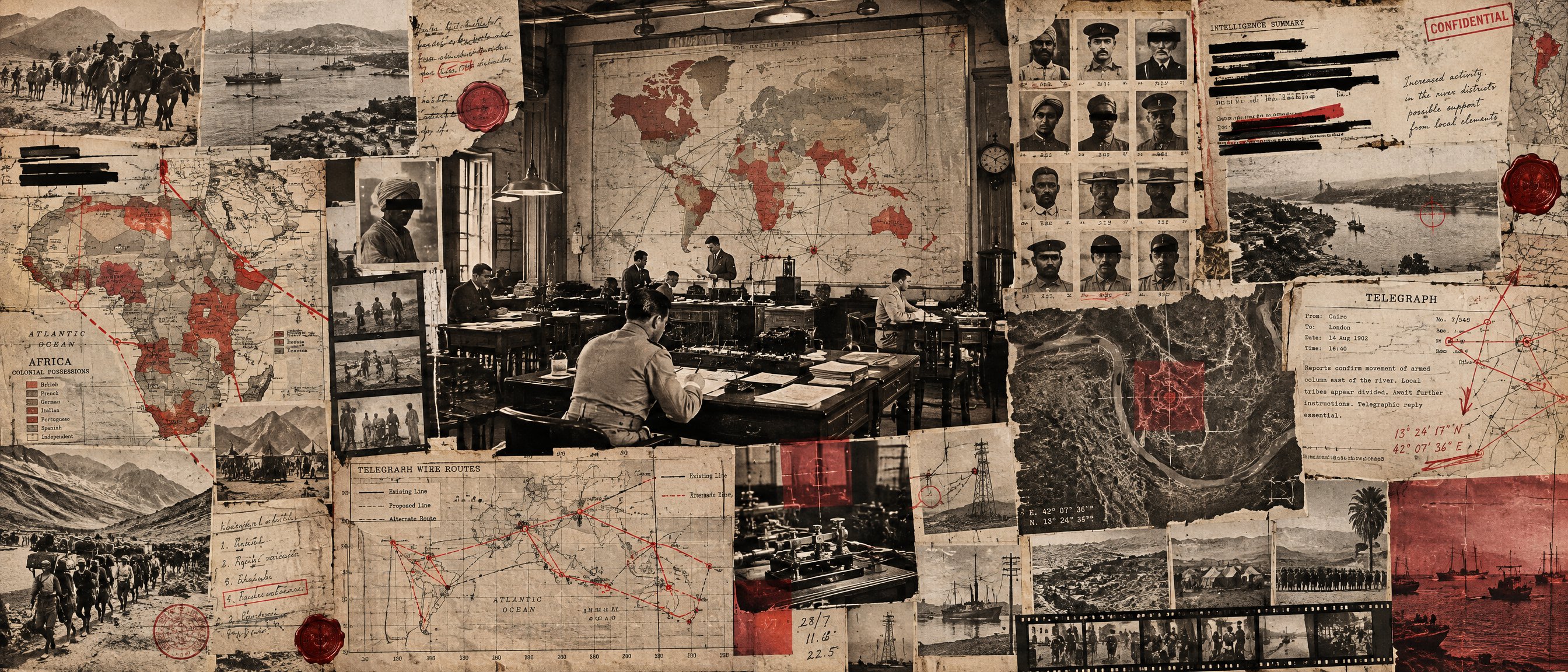
Content note: this page shows an 1864 racist caricature with dialect speech and a slur, a Confederate etching that pictures the Haitian Revolution as a massacre, and a photograph of a starving prisoner of war.
In one line: both sides of the American Civil War sold the war on cheap paper: flag envelopes, lithographs, illustrated weeklies and photographs of starved prisoners; and in the 1864 election a pamphlet written by Democratic journalists posing as advocates of racial "blending" coined the word "miscegenation" to use against Lincoln.
Content note: Racist caricature of Black people, with a slur. This object is shown as it was published. Why 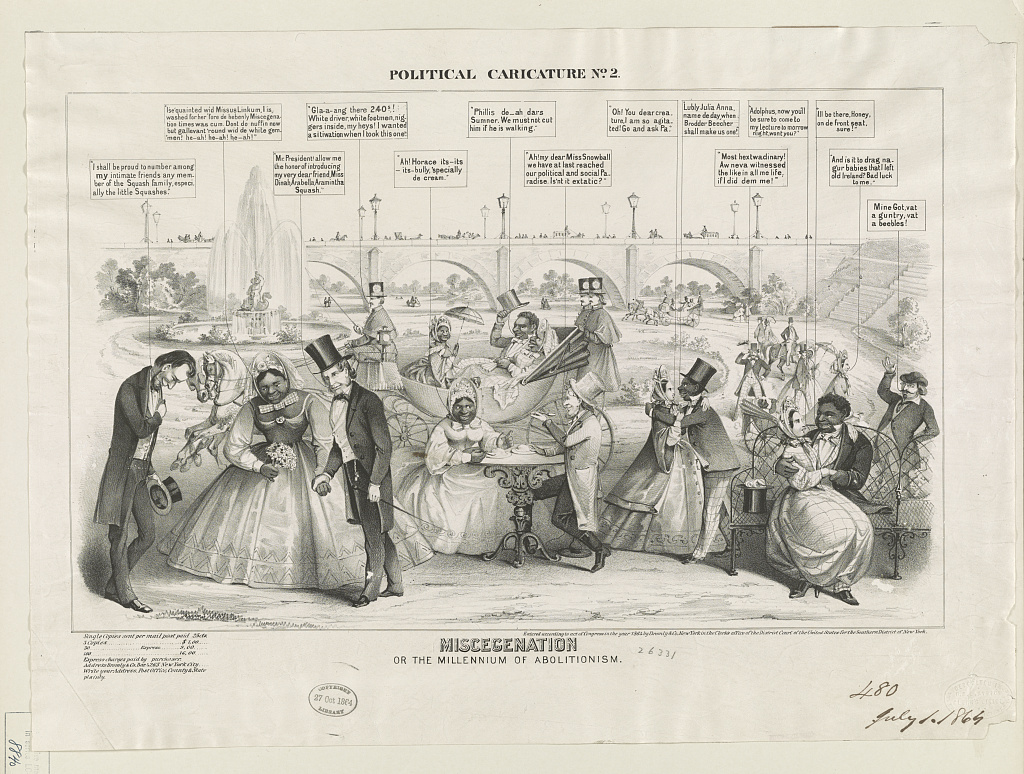
"Political caricature No. 2: Miscegenation or the millennium of abolitionism", G. W. Bromley & Co., New York, deposited for copyright 1 July 1864. An anti-Lincoln Democratic campaign print, sold at 25 cents a copy. Library of Congress. Public domain.
What happened
- April 1861 onward. After Fort Sumter, a craze for pictorial "patriotic envelopes" (covers) spreads in both sections. Steven R. Boyd's study counts thousands of Union designs against a much smaller Confederate output, which reflects the North's printing plants and paper supply, not a difference in intent. Most date from 1861-62.
- 1861-1865. Name wars. Republicans call anti-war Democrats "Copperheads", after the venomous snake; some Peace Democrats answer by wearing copper Liberty-head pennies as badges. Democrats call their opponents "Black Republicans". Confederate papers call Union troops "Yankee" invaders and "Hessians"; Union papers call Confederates "rebels" and "traitors".
- 21 March 1861. Confederate Vice-President Alexander Stephens says in Savannah (the "Cornerstone Speech") that the new government rests on the principle that the Black man is not equal to the white man and that slavery is his natural condition. Several secession declarations say the same in their own words; Mississippi's (January 1861) states: "Our position is thoroughly identified with the institution of slavery."
- 1862-1865. The Southern Illustrated News (Richmond) tries to give the Confederacy its own illustrated weekly, with portraits of generals and war news; it is short of trained engravers and paper. In New York, Harper's Weekly and Frank Leslie's Illustrated Newspaper run weekly battle engravings. Thomas Nast joins Harper's in 1862.
- 1 January 1863. The final Emancipation Proclamation takes effect.
- 30 April 1863. The Confederate Congress adopts a national seal: George Washington on horseback, with the motto Deo Vindice ("with God as our vindicator"). It is cut in London by Joseph S. Wyon and reaches Richmond in 1864.
- June 1863. General Ambrose Burnside suspends the Democratic Chicago Times for disloyal publication; Lincoln revokes the order within days. The arrest of the Ohio Peace Democrat Clement Vallandigham (May 1863) becomes a Democratic rallying point against "military despotism".
- Late 1863 (title page dated 1864). Miscegenation: The Theory of the Blending of the Races, Applied to the American White Man and Negro appears anonymously in New York. It poses as a sincere Republican-abolitionist tract urging racial intermarriage. Its authors were David Goodman Croly and George Wakeman of the Democratic New York World. They sent copies to prominent abolitionists to draw endorsements that could be quoted against the Republicans. Democratic speakers and papers then cited it as the Republican programme. Its authorship was not acknowledged during the campaign.
- 1864. Adalbert J. Volck, a German-born Baltimore dentist and Confederate sympathiser living in Union-held Maryland, issues his etchings under the pseudonym "V. Blada". The Library of Congress catalogue gives the imprint as "London [i.e. Baltimore], 1864": the title page named a foreign city.
- May-September 1864. Prisoners. Photographs of emaciated Union soldiers released from Belle Isle and other Richmond prisons, taken at the U.S. General Hospital in Annapolis, are published by Congress's Joint Committee on the Conduct of the War (Returned Prisoners, 1864) and by the U.S. Sanitary Commission in its Narrative of Privations and Sufferings of United States Officers and Soldiers While Prisoners of War in the Hands of the Rebel Authorities (Philadelphia, 1864). Engravings from them run in the illustrated press.
- 29-31 August 1864. The Democratic convention in Chicago nominates George B. McClellan on a platform calling for "a cessation of hostilities" after "four years of failure to restore the Union by the experiment of war". McClellan's acceptance letter of 8 September rejects an armistice without Union.
- 2-3 September 1864. Atlanta falls. Harper's Weekly (issue of 3 September) prints Nast's Compromise with the South, "Dedicated to the Chicago Convention".
- July-November 1864. Campaign prints on both sides. Currier & Ives, which sold to both parties, publishes the pro-McClellan The True Issue. Bromley publishes the numbered anti-Lincoln "Political caricature" series. M. W. Siebert publishes the pro-Lincoln Union and Liberty! And Union and Slavery!
- 8 November 1864. Lincoln is re-elected with 212 electoral votes to McClellan's 21.
- March 1865. A Confederate congressional joint select committee on prisoners replies to the Northern publications, contrasting them with conditions at Northern camps and blaming the Union for ending exchanges.
- 10 November 1865. Henry Wirz, commandant at Andersonville, is hanged after a military trial. Postwar, the Southern Historical Society Papers (from 1876) republish the Confederate case on prisons, focusing on Elmira and Camp Douglas.
How it works
- Transfer: both sides borrowed the same founding symbols. Union envelopes set George Washington above the word "Union"; the Confederate seal put Washington on horseback at its centre. Each claimed the Revolution's prestige. The borrowing ran to stigma too. Volck's Emancipation Proclamation (below) puts a devil on Lincoln's desk holding the inkwell, and hangs a haloed "St. Ossawotamie" (John Brown) on the wall, moving the stigma of Brown's 1859 raid onto the Proclamation.
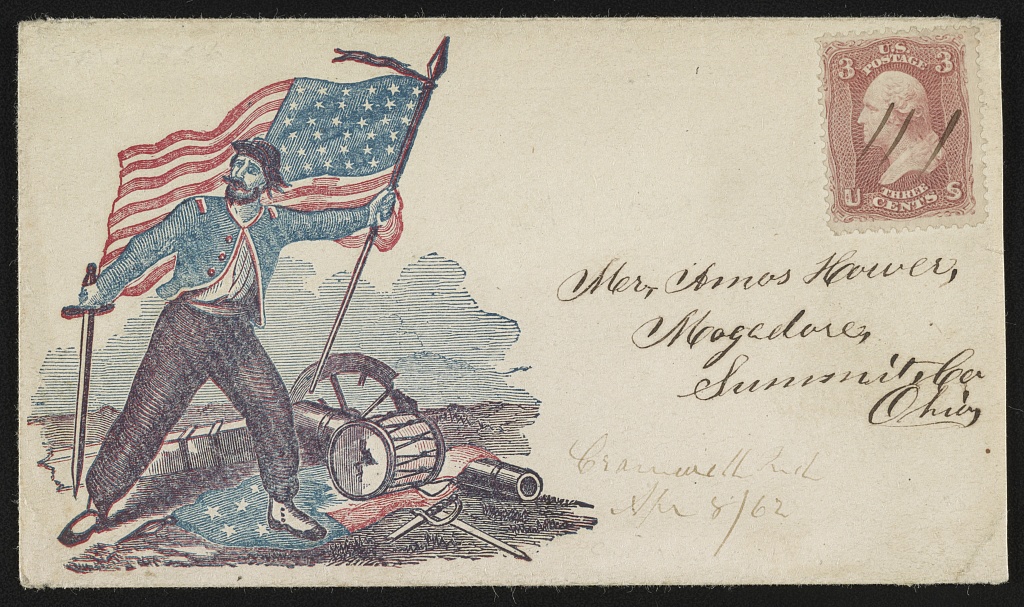
Union patriotic envelope, 1861-62, posted in April 1862 to Mogadore, Ohio. Publisher not identified. Library of Congress. Public domain.
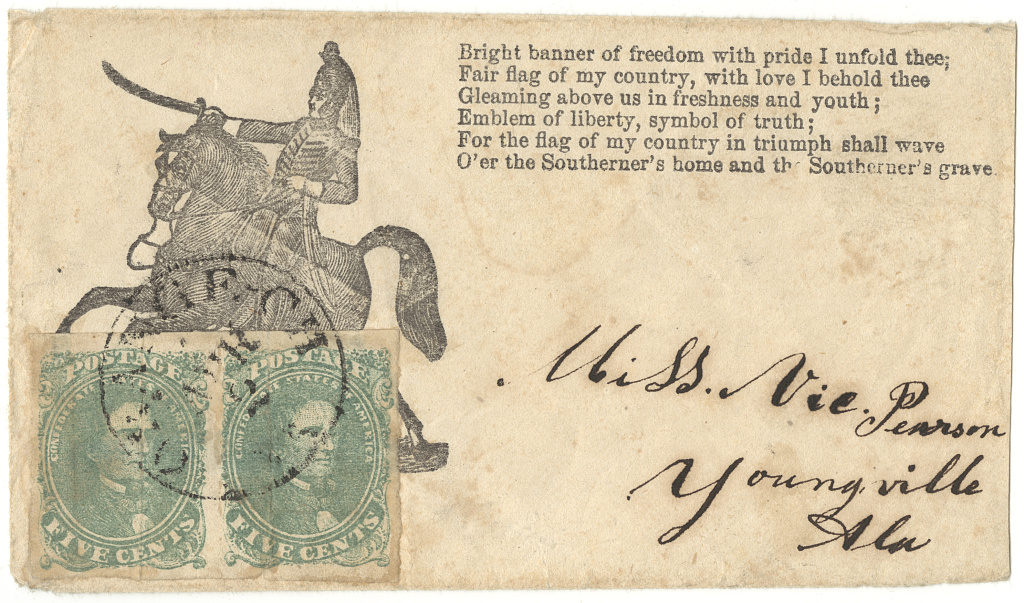
Confederate patriotic envelope with verse, addressed to Youngville, Alabama, franked with two five-cent Confederate stamps (the stamps date it to 1862 or later). Publisher not identified. Library of Congress. Public domain.
- Glittering generalities: the envelopes carried slogans with no testable claim in them. Northern covers read "The Union and the Constitution", "Our Union forever" and "Union forever. Separation never". The Confederate cover above calls its flag "Emblem of liberty, symbol of truth", waving "O'er the Southerner's home and the Southerner's grave". Both name virtues in place of a claim that could be checked, such as what the war was for.
- Name-calling: "Copperhead", "Black Republican", "Yankee", "Hessian", "rebel", "traitor". Each label asks the reader to reject a group before weighing its argument. The word "miscegenation" was itself a coinage built to work as a label: a new Latin-looking term for "race-mixing" that could be pinned on Republicans.
- Fear appeal: the Democratic miscegenation prints staged racial equality as a social catastrophe for white Northern voters (the Bromley print above: Lincoln bowing to a Black woman, an Irish nurse complaining that she must push a Black baby). Volck's plate has a painting labelled "St. Domingo" on the wall, the Haitian Revolution shown as a massacre, presenting emancipation as a coming slave insurrection. Nast's Compromise with the South stages the opposite fear for Republicans: that a Democratic peace would mean a humbled Union veteran, a weeping Columbia, and, behind the Confederate, a kneeling Black family, generally read as a return to slavery.
Content note: Etching that includes a scene of a massacre in Haiti, used to stir racial fear. This object is shown as it was published. Why 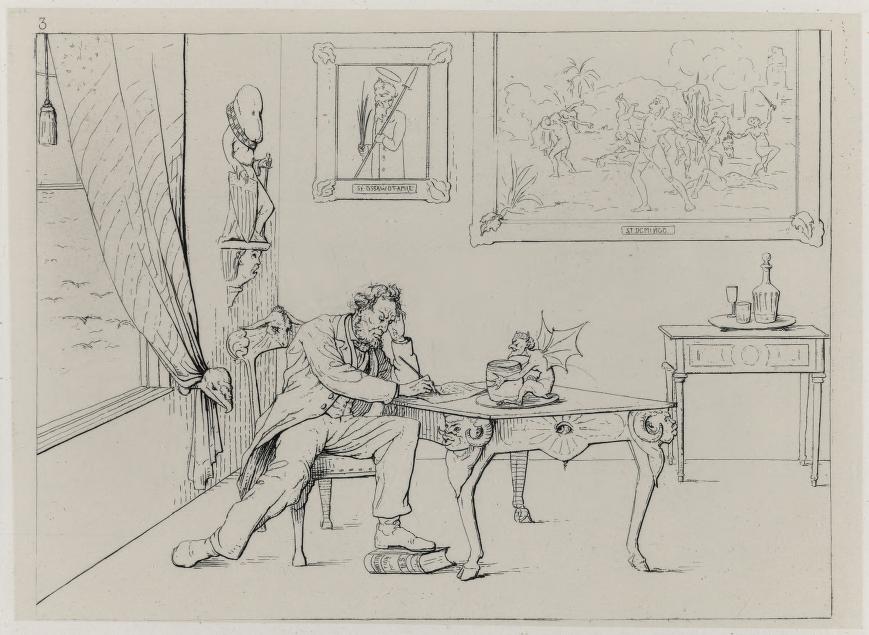
Adalbert J. Volck ("V. Blada"), "The Emancipation Proclamation", etching, pl. 25 of V. Blada's War Sketches, imprint "London [i.e. Baltimore]", 1864. Library of Congress. Public domain.
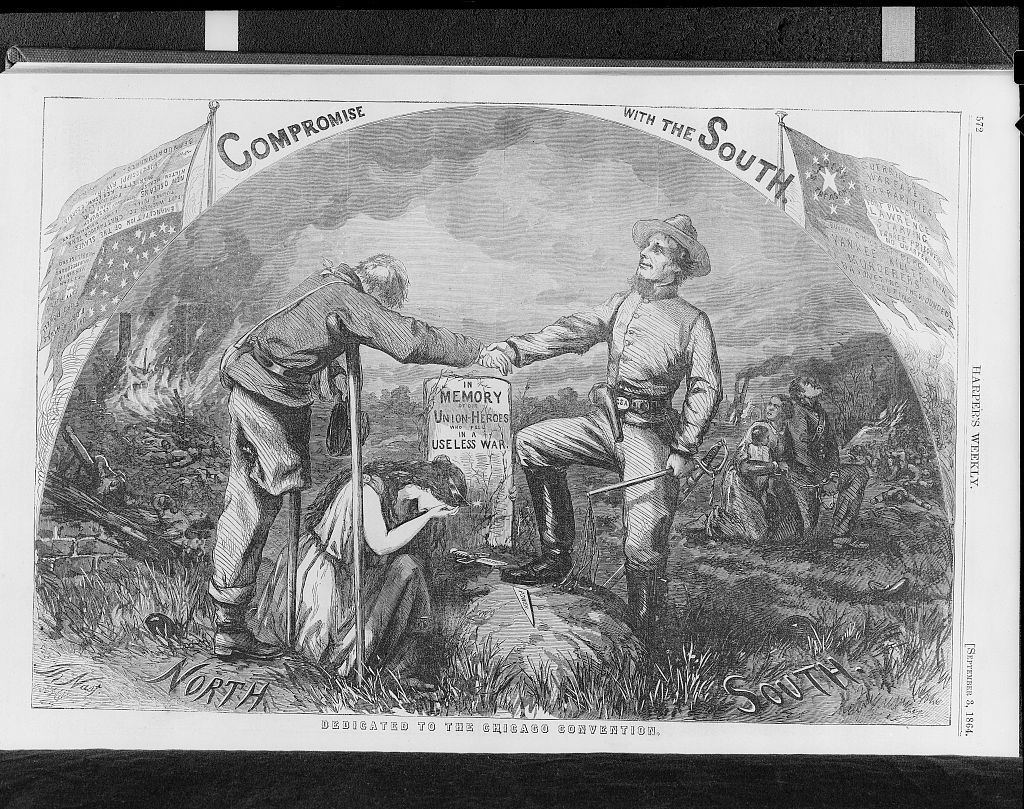
Thomas Nast, "Compromise with the South. Dedicated to the Chicago Convention", Harper's Weekly, 3 September 1864, p. 572. Library of Congress. Public domain.
- Card stacking: the 1864 campaign prints reduce each party to one scene. Siebert's Union and Liberty! sets Lincoln with a white worker and a mixed schoolhouse against McClellan shaking hands with Jefferson Davis beside a slave auction. Currier & Ives's The True Issue shows Lincoln ("No peace without Abolition!") and Davis ("No peace without Separation!!") tearing the map, with McClellan alone holding it together. Each print picks the opponent's most damaging position and leaves out the rest of his stated one: McClellan's acceptance letter rejected peace without Union, which the Siebert print omits, while The True Issue reduces Lincoln to the abolition condition alone, though his July 1864 "To Whom It May Concern" letter named restoration of the Union and the abandonment of slavery together as the terms he would receive. The prisoner material stacks in the same way on both sides (see below).
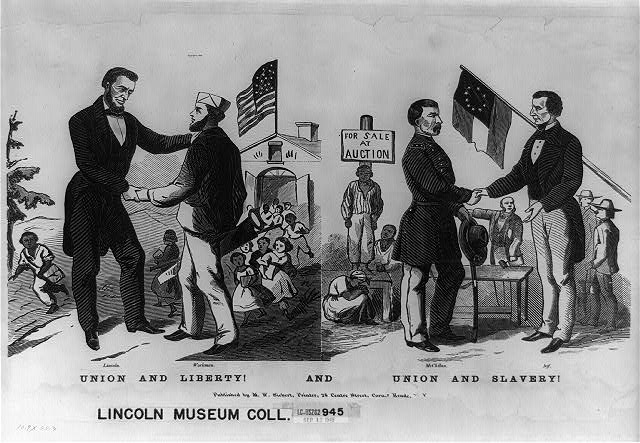
"Union and Liberty! And Union and Slavery!", M. W. Siebert, New York, 1864. Pro-Lincoln campaign print. Library of Congress. Public domain.
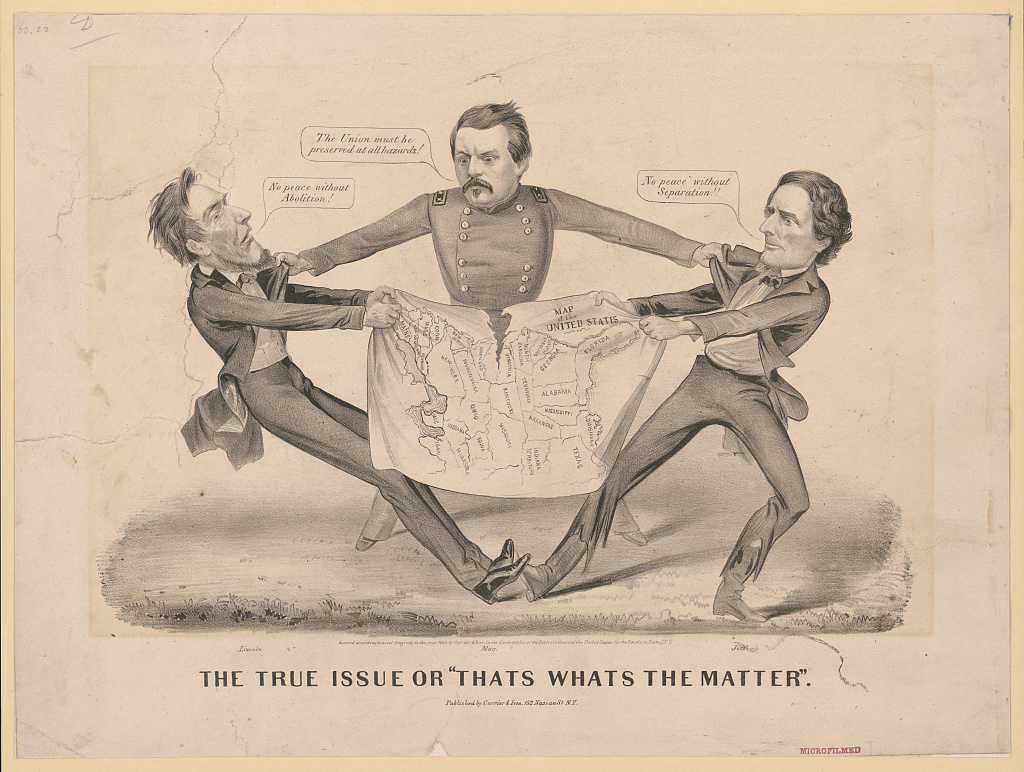
"The True Issue or 'That's what's the matter'", Currier & Ives, New York, 1864. Pro-McClellan campaign print. Library of Congress. Public domain.
- Astroturfing: the definition covers "personas... that are not what they claim". Miscegenation is a single pamphlet, not a crowd, so it is a narrow fit, but it is the persona case: a text written by opposition journalists in the voice of the Republican-abolitionist camp, seeded to real abolitionists for endorsements, then quoted by Democrats as the other side's own programme. By Jowett and O'Donnell's colours it is black propaganda: its source is falsified.
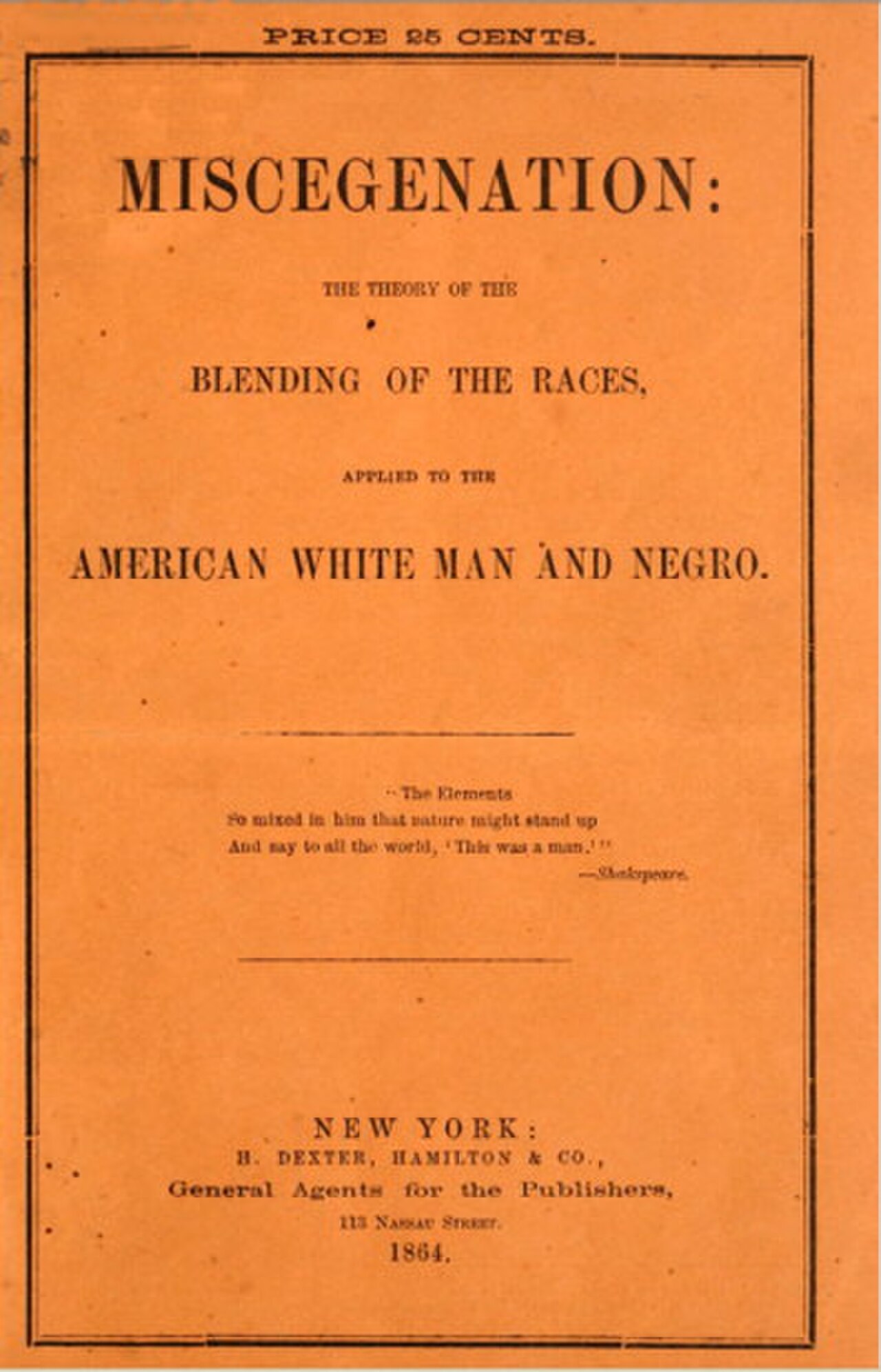
Cover of the anonymous pamphlet Miscegenation (New York: H. Dexter, Hamilton & Co., 1864), written by David Goodman Croly and George Wakeman. Wikimedia Commons. Public domain.
The prison photographs and the reply
Content note: Photograph of a starving prisoner of war. This object is shown as it was published. Why 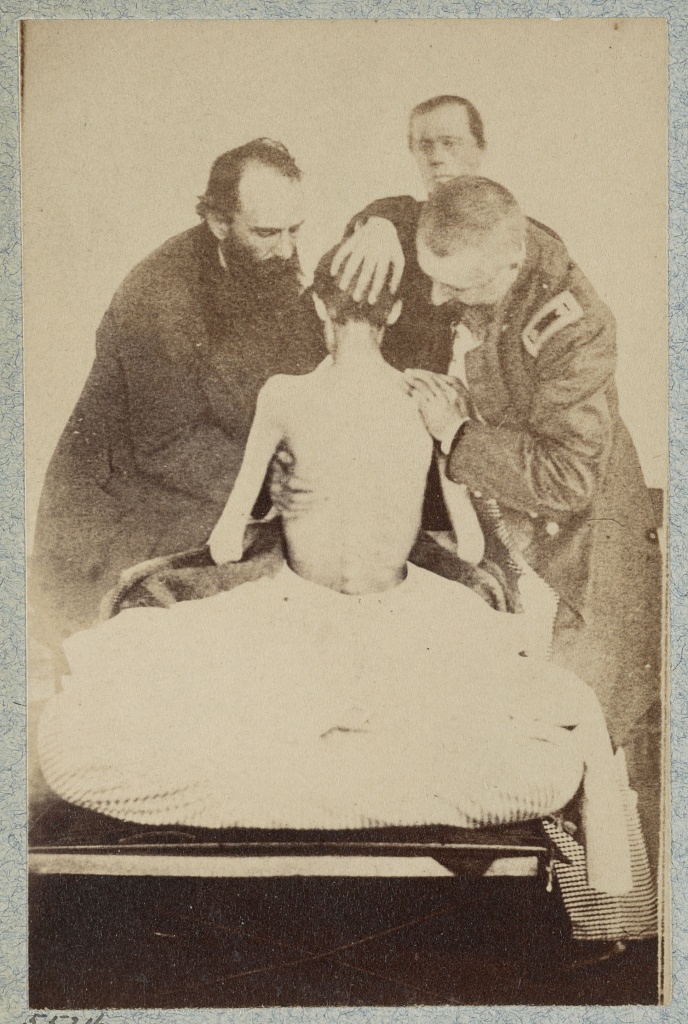
Private Isaiah G. Bowker, Co. B, 9th Maine Volunteers, a released Belle Isle prisoner, at the U.S. General Hospital, Division 1, Annapolis, 1864 (print made in the 1880s). Photographer unknown. Library of Congress. Public domain.
The Annapolis men were real, and their condition is documented by the photographs and by the hospital's own records. What made the photographs messaging was the frame: they were issued as proof of deliberate "rebel" cruelty, a claim the Joint Committee and the Sanitary Commission put forward, in the same months that exchanges were stopped. The exchange cartel had broken down in 1863, in part over the Confederacy's refusal to treat captured Black soldiers as prisoners of war, and in 1864 Grant kept exchanges suspended. The Northern publications left the exchange question and conditions in Union camps largely out of the account.
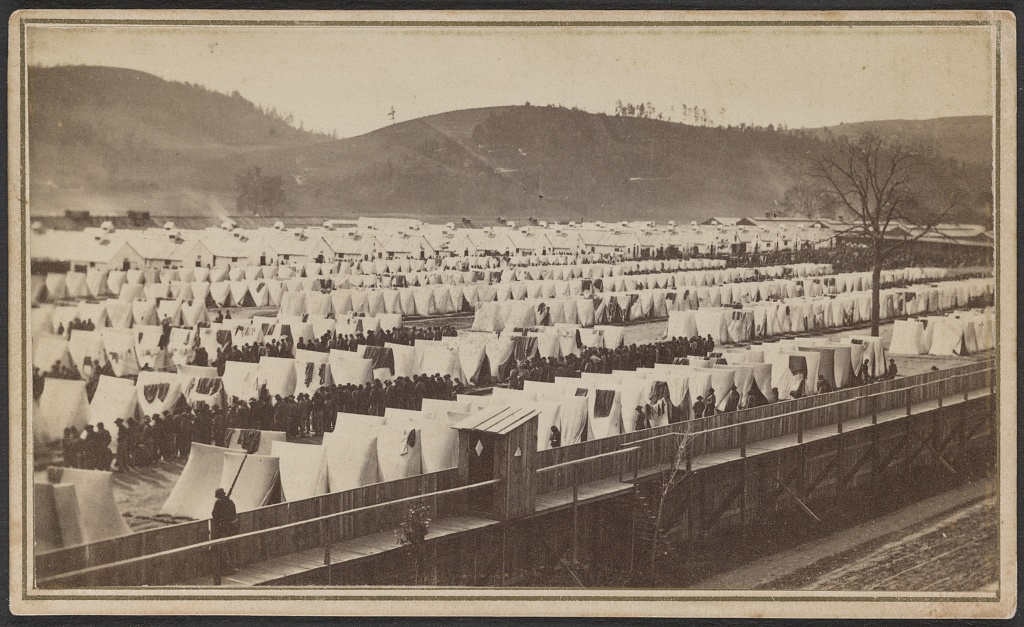
Elmira prison camp, Elmira, New York, 1864-65. Moulton & Larkin, photographers. Library of Congress. Public domain.
The Confederate reply did the mirror image. The 1865 congressional report, and later the Southern Historical Society Papers, dwelt on Elmira and Camp Douglas and on the Union's halt to exchanges, and attributed hardship in Southern prisons to shortages that Confederate soldiers also suffered, rather than to policy. Modern counts show that both prison systems killed on a large scale: of the order of 30,000 Union prisoners died in Confederate hands and 26,000 Confederate prisoners in Union hands (Speer). Andersonville held some 45,000 men over its existence and nearly 13,000 died there; Elmira, a camp of about 12,000, lost close to a quarter of its prisoners. The totals are comparable; the worst single camp was Confederate. The finding here is that each side's print selected the other side's camps.
Then and now
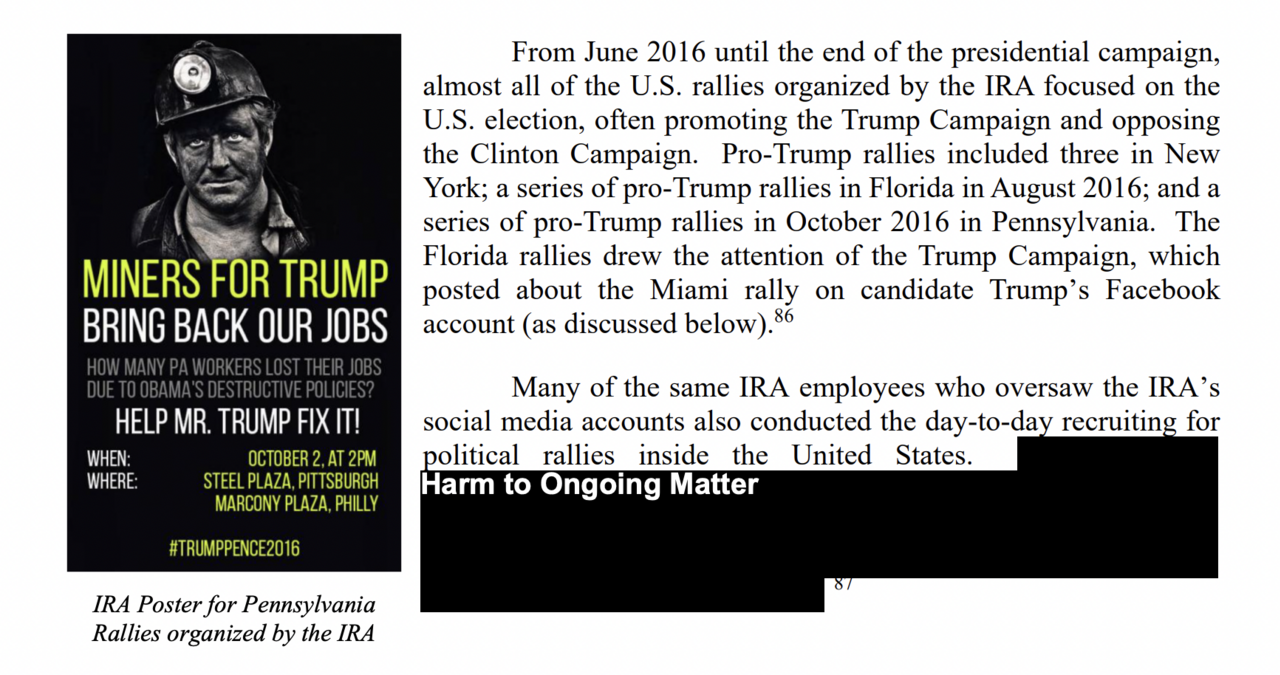
'Miners for Trump' rally poster (Internet Research Agency), Internet Research Agency, 2016, as reproduced in the Special Counsel's report. Public domain (U.S. government work).
The Miscegenation pamphlet and the 2016 "Miners for Trump" posters share one move: material made by one camp is presented as the voice of another, so that its content is read as that group's own position. The differences are large. Croly and Wakeman were American journalists acting in a domestic election for their own party; the Internet Research Agency was a foreign company running many fake accounts and recruiting real Americans to rallies. The 1864 hoax impersonated its opponents in order to discredit them; the 2016 posters impersonated supporters of the candidate they promoted. One pamphlet is not a network. For the atrocity side, the Belle Isle photographs belong to the same family as Remember Belgium — Enlist To-Day: real suffering presented as a verdict on the whole enemy. The earlier pamphlet wars in The English Civil War pamphlet war, 1641-1649 and Join or Die to the Boston Massacre: patriot and loyalist print, 1754-1783 used the same forms at smaller scale.
Positions on the record
- The Union government and Republicans: the war was to preserve the Union against an unlawful rebellion; from 1863, emancipation was a war measure. The 1864 Republican (National Union) platform called for a constitutional amendment ending slavery.
- Northern Democrats: they stood for "the Union as it was, the Constitution as it is", opposed emancipation and conscription, and charged the administration with arbitrary arrests and press suppression. The 1864 platform called the war a failure; its Peace wing wanted an armistice; McClellan himself insisted on Union first.
- The Confederacy: it described secession as the exercise of state sovereignty and self-defence against invasion. Its founders' own statements, including Stephens's Cornerstone Speech and the Mississippi declaration, name the protection of slavery as central.
- What historians say: Weber argues that the Peace Democrats were a serious threat to the Union war effort in 1863-64; Neely stresses that two-party competition, and a vigorous opposition press, continued in the North throughout the war. Kaplan and Lemire document the Miscegenation hoax and its uptake. Neely, Holzer and Boritt discuss Volck's etchings and their small, private circulation. Most historians credit military news, especially Atlanta, over campaign prints for the 1864 result.
- This archive's reading: documented: the prints, their publishers and dates; Croly and Wakeman's authorship; the Annapolis photographs and their subjects; mortality in both prison systems. Not shown: that any single print moved a measurable number of votes. The record is lopsided in volume: Northern print survives in far greater quantity because the North had more presses, paper and engravers. Thinner Confederate survival does not show that Confederate messaging was milder.
Same-method test
If a Republican editor had written a fake Democratic pamphlet urging the restoration of the slave trade and seeded it to Democratic leaders, it would be black propaganda and tagged the same way as Miscegenation. Nast's grave and Bromley's park are both fear-appeals for the same reason, though they aim at opposite fears. The Union's Belle Isle pictures and the Confederacy's Elmira accounts are both card-stacking: each is accurate about its own evidence and silent about the other camp.
How to spot it
- Ask who wrote it. An unsigned tract that states the other side's "real" programme in that side's own voice is a question about origin first.
- Put the rival prints next to each other. The True Issue and Union and Liberty! each show one candidate's worst reading; the candidates' own letters and platforms are on the record.
- For atrocity images, keep two questions apart: is the suffering real (here it was), and does the picture show who is responsible and what was left out?
- Check the counts for both sides before accepting a verdict about one side's camps.
Images
| Image | Source | Licence |
|---|---|---|
| Miscegenation or the millennium of abolitionism, Bromley & Co. (1864) | Library of Congress | Public domain (no known restrictions) |
| Union envelope, soldier trampling Confederate flag (1861-62) | Library of Congress | Public domain (no known restrictions) |
| Confederate envelope, dragoon with verse (1862-65) | Library of Congress | Public domain (no known restrictions) |
| Volck, The Emancipation Proclamation (1864) | Library of Congress | Public domain (no known restrictions) |
| Nast, Compromise with the South, Harper's Weekly (1864) | Library of Congress | Public domain (no known restrictions) |
| Siebert, Union and Liberty! And Union and Slavery! (1864) | Library of Congress | Public domain (no known restrictions) |
| Currier & Ives, The True Issue (1864) | Library of Congress | Public domain (no known restrictions) |
| Miscegenation pamphlet cover (1864) | Wikimedia Commons | Public domain (PD-old) |
| Pvt. Isaiah G. Bowker, Annapolis (1864) | Library of Congress | Public domain (no known restrictions) |
| Elmira prison camp, Moulton & Larkin (1864-65) | Library of Congress | Public domain (no known restrictions) |
| Miners for Trump (2016) | FRAME gallery | Public domain (U.S. government work) |

Image gaps
- The Southern Illustrated News. Public domain, but no page image was found in the Library of Congress picture collections or on Commons for this build. Fillable from a digitised run.
- A Confederate recruiting broadside. None turned up in the LOC Prints and Photographs search used here; state archives hold examples. Fillable.
- The Confederate seal. A photograph is on Commons, but its photographer and licence basis were not clear enough to use for a photograph of a three-dimensional object.
- Camp Douglas and Andersonville. The LOC holds public-domain photographs of both (for example, Confederate prisoners at Camp Douglas, 1862-65); they were not added for length. Fillable.
- The Sanitary Commission Narrative plates and the Confederate 1865 report. Both public domain; no single-page scans were taken for this build.
- Bromley's other numbered caricatures and The Miscegenation Ball (1864). In the LOC; not added to avoid repeating the same racist imagery without new evidence.
Sources
- Library of Congress, Prints and Photographs Division, catalogue records for the items above, including Bernard F. Reilly's descriptions from American Political Prints, 1766-1876: A Catalog of the Collections in the Library of Congress (G. K. Hall, 1991), entries 1864-27, 1864-28 and 1864-38.
- [Anonymous] (David Goodman Croly and George Wakeman), Miscegenation: The Theory of the Blending of the Races, Applied to the American White Man and Negro (New York: H. Dexter, Hamilton & Co., 1864).
- V. Blada [Adalbert J. Volck], V. Blada's War Sketches (imprint "London" [Baltimore], 1864).
- Harper's Weekly, 3 September 1864, p. 572.
- U.S. Congress, Joint Committee on the Conduct of the War, Returned Prisoners (38th Congress, 1st session, 1864).
- U.S. Sanitary Commission, Narrative of Privations and Sufferings of United States Officers and Soldiers While Prisoners of War in the Hands of the Rebel Authorities (Philadelphia: King & Baird, 1864).
- Confederate States Congress, Report of the Joint Select Committee Appointed to Investigate the Condition and Treatment of Prisoners of War (Richmond, 1865).
- Democratic Party platform, Chicago, 29 August 1864; George B. McClellan, letter accepting the nomination, 8 September 1864.
- Alexander H. Stephens, speech at Savannah, 21 March 1861; Mississippi, A Declaration of the Immediate Causes Which Induce and Justify the Secession of the State of Mississippi from the Federal Union (1861).
- Sidney Kaplan, "The Miscegenation Issue in the Election of 1864", Journal of Negro History 34 (1949).
- Elise Lemire, "Miscegenation": Making Race in America (University of Pennsylvania Press, 2002).
- Steven R. Boyd, Patriotic Envelopes of the Civil War: The Iconography of Union and Confederate Covers (Louisiana State University Press, 2010).
- Mark E. Neely Jr., Harold Holzer and Gabor S. Boritt, The Confederate Image: Prints of the Lost Cause (University of North Carolina Press, 1987).
- Mark E. Neely Jr., The Union Divided: Party Conflict in the Civil War North (Harvard University Press, 2002).
- Jennifer L. Weber, Copperheads: The Rise and Fall of Lincoln's Opponents in the North (Oxford University Press, 2006).
- James M. McPherson, Battle Cry of Freedom: The Civil War Era (Oxford University Press, 1988).
- Lonnie R. Speer, Portals to Hell: Military Prisons of the Civil War (Stackpole, 1997).
- Charles W. Sanders Jr., While in the Hands of the Enemy: Military Prisons of the Civil War (Louisiana State University Press, 2005).
- Alice Fahs, The Imagined Civil War: Popular Literature of the North and South, 1861-1865 (University of North Carolina Press, 2001).
- Garth S. Jowett and Victoria O'Donnell, Propaganda and Persuasion (SAGE), on white, gray and black propaganda.