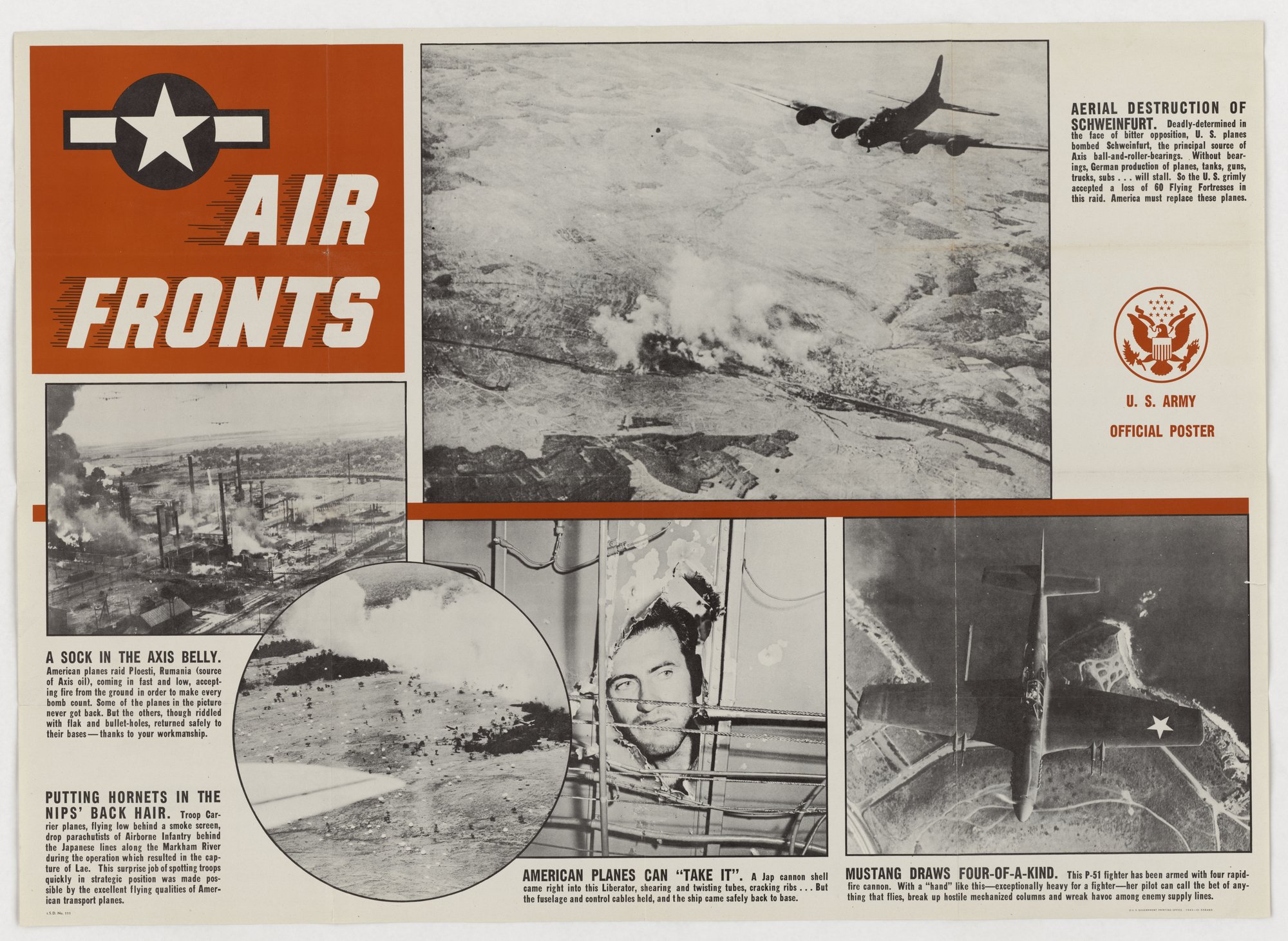
Air Fronts (Aerial Destruction of Schweinfurt, A Sock in the Axis Belly, American Planes Can Take It)
Photo-sheet headed AIR FRONTS: a B-17 over burning Schweinfurt, the Ploesti oil raid, paratroops near Lae, a crewman looking through a flak hole and a P-51 from above. Captions tie each photo to the reader's output ('thanks to your workmanship', 'America must replace these planes') and use slang for the enemy ('Nips', 'Jap'), name-calling alongside selective success reports (card-stacking).
Propaganda techniques used in this poster
- Date
- 1943
- Period
- Second World War
- Made by
- U.S. Army
- Region
- North America
- Country
- United States
- Medium
- Poster
- Issuer type
- Military
- Regime
- Roosevelt Administration
- Leader
- Franklin D. Roosevelt
- Audience
- Domestic public
- Purpose
- Mobilize or secure compliance
- Themes
- War and the military, Home front
- Event
- World War II
- Regime
- Roosevelt administration
- Leader
- Franklin D. Roosevelt
- Source
- Identified Openly sourced: the speaker is who they say they are
- Source
- U.S. National Archives and Records Administration, Record Group 44, World War II Posters, retrieved October 4, 2026
- Rights
- Public domain (U.S. government work)
U.S. Army. National Archives and Records Administration, RG 44, 44-PA-318 (NAID 513765).
Text on the object
AIR FRONTS
AERIAL DESTRUCTION OF SCHWEINFURT. Deadly-determined in the face of bitter opposition, U. S. planes bombed Schweinfurt, the principal source of Axis ball-and-roller-bearings. Without bearings, German production of planes, tanks, guns, trucks, subs . . . will stall. So the U.S. grimly accepted a loss of 60 Flying Fortresses in this raid. America must replace these planes.
A SOCK IN THE AXIS BELLY. American planes raid Ploesti, Rumania (source of Axis oil), coming in fast and low, accepting fire from the ground in order to make every bomb count. Some of the planes in the picture never got back. But the others, though riddled with flak and bullet-holes, returned safely to their bases--thanks to your workmanship.
PUTTING HORNETS IN THE NIPS' BACK HAIR. Troop Carrier planes, flying low behind a smoke screen, drop parachutists of Airborne Infantry behind the Japanese lines along the Markham River during the operation which resulted in the capture of Lae. This surprise job of spotting troops quickly in strategic position was made possible by the excellent flying qualities of American transport planes.
AMERICAN PLANES CAN "TAKE IT". A Jap cannon shell came right into this Liberator, shearing and twisting tubes, cracking ribs . . . But the fuselage and control cables held, and the ship came safely back to base.
MUSTANG DRAWS FOUR-OF-A-KIND. This P-51 fighter has been armed with four rapid-fire cannon. With a "hand" like this--exceptionally heavy for a fighter--her pilot can call the bet of anything that flies, break up hostile mechanized columns and wreak havoc among enemy supply lines.
U. S. ARMY OFFICIAL POSTER
I.S.D. No. 111
[imprint: U.S. GOVERNMENT PRINTING OFFICE : 1943--O-558468]