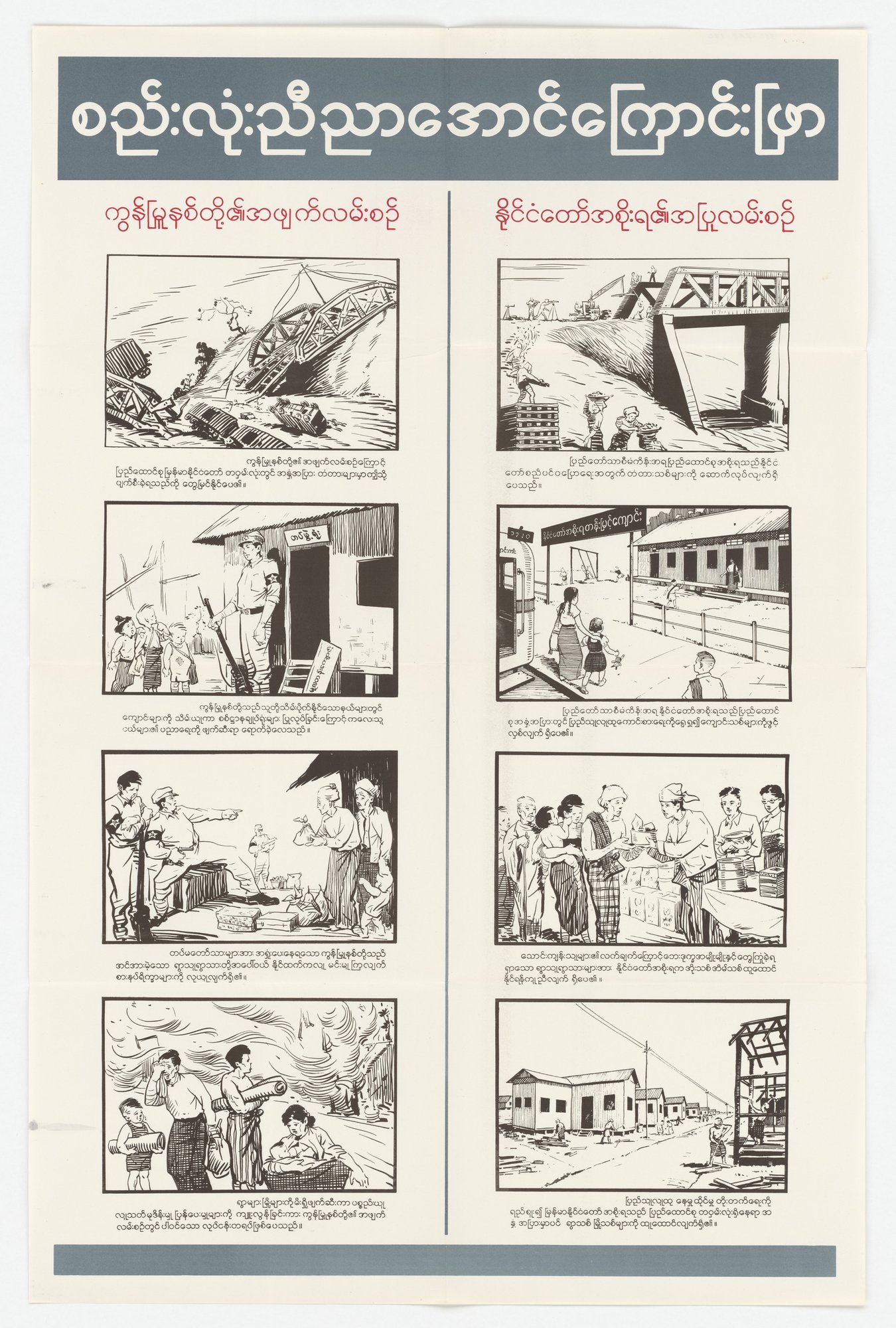
Communist Atrocities and Governments poster (Burmese, Rangoon)
A two-column Burmese comic-strip poster in four paired panels. The left column, headed in red, shows scenes attributed to Communist forces: a wrecked bridge and train, an armed man in an armband at a school door with children, armed men taking food from villagers, and a burning village with fleeing families. The right column shows a rebuilt bridge, a school and train, relief supplies handed out and new housing, attributed to the government. The tell is card-stacking: one side is shown only by destruction and the other only by construction.
Propaganda techniques used in this poster
- Date
- July 19, 1954
- Period
- Cold War
- Made by
- U.S. Information Agency (predecessor: State Department International Information and Educational Exchange Program), Propaganda Posters Distributed in Asia, Latin America and the Middle East series
- Region
- North America
- Country
- United States
- Medium
- Poster
- Issuer type
- State
- Regime
- Eisenhower Administration
- Leader
- Dwight D. Eisenhower
- Audience
- Foreign public
- Purpose
- Persuade or win support
- Themes
- War and the military, Security and surveillance
- Event
- Cold War
- Source
- Unidentified Source blurred: contractors, cutouts, buried disclosure
- Source
- U.S. National Archives (NARA), RG 306, Propaganda Posters Distributed in Asia, Latin America and the Middle East, retrieved October 4, 2026
- Rights
- Public domain (U.S. government work; NARA RG 306)
U.S. Information Agency / Department of State, July 19, 1954. National Archives, Record Group 306 (NAID 6948998, 306-PBB-126).
Text on the object
[Burmese script: headline, two red column headings and eight panel captions printed in Burmese; not reliably legible at the available image resolution]
Not transcribed. By NARA's title the sheet concerns Communist atrocities and governments: the left column depicts attacks and the right column depicts government reconstruction work (bridge, school, relief distribution, housing).
Burmese text could not be transcribed verbatim from the scan; no imprint is printed.