El Correo Grafico poster, private sector industry (Spanish, San Jose)
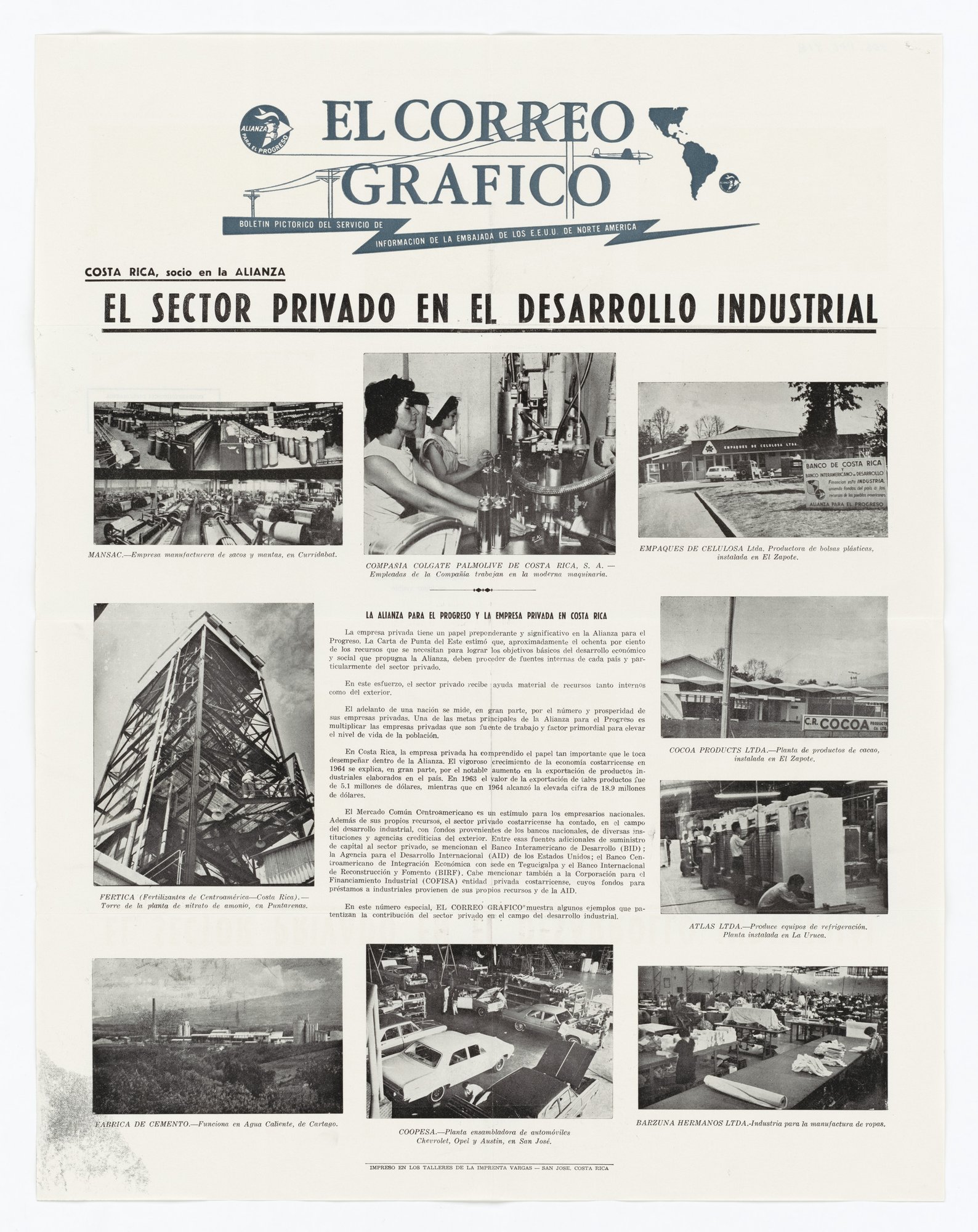
A special issue of the U.S. Embassy pictorial bulletin for Costa Rica, headed 'The private sector in industrial development', with nine photographs of named Costa Rican factories (textiles, fertiliser, cocoa, refrigeration, cement, car assembly, clothing) and a text box on private enterprise in the Alliance for Progress, giving export figures of 5.1 million dollars in 1963 and 18.9 million in 1964. The tell is card-stacking: only successful firms and one export comparison are shown, and the text names the funding sources behind them.
Propaganda techniques used in this poster
- Date
- January 1, 1965
- Period
- Cold War
- Made by
- U.S. Information Agency (predecessor: State Department International Information and Educational Exchange Program), Propaganda Posters Distributed in Asia, Latin America and the Middle East series
- Region
- North America
- Country
- United States
- Medium
- Poster
- Issuer type
- State
- Regime
- Johnson Administration
- Leader
- Lyndon B. Johnson
- Audience
- Foreign public
- Purpose
- Persuade or win support
- Themes
- Economy and finance, Labor
- Event
- Cold War
- Source
- Identified Openly sourced: the speaker is who they say they are
- Source
- U.S. National Archives (NARA), Record Group 306, Posters in Asia, Latin America, Middle East, retrieved October 4, 2026
- Rights
- Public domain (U.S. government work; NARA RG 306)
U.S. Information Agency / Department of State, January 1, 1965. National Archives, Record Group 306 (NAID 6949243, 306-PPB-318).
Text on the object
EL CORREO GRAFICO
BOLETIN PICTORICO DEL SERVICIO DE INFORMACION DE LA EMBAJADA DE LOS E.E.U.U. DE NORTE AMERICA
[emblem:] ALIANZA PARA EL PROGRESO

COSTA RICA, socio en la ALIANZA
EL SECTOR PRIVADO EN EL DESARROLLO INDUSTRIAL

MANSAC.—Empresa manufacturera de sacos y mantas, en Curridabat.
COMPAÑIA COLGATE PALMOLIVE DE COSTA RICA, S. A.—Empleadas de la Compañía trabajan en la moderna maquinaria.
EMPAQUES DE CELULOSA Ltda. Productora de bolsas plásticas, instalada en El Zapote.
[sign:] BANCO DE COSTA RICA Y BANCO INTERAMERICANO DE DESARROLLO Financian esta INDUSTRIA, uniendo fondos del país y los recursos de los pueblos americanos. ALIANZA PARA EL PROGRESO

LA ALIANZA PARA EL PROGRESO Y LA EMPRESA PRIVADA EN COSTA RICA

La empresa privada tiene un papel preponderante y significativo en la Alianza para el Progreso. La Carta de Punta del Este estimó que, aproximadamente el ochenta por ciento de los recursos que se necesitan para lograr los objetivos básicos del desarrollo económico y social que propugna la Alianza, deben proceder de fuentes internas de cada país y particularmente del sector privado.

En este esfuerzo, el sector privado recibe ayuda material de recursos tanto internos como del exterior.

El adelanto de una nación se mide, en gran parte, por el número y prosperidad de sus empresas privadas. Una de las metas principales de la Alianza para el Progreso es multiplicar las empresas privadas que son fuente de trabajo y factor primordial para elevar el nivel de vida de la población.

En Costa Rica, la empresa privada ha comprendido el papel tan importante que le toca desempeñar dentro de la Alianza. El vigoroso crecimiento de la economía costarricense en 1964 se explica, en gran parte, por el notable aumento en la exportación de productos industriales elaborados en el país. En 1963 el valor de la exportación de tales productos fue de 5.1 millones de dólares, mientras que en 1964 alcanzó la elevada cifra de 18.9 millones de dólares.

El Mercado Común Centroamericano es un estímulo para los empresarios nacionales. Además de sus propios recursos, el sector privado costarricense ha contado, en el campo del desarrollo industrial, con fondos provenientes de los bancos nacionales, de diversas instituciones y agencias crediticias del exterior. Entre esas fuentes adicionales de suministro de capital al sector privado, se mencionan el Banco Interamericano de Desarrollo (BID); la Agencia para el Desarrollo Internacional (AID) de los Estados Unidos; el Banco Centroamericano de Integración Económica con sede en Tegucigalpa y el Banco Internacional de Reconstrucción y Fomento (BIRF). Cabe mencionar también a la Corporación para el Financiamiento Industrial (COFISA) entidad privada costarricense, cuyos fondos para préstamos a industriales provienen de sus propios recursos y de la AID.

En este número especial, EL CORREO GRAFICO muestra algunos ejemplos que patentizan la contribución del sector privado en el campo del desarrollo industrial.

FERTICA (Fertilizantes de Centroamérica—Costa Rica).—Torre de la planta de nitrato de amonio, en Puntarenas.
COCOA PRODUCTS LTDA.—Planta de productos de cacao, instalada en El Zapote.
ATLAS LTDA.—Produce equipos de refrigeración. Planta instalada en La Uruca.
FABRICA DE CEMENTO.—Funciona en Agua Caliente, de Cartago.
COOPESA.—Planta ensambladora de automóviles Chevrolet, Opel y Austin, en San José.
BARZUNA HERMANOS LTDA.—Industria para la manufactura de ropas.

IMPRESO EN LOS TALLERES DE LA IMPRENTA VARGAS—SAN JOSE, COSTA RICA
THE GRAPHIC MAIL. Pictorial bulletin of the Information Service of the Embassy of the U.S.A. of North America. [Alliance for Progress emblem.] COSTA RICA, partner in the ALLIANCE: THE PRIVATE SECTOR IN INDUSTRIAL DEVELOPMENT. Photo captions: MANSAC, maker of sacks and blankets, in Curridabat; Colgate Palmolive of Costa Rica, employees at the modern machinery; Empaques de Celulosa Ltda., plastic-bag maker in El Zapote, with a sign reading 'Bank of Costa Rica and Inter-American Development Bank finance this INDUSTRY, uniting the country's funds and the resources of the American peoples. Alliance for Progress'; Fertica fertiliser plant tower (ammonium nitrate) in Puntarenas; Cocoa Products Ltda. cocoa plant in El Zapote; Atlas Ltda. refrigeration equipment in La Uruca; cement factory at Agua Caliente, Cartago; COOPESA car assembly plant (Chevrolet, Opel, Austin) in San Jose; Barzuna Hermanos Ltda. clothing factory. Text box 'THE ALLIANCE FOR PROGRESS AND PRIVATE ENTERPRISE IN COSTA RICA': private enterprise has a leading role in the Alliance; the Punta del Este Charter estimated that about eighty percent of the resources needed for the Alliance's economic and social development goals must come from each country's internal sources, particularly the private sector; a main goal is to multiply private firms as a source of work and to raise living standards; Costa Rica's economic growth in 1964 is explained largely by the rise in manufactured exports, from 5.1 million dollars in 1963 to 18.9 million in 1964; the Central American Common Market is a stimulus; funding sources named are national banks, the Inter-American Development Bank, the U.S. AID, the Central American Bank for Economic Integration, the World Bank and the private Costa Rican finance corporation COFISA, which lends its own funds and AID funds. This special issue shows examples of the private sector's contribution. Printed at the workshops of Imprenta Vargas, San Jose, Costa Rica.
Captions follow the image order by position; the translation is abridged to the sense of each caption and the text box.