Evolution in South Vietnam: The Partitioning of South Vietnam
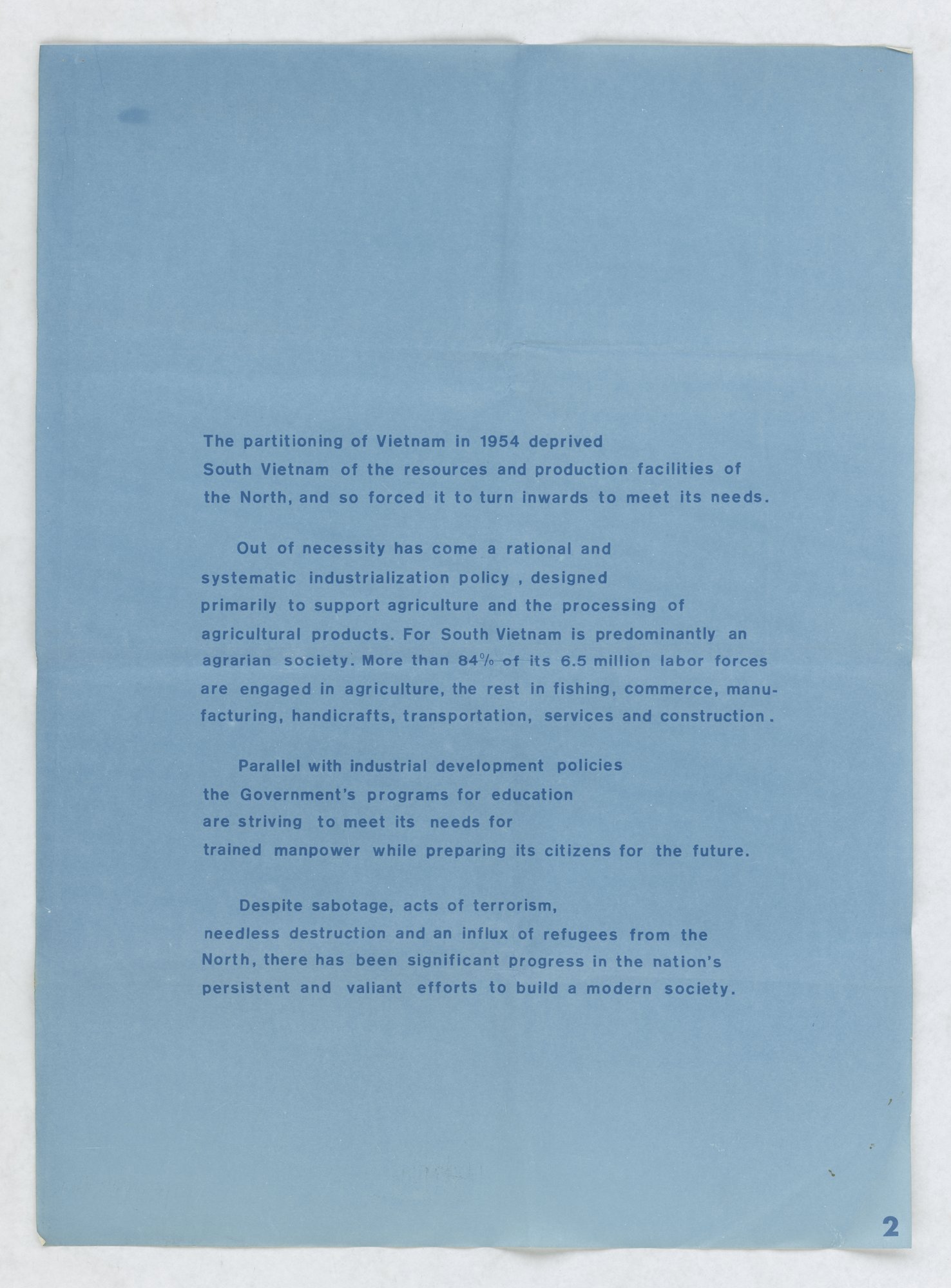
A text-only English sheet on blue paper explains South Vietnam's industrialisation policy as a consequence of the 1954 partition, stating that more than 84% of 6.5 million workers are in agriculture. It names 'sabotage, acts of terrorism, needless destruction' and a refugee influx as obstacles and ends on 'persistent and valiant efforts to build a modern society.' Statistics and a development narrative are presented together, and the praise words are the sheet's own.
Propaganda techniques used in this poster
- Date
- 1965
- Period
- Cold War
- Made by
- Joint U.S. Public Affairs Office (JUSPAO) psychological-operations output, as placed by the National Archives series; no issuing body printed on the sheet
- Region
- North America
- Country
- United States
- Medium
- Poster
- Issuer type
- State
- Regime
- Johnson Administration
- Leader
- Lyndon B. Johnson
- Audience
- Foreign public
- Purpose
- Persuade or win support
- Themes
- Economy and finance, War and the military
- Event
- Vietnam War
- Source
- Identified Openly sourced: the speaker is who they say they are
- Source
- U.S. National Archives (NARA), RG 306, Psychological Warfare Posters, Vietnam War (NAID 561393), retrieved October 3, 2026
- Rights
- NARA Unrestricted; hosted by owner decision
Joint U.S. Public Affairs Office (JUSPAO). National Archives and Records Administration, 306-VP-011-46.
Text on the object
The partitioning of Vietnam in 1954 deprived South Vietnam of the resources and production facilities of the North, and so forced it to turn inwards to meet its needs.

Out of necessity has come a rational and systematic industrialization policy, designed primarily to support agriculture and the processing of agricultural products. For South Vietnam is predominantly an agrarian society. More than 84% of its 6.5 million labor forces are engaged in agriculture, the rest in fishing, commerce, manufacturing, handicrafts, transportation, services and construction.

Parallel with industrial development policies the Government's programs for education are striving to meet its needs for trained manpower while preparing its citizens for the future.

Despite sabotage, acts of terrorism, needless destruction and an influx of refugees from the North, there has been significant progress in the nation's persistent and valiant efforts to build a modern society.