Content note: Wartime broadcast text urging U.S. troops to refuse orders, with accusations of genocide and racism against the U.S. government. This object is shown as it was published. Why
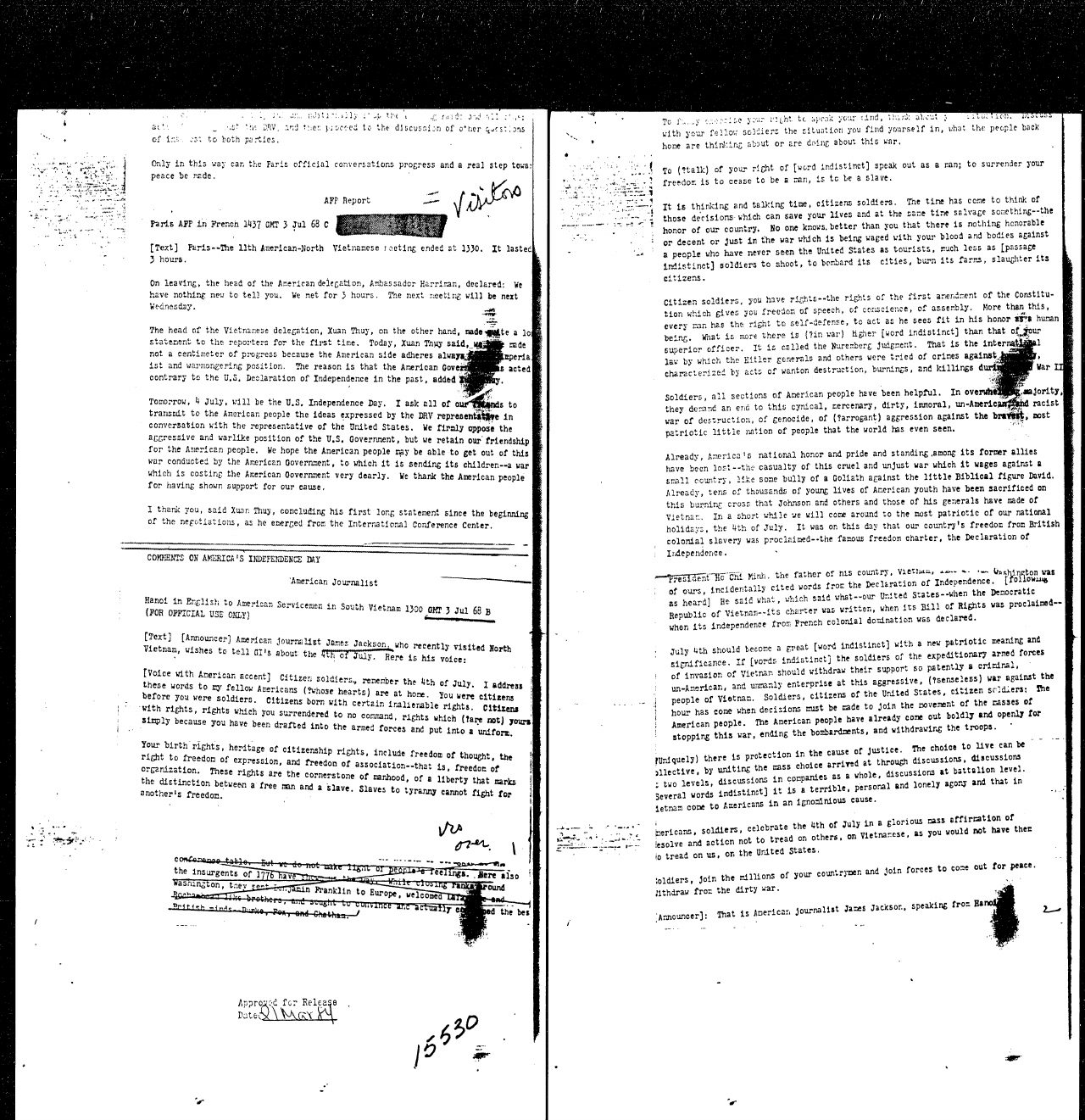
Hanoi in English: 'Comments on America's Independence Day', 3 July 1968
U.S. Government transcript of a Radio Hanoi English-language broadcast of 3 July 1968, the day before U.S. Independence Day. An announcer introduces a talk by a self-described American journalist who tells 'citizen soldiers' that the First Amendment, the Nuremberg judgment and the Declaration of Independence support refusing the war. The tells: an American voice as witness (testimonial) and the borrowing of the Declaration's authority, including Ho Chi Minh's quotation of it (transfer).
- Date
- July 3, 1968
- Period
- Cold War
- Made by
- Radio Hanoi (Democratic Republic of Vietnam), English-language service to American servicemen in South Vietnam
- Region
- Southeast Asia
- Medium
- Broadcast
- Issuer type
- State
- Leader
- Ho Chi Minh
- Audience
- Enemy forces
- Purpose
- Persuade or win support
- Event
- Vietnam War
- Techniques
- TestimonialTransfer
- Source
- Identified Openly sourced: the speaker is who they say they are
- Source
- Library of Congress, Vietnam-Era POW/MIA Database (Defense POW/Missing Personnel Office records), retrieved October 2, 2026
- Rights
- Public domain (U.S. government work), LOC POW/MIA Database; no rights statement
U.S. Government monitoring-service transcript (translated and typed by the U.S. Government) of a foreign state broadcast; Library of Congress Federal Research Division / DPAA records. LOC item has no rights statement.
Text on the object
COMMENTS ON AMERICA'S INDEPENDENCE DAY
American Journalist
Hanoi in English to American Servicemen in South Vietnam 1300 GMT 3 Jul 68 B
(FOR OFFICIAL USE ONLY)
[Text] [Announcer] American journalist James Jackson, who recently visited North Vietnam, wishes to tell GI's about the 4th of July. Here is his voice:
[Voice with American accent] Citizen soldiers, remember the 4th of July. I address these words to my fellow Americans (?whose hearts) are at home. You were citizens before you were soldiers. Citizens born with certain inalienable rights. Citizens with rights, rights which you surrendered to no command, rights which (?are not) yours simply because you have been drafted into the armed forces and put into a uniform.
Your birth rights, heritage of citizenship rights, include freedom of thought, the right to freedom of expression, and freedom of association--that is, freedom of organization. These rights are the cornerstone of manhood, of a liberty that marks the distinction between a free man and a slave. Slaves to tyranny cannot fight for another's freedom.
To fully exercise your right to speak your mind, think about [illegible] situation. Discuss with your fellow soldiers the situation you find yourself in, what the people back home are thinking about or are doing about this war.
To (?talk) of your right of [word indistinct] speak out as a man; to surrender your freedom is to cease to be a man, is to be a slave.
It is thinking and talking time, citizens soldiers. The time has come to think of those decisions which can save your lives and at the same time salvage something--the honor of our country. No one knows better than you that there is nothing honorable or decent or just in the war which is being waged with your blood and bodies against a people who have never seen the United States as tourists, much less as [passage indistinct] soldiers to shoot, to bombard its cities, burn its farms, slaughter its citizens.
Citizen soldiers, you have rights--the rights of the first amendment of the Constitution which gives you freedom of speech, of conscience, of assembly. More than this, every man has the right to self-defense, to act as he sees fit in his honor as a human being. What is more there is (?in war) higher [word indistinct] than that of your superior officer. It is called the Nuremberg Judgment. That is the international law by which the Hitler generals and others were tried of crimes against [illegible], characterized by acts of wanton destruction, burnings, and killings during [illegible] War II.
Soldiers, all sections of American people have been helpful. In overwhel[illegible] majority, they demand an end to this cynical, mercenary, dirty, immoral, un-American [illegible] racist war of destruction, of genocide, of (?arrogant) aggression against the bravest, most patriotic little nation of people that the world has even seen.
Already, America's national honor and pride and standing among its former allies have been lost--the casualty of this cruel and unjust war which it wages against a small country, like some bully of a Goliath against the little Biblical figure David. Already, tens of thousands of young lives of American youth have been sacrificed on this burning cross that Johnson and others and those of his generals have made of Vietnam. In a short while we will come around to the most patriotic of our national holidays, the 4th of July. It was on this day that our country's freedom from British colonial slavery was proclaimed--the famous freedom charter, the Declaration of Independence.
President Ho Chi Minh, the father of his country, Vietnam, [illegible] Washington was of ours, incidentally cited words from the Declaration of Independence. [following as heard] He said what, which said what--our United States--when the Democratic Republic of Vietnam--its charter was written, when its Bill of Rights was proclaimed--when its independence from French colonial domination was declared. [continues]
Verbatim from the U.S. Government transcript, with its '(?...)' guesses and '[word indistinct]' marks kept. '[illegible]' marks where the scan is cut off, struck through or overprinted. The upper AFP report on the same page is not transcribed. The last three paragraphs of the talk (from 'July 4th should become...' to the announcer's closing line) are on the same scan but are not transcribed here, to stay within the field limit.