How a tree grows
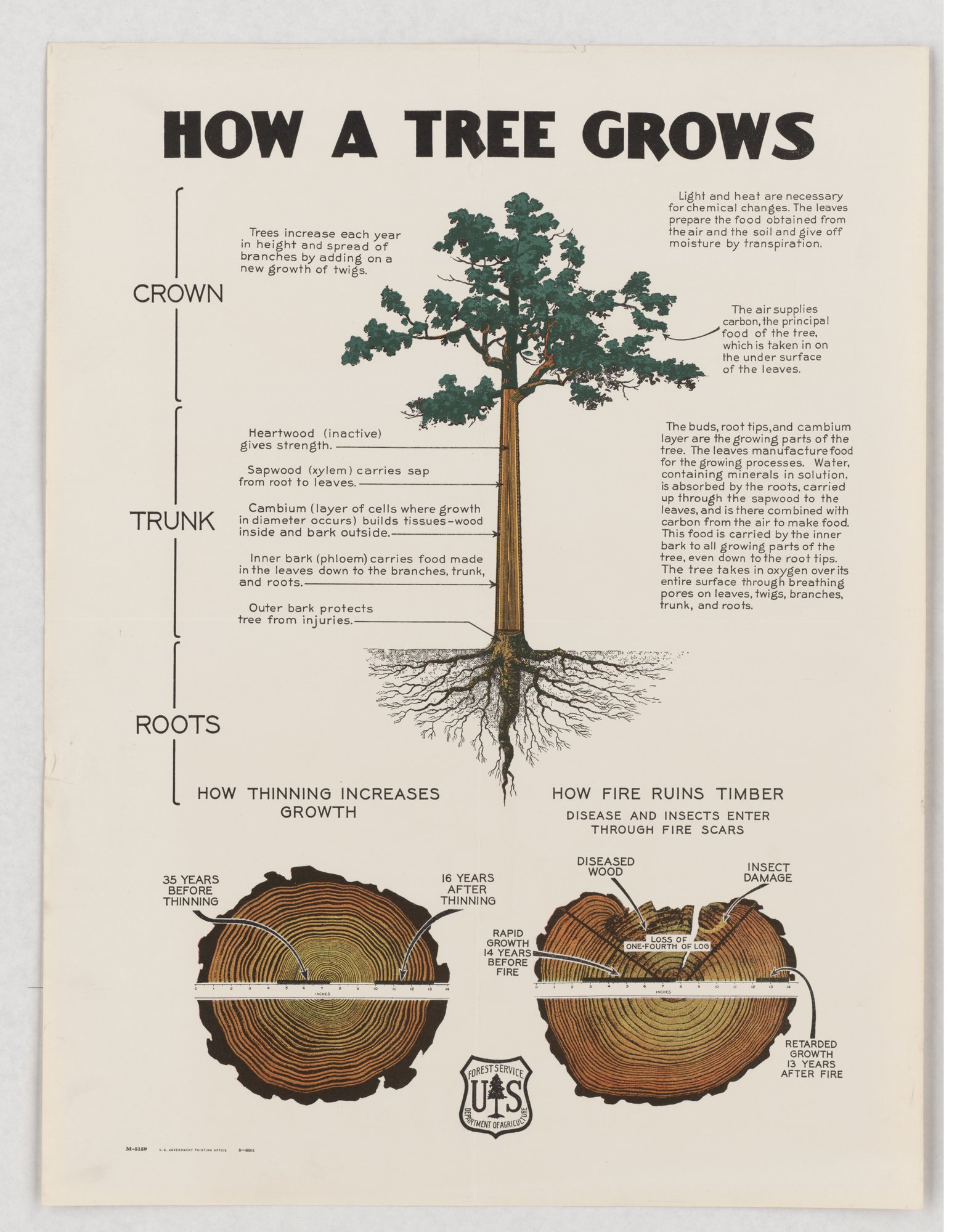
Forest Service educational chart: a tree drawn in section, labelled crown, trunk and roots, with captions on how sap and food move, and below it two cross-sections of logs, one showing growth after thinning and one showing loss of one-fourth of a log after fire. It is mainly informational; the technique is faint, and the closest is card-stacking in the choice of the two examples, which both show thinning as helpful and fire as harmful.
Propaganda techniques used in this poster
- Date
- 1941
- Period
- Second World War
- Made by
- U.S. Forest Service, Department of Agriculture
- Region
- North America
- Country
- United States
- Medium
- Poster
- Issuer type
- State
- Regime
- Roosevelt Administration
- Leader
- Franklin D. Roosevelt
- Audience
- Domestic public
- Purpose
- Warn or inform
- Themes
- Science and technology, Home front
- Event
- World War II
- Regime
- Roosevelt administration
- Leader
- Franklin D. Roosevelt
- Source
- Identified Openly sourced: the speaker is who they say they are
- Source
- U.S. National Archives and Records Administration, Record Group 44, World War II Posters, retrieved October 4, 2026
- Rights
- Public domain (U.S. government work)
U.S. Forest Service, Department of Agriculture. National Archives and Records Administration, RG 44, 44-PA-1005 (NAID 514531).
Text on the object
HOW A TREE GROWS
CROWN
Trees increase each year in height and spread of branches by adding on a new growth of twigs.
Light and heat are necessary for chemical changes. The leaves prepare the food obtained from the air and the soil and give off moisture by transpiration.
The air supplies carbon, the principal food of the tree, which is taken in on the under surface of the leaves.
TRUNK
Heartwood (inactive) gives strength.
Sapwood (xylem) carries sap from root to leaves.
Cambium (layer of cells where growth in diameter occurs) builds tissues-wood inside and bark outside.
Inner bark (phloem) carries food made in the leaves down to the branches, trunk, and roots.
Outer bark protects tree from injuries.
The buds, root tips, and cambium layer are the growing parts of the tree. The leaves manufacture food for the growing processes. Water, containing minerals in solution, is absorbed by the roots, carried up through the sapwood to the leaves, and is there combined with carbon from the air to make food. This food is carried by the inner bark to all growing parts of the tree, even down to the root tips. The tree takes in oxygen over its entire surface through breathing pores on leaves, twigs, branches, trunk, and roots.
ROOTS
HOW THINNING INCREASES GROWTH
35 YEARS BEFORE THINNING
16 YEARS AFTER THINNING
HOW FIRE RUINS TIMBER
DISEASE AND INSECTS ENTER THROUGH FIRE SCARS
DISEASED WOOD
INSECT DAMAGE
LOSS OF ONE-FOURTH OF LOG
RAPID GROWTH 14 YEARS BEFORE FIRE
RETARDED GROWTH 13 YEARS AFTER FIRE
[scale: INCHES 0 to 14, twice]
[emblem: FOREST SERVICE U.S. DEPARTMENT OF AGRICULTURE]
[imprint: M-5159  U.S. GOVERNMENT PRINTING OFFICE  8—8601]