Just in case: nurses are needed now for service in the Army Nurse Corps
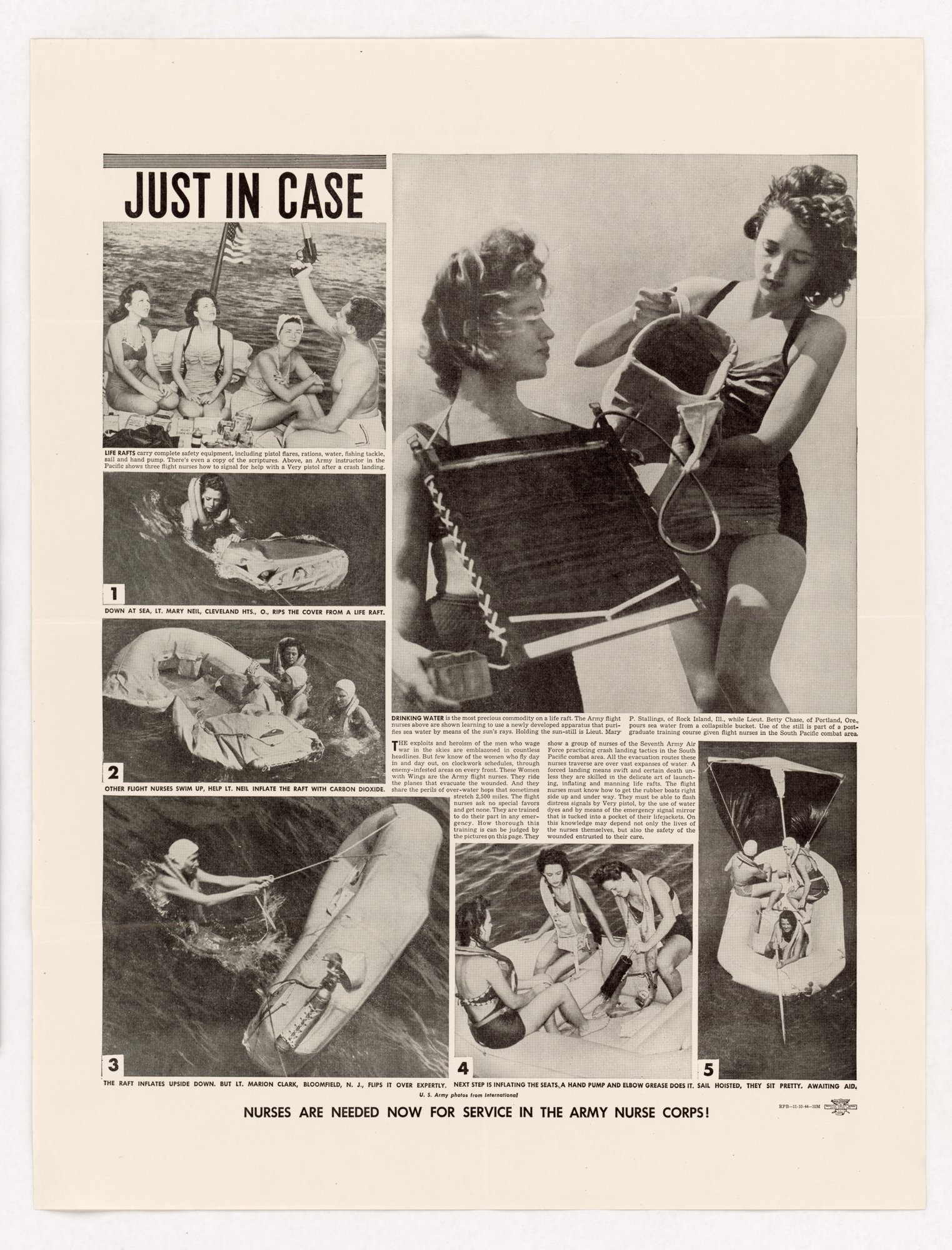
Black-and-white photo-essay page showing Army flight nurses in swimsuits training with life rafts, a Very pistol and a sun-still for drinking water, with numbered captions and a column of text. The closing line asks for nurses. The tells are the selection of rescue-training scenes with named nurses and no mention of casualties (card-stacking) and the named nurses as examples (testimonial).
Propaganda techniques used in this poster
- Date
- 1944
- Period
- Second World War
- Made by
- U.S. Army (photographs from International)
- Region
- North America
- Country
- United States
- Medium
- Poster
- Issuer type
- Military
- Regime
- Roosevelt Administration
- Leader
- Franklin D. Roosevelt
- Audience
- Domestic public
- Purpose
- Recruit
- Themes
- War and the military, Health, Gender and suffrage
- Event
- World War II
- Regime
- Roosevelt administration
- Leader
- Franklin D. Roosevelt
- Source
- Identified Openly sourced: the speaker is who they say they are
- Source
- U.S. National Archives and Records Administration, Record Group 44, World War II Posters, retrieved October 4, 2026
- Rights
- Public domain (U.S. government work)
U.S. Army (photographs from International). National Archives and Records Administration, RG 44, 44-PA-1158 (NAID 514754).
Text on the object
JUST IN CASE
LIFE RAFTS carry complete safety equipment, including pistol flares, rations, water, fishing tackle, sail and hand pump. There's even a copy of the scriptures. Above, an Army instructor in the Pacific shows three flight nurses how to signal for help with a Very pistol after a crash landing.
1
DOWN AT SEA, LT. MARY NEIL, CLEVELAND HTS., O., RIPS THE COVER FROM A LIFE RAFT.
2
OTHER FLIGHT NURSES SWIM UP, HELP LT. NEIL INFLATE THE RAFT WITH CARBON DIOXIDE.
3
THE RAFT INFLATES UPSIDE DOWN. BUT LT. MARION CLARK, BLOOMFIELD, N. J., FLIPS IT OVER EXPERTLY.
DRINKING WATER is the most precious commodity on a life raft. The Army flight nurses above are shown learning to use a newly developed apparatus that purifies sea water by means of the sun's rays. Holding the sun-still is Lieut. Mary P. Stallings, of Rock Island, Ill., while Lieut. Betty Chase, of Portland, Ore., pours sea water from a collapsible bucket. Use of the still is part of a post-graduate training course given flight nurses in the South Pacific combat area.
THE exploits and heroism of the men who wage war in the skies are emblazoned in countless headlines. But few know of the women who fly day in and day out, on clockwork schedules, through enemy-infested areas on every front. These Women with Wings are the Army flight nurses. They ride the planes that evacuate the wounded. And they share the perils of over-water hops that sometimes stretch 2,500 miles. The flight nurses ask no special favors and get none. They are trained to do their part in any emergency. How thorough this training is can be judged by the pictures on this page. They show a group of nurses of the Seventh Army Air Force practicing crash landing tactics in the South Pacific. All the evacuation routes these nurses traverse are over vast expanses of water. A forced landing means swift and certain death unless they are skilled in the delicate art of launching, inflating and manning life rafts. The flight nurses must know how to get the rubber boats right side up and under way. They must be able to flash distress signals by Very pistol, by the use of water dyes and by means of the emergency signal mirror that is tucked into a pocket of their lifejackets. On this knowledge may depend not only the lives of the nurses themselves, but also the safety of the wounded entrusted to their care.
4
NEXT STEP IS INFLATING THE SEATS. A HAND PUMP AND ELBOW GREASE DOES IT.
5
SAIL HOISTED, THEY SIT PRETTY. AWAITING AID.
U. S. Army photos from International
NURSES ARE NEEDED NOW FOR SERVICE IN THE ARMY NURSE CORPS!
RPB-11-10-44-10M
Small print is dense; a few words at the column joins may be misread.