Moon Close-Ups from Ranger poster, Bangkok (English)
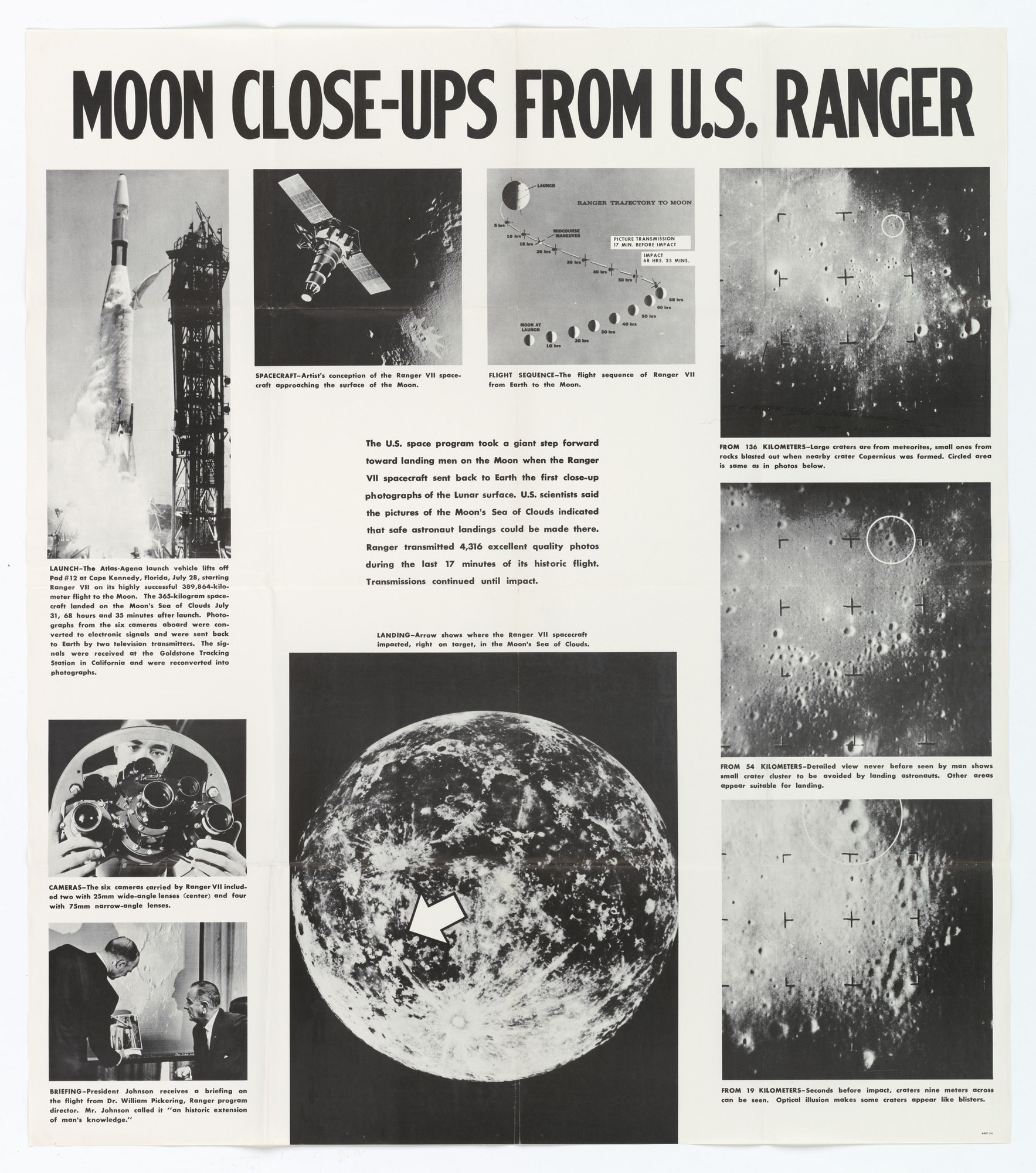
An English photo-poster on the Ranger VII lunar probe: the launch, the spacecraft, the flight path, a full-Moon photograph with an arrow at the impact point, three close-up frames from 136, 54 and 19 kilometres, and a photograph of President Johnson being briefed. The text calls the flight a giant step toward landing men on the Moon. The tell is card-stacking: only the successes are shown, framed as national achievement.
Propaganda techniques used in this poster
- Date
- September 8, 1964
- Period
- Cold War
- Made by
- U.S. Information Agency (predecessor: State Department International Information and Educational Exchange Program), Propaganda Posters Distributed in Asia, Latin America and the Middle East series
- Region
- North America
- Country
- United States
- Medium
- Poster
- Issuer type
- State
- Regime
- Johnson Administration
- Leader
- Lyndon B. Johnson
- Audience
- Foreign public
- Purpose
- Persuade or win support
- Theme
- Science and technology
- Event
- Cold War
- Source
- Unidentified Source blurred: contractors, cutouts, buried disclosure
- Source
- U.S. National Archives (NARA), Record Group 306, Posters in Asia, Latin America, Middle East, retrieved October 4, 2026
- Rights
- Public domain (U.S. government work; NARA RG 306)
U.S. Information Agency / Department of State, September 8, 1964. National Archives, Record Group 306 (NAID 6949263, 306-PPB-338).
Text on the object
MOON CLOSE-UPS FROM U.S. RANGER

LAUNCH-The Atlas-Agena launch vehicle lifts off Pad #12 at Cape Kennedy, Florida, July 28, starting Ranger VII on its highly successful 389,864-kilometer flight to the Moon. The 365-kilogram spacecraft landed on the Moon's Sea of Clouds July 31, 68 hours and 35 minutes after launch. Photographs from the six cameras aboard were converted to electronic signals and were sent back to Earth by two television transmitters. The signals were received at the Goldstone Tracking Station in California and were reconverted into photographs.

SPACECRAFT-Artist's conception of the Ranger VII spacecraft approaching the surface of the Moon.

FLIGHT SEQUENCE-The flight sequence of Ranger VII from Earth to the Moon.
[diagram labels: RANGER TRAJECTORY TO MOON; LAUNCH; MIDCOURSE MANEUVER; PICTURE TRANSMISSION 17 MIN. BEFORE IMPACT; IMPACT 68 HRS. 35 MINS.; MOON AT LAUNCH; hour marks 5 hrs to 68 hrs]

The U.S. space program took a giant step forward toward landing men on the Moon when the Ranger VII spacecraft sent back to Earth the first close-up photographs of the Lunar surface. U.S. scientists said the pictures of the Moon's Sea of Clouds indicated that safe astronaut landings could be made there. Ranger transmitted 4,316 excellent quality photos during the last 17 minutes of its historic flight. Transmissions continued until impact.

LANDING-Arrow shows where the Ranger VII spacecraft impacted, right on target, in the Moon's Sea of Clouds.

CAMERAS-The six cameras carried by Ranger VII included two with 25mm wide-angle lenses (center) and four with 75mm narrow-angle lenses.

BRIEFING-President Johnson receives a briefing on the flight from Dr. William Pickering, Ranger program director. Mr. Johnson called it "an historic extension of man's knowledge."

FROM 136 KILOMETERS-Large craters are from meteorites, small ones from rocks blasted out when nearby crater Copernicus was formed. Circled area is same as in photos below.

FROM 54 KILOMETERS-Detailed view never before seen by man shows small crater cluster to be avoided by landing astronauts. Other areas appear suitable for landing.

FROM 19 KILOMETERS-Seconds before impact, craters nine meters across can be seen. Optical illusion makes some craters appear like blisters.

5-577 (14)
Imprint code at lower right is small; best reading given.