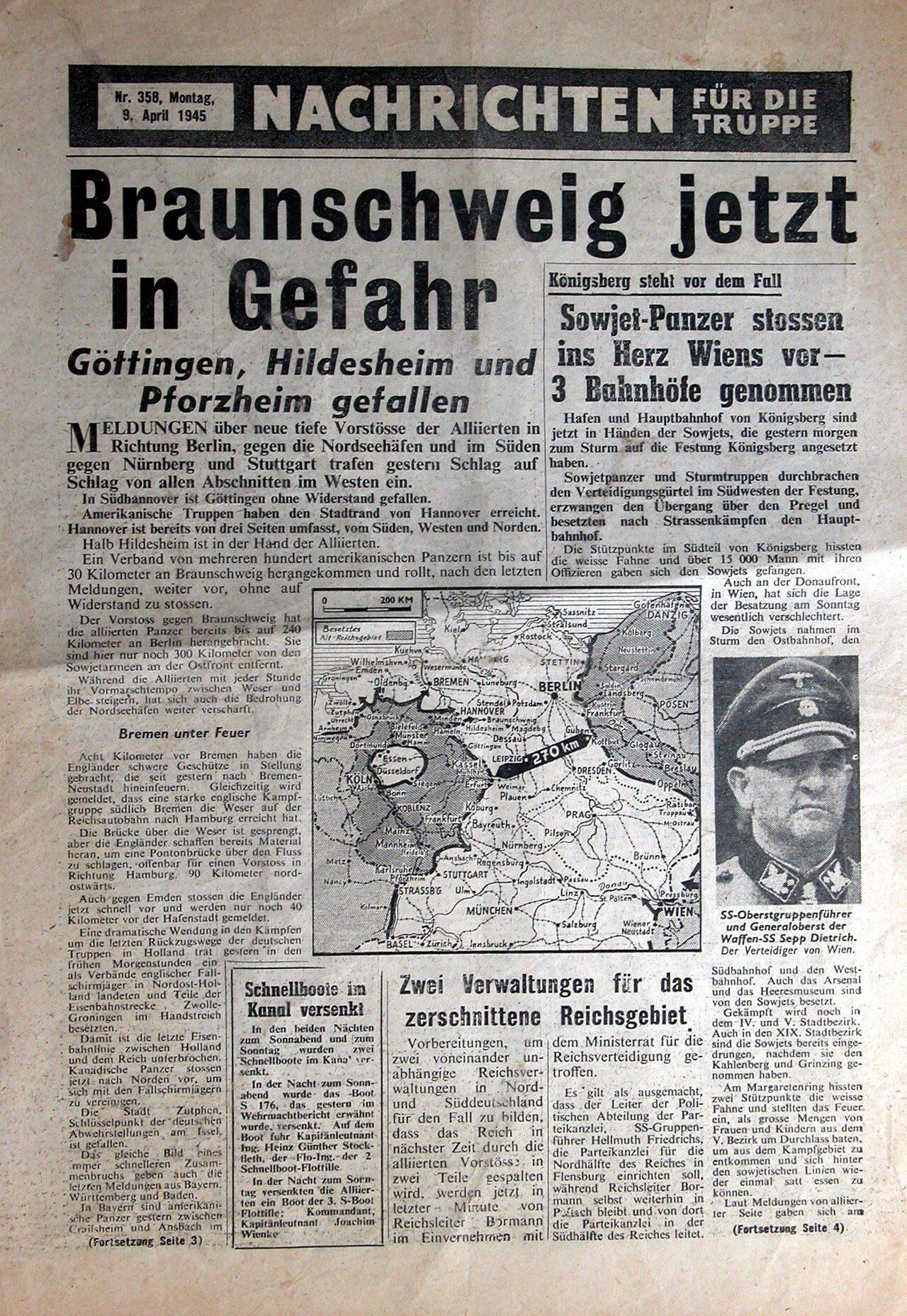
Nachrichten für die Truppe, No. 358, 9 April 1945
A daily German-language newspaper for German soldiers, dropped from B-17s of the U.S. Eighth Air Force's leaflet squadron between April 1944 and May 1945. This front page reports checkable Allied and Soviet advances (Göttingen, Hildesheim and Pforzheim fallen, Soviet tanks in Vienna, a map of the shrinking Reich) in the look of a German forces paper, next to a report on plans for two separate administrations for a Reich cut in two. Accurate front news is what gave the paper its readers and its credibility for the items that were meant to demoralise.
- Date
- April 9, 1945
- Period
- Second World War
- Made by
- Political Warfare Executive (as Political Intelligence Department) with the U.S. Office of Strategic Services, for SHAEF's Psychological Warfare Division; dropped by the U.S. Eighth Air Force
- Region
- Western and Central Europe
- Country
- United Kingdom
- Medium
- Newspaper pages
- Issuer type
- Intelligence
- Regime
- Churchill Government
- Leader
- Winston Churchill
- Audience
- Enemy forces
- Purpose
- Warn or inform
- Themes
- War and the military, Media and information
- Event
- World War II
- Techniques
- TransferCard stacking
- Source
- Unidentified Source blurred: contractors, cutouts, buried disclosure
- Source
- Wikimedia Commons (photograph by Brunswyk), retrieved September 27, 2026
- Rights
- Public domain (U.S. government work and UK Crown copyright expired; photograph released under the Public Domain Mark)
Political Intelligence Department (PWE) and OSS for SHAEF Psychological Warfare Division, 1945. Photograph: Brunswyk, Wikimedia Commons.
Text on the object
Nr. 358, Montag, 9. April 1945

NACHRICHTEN FÜR DIE TRUPPE

Braunschweig jetzt in Gefahr

Göttingen, Hildesheim und Pforzheim gefallen

MELDUNGEN über neue tiefe Vorstösse der Alliierten in Richtung Berlin, gegen die Nordseehäfen und im Süden gegen Nürnberg und Stuttgart trafen gestern Schlag auf Schlag von allen Abschnitten im Westen ein.

In Südhannover ist Göttingen ohne Widerstand gefallen.

Amerikanische Truppen haben den Stadtrand von Hannover erreicht. Hannover ist bereits von drei Seiten umfasst, vom Süden, Westen und Norden.

Halb Hildesheim ist in der Hand der Alliierten.

Ein Verband von mehreren hundert amerikanischen Panzern ist bis auf 30 Kilometer an Braunschweig herangekommen und rollt, nach den letzten Meldungen, weiter vor, ohne auf Widerstand zu stossen.

Der Vorstoss gegen Braunschweig hat die alliierten Panzer bereits bis auf 240 Kilometer an Berlin herangebracht. Sie sind hier nur noch 300 Kilometer von den Sowjetarmeen an der Ostfront entfernt.

Während die Alliierten mit jeder Stunde ihr Vormarschtempo zwischen Weser und Elbe steigern, hat sich auch die Bedrohung der Nordseehäfen weiter verschärft.

Bremen unter Feuer

Acht Kilometer vor Bremen haben die Engländer schwere Geschütze in Stellung gebracht, die seit gestern nach Bremen-Neustadt hineinfeuern. Gleichzeitig wird gemeldet, dass eine starke englische Kampfgruppe südlich Bremen die Weser auf der Reichsautobahn nach Hamburg erreicht hat.

Die Brücke über die Weser ist gesprengt, aber die Engländer schaffen bereits Material heran, um eine Pontonbrücke über den Fluss zu schlagen, offenbar für einen Vorstoss in Richtung Hamburg, 90 Kilometer nordostwärts.

Auch gegen Emden stossen die Engländer jetzt schnell vor und werden nur noch 40 Kilometer vor der Hafenstadt gemeldet.

Eine dramatische Wendung in den Kämpfen um die letzten Rückzugswege der deutschen Truppen in Holland trat gestern in den frühen Morgenstunden ein, als Verbände englischer Fallschirmjäger in Nordost-Holland landeten und Teile der Eisenbahnstrecke Zwolle-Groningen im Handstreich besetzten.

Damit ist die letzte Eisenbahnlinie zwischen Holland und dem Reich unterbrochen. Kanadische Panzer stossen jetzt nach Norden vor, um sich mit den Fallschirmjägern zu vereinigen.

Das gleiche Bild eines immer schnelleren Zusammenbruchs geben auch die letzten Meldungen aus Bayern, Württemberg und Baden.

Königsberg steht vor dem Fall

Sowjet-Panzer stossen ins Herz Wiens vor — 3 Bahnhöfe genommen

Hafen und Hauptbahnhof von Königsberg sind jetzt in Händen der Sowjets, die gestern morgen zum Sturm auf die Festung Königsberg angesetzt haben.

Sowjetpanzer und Sturmtruppen durchbrachen den Verteidigungsgürtel im Südwesten der Festung, erzwangen den Übergang über den Pregel und besetzten nach Strassenkämpfen den Hauptbahnhof.

Die Stützpunkte im Südteil von Königsberg hissten die weisse Fahne und über 15 000 Mann mit ihren Offizieren gaben sich den Sowjets gefangen.

Auch an der Donaufront, in Wien, hat sich die Lage der Besatzung am Sonntag wesentlich verschlechtert.

Die Sowjets nahmen im Sturm den Ostbahnhof, den Südbahnhof und den Westbahnhof. Auch das Arsenal und das Heeresmuseum sind von den Sowjets besetzt.

Gekämpft wird noch in dem IV. und V. Stadtbezirk. Auch in den XIX. Stadtbezirk sind die Sowjets bereits eingedrungen, nachdem sie den Kahlenberg und Grinzing genommen haben.

Am Margaretenring hissten zwei Stützpunkte die weisse Fahne und stellten das Feuer ein, als grosse Mengen von Frauen und Kindern aus dem V. Bezirk um Durchlass baten, um aus dem Kampfgebiet zu entkommen und sich hinter den sowjetischen Linien wieder einmal satt essen zu können.

Laut Meldungen von alliierter Seite gaben sich am (Fortsetzung Seite 4)

[Bildunterschrift:] SS-Oberstgruppenführer und Generaloberst der Waffen-SS Sepp Dietrich. Der Verteidiger von Wien.

Schnellboote im Kanal versenkt

Zwei Verwaltungen für das zerschnittene Reichsgebiet
No. 358, Monday, 9 April 1945

NEWS FOR THE TROOPS

Braunschweig Now in Danger

Göttingen, Hildesheim and Pforzheim Fallen

REPORTS of deep new Allied advances toward Berlin, against the North Sea ports, and in the south against Nuremberg and Stuttgart came in blow after blow yesterday from every sector in the West.

In southern Hanover, Göttingen has fallen without resistance.

American troops have reached the outskirts of Hanover. Hanover is already encircled from three sides, from the south, west and north.

Half of Hildesheim is in Allied hands.

A formation of several hundred American tanks has come to within 30 kilometres of Braunschweig and, according to the latest reports, continues to advance without meeting resistance.

The advance on Braunschweig has already brought the Allied tanks to within 240 kilometres of Berlin. They are now only 300 kilometres from the Soviet armies on the Eastern Front.

While the Allies increase their rate of advance between the Weser and Elbe with every hour, the threat to the North Sea ports has also sharpened further.

Bremen Under Fire

Eight kilometres outside Bremen the British have brought heavy guns into position, which since yesterday have been firing into Bremen-Neustadt. At the same time it is reported that a strong British battle group south of Bremen has reached the Weser on the Reich motorway to Hamburg.

The bridge over the Weser has been blown, but the British are already bringing up material to throw a pontoon bridge across the river, apparently for an advance toward Hamburg, 90 kilometres to the northeast.

The British are also advancing quickly against Emden now and are reported to be only 40 kilometres from the port city.

A dramatic turn in the fighting over the last German retreat routes in Holland occurred yesterday in the early morning hours, when British parachute units landed in northeast Holland and seized parts of the Zwolle-Groningen railway line in a surprise strike.

This has cut the last railway line between Holland and the Reich. Canadian tanks are now pushing north to join up with the paratroopers.

The same picture of an ever faster collapse is also given by the latest reports from Bavaria, Württemberg and Baden.

Königsberg on the Verge of Falling

Soviet Tanks Push into the Heart of Vienna — 3 Stations Taken

The port and main railway station of Königsberg are now in Soviet hands; yesterday morning the Soviets began their assault on the fortress of Königsberg.

Soviet tanks and assault troops broke through the defensive belt in the southwest of the fortress, forced the crossing of the Pregel, and, after street fighting, occupied the main railway station.

The strongpoints in the southern part of Königsberg raised the white flag, and more than 15,000 men with their officers surrendered to the Soviets.

On the Danube front too, in Vienna, the position of the garrison worsened significantly on Sunday.

The Soviets took the eastern, southern and western railway stations by storm. The Arsenal and the Army Museum have also been occupied by the Soviets.

Fighting continues in the 4th and 5th city districts. The Soviets have also already penetrated the 19th city district, after taking the Kahlenberg and Grinzing.

At the Margaretenring, two strongpoints raised the white flag and ceased fire, as large numbers of women and children from the 5th district asked to pass through, to escape the combat zone and, behind Soviet lines, to be able to eat their fill once again.

According to reports from the Allied side, more surrendered on (continued on page 4)

[Photo caption:] SS-Oberstgruppenführer and Colonel-General of the Waffen-SS Sepp Dietrich. The defender of Vienna.

E-boats Sunk in the Channel

Two Administrations for the Divided Reich Territory
Front page only; the paper runs to 4+ pages per its own page-3/4 continuation notices. To fit the 4000-char schema limit, the two lead stories and the photo caption are transcribed in full; the two sidebar items ('Schnellboote im Kanal versenkt', 'Zwei Verwaltungen...') are headline only, bodies cut for length, not altered. The page's small front-line map has dozens of tiny city-name labels, omitted as cartographic labelling, not prose, and often too small to read here.


.jpg)