Photos d'actualité poster, No. 6 (French, Beirut)
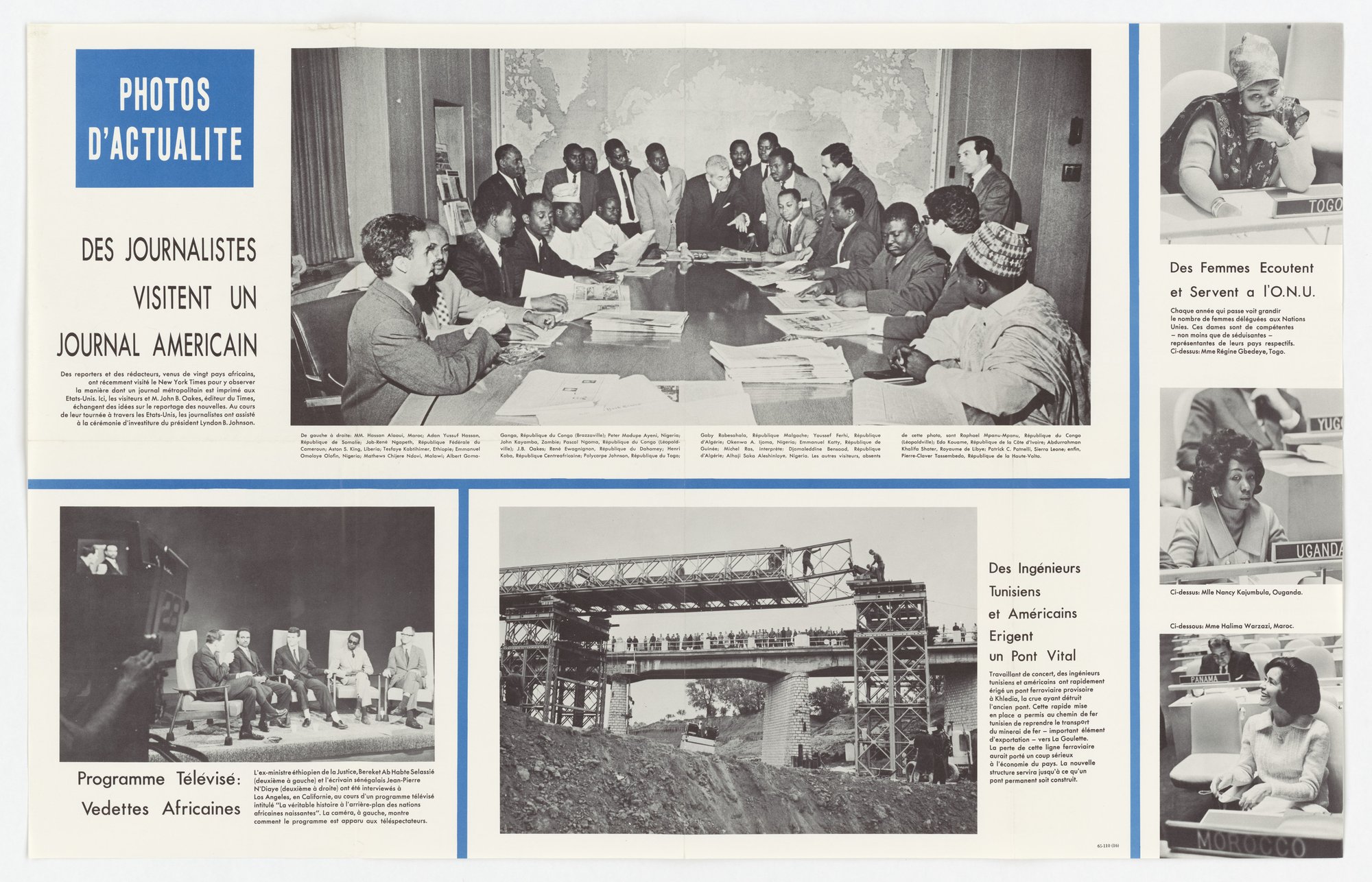
A fold-out photo sheet in French for African readers. Items cover African journalists visiting the New York Times and its editor John B. Oakes, an Ethiopian and a Senegalese guest on a Los Angeles television programme, Tunisian and American engineers building a temporary railway bridge at Khledia after a flood, and women delegates at the United Nations. The tell is card-stacking: the selected news shows cooperation, press access and shared engineering work, and the Times visit presents a free press as a US export.
Propaganda techniques used in this poster
- Date
- March 25, 1965
- Period
- Cold War
- Made by
- U.S. Information Agency, Propaganda Posters Distributed in Asia, Latin America and the Middle East series (RSC Beirut)
- Region
- North America
- Country
- United States
- Medium
- Poster
- Issuer type
- State
- Regime
- Johnson Administration
- Leader
- Lyndon B. Johnson
- Audience
- Foreign public
- Purpose
- Persuade or win support
- Themes
- Media and information, Economy and finance
- Event
- Cold War
- Source
- Unidentified Source blurred: contractors, cutouts, buried disclosure
- Source
- U.S. National Archives (NARA), Record Group 306, Posters in Asia, Latin America, Middle East, retrieved October 4, 2026
- Rights
- Public domain (U.S. government work; NARA RG 306)
U.S. Information Agency / Department of State, March 25, 1965. National Archives, Record Group 306 (NAID 6949190, 306-PPB-266).
Text on the object
PHOTOS D'ACTUALITE

DES JOURNALISTES VISITENT UN JOURNAL AMERICAIN

Des reporters et des rédacteurs, venus de vingt pays africains, ont récemment visité le New York Times pour y observer la manière dont un journal métropolitain est imprimé aux Etats-Unis. Ici, les visiteurs et M. John B. Oakes, éditeur du Times, échangent des idées sur le reportage des nouvelles. Au cours de leur tournée à travers les Etats-Unis, les journalistes ont assisté à la cérémonie d'investiture du président Lyndon B. Johnson.

De gauche à droite: MM. Hassan Alaoui, Maroc; Adan Yussuf Hassan, République de Somalie; Job-René Ngapeth, République Fédérale du Cameroun; Aston S. King, Libéria; Tesfaye Kobtihimer, Ethiopie; Emmanuel Omoloye Olofin, Nigéria; Mathews Chijere Ndovi, Malawi; Albert Goma-Gongo, République du Congo (Brazzaville); Peter Modupe Ayeni, Nigéria; John Kayamba, Zambie; Pascal Ngoma, République du Congo (Léopoldville); J.B. Oakes; René Ewognignon, République du Dahomey; Henri Koba, République Centrafricaine; Polycarpe Johnson, République du Togo; Gaby Rabesahala, République Malagache; Youssef Ferhi, République d'Algérie; Okenwa A. Ijoma, Nigéria; Emmanuel Katty, République de Côte d'Ivoire; Abdurrahman Khalifa Shater, Royaume de Libye; Patrick C. Patrelli, Sierra Leone; enfin, Pierre-Claver Tassembedo, République de la Haute-Volta. [Text partly illegible; names in the original caption continue across four columns and some spellings above are uncertain.]

Programme Télévisé: Vedettes Africaines

L'ex-ministre éthiopien de la Justice, Bereket Ab Habte Selassié (deuxième à gauche) et l'écrivain sénégalais Jean-Pierre N'Diaye (deuxième à droite) ont été interviewés à Los Angeles, en Californie, au cours d'un programme télévisé intitulé "La véritable histoire à l'arrière-plan des nations africaines naissantes". La caméra, à gauche, montre comment le programme est apparu aux téléspectateurs.

Des Ingénieurs Tunisiens et Américains Erigent un Pont Vital

Travaillant de concert, des ingénieurs tunisiens et américains ont rapidement érigé un pont ferroviaire provisoire à Khledia, la crue ayant détruit l'ancien pont. Cette rapide mise en place a permis au chemin de fer tunisien de reprendre le transport du minerai de fer - important élément d'exportation - vers La Goulette. La perte de cette ligne ferroviaire aurait porté un coup sérieux à l'économie du pays. La nouvelle structure servira jusqu'à ce qu'un pont permanent soit construit.

Des Femmes Ecoutent et Servent a l'O.N.U.

Chaque année qui passe voit grandir le nombre de femmes déléguées aux Nations Unies. Ces dames sont de compétentes - non moins que de séduisantes - représentantes de leurs pays respectifs. Ci-dessus: Mme Régine Gbedeye, Togo.

Ci-dessus: Mlle Nancy Kajumbula, Ouganda.

Ci-dessous: Mme Halima Warzazi, Maroc.

65-110 (16)
NEWS PHOTOS [printed headline 'Photos d'actualité'; NARA title 'Pictures in the News No. 6']

JOURNALISTS VISIT AN AMERICAN NEWSPAPER: Reporters and editors from twenty African countries recently visited the New York Times to observe how a metropolitan newspaper is printed in the United States. Here the visitors and John B. Oakes, editor of the Times, exchange ideas on news reporting. During their tour of the United States the journalists attended President Lyndon B. Johnson's inauguration ceremony. [The list of visitors by country follows in the caption.]

TELEVISION PROGRAMME: AFRICAN STARS: The former Ethiopian Minister of Justice, Bereket Ab Habte Selassie (second from left) and the Senegalese writer Jean-Pierre N'Diaye (second from right) were interviewed in Los Angeles, California, on a television programme entitled 'The true story behind the emerging African nations'. The camera at left shows how the programme appeared to viewers.

TUNISIAN AND AMERICAN ENGINEERS ERECT A VITAL BRIDGE: Working together, Tunisian and American engineers quickly erected a temporary railway bridge at Khledia, a flood having destroyed the old one. This allowed the Tunisian railway to resume carrying iron ore, an important export, to La Goulette. Loss of the line would have dealt a serious blow to the country's economy. The new structure will serve until a permanent bridge is built.

WOMEN LISTEN AND SERVE AT THE U.N.: Each year the number of women delegates to the United Nations grows. These ladies are capable, no less than charming, representatives of their countries. Above: Mrs. Regine Gbedeye, Togo. Above: Miss Nancy Kajumbula, Uganda. Below: Mrs. Halima Warzazi, Morocco.
Long journalist-name caption is partly illegible at this resolution; spellings of some names are uncertain and are marked in the text. Translation condenses the visitor list.