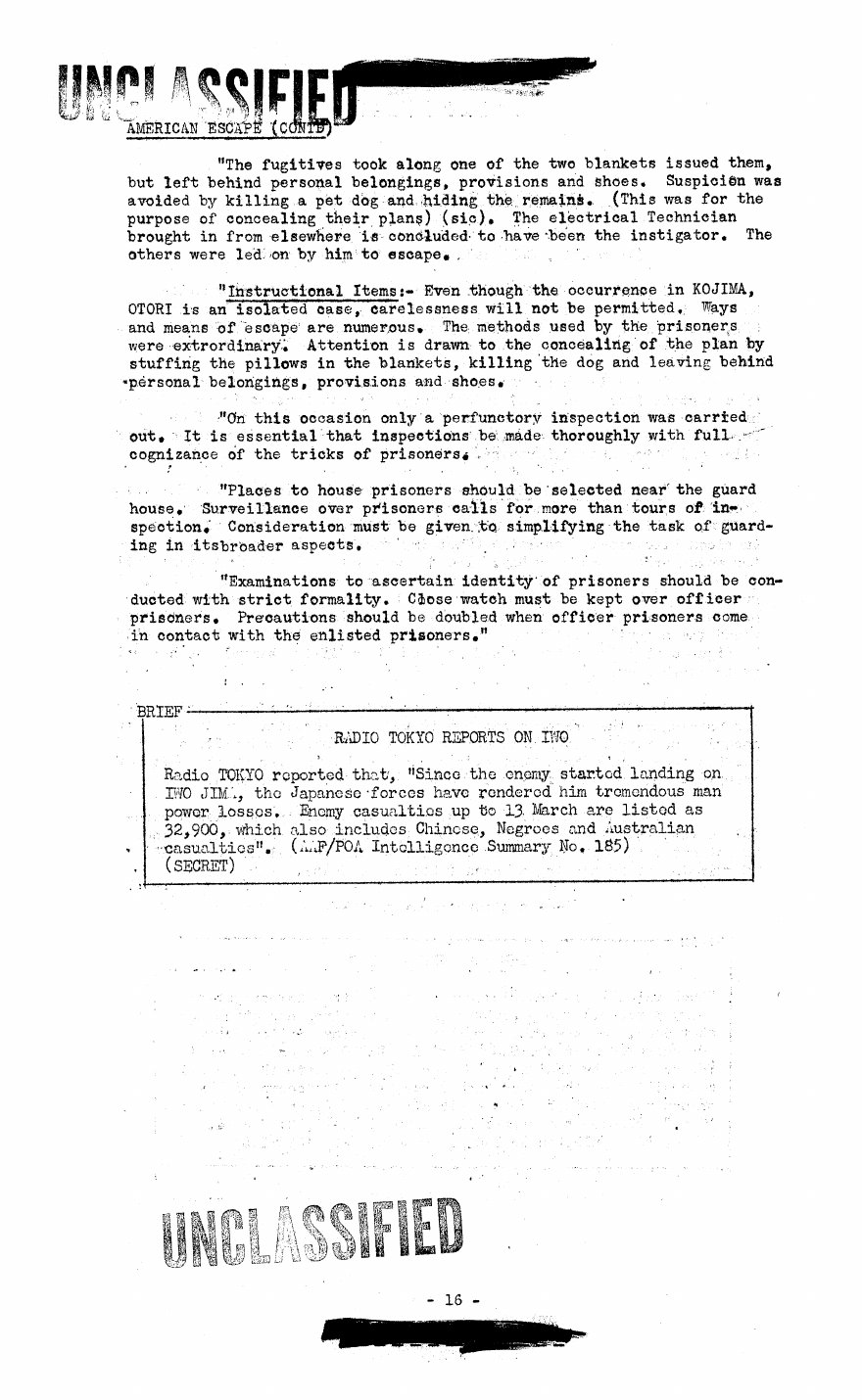
Radio Tokyo Reports on Iwo, as quoted in a U.S. Army intelligence bulletin
A boxed 'Brief' in a U.S. Army intelligence bulletin quotes a Radio Tokyo broadcast giving 32,900 Allied casualties on Iwo Jima up to 13 March 1945, a total said to include Chinese, Negro and Australian casualties. The quoted text gives one side's figure with no source, no basis for the count and no figure for Japanese losses, the missing-denominator tell of card stacking.
- Date
- April 6, 1945
- Period
- Second World War
- Made by
- Radio Tokyo (Japanese state broadcasting), as intercepted and quoted by Headquarters, United States Army Forces, Pacific Ocean Areas (Intelligence Bulletin No. 13)
- Region
- East Asia
- Country
- Empire of Japan
- Medium
- Document
- Issuer type
- State
- Regime
- Showa Japan
- Leader
- Hideki Tojo
- Audience
- Mixed
- Purpose
- Persuade or win support
- Event
- World War II
- Techniques
- Card stacking
- Leader
- Hideki Tōjō
- Source
- Identified Openly sourced: the speaker is who they say they are
- Source
- Internet Archive (US Army Combined Arms Research Library digitisation of USAFPOA Intelligence Bulletin No. 13, 6 April 1945), retrieved October 2, 2026
- Rights
- Public domain (U.S. Army work, declassified; Internet Archive PD Mark 1.0); quoted Radio Tokyo text
Headquarters, United States Army Forces, Pacific Ocean Areas, Intelligence Bulletin No. 13, 6 April 1945; digitised by the Combined Arms Research Library, Fort Leavenworth, via the Internet Archive
Text on the object
[page header] AMERICAN ESCAPE (CONT)

[box, BRIEF] RADIO TOKYO REPORTS ON IWO

Radio TOKYO reported that, "Since the enemy started landing on IWO JIMA, the Japanese forces have rendered him tremendous manpower losses. Enemy casualties up to 13 March are listed as 32,900, which also includes Chinese, Negroes and Australian casualties". (AAF/POA Intelligence Summary No. 185) (SECRET)

[page number] - 16 -
Text above the box (a quoted Japanese instruction on prisoner escape) is not transcribed. Page also carries UNCLASSIFIED declassification stamps. Original is English; no translation needed.