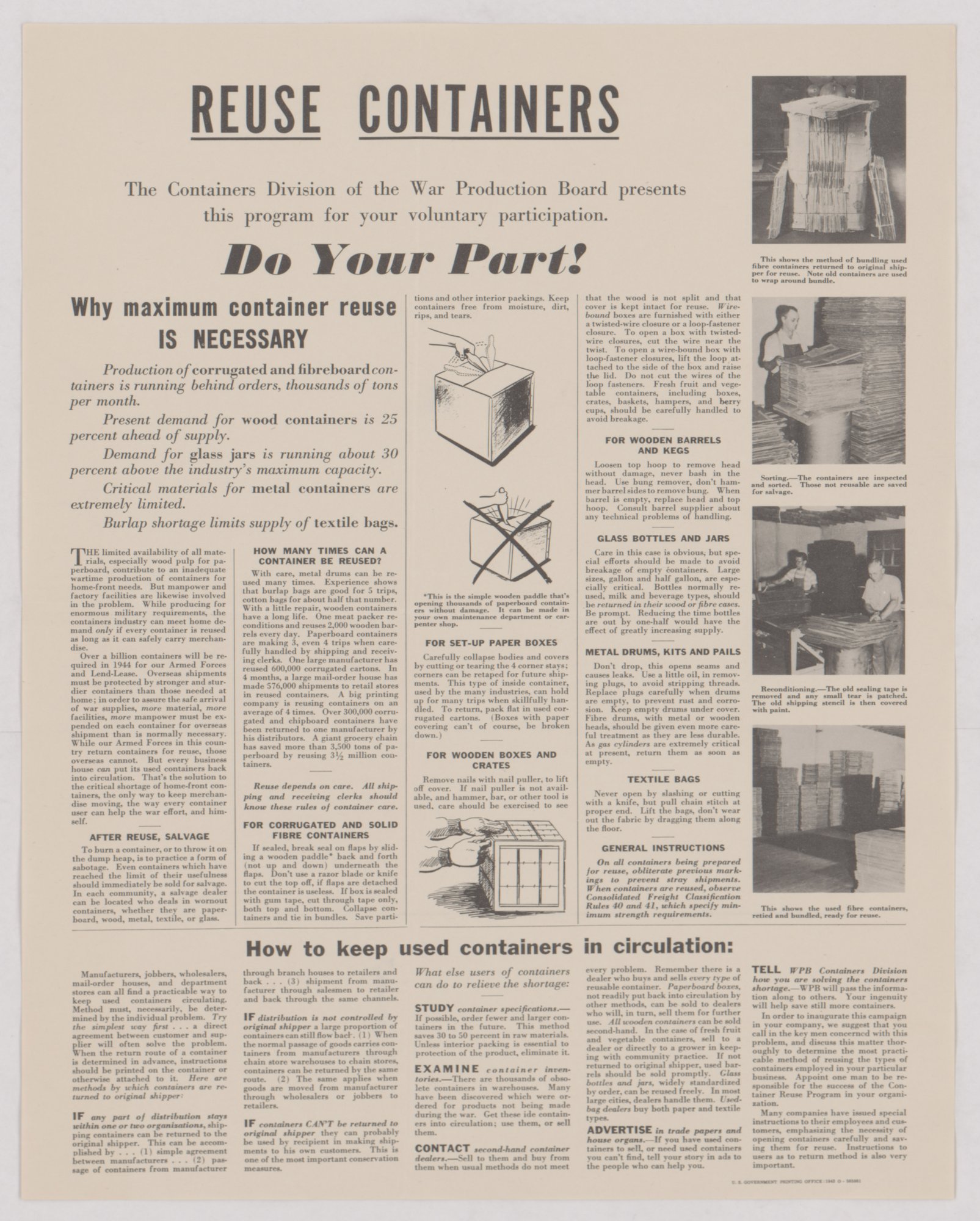
Reuse containers: do your part!
Text-heavy broadside with five small photographs and line drawings of container handling, presented by the War Production Board's Containers Division to business users. It stacks supply and demand figures for containers and ends in the headline 'Do Your Part!' with 'voluntary participation'; there is no portrait or slogan image.
Propaganda techniques used in this poster
- Date
- 1943
- Period
- Second World War
- Made by
- War Production Board, Containers Division
- Region
- North America
- Country
- United States
- Medium
- Poster
- Issuer type
- State
- Regime
- Roosevelt Administration
- Leader
- Franklin D. Roosevelt
- Audience
- Domestic public
- Purpose
- Mobilize or secure compliance
- Themes
- Home front, Economy and finance
- Event
- World War II
- Regime
- Roosevelt administration
- Leader
- Franklin D. Roosevelt
- Source
- Identified Openly sourced: the speaker is who they say they are
- Source
- U.S. National Archives and Records Administration, Record Group 44, World War II Posters, retrieved October 4, 2026
- Rights
- Public domain (U.S. government work)
War Production Board. National Archives and Records Administration, RG 44, 44-PA-1643 (NAID 515310).
Text on the object
REUSE CONTAINERS

The Containers Division of the War Production Board presents
this program for your voluntary participation.

Do Your Part!

Why maximum container reuse
IS NECESSARY

Production of corrugated and fibreboard containers is running behind orders, thousands of tons per month.
Present demand for wood containers is 25 percent ahead of supply.
Demand for glass jars is running about 30 percent above the industry's maximum capacity.
Critical materials for metal containers are extremely limited.
Burlap shortage limits supply of textile bags.

THE limited availability of all materials, especially wood pulp for paperboard, contribute to an inadequate wartime production of containers for home-front needs. But manpower and factory facilities are likewise involved in the problem. While producing for enormous military requirements, the containers industry can meet home demand only if every container is reused as long as it can safely carry merchandise.
Over a billion containers will be required in 1944 for our Armed Forces and Lend-Lease. Overseas shipments must be protected by stronger and sturdier containers than those needed at home; in order to assure the safe arrival of war supplies, more material, more facilities, more manpower must be expended on each container for overseas shipment than is normally necessary. While our Armed Forces in this country return containers for reuse, those overseas cannot. But every business house can put its used containers back into circulation. That's the solution to the critical shortage of home-front containers, the only way to keep merchandise moving, the way every container user can help the war effort, and himself.

AFTER REUSE, SALVAGE
To burn a container, or to throw it on the dump heap, is to practice a form of sabotage. Even containers which have reached the limit of their usefulness should immediately be sold for salvage. In each community, a salvage dealer can be located who deals in wornout containers, whether they are paperboard, wood, metal, textile, or glass.

HOW MANY TIMES CAN A CONTAINER BE REUSED?
With care, metal drums can be reused many times. Experience shows that burlap bags are good for 5 trips, cotton bags for about half that number. With a little repair, wooden containers have a long life. One metal packer reconditions and reuses 2,000 wooden barrels every day. Paperboard containers are making 3, even 4 trips when carefully handled by shipping and receiving clerks. One large manufacturer has reused 600,000 corrugated cartons. In 4 months, a large mail-order house has made 576,000 shipments to retail stores in reused containers. A big printing company is reusing containers on an average of 4 times. Over 300,000 corrugated and chipboard containers have been returned to one manufacturer by his distributors. A giant grocery chain has saved more than 3,500 tons of paperboard by reusing 3½ million containers.

Reuse depends on care. All shipping and receiving clerks should know these rules of container care.

FOR CORRUGATED AND SOLID FIBRE CONTAINERS
If sealed, break seal on flaps by sliding a wooden paddle* back and forth (not up and down) underneath the flaps. Don't use a razor blade or knife to cut the top off, if flaps are detached the container is useless. If box is sealed with gum tape, cut through tape only, both top and bottom. Collapse containers and tie in bundles. Save partitions and other interior packings. Keep containers free from moisture, dirt, rips, and tears.

*This is the simple wooden paddle that's opening thousands of paperboard containers without damage. It can be made in your own maintenance department or carpenter shop.

[The remaining body text (further container-type rules, the "How to keep used containers in circulation" columns, four photograph captions and the GPO imprint) is not transcribed here: the sheet is a full broadside of about 9,000 characters, cut at the 4,000-character field cap.]