Save Fuel in Dairy Plants: Nearly One-Half the Coal Can Be Saved
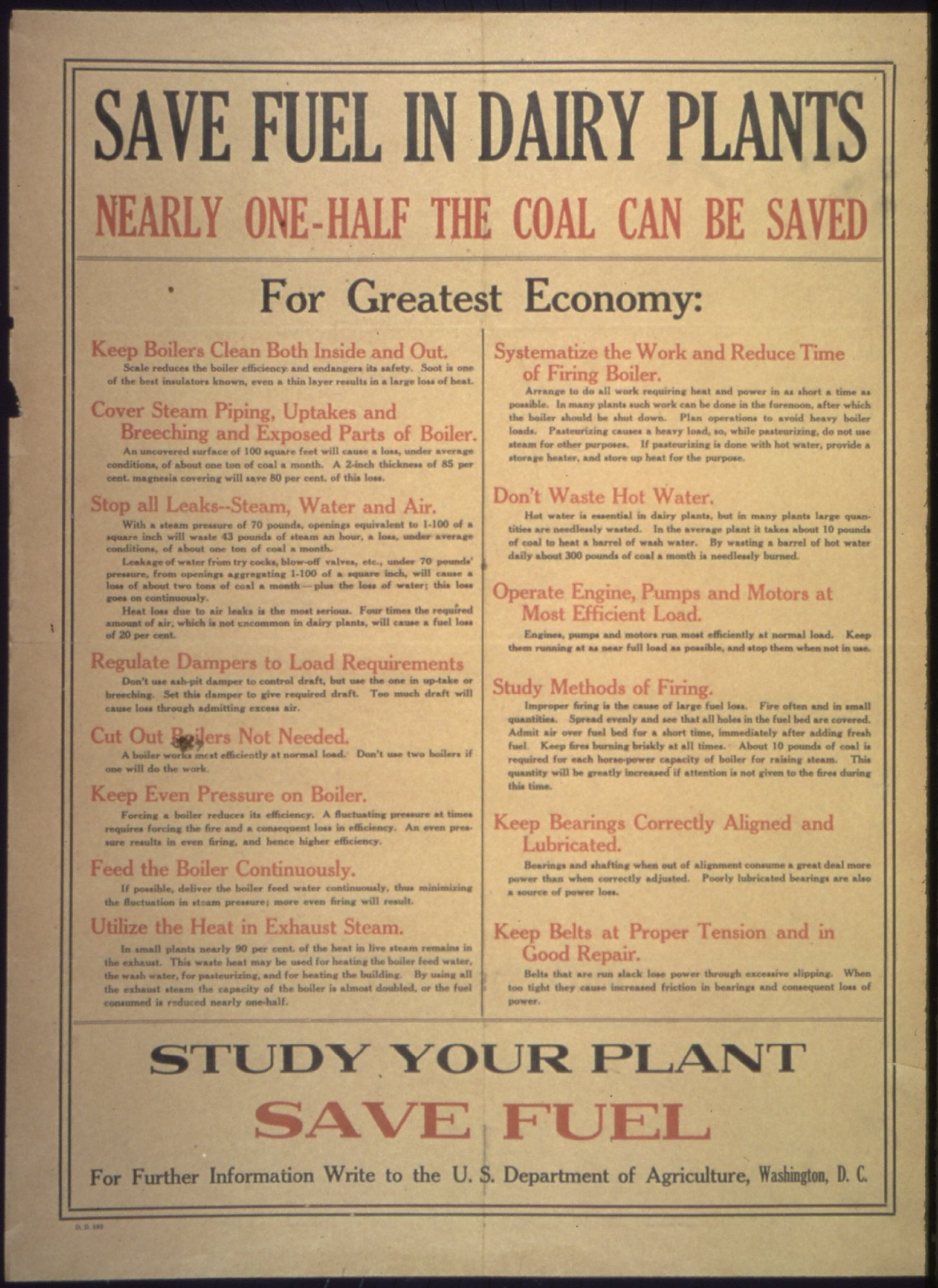
A dense two-column instruction sheet lists thirteen practices for dairy-plant boilers, from cleaning and insulation to firing methods, each with a figure for the coal it wastes, under the headline claim that nearly half the coal can be saved. Contact details for the Department of Agriculture close the sheet. It is mainly technical guidance; the persuasive element is the lead claim and the selected loss figures, which are presented without sources.
Propaganda techniques used in this poster
- Date
- 1917
- Period
- First World War
- Made by
- U.S. Department of Agriculture
- Region
- North America
- Country
- United States
- Medium
- Poster
- Issuer type
- State
- Regime
- Wilson Administration
- Leader
- Woodrow Wilson
- Audience
- Domestic public
- Purpose
- Warn or inform
- Themes
- Home front, Economy and finance, Science and technology
- Event
- World War I
- Regime
- Wilson administration
- Leader
- Woodrow Wilson
- Source
- Identified Openly sourced: the speaker is who they say they are
- Source
- U.S. National Archives (NARA), RG 4 (U.S. Food Administration), World War I Posters (NAID 512439), retrieved October 3, 2026
- Rights
- NARA Unrestricted; hosted by owner decision
U.S. Department of Agriculture. National Archives and Records Administration, 4-P-257.
Text on the object
SAVE FUEL IN DAIRY PLANTS
NEARLY ONE-HALF THE COAL CAN BE SAVED

For Greatest Economy:

Keep Boilers Clean Both Inside and Out.
Scale reduces the boiler efficiency and endangers its safety. Soot is one of the best insulators known, even a thin layer results in a large loss of heat.

Cover Steam Piping, Uptakes and Breeching and Exposed Parts of Boiler.
An uncovered surface of 100 square feet will cause a loss, under average conditions, of about one ton of coal a month. A 2-inch thickness of 85 per cent. magnesia covering will save 80 per cent. of this loss.

Stop all Leaks--Steam, Water and Air.
With a steam pressure of 70 pounds, openings equivalent to 1-100 of a square inch will waste 43 pounds of steam an hour, a loss, under average conditions, of about one ton of coal a month.
Leakage of water from try cocks, blow-off valves, etc., under 70 pounds' pressure, from openings aggregating 1-100 of a square inch, will cause a loss of about two tons of coal a month--plus the loss of water; this loss goes on continuously.
Heat loss due to air leaks is the most serious. Four times the required amount of air, which is not uncommon in dairy plants, will cause a fuel loss of 20 per cent.

Regulate Dampers to Load Requirements
Don't use ash-pit damper to control draft, but use the one in up-take or breeching. Set this damper to give required draft. Too much draft will cause loss through admitting excess air.

Cut Out Boilers Not Needed.
A boiler works most efficiently at normal load. Don't use two boilers if one will do the work.

Keep Even Pressure on Boiler.
Forcing a boiler reduces its efficiency. A fluctuating pressure at times requires forcing the fire and a consequent loss in efficiency. An even pressure results in even firing, and hence higher efficiency.

Feed the Boiler Continuously.
If possible, deliver the boiler feed water continuously, thus minimizing the fluctuation in steam pressure; more even firing will result.

Utilize the Heat in Exhaust Steam.
In small plants nearly 90 per cent. of the heat in live steam remains in the exhaust. This waste heat may be used for heating the boiler feed water, the wash water, for pasteurizing, and for heating the building. By using all the exhaust steam the capacity of the boiler is almost doubled, or the fuel consumed is reduced nearly one-half.

Systematize the Work and Reduce Time of Firing Boiler.
Arrange to do all work requiring heat and power in as short a time as possible. In many plants such work can be done in the forenoon, after which the boiler should be shut down. Plan operations to avoid heavy boiler loads. Pasteurizing causes a heavy load, so, while pasteurizing, do not use steam for other purposes. If pasteurizing is done with hot water, provide a storage heater, and store up heat for the purpose.

Don't Waste Hot Water.
Hot water is essential in dairy plants, but in many plants large quantities are needlessly wasted. In the average plant it takes about 10 pounds of coal to heat a barrel of wash water. By wasting a barrel of hot water daily about 300 pounds of coal a month is needlessly burned.

Operate Engine, Pumps and Motors at Most Efficient Load.
Engines, pumps and motors run most efficiently at normal load. Keep them running at as near full load as possible, and stop them when not in use.

[Three further paragraphs, 'Study Methods of Firing.', 'Keep Bearings Correctly Aligned and Lubricated.' and 'Keep Belts at Proper Tension and in Good Repair.', omitted here to fit the 4000-character limit.]

STUDY YOUR PLANT
SAVE FUEL

For Further Information Write to the U. S. Department of Agriculture, Washington, D. C.

D. D. 193 [print code, partly illegible]
Small print was read from a full-resolution scan; a few figures at the edge of legibility were checked against context. The print code at the foot left is tiny and only approximately legible.