Content note: Photograph of a soldier with a shell-wounded arm in a brace, with a first-person account of the injury. This object is shown as it was published. Why
She was wonderful
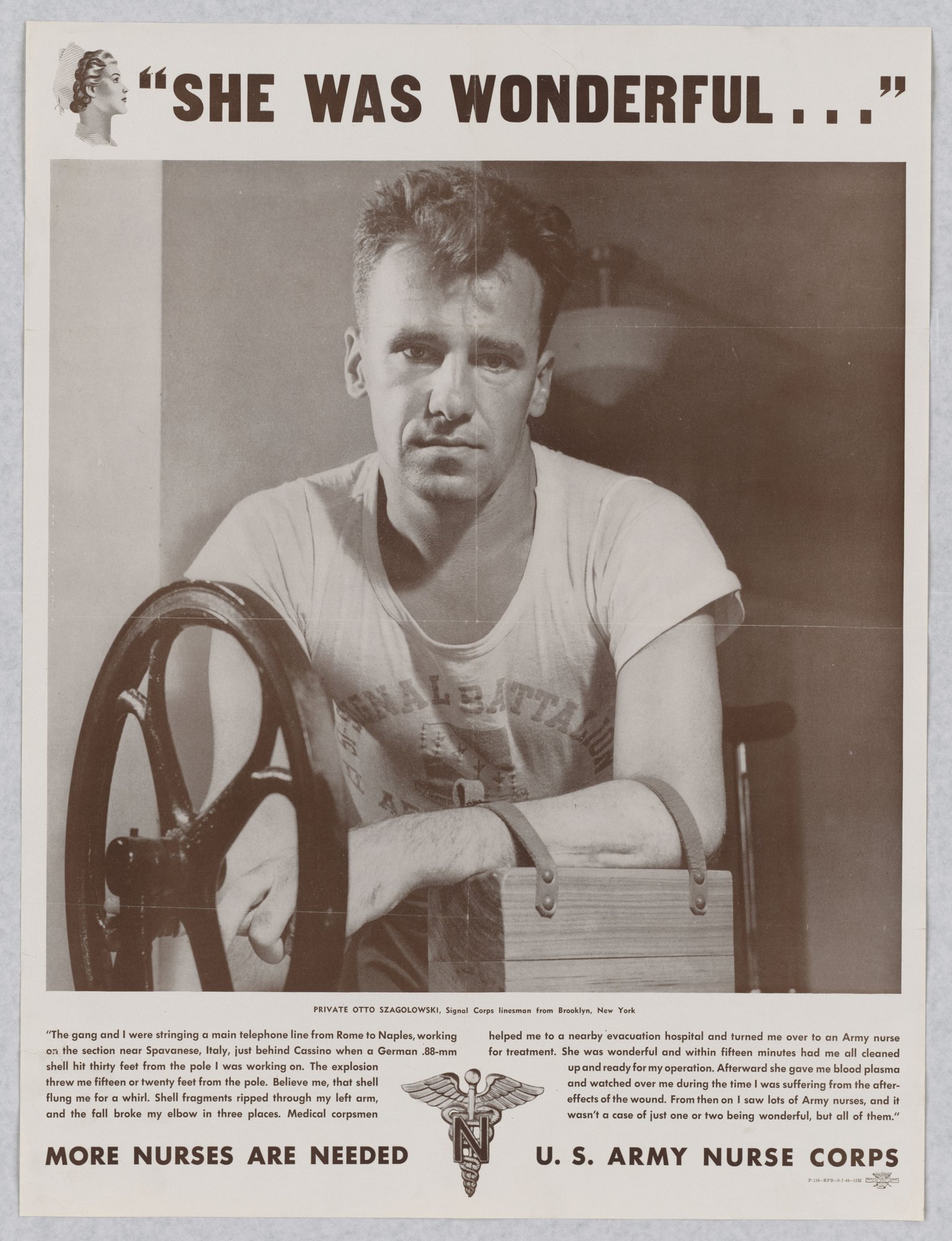
Army Nurse Corps recruiting sheet: a large photograph of Private Otto Szagolowski, a Signal Corps linesman from Brooklyn, in a Signal Battalion shirt with an arm in a leather brace, and his first-person account of his wound in Italy. Testimonial: a named soldier's praise of Army nurses carries the appeal 'More nurses are needed'. Headline in quotes: "She was wonderful . . ."
Propaganda techniques used in this poster
- Date
- 1944
- Period
- Second World War
- Made by
- U.S. Army Nurse Corps
- Region
- North America
- Country
- United States
- Medium
- Poster
- Issuer type
- Military
- Regime
- Roosevelt Administration
- Leader
- Franklin D. Roosevelt
- Audience
- Domestic public
- Purpose
- Recruit
- Themes
- War and the military, Health, Home front
- Event
- World War II
- Regime
- Roosevelt administration
- Leader
- Franklin D. Roosevelt
- Source
- Identified Openly sourced: the speaker is who they say they are
- Source
- U.S. National Archives and Records Administration, Record Group 44, World War II Posters, retrieved October 4, 2026
- Rights
- Public domain (U.S. government work)
U.S. Army Nurse Corps. National Archives and Records Administration, RG 44, 44-PA-1730 (NAID 515401).
Text on the object
"SHE WAS WONDERFUL . . ."
PRIVATE OTTO SZAGOLOWSKI, Signal Corps linesman from Brooklyn, New York
"The gang and I were stringing a main telephone line from Rome to Naples, working on the section near Spavanese, Italy, just behind Cassino when a German .88-mm shell hit thirty feet from the pole I was working on. The explosion threw me fifteen or twenty feet from the pole. Believe me, that shell flung me for a whirl. Shell fragments ripped through my left arm, and the fall broke my elbow in three places. Medical corpsmen helped me to a nearby evacuation hospital and turned me over to an Army nurse for treatment. She was wonderful and within fifteen minutes had me all cleaned up and ready for my operation. Afterward she gave me blood plasma and watched over me during the time I was suffering from the after-effects of the wound. From then on I saw lots of Army nurses, and it wasn't a case of just one or two being wonderful, but all of them."
MORE NURSES ARE NEEDED
U. S. ARMY NURSE CORPS
P-134--RPB--9-7-44--15M