Appareils de la R.A.F. Quelques modèles fameux - II
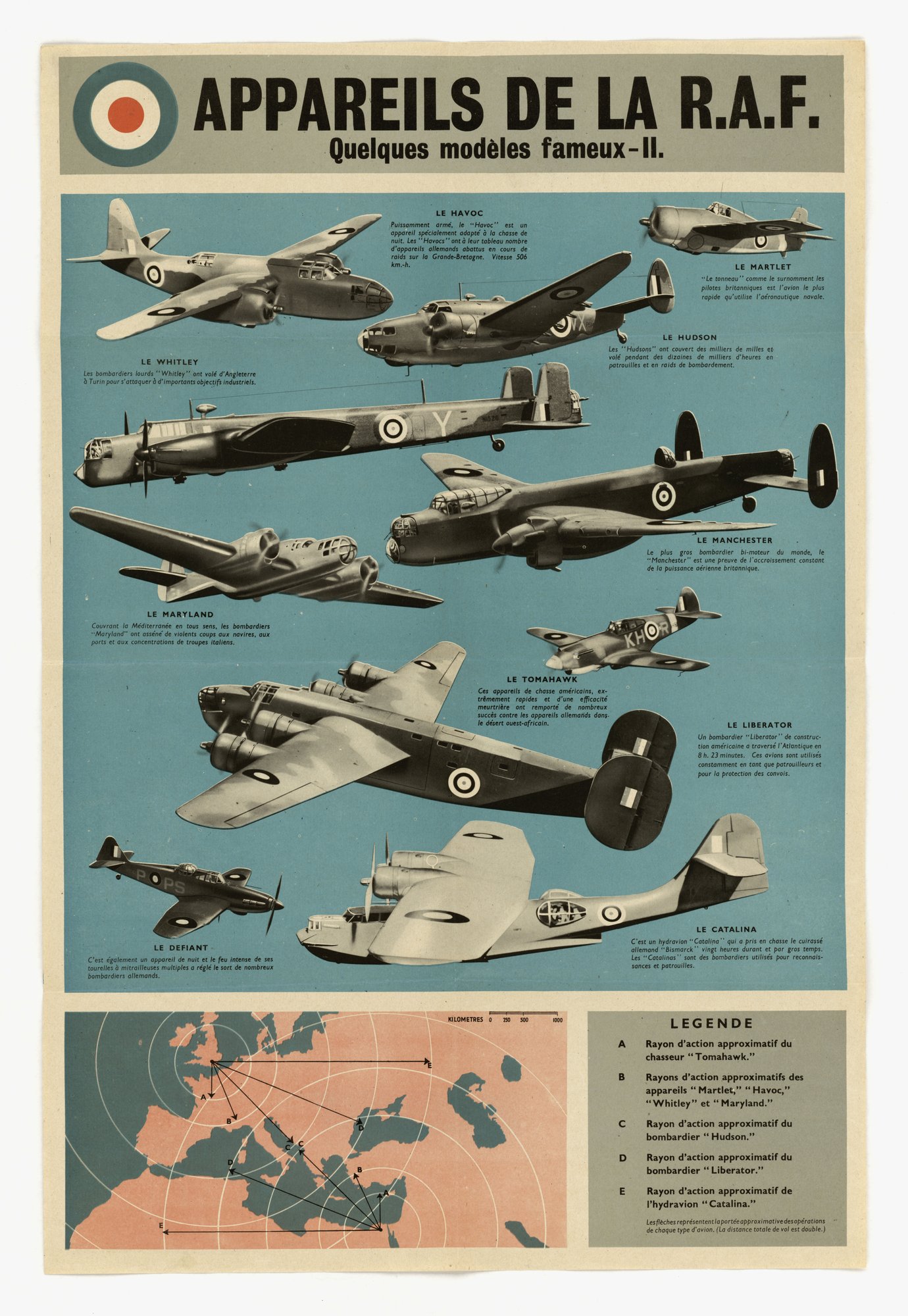
A sheet of ten RAF aircraft photographs on blue, each with a short French caption, above a range map of Europe and the Mediterranean with arrows lettered A to E. The tell is that each caption reports only successes or capability (German aircraft shot down, 'constant growth of British air power'), with no losses or limits given (card-stacking).
Propaganda techniques used in this poster
- Date
- 1939
- Period
- Second World War
- Made by
- Not stated on the sheet (French-language Royal Air Force aircraft sheet; no imprint visible)
- Region
- Western and Central Europe
- Country
- United Kingdom
- Medium
- Poster
- Issuer type
- State
- Regime
- Churchill Government
- Leader
- Winston Churchill
- Audience
- Foreign public
- Purpose
- Persuade or win support
- Theme
- War and the military
- Event
- World War II
- Leader
- Winston Churchill
- Source
- Unidentified Source blurred: contractors, cutouts, buried disclosure
- Source
- U.S. National Archives and Records Administration, Record Group 44, World War II Foreign Posters, retrieved October 3, 2026
- Rights
- UK origin presumed, published 1939-1945, Crown copyright expired; NARA Unrestricted; hosted by owner decision
Royal Air Force aircraft sheet, French language, issuer not stated. National Archives and Records Administration, 44-PF-798.
Text on the object
APPAREILS DE LA R.A.F.
Quelques modèles fameux - II.

LE HAVOC: Puissamment armé, le "Havoc" est un appareil spécialement adapté à la chasse de nuit. Les "Havocs" ont à leur tableau nombre d'appareils allemands abattus au cours de raids sur la Grande-Bretagne. Vitesse 506 km.-h.
LE MARTLET: "Le tonneau" comme le surnomment les pilotes britanniques est l'avion le plus rapide qu'utilise l'aéronautique navale.
LE HUDSON: Les "Hudsons" ont couvert des milliers de milles et volé pendant des dizaines de milliers d'heures en patrouilles et en raids de bombardement.
LE WHITLEY: Les bombardiers lourds "Whitley" ont volé d'Angleterre à Turin pour s'attaquer à d'importants objectifs industriels.
LE MANCHESTER: Le plus gros bombardier bi-moteur du monde, le "Manchester" est une preuve de l'accroissement constant de la puissance aérienne britannique.
LE MARYLAND: Couvrant la Méditerranée en tous sens, les bombardiers "Maryland" ont assené de violents coups aux navires, aux ports et aux concentrations de troupes italiens.
LE TOMAHAWK: Ces appareils de chasse américains, extrêmement rapides et d'une efficacité meurtrière ont remporté de nombreux succès contre les appareils allemands dans le désert ouest-africain.
LE LIBERATOR: Un bombardier "Liberator" de construction américaine a traversé l'Atlantique en 8 h. 23 minutes. Ces avions sont utilisés constamment en tant que patrouilleurs et pour la protection des convois.
LE DEFIANT: C'est également un appareil de nuit et le feu intense de ses tourelles à mitrailleuses multiples a réglé le sort de nombreux bombardiers allemands.
LE CATALINA: C'est un hydravion "Catalina" qui a pris en chasse le cuirassé allemand "Bismarck" vingt heures durant et par gros temps. Les "Catalinas" sont des bombardiers utilisés pour reconnaissances et patrouilles.

LEGENDE
A Rayon d'action approximatif du chasseur "Tomahawk."
B Rayons d'action approximatifs des appareils "Martlet," "Havoc," "Whitley" et "Maryland."
C Rayon d'action approximatif du bombardier "Hudson."
D Rayon d'action approximatif du bombardier "Liberator."
E Rayon d'action approximatif de l'hydravion "Catalina."
Les flèches représentent la portée approximative des opérations de chaque type d'avion. (La distance totale de vol est double.)
[Translation: AIRCRAFT OF THE R.A.F. Some famous models - II. Havoc: powerfully armed, specially adapted to night fighting; its tally includes many German aircraft shot down in raids on Great Britain; speed 506 km/h. Martlet: nicknamed 'the barrel' by British pilots, the fastest aircraft used by naval aviation. Hudson: covered thousands of miles and tens of thousands of hours on patrols and bombing raids. Whitley: heavy bombers flew from England to Turin to attack important industrial targets. Manchester: the largest twin-engine bomber in the world, proof of the constant growth of British air power. Maryland: ranging over the Mediterranean, struck violent blows at Italian ships, ports and troop concentrations. Tomahawk: American fighters, extremely fast and deadly, won many successes against German aircraft in the Western Desert. Liberator: an American-built bomber crossed the Atlantic in 8 h 23 min; used constantly as patrol aircraft and convoy protection. Defiant: also a night aircraft; the intense fire of its multiple machine-gun turrets settled the fate of many German bombers. Catalina: a flying boat that shadowed the German battleship Bismarck for twenty hours in heavy weather; used for reconnaissance and patrols. Legend: approximate operating radii of each type, shown by arrows; the total flight distance is double.]