Voyage to Mars poster, English edition (English poster distributed in Beirut)
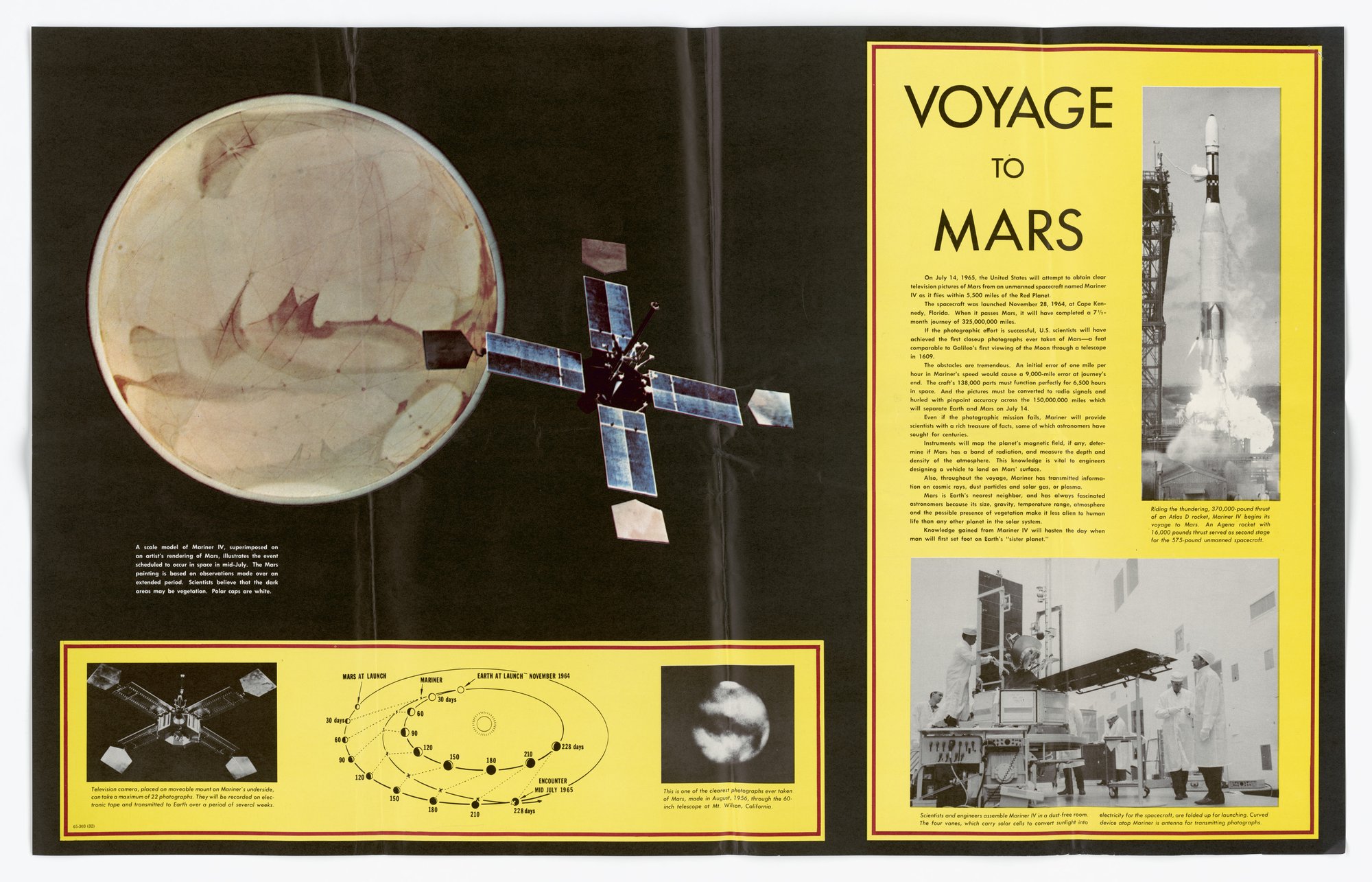
A large folded display sheet on the Mariner IV space probe. A painted Mars with a model of the probe on black, a diagram of the flight path, an older Mars photograph, a rocket launch and technicians in clean-room gowns are set around a text column that says the U.S. will try on 14 July 1965 to take close pictures of Mars. The tell is card-stacking: it lists the spacecraft's difficulties and goals as a national scientific effort, and the sheet carries no argument on any other topic.
Propaganda techniques used in this poster
- Date
- June 20, 1965
- Period
- Cold War
- Made by
- U.S. Information Agency (predecessor: State Department International Information and Educational Exchange Program), Propaganda Posters Distributed in Asia, Latin America and the Middle East series
- Region
- North America
- Country
- United States
- Medium
- Poster
- Issuer type
- State
- Regime
- Johnson Administration
- Leader
- Lyndon B. Johnson
- Audience
- Foreign public
- Purpose
- Warn or inform
- Theme
- Science and technology
- Event
- Cold War
- Source
- Unidentified Source blurred: contractors, cutouts, buried disclosure
- Source
- U.S. National Archives (NARA), Record Group 306, Posters in Asia, Latin America, Middle East, retrieved October 4, 2026
- Rights
- Public domain (U.S. government work; NARA RG 306)
U.S. Information Agency / Department of State, June 20, 1965. National Archives, Record Group 306 (NAID 6949217, 306-PPB-293).
Text on the object
VOYAGE
TO
MARS

On July 14, 1965, the United States will attempt to obtain clear television pictures of Mars from an unmanned spacecraft named Mariner IV as it flies within 5,500 miles of the Red Planet.
The spacecraft was launched November 28, 1964, at Cape Kennedy, Florida. When it passes Mars, it will have completed a 7½-month journey of 325,000,000 miles.
If the photographic effort is successful, U.S. scientists will have achieved the first closeup photographs ever taken of Mars—a feat comparable to Galileo's first viewing of the Moon through a telescope in 1609.
The obstacles are tremendous. An initial error of one mile per hour in Mariner's speed would cause a 9,000-mile error at journey's end. The craft's 138,000 parts must function perfectly for 6,500 hours in space. And the pictures must be converted to radio signals and hurled with pinpoint accuracy across the 150,000,000 miles which separate Earth and Mars on July 14.
Even if the photographic mission fails, Mariner will provide scientists with a rich treasure of facts, some of which astronomers have sought for centuries.
Instruments will map the planet's magnetic field, if any, determine if Mars has a band of radiation, and measure the depth and density of the atmosphere. This knowledge is vital to engineers designing a vehicle to land on Mars' surface.
Also, throughout the voyage, Mariner has transmitted information on cosmic rays, dust particles and solar gas, or plasma.
Mars is Earth's nearest neighbor, and has always fascinated astronomers because its size, gravity, temperature range, atmosphere and the possible presence of vegetation make it less alien to human life than any other planet in the solar system.
Knowledge gained from Mariner IV will hasten the day when man will first set foot on Earth's "sister planet."

Riding the thundering, 370,000-pound thrust of an Atlas D rocket, Mariner IV begins its voyage to Mars. An Agena rocket with 16,000 pounds thrust served as second stage for the 575-pound unmanned spacecraft.

Scientists and engineers assemble Mariner IV in a dust-free room. The four vanes, which carry solar cells to convert sunlight into electricity for the spacecraft, are folded up for launching. Curved device atop Mariner is antenna for transmitting photographs.

A scale model of Mariner IV, superimposed on an artist's rendering of Mars, illustrates the event scheduled to occur in space in mid-July. The Mars painting is based on observations made over an extended period. Scientists believe that the dark areas may be vegetation. Polar caps are white.

Television camera, placed on moveable mount on Mariner's underside, can take a maximum of 22 photographs. They will be recorded on electronic tape and transmitted to Earth over a period of several weeks.

This is one of the clearest photographs ever taken of Mars, made in August, 1956, through the 60-inch telescope at Mt. Wilson, California.

MARS AT LAUNCH   MARINER   EARTH AT LAUNCH--NOVEMBER 1964   ENCOUNTER MID JULY 1965 (diagram labels: 30 days, 60, 90, 120, 150, 180, 210, 228 days)

65-303 (32)
English text; no translation needed. Diagram labels abbreviated.