Window Display Suggestions for Food Conservation Week, November 21 to 28
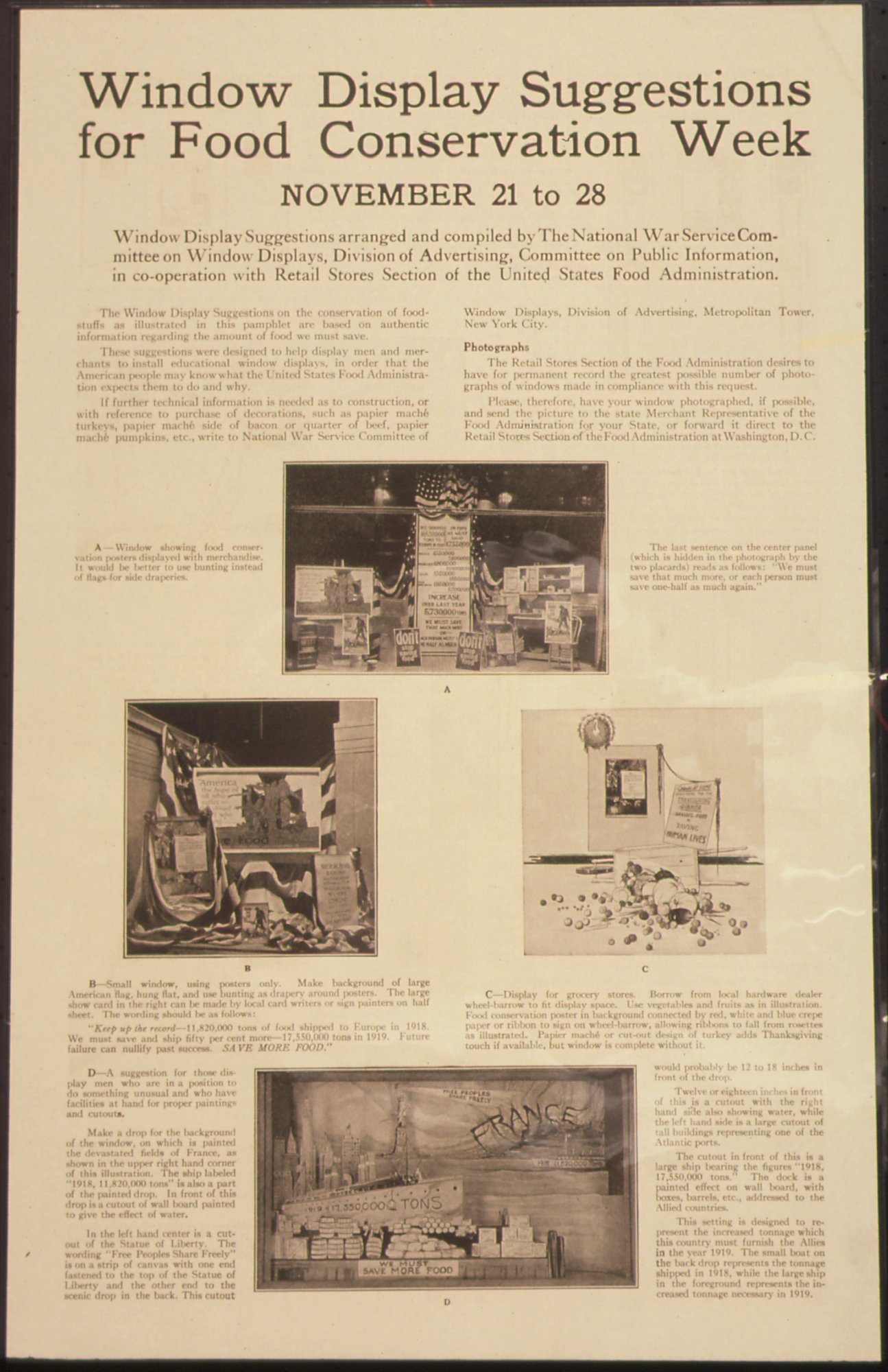
A printed instruction sheet for shopkeepers shows four photographed storefront displays (A to D) with captions explaining how to stage flags, posters, wheat sheaves and food-saving slogans during Food Conservation Week. The sheet's persuasion works through shop windows: each display attaches patriotic symbols to everyday goods.
Propaganda techniques used in this poster
- Date
- 1918
- Period
- First World War
- Made by
- National War Service Committee, Committee on Window Displays, with the Retail Stores Section of the U.S. Food Administration
- Region
- North America
- Country
- United States
- Medium
- Poster
- Issuer type
- State
- Regime
- Wilson Administration
- Leader
- Woodrow Wilson
- Audience
- Domestic public
- Purpose
- Mobilize or secure compliance
- Themes
- Home front, Economy and finance
- Event
- World War I
- Regime
- Wilson administration
- Leader
- Woodrow Wilson
- Source
- Identified Openly sourced: the speaker is who they say they are
- Source
- U.S. National Archives (NARA), RG 4 (U.S. Food Administration), World War I Posters (NAID 512439), retrieved October 3, 2026
- Rights
- NARA Unrestricted; hosted by owner decision
National War Service Committee / U.S. Food Administration. National Archives and Records Administration, 4-P-80.
Text on the object
Window Display Suggestions
for Food Conservation Week
NOVEMBER 21 to 28

Window Display Suggestions arranged and compiled by The National War Service Committee on Window Displays, Division of Advertising, Committee on Public Information, in co-operation with Retail Stores Section of the United States Food Administration.

The Window Display Suggestions on the conservation of food-stuffs as illustrated in this pamphlet are based on authentic information regarding the amount of food we must save.
These suggestions were designed to help display men and merchants to install educational window displays, in order that the American people may know what the United States Food Administration expects them to do and why.
If further technical information is needed as to construction, or with reference to purchase of decorations, such as papier maché turkeys, papier maché side of bacon or quarter of beef, papier maché pumpkins, etc., write to National War Service Committee of Window Displays, Division of Advertising, Metropolitan Tower, New York City.

Photographs
The Retail Stores Section of the Food Administration desires to have for permanent record the greatest possible number of photographs of windows made in compliance with this request.
Please, therefore, have your window photographed, if possible, and send the picture to the state Merchant Representative of the Food Administration, or forward it direct to the Retail Stores Section of the Food Administration at Washington, D.C.

A - Window showing food conservation posters displayed with merchandise. It would be better to use bunting instead of flags for side draperies.
The last sentence on the center panel (which is hidden in the photograph by the two placards) reads as follows: "We must save that much more, or each person must save one-half as much again."

B - Small window, using posters only. Make background of large American flag, hung flat, and use bunting as drapery around posters. The large show card in the right can be made by local card writers or sign painters on half sheet. The wording should be as follows:
"Keep up the record - 11,820,000 tons of food shipped to Europe in 1918. We must save and ship fifty per cent more - 17,550,000 tons in 1919. Future failure can nullify past success. SAVE MORE FOOD."

C - Display for grocery stores. Borrow from local hardware dealer wheel-barrow to fit display space. Use vegetables and fruits as in illustration. Food conservation poster in background connected by red, white and blue crepe paper or ribbon to sign on wheel-barrow, allowing ribbons to fall from rosettes as illustrated. Papier maché or cut-out design of turkey adds Thanksgiving touch if available, but window is complete without it.

D - A suggestion for those display men who are in a position to do something unusual and who have facilities at hand for proper paintings and cutouts.
Make a drop for the background of the window, on which is painted the devastated fields of France, as shown in the upper right hand corner of this illustration. The ship labeled "1918, 11,820,000 tons" is also a part of the painted drop. In front of this drop is a cutout of wall board painted to give the effect of water.
In the left hand center is a cutout of the Statue of Liberty. The wording "Free Peoples Share Freely" is on a strip of canvas with one end fastened to the top of the Statue of Liberty and the other end to the scenic drop in the back. This cutout would probably be 12 to 18 inches in front of the drop.
[… remaining text omitted: last four paragraphs of caption D (cutouts, ship and dock, closing explanation)]
The printed body text is small but now largely legible; the sign lettering inside the four photographs is only partly readable and is not transcribed. Transcription truncated for the 4000-character schema limit: the last paragraphs of caption D are omitted. Photograph A's center panel carries a list of figures that is not legible. The captions give 1918 and 1919 as the shipment years, so the week is November 1918.