In one line: the Republican ticket of President William McKinley and Theodore Roosevelt defeated the Democratic ticket of William Jennings Bryan and Adlai E. Stevenson, in a rematch of 1896 fought over empire and the Philippines, trusts, the gold standard and prosperity, with several smaller tickets in the field.
Context
The Republicans renominated McKinley at Philadelphia in June 1900. Vice President Garret A. Hobart had died in office, and the convention's most notable decision was to place Governor Theodore Roosevelt of New York on the ticket [1]. The Democrats met at Kansas City and again nominated Bryan, with Adlai E. Stevenson, Grover Cleveland's former vice president, for second place [1]. Several smaller parties also named candidates: Prohibition (John G. Woolley and Henry B. Metcalf), Social Democratic (Eugene V. Debs and Harriman) and two Populist factions, one of which had fused with the Democrats while the other nominated Wharton Barker and Ignatius Donnelly [4].
The Miller Center's account says that Bryan kept the free-silver call although new gold supplies had raised prices and eased farm distress, and that Democratic managers kept a silver plank but put more weight on opposition to expansionism and to the Philippine war; the Republicans defended American interests in foreign markets, a protectorate for the Philippines and an antitrust policy that condemned monopolies while approving "honest cooperation of capital" [1]. It records that the Republicans spent several million dollars on 125 million campaign documents and employed 600 speakers, that McKinley stayed at home giving written speeches, and that Roosevelt campaigned across the country [1]. Using the National Archives count, McKinley took 292 electoral votes to Bryan's 155 (447 cast, 224 needed) [2]. The popular vote is given as 7,219,193 (51.7 percent) to 6,357,698 (45.5 percent) by the American Presidency Project [3]; the Miller Center essay gives 7,218,491 and 6,356,734 [1]. Debs received 87,945 votes [4].
Every object below is a printed 1900 item, public domain by age. Each ticket has the same two sub-sections: material made in support and material made against, the second mostly from the humour weeklies Puck, Judge and The Verdict. Those magazines are not party committees, and a cartoon criticising a ticket is not a statement by the ticket's rival. The page does not say which side was right.
Campaign literature
The page hosts 20 objects: 10 for McKinley and Roosevelt (6 in support, 4 in opposition), 9 for Bryan and Stevenson (5 in support, 4 in opposition) and 1 about both. The posters name lithographers or copyright holders, not a party committee; the cartoons are magazine pages and the Underwood cards are commercial photographs.
William McKinley and Theodore Roosevelt (Republican)
In support
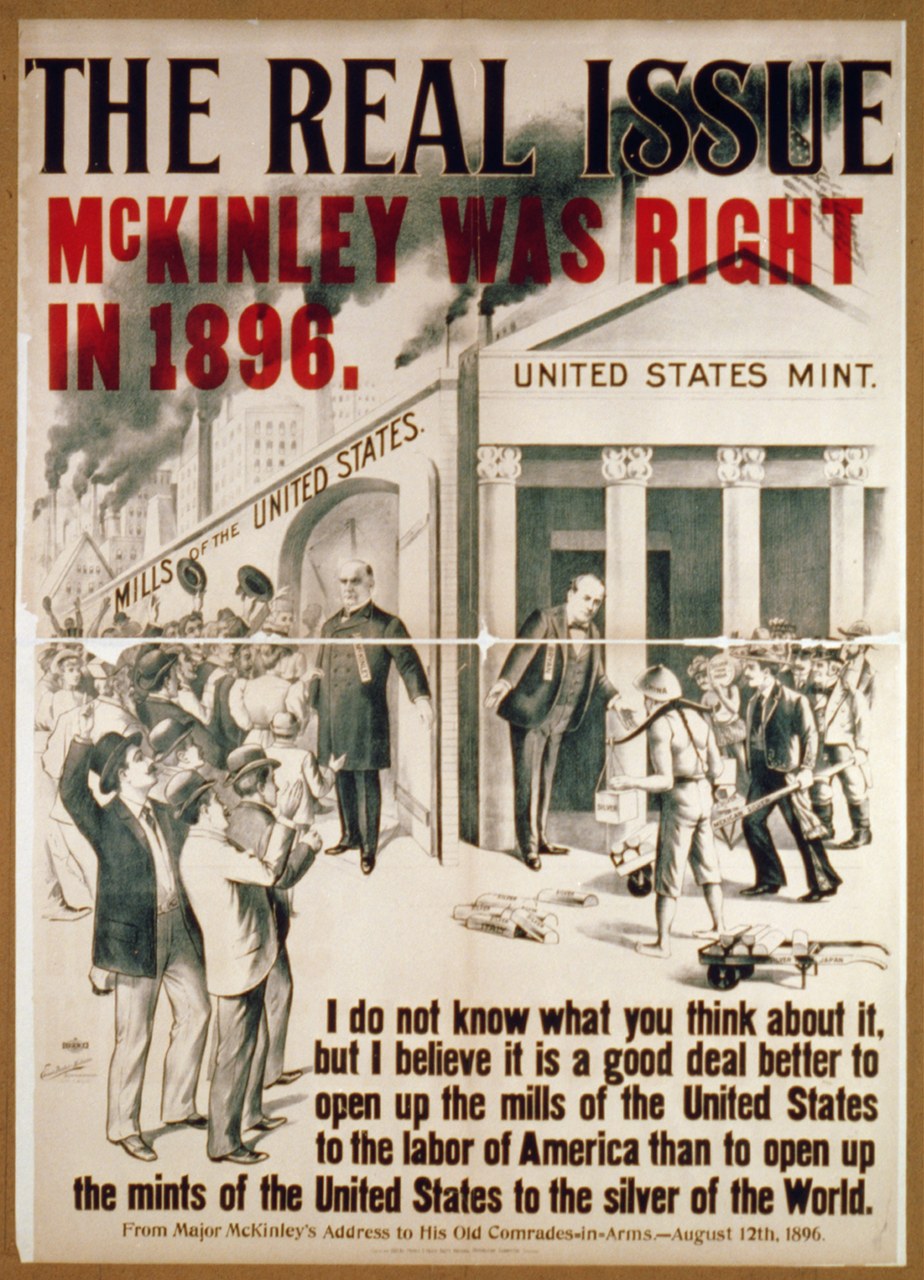
The Real Issue: McKinley Was Right in 1896. Edwards, Deutsch & Heitmann, Chicago, 1900 (lithographers). Public domain by age; Library of Congress. A poster that sets a crowd outside the mills against the door of the mint and prints McKinley's own August 1896 words about opening "the mills" rather than "the mints". It carries his old statement into the new contest and reduces the money question to two buildings (Card stacking). The sheet names no committee as issuer.
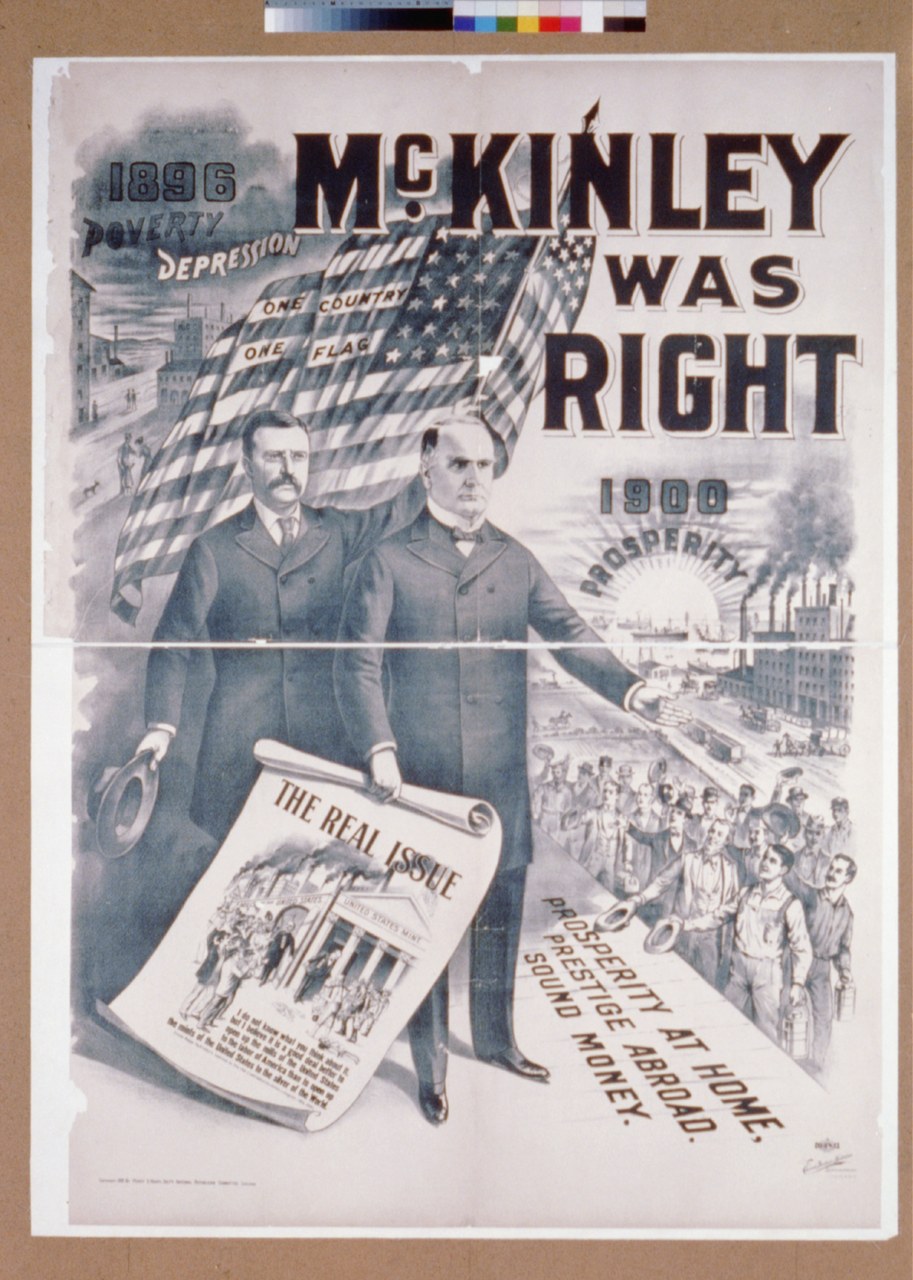
McKinley Was Right (poster: 1896 poverty, 1900 prosperity). Edwards, Deutsch & Heitmann, Chicago, 1900 (lithographers). Public domain by age; Library of Congress. The same lithographers' companion sheet, with the ticket in front of a flag and the 1896 and 1900 years labelled "Poverty Depression" and "Prosperity". Two years are set side by side as if one caused the other (Card stacking), and the closing line, "Prosperity at home, prestige abroad, sound money", is a set of virtue words with no testable claim (Glittering generalities).
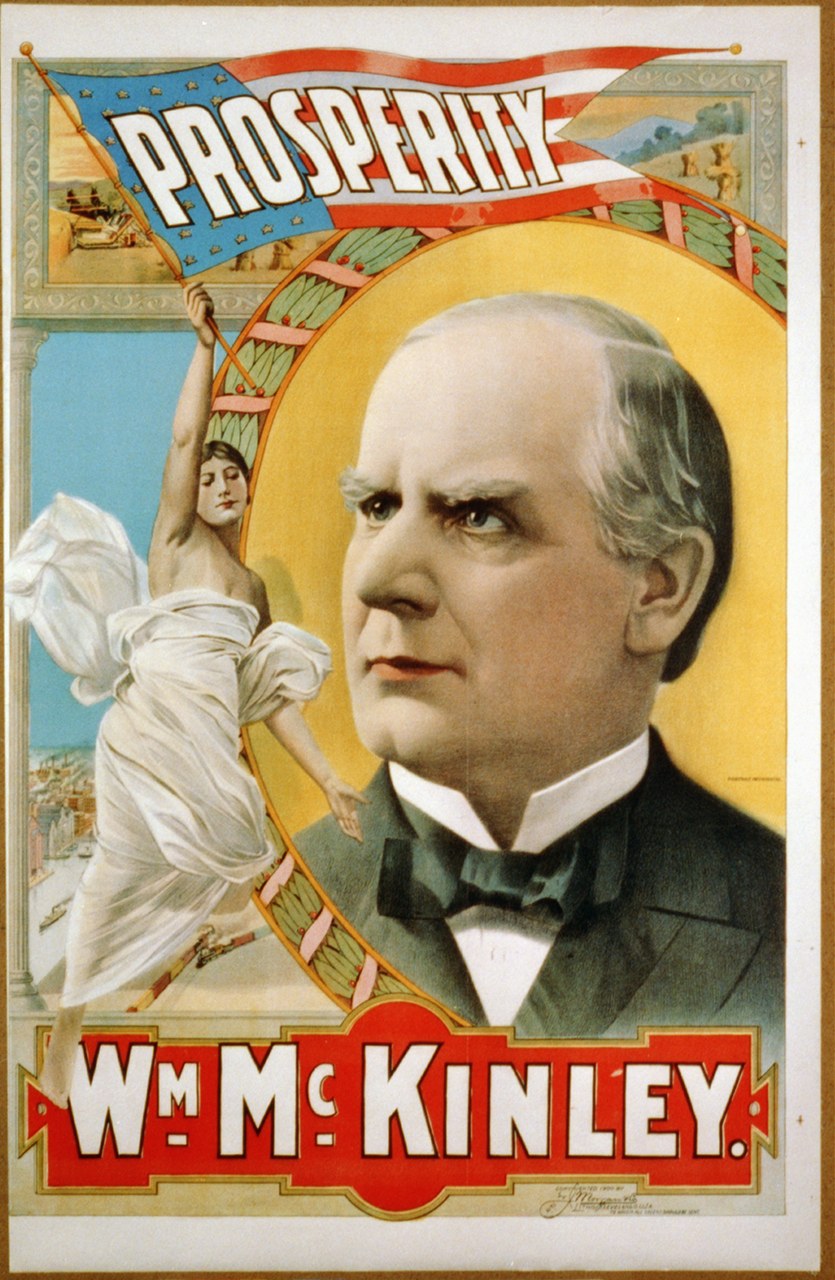
Wm. McKinley, Prosperity. W. J. Morgan & Co., Cleveland, 1900. Public domain by age; Library of Congress. A portrait lithograph with one word as its message. "Prosperity" stands in place of a platform (Glittering generalities), and the flag and the robed allegorical figure lend national symbolism to the portrait (Transfer).
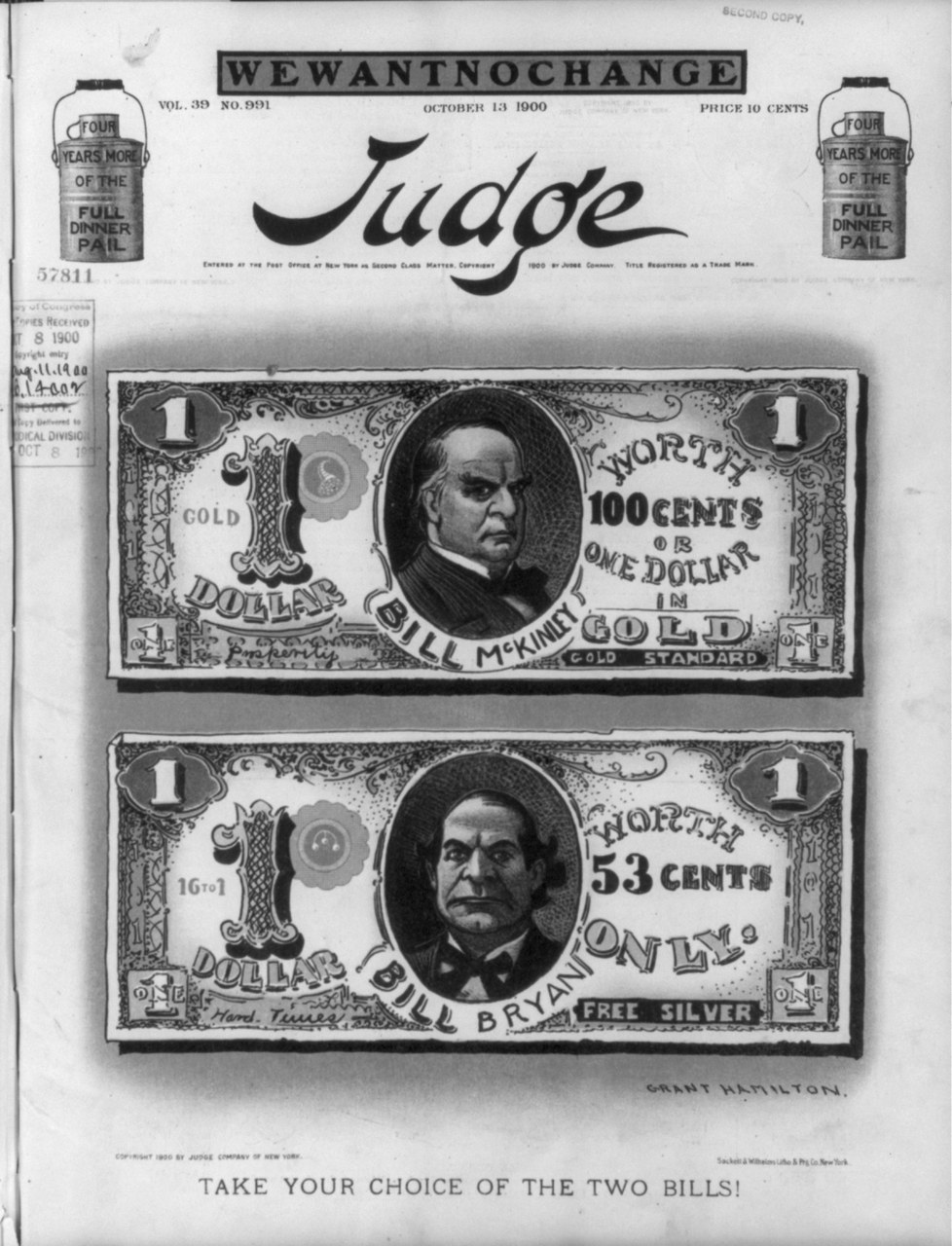
Take Your Choice of the Two Bills! (Judge cover, 13 October 1900). Grant Hamilton for Judge, 13 October 1900. Public domain by age; Library of Congress. A magazine cover rather than a committee sheet. It turns the silver question into one price comparison, 100 cents against 53, and repeats "Four years more of the full dinner pail" beside a masthead reading "We want no change" (Card stacking). Each candidate is shown with a first-name nickname on a note (Name-calling).
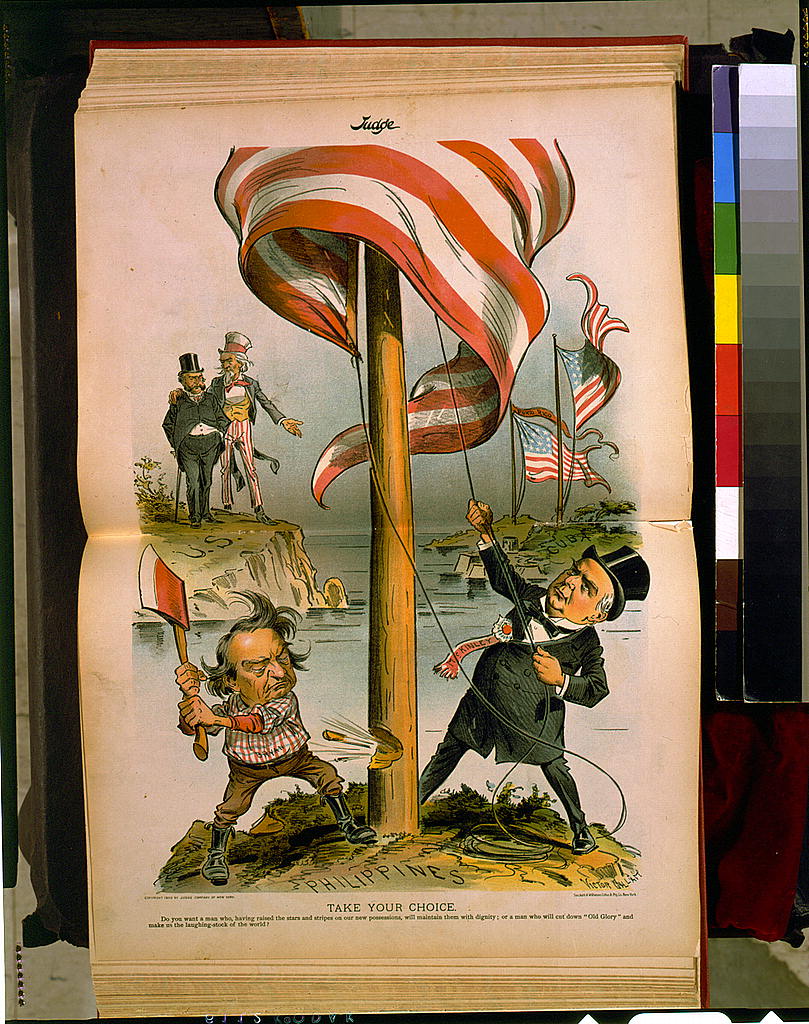
Take Your Choice (Judge, 12 May 1900). Victor Gillam for Judge, 12 May 1900. Public domain by age; Library of Congress. The caption offers voters a man who will "maintain" the flag "with dignity" or one who will "cut down Old Glory". The flag's prestige is placed on one candidate and its destruction on the other (Transfer), and no third option, such as opposing annexation while honouring the flag, is offered (Card stacking).
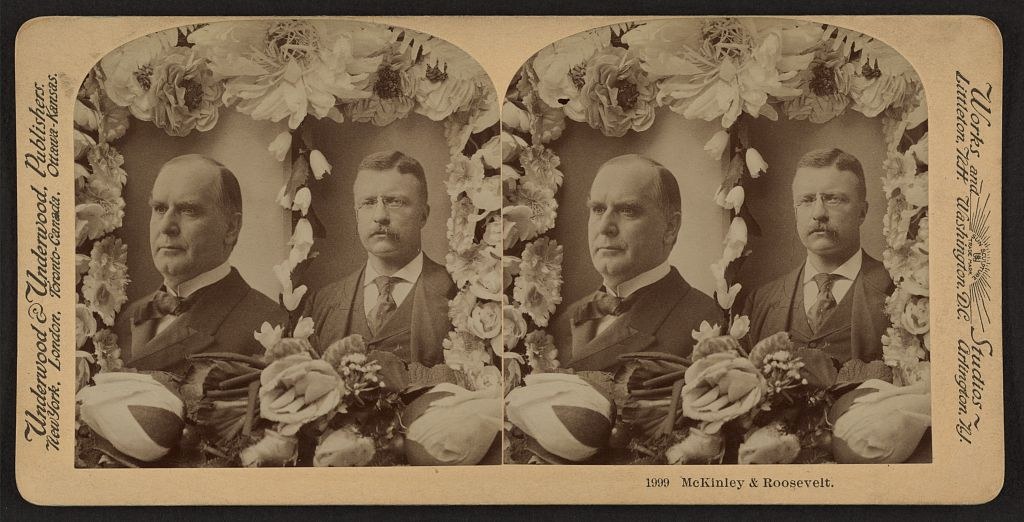
McKinley & Roosevelt (Underwood & Underwood stereograph). Underwood & Underwood, 16 October 1900. Public domain by age; Library of Congress. A commercial souvenir, not a party document. The two nominees are shown by likeness and flowers alone, with no slogan (Transfer of the dignity of the setting).
In opposition
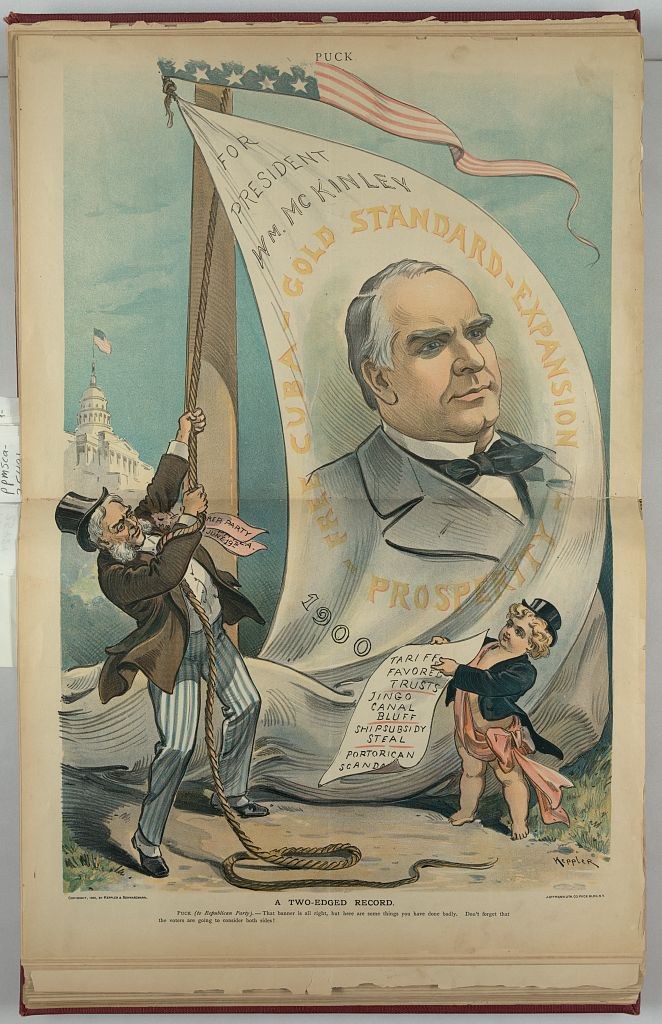
A Two-Edged Record (Puck centerfold, 13 June 1900). Udo J. Keppler for Puck, 13 June 1900. Public domain by age; Library of Congress. Puck, drawn as a child, answers the party's platform banner ("Free Cuba, Gold Standard, Expansion, Prosperity") with a rival list: "Tariff favored trusts", "Jingo canal bluff", "Ship subsidy steal", "Portorican scandals". The loaded words are attached to the administration's record (Name-calling) and the list picks the negatives to set against a list of positives (Card stacking).
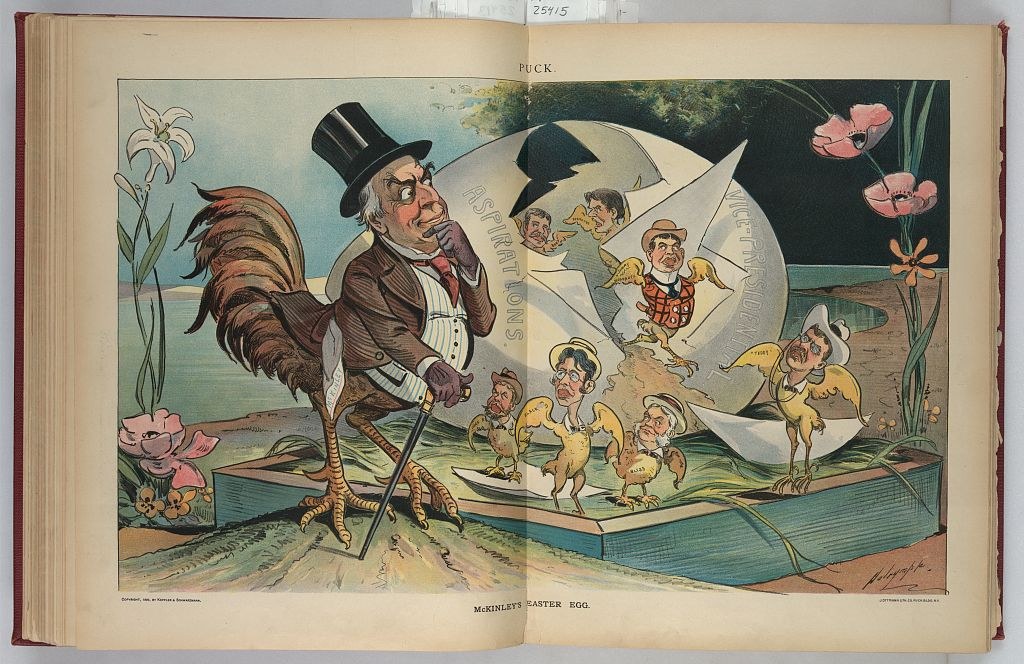
McKinley's Easter Egg (Puck, 18 April 1900). Louis Dalrymple for Puck, 18 April 1900. Public domain by age; Library of Congress. McKinley is a top-hatted rooster and the vice-presidential hopefuls, including a chick labelled "Teddy", are his chicks. The animal body is a status-lowering label applied to the president and to every aspirant alike (Name-calling).
Content note: period racial caricature of a Hawaiian and a Puerto Rican woman.
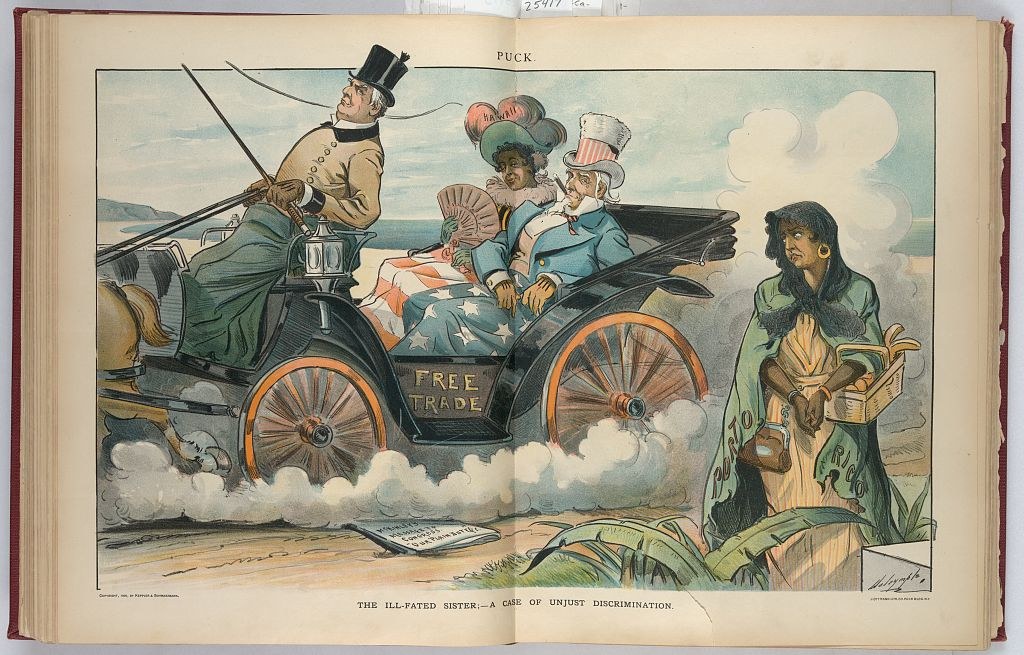
The Ill-Fated Sister: A Case of Unjust Discrimination (Puck, 25 April 1900). Louis Dalrymple for Puck, 25 April 1900. Public domain by age; Library of Congress. The cartoon appears to criticise the way Congress treated Puerto Rico's trade differently from Hawaii's, contrasting two women in one frame under the title "a case of unjust discrimination". It picks one contrast out of a larger tariff dispute (Card stacking) and draws both women in period racial caricature.
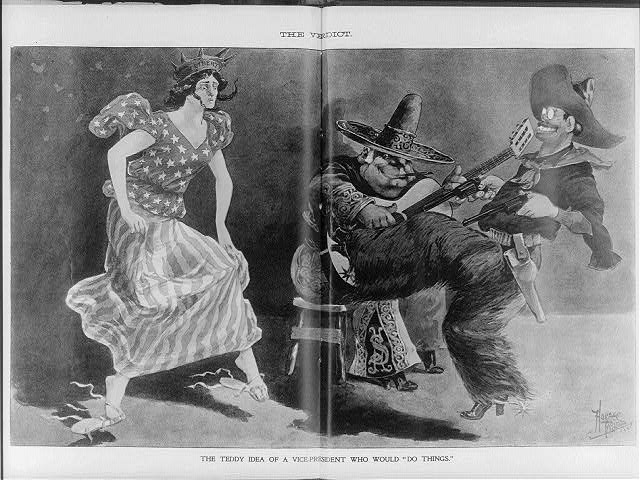
The Teddy Idea of a Vice-President Who Would "Do Things" (The Verdict, 29 October 1900). The Verdict, New York, 29 October 1900. Public domain by age; Library of Congress. A cartoon on the vice-presidential candidate rather than on the head of the ticket. Its title makes the nominee the butt of the joke through costume and a revolver (Name-calling). The Library of Congress notes its later reproduction in Albert Shaw's 1910 cartoon history of Roosevelt.
William Jennings Bryan and Adlai E. Stevenson (Democratic, with Populist fusion)
In support
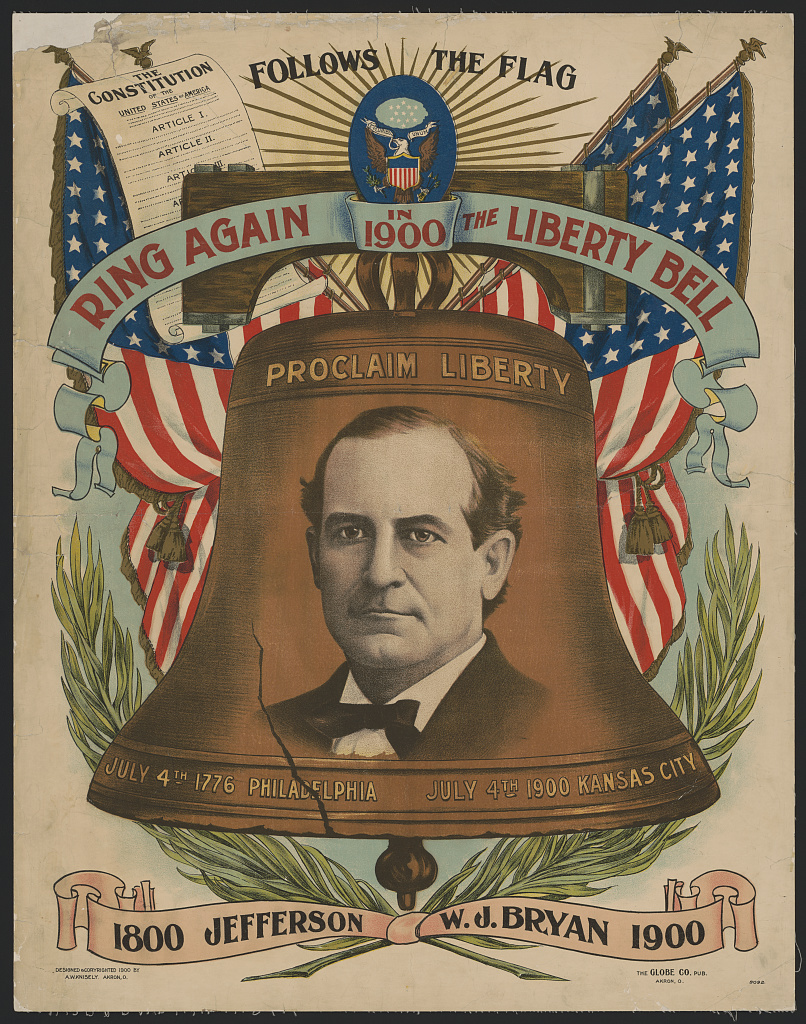
Ring Again the Liberty Bell in 1900 (Bryan poster). The Globe Co., Akron, Ohio, copyright A. W. Knisely, 1900. Public domain by age; Library of Congress. Bryan's portrait sits inside the Liberty Bell, with a printed Constitution, flags, "Follows the Flag" above and "1800 Jefferson / W. J. Bryan 1900" below. The nominee is placed beside the Liberty Bell and Jefferson (Transfer) and the message is virtue words, "Proclaim Liberty" (Glittering generalities). The bell's rim names Kansas City, the Democratic convention city.
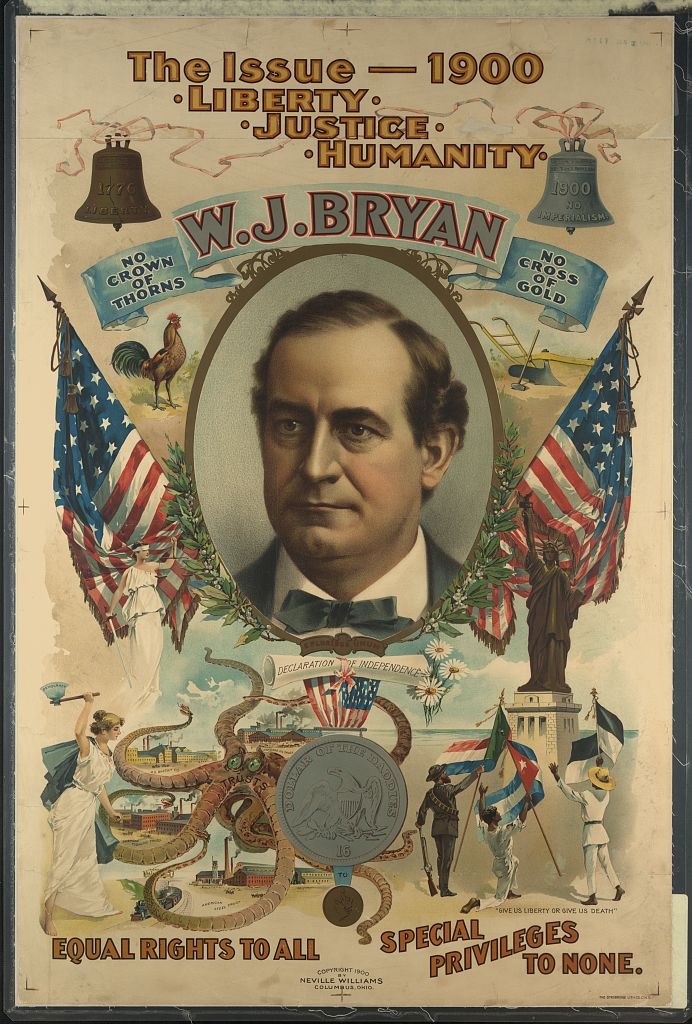
The Issue - 1900. Liberty. Justice. Humanity. W. J. Bryan. Neville Williams, Columbus, Ohio, copyright 1900. Public domain by age; Library of Congress. The headline names the issues, "Liberty. Justice. Humanity.", with "No imperialism" on one bell and "No cross of gold" on a banner. A Statue of Liberty and the Declaration of Independence borrow national standing (Transfer), the headline words are virtue words (Glittering generalities), and an octopus labelled "Trusts" coiled round factories stages a threat for the voter to resist (Fear appeal).
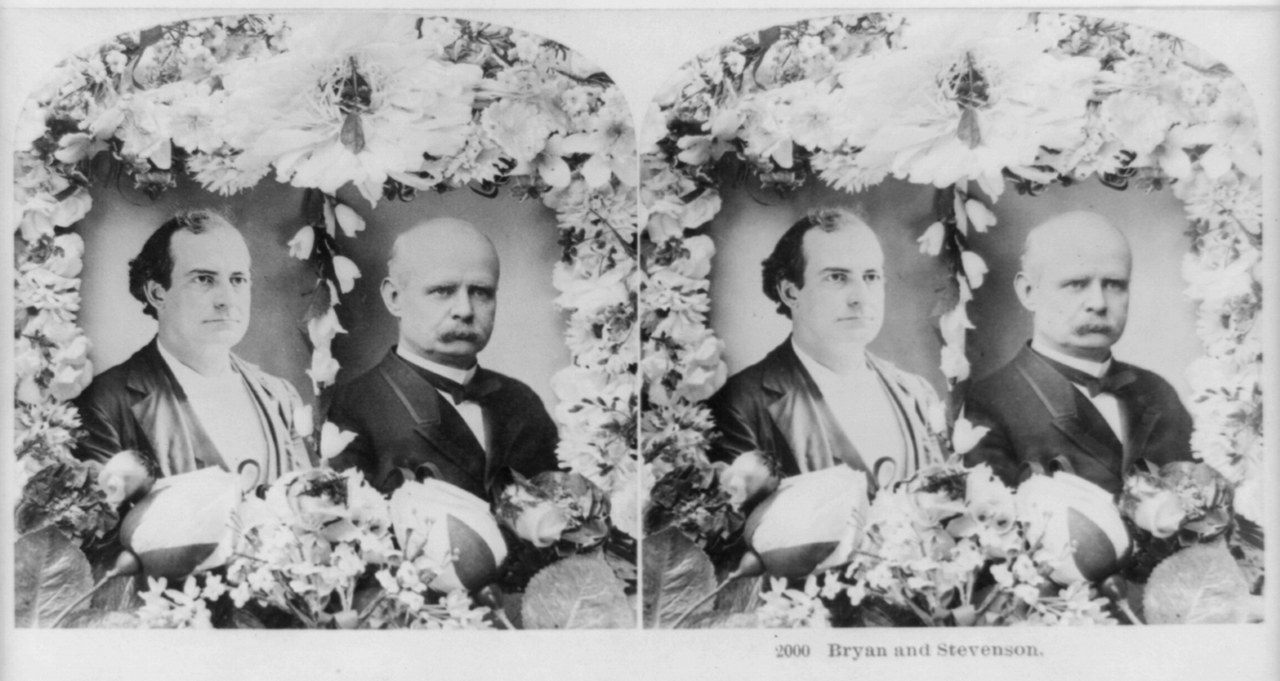
Bryan and Stevenson (Underwood & Underwood stereograph). Underwood & Underwood, 1900. Public domain by age; Library of Congress. The Democratic counterpart of the same publisher's McKinley and Roosevelt card, in the same arch, flowers and layout. Again the ticket is shown by likeness and setting alone (Transfer).
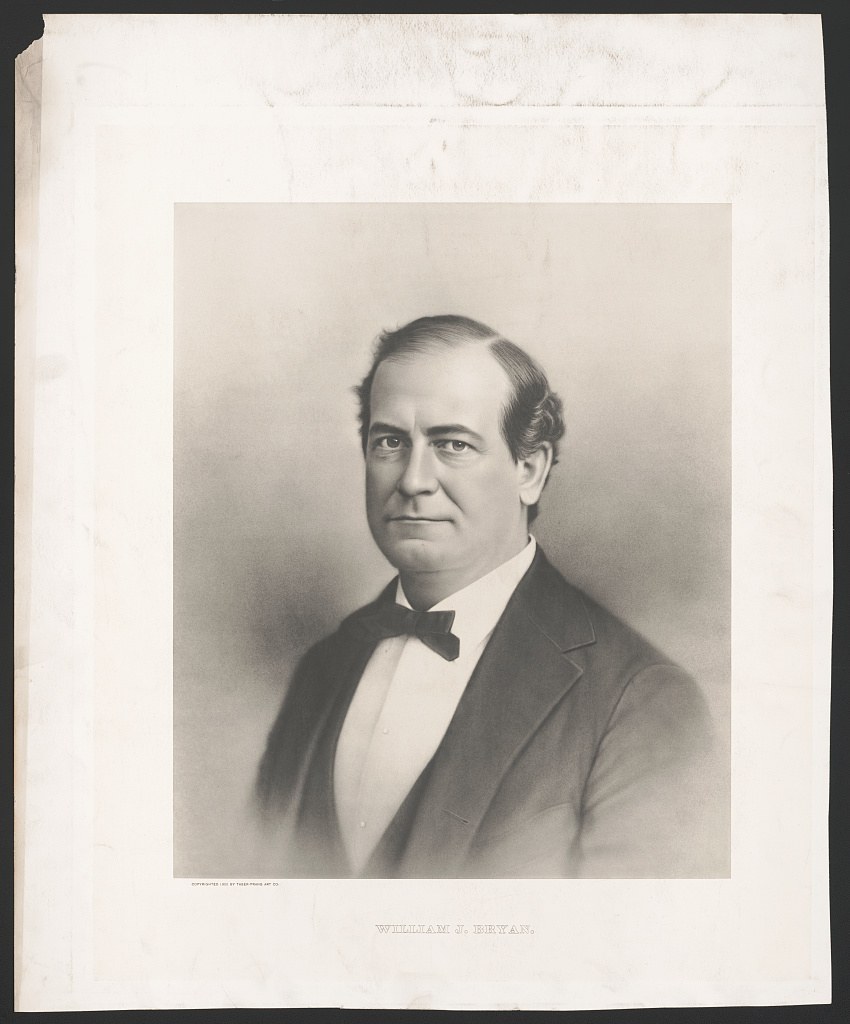
William J. Bryan (Taber-Prang Art Co. portrait print). Taber-Prang Art Co., Springfield, Massachusetts, 1900. Public domain by age; Library of Congress. The Democratic counterpart of the McKinley portrait lithograph: a commercial portrait with no slogan or party device, the nominee presented by likeness alone (Transfer).
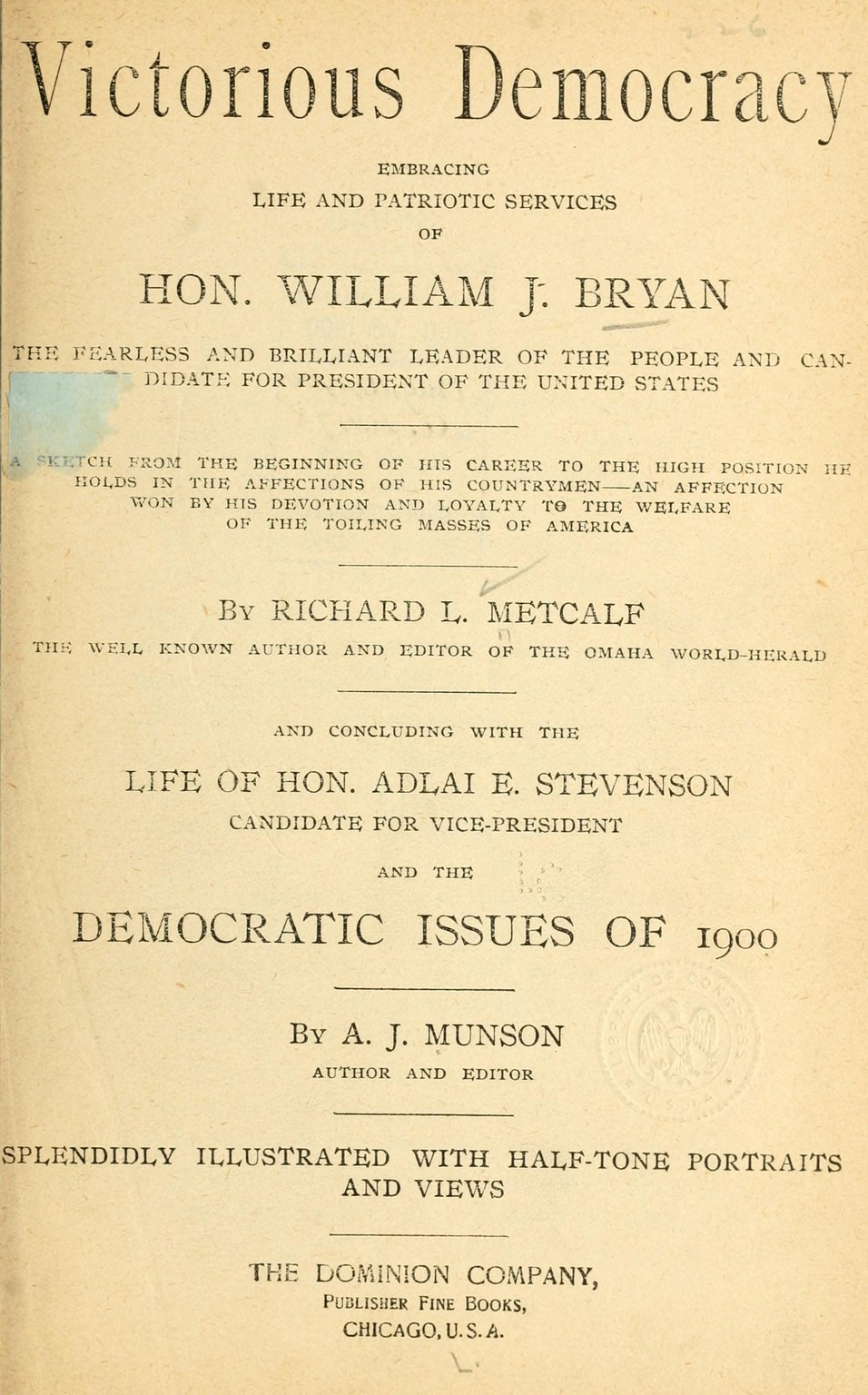
Victorious Democracy: title page of a 1900 Bryan campaign biography. R. L. Metcalf and A. J. Munson, The Dominion Company, Chicago, 1900. Public domain by age; Internet Archive, scan of a Library of Congress copy. The only book in the set, and the only one whose text could be read in full. The title page calls Bryan "the fearless and brilliant leader of the people" and credits him with "devotion and loyalty to the welfare of the toiling masses of America", virtue words in place of a testable claim (Glittering generalities). It is a campaign biography with a section on "The Democratic Issues of 1900".
In opposition
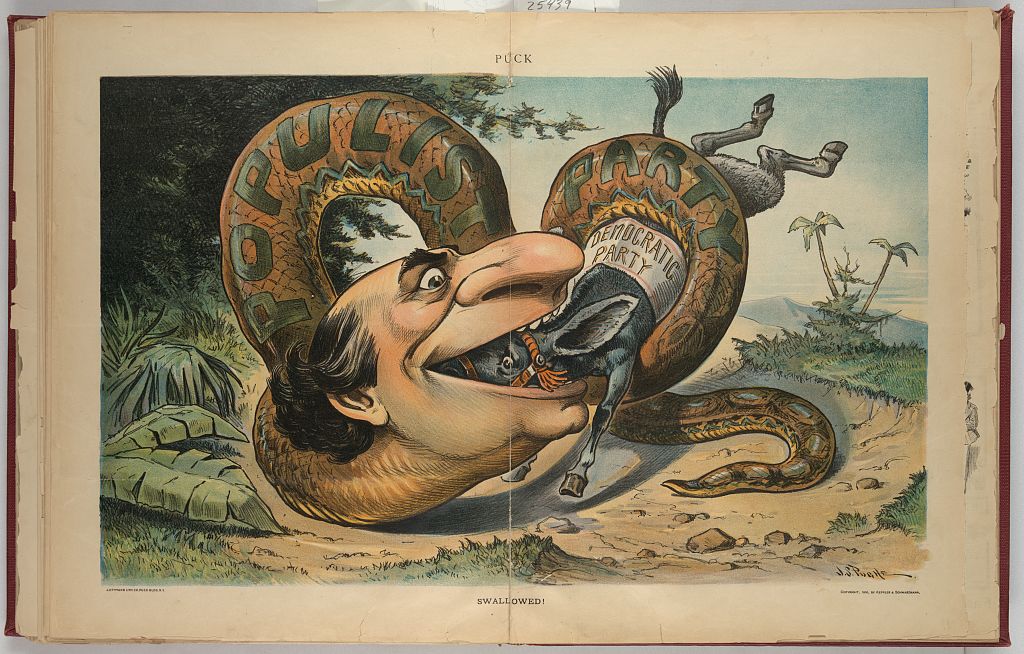
Swallowed! (Puck centerfold, 11 July 1900). J. S. Pughe for Puck, 11 July 1900. Public domain by age; Library of Congress. The snake image casts the Populist-Democratic alliance as one party consuming the other (Transfer) and relies on the two party labels as the whole argument (Name-calling). The Library of Congress record does not name the figure.
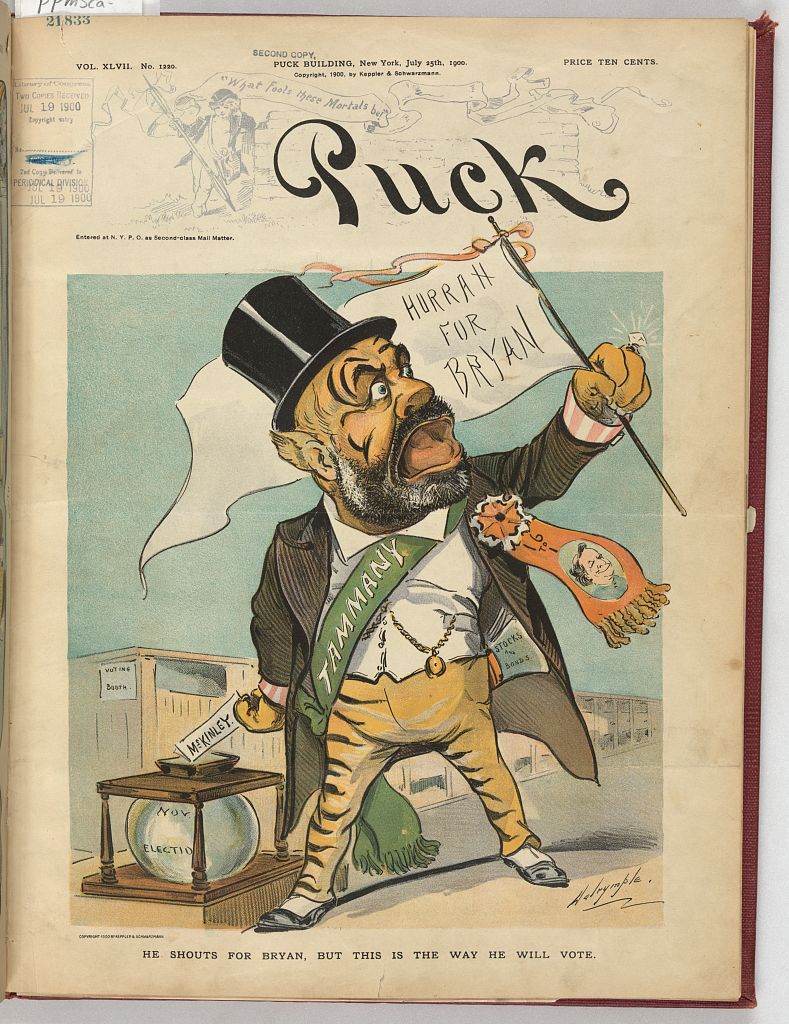
He Shouts for Bryan, but This Is the Way He Will Vote (Puck cover, 25 July 1900). Louis Dalrymple for Puck, 25 July 1900. Public domain by age; Library of Congress. A man in a Tammany sash and tiger-striped trousers shouts for Bryan and votes for McKinley, with "Stocks and Bonds" on his pocket. The Tammany label and tiger stripes attach a ready-made stigma (Transfer, Name-calling); the claim about how he will vote is the cartoonist's, not a record.
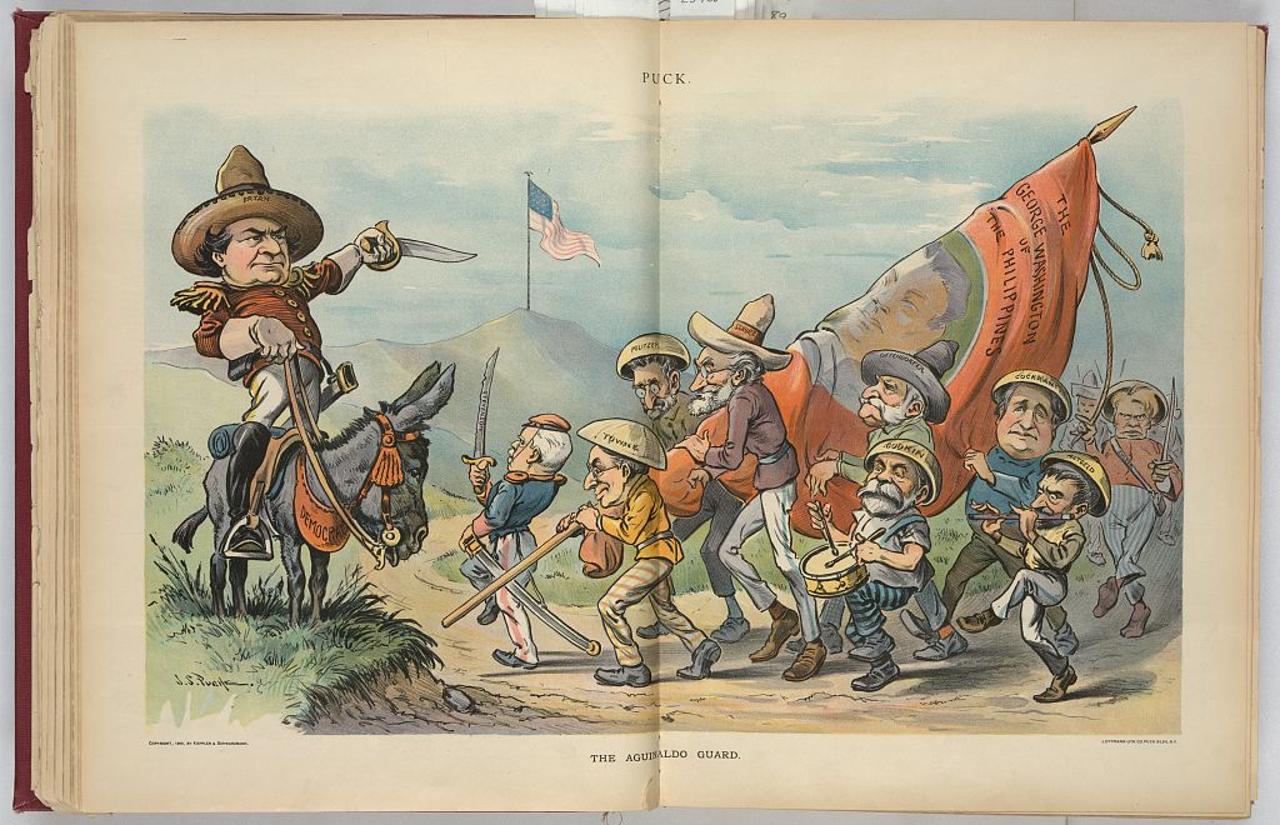
"The Aguinaldo Guard" (Puck, 1900). J. S. Pughe for Puck, 17 October 1900. Public domain by age; Library of Congress. Named critics of the war are drawn as a ragged guard marching behind a banner for Emilio Aguinaldo, so that opposing the war reads as service to a foreign commander (Name-calling, Transfer). The case study 'Benevolent assimilation': the Philippine-American War and the propaganda on every side discusses the same cartoon.
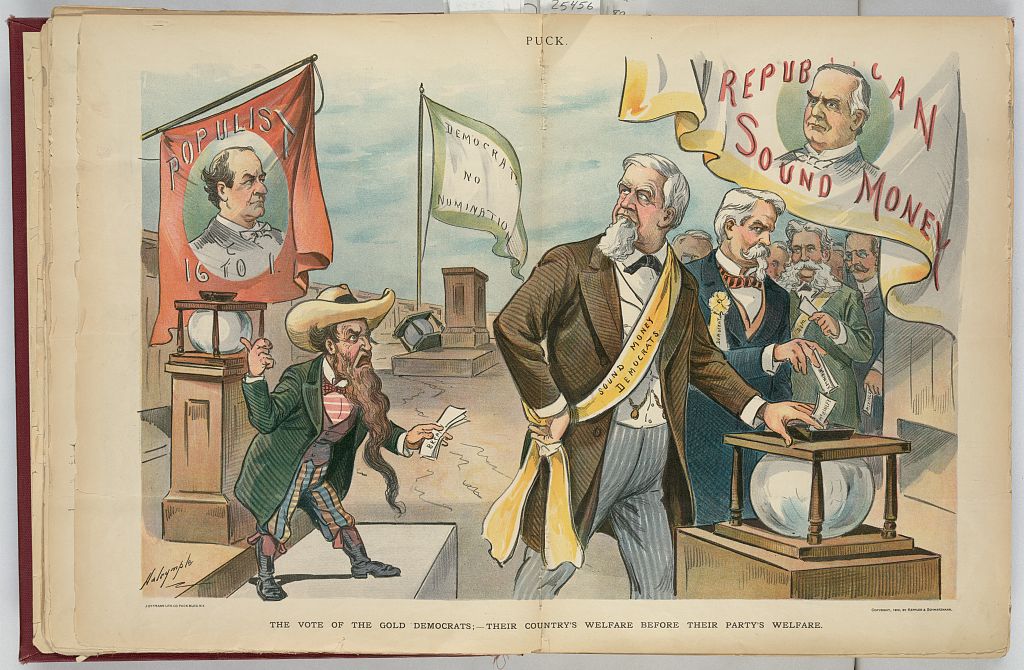
The Vote of the Gold Democrats; Their Country's Welfare Before Their Party's Welfare (Puck, 12 September 1900). Louis Dalrymple for Puck, 12 September 1900. Public domain by age; Library of Congress. The caption praises the gold Democrats' vote. A queue of prominent defectors is offered as the reason to follow (Bandwagon), while the Populist-and-Bryan side is drawn as a small caricature (Name-calling).
Cartoon about both major tickets
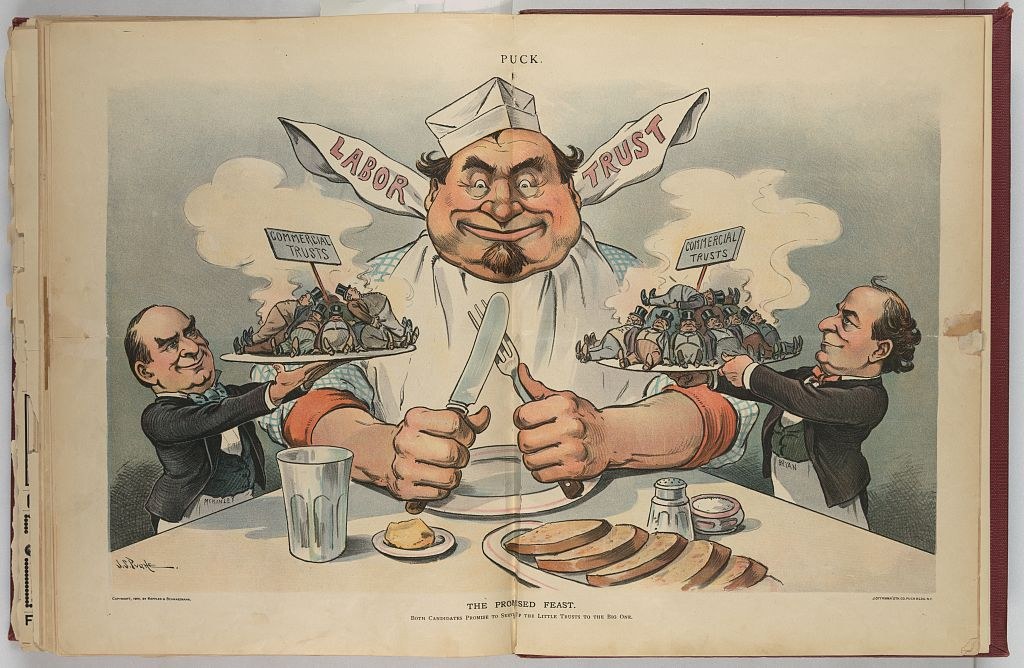
The Promised Feast (Puck centerfold, 8 August 1900). J. S. Pughe for Puck, 8 August 1900. Public domain by age; Library of Congress. The recorded caption reads "Both candidates promise to serve up the little trusts to the big one." The two are drawn as mirror images, so any difference between their positions on trusts is left out of the frame (Card stacking). Placing it in a separate section keeps it from counting for either side.
Smaller tickets
The Prohibition, Social Democratic and Populist (Barker and Donnelly) tickets are not represented by any hosted object. The Library of Congress holdings searched, which are largely Puck, Judge and photographs, turned up no 1900 campaign poster, badge or broadside for them, and Eugene V. Debs's undated press photographs in the Bain collection are not campaign literature. This is a gap in the archive, not evidence about those campaigns; Debs received 87,945 votes [4].
Techniques visible
- Transfer is on every ticket's own literature: the flag, the Liberty Bell, Jefferson and the Declaration on the Bryan posters; the flag and allegorical figures on the McKinley sheets; the dignity of the setting on both Underwood stereographs. It is also the device of the hostile cartoons, which paste a stigma onto the target (a snake, the Tammany sash, a column of marchers behind a foreign commander).
- Card stacking appears on both tickets' own material (the "Real Issue" and "Was Right" sheets, the Judge banknotes, the Bryan poster's trusts octopus) and in the cartoons that pit two lists or two pictures against each other, whether the target is McKinley (A Two-Edged Record, the Puerto Rico cartoon) or Bryan (Take Your Choice).
- Name-calling is the main tool of the humour weeklies: aimed at McKinley and the vice-presidential field (the Easter egg, The Verdict), at the Democratic alliance (Swallowed!, Tammany, the Aguinaldo guard) and at both (The Promised Feast).
- Glittering generalities are the content of the Bryan sheets ("Liberty. Justice. Humanity.", "Proclaim Liberty") and of the McKinley sheets ("Prosperity at home, prestige abroad, sound money"). The two sides use the same technique with different words.
- Fear appeal is visible on the Bryan poster, which stages the trusts as a threat, and on the Judge cartoons that pose the money question as a loss of value or national honour. Bandwagon is in the Puck centerfold on the gold Democrats' vote.
- The "Puerto Rican and Hawaiian" cartoon contains period racial caricature and is shown complete.
- Scale: the Republicans' own figures, as the Miller Center reports them, included 125 million campaign documents [1]. The hosted material here is a small sample, and the numbers of objects per side do not measure the size of either campaign.
Sources
- Miller Center, University of Virginia, "William McKinley: Campaigns and Elections" (Lewis L. Gould), https://millercenter.org/president/mckinley/campaigns-and-elections
- National Archives, "1900 Electoral College Results", https://www.archives.gov/electoral-college/1900
- American Presidency Project, "1900", https://www.presidency.ucsb.edu/statistics/elections/1900
- Wikipedia, "1900 United States presidential election", https://en.wikipedia.org/wiki/1900_United_States_presidential_election (secondary source, used for the minor-party tickets and the Debs vote)
- Library of Congress Prints and Photographs Division, records 2002719965, 2002719964, 2002719963, 2003688942, 97514443, 2010646545, 2010651285, 2010651269, 2010651271, 2010645523, 2018695418, 2003656987, 2018697013, 2016649256, 2010651311, 2010651314, 2010651338, 2010651328 and 2010651319, each at https://www.loc.gov/item/
/ - Internet Archive, R. L. Metcalf and A. J. Munson, Victorious Democracy (Chicago: The Dominion Company, 1900), scan of a Library of Congress copy, https://archive.org/details/victoriousdemocr00metc