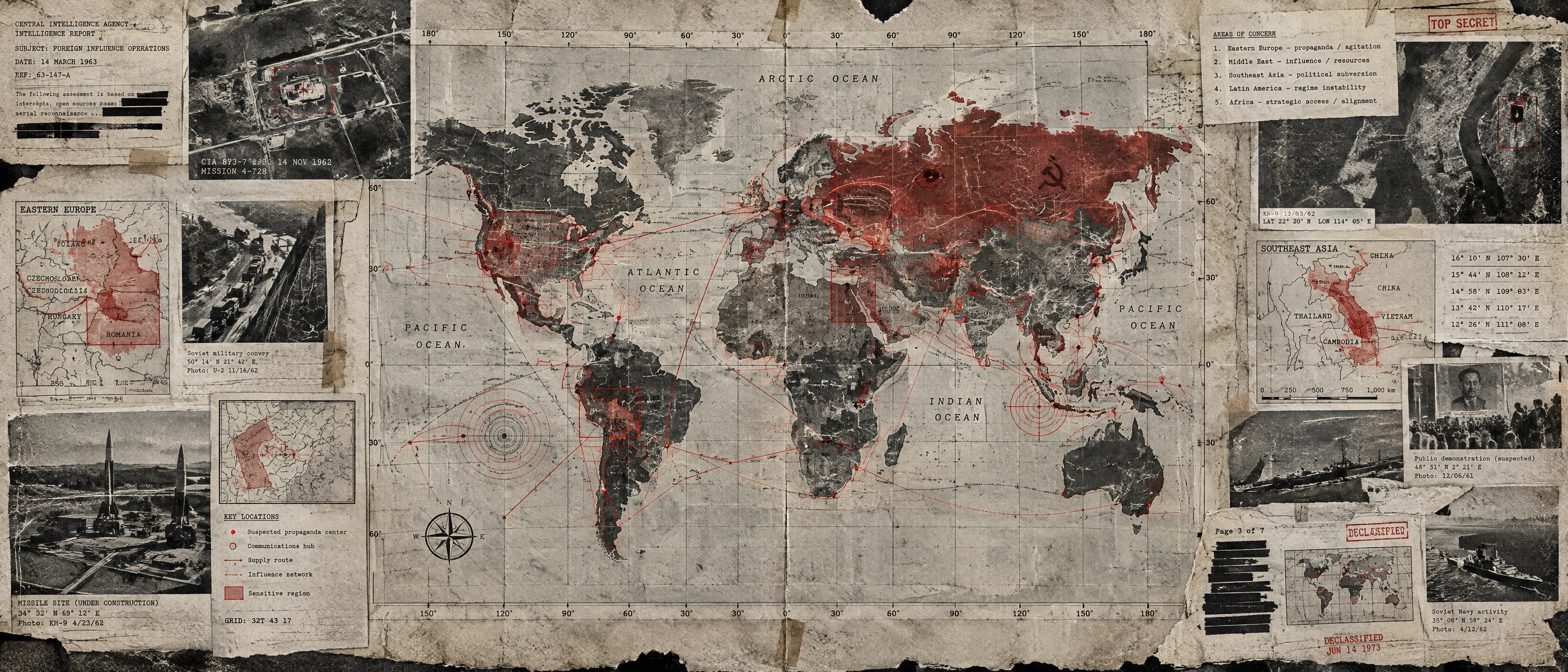
Bandwagon: when the crowd is the argument
Illustration, not an archive object
By the end: Tell a real majority from a crowd used as a substitute for a reason, and check who counted and whether anyone could have said no. About 8 minutes.
What it is
Definition
Treat popularity, momentum, or 'everyone knows' as proof.
The tell
Polls, view-counts, or 'the tide' offered in place of the claim's merits.
Not this
Reporting a real majority as a political fact.
Every lesson in this course starts the same way: a plain definition, the sign that gives the technique away, and the look-alike that is not the technique.
Bandwagon answers the question "why should I?" with "because everyone else is." It was one of the seven devices named by the Institute for Propaganda Analysis in 1937 and is one of the oldest on the list.
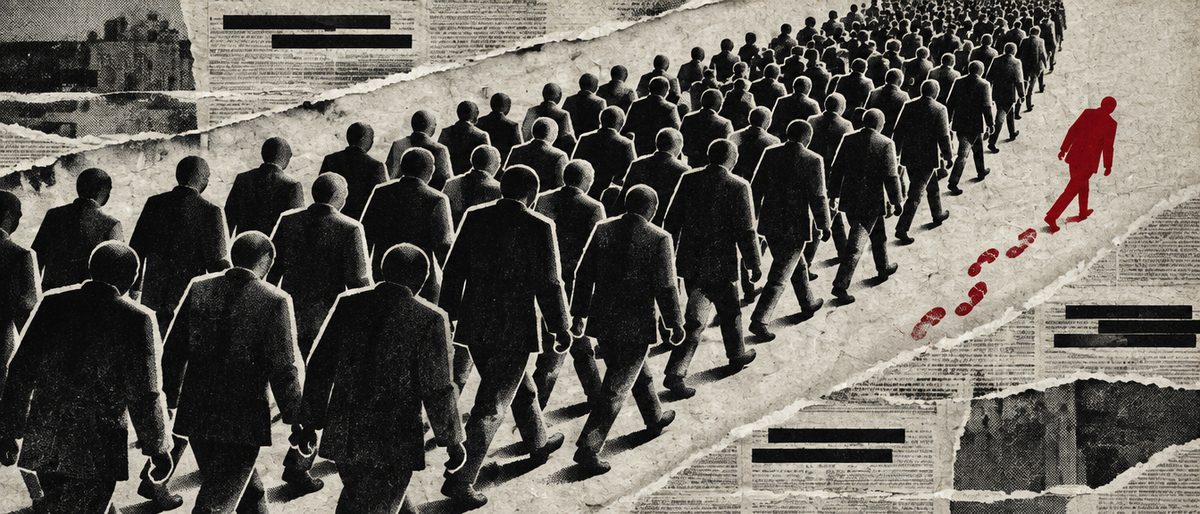
Illustration, not an archive object How it works
The crowd can be shown in three ways:
- Numbers. Sales figures, poll leads, vote shares, signatures, follower counts.
- Sight. Rallies filmed from above, massed uniforms, a flag in every window, badges that make joining visible.
- Time. "Momentum", "the tide", "a movement whose time has come": the claim that the crowd is growing and latecomers will be left behind.
There are two common settings. In open competition (elections, markets) the claim is that the crowd is winning; campaigns of both major US parties talk up momentum and advertisers cite sales. In closed systems the claim is that the crowd is already total: the published result, the filmed rally, the workplace quota.
Why it works on people
A crowd is sometimes real evidence: if many independent people chose something, they may know something. The device borrows that shortcut when the crowd is not independent, not informed, or not real.
- Social proof. Under uncertainty, people look at what others do to decide what is correct (Robert Cialdini, Influence, 1984).
- Conformity. In Solomon Asch's line-judgement experiments (1951, 1956), participants went along with an obviously wrong unanimous group on roughly a third of the critical trials, and a single dissenting ally sharply reduced that.
- Silence. People who think they are in the minority speak up less, which makes the majority look larger still (Elisabeth Noelle-Neumann, the spiral of silence, 1974).
Same device, different stakes (1 of 3)
Three real objects from the archive. The technique is the same in each; the setting, the choice the audience had and what was at stake are not.
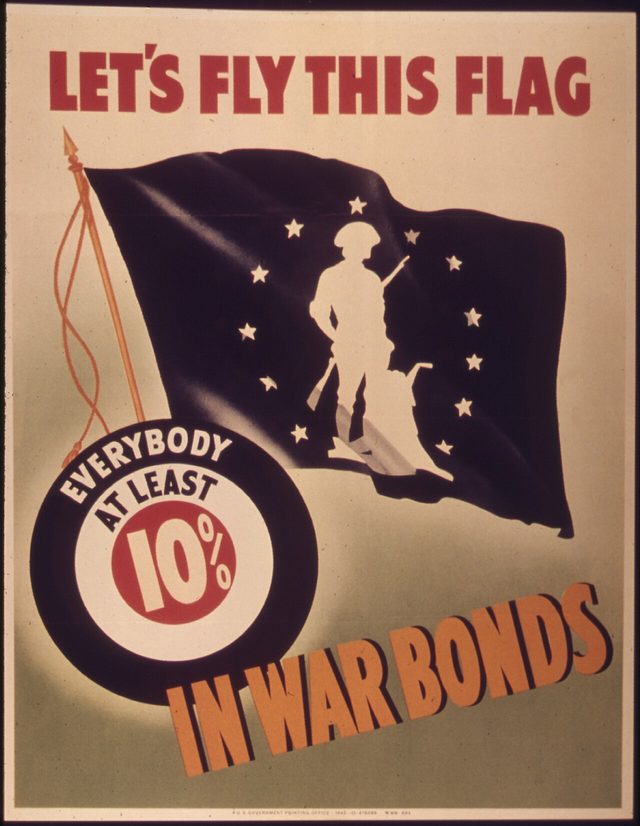
Let's Fly This Flag: Everybody at Least 10 Percent in War Bonds · 1943 · U.S. Treasury Department (War Bonds payroll-savings campaign) · Full record Notice: The shop is offered a flag once everybody puts at least 10 percent of pay into war bonds. The reason given is that the whole shop takes part, not anything about the bonds. The stake is a share of pay put into a government savings bond.
Same device, different stakes (2 of 3)

'Join us in a victory job' (Australian Department of National Service) · 1943 · Commonwealth of Australia, Department of National Service (artist Maurice Bramley) · Full record Notice: Six women in service uniforms stand shoulder to shoulder under 'Join us'. The line-up of women who have already joined is the appeal; the only instruction is where to apply.
Same device, different stakes (3 of 3)
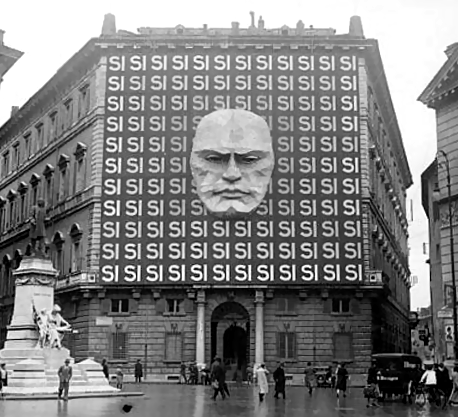
Palazzo Braschi dressed for the 1934 plebiscite: rows of "SI" around the Duce · Mar 1934 · Fascist Federation of Rome (Partito Nazionale Fascista) · Full record Notice: For the 1934 single-list plebiscite, a Rome facade was covered with a giant face and rows of the word SI (Yes). Voters could only accept or reject one list of 400 candidates chosen by the Fascist Grand Council, and the Yes is repeated scores of times around the leader.
Check yourself
A newspaper reports that a candidate leads in an independent poll and prints the sample size, the method and the margin of error. Is that bandwagon?
Show the answer
No. It reports a real majority and shows how it was counted. It would become bandwagon if the number were offered as the reason the claim is true. Right. The device begins when popularity replaces the argument. Here the number is described, not used as a reason.
Spot it in the archive
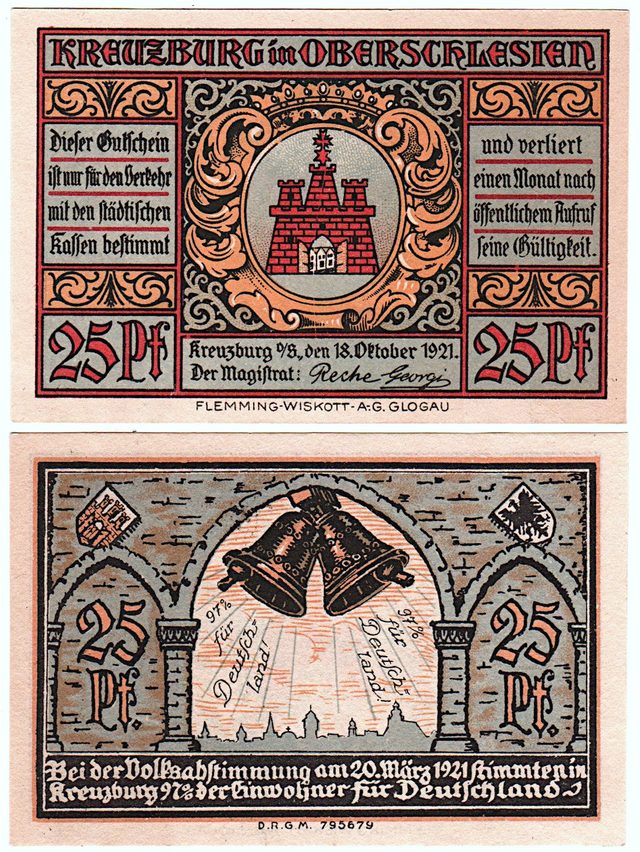
Kreuzburg O.S. 25-pfennig note: "97% für Deutschland!" (Upper Silesia, 1921) · Oct 18, 1921 · Magistrat der Stadt Kreuzburg O.S. (municipal emergency-money issue); printed by Flemming-Wiskott A.-G., Glogau · Full record This municipal emergency banknote was issued in 1921. On the back, two bells ring out '97% für Deutschland!' above the town skyline. Which technique is doing the work?
A vote share is printed on the money as the message itself, and the size of the majority stands in for any argument about the border question. The note gives the town's own claim, and nothing on it shows how it was counted.
Show the answer
Bandwagon A vote share is printed on the money as the message itself, and the size of the majority stands in for any argument about the border question. The note gives the town's own claim, and nothing on it shows how it was counted.
How to spot it, and what next
- If you delete the crowd (the number, the rally shot, the trending badge), is any argument left for the claim itself?
- Who counted, and can the count be checked?
- Could the people in the crowd have said no without cost? A 99 percent result where dissent is punished measures compliance, not agreement.
- For online numbers: do the accounts behind the likes look real?
Read the full page: Bandwagon in the technique library · All 32 examples in the collection