In one line: Nicolae Ceaușescu led the Romanian Communist Party from 1965 and the Romanian state from 1967 until he was overthrown and shot in December 1989; his government combined a foreign policy that broke with Moscow on some issues with a domestic system of censorship, a large secret police and, from the 1970s, a leader-centred cult.
The leader and the people under the leader
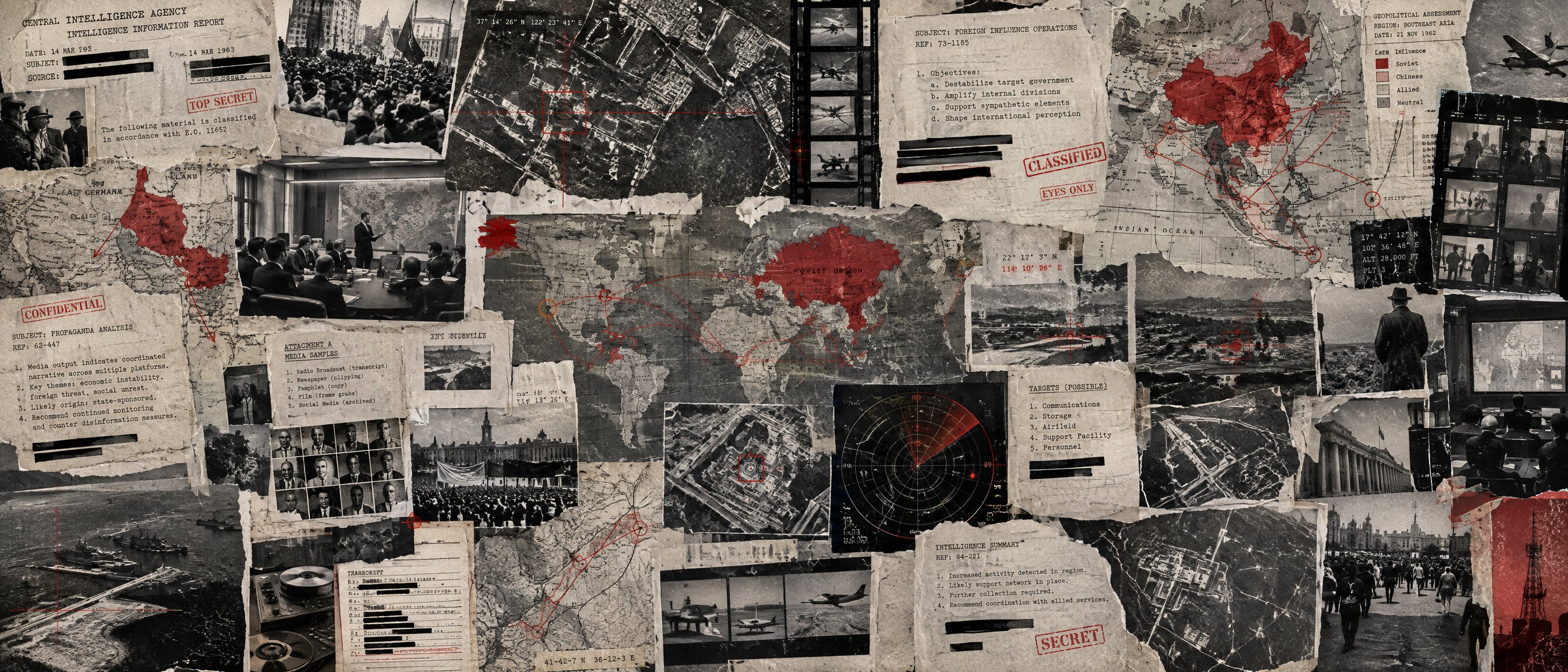
Photo: Anefo (Algemeen Nederlands Persbureau), Nationaal Archief, CC0 1.0
Nicolae Ceaușescu
General Secretary of the Romanian Communist Party and President of the Republic · 1965 to 1989
Nicolae Ceaușescu: Read more
Head of the party from 22 March 1965 (General Secretary from the Ninth Congress in July 1965), President of the State Council from 9 December 1967 and President of the Republic from 28 March 1974; tried and shot at Târgoviște on 25 December 1989.
In their words
“I only recognize the Grand National Assembly. I will only speak in front of it.”
“I do not recognize this court. The charges are incorrect, and I will not answer a single question here.”
Leader and family
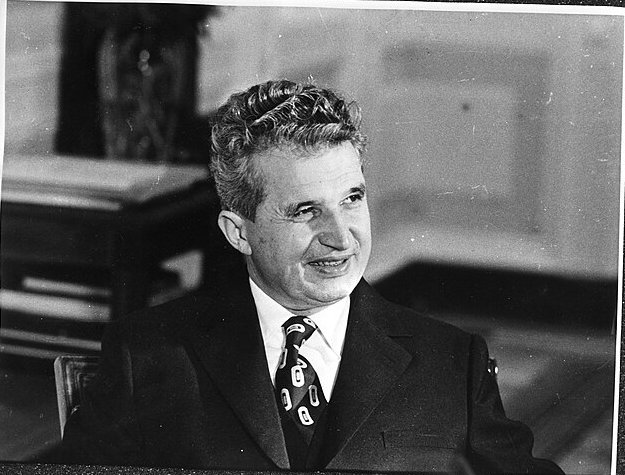
Photo: Karl H. Schumacher, White House Staff Photographer, Public domain (US federal government work)
Elena Ceaușescu
First Deputy Prime Minister and member of the Political Executive Committee · 1980 to 1989
Elena Ceaușescu: Read more
Full member of the Central Committee from July 1972 and of the party's executive from 1973; First Deputy Prime Minister from March 1980 and head of the National Council for Science and Technology; shot with her husband on 25 December 1989.
In their words
“I am a member and the chairwoman of the Academy of Sciences. You cannot talk to me in such a way!”
Chairman of the Council of Ministers (Prime Minister) · 1961 to 1974
Ion Gheorghe Maurer: Read more
Prime Minister from 1961 under Gheorghiu-Dej and then under Ceaușescu until March 1974, when the new presidency was created.
MMNo public-domain or openly licensed portrait found. Nearest: source, uploaded with a generic attribution tag and an unknown author, so not cleared.
Manea Mănescu
Prime Minister · 1974 to 1979
Manea Mănescu: Read more
First Prime Minister under the new presidency, from March 1974 to March 1979, and a member of the party's executive committee.
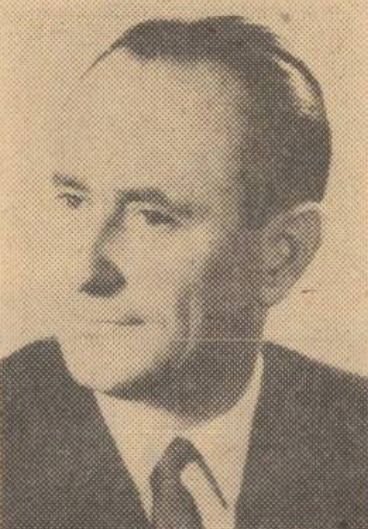
IVNo public-domain or openly licensed portrait found. Nearest: source, uploaded under a generic attribution tag from a communism-era photo site with an unknown author, so not cleared.
Ilie Verdeț
Prime Minister · 1979 to 1982
Ilie Verdeț: Read more
Prime Minister from March 1979 to 21 May 1982, during the first years of the debt crisis.
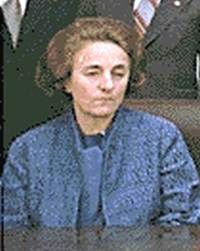
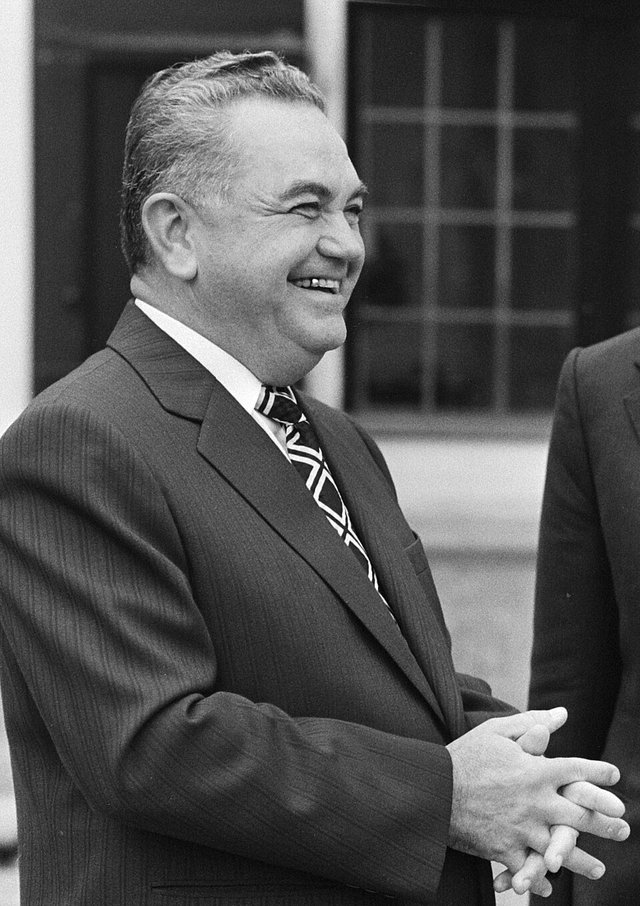
Photo: Marcel Antonisse, Anefo (Nationaal Archief), CC BY-SA 3.0 nl
Constantin Dăscălescu
Prime Minister · 1982 to 1989
Constantin Dăscălescu: Read more
Prime Minister from 21 May 1982 until the fall of the regime in December 1989; he headed the government during the 1980s austerity and the debt repayment.
Security
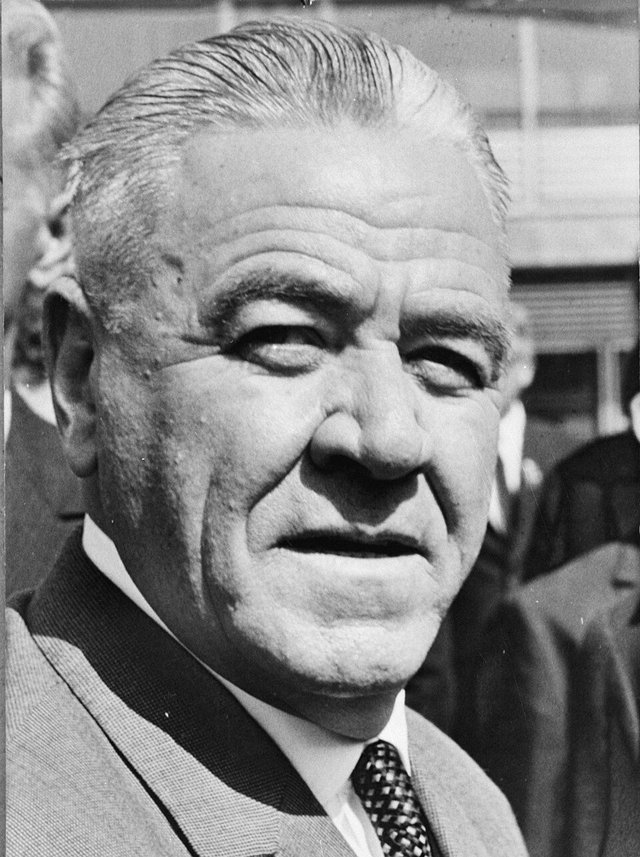
Photo: Unknown (Drum Nou, 13 August 1969), Public domain (Commons: PD-RO-photo and PD-1996)
Ion Stănescu
Minister of the Interior and President of the State Security Council · 1968 to 1972
Ion Stănescu: Read more
Member of the Central Committee who headed the Securitate and the Interior Ministry in the first years of Ceaușescu's leadership; the Securitate was reorganised as the Department of State Security in 1973.
TPNo public-domain or openly licensed portrait found on Wikimedia Commons or in the archives searched.
Tudor Postelnicu
Director General of the Securitate; from 1987 Minister of the Interior · 1978 to 1989
Tudor Postelnicu: Read more
Director General of the Department of State Security from March 1978 to October 1987 and Minister of the Interior from 5 October 1987 to 22 December 1989; convicted in 1990 and later given a reduced sentence on appeal.
IVNo public-domain or openly licensed portrait found on Wikimedia Commons or in the archives searched.
Iulian Vlad
Head of the Department of State Security · 1987 to 1989
Iulian Vlad: Read more
Last head of the Securitate, from October 1987 to December 1989; arrested after the revolution and sentenced in 1991, he was released in 1994.
Armed forces
VMNo public-domain or openly licensed portrait found. Nearest: source, tagged CC BY-SA 3.0 by a Romanian Wikipedia uploader with no source given for the photograph, so not cleared.
Vasile Milea
Minister of National Defence · 1985 to 1989
Vasile Milea: Read more
Defence minister who died on the morning of 22 December 1989; he was publicly described as having killed himself, and some accounts say he was shot after refusing to order troops to fire. The circumstances are disputed.
VSNo public-domain or openly licensed portrait found. Nearest: source, tagged CC BY-SA 3.0 with no author or source, so not cleared.
Victor Stănculescu
General; Minister of National Defence from 22 December 1989 · 1989 to 1989
Victor Stănculescu: Read more
General who succeeded Milea on 22 December 1989 and ordered the army back to barracks; he was later convicted for his part in the repression in Timișoara.
Party and propaganda
DPNo public-domain or openly licensed portrait found. Nearest: source, uploaded under a generic attribution tag from a communism-era photo site with an unknown author, so not cleared.
Dumitru Popescu ("Dumnezeu")
Secretary of the Central Committee for ideology; President of the Council of Socialist Culture and Education · 1971 to 1976
Dumitru Popescu ("Dumnezeu"): Read more
Central Committee secretary from 1968 and executive committee member from 1969, nicknamed 'Dumnezeu' (God), head of the Council of Socialist Culture and Education from 1971 to 1976, and rector of the party's social-political academy from 1981.
SGNo public-domain or openly licensed portrait found. Nearest: source, tagged only with the Commons Romanian-photograph template from a 1982 reference book, so not cleared.
Suzana Gâdea
President of the Council of Socialist Culture and Education · 1979 to 1989
Suzana Gâdea: Read more
Chemical engineer who was Minister of Education from 1976 to 1979 and then, from 28 August 1979 to 22 December 1989, president of the council that supervised publishing, the press and cultural events; sentenced after the revolution.
Background and rise to power
Ceaușescu was born on 26 January 1918 in the village of Scornicești. He joined the communist movement as a youth, was jailed in the 1930s and 1940s, and rose in the party under Gheorghe Gheorghiu-Dej, who led it until his death on 19 March 1965. Three days later, on 22 March 1965, the party's Central Committee elected Ceaușescu to succeed him. At the Ninth Congress in July 1965 the Romanian Workers' Party took back its older name, the Romanian Communist Party (PCR), Ceaușescu became General Secretary, and a new constitution adopted in August 1965 renamed the state the Socialist Republic of Romania. He became President of the State Council, the head-of-state office, on 9 December 1967 and on 28 March 1974 took the new office of President of the Republic.
The first years are usually described as a period of relative cultural opening. Romania's independence from Moscow was the best-known feature: Romanian troops did not take part in the Warsaw Pact invasion of Czechoslovakia in August 1968, and in a public speech in Bucharest on 21 August Ceaușescu condemned the invasion. On 1 October 1966 the State Council issued Decree 770, which prohibited abortion except in a short list of cases and was later tightened. The Library of Congress country study records that live births nearly doubled between 1966 and 1967 and that the policy's initial success was followed by rising maternal and infant mortality; the decree remained in force until Decree-Law no. 1 of 26 December 1989 repealed it.
The turn came in the summer of 1971. After visits to China, North Korea, Mongolia and North Vietnam, Ceaușescu gave a speech to the party's executive committee on 6 July 1971 titled "Proposed measures for the improvement of political-ideological activity, of the Marxist-Leninist education of Party members, of all working people", known as the July Theses. Its seventeen proposals called for a larger leading role for the party, more political education in schools and youth organisations, a more militant, "revolutionary" character for literature, theatre, film and the press, and tighter control of publishing. Historians describe the result as a "mini cultural revolution" that ended the liberalisation of the late 1960s, brought back lists of banned books and cut back disciplines such as sociology. A December 1971 law banned publication abroad of material judged to harm state interests.
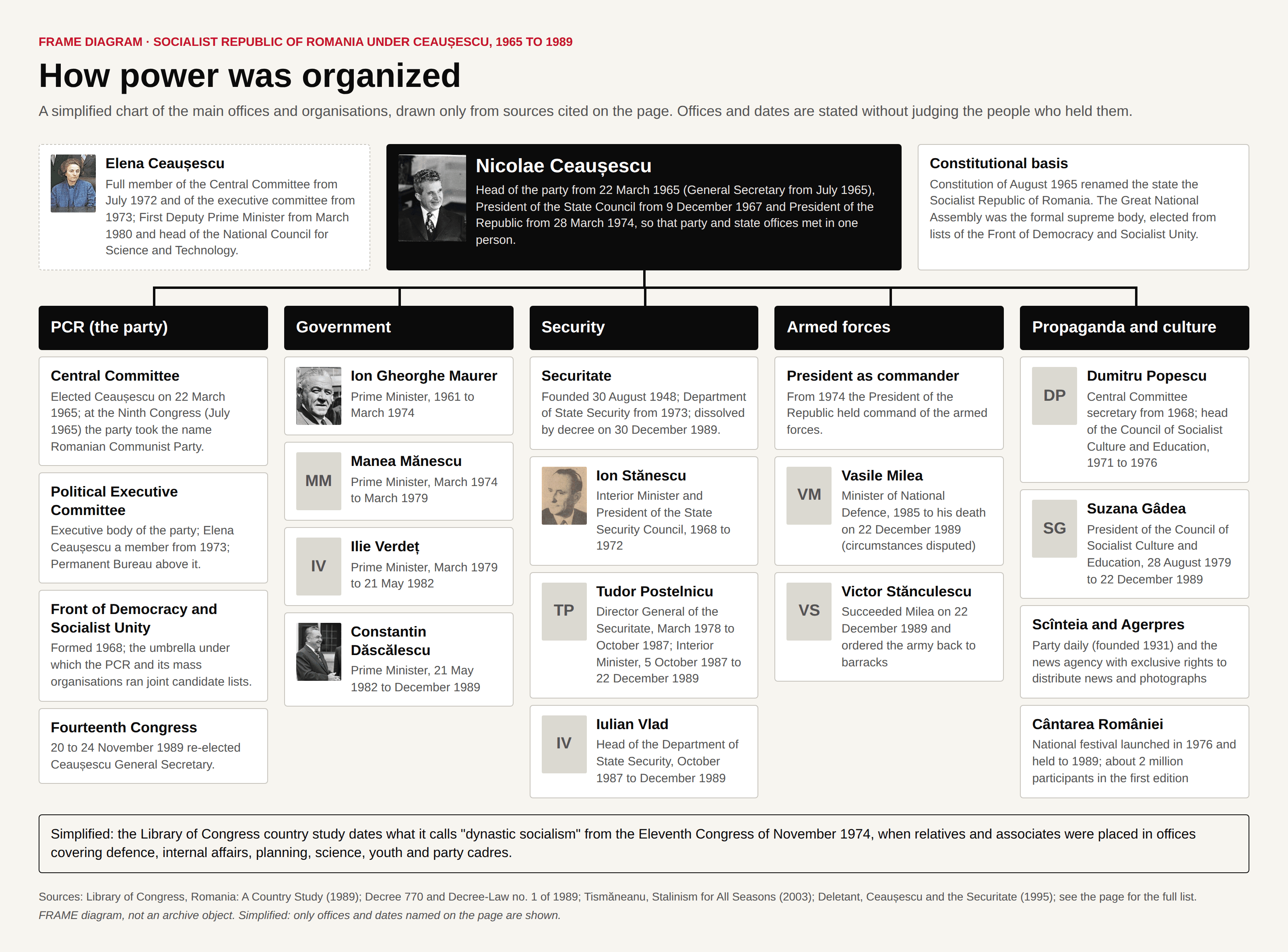
How power was organized
Formally Romania was a republic whose supreme body was the Great National Assembly, elected from lists put forward by the Front of Democracy and Socialist Unity (formed in 1968 as the Front of Socialist Unity and renamed in 1980), the umbrella under which the PCR and its mass organisations ran joint candidate lists. Real authority lay in the PCR: its Central Committee, the Political Executive Committee (the Politburo's counterpart) and its Permanent Bureau, all led by the General Secretary. From 1974 Ceaușescu also held the presidency, with powers to issue decrees, command the armed forces and chair the state's main bodies, so that party and state offices met in one person. The government, a Council of Ministers headed by a Prime Minister (Ion Gheorghe Maurer to 1974, Manea Mănescu to 1979, Verdeț to 1982 and Constantin Dăscălescu from 1982), carried out decisions taken in the party.
The main offices and organisations of the Romanian state under Ceaușescu, 1965 to 1989, simplified from the sources cited on this page. Source: FRAME diagram. Portraits, cropped to thumbnails: Marcel Antonisse / Anefo, Nationaal Archief, Den Haag, bestanddeelnr 932-7427 (25 October 1983) / CC BY-SA 3.0 nl; Jimmy Carter Presidential Library and Museum / White House Staff Photographers collection, 13 April 1978; Nationaal Archief, Den Haag, Fotocollectie Anefo, bestanddeelnr 919-9822 (13 January 1967); Drum Nou, no. 7655, 13 August 1969, via Arcanum Digiteca and Wikimedia Commons; Nationaal Archief, Den Haag, Fotocollectie Anefo, bestanddeelnr 929-5397 (24 January 1978), CC BY-SA 3.0 nl (the portraits that carry it); other portraits: CC0 1.0; Public domain (Commons: PD-RO-photo and PD-1996); Public domain (US federal government work).
The Eleventh Congress in November 1974 is the point from which the Library of Congress country study dates what it calls "dynastic socialism": Ceaușescu placed relatives and associates in offices covering defence, internal affairs, planning, science, youth and party cadres. Elena Ceaușescu, a full member of the Central Committee from July 1972 and of the executive committee from 1973, became First Deputy Prime Minister in March 1980 and headed the National Council for Science and Technology; accounts of the 1970s and 1980s describe her as the second most influential person in the state, and the Library of Congress study records that the press called her "a world-renowned thinker".
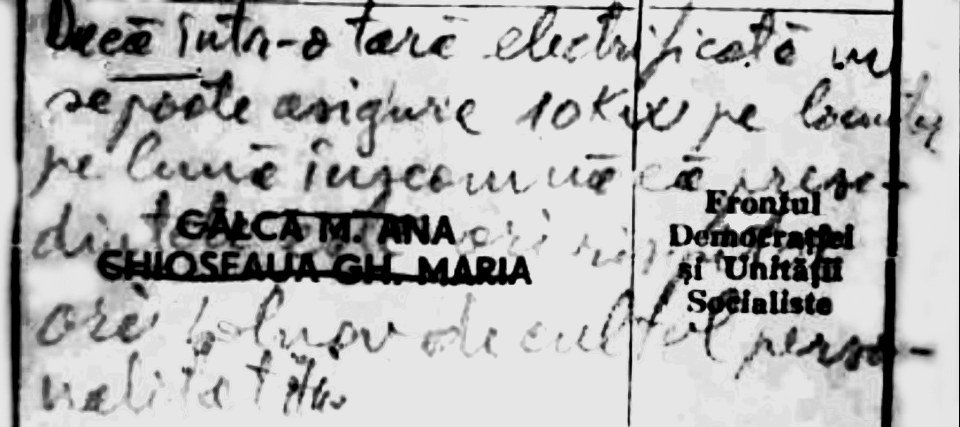
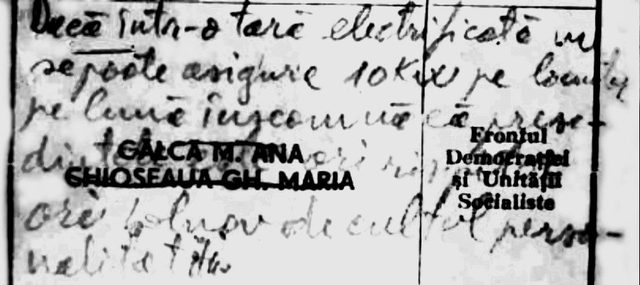
Elections to the Great National Assembly were held on single lists; the Front's slate offered voters a ballot with the names of its candidates. A ballot from Tulcea County in November 1987, published in a 2016 newspaper article, shows a voter striking out both names and writing a complaint about electricity rationing and the cult of personality (the 1987 ballot). The Front's own self-description is on a mid-1980s wall chart (the Front of Democracy and Socialist Unity, 1985).
The Securitate, formally the Department of State Security from 1973, was the political police. It had been founded on 30 August 1948 under Soviet guidance. Under Ceaușescu it ran a network of informers in workplaces, schools, churches and the literary and artistic unions, monitored foreign contacts, and censored mail and telephone calls; typewriters and copying machines had to be registered with the police. Its heads included Ion Stănescu (1968 to 1972), Tudor Postelnicu (1978 to 1987) and Iulian Vlad (1987 to 1989) (Deletant). In July 1978 Ion Mihai Pacepa, a deputy head of the foreign intelligence service, defected to the United States. The Securitate was dissolved by decree on 30 December 1989. Violent repression was targeted: the Jiu Valley miners' strike of August 1977, the Brașov workers' revolt of 15 November 1987 and the demonstrations in Timișoara in December 1989 were each answered by arrests and, in Timișoara, by shooting.
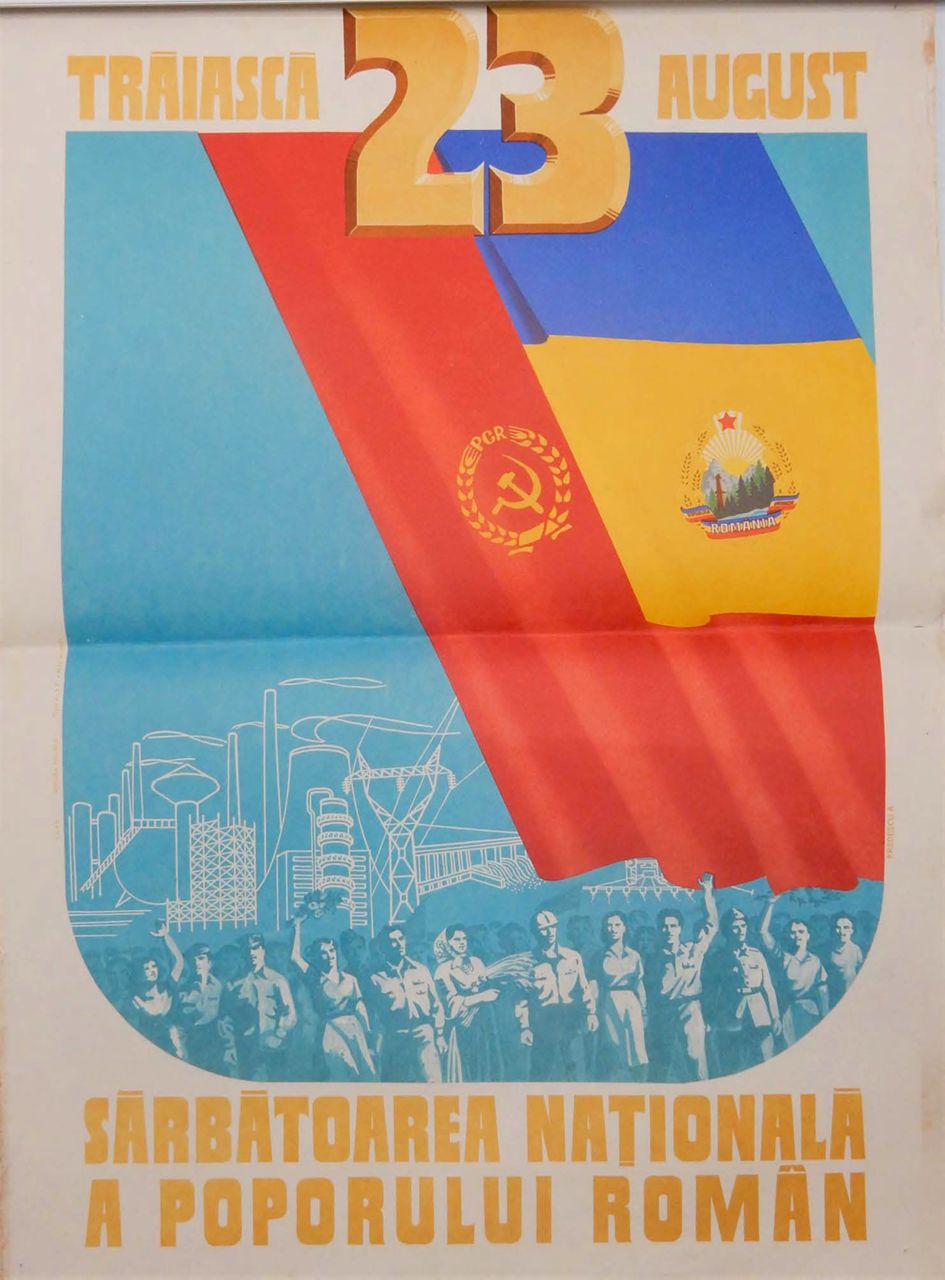
Illustration, not an archive object
The propaganda apparatus
The message machinery rested on the party's Central Committee secretary for ideology and propaganda and on the Council of Socialist Culture and Education, created after the July Theses, which supervised publishing houses, the press, theatres and cultural events. Dumitru Popescu, Central Committee secretary from 1968 and nicknamed "Dumnezeu" (God), led the council from 1971 to 1976 and is described in later accounts as an architect of the leader's public image; Suzana Gâdea chaired it from August 1979 to December 1989. The party daily Scînteia ("The Spark", founded in 1931) was the main channel for policy statements and, in the late 1980s, had by far the largest daily circulation; the youth paper Scînteia Tineretului, România Liberă and county papers carried the same line, and the state news agency Agerpres held exclusive rights to distribute news and photographs. Radio and television were state-run: Radio and television were extended through the 1960s and 1970s, but after the energy savings of 1984 television was cut from about 100 to 22 hours a week (Library of Congress), and foreign stations such as Radio Free Europe broadcast to Romanian listeners.
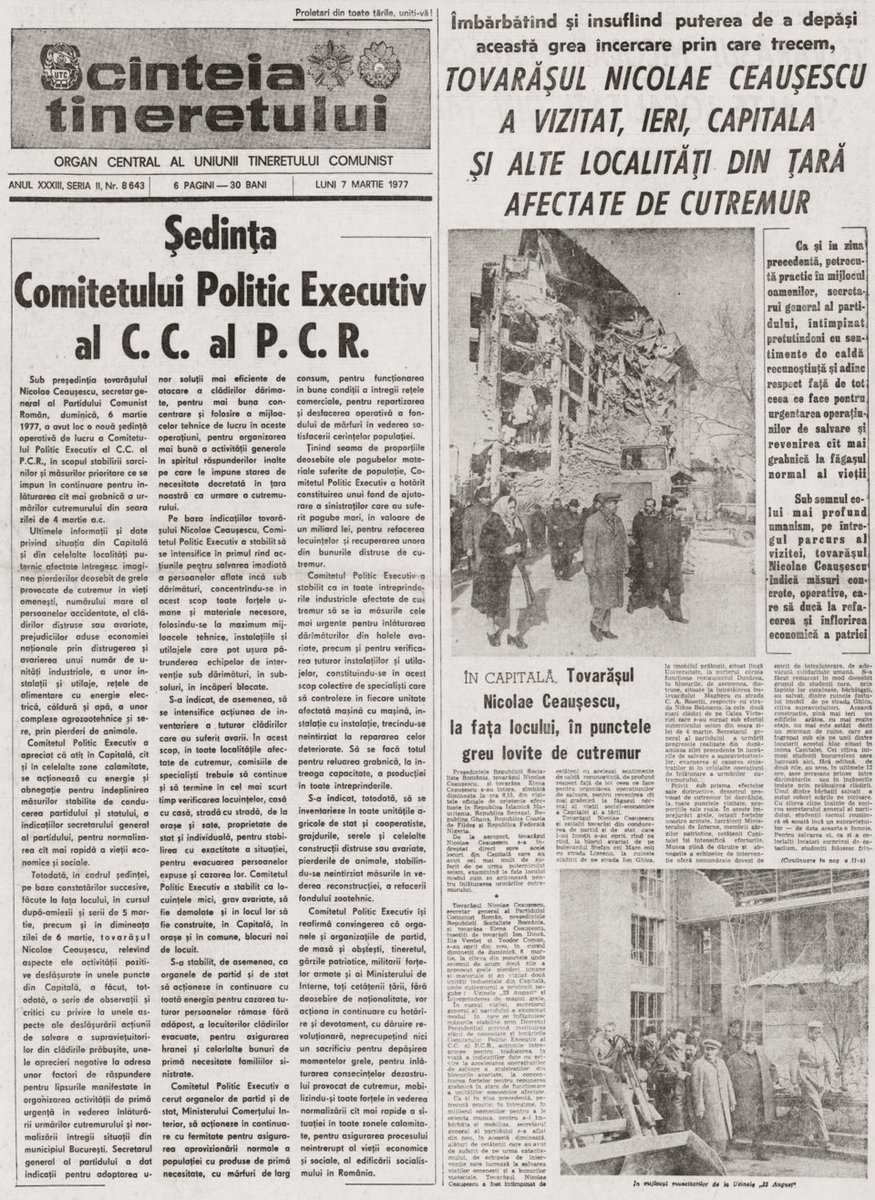
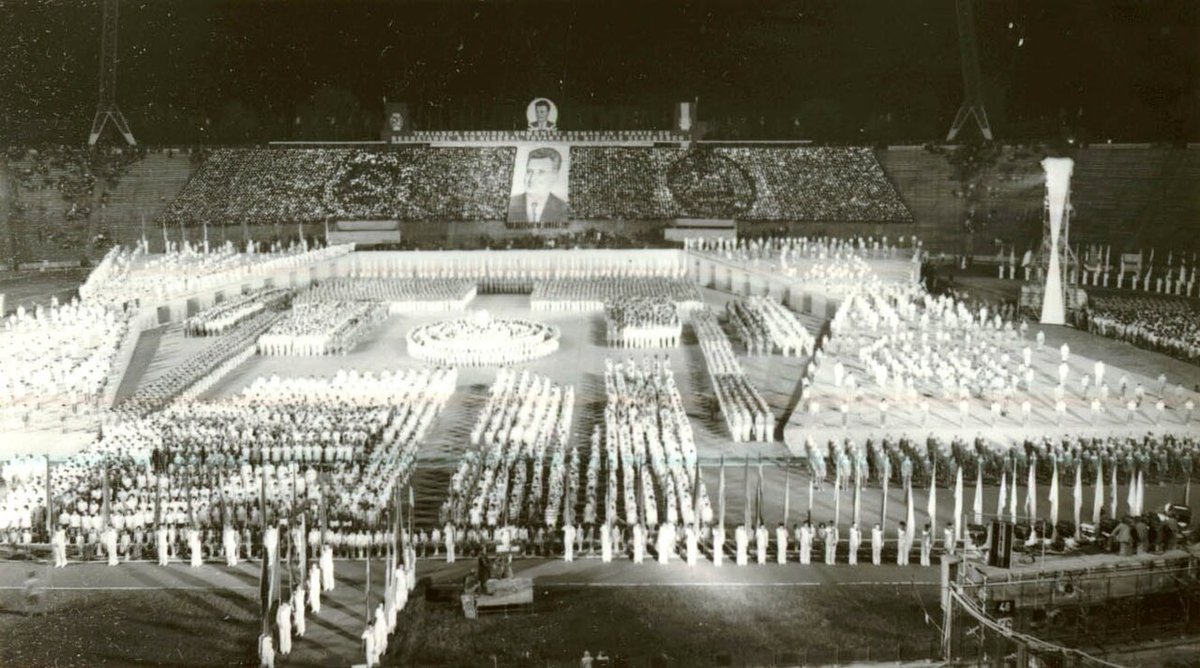
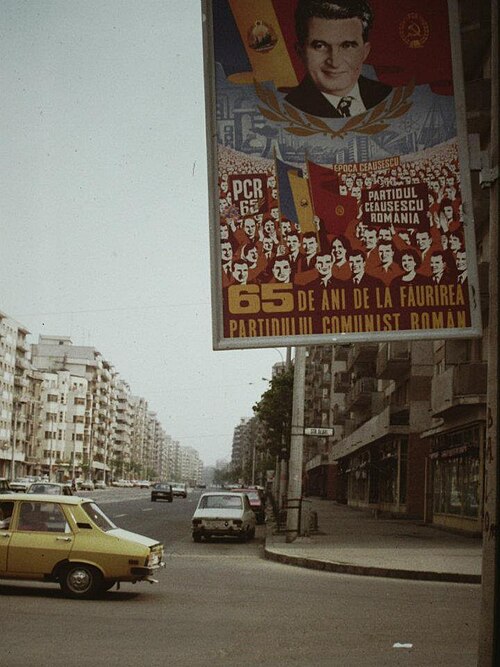
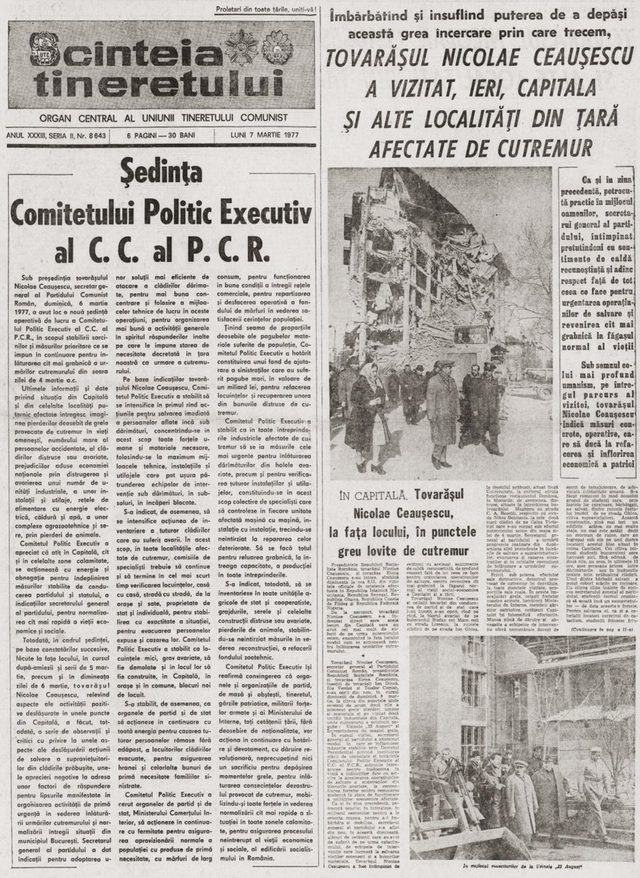
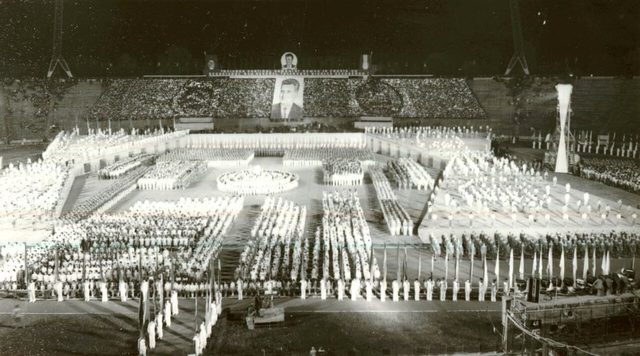
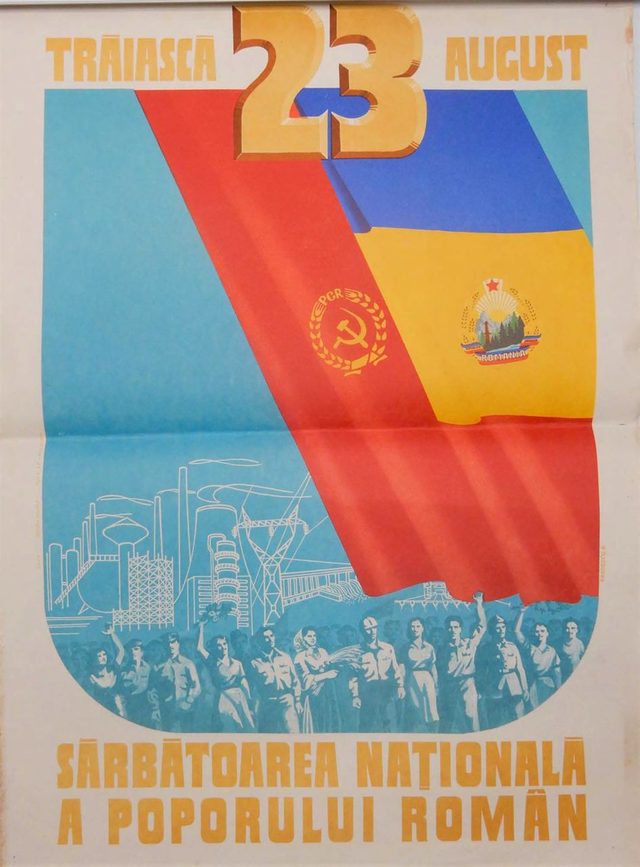
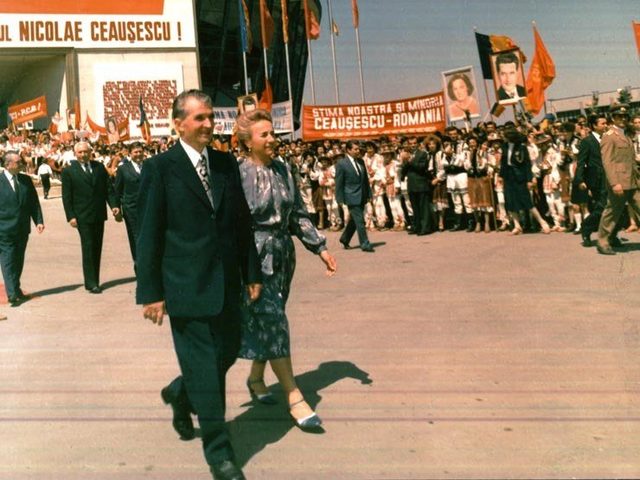
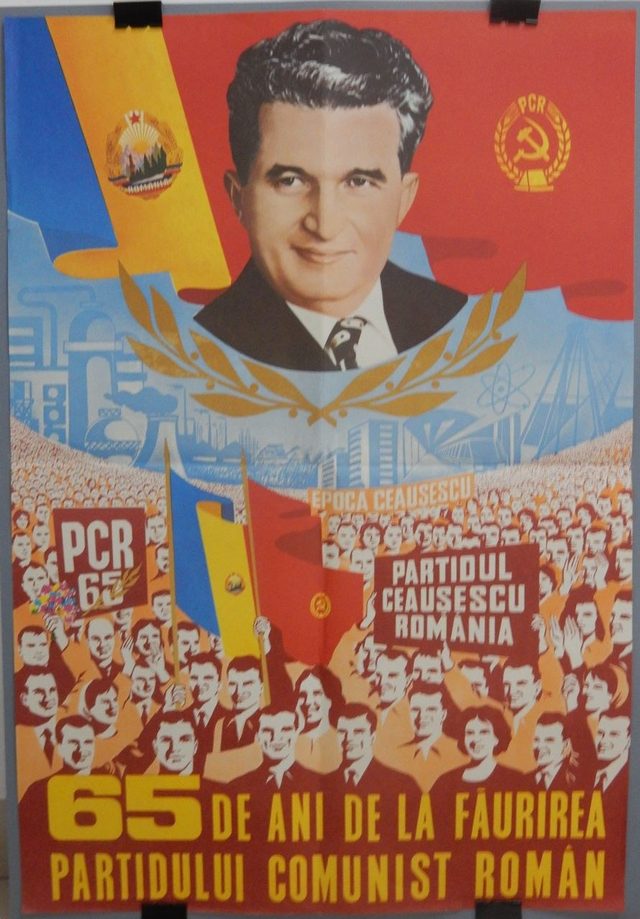
The archive's objects show how the content worked. A front page of Scînteia Tineretului on 7 March 1977, three days after the earthquake of 4 March, made the leader's visit to the damaged districts its headline and described it in terms of "the most profound humanism" (earthquake front page, 1977). The Daciada national sports and culture competition and the Cântarea României ("Song to Romania") festival, launched in 1976 after the first Congress of Political Education and Socialist Culture and held in editions to 1989, organised amateur and professional performers through local, county and national rounds; the sources cited here give about two million participants in the first edition and more than five million in later ones, and describe its stated aim as the "multilaterally developed" citizen and a national-historical narrative that placed Ceaușescu as heir of Stephen the Great and other rulers. Mass shows in stadiums put the leader's enlarged portrait over thousands of performers (stadium spectacle, 1978). By the mid-1980s the Library of Congress study reports the cult at "epic dimensions", with Ceaușescu called "the greatest genius of the age"; the objects show the leader and his wife shown together and the period called the Epoca Ceaușescu (65th anniversary billboard, Bucharest, 1986; portraits and banners, 1986).
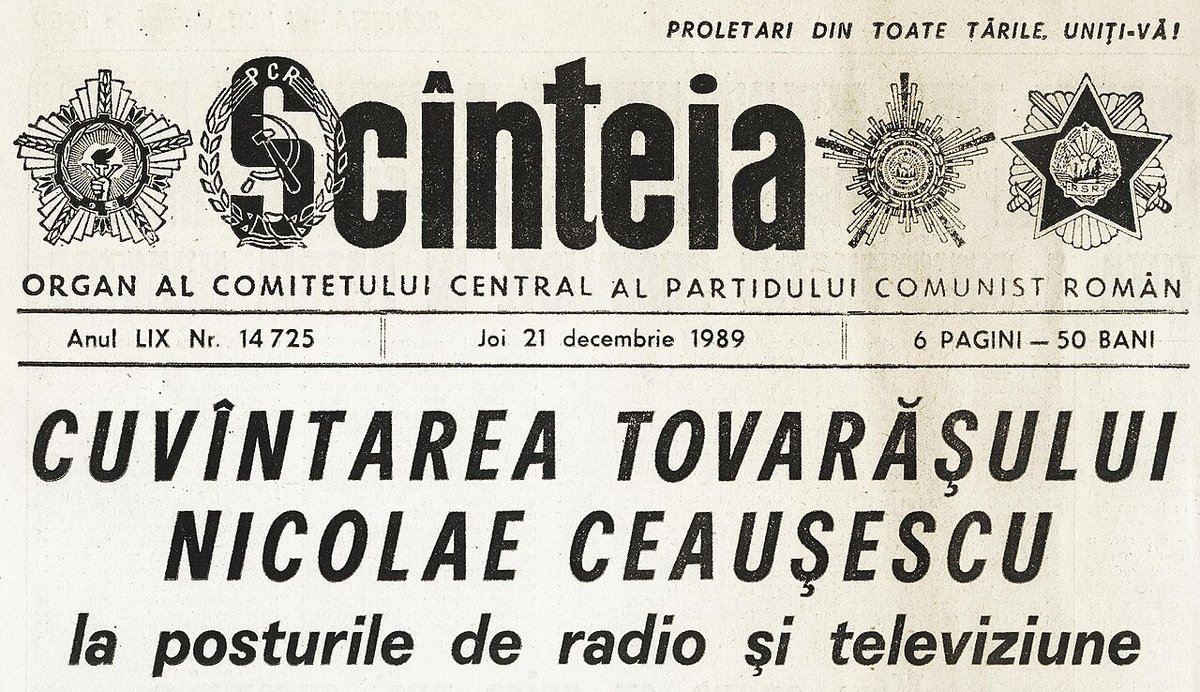
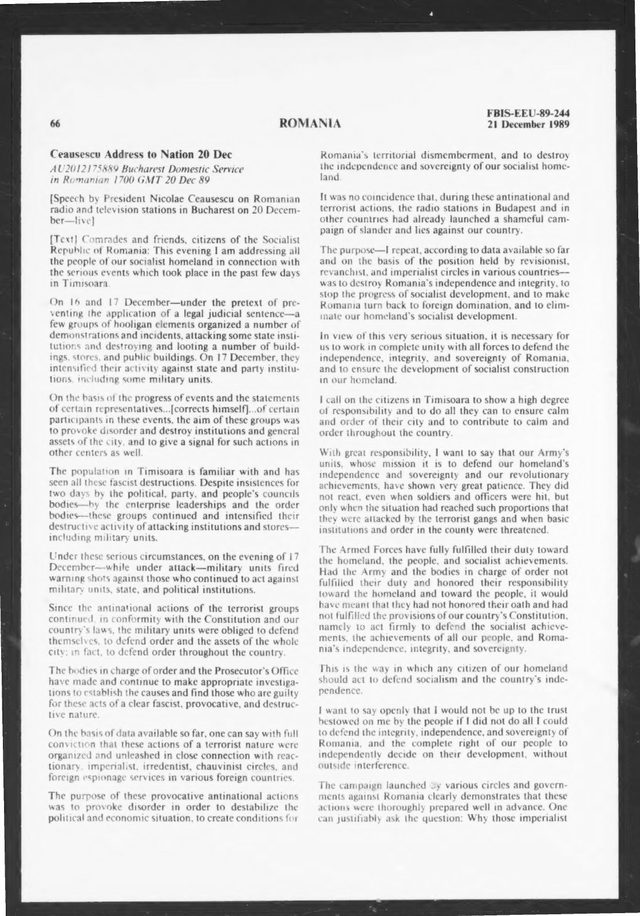
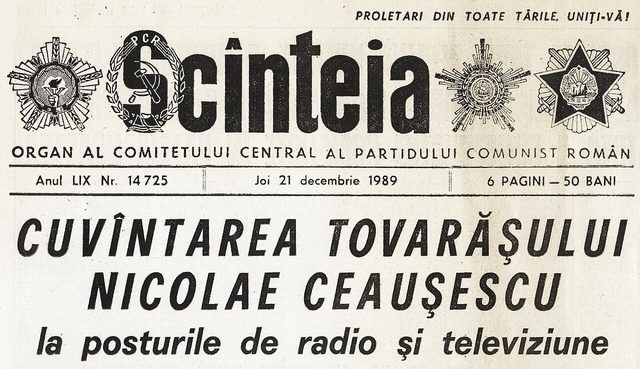
The regime's language also carried a foreign-policy message: "national communism", with the leader as defender of sovereignty, which won the regime goodwill in the West through the 1970s, including a US state visit in April 1978. In the 1980s the same press presented rationing as sacrifice to repay the foreign debt: Romania had asked to reschedule its debt in 1981, and the regime then cut domestic use of energy and exported food. The Library of Congress study describes one forty-watt bulb per apartment, controlled temperatures in homes and cars banned from the streets in the winter of 1984 to 1985, and shortages of bread, meat and vegetables. Accounts say the debt was virtually repaid by spring 1989 and a decree barred new foreign borrowing. At the same time the regime tightened the demographic policy of Decree 770 in the 1980s (a monthly gynaecological examination for women in workplaces, a legal marriage age lowered to 15 for women, higher penalties), and began a rural "systematisation" plan and the building of a new civic centre and large palace in Bucharest. The last open act of the machinery was the speech Ceaușescu gave on radio and television on 20 December 1989, which accounts say blamed foreign forces for the unrest, and which Scînteia printed the next day (Scînteia, 21 December 1989).
The archive's definitions fit most clearly here: glittering generalities and semantic hijacking (the Front of Democracy and Socialist Unity, "democracy" and "humanism"), transfer (the party's founding anniversary staged as the leader's), bandwagon (mass participation as proof of support), manufactured consensus (single-list elections, festival participation numbers) and scapegoating (the December 1989 address).
Timeline
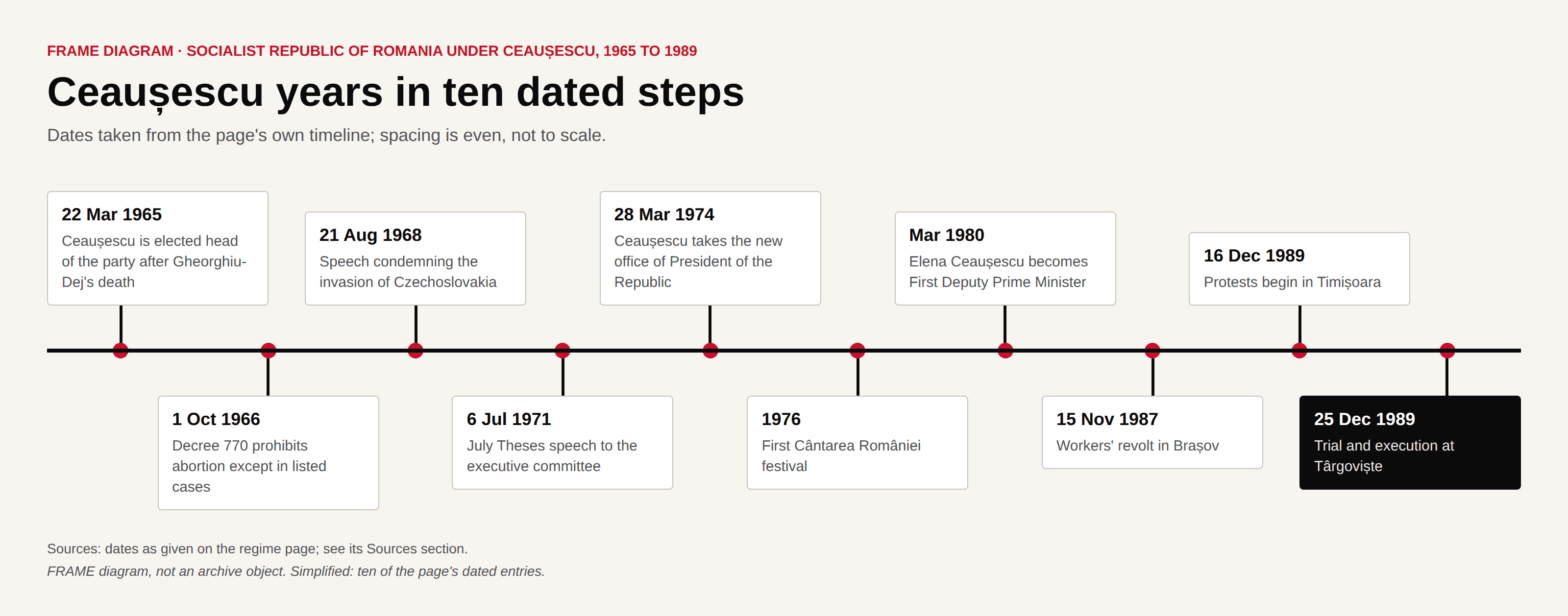
22 March 1965: Ceaușescu is elected head of the party after Gheorghiu-Dej's death.
July 1965: Ninth Congress; the party takes the name Romanian Communist Party and Ceaușescu becomes General Secretary.
August 1965: new constitution; the state becomes the Socialist Republic of Romania.
1 October 1966: Decree 770 prohibits abortion except in listed cases.
9 December 1967: Ceaușescu becomes President of the State Council.
21 August 1968: Ceaușescu condemns the invasion of Czechoslovakia in a speech in Bucharest.
6 July 1971: the July Theses speech to the executive committee.
28 March 1974: Ceaușescu takes the new office of President of the Republic.
November 1974: Eleventh Congress, the point from which one account dates "dynastic socialism".
1976: the first Cântarea României festival is launched.
4 March 1977: Vrancea earthquake; the press builds its coverage around Ceaușescu's visits.
August 1977: Jiu Valley miners' strike.
July 1978: Pacepa defects to the United States.
March 1980: Elena Ceaușescu becomes First Deputy Prime Minister.
1981 to 1989: debt rescheduling, then energy and food rationing; television cut to a few hours a day after 1984.
15 November 1987: workers' revolt in Brașov.
20 to 24 November 1989: Fourteenth Congress re-elects Ceaușescu General Secretary.
16 to 25 December 1989: protests in Timișoara, the Bucharest rally of 21 December, flight on 22 December, trial and execution on 25 December.
The Ceaușescu years, 22 March 1965 to 25 December 1989, using the dates given on this page; spacing is even, not to scale, simplified from the sources cited on this page. Source: FRAME diagram, drawn from the sources listed on this page, CC BY 4.0 (FRAME archive content).
How it ended
Protests began in Timișoara on 16 December 1989 and security forces and soldiers used force on 16 and 17 December. Ceaușescu returned from a visit to Iran on the evening of 20 December and gave a televised address; on 21 December a rally he addressed in Bucharest was interrupted and protests and shooting followed. On the morning of 22 December Defence Minister Milea died, the army was ordered back to barracks, and the Ceaușescus left the Central Committee building by helicopter; they were detained that afternoon at Târgoviște, and a National Salvation Front led by Ion Iliescu announced itself in Bucharest. An extraordinary military tribunal sat at Târgoviște on 25 December, charged them with genocide among other counts, sentenced them to death, and they were shot the same afternoon; Romanian Television announced it that evening, and the legality of the trial is still disputed (How Nicolae Ceaușescu died).
Same-standard note
This page uses the same structure and definitions as every other regime page: a technique is listed only where the archive's working definition and a documented example fit, and offices and dates are stated without judging the people who held them. The regime combined a state-run press and television with a very large secret-police and informer system, a mandatory birth-rate policy, and, in the 1980s, energy and food rationing to repay foreign debt,; it differed from other regime pages in its aim of national independence within the Soviet bloc and in its mix of party, state and family offices. Other regime pages record other systems, each with its own scale, intent and context.
Sources
Library of Congress, Federal Research Division, Romania: A Country Study, ed. Ronald D. Bachman (1989), including "The Ceausescu Succession", "Dynastic Socialism and the Economic Downturn", "Demographic Policy" and "Mass Media": https://www.loc.gov/item/90006449 and https://countrystudies.us/romania/
Decree no. 770 of 1 October 1966 (Official Bulletin no. 60), Article 1; Decree-Law no. 1 of 26 December 1989: https://legislatie.just.ro/Public/DetaliiDocumentAfis/177
Vladimir Tismăneanu, Stalinism for All Seasons: A Political History of Romanian Communism (University of California Press, 2003); Presidential Commission for the Study of the Communist Dictatorship in Romania, Final Report (Bucharest, 2006).
Dennis Deletant, Ceaușescu and the Securitate: Coercion and Dissent in Romania, 1965 to 1989 (M. E. Sharpe, 1995).
Mary Ellen Fischer, Nicolae Ceaușescu: A Study in Political Leadership (Lynne Rienner, 1989); Katherine Verdery, National Ideology under Socialism: Identity and Cultural Politics in Ceaușescu's Romania (University of California Press, 1991); Gail Kligman, The Politics of Duplicity: Controlling Reproduction in Ceaușescu's Romania (University of California Press, 1998).
On the Cântarea României festival: "Political Legitimacy, National Identities, and Cultural Pursuits in The Song of Romania Festival", The Attic: https://theatticmag.com/features/2496/political-legitimacy,-national-identities,-and-cultural-pursuits-in-the-song-of-romania-festival.html
On the July Theses: The End of Liberalization in Communist Romania, The Historical Journal: https://www.cambridge.org/core/journals/historical-journal/article/end-of-liberalization-in-communist-romania/E19F5D89FB1D076FE51EA59B53D4614F
TVR, "The Romanian Revolution, broadcast live", Google Arts & Culture: https://artsandculture.google.com/story/the-romanian-revolution-broadcast-live-tvr-the-romanian-public-broadcaster/bgXxhgiAqgAA8A?hl=en
For December 1989 and the trial: transcript of the closed trial of Nicolae and Elena Ceaușescu (FBIS translation), Wikisource: https://en.wikisource.org/wiki/Transcript_of_the_closed_trial_of_Nicolae_and_Elena_Ceau%C8%99escu ; Helsinki Watch, "A Rush to Appease... And to Conceal", 1990: https://www.hrw.org/reports/pdfs/r/romania/romania903.pdf ; Radio Free Europe/Radio Liberty, "Romania: 1989's Bloody Revolution": https://www.rferl.org/a/1092891.html
Office dates for Postelnicu, Vlad, Popescu and Gâdea: Romanian and English Wikipedia biographies (secondary, cross-checked against the Final Report where it covers them).
_op_wintersport_portret,_Bestanddeelnr_929-5397.jpg)

.jpg)


