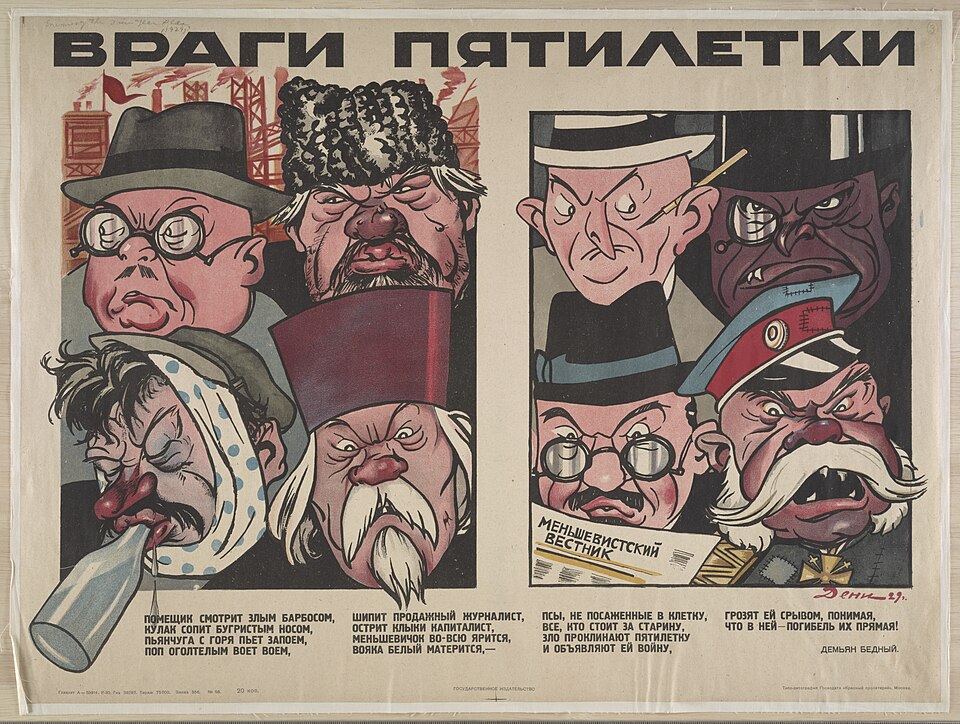
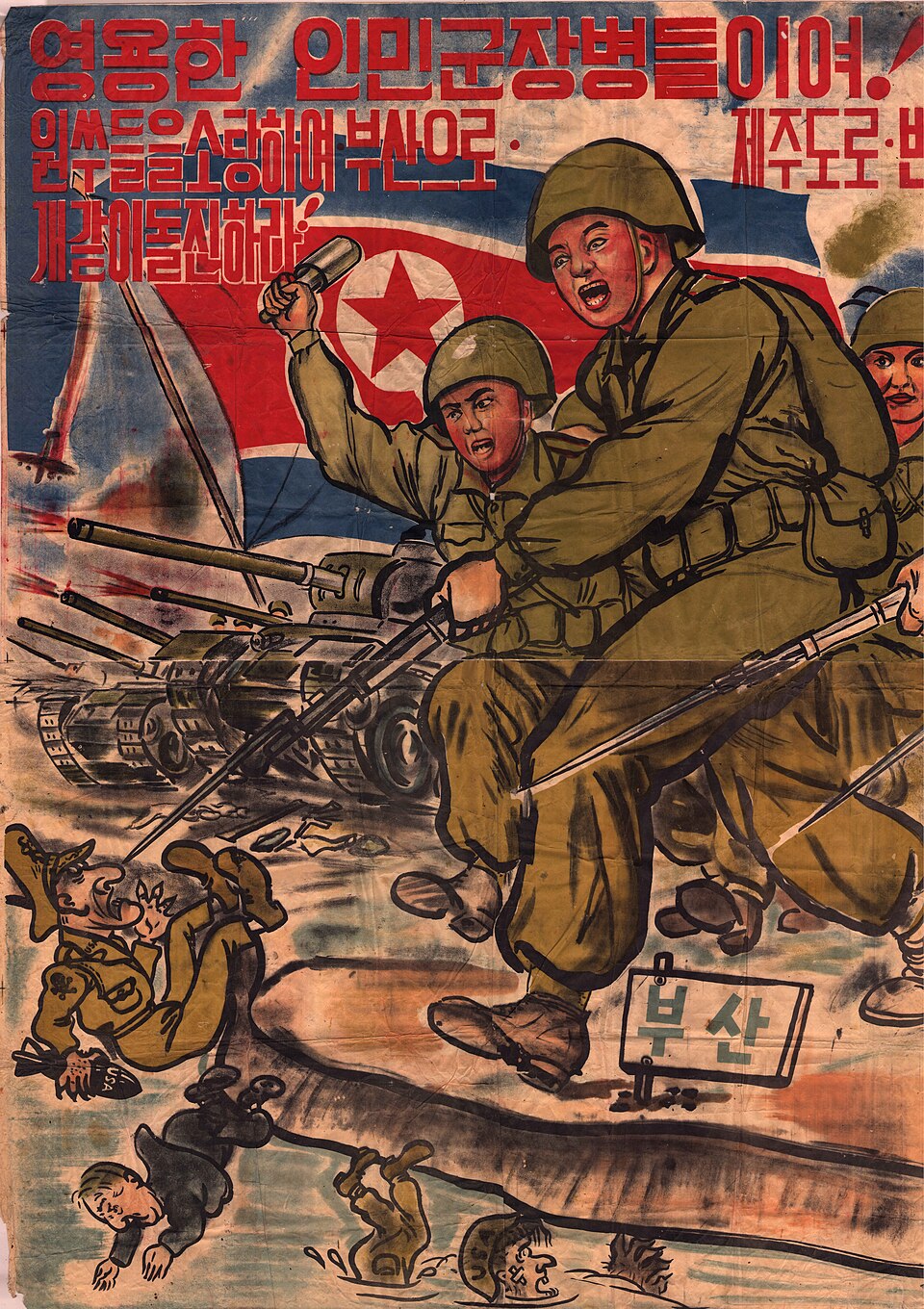
Content note. The practice gallery includes a 1929 Soviet sheet of caricatured "enemies" and a 1951 North Korean sheet showing caricatured American soldiers bayoneted and drowned. They are shown as issued, as evidence of what each audience was shown. Showing a poster is not endorsing it.
Short answer
SOAPSTone is a six-part reading frame: Speaker, Occasion, Audience, Purpose, Subject and Tone. Applied to a propaganda poster, you name who issued it, what moment it answers, whom it addresses, what it asks, what it is about and how it sounds. Add the technique and the same questions work for every side. A blank grid is at the end.
What SOAPSTone is, and what it leaves out
SOAPSTone is a classroom mnemonic from English teaching: six prompts that make a student read a text as an act of communication by someone, at some moment, to someone, rather than as a free-floating block of words. This page describes it in the archive's own words and does not reproduce any exam material.
Explain moreShow less
It suits posters because a poster has all six parts in a small space. It leaves out two things propaganda analysis needs: a named technique (what device carries the ask) and a check (what is missing, and whether you would say the same of the other side). The grid below therefore adds a seventh row. The wider method is on how to analyse propaganda; the printable eight-question form is the poster analysis worksheet.
The six parts, as questions about a poster
The "fact or reading" column is the habit that matters most. Speaker and Occasion can be checked; Tone cannot. A student who labels the two differently writes a better essay. For the technique definitions, see the technique pages and the ten-technique list.
Explain moreShow less
| Part | Ask of a poster | Fact or reading? |
|---|---|---|
| Speaker | Which body or person issued it? Read the imprint, the signature and the language. | Fact, or "not stated" |
| Occasion | What event or date does it answer? | Fact, with a stated basis for the date |
| Audience | Who was meant to see it? | Fact if the sheet says; otherwise a reading |
| Purpose | What does it ask the audience to do or believe? | Reading, anchored in quoted words |
| Subject | What is it about? | Reading |
| Tone | How does it sound: solemn, urgent, mocking, final? | The least firm column; a reading |
| Technique (added) | Which device carries the ask, and what is the quoted tell? | Reading, with a tell |
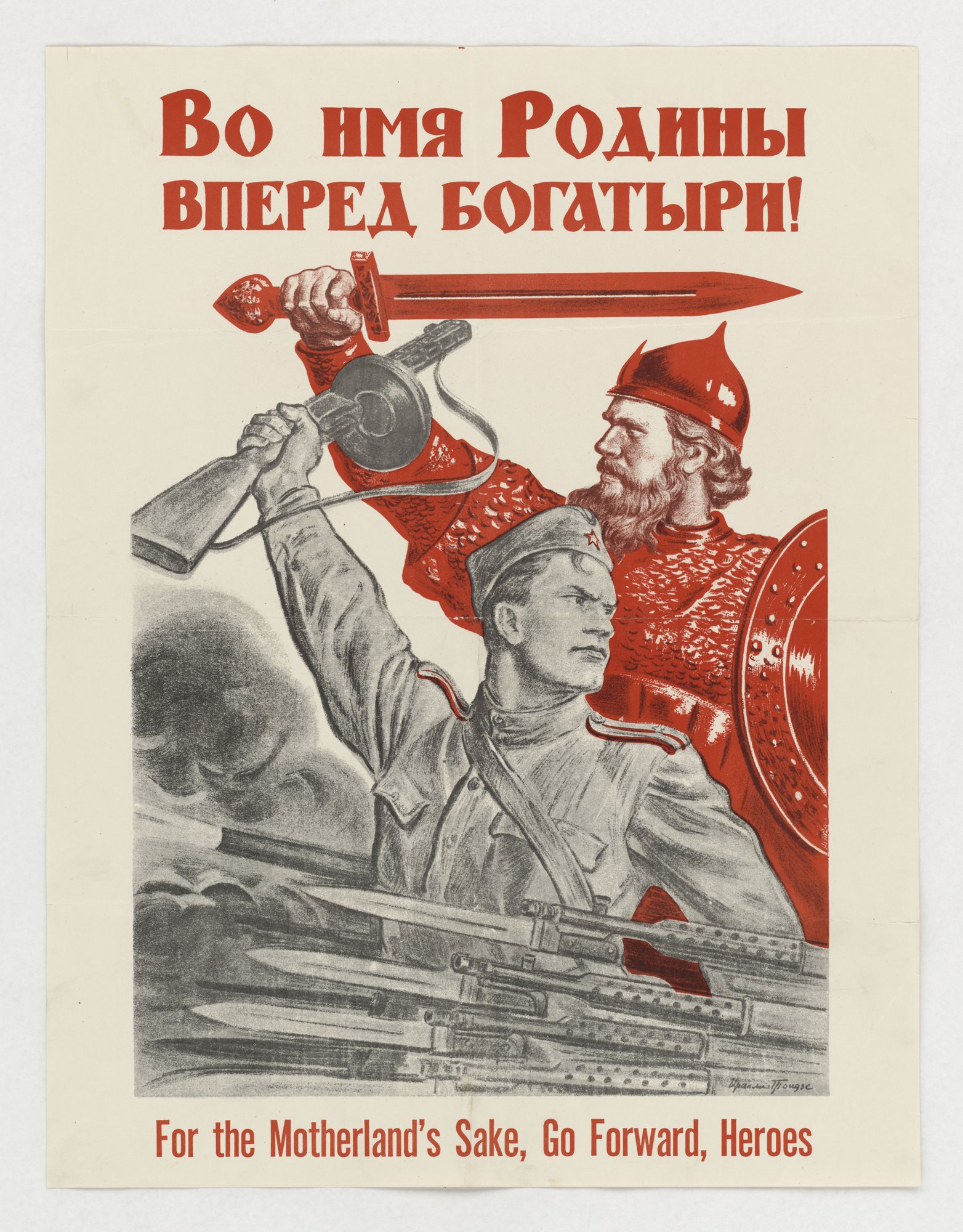
Poster 1: Soviet Union, 1943
Check: what is missing is any named reason, place or objective. The sheet gives no reason beyond the appeal itself, which is also true of the Australian and West German posters below. The same definition of transfer applies to the 1917 U.S. recruiting sheet in the gallery below. For the technique, see transfer.
Explain moreShow less
| Part | Evidence |
|---|---|
| Speaker | The Soviet Union; the artist is Irakli Toidze, who signed it. No publisher or printer imprint is visible. An English line at the foot is the National Archives' title, probably added for foreign distribution, and the entry says who added it is not stated. |
| Occasion | The Second World War. No year is printed; the entry uses 1943 because the soldier wears shoulder boards, reintroduced in the Red Army in January 1943. |
| Audience | The Russian text addresses the Soviet public and the troops. The English caption suggests a second, foreign audience. |
| Purpose | Mobilise and comply: "forward, heroes". The ask is to fight, not an argument for why. |
| Subject | A present soldier and a legendary warrior, a bogatyr, standing together under the headline "For the Motherland's sake, forward, heroes!" |
| Tone | Commanding and solemn. The reading rests on the headline's imperative and the heroic pose. |
| Technique | Transfer and glittering generalities, per the entry. The epic warrior lends the past's prestige to the present soldier; "Motherland" and "heroes" are virtue words without specifics. Cover the bogatyr and the sheet still commands but no longer borrows. |
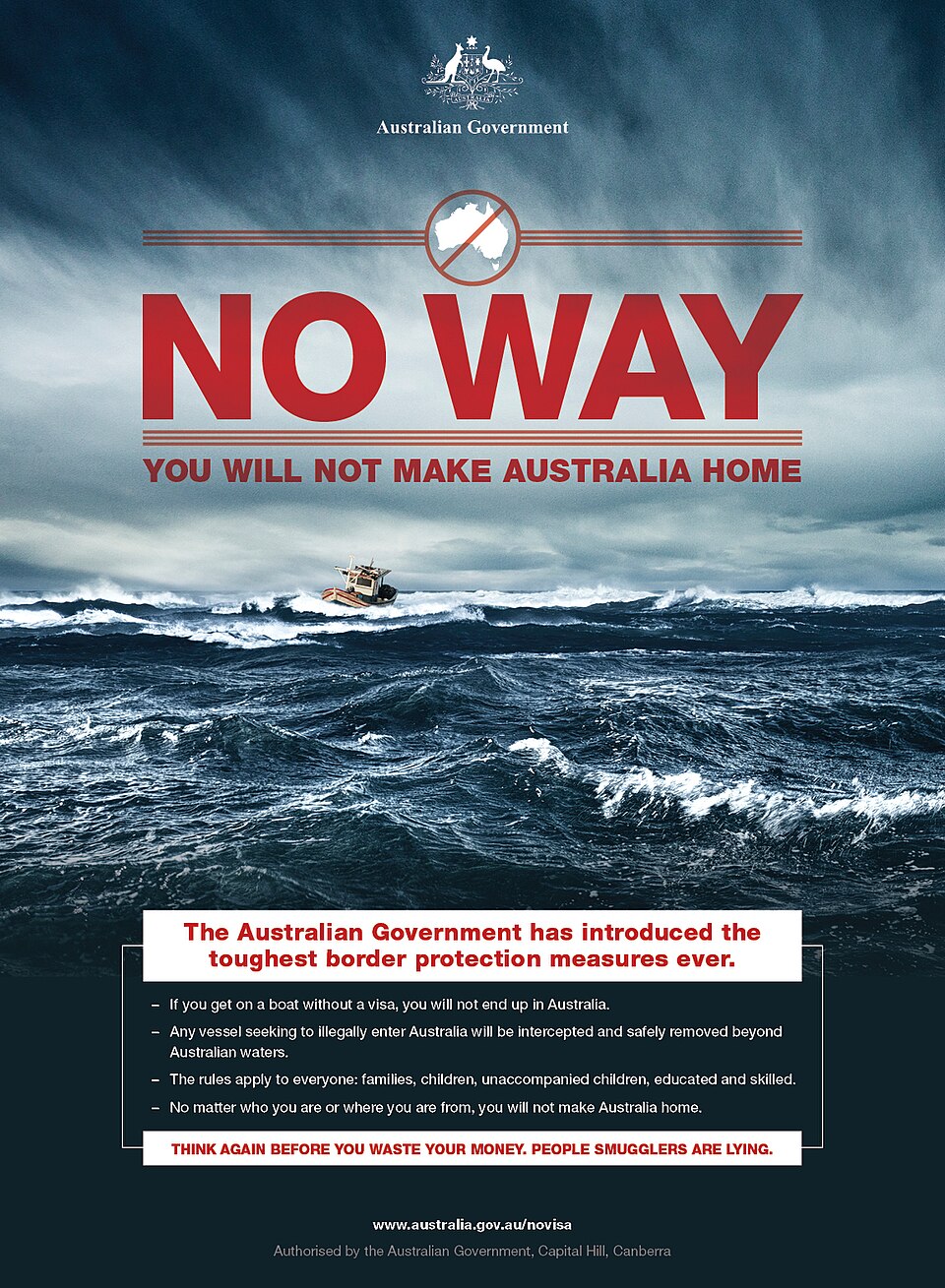
Poster 2: Australia, 2013
Check: the entry records that the government described the campaign as deterrence meant to reduce dangerous sea voyages and undercut smugglers' marketing, and that refugee advocates and some commentators criticised the campaign and the policy behind it. The entry documents the messaging technique, not the merits of the policy, and so does this page. What the sheet does not say is how many people made the voyage or how a person might apply for protection by another route.
Explain moreShow less
| Part | Evidence |
|---|---|
| Speaker | The Australian Government, through the Australian Customs and Border Protection Service. The sheet names its sponsor and carries the line "Authorised by the Australian Government, Capital Hill, Canberra", which makes it openly attributed (the archive's term is white propaganda). |
| Occasion | Dated 13 September 2013 on the Commons file page, five days before Operation Sovereign Borders, a military-led border operation, formally began on 18 September 2013. |
| Audience | The entry tags it as aimed at a foreign public. The campaign ran in Australia and in source and transit countries, with translated versions. |
| Purpose | Warn and inform: do not travel to Australia by boat. The text states "you will not make Australia home" and "think again before you waste your money". |
| Subject | Border protection measures and what they mean for people arriving by boat. |
| Tone | Blunt and final, from the capitalised "NO WAY" and the list of flat rules. A reading. |
| Technique | Fear appeal, per the entry. The storm-dark sea and boat picture the risk, one safe course is named (do not come by boat), and the opposite advice is credited to "people smugglers", who "are lying". |
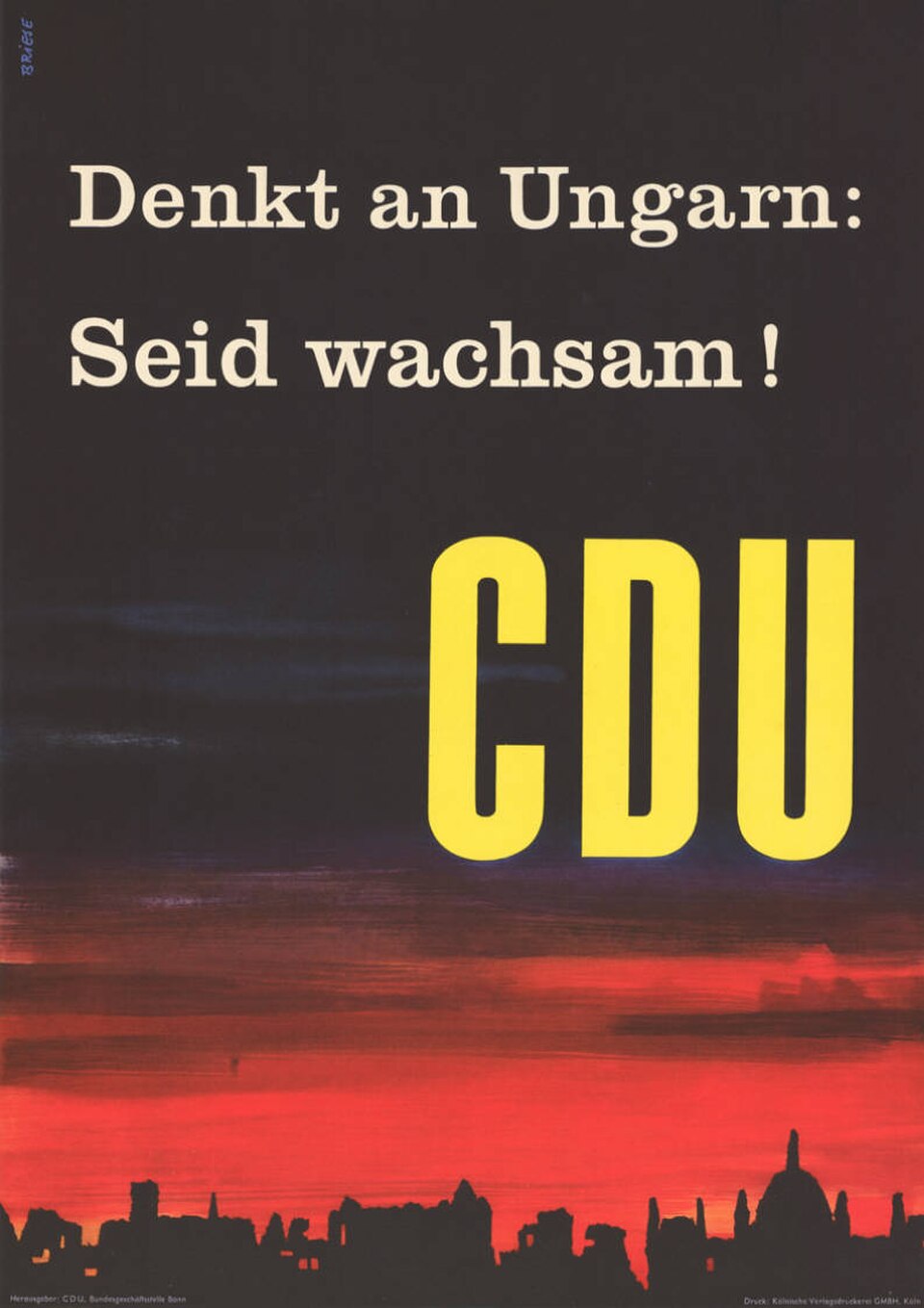
Poster 3: West Germany, 1957
Check: the sheet names no opponent. The event on it is documented, and the technique scored is the use of it as a warning attached to a party choice. The entry also records that the CDU/CSU took 50.2 percent of the vote on 15 September 1957 under the slogan "Keine Experimente!"; the poster's effect on that result is not measured here and no causal claim is made. For the technique, see fear appeal.
Explain moreShow less
| Part | Evidence |
|---|---|
| Speaker | The Christian Democratic Union (CDU), federal office in Bonn; the artist signed "Briese"; printed by Kölnische Verlagsdruckerei, Cologne. |
| Occasion | The Bundestag election of 15 September 1957, less than a year after the Hungarian uprising of October to November 1956 was suppressed by Soviet forces. |
| Audience | German voters. |
| Purpose | Persuade: be vigilant, and, by implication, vote CDU. The party letters are the only remedy on the sheet. |
| Subject | The fate of Hungary, invoked as a warning. |
| Tone | Ominous and urgent, from the black sky, red horizon and ruins. A reading. |
| Technique | Fear appeal and transfer, per the entry. |
What the three show
Three issuers, three decades and three media settings give three different Occasions and Audiences, but the same grid worked on all of them. Two used fear appeal and one used transfer, and the checks were the same. They differ in scale, intent and context: a wartime state mobilising troops, a government deterring a journey, and a party in a free election. The grid does not rank those; it asks the same questions and leaves each answer to the evidence. A student who finds the first poster "worse" than the third must point to something in the grid that says so.
Try the grid on these nine
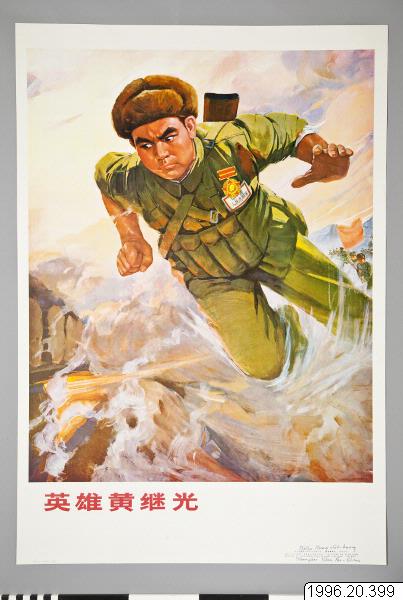
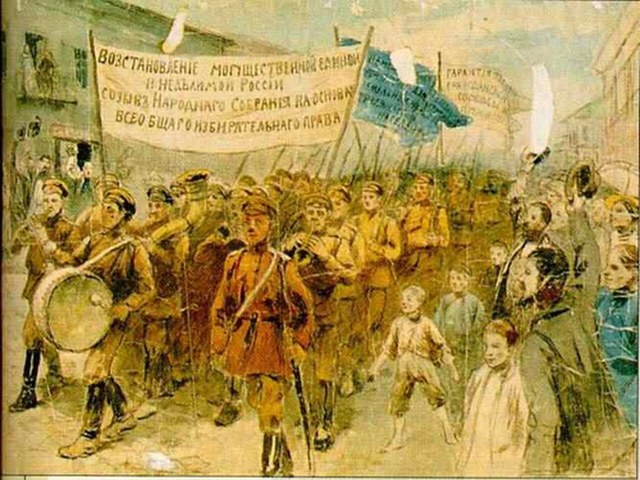
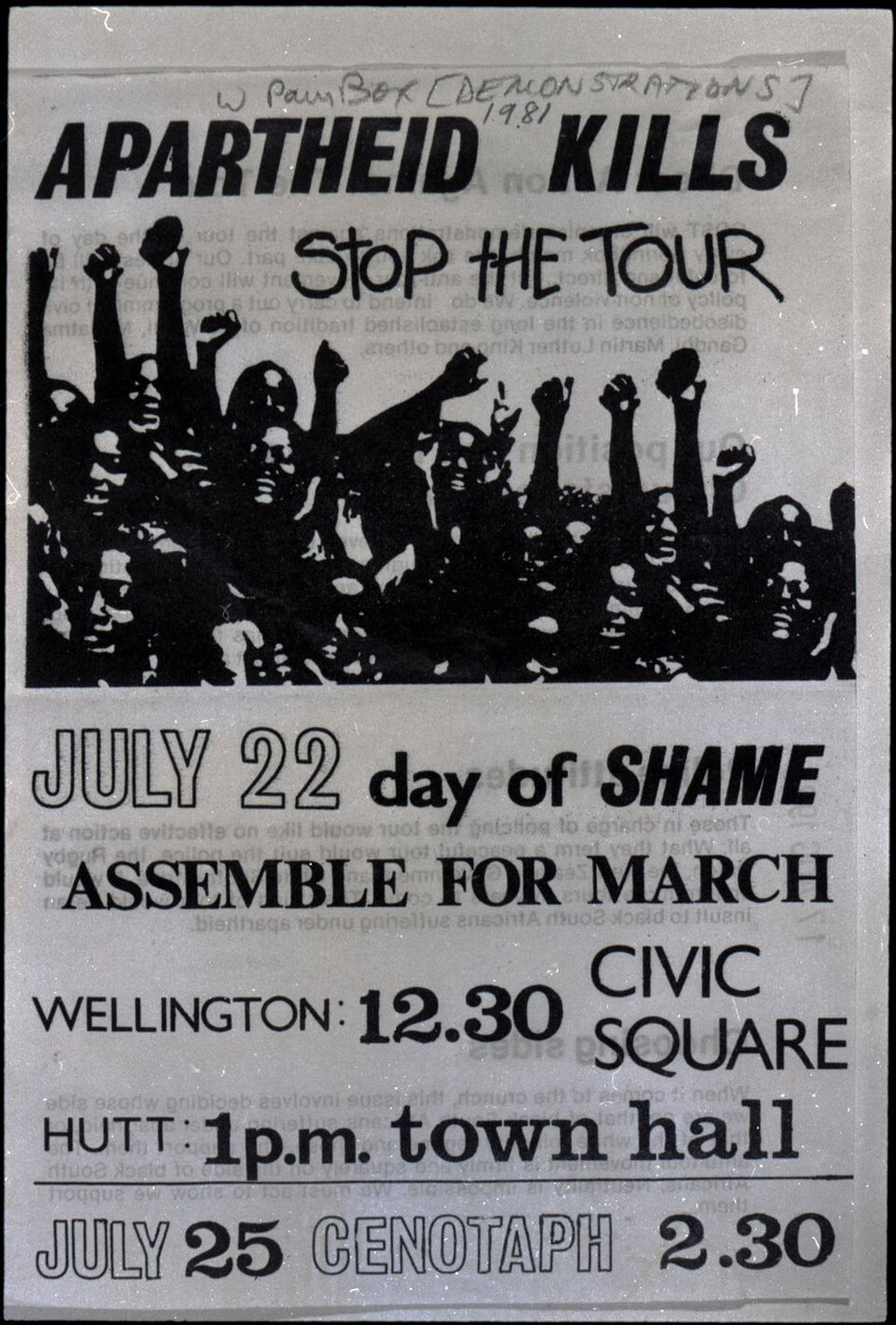
Each is a real entry in the collection. Fill the grid and compare with the entry on its object page.
Content note: Illustration of forcible feeding: a restrained woman has a tube inserted in her nose in a prison cell. This object is shown as it was published. Why 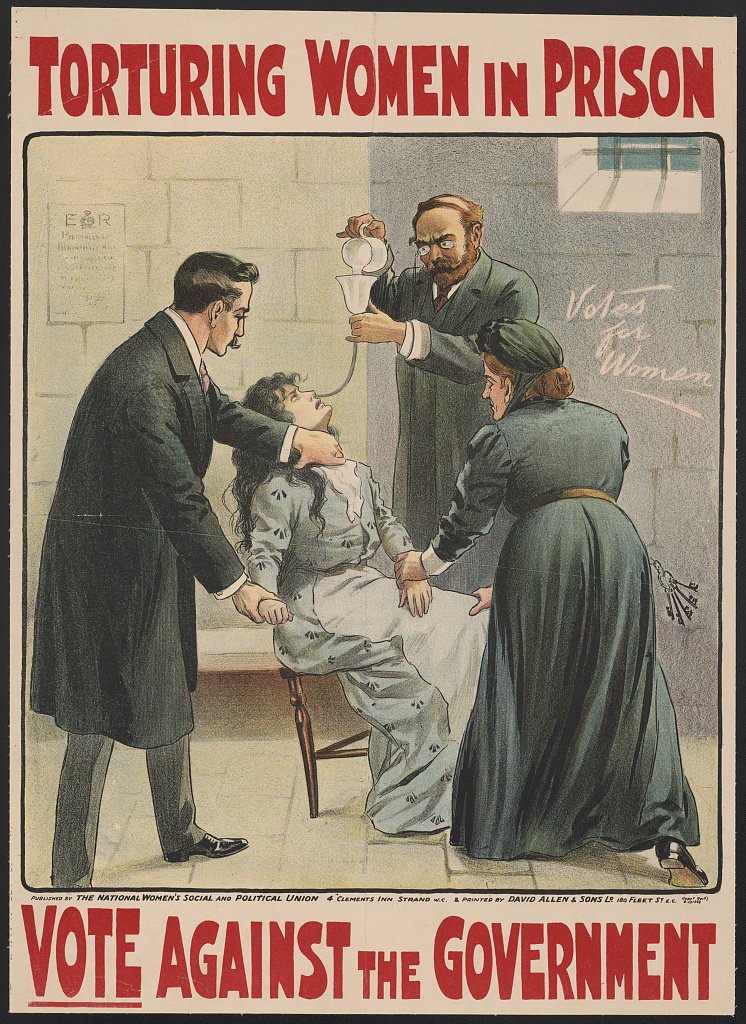
Explain moreShow less
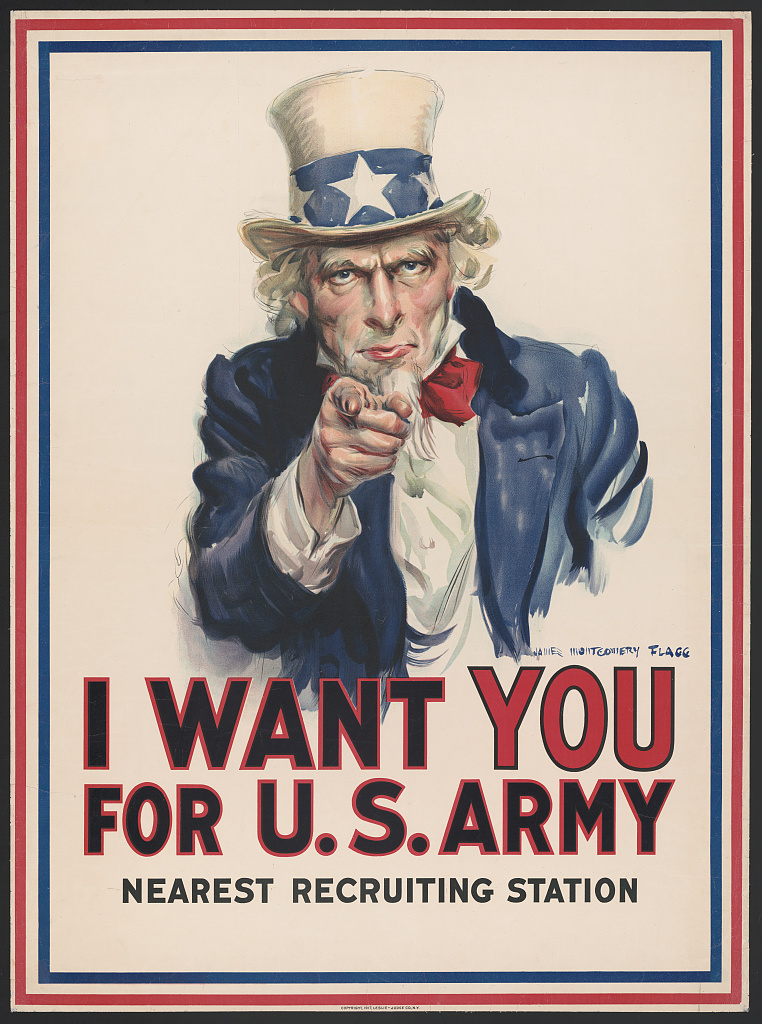
A. U.S. Army recruiting, 1917; artist James Montgomery Flagg.
B. Women's Social and Political Union, London, 1910.
C. Gosizdat, Moscow and Leningrad, 1929; drawings by Viktor Deni, verse by Demyan Bedny.
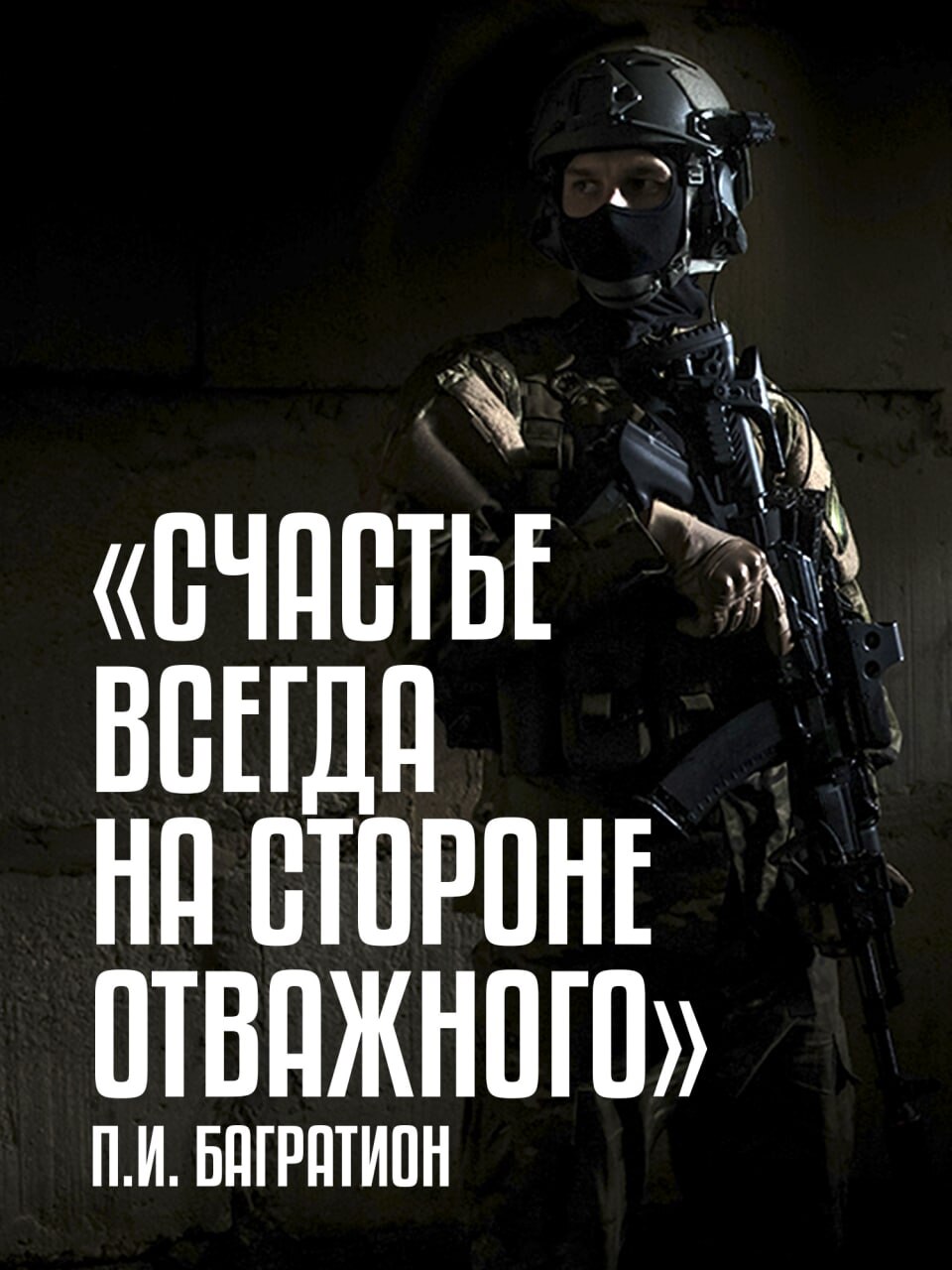
D. Russian Ministry of Defence, 2022.
E. People's Republic of China, Shanghai, 1973; artist Zhou Ruizhuang.
F. White Volunteer Army, 1919.
G. Democratic People's Republic of Korea, 1951.
H. Anti-tour protest organisers, Wellington, 1981.
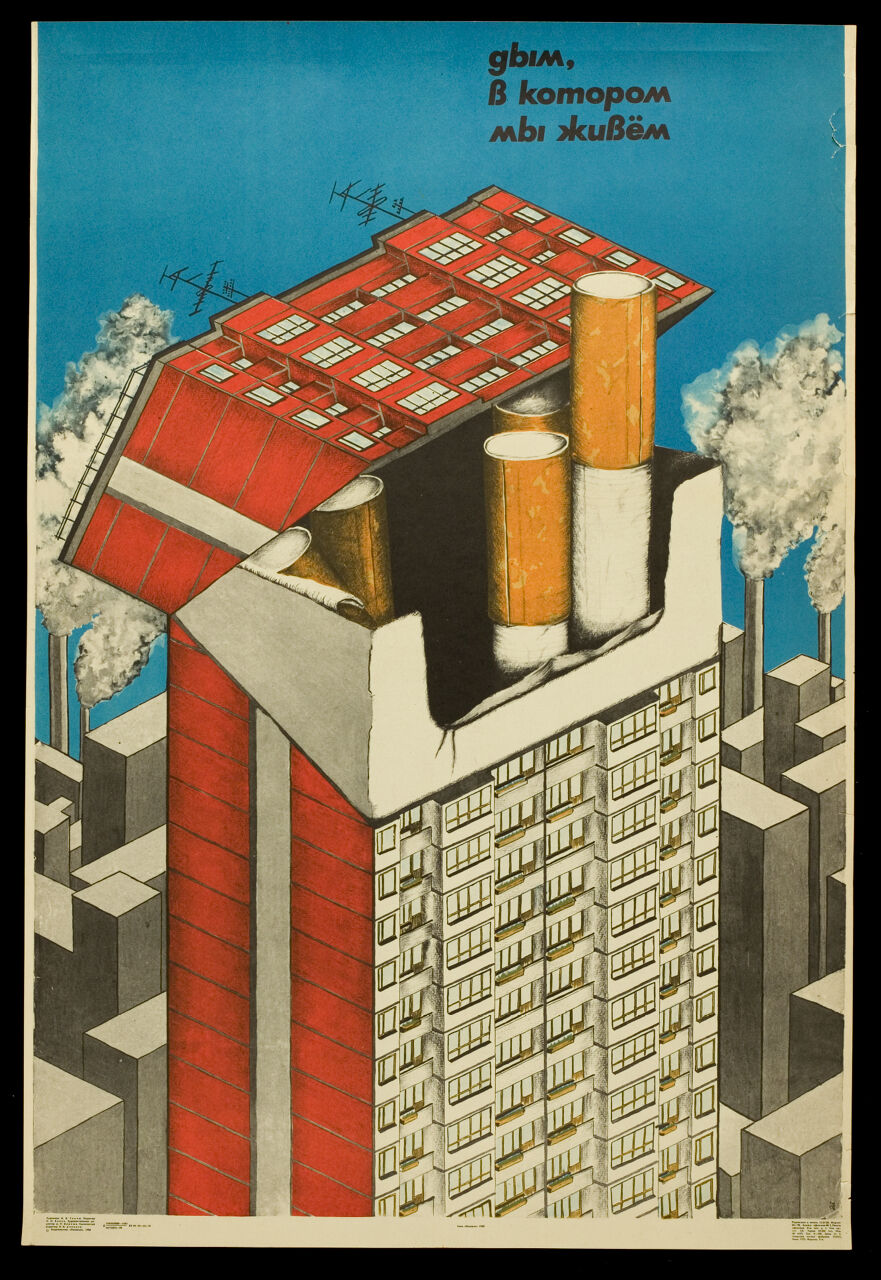
I. Reklama state publishing house, Kiev, 1988; design by I. V. Tomash.
Common mistakes with SOAPSTone
- Confusing Speaker with the artist or the printer. The artist drew it; the issuer paid for it or ordered it. Name both when the sheet does, and say if the issuer is not stated.
- Treating Tone as a fact. Write "reads as" and quote the words or colours that give that impression.
- Merging Purpose and Subject. The subject is what the poster is about; the purpose is what it asks the viewer to do or believe.
Show all 5Show fewer
- Stopping at six. The frame does not name the device. Add the technique and its quoted tell.
- Different standards for different sides. Run the swap test: would I write the same Tone and Technique if the other side had issued it?
Blank grid
``` SOAPSTone: PROPAGANDA POSTER Name: __ Date: _ Poster: ___ Issuer, date, place: ________
Explain moreShow less
S Speaker (who issued it; artist/printer if different):
O Occasion (event and date; how do you know the date?):
A Audience (who was it for; fact or reading?):
P Purpose (one sentence; quote the words that ask):
S Subject (what is it about?):
T Tone (how does it sound? reading, quote the evidence):
- Technique and quoted tell: ______ Cover test: with the symbol/number/label covered, is an argument left? Y / N
- Missing, and one thing to check: ________ Same-standard check: would I write the same if the other side had issued it? Y / N ```
Counts and sources
The collection holds 6,705 entries, of which 5,137 are posters from 69 countries (counted from examples/entries/). Each poster above has an entry giving the holding institution, licence basis, transcription and, for non-English texts, a translation. Related pages: how to analyse propaganda, the propaganda lesson plan, ethos, pathos and logos in propaganda and Animal Farm and propaganda.