Content note. Some objects on this page are wartime posters that repeat atrocity claims, some later shown to be false or unverified, and hostile labels for enemies. They are shown as issued, from several sides.
What is disinformation?
Disinformation is false or misleading information created or spread deliberately to deceive or cause harm. The word is a loan from the Russian dezinformatsiya and entered English dictionaries in 1985. Misinformation, by contrast, is false content shared without intent to deceive. This page traces the word's origin, documented cases and "fake news".
The definitions in brief
Wardle and Derakhshan's 2017 Council of Europe report sorts content by whether it is false and whether harm is intended: disinformation is deliberate, misinformation is not, and mal-information is true but used to harm. The EU High Level Expert Group (2018) defined disinformation as false, inaccurate or misleading information "designed, presented and promoted to intentionally cause public harm or for profit", so companies, parties and individuals are covered as well as states. The full comparison with propaganda is on Propaganda, misinformation and disinformation: the differences, and the wider map is on types of propaganda.
Where the word comes from
"Disinformation" is generally treated as a loan from the Russian dezinformatsiya. Several writers on propaganda, including Jowett and O'Donnell and the Czech defector Ladislav Bittman, trace the Russian word to a KGB department responsible for black propaganda. Soviet reference works defined the term in the 1950s as the dissemination, in the press or on radio, of false reports intended to mislead public opinion. Historians date the tactic to the early Soviet state, and the Soviet apparatus later grouped it with forgeries and planted stories under "active measures" (Soviet agitprop). The English word appeared in print with a different sense (removing information) as early as 1887 and entered dictionaries in 1985. The word is Russian in origin. The practice is not specific to Russia or to the Soviet period, as the cases below show.
Documented cases from several states
The cases are listed so they can be checked, and they are not equivalent. They differ in scale, evidence, intent and institutional setting. Where the record of intent is incomplete, the entry says so.
Explain moreShow less
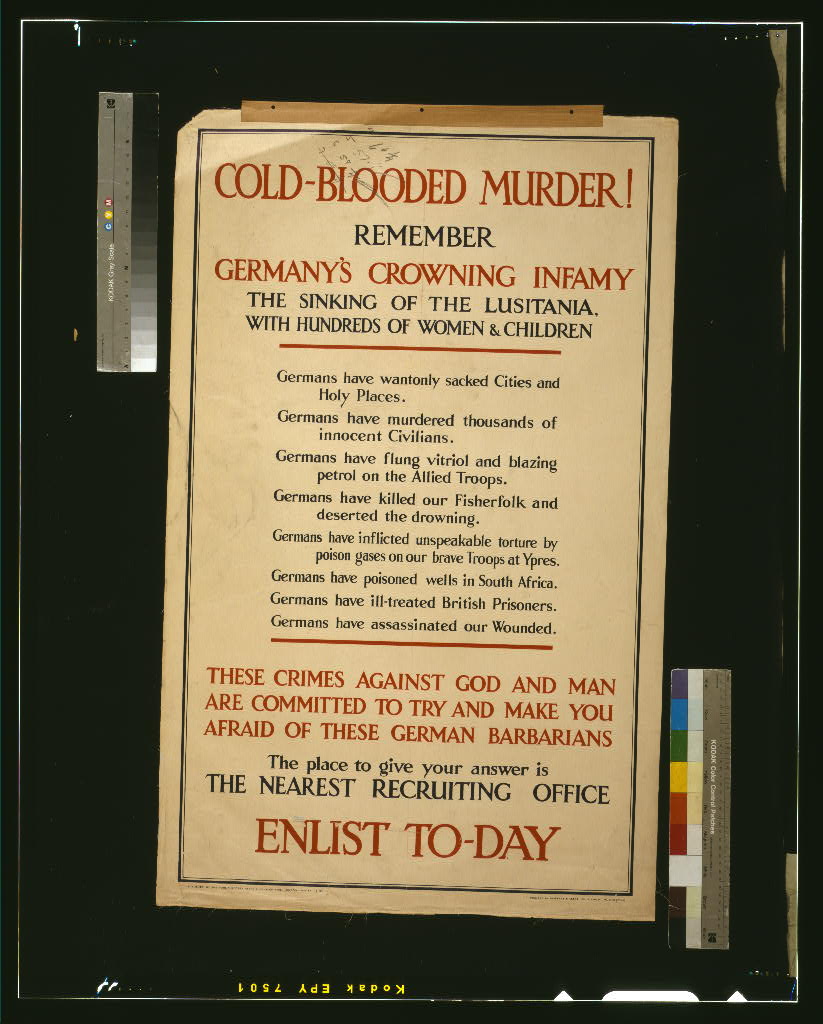
Britain, 1915 and 1917. The Parliamentary Recruiting Committee's text-only poster "Cold-Blooded Murder!" listed charges against Germany. In April 1917 British newspapers reprinted a report that Germany rendered its dead soldiers for fat. The German government denied it, and in 1925 the Foreign Secretary told the Commons the story had no foundation. Its origin is disputed: The German 'corpse factory': a false atrocity story and its long afterlife (1917-1925).
"Cold-Blooded Murder! Remember Germany's Crowning Infamy", Parliamentary Recruiting Committee poster no. 97, 1915. Library of Congress. Public domain in the US (published before 1931).
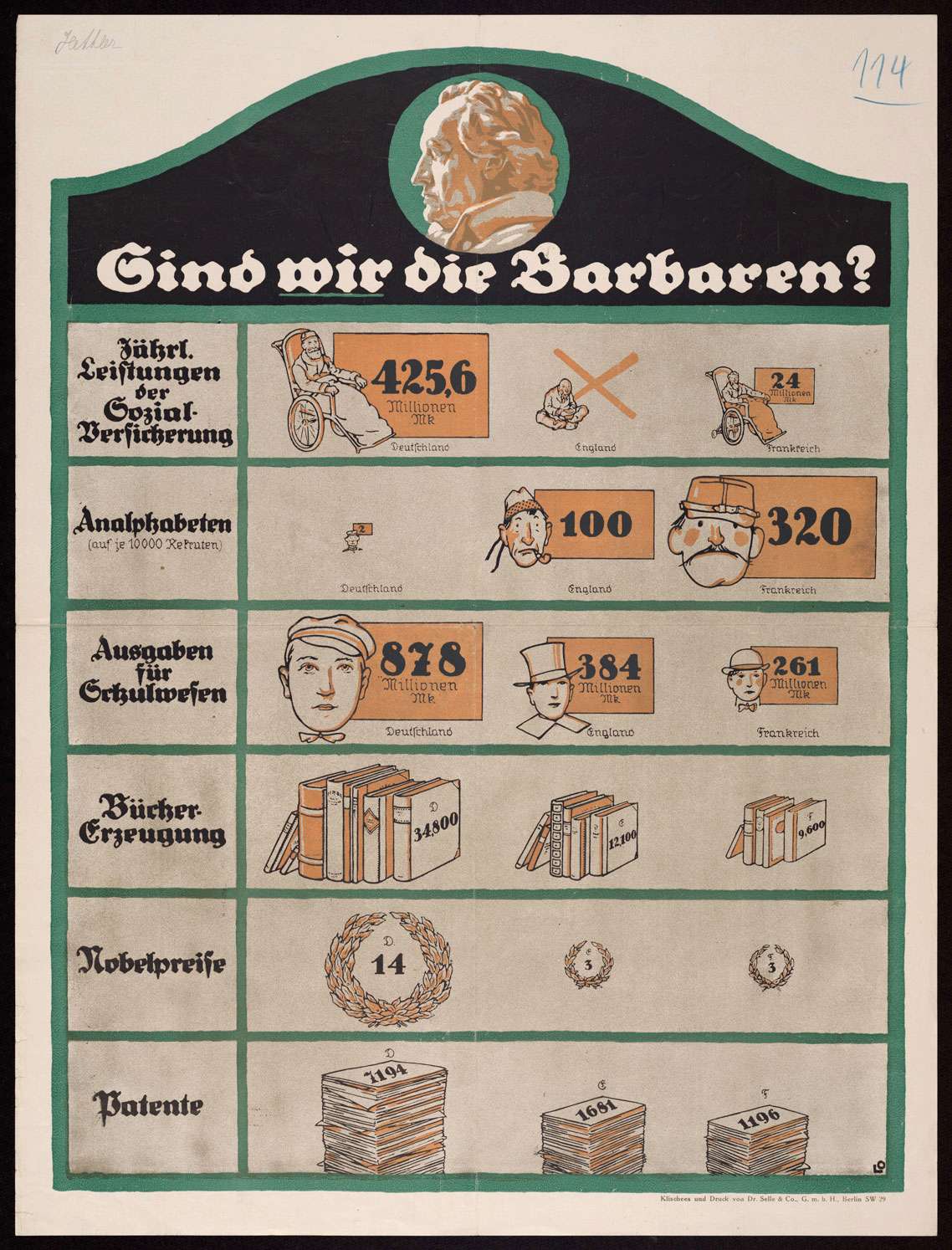
Germany, 1916. The Imperial German government's counter-propaganda poster "Are We the Barbarians?", by Louis Oppenheim, answered Allied atrocity claims with a statistical chart. It is a rebuttal of claims some of which were false and some of which had a basis, and it is itself a selective use of figures (Card stacking).
"Sind wir die Barbaren?", poster by Louis Oppenheim, 1916. Landesarchiv Baden-Württemberg, Hauptstaatsarchiv Stuttgart, via Wikimedia Commons. Public domain.
Britain, 1924: the Zinoviev letter. The Daily Mail published a letter attributed to the Comintern chairman Grigory Zinoviev about four days before the 29 October 1924 general election. MI5 judged it a forgery in late 1924, though the government was not told. A 1999 Foreign Office historical paper by Gill Bennett concluded that it is impossible to say who wrote it, with a best guess of White Russian intelligence circles, using forgers in Berlin or the Baltic states.
Soviet Union and East Germany, 1980s. An anonymous letter in an Indian newspaper, Patriot (17 July 1983), claimed AIDS was made in US laboratories. A Soviet weekly cited it on 30 October 1985, and East German state security helped spread a report by the biophysicist Jakob Segal. In 1992 Yevgeny Primakov, head of Russia's Foreign Intelligence Service, acknowledged the KGB's role. Thomas Boghardt's account in Studies in Intelligence (2009) also notes that suspicion of a US origin was circulating before any KGB involvement. A related case is the 1984 letters on Ku Klux Klan letterhead threatening Olympic athletes: 'For whites only': the forged Klan letters sent to Olympic committees in 1984.
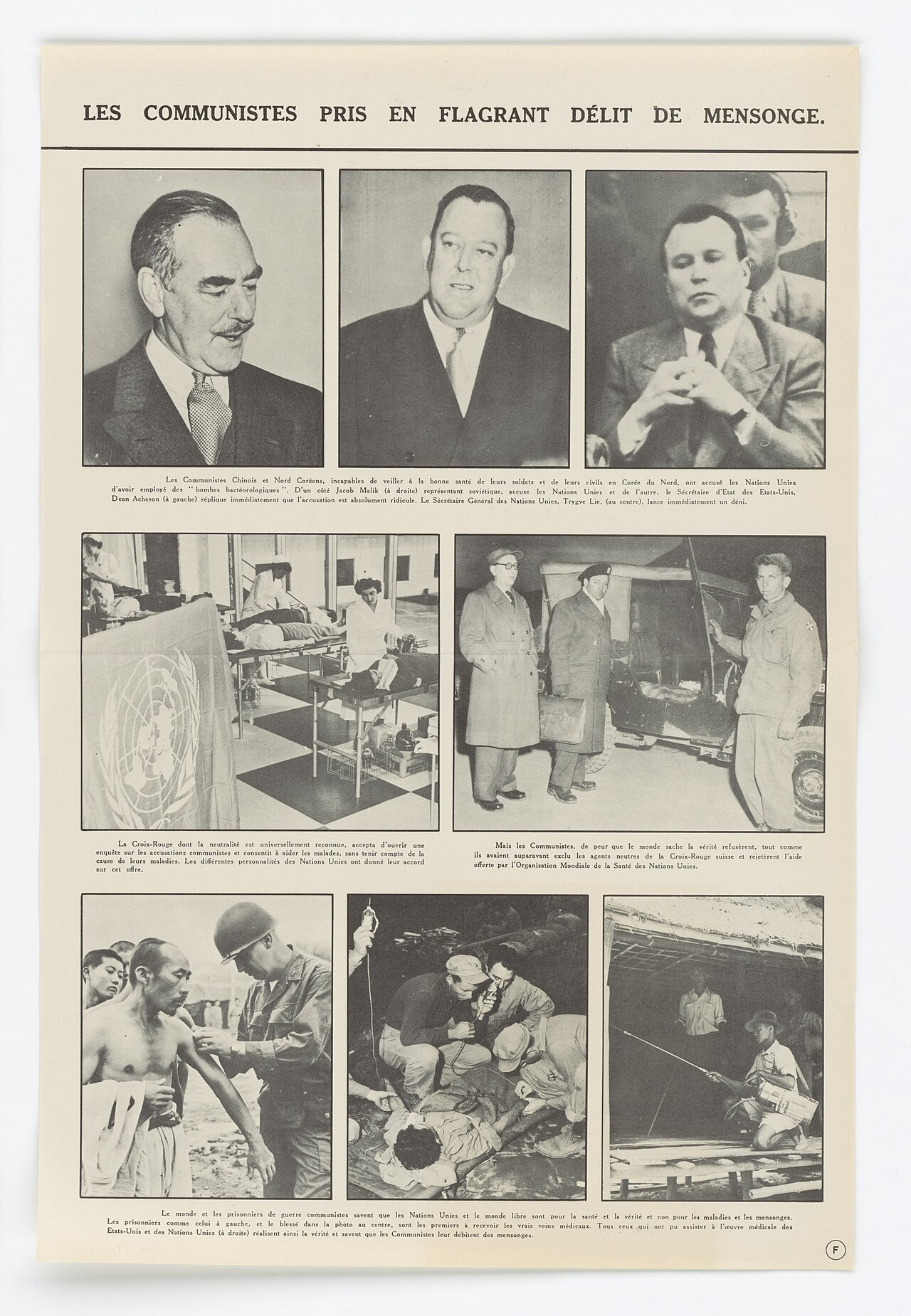
United States, 1950s. The 1952 State Department poster "The Communists Caught Lying", printed in French and at least eight Asian languages, places the Soviet delegate Jacob Malik's charge of germ warfare beside denials by Dean Acheson and Trygve Lie. It is an open, attributed rebuttal.
"Les communistes pris en flagrant délit de mensonge", US Department of State, 8 May 1952. US National Archives, RG 306, NAID 5729954. Public domain (US government work).
United States, other cases. The press reported in 2000 that the CIA placed fictitious stories in an Iranian newspaper during the 1953 effort against Prime Minister Mossadegh. The FBI placed material about US political groups in the press from 1956 to 1971 and mailed items that did not name it as source (COINTELPRO: the FBI's covert media and information operations against U.S. groups, 1956-1971). In 1986 a US campaign against Libya's Muammar Gaddafi became public; State Department spokesman Bernard Kalb resigned in protest. In 2002-03 US and UK officials stated intelligence judgements on Iraqi weapons with more certainty than the classified assessments, and inquiries differed on intent (How the US and UK governments presented the case for war in Iraq, 2002-03). From 2020 to mid-2021 the US military ran fake accounts in the Philippines casting doubt on China's Sinovac vaccine, as Reuters reported on 14 June 2024. The US government publishes its military doctrine for psychological operations, which states a preference for attributed, truthful products (psychological operations).
Russia, 2010s. A St Petersburg firm, the Internet Research Agency, ran Facebook pages posing as American communities on opposite sides of US politics, as the House Intelligence Committee documented in 2018: 'Russian Ads on Facebook' (House Intelligence Committee exhibit).
China, 1958-59. The Party press printed record harvests, the figures were added into a national total, grain was requisitioned against it, and questioning the numbers was condemned in 1959. This is a case of falsified reporting inside an institution as much as outward deception: The Great Leap Forward's 'sputnik' harvests and the famine that followed.
A case counts as disinformation only when evidence of intent exists: a document, an admission, concealed coordination. Where intent is only inferred from the effect, "false claim" is the accurate description.
"Fake news": a term used by many sides
"Fake news" has two meanings that are easy to confuse. As a genre, it describes deliberately fabricated pseudo-journalism. This sense is old. The Great Moon Hoax of 1835 was a fabricated newspaper series about life on the Moon, and the phrase appeared in print by the 1890s, in the era of sensationalist newspapers. As a label, it is attached to real reporting that the speaker wants the audience to distrust.
Explain moreShow less
The label sense became common after 2016. US President Donald Trump is credited with popularising the term by using it for negative press coverage of himself, and journalists such as Margaret Sullivan urged colleagues to stop using it. It was also adopted by governments elsewhere, and "fake news" has been written into law in several countries, with the stated aim of curbing false statements. Singapore's 2019 law allows ministers to order a correction notice on posts they judge to be false statements of fact; the government says it does not reach opinion, and critics say it can reach disputed political claims (Operation Spectrum: Singapore's 'Marxist conspiracy' and its answers). In the EU the High Level Expert Group (2018) dropped the phrase because it is "inadequate" and because politicians used it against outlets they disliked.
In this archive, where a claim is checkably false, the page says so and cites the primary source. Where a label is applied to a disputed claim, it records the dispute. The label itself is a technique: calling a report "fake" without checking is Name-calling, and refusing to engage with the record is Ad hominem when it targets the reporter, not the report.
Critiques of the term
Researchers argue the words are hard to measure and easy to misapply. In a 2023 survey of 150 misinformation researchers, 73% defined misinformation as false and misleading information, but experts split on whether intent matters. On whether propaganda counts as misinformation, 72% of psychologists agreed against 36% of political scientists. The authors warn that vague boundaries risk use of the label to suppress legitimate speech.
Explain moreShow less
The archive holds examples of that worry. A dashboard presented as tracking Russian disinformation was later reported to rest on a list of mostly ordinary accounts (Hamilton 68: the Russian-influence dashboard and its secret account list). A Department of Homeland Security board created to counter disinformation was paused within weeks after criticism from Republican lawmakers and civil-liberties groups (The DHS Disinformation Governance Board (2022)). In the pandemic both officials and critics used these labels in disputes over open questions (Follow the science, Plandemic: COVID-19 messaging from officials and contrarians, 2020-2022).
How to tell a documented case from a claim
- Is the claim checkably false, against which primary source?
- Is intent shown by documents, admissions or coordination, or only inferred from effect?
- Is the origin disclosed or concealed (Narrative laundering, Astroturfing)?
- Would the same label be applied if the source were on the side you favour?
Sources and further reading
Sources
Claire Wardle and Hossein Derakhshan, Information Disorder: Toward an interdisciplinary framework for research and policy making…
Claire Wardle and Hossein Derakhshan, Information Disorder: Toward an interdisciplinary framework for research and policy making, Council of Europe report DGI(2017)09 (2017). High Level Group on Fake News and Online Disinformation, A multi-dimensional approach to disinformation (European Commission, 12 March 2018). Cherilyn Ireton and Julie Posetti (eds), Journalism, 'Fake News' and Disinformation (UNESCO, 2018). Sacha Altay, Manon Berriche and Alberto Acerbi, "Misinformation on misinformation," Social Media + Society 9, no. 1 (2023); Altay, Berriche, Heuer, Farkas and Rathje, Harvard Kennedy School Misinformation Review 4, no. 4 (2023). Thomas Boghardt, "Operation INFEKTION," Studies in Intelligence 53, no. 4 (2009). Gill Bennett, The Zinoviev Letter of 1924 (Foreign and Commonwealth Office historical paper, 1999). Chris Bing and Joel Schectman, Reuters, 14 June 2024. Garth Jowett and Victoria O'Donnell, Propaganda and Persuasion (Sage).