Content note. The practice set includes a 1933 German election banner and a 2022 Russian war-symbol billboard. Everything is shown as issued, as evidence of what each audience was shown. Showing a poster is not endorsing it.
Short answer
To analyse a propaganda poster, answer eight numbered questions in order: describe it, then find who issued it, who it was for, what it asks and which technique carries the ask. Test the technique by covering the symbol, number or label and checking whether an argument remains. Apply the same test whichever side issued it. A printable copy is at the end.
How to use this worksheet
Print this page, or copy the blank block at the end. Work on one poster at a time, in pairs, for 15 to 20 minutes. Write evidence from the poster in every box, not opinions. The archive's object pages give the holding institution, a transcription and, for non-English posters, a translation, so students can check the text. The worksheet is the tool for session 3 of the propaganda lesson plan.
The eight questions
- Describe. List what you see and every word printed on it, without judging it.
- Who issued it? Name the body or person: a ministry, a party, a campaign, a company or a printer only. Say if it is not stated.
- When and where? Give the date, the country and the event around it.
Show all 8Show fewer
- Who was it for? Name the audience: citizens, soldiers, a foreign public, a language group.
- What does it ask? State the action or belief in one sentence: enlist, buy, vote, hate, obey, believe.
- Which words or images carry the ask? Quote or point.
- Which technique? Pick from the table below and quote the "tell".
- What is missing, and what would you check? Name one fact, source or alternative the poster leaves out.
Explain moreShow less
Then answer one more: would I give the same label if the other side had issued it?
The archive's four questions and SOAPSTone
SOAPSTone is a classroom reading frame (Speaker, Occasion, Audience, Purpose, Subject, Tone) widely used in English courses. The archive's own four questions (who issued it, who it was for, what it asks, which technique) cover the same ground for posters. Fill the table if your teacher uses SOAPSTone.
Explain moreShow less
| SOAPSTone | Question (of the eight) | Archive question | Your evidence |
|---|---|---|---|
| Speaker | 2 | Who issued it? | |
| Occasion | 3 | (context) | |
| Audience | 4 | Who was it for? | |
| Purpose | 5 | What does it ask? | |
| Subject | 1 and 6 | (what the poster shows and says) | |
| Tone | 6 and 7 | Which technique? |
The mapping is approximate. Tone is the least firm column: a poster's tone is a reading, while the issuer and audience are facts. Mark which is which.
The ten techniques at a glance
The definitions come from the archive's technique pages and are the same for every side. Each has a lesson in the archive's course.
Explain moreShow less
| Technique | Tell | Not this |
|---|---|---|
| Bandwagon | Polls, view-counts or "the tide" offered in place of the claim's merits | Reporting a real majority as a fact |
| Card stacking | Missing denominator, counterexample or dates | A short item that flags its own limits |
| Fear appeal | Catastrophe plus a single prescribed remedy | A dated, sourced warning with magnitude |
| Glittering generalities | Swap the virtue word for a measure and the sentence collapses | A defined principle applied to a named case |
| Identity fusion | "People like us don't ask that" | Shared identity as context |
| Name-calling | The insult does the work | Accurate naming of a documented crime or office |
| Plain folks | Costume or "as a worker" as the warrant | A person who really is that thing |
| Scapegoating | One villain class for many causes | A specific act attributed to a named person |
| Testimonial | A name used to end checking | A witness describing what they saw |
| Transfer | Flags, clergy or uniforms doing the work | Relevant affiliation stated as a fact |
Worked example 1: a United States poster, 1943
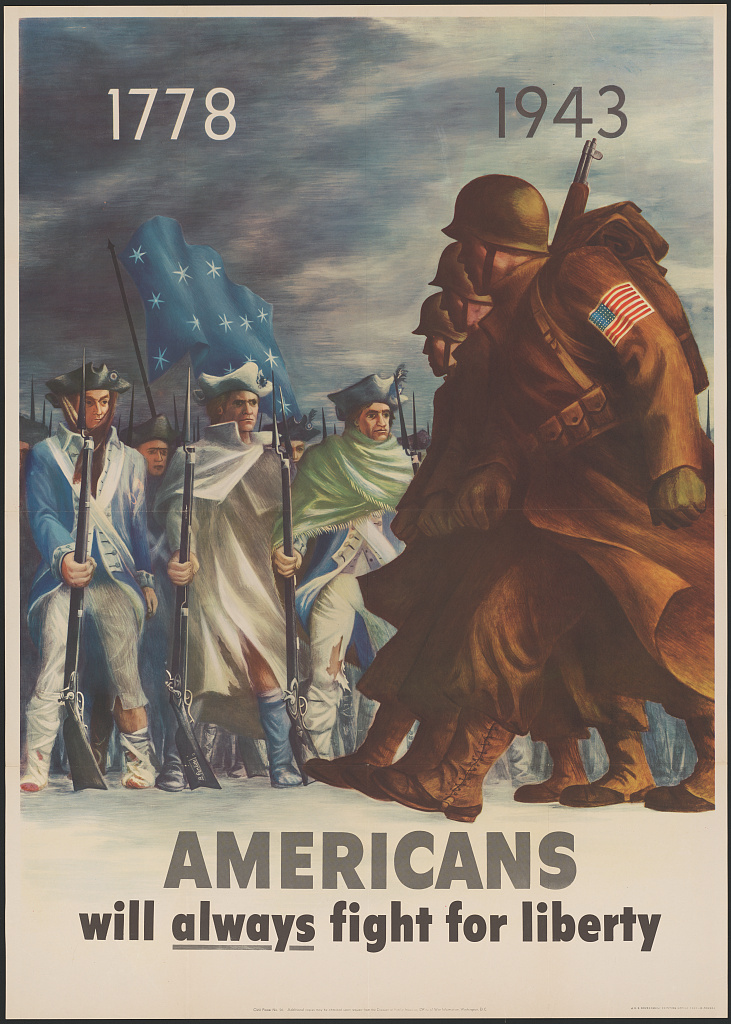
- Describe. Ragged soldiers marked 1778 stand beside helmeted soldiers marked 1943 under a starred flag. Printed: "AMERICANS will always fight for liberty", with "always" underlined.
- Issued by. The U.S. Office of War Information, Poster No. 26, painted by Bernard Perlin and printed by the Government Printing Office.
- When and where. 1943, United States, during the Second World War.
Show all 8Show fewer
- For. The domestic public.
- Asks. No action is named. It asks the viewer to see the present war as the same cause as 1778.
- Carried by. The two dates side by side, the flag and the underlined word "always".
- Technique. Transfer and glittering generalities, per the archive's entry. The Revolutionary War's prestige is placed on the present war, and "liberty" is offered as the aim of both without saying what it means.
- Missing. What "liberty" means in 1943, and what the viewer is asked to do. The "cover it" test: cover the 1778 soldiers and nothing in the text says why this war is a war for liberty.
Explain moreShow less
Same-standard check: a poster that stated an institutional fact, such as which unit descends from which, would be the technique's "not this". This one implies a shared aim rather than stating a fact.
Worked example 2: a Soviet poster, 1920
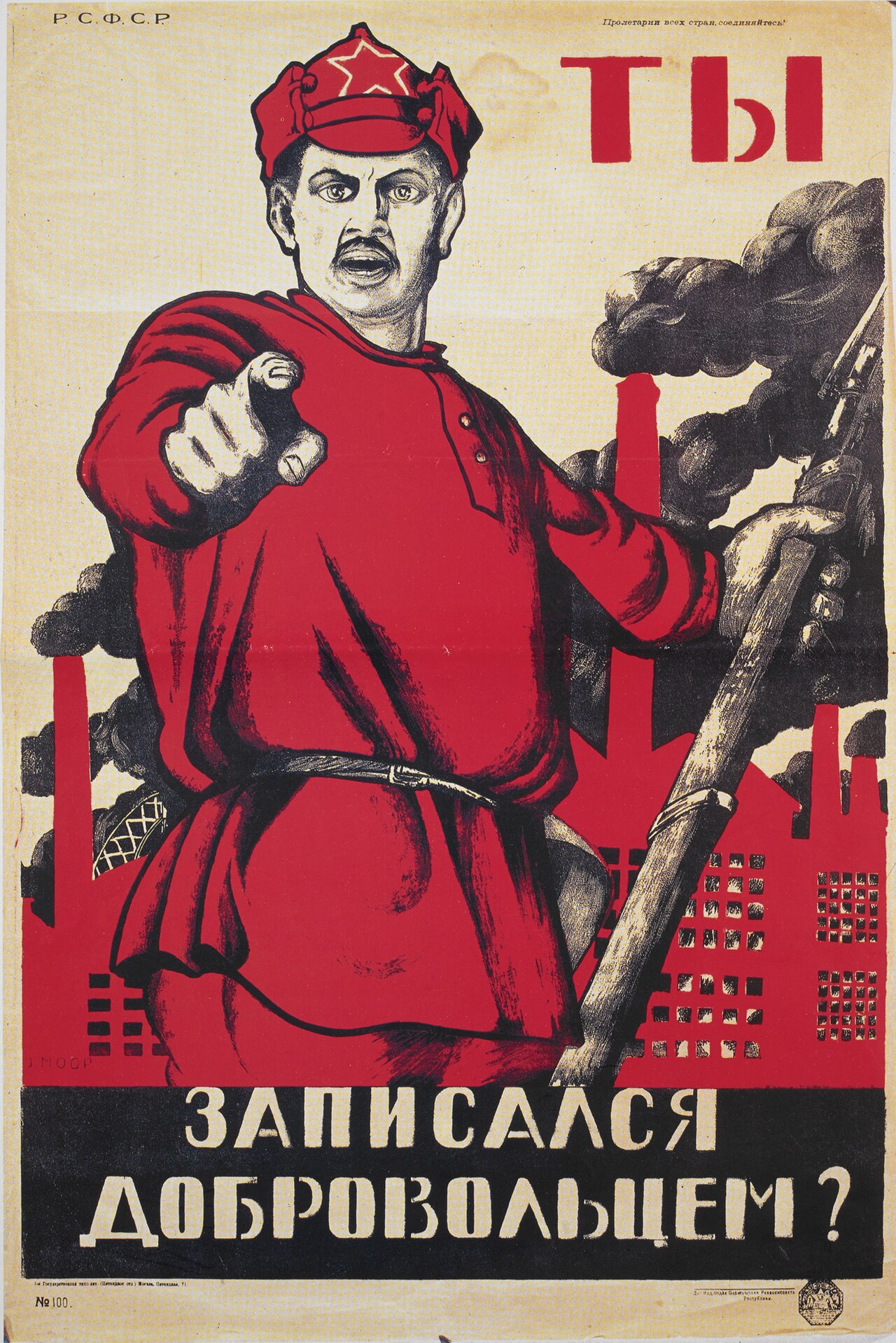
- Describe. A Red Army soldier strides forward and points at the viewer. Printed: "Have YOU volunteered?", "R.S.F.S.R." and "Proletarians of all countries, unite!", and "No. 100".
- Issued by. The Russian Soviet Federative Socialist Republic, for Red Army recruitment; the artist is Dmitry Moor.
- When and where. June 1920, during the Russian Civil War, in the RSFSR.
Show all 8Show fewer
- For. The domestic public.
- Asks. Volunteer for the Red Army.
- Carried by. The pointing figure and the direct question "you".
- Technique. Transfer, per the archive's entry. The entry reads the uniformed figure's accusing gaze as putting the burden of proof on the viewer rather than the state.
- Missing. No term of service or risk is stated, and no address for enlisting is legible in the transcription.
Explain moreShow less
Same-standard check: the entry records the direct-address pose as comparable to recruiting posters from other belligerents, and the recruiting posters page sets Moor's sheet beside the U.S. Army poster of 1917. Run both through the same table before comparing their regimes.
Practice set
Use the blank copy below for each. The teacher key follows. All ten come from the collection.
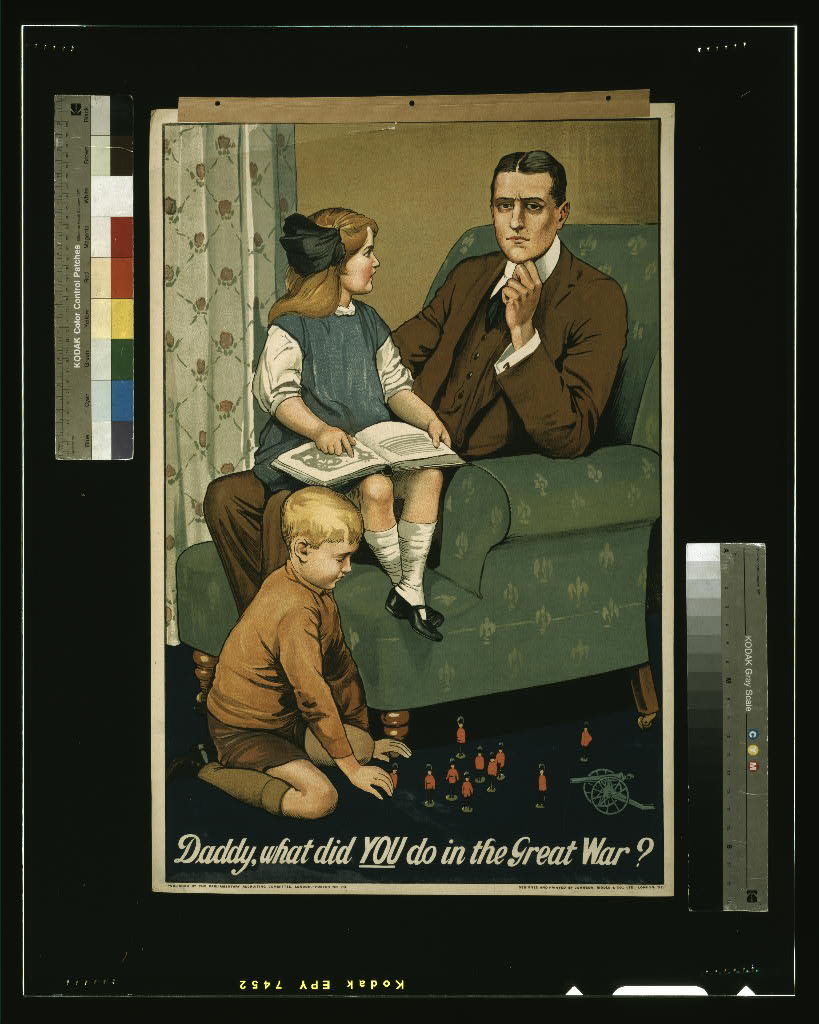
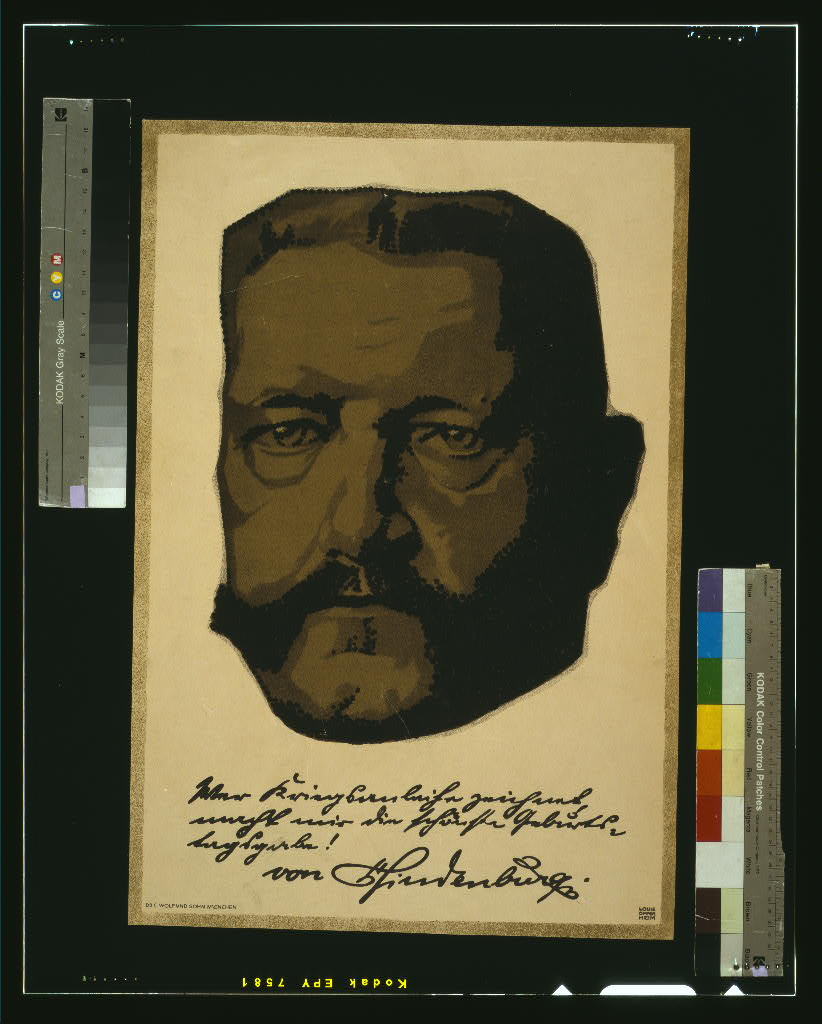
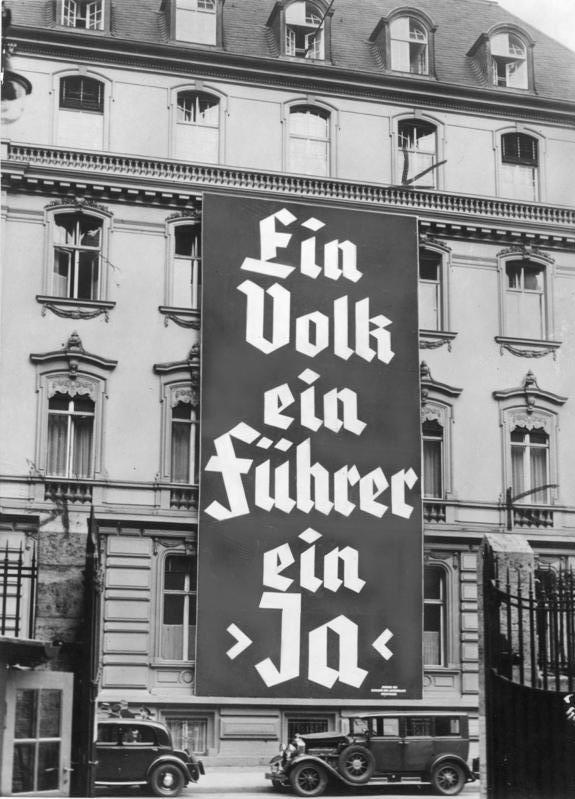
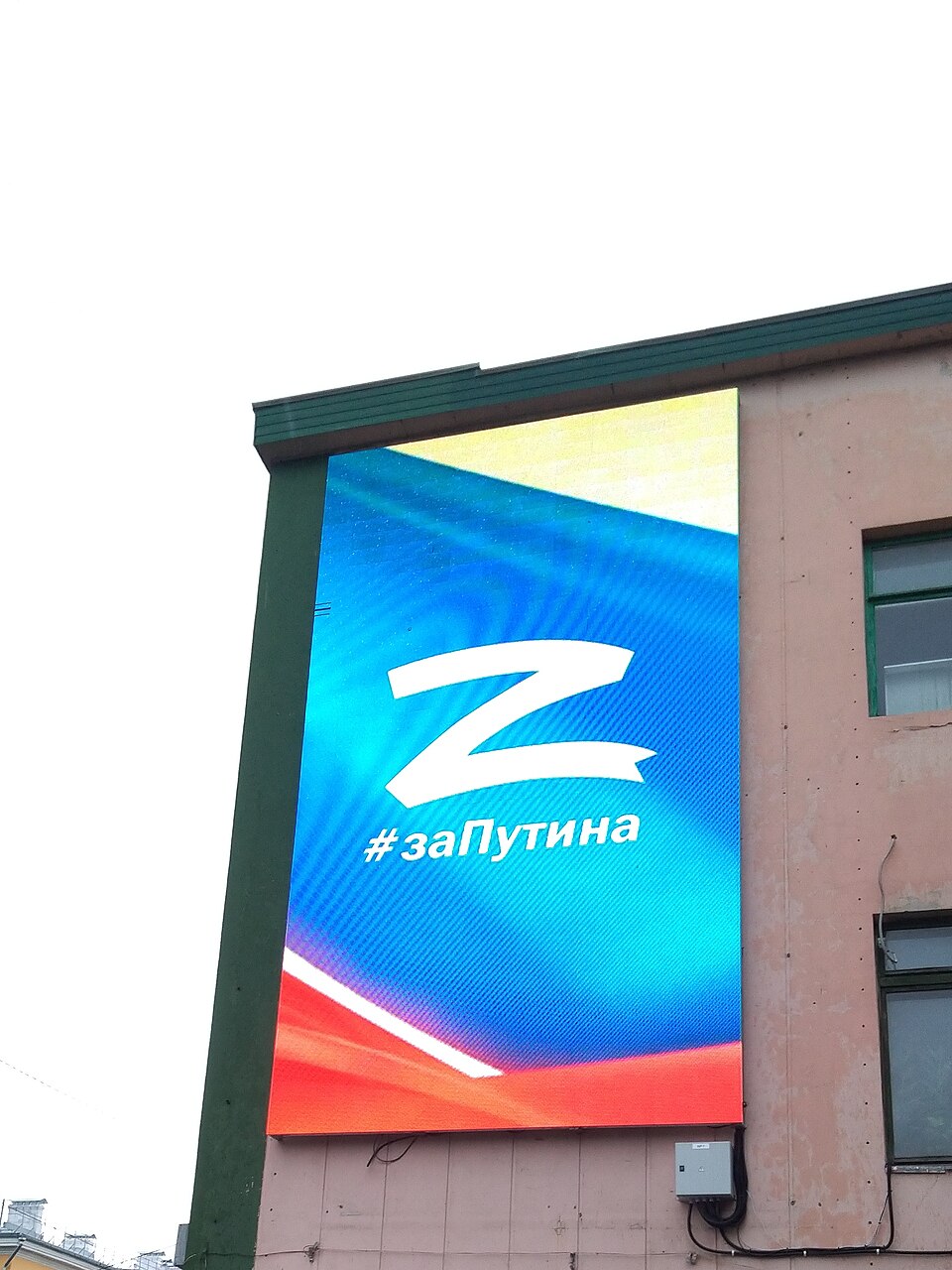

Explain moreShow less
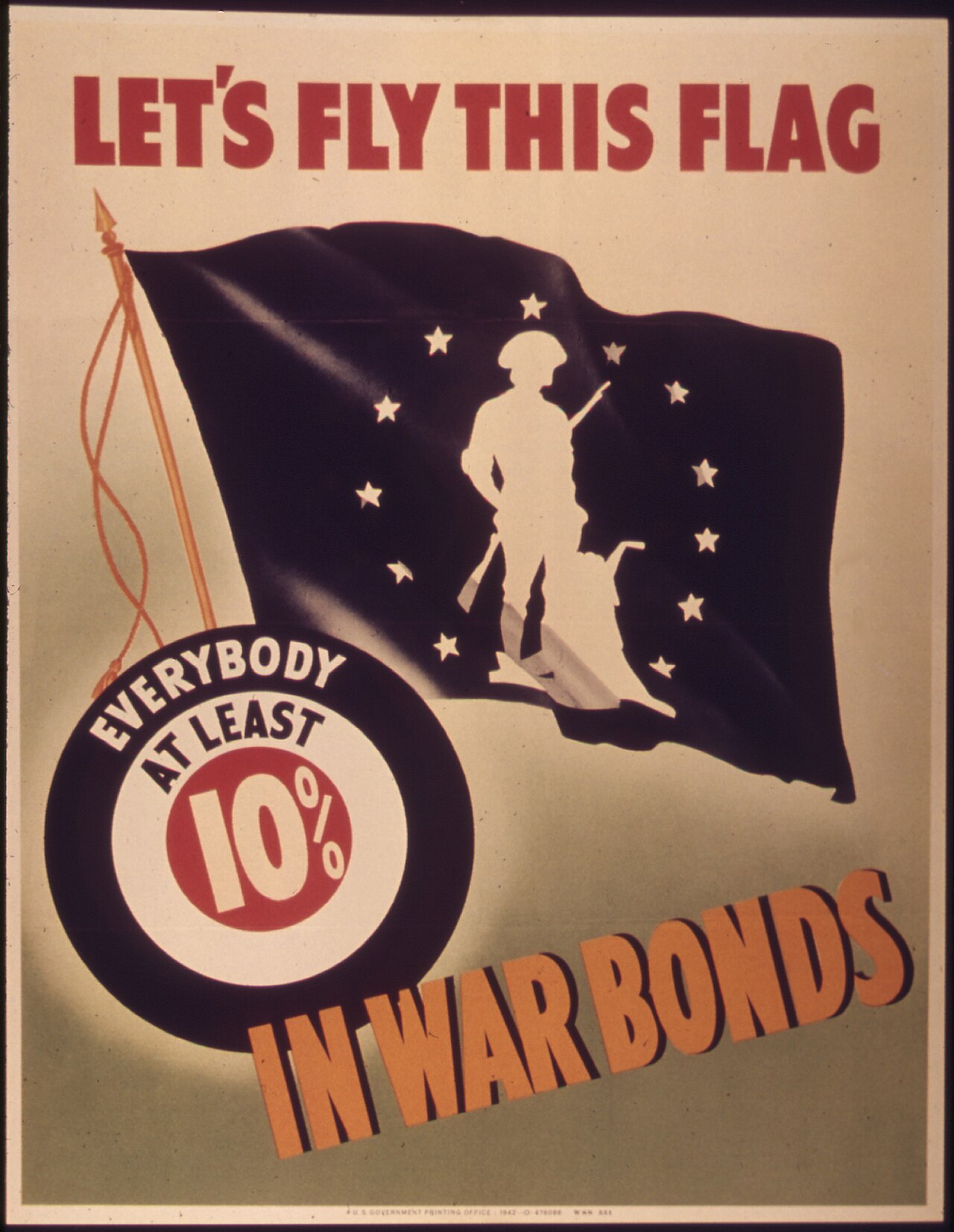
A. United States Treasury Department, 1943. A workplace poster.
B. Parliamentary Recruiting Committee, United Kingdom, 1915; artist Savile Lumley.
C. Imperial German war-loan campaign, 1917.
D. Banner by the National Socialist German Workers' Party, Berlin, November 1933.
E. LED billboard, operator not identified, Russia, 2022.
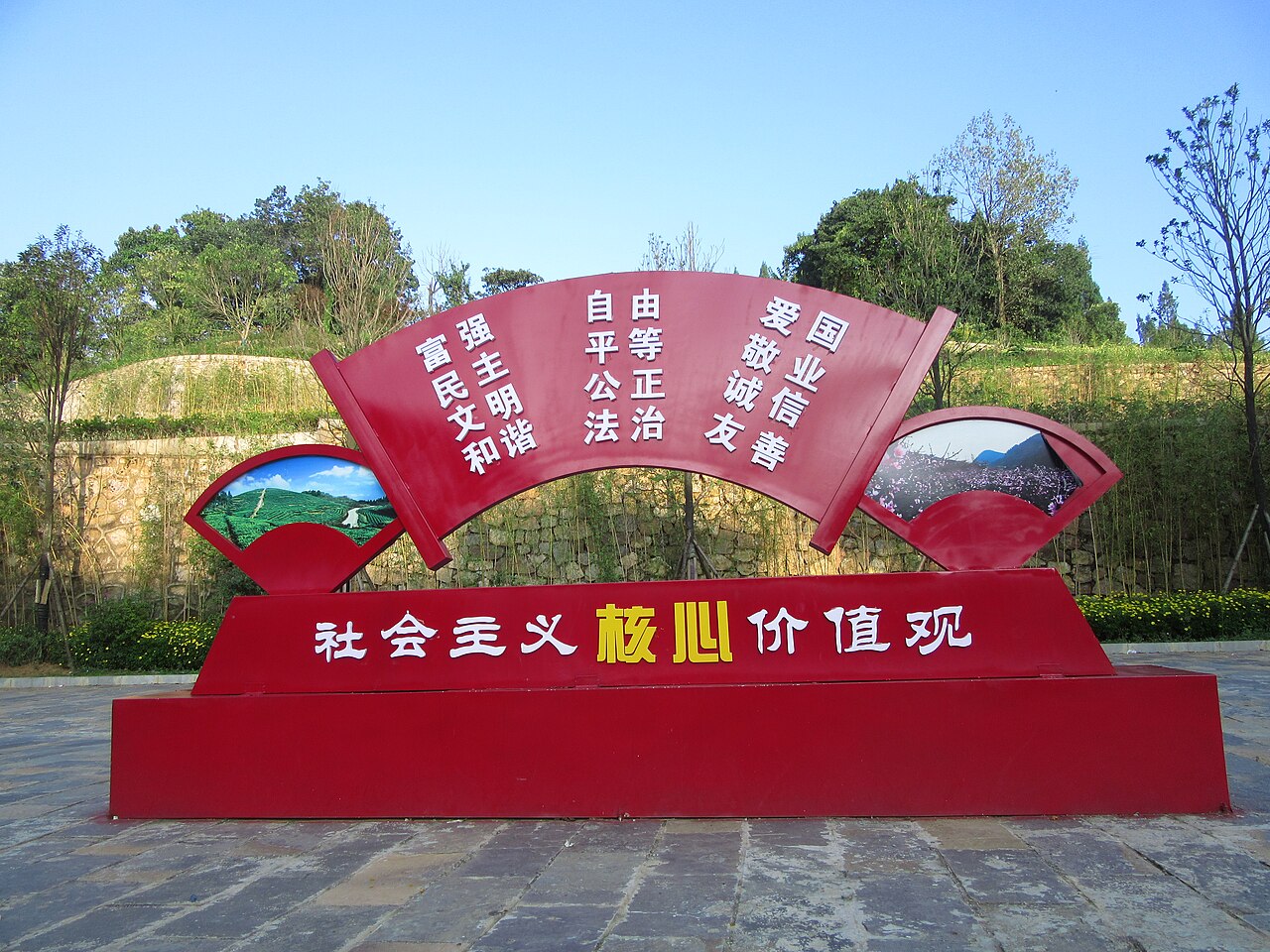
F. Billboard in Puding County, Guizhou, China, 2020.
G. Westinghouse Electric and the War Production Co-ordinating Committee, 1943.
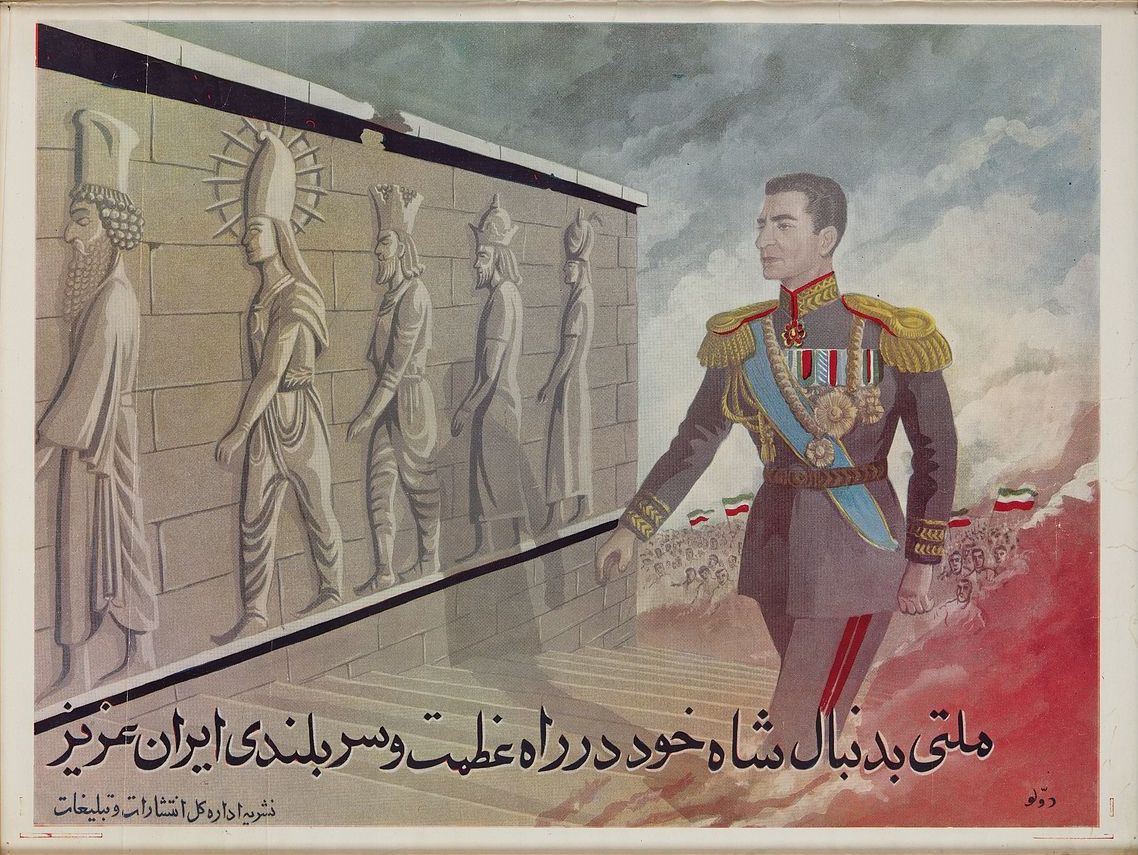
H. General Directorate of Publications and Propaganda, Imperial Iran, about 1965.
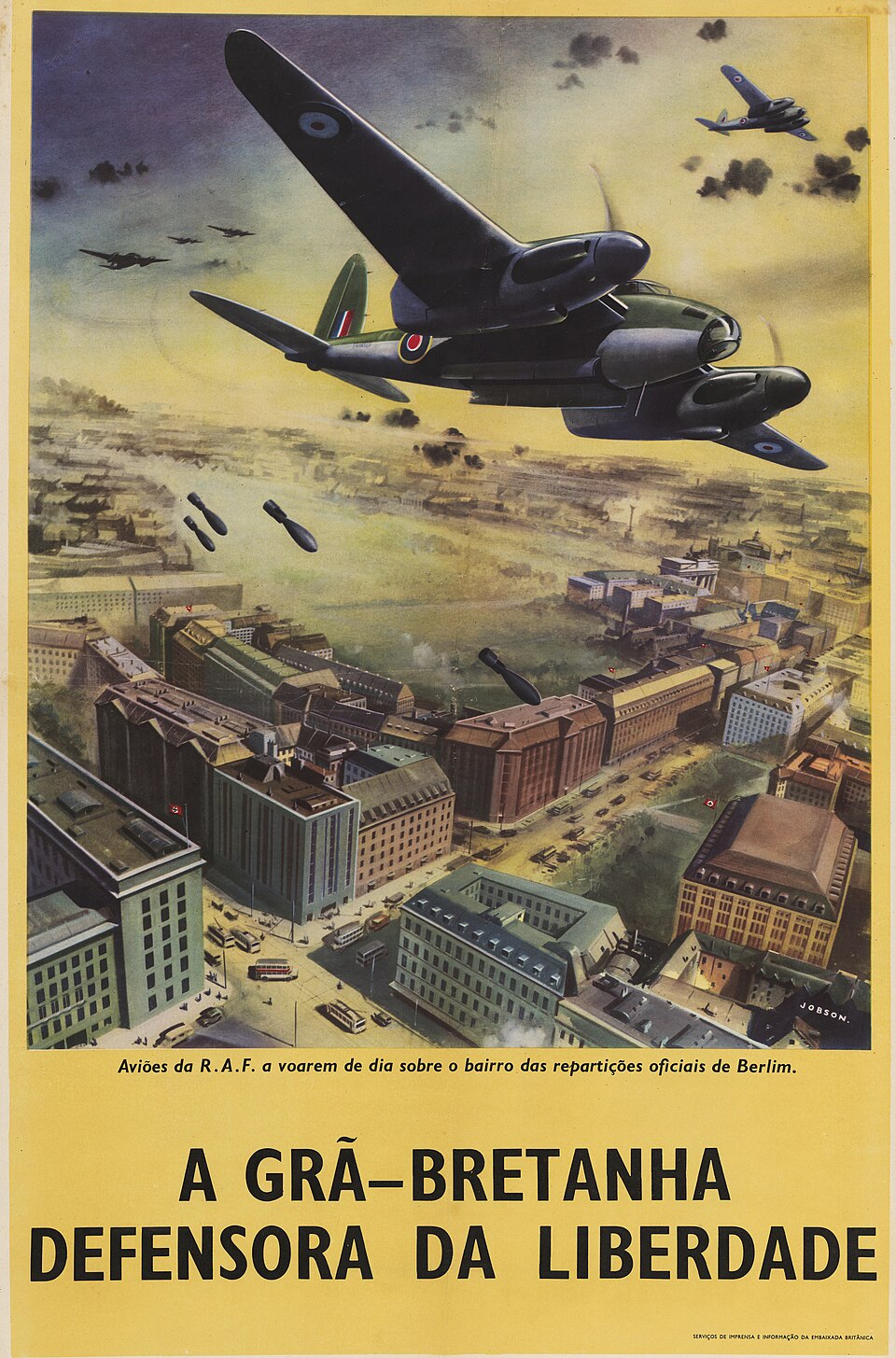
I. British Embassy Press and Information Services, in Portuguese, 1942.
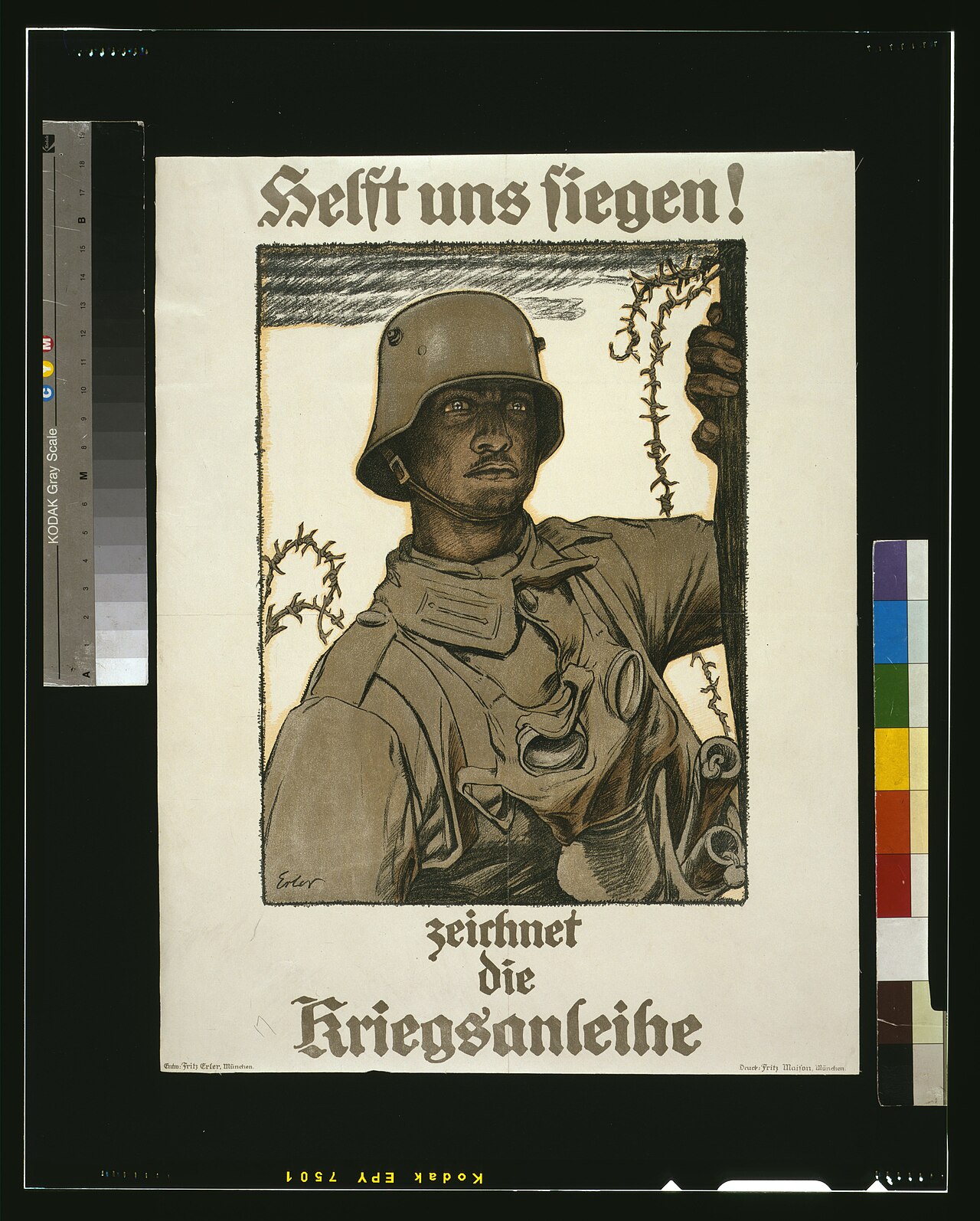
J. Imperial German war-bond campaign, 1917; artist Fritz Erler.
Teacher key (the archive's own technique tags).
| Poster | Tag |
|---|---|
| A | Bandwagon |
| B | Fear appeal, appeal to emotion |
| C | Testimonial |
| D | Identity fusion, demagoguery |
| E | Identity fusion |
| F | Glittering generalities |
| G | Glittering generalities, plain folks |
| H | Transfer, glittering generalities |
| I | Glittering generalities |
| J | Fear appeal, transfer, glittering generalities |
A tag is the archive's reading, not the only defensible one. Accept a different technique if the student quotes the tell.
Counts and sources
The collection holds 6,705 entries, of which 5,137 are posters carrying 69 distinct country values (counted from the entry files in examples/entries/). Posters tagged with at least one of the ten techniques here: transfer 2,023, glittering generalities 1,350, card stacking 1,144, fear appeal 1,068, plain folks 800, testimonial 554, name-calling 521, bandwagon 394, identity fusion 196 and scapegoating 70. For more to practise on, see propaganda posters and propaganda examples. Images come from the Library of Congress, Wikimedia Commons and the holders named on each object page.
Blank copy
``` PROPAGANDA POSTER ANALYSIS Name: __ Date: _ Poster: _______
Explain moreShow less
- Describe (what you see and every word printed):
- Who issued it? ____
- When and where? _________
- Who was it for? ____
- What does it ask (one sentence)?
- Which words or images carry the ask?
- Which technique? __ Quote the tell: ____ Cover test: with the symbol/number/label covered, is an argument left? Y / N
- What is missing, and what would you check?
Same-standard check: Would I give the same label if the other side had issued it? Y / N Why: _____ ```