Also called False dichotomy, Either/or fallacy, Black-and-white fallacy, With us or against us
Present two options as the only ones, so rejecting one forces acceptance of the other.
How to spot False dilemma: the tell
'With us or against us'; middle positions and third options are absent though they exist.
What False dilemma is not
A choice that really is binary, such as a yes-or-no ballot question.
History and effect of False dilemma propaganda
The either/or form is older than the name. Two sayings attributed to Jesus in the Gospels point in opposite directions: "He that is not with me is against me" (Matthew 12:30) and "he that is not against us is on our part" (Mark 9:40). The first draws a line with no middle; the second leaves room for one. Both were quoted for centuries by people with causes of their own. Logic textbooks later named the fault: a disjunction ("A or B") offered as exhaustive when it is not.
Explain moreShow less
In propaganda the form is common wherever a government wants an action it cannot easily justify on the merits: enlistment, a bond purchase, a vote, a surrender. A sharp two-way choice does three things. It removes the option of doing nothing or doing less. It attaches the speaker's preferred option to a good (safety, honour, liberty) and the other to a harm (bondage, death, disgrace). And it makes hesitation look like taking a side. The emotional effect is pressure: the listener is told that time and choice are short, and often that the cost of the wrong answer falls on family or country.
Lineage: Informal logic (false dichotomy, either/or fallacy)
How False dilemma propaganda works
- Name two options. Usually the speaker's own and one the audience already fears.
- Make them exhaustive. Words such as "or", "either", "only", "now or never" and "take your choice" close the set.
- Load the sides. The favoured option gets the flag, the family, the future. The other gets the chain, the enemy, the ruin.
Show all 4Show fewer
- Treat the middle as a choice for the enemy. Doubt, delay, a partial contribution or a different cause is counted as the second option.
Explain moreShow less
False dilemmas usually travel with Fear appeal, because the second option has to be frightening to hold the audience, and with Card stacking, because the options that are missing are the ones the audience would have to be told about.
Why False dilemma propaganda works
A shortlist is easier to decide on than an open field, and under time pressure or fear people narrow their choices (Fear messaging). The loaded labels do emotional work before any reasoning starts (Affect heuristic). How a choice is framed changes which option feels like the loss (Framing effect). In-group loyalty also supplies the "us" and "them" that the form depends on (In-group favoritism).
False dilemma propaganda examples across eras and sides
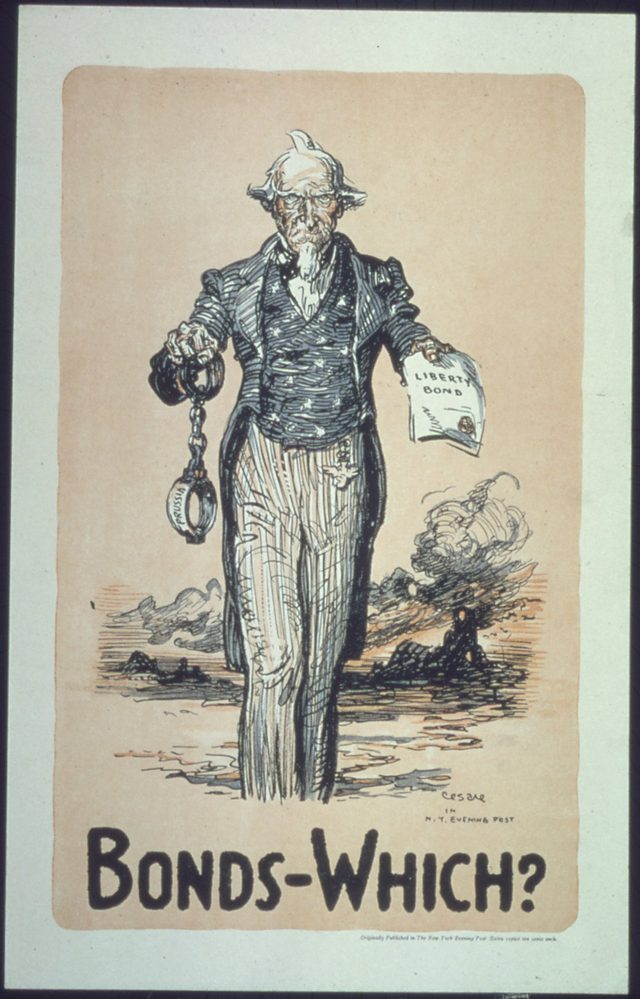
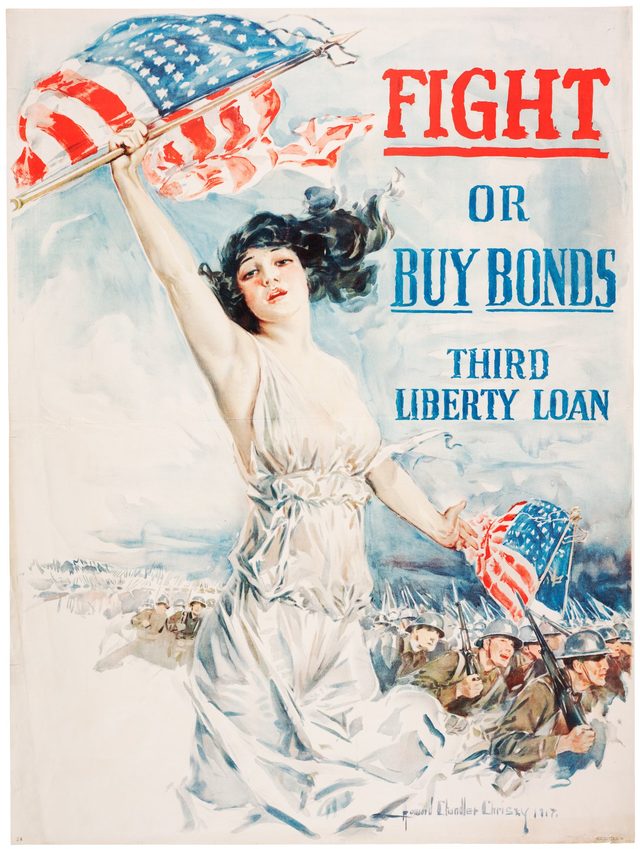
- United States, 1918. A cartoon by an artist signed "Cesare", first published in the New York Evening Post and later filed by the U.S. Food Administration, shows an elderly Uncle Sam holding open shackles labelled "Prussia" in one hand and a Liberty Bond booklet in the other, in front of a ruined landscape, under the caption "Bonds-Which?". Buying a bond and being shackled are presented as the only two outcomes. Other U.S. loan posters of the same year used the same shape: "Fight or Buy Bonds" and "Hun or Home?"
- Australia, 1918. Norman Lindsay drew a series of recruiting posters for the Commonwealth Government's last national campaign. One asks, "Will you fight now or wait for this", and shows German soldiers shooting a man against a corrugated-iron water tank in an Australian setting. The Australian War Memorial's own comment is that the suggestion of an invading German army was ludicrous. No German force reached Australia in the war. Australia's forces were volunteers: voters had rejected overseas conscription in referendums in October 1916 and December 1917. The poster offers enlistment as the only way to prevent an invasion that was not in prospect.
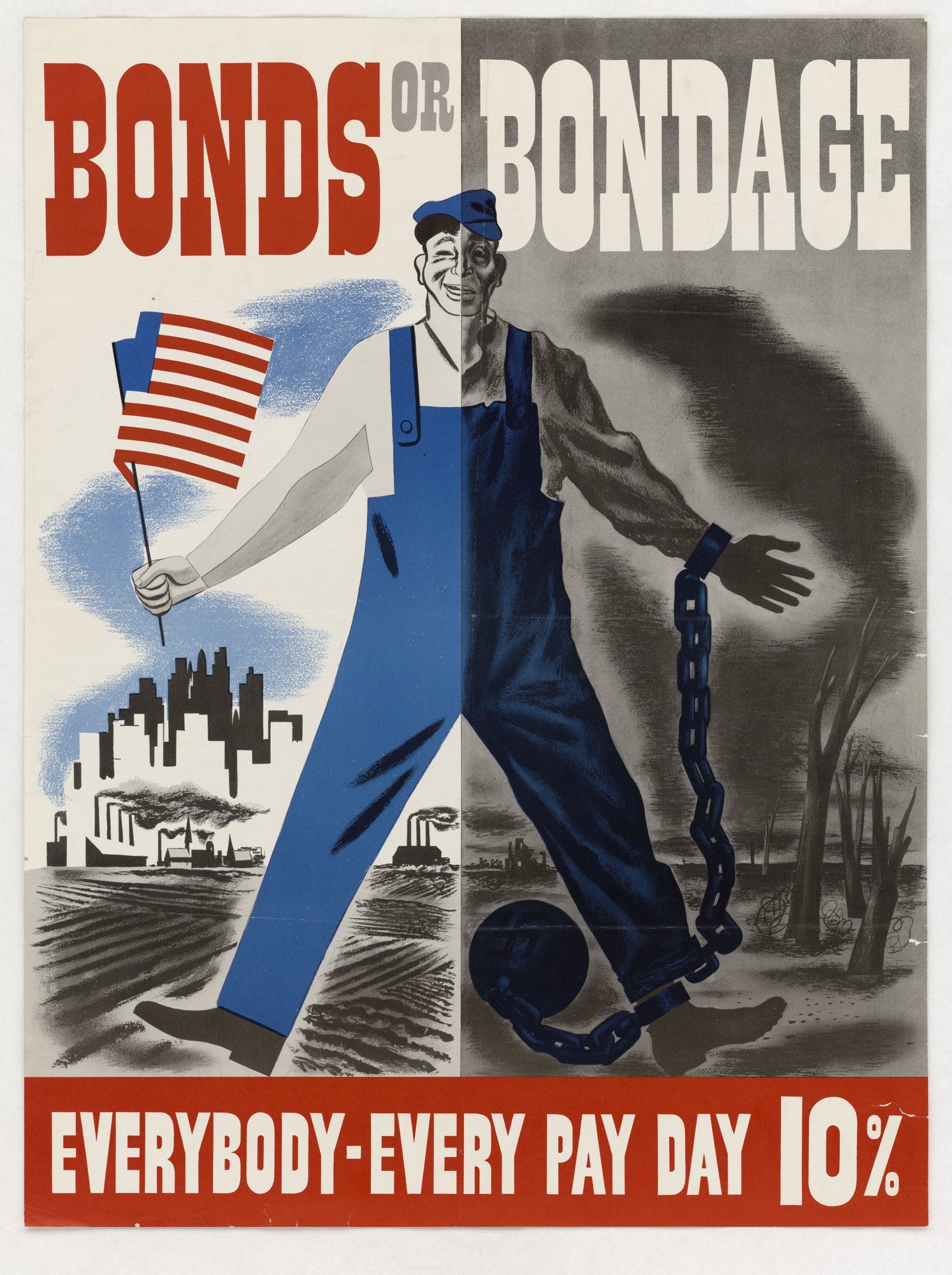
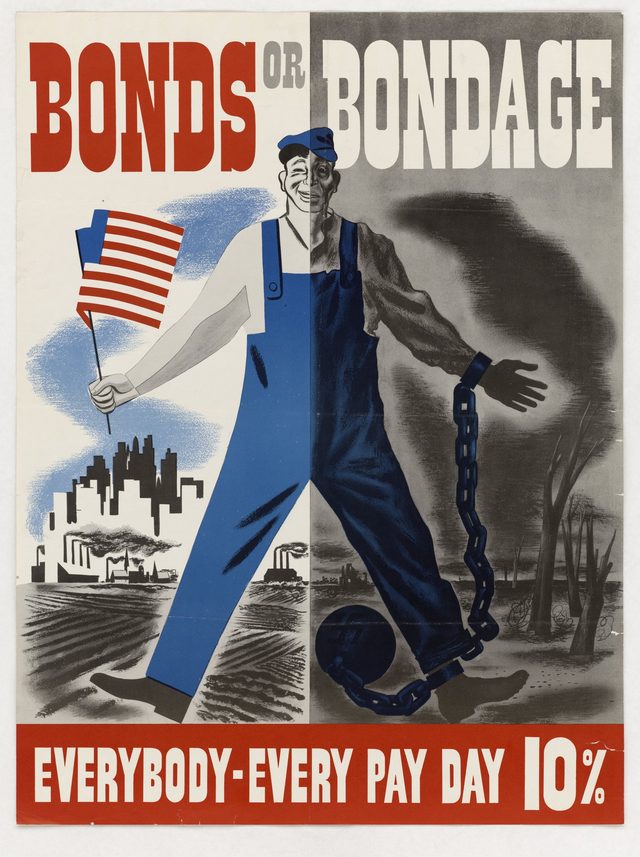
- United States, 1941 to 1945. "Bonds or bondage: Everybody, every pay day, 10%" splits a worker down the middle: smiling with a flag on one side, chained to a ball on the other. A 1943 Treasury poster sets "U.S. Bonds" against "Axis Bonds" with the line "Take your choice", showing the Axis leaders as caricatures leading chained captives. The posters make a savings decision the same thing as a stand against slavery.
Show all 6Show fewer
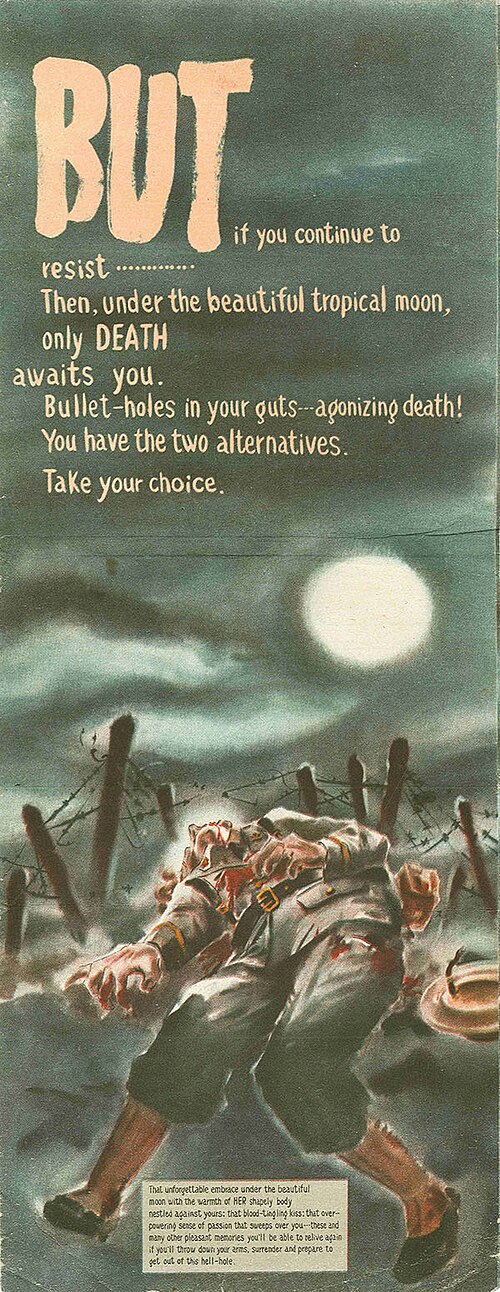
- Japan, 1942. A leaflet attributed to the Imperial Japanese Army and dropped on Australian troops reads: "BUT if you continue to resist... Then, under the beautiful tropical moon, only DEATH awaits you... You have the two alternatives. Take your choice." The other alternative, described in the smaller print, is a return to a woman's embrace if the reader will "throw down your arms, surrender". The leaflet shows a dismembered soldier. It is an ultimatum between death and surrender with no third course shown. Content note: graphic image of a dead soldier and sexual appeal, shown as it was dropped.
- United States, 2001. In his address to a joint session of Congress on 20 September 2001, nine days after the attacks of 11 September, President George W. Bush told other governments: "Every nation, in every region, now has a decision to make. Either you are with us, or you are with the terrorists." This is a policy statement addressed to states, not a poster to individuals, and the demand that governments take a side in a coalition formed after the attacks was a real one. The tell is the form: governments with other positions (neutrality, help on some points but not others, opposition to particular methods) are placed in the second camp by the sentence itself.
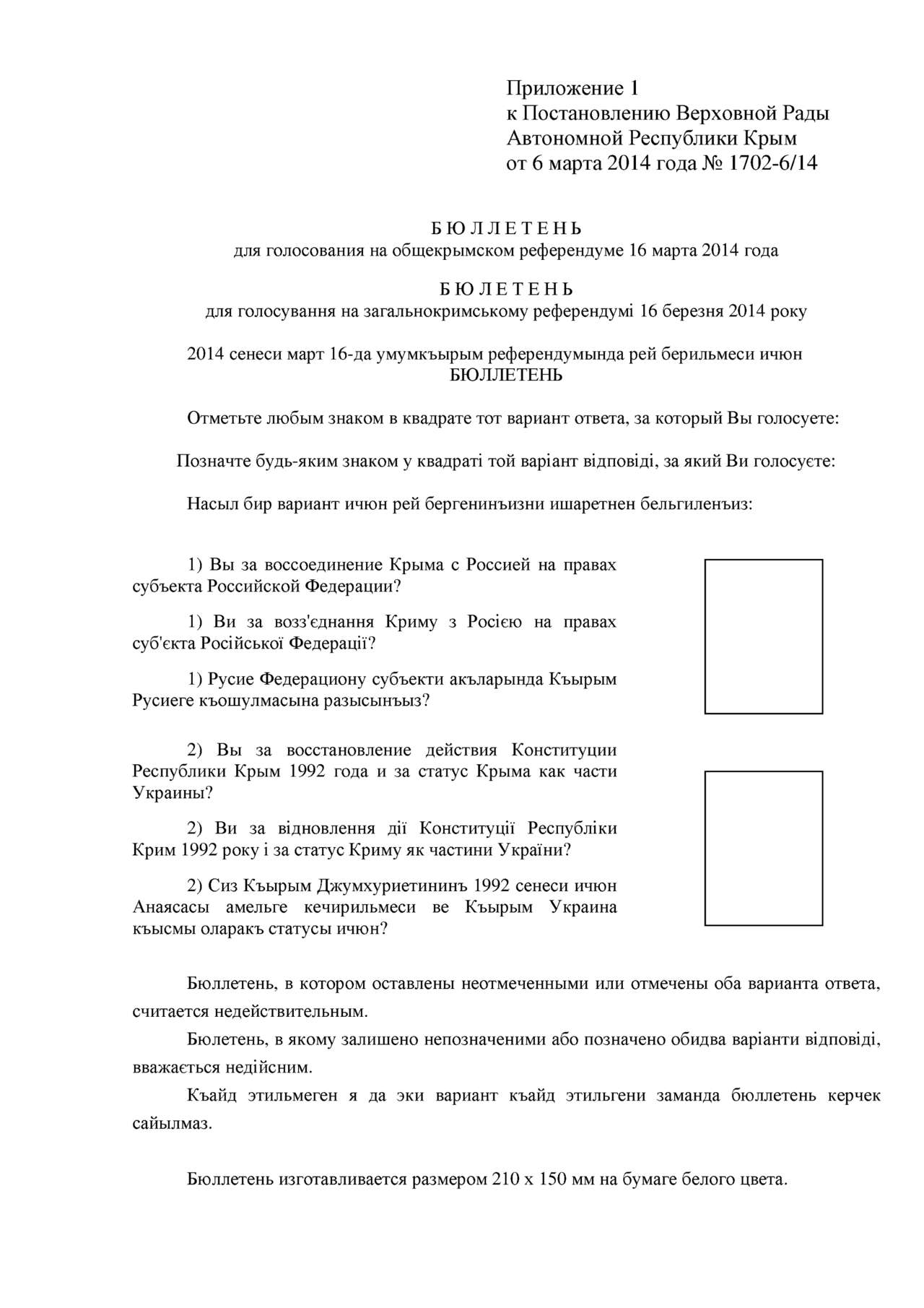
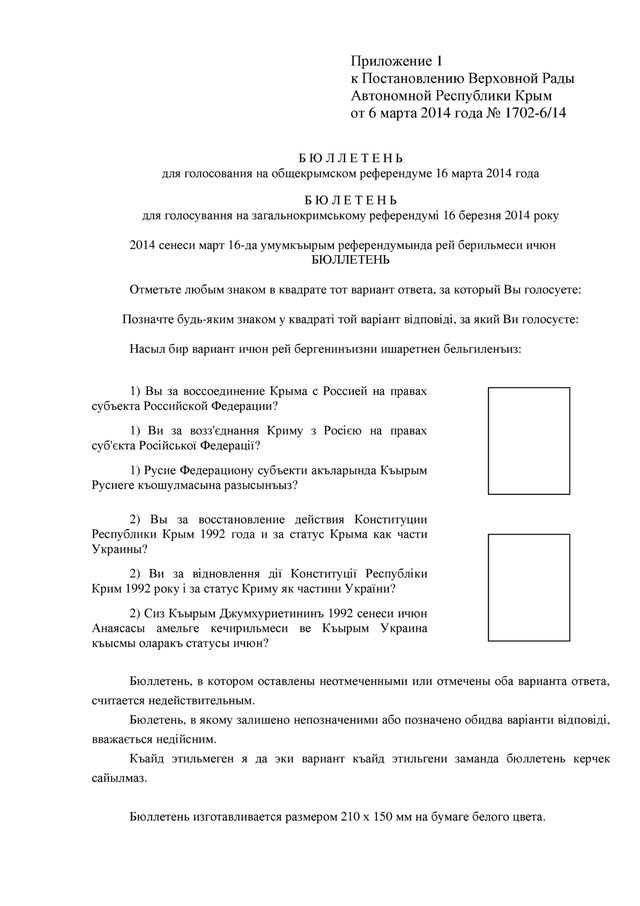
- Crimea, 2014. The Supreme Council of Crimea's resolution of 6 March 2014 annexed a ballot for the referendum of 16 March with two questions: reunification with Russia as a federal subject, or restoring the 1992 Crimean constitution and Crimea's status as part of Ukraine. A ballot with both marked, or neither, was invalid. Neither option was the constitutional arrangement then in force, and there was no way to vote for it. The organisers and Russian officials rested the vote on the right of peoples to self-determination; Ukraine's authorities called it unconstitutional. The Venice Commission's opinion of 21 March 2014 (CDL-AD(2014)002) examined whether the decision met constitutional principles, and UN General Assembly resolution 68/262 of 27 March 2014 (100 in favour, 11 against, 58 abstentions) called the referendum invalid. The Russian representative at the UN said the vote reunited Crimea with Russia and called on everyone to respect "that voluntary choice". This page documents the ballot's option set, not the result.
Content note: Invasion-atrocity imagery: German soldiers threatening civilians, a body on the ground and a burning building. This object is shown as it was published. Why 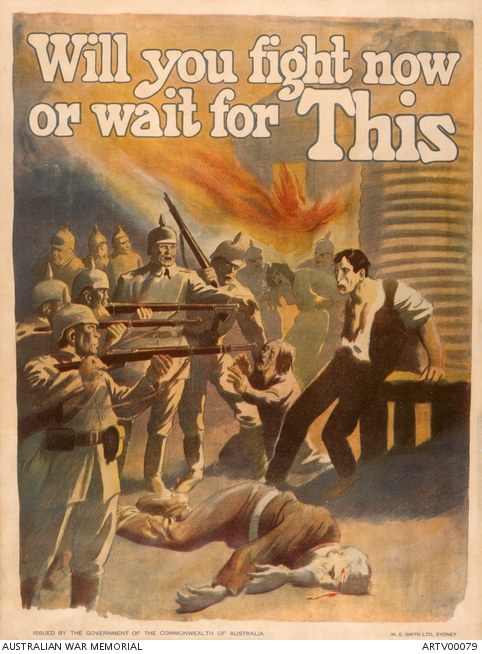
Explain moreShow less
"Bonds or bondage: Everybody, every pay day, 10%", U.S. government war bond campaign poster, 1941 to 1945 series (date not printed). National Archives and Records Administration, RG 44 (NAID 513577). Public domain (U.S. government work).
"Will you fight now or wait for this", Norman Lindsay, Government of the Commonwealth of Australia, W. E. Smith Ltd, Sydney, 1918. Australian War Memorial, ARTV00079. Public domain (copyright expired).
"BUT if you continue to resist...", leaflet attributed to the Imperial Japanese Army, 1942, Gessler collection, Duke University, via Wikimedia Commons. Public domain (PD-Art, PD-Japan-organization). Graphic content: shown as it was dropped.
Sample ballot annexed to resolution no. 1702-6/14 of the Supreme Council of the Autonomous Republic of Crimea, 6 March 2014, via Wikimedia Commons. Public domain (PD-UA-exempt, official act of a Ukrainian state body).
How to spot False dilemma propaganda
- Count the options and ask who set them. If the set was chosen by the party that wants one of them, test it.
- Look for the missing third. Delay, a partial step, a different remedy, neutrality, doing nothing: is any of it mentioned?
- Watch the labels. When one side is a flag and the other is a chain, the choice has already been made for you.
Show all 5Show fewer
- Look for the clock. "Now or never" and "every pay day" are there to stop the question "are there other ways?"
- Ask what the second option actually is. In the 1918 Australian poster it was an invasion that was not coming. In the 1942 leaflet it was the reader's own death.
Where False dilemma propaganda ends: edge cases and legitimate persuasion
Some choices really are binary.
Some choices really are binary. A yes-or-no ballot question, a verdict, a medical consent form or a bridge that either holds or does not are binary by design, and describing them so is not a false dilemma. Nor is an ultimatum: a surrender demand that truly offers only two outcomes is a threat, not a mistaken disjunction, though it may still be propaganda in other respects. Wartime coalitions also impose real binaries, as when a state must allow or refuse passage. The technique starts when a third option exists and is hidden or priced out of reach. A ballot is a good test case: the form is binary, so the question is whether the options offered cover what the voters actually hold.
Sources
- "Bonds-Which?", cartoon signed "Cesare", New York Evening Post, c. 1918, National Archives, RG 4, U.S. Food Administration (NAID 512629): catalog.archives.gov/id/512629.
- "Bonds or bondage: Everybody, every pay day, 10%", U.S. government war bond campaign, National Archives, RG 44 (NAID 513577): catalog.archives.gov/id/513577.
- "U.S. Bonds. Axis Bonds. Take Your Choice", U.S. Department of the Treasury, 1943, National Archives (NAID 534047), via Wikimedia Commons: commons.wikimedia.org.
- Norman Lindsay, "Will you fight now or wait for this", 1918, Australian War Memorial, ARTV00079: awm.gov.au/collection/ARTV00079.
- "BUT if you continue to resist...", Japanese leaflet to Australian troops, 1942, Wikimedia Commons (Gessler collection, Duke University): commons.wikimedia.org.
- George W. Bush, "Address to a Joint Session of Congress and the American People", 20 September 2001, White House archive: georgewbush-whitehouse.archives.gov/news/releases/2001/09/text/20010920-8.html.
- Supreme Council of the Autonomous Republic of Crimea, resolution no. 1702-6/14 of 6 March 2014, annex 1 (sample ballot), via Wikimedia Commons: commons.wikimedia.org.
- Venice Commission, opinion CDL-AD(2014)002, 21 March 2014: coe.int/en/web/venice-commission/-/CDL-AD(2014)002-e.
- United Nations, General Assembly meeting coverage on "Territorial integrity of Ukraine" (A/68/L.39), 27 March 2014: press.un.org/en/node/170363.
Sourcing note (7 October 2026): the Bush passage and the UN vote and Russian statement were read directly. The Venice Commission page loaded only its title and metadata, so its finding is taken from the archive entry for the ballot and should be checked against the full opinion. The Gospel verses are quoted from the King James text.
Sources and further reading
The science
Research on the psychology this technique relies on, from the Learn library:
Research on the psychology this technique relies on, from the Learn library:
- Fear messaging — Fear messaging
- Affect heuristic — Affect heuristic
- Framing effect — Framing effect
- In-group favoritism — In-group favoritism

.jpg)
