Emotion isn't the opposite of reason in politics. People act on what they care about, and caring is an emotion. Aristotle counted pathos as one of the three legitimate means of persuasion, alongside the speaker's character (ethos) and the argument (logos). The question isn't whether to use emotion but whether the feeling you raise fits the facts.
Do this
- Choose the emotion that fits the true situation. Fear for a real, likely threat. Hope for a real, achievable fix. Anger for a real, documented wrong. Pride for a real achievement.
- Pair fear with a way out. Every warning needs a specific, doable action and evidence that it works. Fear without a way out makes people tune out.
- Pair anger with a target that is responsible. A named decision, body or policy, with evidence. Never a whole group of people.
- Give hope a date and a number. "Buses every ten minutes from next September" is hope people can hold you to.
- Match the dose to the facts. Describe the size and likelihood of the harm honestly. If you need to exaggerate to get the reaction, the reaction isn't warranted.
What the research says
Fear works when people feel able to act. Witte's Extended Parallel Process Model (1992) predicts that a fear appeal changes behaviour when people see both a serious threat and an effective response they can carry out. When the threat is high and efficacy low, people control their fear instead, by dismissing the message. A meta-analysis by Tannenbaum et al. (2015) found fear appeals were effective on average, and more so when they recommended one-time behaviours and stated efficacy. See Fear messaging.
Anxiety makes people look for information; enthusiasm mobilises. Affective intelligence theory (Marcus, Neuman & MacKuen, 2000) found that anxiety about a candidate or issue led voters to pay more attention and rely less on habit, while enthusiasm led them to participate. Valentino et al. (2011) found anger in particular drove political participation. See Hope appeals and Emotion and fear.
Moral and emotional words spread faster online. Brady et al. (2017) found each moral-emotional word in a tweet on contested issues was associated with about a 20% increase in retweets, mostly within the sender's own political group. Berger & Milkman (2012) found high-arousal emotions (awe, anger, anxiety) made news articles more likely to be shared than low-arousal ones like sadness. See Moral outrage and Emotional contagion. This is a strong effect, and it rewards outrage whoever uses it.
Negative information gets more weight. People attend to threats and losses more than to gains of the same size (Negativity bias). That's why attack messages get noticed, and why they so easily slide into distortion.
Worked examples: real campaigns
Paired so each emotion appears on more than one side. Most are from the US, where the research record on campaign ads is deepest; Chile and the UK are included, and more non-US examples are wanted.
- Fear, Democratic, US, 1964. Lyndon Johnson's "Daisy" ad showed a girl counting petals before a nuclear countdown and explosion, with the line "Vote for President Johnson on November 3. The stakes are too high for you to stay home." It aired once as a paid spot. It never named Barry Goldwater, but implied he would risk nuclear war; the Goldwater campaign protested, and it never ran again as a paid ad.

Peace, Little Girl ("Daisy"). A frame from the Johnson campaign's "Peace, Little Girl" ("Daisy") advertisement, first broadcast 7 September 1964. Public domain (published without a copyright notice, per Wikimedia Commons).
- Fear, Republican-aligned, US, 1988. An independent committee, the National Security Political Action Committee, ran "Weekend Passes" about Willie Horton, a prisoner who committed violent crimes while on a furlough from a Massachusetts programme, and the Bush campaign ran the related "Revolving Door" ad against Michael Dukakis. Mendelberg (2001) analyses how the Horton imagery worked through racial fear.
- The same standard for both. Jamieson (1996) analyses "Daisy" and the 1988 ads alike as fear appeals whose implications went beyond what they stated or documented: about Goldwater and nuclear war in 1964, about Dukakis and crime in 1988.
- Anger, right-populist, US, 2009. Tea Party protests adopted "Taxed Enough Already" as a backronym for TEA, channelling anger at bailouts and spending.
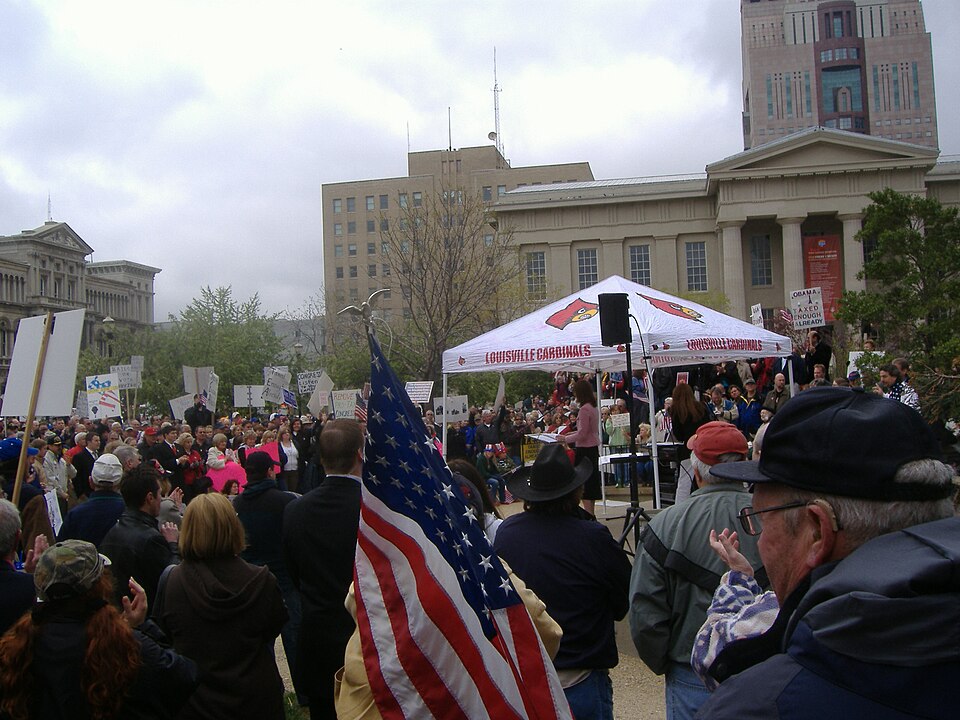
A Tax Day Tea Party rally across from Louisville Metro Hall, Louisville, Kentucky, 15 April 2009: a crowd with flags and hand-lettered signs around a speaker's tent. Photograph: C. Bedford Crenshaw. Attribution-only licence per Wikimedia Commons.
- Anger, left-populist, US, 2011. Occupy Wall Street's "We are the 99%" channelled anger at financial inequality after the 2008 crisis.
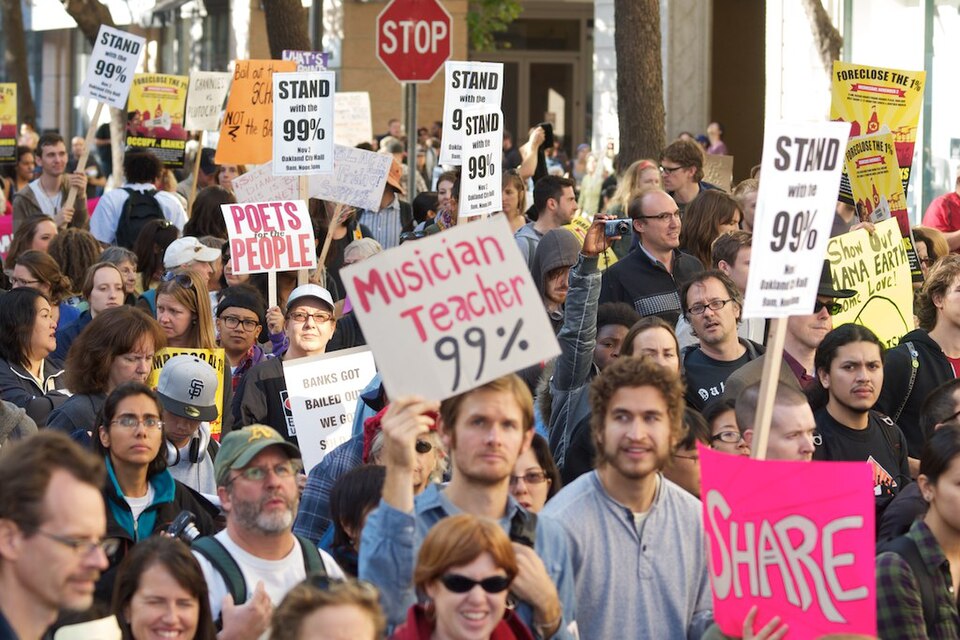
Protesters with "Stand with the 99%" signs at the Occupy Oakland general strike, Oakland, California, 2 November 2011. Photograph: Brian Sims. CC BY 2.0. - Hope and pride, Republican, US, 1984. Reagan's "Prouder, Stronger, Better" ("It's morning again in America").
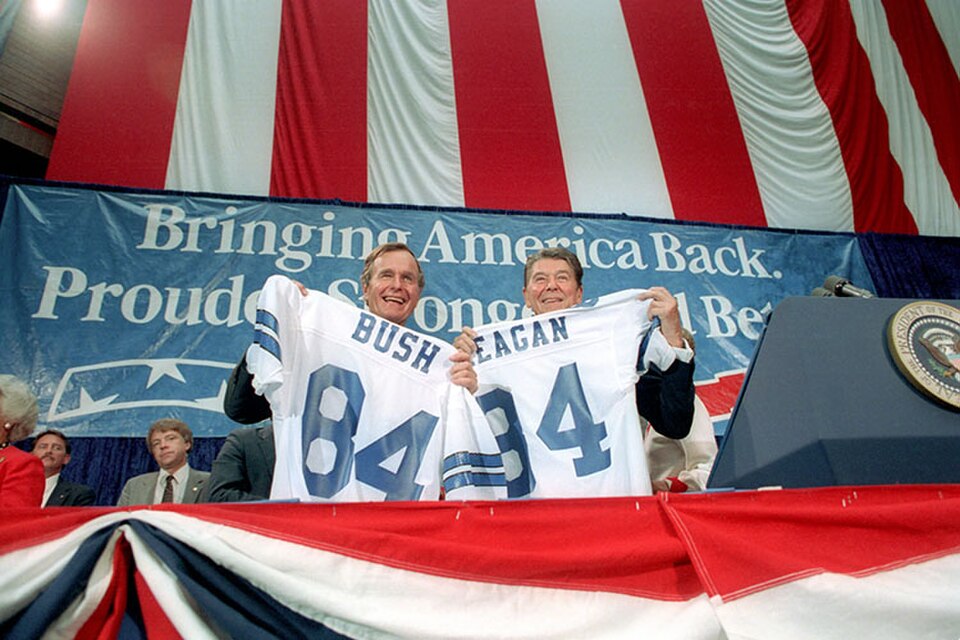
President Ronald Reagan and Vice President George H. W. Bush holding jerseys numbered 84 at a welcoming rally in Dallas, Texas, 22 August 1984, in front of a banner reading "Bringing America Back. Prouder, Stronger, Better." Photograph: Ronald Reagan Presidential Library. Public domain (US federal government work). - Hope, Democratic, US, 2008. Obama's campaign built around "Hope" and "Change we can believe in". - Hope against fear, Chile, 1988. In the plebiscite on extending Augusto Pinochet's military rule, the "No" campaign's television spots were built around the jingle "Chile, la alegría ya viene" (Chile, joy is coming), choosing optimism over a catalogue of the government's abuses. The "Sí" campaign stressed stability and warned of a return to what it called the turmoil before the 1973 coup. "No" won with about 56% of the vote. - Contrast, UK Conservatives, 1978–79. The Saatchi & Saatchi poster "Labour Isn't Working" showed a long dole queue (staged, using Conservative volunteers), turning unemployment figures into an image of frustration.
Worked example: you applying it
Invented case: Riverton's Measure 12, a half-cent sales tax for buses every ten minutes.
| For | Against | |
|---|---|---|
| Emotion | Hope, with a date. | Worry, with a way out. |
| Line | "From next September, the bus is there before you are. Yes on 12." | "Three shops closed on Main Street last year. Don't make it harder for the rest. No on 12, and fund buses from the county grant." |
| Threat, honestly sized | (none needed) | Three closures is the real count; the piece doesn't claim "Main Street is dying". |
| Efficacy | One vote, one date. | A named alternative and a meeting to attend. |
Where it crosses the line
- Catastrophe plus a single remedy, with no base rates or alternatives, is Fear appeal in the archive's sense.
- Fury as the product, with a thin factual body, is Outrage bait.
- Blaming a whole group of people for a complex harm is Scapegoating, and appeals to disgust at groups of people are a documented step toward Dehumanization (see Disgust).
- Raising fear of a threat you know is minor, or inventing one, is disinformation.
Go deeper
- Fear messaging, Hope appeals, Moral outrage, Negativity bias, Nostalgia, Affect heuristic
- Next chapter: Evidence and credibility
Sources
- Aristotle, Rhetoric, Book I, ch. 2.
- Witte, K. (1992). Putting the fear back into fear appeals: The extended parallel process model. Communication Monographs, 59(4), 329–349.
- Tannenbaum, M. B. et al. (2015). Appealing to fear: A meta-analysis of fear appeal effectiveness and theories. Psychological Bulletin, 141(6), 1178–1204.
- Marcus, G. E., Neuman, W. R. & MacKuen, M. (2000). Affective Intelligence and Political Judgment. University of Chicago Press.
- Valentino, N. A. et al. (2011). Election night's alright for fighting: The role of emotions in political participation. Journal of Politics, 73(1), 156–170.
- Brady, W. J., Wills, J. A., Jost, J. T., Tucker, J. A. & Van Bavel, J. J. (2017). Emotion shapes the diffusion of moralized content in social networks. PNAS, 114(28), 7313–7318.
- Berger, J. & Milkman, K. L. (2012). What makes online content viral? Journal of Marketing Research, 49(2), 192–205.
- Mendelberg, T. (2001). The Race Card: Campaign Strategy, Implicit Messages, and the Norm of Equality. Princeton University Press.
- Collier, S. & Sater, W. F. (2004). A History of Chile, 1808–2002, 2nd ed. Cambridge University Press (on the 1988 plebiscite campaigns).
- Jamieson, K. H. (1996). Packaging the Presidency, 3rd ed. Oxford University Press (on "Daisy", 1964, and the 1988 ads).
Images
| Image | Source | Licence |
|---|---|---|
| "Daisy" advertisement frame, 1964 | FRAME gallery, Peace, Little Girl ("Daisy") | Public domain (per Wikimedia Commons) |
| Reagan and Bush, Dallas, 1984 | Wikimedia Commons | Public domain (US government work) |
| Tea Party rally, Louisville, 2009 | Wikimedia Commons | Attribution-only (photographer's grant) |
| Occupy Oakland, 2011 | Wikimedia Commons | CC BY 2.0 |


