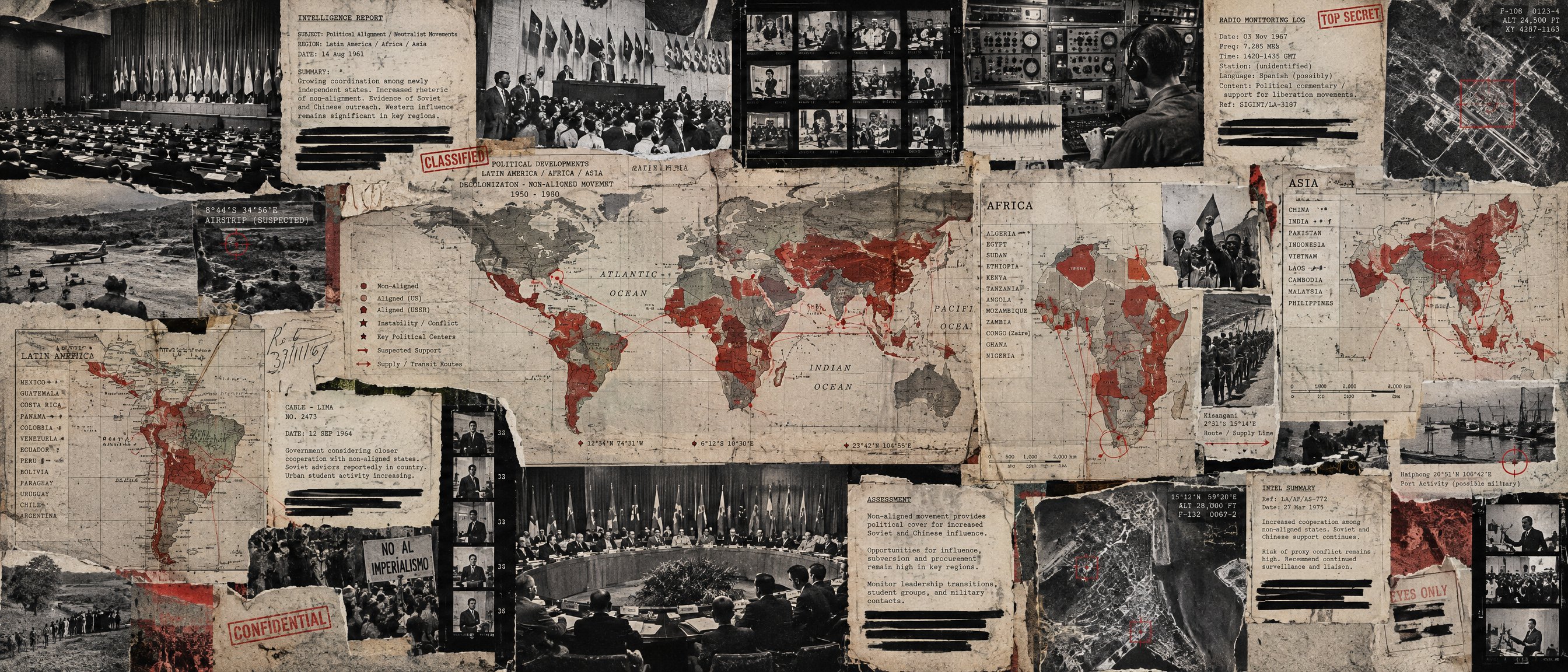
This folder holds two kinds of page.
The archive's own contract. Doctrine (working definition) says what this archive counts as propaganda, and Method (how to file) says how a brief or dossier is filed. Every brief, case study and caption is held to these two pages. They change only on an explicit maintainer pass.
The doctrines the archive studies. The other pages describe the theories, official doctrines and manuals behind propaganda: what each one says, who wrote or issued it, how it was put into practice, which techniques in this archive's taxonomy it names or describes, and how it has been received and criticised. They cover analysts and practitioners, democracies and one-party states, and the early twentieth century to the present, and they are written to the same standard throughout: the same headings, the same kinds of source and a same-standard note on each page.
These pages explain how each doctrine worked in full. They are not instructions for running an operation.
Theorists and critics
| Page | Author | First published | What it contributes |
|---|---|---|---|
| Walter Lippmann, Public Opinion (1922) | Walter Lippmann | 1922, United States | The "pseudo-environment", stereotypes and "the manufacture of consent" |
| Edward Bernays, Propaganda (1928) | Edward Bernays | 1923 and 1928, United States | Public relations as organised propaganda for business and government |
| Harold D. Lasswell, Propaganda Technique in the World War (1927) | Harold D. Lasswell | 1927, United States | Four objectives of wartime propaganda, compared across four belligerents |
| Arthur Ponsonby, Falsehood in War-Time (1928) | Arthur Ponsonby | 1928, United Kingdom | A catalogue of First World War falsehoods |
| Institute for Propaganda Analysis, How to Detect Propaganda (1937) | Institute for Propaganda Analysis | 1937, United States | The seven devices this archive's classical family descends from |
| Jacques Ellul, Propaganda: The Formation of Men's Attitudes (1962) | Jacques Ellul | 1962, France | Propaganda as a condition of mass society: agitation and integration |
| Edward S. Herman and Noam Chomsky, Manufacturing Consent (1988) | Edward S. Herman and Noam Chomsky | 1988, United States | Five structural filters on news media |
Official doctrines and manuals
| Page | Issuer | Period | What it contributes |
|---|---|---|---|
| Lenin and the Communist Party of the Soviet Union, the agitprop model (1902-1991) | Lenin and the Soviet Communist Party | 1902 onwards | Propaganda and agitation as party work; later "active measures" |
| Hitler, Goebbels and the Reich Ministry for Public Enlightenment and Propaganda (1925-1945) | Reich Ministry for Public Enlightenment and Propaganda | 1933 to 1945 | A single ministry over press, radio, film and culture; Doob's summary of Goebbels' principles |
| Mao Zedong and the Chinese Communist Party, thought work and the mass line (1942-present) | Mao Zedong and the Chinese Communist Party | 1942 onwards | The Yan'an Talks, the mass line and "thought work" |
| U.S. Army and Joint Staff, Psychological Operations doctrine (1987-2013) | United States Army and Joint Staff | 1940s to present | Psychological operations field manuals and documented operations |
| People's Liberation Army, the Three Warfares (2003) | People's Liberation Army | 2003 onwards | Public opinion, psychological and legal warfare |
| Soviet and Russian military theory, Reflexive control and information confrontation (1960s-2016) | Soviet and Russian military theory | 1960s to present | Reflexive control and "information confrontation" |
How to read these pages
- Quotations. Works published in the United States in 1930 or earlier, and US government publications, are in the public domain and are quoted directly. Later works are summarised in this archive's own words, with short quotations.
- Techniques. Each page links only the techniques its source clearly names or describes. A doctrine that uses a move without describing it is not tagged with it.
- Attribution. Where a popular quotation attributed to a theorist or official has no located source, the page says so.