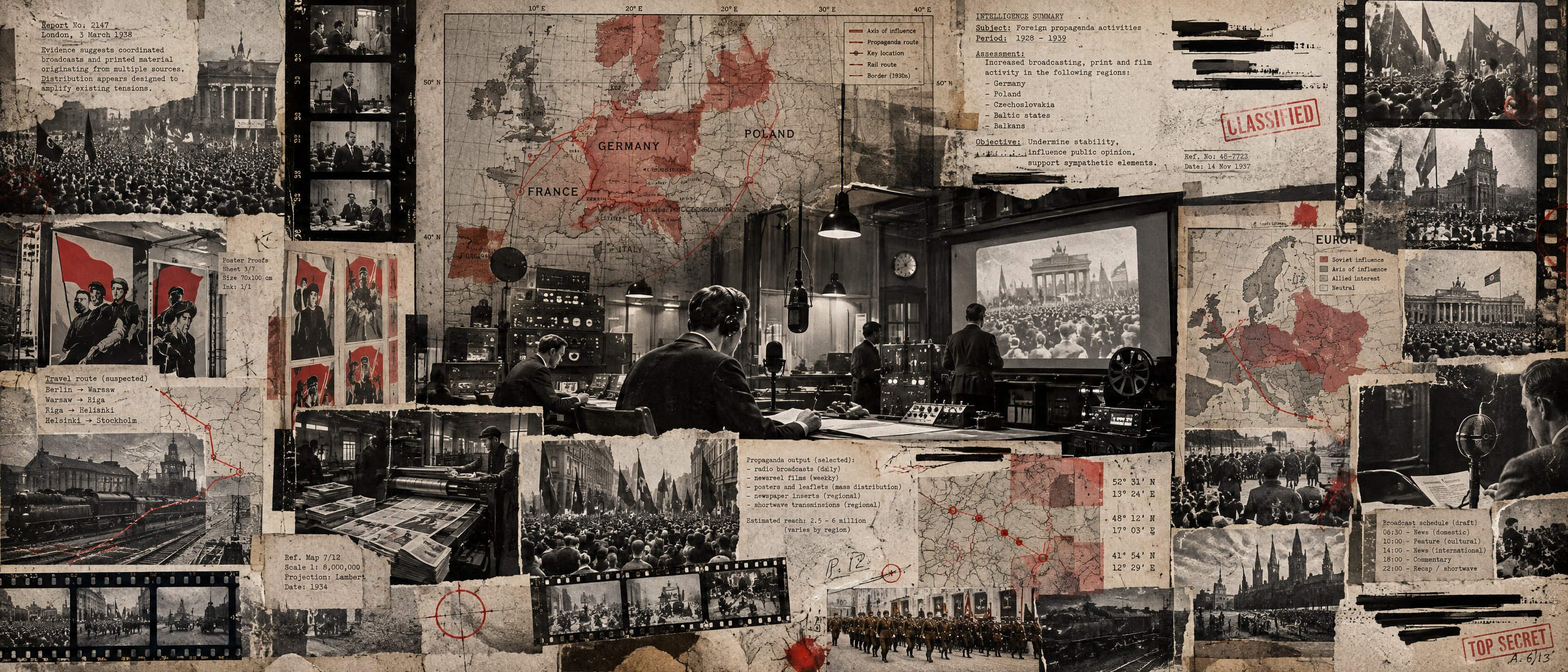
In one line: a small nonprofit at Columbia University's Teachers College taught Americans to spot propaganda through a monthly bulletin, school materials and a list of seven "devices," then suspended its work in January 1942, weeks after the United States entered the Second World War, citing both the war and a lack of money.
What happened
- 1937. Former journalist Clyde R. Miller, an associate professor of education at Teachers College, founds the Institute for Propaganda Analysis (IPA) with the Harvard geologist Kirtley Mather and the department-store owner and philanthropist Edward A. Filene. Filene gives Miller a check for $10,000 to fund the first year. His Good Will Fund later agrees to continue funding for three years. The staff numbers seven.
- 31 October 1937. The New York Times runs "Propaganda Foes Expose Its Tricks: 7 Word-Tools to Fool Public Listed and Defined." The seven devices also appear in the Institute's second monthly bulletin.
- First year. The bulletin Propaganda Analysis, billed as "a monthly letter to help the intelligent citizen detect and analyze propaganda," reaches 5,900 subscriptions.
- 1938. The House appoints Martin Dies (Democrat, Texas) to chair a special Committee on Un-American Activities. In the same month the IPA issues its first case study on the propaganda techniques of German fascism.
- May 1939. Miller writes to Dies, sharing sources the Institute had found in its own research on domestic fascist groups.
- 1939. Harcourt, Brace publishes The Fine Art of Propaganda: A Study of Father Coughlin's Speeches, an IPA book edited by Alfred McClung Lee and Elizabeth Briant Lee. A second printing follows in October 1939.
- 1939 to 1940. The IPA runs a series in Scholastic magazine, "What Makes You Think So? Expert Guidance to Help You Think Clearly and Detect Propaganda in Any Form."
- January 1941. Alfred M. Bingham, editor of the anticommunist, democratic-socialist magazine Common Sense, warns Miller that the IPA's new editorial director, Clyde Beals, is likely a communist. Miller defends Beals and asks Bingham for evidence.
- Before U.S. entry into the war. Two directors resign over the Institute's analyses of war propaganda: the economist Paul H. Douglas (University of Chicago) and the social-work scholar Eduard C. Lindeman (New York School of Social Work).
- 9 January 1942. The farewell bulletin, headlined "We Say Au Revoir," says the board has voted to suspend operations.
- 1947 and 1948. The House Committee on Un-American Activities is reported (West Side Rag, 2023; Wikipedia's Miller entry) to have called the IPA a "Communist front organization" in 1947. Teachers College dismisses Miller in 1948.
How it worked
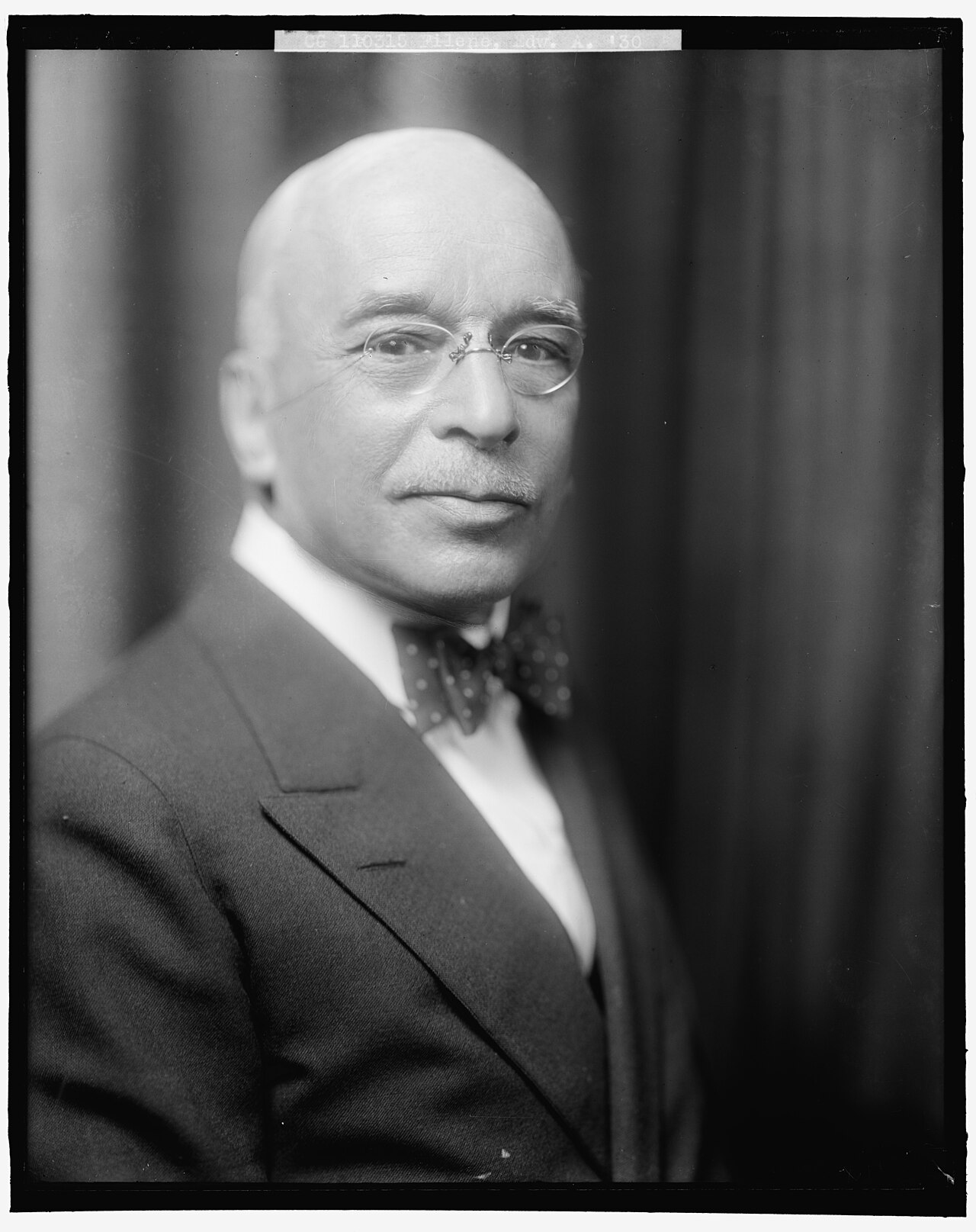
Edward A. Filene, whose $10,000 check and Good Will Fund paid for the Institute's early years. Harris & Ewing studio portrait, Library of Congress. Public domain.
The IPA did not try to answer propaganda with counter-messages. It tried to teach a method. Its bulletins took a live campaign (German fascism, domestic fascist groups, a grocery chain's public political campaigning, war appeals and U.S. administration policy) and walked readers through who was speaking, to whom, and with what devices.
The seven devices. The Institute's best-known output was a list of seven "devices," each tied here to its FRAME technique page: Name-calling, Glittering generalities, Transfer, Testimonial, Plain folks, Card stacking and Bandwagon. The IPA said these devices work "because they appeal to our emotions rather than to our reason." J. Michael Sproule traced who drafted the list and how it was first published in a 2001 research note in Rhetoric & Public Affairs. The seven devices themselves are set out in Institute for Propaganda Analysis, How to Detect Propaganda (1937).
The ABCs. Alongside the seven devices the IPA taught a less well-known checklist, the "ABC's of Propaganda Analysis." Renee Hobbs and Sandra McGee compared the two lists in a 2014 article in the Journal of Media Literacy Education.
Worked examples. The Fine Art of Propaganda applied the method to the radio sermons of Father Charles E. Coughlin. The Smithsonian's National Museum of American History holds a copy in its Father Charles E. Coughlin collection. Book dealers' descriptions of the 140-page book say the Lees used Coughlin's antisemitic and pro-Nazi speeches to teach propaganda techniques. The Institute also examined the grocery chain A&P's public political campaigning in the late 1930s, a case revisited in the 2021 HKS Misinformation Review special issue on propaganda analysis (see "Propaganda, obviously" in Sources).
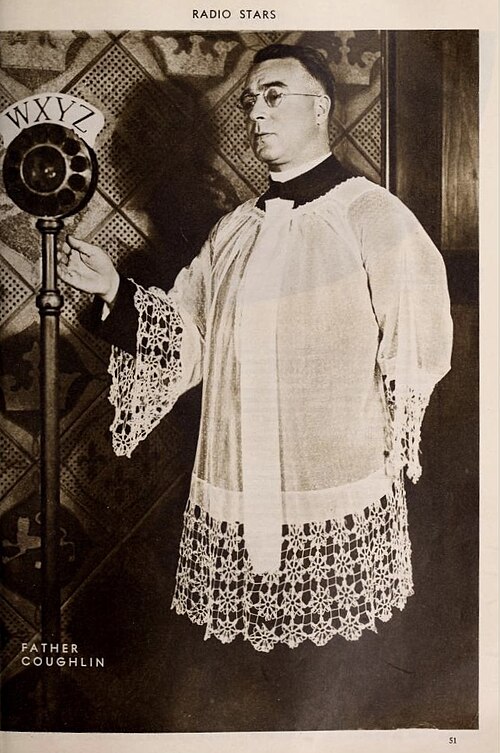
Father Charles E. Coughlin at a WXYZ microphone, from Radio Stars, May 1934, page 51. The IPA's 1939 book The Fine Art of Propaganda analyzed his radio speeches. Photographer unknown. Public domain (no copyright renewal found for the serial).
Schools and study groups. The IPA promoted study groups in public schools. By 1939 high schools, colleges and adult civic groups were holding discussions built on its materials. The IPA itself said that by the late 1930s one million schoolchildren were using its methods. That figure is the Institute's own and was not independently audited. After the Institute closed, Miller's propaganda-analysis methods fed into the Springfield Plan, an intercultural-education curriculum adopted in Springfield, Massachusetts, in the mid-1940s.
Its own stance. The Institute's teaching guides said students needed to think critically as engaged citizens and that doing so would not build "attitudes of cynicism and defeatism." Elisabeth Fondren took the title of her 2021 history from the IPA's own phrase: "We are Propagandists for Democracy."
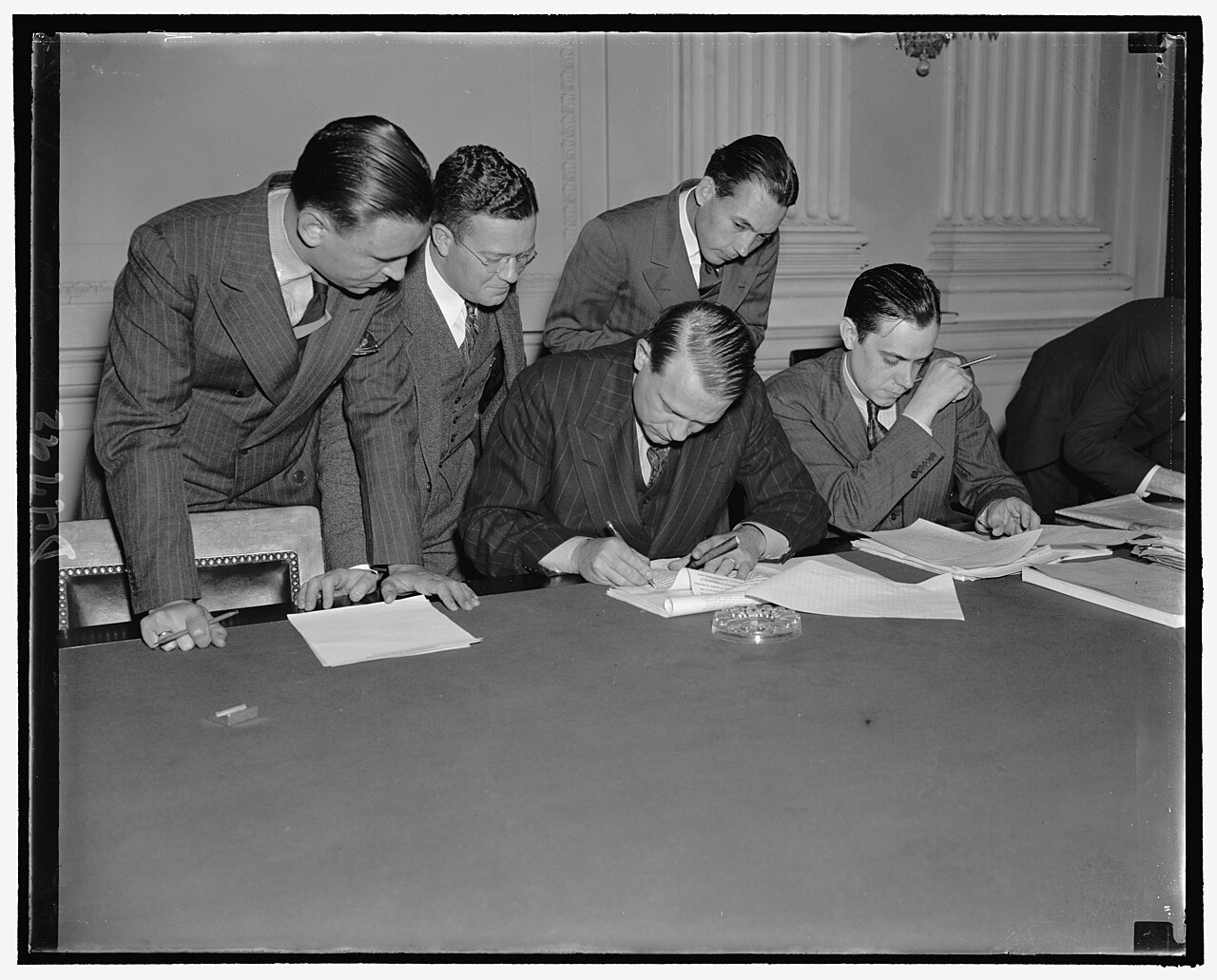
Photograph catalogued as showing Representative Martin Dies Jr., chairman of the House committee investigating un-American activities, preparing a statement while reporters look on, 26 October 1938. Harris & Ewing, Library of Congress (hec.25256). Public domain (Library of Congress: no known restrictions on publication).
Measured effect
- No controlled evaluation of the IPA's program was found in the sources checked for this page. The record of its reach is subscriptions (5,900 in the first year), book printings and the Institute's own claim of one million schoolchildren. These measure distribution, not whether readers resisted propaganda better.
- Contemporary experiments. Teachers College published Edward M. Glaser's An Experiment in the Development of Critical Thinking in 1941, and its index lists propaganda analysis. This page does not report Glaser's findings on propaganda-analysis teaching, because they could not be checked for this page.
- Later judgments are interpretive, not experimental. A. J. Bauer (2024) calls the IPA "a case study of under-examined priors": in his reading, a lack of reflexivity in its research design and teaching led to "muddled and ineffective results." That is a historian's reading, not a measured outcome.
- What was not measured: any before-and-after change in students' ability to recognize the seven devices, any change in attitudes toward the propaganda analyzed, and any decay over time. For modern tests of technique-spotting, see Inoculation and prebunking and Media literacy.
Positions on the record
- The Institute's own position. It described its work as dispassionate analysis of all kinds of propaganda. Fondren (2021) sums up its approach as training people to think for themselves about propaganda tactics rather than telling them how to think. In January 1942 it said such analysis could be misunderstood during a war emergency and misused by people opposing the government's war effort. It also said the deciding reason was a lack of funds, not the war: according to Miller, "The simple fact is that the Institute does not have the money to continue publication of bulletins." Circulation had fallen as subscriptions went unrenewed.
- Interventionists on its own board. Paul H. Douglas said the bulletins were "much more critical of many Administration policies than I wanted them to be." Eduard C. Lindeman said he was "all-out for intervention" and that the Institute "did not seem to be." Lindeman objected to the April bulletin "Strikes, Profits, and Defense" as more propaganda than analysis (TIME, "From Analysis to Propaganda").
- Educators worried about cynicism. Some educators opposed propaganda-analysis teaching on the grounds that it would make adolescents unduly cynical. Critics also said the IPA produced "more of a destructive skepticism than an intelligent reflectiveness."
- Anticommunist critics. Alfred M. Bingham of Common Sense raised communist-affiliation concerns about staff in 1941. Correspondence in the IPA's papers at the New York Public Library deals in part with allegations that some officers were Communists or Communist sympathizers. Columbia News reports that Miller and colleagues were investigated by the Dies Committee, the precursor of HUAC. Miller, for his part, told the New York Times in 1948 that Teachers College had violated his academic freedom. The college's letter to him said it did "not in the foreseeable future require the services of a person working in your special field of competence."
- Later scholars. J. Michael Sproule wrote a book-length study of propaganda and U.S. democracy, Propaganda and Democracy (Cambridge University Press, 1997). Bauer (2024) describes Sproule's work as recasting the IPA as the model of a long-lost progressive tradition of propaganda research. Fondren (2021) calls the IPA the first institutional U.S. effort to teach people to recognize propaganda tactics rather than tell them what to think. A 2022 International Journal of Communication article examines Miller's life and draws on archival material about his dismissal from Columbia. Bauer (2024) argues against the Institute's self-image: in his reading, its public messaging against propaganda masked propagandistic aims of its own, and by using scientific language while claiming to stand above politics, the IPA unwittingly made worse the problem it set out to fight.
Same-method test
A privately funded institute in any country that taught schoolchildren to spot "devices" in its own government's speeches, its business lobbies and a foreign dictatorship's broadcasts, and that went quiet once its country went to war, would be scored the same way here: documented reach, self-reported impact, no controlled evaluation, and criticism both for being too critical of its own government (Douglas, Lindeman) and for alleged political sympathies (Bingham, the Dies Committee). Bauer's charge that the IPA practiced the propaganda it analyzed would be weighed the same way for a counter-propaganda body of any flag, on the evidence of its outputs.
What the record shows and doesn't
- Documented: founding in 1937 at Teachers College; Filene's $10,000 and the Good Will Fund commitment; the seven devices published in October 1937; 5,900 first-year subscriptions; The Fine Art of Propaganda (1939); the Scholastic series; the resignations of Douglas and Lindeman; the 9 January 1942 suspension notice and its two stated reasons (war and money); Miller's 1948 departure from Teachers College.
- Self-reported: the one-million-schoolchildren figure.
- Contested frames: "pioneer of media literacy" (Fondren, Sproule, Columbia's 2024 conference) versus "propagandists for their own politics" (Bauer 2024, and in a different form the Institute's anticommunist critics). Whether the war or the budget ended it is also contested: the IPA gave both reasons.
- Not shown: that IPA teaching changed how Americans responded to propaganda.
See also
- Countering propaganda
- Institute for Propaganda Analysis, How to Detect Propaganda (1937), the doctrine page on the 1937 bulletin and its seven devices
- Media literacy, Inoculation and prebunking, The debate over counter-disinformation
- World War II rumor clinics and rumor control (1940 to 1947), a U.S. wartime counter-rumor effort
- Finland's media literacy model, a modern national program in the same teaching tradition
See also in Learn
Images
| Image | Source | Licence |
|---|---|---|
| Edward A. Filene, Harris & Ewing studio portrait | Wikimedia Commons, from the Library of Congress | Public domain |
| Father Coughlin at a WXYZ microphone, Radio Stars, May 1934 | Wikimedia Commons, via the Media History Digital Library | Public domain (no copyright renewal found for the serial) |
| Martin Dies Jr. with reporters, Washington, 26 October 1938 | Wikimedia Commons, Harris & Ewing, from the Library of Congress | Public domain (LOC: no known restrictions on publication) |


Image gaps
- Clyde R. Miller and Kirtley Mather. No openly licensed photo of Miller was found on Wikimedia Commons. A Smithsonian photo of Mather is on Commons marked "no known copyright restrictions"; it was left out to keep to images with a clear public-domain statement.
- A page of the bulletin Propaganda Analysis or of The Fine Art of Propaganda. Both are scanned on the Internet Archive, but their copyright status (renewal or not) was not checked for this page, and archive.org could not be reached from the environment used to build it. This gap can be filled once renewal status is confirmed.
- The seven-devices list as the IPA printed it. Same reason as above.
Sources
- Wikipedia: Institute for Propaganda Analysis (founders, Filene grant, Good Will Fund, 5,900 subscriptions, farewell issue, Scholastic series)
- Wikipedia: Clyde R. Miller
- Columbia Journalism Review: "Fighting disinformation with media literacy, in 1939"
- New-York Historical Society: "The Institute for Propaganda Analysis, Inc."
- Columbia News: "Exploring Propaganda Scholarship in the 1930s and Today"
- Teachers College: "Fighting fake news before it was trendy"
- TIME: "Education: From Analysis to Propaganda"
- New York Public Library: Institute for Propaganda Analysis records
- Internet Archive: Propaganda Analysis, Volume I
- Internet Archive: The Fine Art of Propaganda (1939)
- Smithsonian NMAH: The Fine Art of Propaganda, Coughlin collection
- Fondren, E. (2021). "We are Propagandists for Democracy." American Journalism 38(3)
- Bauer, A. J. (2024). "Glittering Generalities: Reconsidering the Institute for Propaganda Analysis." International Journal of Communication 18, 1976-1994
- "Fighting Disinformation in the 1930s: Clyde Miller and the Institute for Propaganda Analysis." International Journal of Communication 16 (2022), 3715-3741
- Sproule, J. M. (2001). "Authorship and Origins of the Seven Propaganda Devices: A Research Note." Rhetoric & Public Affairs 4(1), 135-143
- Sproule, J. M. (1997). Propaganda and Democracy: The American Experience of Media and Mass Persuasion. Cambridge University Press (review in American Journalism)
- Hobbs, R. and McGee, S. (2014). "Teaching about Propaganda: An Examination of the Historical Roots of Media Literacy." Journal of Media Literacy Education 6(2)
- Bauer, A. J. and Nadler, A. (2021). "Propaganda analysis revisited." HKS Misinformation Review
- "Propaganda, obviously: How propaganda analysis fixates on the hidden and misses the conspicuous." HKS Misinformation Review (2021)
- Glaser, E. M. (1941). An Experiment in the Development of Critical Thinking. HathiTrust catalog record
- West Side Rag (2023): "In the 1930s This Man Fought Disinformation, Until Teachers College 'Let Him Go'"
- Wikipedia: The Springfield Plan