In one line: On 22 December 1968 the People's Daily published Mao Zedong's instruction that "it is necessary for educated young people to go to the countryside to be re-educated by the poor and lower-middle peasants"; over the following decade an estimated 17 million urban youth, many of them recently mobilised Red Guards the Party no longer needed on the streets, were relocated to villages and border regions under a banner of voluntary revolutionary duty that also happened to disperse a volatile youth movement and absorb a graduating cohort the cities could not employ, until province-by-province protests by the sent-down themselves forced Deng Xiaoping's government to wind the programme down in 1978-80.
What happened
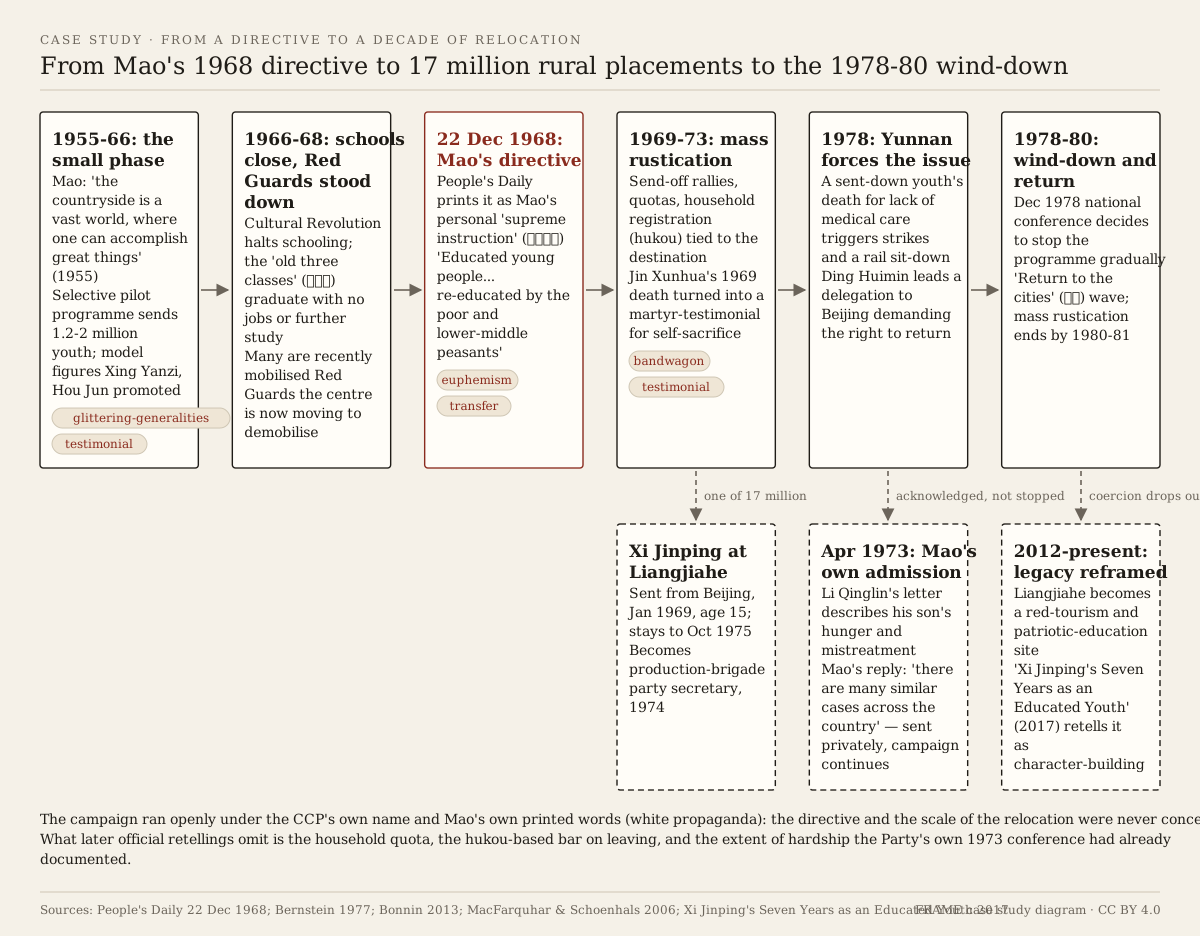
- 1955. In an editorial note appended to a rural report reprinted in the collection The Socialist Upsurge in China's Countryside, Mao writes that "the countryside is a vast world, where one can accomplish great things" (农村是一个广阔的天地,在那里是可以大有作为的). The same year, a small "Beijing Youth Land Reclamation Team" travels to Heilongjiang to break new farmland — a voluntary, propaganda-covered pilot, not yet a mass policy.
- 1962-66, the small phase. With the economy still recovering from the Great Leap Forward famine and unable to absorb the first wave of middle-school leavers, the state runs a smaller, more selective rustication programme: an estimated 1.2 to 2 million urban youth are sent to state farms and villages, and model figures such as Xing Yanzi (邢燕子, from 1958) and Hou Jun (侯隽, from 1962) — young women celebrated in the press for choosing farm labour over further schooling — are built into a template the 1968-80 campaign will reuse (Bernstein 1977).
- 1966-68. The Cultural Revolution closes China's schools and universities. Three consecutive graduating classes — 1966, 1967 and 1968, known collectively as "the old three classes" (老三届) — finish middle or high school with no further education and no urban jobs to go to. Many of the same students had spent 1966-68 mobilised as Red Guards; see The Red Guards: how Mao turned millions of students into a political weapon, 1966-68 for that mobilisation and its factional violence, which by mid-1968 Mao and the Party centre are moving to shut down.
- 22 December 1968. The People's Daily publishes what is presented as Mao's newest "supreme instruction" (最高指示): "It is necessary for educated young people to go to the countryside to be re-educated by the poor and lower-middle peasants. Cadres and other city people should be persuaded to send their children who have finished junior or senior middle school, or college, to the countryside. Let us mobilise. Comrades in the rural areas should welcome them." Within days, schools and neighbourhood committees stage send-off rallies with drums, red flags and quotas, and the mass phase of the movement begins.
- 1969-73, the mass phase. Roughly 17 million urban youth in total are relocated to villages, state farms and border-region "production-construction corps" (生产建设兵团) in Heilongjiang, Yunnan, Inner Mongolia, Xinjiang, Shaanxi and elsewhere between 1968 and 1980, with the earliest years after the directive carrying the largest cohorts (Bonnin 2013; Bernstein 1977). Among them: 15-year-old Xi Jinping, sent from Beijing in January 1969 to Liangjiahe, a village in Yan'an prefecture, Shaanxi, where he lives and works until October 1975, joins the Communist Youth League and then the Communist Party, and by 1974 is elected the local production brigade's party branch secretary — the youth organisation's routine role in running daily life at these postings is covered in Red scarf to Party card: a century of the Communist Youth League of China.
- 8 August 1969. Jin Xunhua (金训华), a 20-year-old sent-down youth in Heilongjiang, drowns trying to save state-owned logs from a flooded river. State media turns his death into a martyr narrative — "heroically sacrificed to rescue state property" — that is used nationwide to model the self-sacrifice expected of the sent-down.
- December 1972 - April 1973. Li Qinglin (李庆霖), a primary-school teacher in Putian county, Fujian, writes directly to Mao describing his sent-down son's hunger, unpaid labour and mistreatment by local cadres. Mao replies by hand in April 1973, sending 300 yuan and writing: "I am sending 300 yuan to help meet your immediate needs. There are many similar cases across the country, and this will have to be resolved comprehensively" (寄上300元,聊补无米之炊,全国此类事甚多,容当统筹解决). The letter becomes semi-public within the Party and triggers a 1973 national conference on educated-youth work that documents food shortages, unpaid labour, corrupt cadres and, in some border-region corps, sexual abuse of young women — problems the conference orders addressed while the relocation policy itself continues (Bonnin 2013).
- October 1978. In Yunnan's Xishuangbanna production-construction corps, a pregnant sent-down youth dies for want of basic medical care. The death becomes the trigger for organised protest among the region's zhiqing: petitions, strikes and, from late 1978, a sit-down on the Kunming-Shanghai rail line and a delegation, led by Ding Huimin (丁惠民), that travels to Beijing to press Vice Premier Wang Zhen and the State Council directly for the right to return to the cities.
- December 1978. The Central Committee convenes a National Conference on the Work of Educated Youth Going to the Mountains and the Countryside (全国知识青年上山下乡工作会议) in Beijing. Under pressure from the Yunnan protests and the accumulated record of complaints since 1973, it concludes the programme should gradually stop, though it does not announce an immediate end.
- 1979-80, the return to the cities. With Deng Xiaoping now consolidating power after Mao's 1976 death and the fall of the "Gang of Four," provincial authorities open channels — including "job succession" (顶替, dingti), letting a sent-down youth take a retiring parent's urban job — for zhiqing to return. Hundreds of thousands come back to cities in 1979 alone, often without secure jobs or housing waiting for them. By 1980-81, new mass rustication has effectively stopped and the movement is over in practice, though it was never formally repudiated the way the Cultural Revolution itself was in the Party's 1981 resolution (see Big-character posters: how the opening labels of China's Cultural Revolution did the work of charges (1966-68)).
- 2012-present. After Xi Jinping becomes General Secretary in November 2012, Liangjiahe is developed into a "red tourism" and patriotic-education site, and Xi Jinping's Seven Years as an Educated Youth (习近平的七年知青岁月), an oral-history volume compiled from interviews with people who knew him there, is published by the Central Party School's press in 2017. State media increasingly frames the zhiqing years as character-forming hardship ("tempering," 磨练) central to Xi's own biography and, by extension, to the nation's, a framing examined further below.
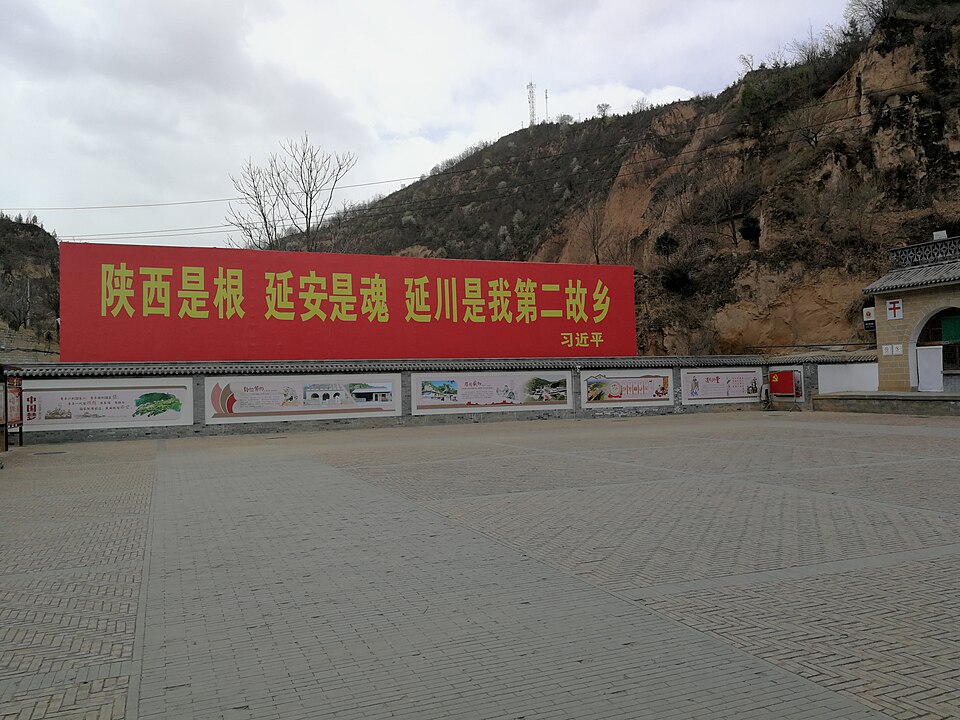
Entrance plaza at Liangjiahe village, Yanchuan County, Yan'an, Shaanxi, 6 April 2018, with a red banner reading "Shaanxi is the root, Yan'an is the soul, Yanchuan is my second hometown", signed 习近平 (Xi Jinping). Photograph by Liuxingy, via Wikimedia Commons. CC BY-SA 4.0.

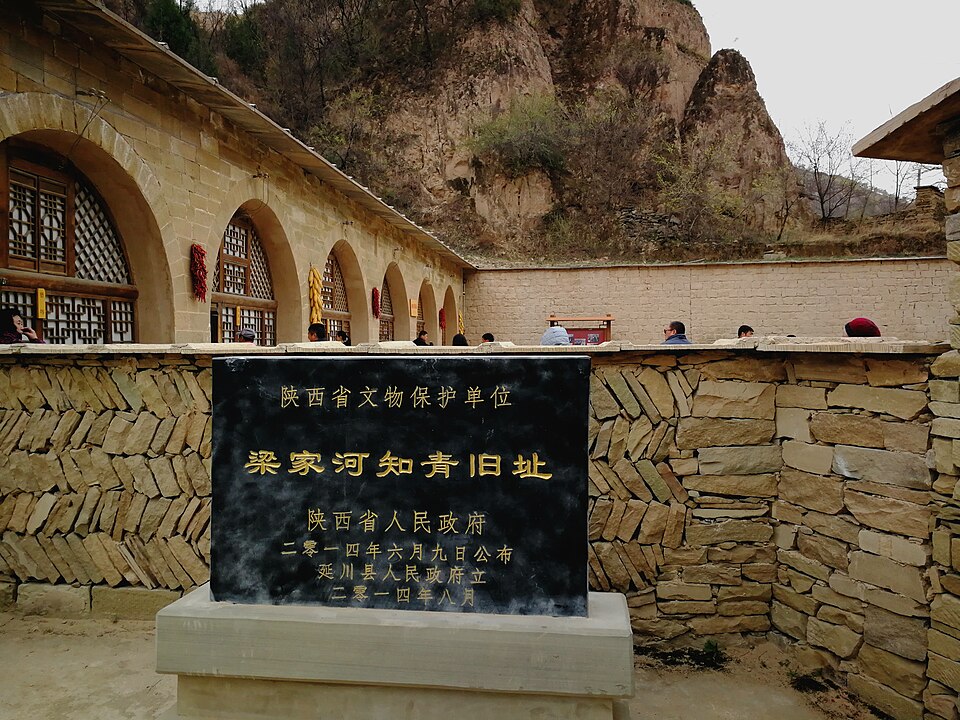
Plaque reading "Liangjiahe Zhiqing (educated youth) Former Site" (梁家河知青旧址), a Shaanxi provincial cultural-relic protection unit listed 9 June 2014 by the provincial government, erected by Yanchuan County government in August 2014, with cave dwellings and visitors behind. Photographed 6 April 2018 by Liuxingy, via Wikimedia Commons. CC BY-SA 4.0.

How it works
- Euphemism / doublespeak: "re-education by the poor and lower-middle peasants" (接受贫下中农的再教育) renames a state-assigned, often years-long, frequently involuntary relocation as pedagogical enrichment. "Up to the mountains and down to the villages" (上山下乡) is a directional, almost pastoral phrase for a policy that in practice fixed a destination, a household quota and no announced return date, backed by the leverage of the household-registration (hukou) system that made an unauthorised return to the city a criminal risk in itself.
- Glittering generalities: Mao's 1955 line that the countryside is "a vast world, where one can accomplish great things," and later slogans about "tempering" (锻炼) youth through "revolutionary practice," supply virtue language with no measurable content — no stated duration, no criterion for when re-education would be considered complete, and no accounting of outcomes for the youth sent.
- Bandwagon: press coverage of enthusiastic send-off rallies, "over-fulfilled" quotas and a rising national total was presented as proof of voluntary, mass consensus, while the underlying mechanism was a quota assigned household by household through schools and work units, with real consequences (a family's remaining ration or job security, a young person's own political record) for resisting it.
- Testimonial: model zhiqing — Xing Yanzi and Hou Jun before 1966, and Jin Xunhua's martyr story from 1969 — were built into press narratives that let the campaign speak through named, ordinary young people's own apparent choices and sacrifice, rather than through the state's own case for the policy.
- Transfer: the December 1968 directive was printed and broadcast as Mao's personal "supreme instruction," borrowing the prestige built up by the Mao cult (see The Mao cult before the state: 'Mao Zedong Thought' and 'The East Is Red', 1943-1949) to make local implementation compulsory in practice and to make questioning the relocation look like disloyalty to the Chairman rather than an ordinary labour or family grievance — the same fusion of policy with personal loyalty that ran through the Cultural Revolution more broadly.
Then and now
The underlying function — a state-directed relocation of youth to rural or frontier labour, framed as character-building duty rather than as a response to unemployment, political control or labour shortages — did not end with the Down to the Countryside Movement's 1980 wind-down. Facing record youth unemployment (a rate the National Bureau of Statistics put above 20 percent in 2022-23 before it stopped publishing the figure), several Chinese cities and provinces from 2022 announced plans to encourage or organise recent university graduates to take up rural and grassroots posts, echoing existing channels such as the "special post teacher," "three supports and one assistance" (三支一扶) and Western China volunteer programmes; officials and state commentators in some cases explicitly invoked the 1968 campaign's language of youth "going down" to serve the country. Chinese social-media comparisons between the new plans and the Mao-era movement circulated widely in late 2022 and were then censored, according to contemporary international press coverage.
The differences are real. The 2020s programmes are framed around graduate employment and rural development rather than "re-education" for an ideological fault located in the youths' urban class background, carry no household quota system or hukou-based coercion of the kind that underpinned the 1968-80 campaign, and are reported to be substantially smaller in scale and, on the evidence available, more genuinely optional for an individual graduate, even where local pressure to accept a placement is real. The core move being scored here is narrower than the whole policy: a state relocates youth for its own economic and political convenience and frames that relocation, then or in retrospect, as the young person's own opportunity for growth.
Positions on the record
- The Party's stated position at the time. The 1968 directive and the press campaign around it framed rustication as revolutionary necessity: closing the "three great differences" (三大差别) between worker and peasant, city and countryside, and mental and manual labour, and giving educated youth the chance to be "tempered" by the peasantry's practical wisdom. Mao's own April 1973 private letter to Li Qinglin — acknowledging that "there are many similar cases across the country" — shows the Party's own leadership knew the lived reality diverged sharply from the public framing years before the programme ended, and chose to keep the programme running while trying to fix its worst administrative abuses.
- The Party's later position. The Central Committee's 1981 "Resolution on Certain Questions in the History of Our Party" condemns the Cultural Revolution broadly but does not single out the rustication movement by name; the movement was wound down administratively in 1978-80 rather than formally repudiated. Since 2012, official and state-media treatments built around Xi Jinping's own Liangjiahe years, including the Party-published Xi Jinping's Seven Years as an Educated Youth (2017), present the zhiqing experience as formative hardship that built the resilience of a national leader, without dwelling on the quota system, the household-registration barrier to leaving, or the 1978 protests that ended it.
- Scholarship. Thomas P. Bernstein's Up to the Mountains and Down to the Villages (1977), written while the programme was still running, treats it primarily as a response to an urban employment crisis the Cultural Revolution had itself worsened, with ideology supplying the justification rather than the underlying cause. Michel Bonnin's The Lost Generation (French 2004; English translation, Chinese University of Hong Kong Press, 2013) is the fullest account, arguing the movement combined at least three real state purposes — dispersing and depoliticising the Red Guards once they had served Mao's purposes in the Cultural Revolution's power struggles, relieving urban unemployment the schools' closure had created, and a genuine, if largely instrumentalised, strand of egalitarian ideology about closing the urban-rural gap — and documents the 1972-73 Li Qinglin affair and the 1978-79 Yunnan protests in detail. Roderick MacFarquhar and Michael Schoenhals's Mao's Last Revolution (2006) covers the Red Guard demobilisation context that fed directly into the December 1968 directive.
- What is documented. The text and 22 December 1968 publication date of Mao's directive; the scale of the movement, on the order of 17 million relocated between 1968 and 1980 (Bonnin 2013; figures vary somewhat by which years and categories of movement are counted); the Li Qinglin letter and Mao's April 1973 reply; the October 1978 Yunnan death and the protests, rail sit-down and Beijing delegation that followed; the December 1978 national conference's decision to begin winding the programme down; the "return to the cities" wave of 1979-80; Xi Jinping's own 1969-75 placement at Liangjiahe.
- What is contested or not precisely known. The exact national death toll and the incidence of abuse, including sexual assault of young women in some border-region production-construction corps, were never comprehensively tabulated by the state and remain known mainly through individual accounts, memoirs and the 1973 conference's own internal findings rather than a public accounting. How far genuine ideological belief, as opposed to quota pressure and hukou-based coercion, drove any individual youth's departure varied enormously by year, region and family circumstance, and is not reducible to a single figure. How deliberately the December 1968 directive was timed as a tool to demobilise the Red Guards, as opposed to reviving and scaling up an existing rustication policy for other reasons, is argued differently by Bernstein and Bonnin, though both treat demobilisation as one real effect regardless of intent.
- Not ruled on here. Whether manual rural labour has any value for a young person's development, or the broader political struggles of the Cultural Revolution that preceded the December 1968 directive. This page scores how the relocation was framed, mobilised and later retold, not the underlying question of what rural experience is worth.
Same-method test
Nazi Germany's Kinderlandverschickung (KLV), covered in Kinderlandverschickung: evacuating Germany's children into Hitler Youth camps, 1940-1945, separated an estimated 2.8 million German children from their families for months or years from 1940, placed in camps run by Hitler Youth leaders under a claim that the state was acting in the children's own best interest. The mechanism scored here — extended, state-organised separation of youth from family and community, administered through a party youth organisation, and framed as the state's benevolent care for the young person rather than as a policy serving the state's own convenience — is genuinely shared. The framings differ in kind, not just degree: KLV was justified by an external military threat (Allied bombing of German cities) and centred on child safety, while the 1968-80 Chinese movement offered no comparable external threat and instead inverted the social hierarchy, casting the rural poor as the class qualified to "re-educate" the urban-born. KLV placements were typically measured in months to a few years and mediated through schools and, formally, parental consent; Down to the Countryside placements for most zhiqing ran for years with no announced end date and no comparable requirement of parental agreement, backed by the hukou system's control over where a person could legally live and work.
A partial Soviet comparator is the Virgin Lands campaign launched under Khrushchev from 1954, which recruited young Komsomol volunteers to break steppe land in Kazakhstan and Siberia through a propaganda drive presenting the move as heroic, voluntary adventure, while institutional and peer pressure through the Komsomol (see the same youth-organisation mechanism discussed in Red scarf to Party card: a century of the Communist Youth League of China) made declining a placement costly in practice (Pohl 1999). Soviet university graduates also faced mandatory post-graduation job "distribution" (raspredelenie), typically a three-year assignment, often to a remote or rural posting, justified as repayment of a debt for free higher education rather than as re-education, and administered as an ordinary bureaucratic requirement rather than a mass political campaign. Neither Soviet practice matches the Chinese movement's scale, its explicit "re-education" framing of the urban young as ideologically deficient, or its origin as a tool for demobilising a mass youth movement the state itself had raised.
The scale and consequences differ enormously across all three. China's movement relocated roughly 17 million people over twelve years, interrupted a decade of schooling for much of a generation, and left an unknown but substantial toll of hunger, injury, abuse and death that was never comprehensively counted. KLV displaced a smaller number for shorter periods inside a country already at war and under bombardment. The Virgin Lands campaign and Soviet job distribution moved far fewer people, for shorter and more bounded terms, without the household-quota compulsion or hukou lock-in that made an unauthorised return home to China's cities a serious risk in itself.
How to spot it
- Ask whether the relocation was voluntary in practice: did refusing carry a real cost — a family's ration or job security, a young person's political record, or, as in China's case, loss of the legal right to live and work in the city they came from?
- Watch for a slogan that names a virtuous destination ("the countryside," "re-education," "a vast world") but sets no duration, no criterion for completion, and no account of outcomes for the people sent.
- Check whether the policy also solves a problem for the state besides the stated one for the young person — an unemployment crisis, an unmanageable youth movement, a labour shortage — and whether that second purpose is acknowledged anywhere in the public framing.
- Look for whether the leadership's own private acknowledgment of hardship, as in Mao's 1973 letter to Li Qinglin, ever reached the public at the time, or only became known later, after the policy that produced the hardship had already ended.
- Compare how the same episode is described soon afterward to how it is retold decades later by people who benefited from it politically: does the later, celebratory version still mention the compulsion, the separation from family, and the interrupted education, or has the coercion quietly dropped out of the story?
Images
| Image | Source | Licence |
|---|---|---|
| Mechanism diagram (above) | Drawn for FRAME from the sources below (make_diagrams_youth_down_to_countryside.py) |
CC BY 4.0, FRAME |
| Entrance plaza and banner, Liangjiahe, 2018 | Wikimedia Commons; photograph by Liuxingy | CC BY-SA 4.0 |
| "Liangjiahe Zhiqing Former Site" plaque, 2018 | Wikimedia Commons; photograph by Liuxingy | CC BY-SA 4.0 |
Image gaps
- 1968-70s "up to the mountains, down to the villages" propaganda posters (send-off rallies, model zhiqing portraits, Stefan Landsberger's chineseposters.net collection) carry the same problem documented on Big-character posters: how the opening labels of China's Cultural Revolution did the work of charges (1966-68) and Land reform and the struggle session: how the CCP's class labels decided who kept their land, 1946-1952: Wikimedia Commons copies are tagged only
PD-China, with Chinese works still protected on 1 January 1996 having their U.S. copyright restored under the URAA, and Commons itself flags several of these files as not public domain in the United States. Unclear U.S. status, so not hosted. - Photographs of sent-down youth at rural postings, 1968-80, including any of Xi Jinping at Liangjiahe from the period itself, are held by Chinese state archives and by Xi Jinping's Seven Years as an Educated Youth (2017) and are not openly licensed. No openly licensed period photograph of a rustication send-off rally, a production-construction corps camp, or Liangjiahe from the 1969-75 period was found that could be hosted with confidence under this archive's licensing rules. The two Liangjiahe photographs above are 2018 tourist-site photographs, not period images.
- A photograph of Li Qinglin, Ding Huimin or the 1978 Yunnan protests was not sought with confidence for the same reasons as the first two gaps above (state-archive or press-agency material, not openly licensed) and, for identifiable individuals photographed as protesters under a government whose response to the protest is part of the story, would raise the same dignity concerns Land reform and the struggle session: how the CCP's class labels decided who kept their land, 1946-1952 states for its own unphotographed subjects.
Sources
- People's Daily (人民日报), front page, 22 December 1968, printing Mao Zedong's instruction "It is necessary for educated young people to go to the countryside to be re-educated by the poor and lower-middle peasants," widely reproduced in translation in the secondary sources below.
- Mao Zedong, editorial note (1955), reprinted in The Socialist Upsurge in China's Countryside (中国农村的社会主义高潮), for "the countryside is a vast world, where one can accomplish great things."
- Thomas P. Bernstein, Up to the Mountains and Down to the Villages: The Transfer of Youth from Urban to Rural China (Yale University Press, 1977).
- Michel Bonnin, The Lost Generation: The Rustication of China's Educated Youth (1968-1980), trans. Krystyna Horko (Chinese University of Hong Kong Press, 2013), for the scale estimate, the Li Qinglin letter and Mao's April 1973 reply, and the 1978-79 Yunnan protests and Ding Huimin's role in them.
- Roderick MacFarquhar and Michael Schoenhals, Mao's Last Revolution (Belknap Press of Harvard University Press, 2006), for the Red Guard demobilisation context; see also Big-character posters: how the opening labels of China's Cultural Revolution did the work of charges (1966-68).
- Editorial Group, Xi Jinping's Seven Years as an Educated Youth (习近平的七年知青岁月) (Beijing: Central Party School Press, 2017), for the post-2012 official retelling of Xi Jinping's 1969-75 placement at Liangjiahe.
- Kerry Brown, CEO, China: The Rise of Xi Jinping (I.B. Tauris, 2016), for an independent account of Xi Jinping's Liangjiahe years.
- Communist Party of China, "Resolution on Certain Questions in the History of Our Party since the Founding of the People's Republic of China," 27 June 1981.
- Michaela Pohl, "The 'Planet of One Hundred Languages': Ethnic Relations and Soviet Identity in the Virgin Lands," in Nicholas Breyfogle et al., eds., Peopling the Russian Periphery (Routledge, 2007); and "The Virgin Lands between Memory and Forgetting," PhD diss., Indiana University, 1999, for the same-method test's Virgin Lands comparison.
- National Bureau of Statistics of China, youth (16-24) surveyed unemployment rate releases, 2022-2023, for the "then and now" section's employment context.
- International press coverage of 2022 provincial and municipal plans encouraging urban graduates toward rural and grassroots postings, and of the online comparisons to the 1968-80 movement that followed, October-November 2022.