
Content note. This page describes a campaign in which mass meetings routinely ended in beatings, and in a documented share of cases, killings of people labelled landlords or "local tyrants". It quotes the campaign's own labels and its own later admissions of "indiscriminate beating and killing". The labels are quoted as evidence of the method. They are not this archive's description of anyone, and the page does not name individual victims. It does reproduce one U.S. government anti-Communist poster whose photographs, as captioned, show a people's court, an execution and bodies of unnamed people; see the Image gaps below and the caption for its provenance.
In one line: Between 1946 and 1952 the Chinese Communist Party sorted every rural household into one of five classes under a formula it had written in 1933, then built "speak bitterness" meetings and mass struggle sessions in which villagers denounced those labelled landlords before their land, tools and grain were confiscated; the labels outlived the campaign by nearly thirty years, and how many people were killed while the campaign applied them is still disputed by historians.
What happened
- March 1926. Mao Zedong's essay "Analysis of the Classes in Chinese Society" opens: "Who are our enemies? Who are our friends? This is a question of the first importance for the revolution." It sets out an early version of the class categories that would later organise land reform (Selected Works of Mao Tse-tung, vol. 1).
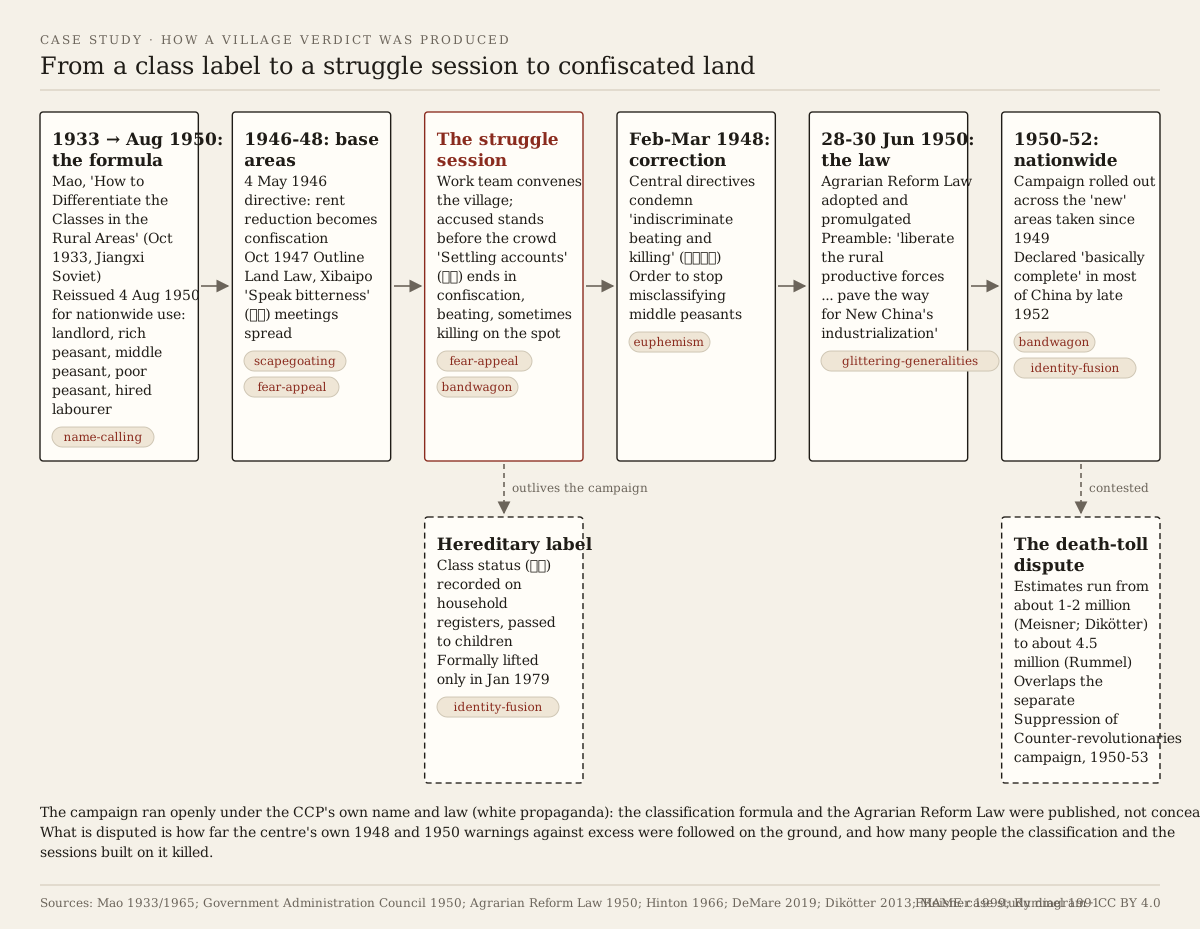
- October 1933, Jiangxi Soviet. Mao's "How to Differentiate the Classes in the Rural Areas" and the accompanying "Decision on Some Questions Concerning the Land Struggle" set out the formula later reissued nationwide: households are sorted into landlord, rich peasant, middle peasant, poor peasant and worker/hired-labourer categories by the share of their income drawn from land rent, hired labour or moneylending, not by any individual act. This is the direct predecessor covered in Divide the land, label the enemy: propaganda and discipline in the Jiangxi Soviet (1927-1934).
- 4 May 1946, the "May Fourth Directive". The Central Committee shifts base-area policy from the wartime "rent and interest reduction" (减租减息) campaign to outright confiscation and redistribution of landlord land in territory the CCP controls after Japan's surrender.
- 1946-48, base areas (Shanxi, Hebei, Shandong, Manchuria). Work teams convene "speak bitterness" (诉苦, suku) meetings, in which villagers are organised to recount grievances against a named landlord before a crowd, followed by a struggle session ("settling accounts", 算账, suanzhang) at which the accused is denounced, and often beaten; land, grain, tools and housing are confiscated on the spot. William Hinton's Fanshen (1966) documents this process household by household in Long Bow village, Shanxi, including cases where "poor peasant leagues" (贫农团) given disproportionate local authority extended punishment beyond the officially defined "landlord" category.
- October 1947, Xibaipo. The National Land Conference adopts the "Outline Land Law of China" (中国土地法大纲), calling for abolition of the landlord land-ownership system and roughly equal per-capita land distribution in CCP-held territory.

Map of the places the page names: Xibaipo, Hebei, where the National Land Conference met in October 1947; Long Bow village, Shanxi, the subject of William Hinton's Fanshen; and Fogang County, Guangdong, given as the location on the U.S. poster above. Drawn for FRAME from Natural Earth data (make_cs7_maps.py); positions approximate.
- February-March 1948. Central Committee and Mao Zedong directives acknowledge and try to correct "left" excesses in the base-area campaign: indiscriminate beating and killing (乱打乱杀), the misclassification of middle peasants as landlords or rich peasants, and seizure of middle-peasant land and property. The directives order that middle-peasant holdings be protected and that classification follow the 1933 criteria rather than local quotas or mob decision (Hartford and Goldstein 1989; DeMare 2019).
- 1 October 1949. The People's Republic of China is proclaimed. Land reform in the "old" base areas is largely complete; in the much larger "new" areas taken in the 1948-49 civil-war advance, the campaign has not yet begun.
- 4 August 1950. The Government Administration Council of the Central People's Government issues "Decisions Concerning the Differentiation of Class Status in the Rural Areas" (关于划分农村阶级成分的决定), reissuing Mao's 1933 formula for nationwide application: landlord, rich peasant, middle peasant, poor peasant, hired labourer.
- 14 June 1950. Liu Shaoqi delivers "Report on the Problem of Agrarian Reform" to the Chinese People's Political Consultative Conference, introducing the draft law and explicitly warning against repeating the base areas' "left" excesses while still calling for the "complete destruction" of the landlord class as a system.
- 28-30 June 1950. The Central People's Government Council adopts the Agrarian Reform Law of the People's Republic of China on 28 June; it is promulgated on 30 June. Article 1 states the law's purpose: to abolish "the system of feudal exploitation by the landlord class" and establish peasant land ownership, "in order to set free the rural productive forces, develop agricultural production and thus pave the way for New China's industrialization."
- 1950-52, nationwide rollout. Work teams, often including students, cadres and soldiers sent from outside the village, are dispatched to the "new" areas, covering roughly two-thirds of China's rural population not yet through land reform. Peasant associations are formed, class status assigned household by household, and speak-bitterness meetings and struggle sessions staged as mass "people's tribunals". Confiscated land, draft animals, farm tools, surplus grain and housing are redistributed to poor and landless households. The campaign runs alongside, and in many localities overlaps with, the separate "Suppression of Counter-revolutionaries" campaign (1950-53), which also targeted rural figures labelled "local tyrants" and "bandits".
Content note: U.S. government poster with photographs captioned as a people's court, an execution and bodies of executed men in Guangdong, 1952. This object is shown as it was published. Why 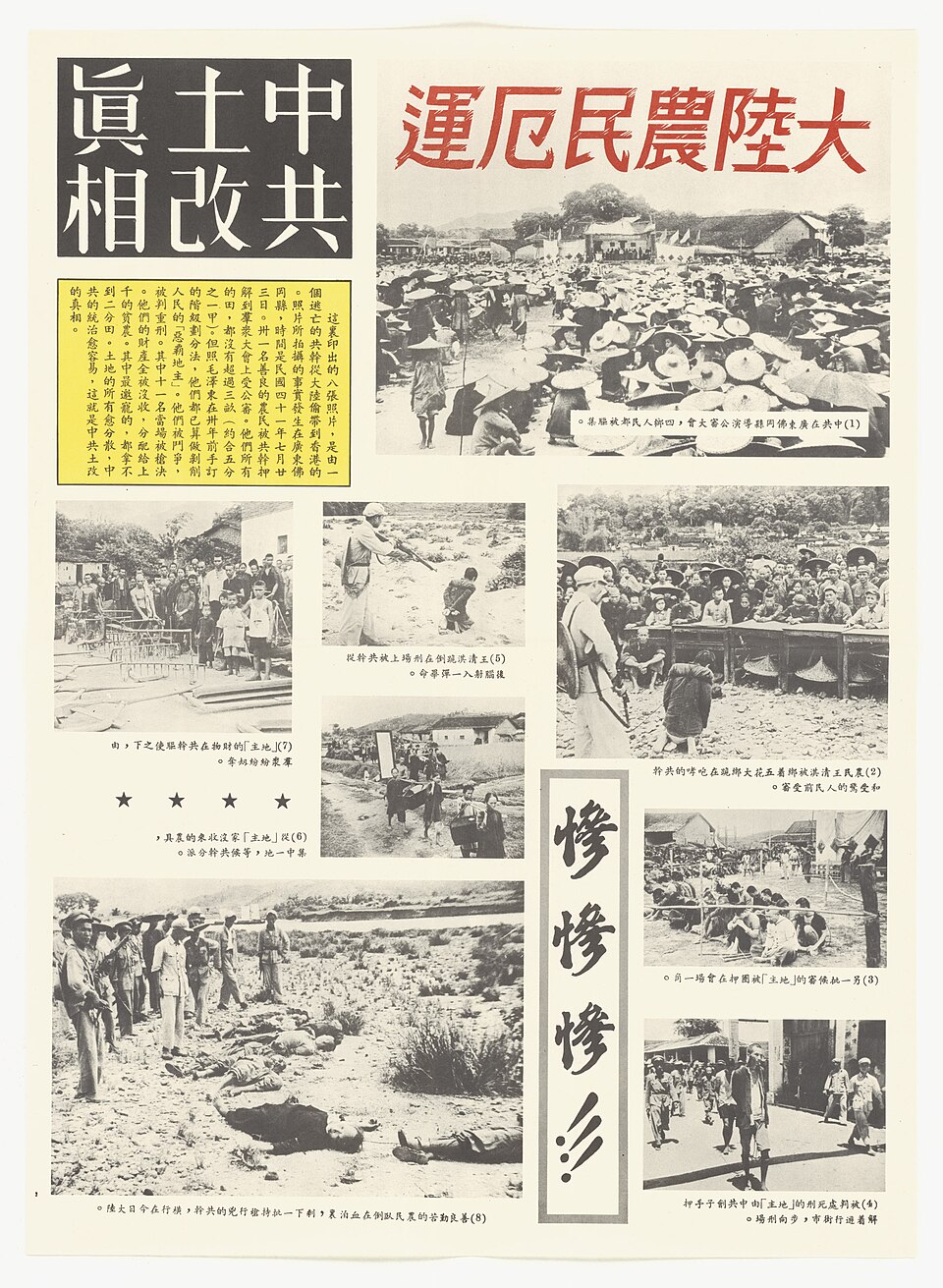
Poster "The Truth About Chinese Communist Land Reform" (中共土改真相; sub-headings "Disaster of the mainland peasants" and "Tragic, tragic, tragic!"), a U.S. government anti-Communist poster distributed in Asia; U.S. Information Agency records (Record Group 306), "Propaganda Posters Distributed in Asia", NARA identifier 5730064, dated 23 July 1952 in the archive record. Its printed text says the eight numbered photographs were brought to Hong Kong by a fleeing Communist cadre and show a people's court in Fogang County, Guangdong, on 23 July 1952 (year 41 of the Republic of China calendar), at which eleven men classed as landlords were shot. The photographs' origin and captions are the poster's own claims and are not independently verified here. Via Wikimedia Commons. Public domain (U.S. federal government work). - By late 1952. Land reform is declared "basically complete" across most of mainland China, excluding Tibet and some minority and frontier regions, where it followed later and in different form (Tibet's "democratic reforms" did not begin until 1959). - January 1979. The Central Committee decides to remove the "landlord" and "rich peasant" class-status labels from the households and descendants who had carried them, ending, on paper, close to three decades in which the label assigned in 1950-52 determined school admission, marriage prospects, army service and treatment in later political campaigns, the Cultural Revolution included (Kraus 1981; see Big-character posters: how the opening labels of China's Cultural Revolution did the work of charges (1966-68)).

How it works
- Scapegoating: rural poverty, debt, hunger and "feudal backwardness" — harms with many causes, including decades of war, taxation and famine — are located in one bounded class, defined by a formula (share of income from rent, hired labour or moneylending) rather than by any individual's documented conduct. The Agrarian Reform Law's stated aim is to abolish "the system of feudal exploitation by the landlord class" as a system, not to prosecute individuals for specific acts.
- Name-calling: the classification vocabulary — "landlord" (地主), "local tyrant" or "local bully" (恶霸), "evil gentry" (劣绅), and later "counter-revolutionary" (反革命) — is assigned by formula before any act is shown. In the struggle session the label itself, not a finding about specific conduct, decided what would be confiscated and who would be denounced, beaten, or in a documented share of cases, killed.
- Identity fusion: class status (chengfen, 成分) was recorded on household registration and passed to children regardless of the child's own conduct, wealth or age at the time of classification. A "landlord" or "rich peasant" family's descendants carried the label into schooling, marriage, army service and later political campaigns for close to thirty years, until the Central Committee formally lifted it in January 1979.
- Fear appeal: the struggle session staged the threat concretely — the accused stood before a crowd whose anger the meeting's organisers had spent hours building — and the outcome (confiscation, beating, imprisonment, or killing on the spot, in a documented share of cases) was neither disclosed in advance nor bounded by any stated procedure or defence. The remedy on offer, denounce or risk being named next, was accepted without any comparison to a fixed penalty or a right of appeal.
- Bandwagon: work teams required broad village turnout at speak-bitterness meetings, and a village's count of households that had "stood up" (翻身, fanshen, literally "turning the body over") and denounced a landlord was treated in campaign reporting as proof of correct political mobilisation; staying silent, or questioning a neighbour's classification, read as sympathy for the target rather than caution.
- Glittering generalities: the Agrarian Reform Law's own preamble states its purpose in terms that need no measurable test — to "set free the rural productive forces, develop agricultural production and thus pave the way for New China's industrialization." Nothing in that language specifies how much land, income or hired labour makes a household a landlord, or what evidence a struggle session needed before acting.
- Euphemism / doublespeak: official vocabulary rendered a public denunciation as an accounting exercise — "settling accounts" (算账, suanzhang) — and folded confiscation, beatings and killings into the general, administrative-sounding term "struggle" (斗争, douzheng). The 1948 directives correcting the campaign's course likewise spoke of "'left' deviations" and "indiscriminate beating and killing" (乱打乱杀), a phrase that names a pattern without giving a number or naming an incident.
Then and now
The core mechanism — a hereditary class-status label, assigned by a state formula rather than by an individual's own conduct, that determines a person's treatment for life — is not confined to 1946-52 China. North Korea's songbun system, which the state built from the late 1940s and still operates, sorts citizens into "core", "wavering" and "hostile" classes, largely inherited, that shape job assignment, food access, residence and vulnerability to the penal system. The United Nations Commission of Inquiry on Human Rights in the Democratic People's Republic of Korea documented the system's continued operation, and its ties to arbitrary detention, forced labour and executions, in its 2014 report (A/HRC/25/63; Collins 2012).
The differences are large. China's land-reform classification was applied through a time-bounded campaign of public mass meetings that regularly ended in physical violence and, in a disputed but substantial number of cases, killing, and the label was formally lifted by the same government in 1979. Songbun has operated continuously for more than seventy years through ordinary bureaucratic administration rather than staged public violence, has never been repealed, and applies to nearly the entire population rather than to a minority singled out for confiscation. Both systems make a family's inherited category, not a person's own record, the basis for how the state treats them.
Positions on the record
- The CCP's stated position at the time. The Agrarian Reform Law frames the campaign as necessary economic and political modernisation: it exists "to abolish the landlord class's system of feudal exploitation... and thus pave the way for New China's industrialization." Liu Shaoqi's 14 June 1950 report to the CPPCC calls for the "complete destruction" of the landlord class as a system while explicitly warning cadres against repeating the "left" excesses of the base-area campaign, and calls for the process to run through legally constituted peasant associations rather than uncontrolled local violence.
- Contemporary critics. The Republic of China government on Taiwan and much of the Cold War-era Western press described the campaign as land seizure and mass killing carried out by "communist bandits" (共匪), a label the ROC used broadly for the CCP in this period; see the parallel Cold War vocabulary discussed in The Great Leap Forward's 'sputnik' harvests and the famine that followed. These characterisations are contemporaneous political labels in their own right and are quoted here as part of the historical record, not adopted as this archive's description.
- Scholarship. William Hinton's Fanshen (1966), an eyewitness and participant account of Long Bow village, documents both genuine grievances against exploitative landlords and coerced or staged elements within the same meetings. Vivienne Shue (1980) and Kathleen Hartford and Steven Goldstein's edited volume (1989) trace how the campaign's format and excesses varied by region and period. Brian DeMare's Land Wars (2019) argues the campaign was less a spontaneous peasant uprising than a centrally choreographed process in which work teams manufactured "spontaneous" denunciation to bind villagers to the new state through shared complicity in violence. Frank Dikötter's The Tragedy of Liberation (2013) treats the campaign as centrally a mechanism of political terror and control, not only of economic redistribution. Maurice Meisner's synthesis (1999) treats it primarily as a (successful, though bloody) redistribution that broke the power of the rural landholding elite and set the stage for collectivisation.
- What is documented. The text and dates of the 1933 and 1950 classification decisions and the 1950 Agrarian Reform Law; the "speak bitterness" and struggle-session format as the standard method, described consistently across local gazetteers, memoirs and Hinton's account; the February-March 1948 directives acknowledging and attempting to correct "indiscriminate beating and killing"; the formal removal of the class-status labels in January 1979.
- What is contested. The national death toll. R. J. Rummel's tabulation (1991) put land-reform-era killings at roughly 4.5 million; Maurice Meisner (1999) cites a commonly used range of 1 to 2 million landlords killed; Frank Dikötter (2013), drawing on newly available Party archives, arrives at estimates in a broadly similar range to Meisner's while stressing how incomplete and internally contradictory the underlying local reports are. All three figures are contested by other scholars on methodological grounds, and the count is made harder by the campaign's overlap with the separate Suppression of Counter-revolutionaries campaign (1950-53), which killed in the same villages under a different official label. How far the violence documented in the 1948 and later directives reflects central policy, as opposed to local activists and work teams exceeding their instructions under quota pressure, is a live historiographical debate (compare DeMare's "scripted violence" argument with accounts emphasising local improvisation). Philip C. C. Huang (1995) further disputes how consistently the classification criteria were applied to real household income in the first place.
- Not ruled on here. The broader economic and political merits of land redistribution, of one-party rule, or of the CCP's assumption of power. This page scores the method by which class status was assigned and denunciation staged, not the underlying question of land tenure reform.
Same-method test
The same scoring applies to category-based liability elsewhere, in eras and systems very different from the CCP's. Revolutionary France's Law of Suspects (17 September 1793) and the decrees confiscating the property of émigrés and nobles made membership of a category — aristocrat, priest, "enemy of the Revolution" — rather than a documented act the basis for arrest, trial before the Revolutionary Tribunal and, in many cases, execution; see Revolution, counter-revolution and Napoleon's bulletins, 1789-1815. A message that assigns guilt by category rather than by act is tagged Scapegoating and Name-calling here regardless of the political system that produces it. Donald Greer's classical count (1935) puts the Terror's formal, tribunal-ordered executions at roughly 16,600 nationwide from September 1793 to July 1794, a figure that excludes the much larger and separately contested death toll of the Vendée civil war.
A fair comparison inside a Western democracy is the United States' confinement of about 120,000 people of Japanese ancestry under Executive Order 9066 (1942): a person's ancestry category, not any finding about their own conduct, determined confinement, which is the same mechanism this page tags Identity fusion and Name-calling. The federal Commission on Wartime Relocation and Internment of Civilians (1982) found no evidence of espionage or sabotage justifying the policy.
The scale and consequences differ enormously across all three cases. China's classification and struggle-session campaign killed, on even the more conservative scholarly estimates, in the high hundreds of thousands to low millions over six years, and its labels attached to descendants for close to thirty years. The French Terror's formal executions numbered in the tens of thousands over roughly ten months. The Japanese American internment involved no executions and no mass beatings; Congress paid $20,000 and a formal apology to each surviving internee under the Civil Liberties Act of 1988. Same mechanism, category over act; very different orders of harm.
How to spot it
- Ask whether the label ("landlord", "local tyrant", "class enemy", "kulak", "aristocrat") describes a specific, dated act, or a formula based on income source, land held or family background.
- Check whether the status is hereditary: does it attach to a person for life, and pass to children who never held the position or income it names?
- Ask who set the classification and who could remove it. Here a village work team assigned the label; only the centre could formally lift it for the whole category, which it did in 1979, nearly thirty years after the campaign began.
- Ask what happened to anyone who questioned a neighbour's classification or a meeting's conduct — were they free to dissent, or did the doubt itself invite the same label?
- Compare the campaign's own casualty language to independent estimates. A directive condemning "indiscriminate beating and killing" names a pattern; it is not an accounting, and the gap between the two is exactly where the death-toll dispute above sits.
Images
| Image | Source | Licence |
|---|---|---|
| Mechanism diagram (above) | Drawn for FRAME from the sources below (make_diagrams_rtp_landreform.py) |
CC BY 4.0, FRAME |
| U.S. Information Agency poster "The Truth About Chinese Communist Land Reform", 1952-53 | Wikimedia Commons; NARA 5730064, RG 306 | Public domain (U.S. federal government work) |
| Locator map of places named on this page | Drawn for FRAME from Natural Earth data (make_cs7_maps.py) |
Public domain data; drawing CC BY 4.0, FRAME |
Image gaps
- Chinese-side photographs of land reform. A man reading the Land Reform Law of the PRC, 1950, and other 1950s land-reform photographs on Wikimedia Commons are tagged only
PD-China(public domain in China under the 50-year rule for organisational works), with no United States public-domain tag and an explicit Commons note that the work "might not be in the public domain in countries... [with] copyright terms longer than life of the author plus 50 years". Chinese works still protected on 1 January 1996 had their U.S. copyright restored under the URAA. Unclear U.S. status, so not hosted; see commons.wikimedia.org/wiki/File:A_man_reads_the_Land_Reform_Law_of_PRC.jpg. The only photographic material hosted here is therefore the U.S. government poster, which is one side's own campaign document, not an independent record; a comparable Chinese official image of a speak-bitterness meeting or land-deed ceremony is an open gap. - A "people's court" struggle-session photograph on Wikimedia Commons carries a CC BY-SA 4.0 tag applied by a 2014 uploader for what is described as a 1950-era photograph; the uploader is very unlikely to hold the original photographic rights to a period image, so the tag's own validity is uncertain. Not hosted; see commons.wikimedia.org/wiki/File:Landlord_Classicide_under_Mao_Zedong.jpg.
- 1950s land-reform propaganda posters and photographs more broadly (peasant associations, "speak bitterness" meetings, land-deed distribution ceremonies) are held by Chinese museums and by Stefan Landsberger's chineseposters.net collection, neither openly licensed, and by the Library of Congress's China holdings, which carry no rights clearance ("Publication may be restricted") for material of this kind, consistent with the same gap documented on Big-character posters: how the opening labels of China's Cultural Revolution did the work of charges (1966-68). No openly licensed image of a struggle session, a land-deed ceremony or a class-status document was found from commons.wikimedia.org or loc.gov that could be hosted with confidence.
- Portraits of named individuals subjected to struggle sessions are not sought for this page. The U.S. poster's photographs show unnamed people as published by the poster.


Sources
- Mao Zedong, "Analysis of the Classes in Chinese Society" (March 1926), and "How to Differentiate the Classes in the Rural Areas" (October 1933), Selected Works of Mao Tse-tung, Vol. 1 (Foreign Languages Press, 1965).
- Central Committee of the Chinese Communist Party, directive of 4 May 1946 on the land question (the "May Fourth Directive").
- "Outline Land Law of China" (中国土地法大纲), adopted at the National Land Conference, Xibaipo, October 1947.
- Central Committee of the CCP and Mao Zedong, directives of February-March 1948 correcting "left" deviations in land reform, discussed in Hartford and Goldstein (1989) and DeMare (2019).
- Government Administration Council of the Central People's Government, "Decisions Concerning the Differentiation of Class Status in the Rural Areas" (关于划分农村阶级成分的决定), 4 August 1950.
- Liu Shaoqi, "Report on the Problem of Agrarian Reform" (关于土地改革问题的报告), Chinese People's Political Consultative Conference, 14 June 1950.
- "Agrarian Reform Law of the People's Republic of China," adopted by the Central People's Government Council 28 June 1950, promulgated 30 June 1950. English translation in Robert R. Bowie and John K. Fairbank, eds., Communist China 1955-1959: Policy Documents with Analysis (Harvard University Press, 1962).
- William Hinton, Fanshen: A Documentary of Revolution in a Chinese Village (Monthly Review Press, 1966).
- C. K. Yang, A Chinese Village in Early Communist Transition (MIT Press, 1959).
- Vivienne Shue, Peasant China in Transition: The Dynamics of Development toward Socialism, 1949-1956 (University of California Press, 1980).
- Kathleen Hartford and Steven M. Goldstein, eds., Single Sparks: China's Rural Revolutions (M.E. Sharpe, 1989).
- Brian DeMare, Land Wars: The Story of China's Agrarian Revolution (Stanford University Press, 2019).
- Frank Dikötter, The Tragedy of Liberation: A History of the Chinese Revolution 1945-1957 (Bloomsbury, 2013).
- Maurice Meisner, Mao's China and After: A History of the People's Republic, 3rd ed. (Free Press, 1999).
- R. J. Rummel, China's Bloody Century: Genocide and Mass Murder Since 1900 (Transaction Publishers, 1991).
- Philip C. C. Huang, "Rural Class Struggle in the Chinese Revolution: Representational and Objective Realities from the Land Reform to the Cultural Revolution," Modern China 21, no. 1 (1995): 105-143.
- Richard Kraus, Class Conflict in Chinese Socialism (Columbia University Press, 1981), for the January 1979 removal of the "landlord" and "rich peasant" labels.
- UN Human Rights Council, Report of the Commission of Inquiry on Human Rights in the Democratic People's Republic of Korea, A/HRC/25/63, 7 February 2014, for the "then and now" comparison.
- Robert Collins, Marked for Life: Songbun, North Korea's Social Classification System (Committee for Human Rights in North Korea, 2012).
- Donald Greer, The Incidence of the Terror during the French Revolution: A Statistical Interpretation (Harvard University Press, 1935), for the same-method test.
- Commission on Wartime Relocation and Internment of Civilians, Personal Justice Denied (U.S. Government Printing Office, 1982-83), for the same-method test.
- Civil Liberties Act of 1988, Public Law 100-383, for the same-method test.