Content note: this page describes the Nuremberg Laws' "Rassenschande" provisions, cases of Germans denouncing Jewish neighbours, spouses and acquaintances to the Gestapo, and the extrajudicial "protective custody" (Schutzhaft) system that sent people to concentration camps without trial. It quotes period labels attached to denunciation targets. The genocide these laws fed into is covered in FRAME's genocide case studies.
In one line: founded by Hermann Göring on 26 April 1933 and never more than a few thousand field officers strong for a country of nearly 70 million, the Gestapo policed private life mainly by processing tips from ordinary citizens, whom party block wardens and a widening set of laws against "malicious" speech and "racial defilement" recruited into reporting neighbours, colleagues and family — while its own case files show that most of those tips led nowhere.
What happened
Founding and command
- 26 April 1933. As Prussian minister president, Hermann Göring creates the Geheimes Staatspolizeiamt (Gestapa, "Secret State Police Office") by decree, carving a political police out of the ordinary Prussian police. Rudolf Diels, a career civil servant, is its first director. Other German states set up their own political police in parallel.
- 20 April 1934. Göring hands control of the Prussian Gestapo to Heinrich Himmler, already political-police chief in most of the other states; Reinhard Heydrich, head of the SS intelligence service (the SD), becomes its operational chief. The political police of the whole Reich are now under one command in all but name.
- 10 February 1936. The "Basic Law on the Secret State Police" declares that Gestapo orders are not subject to review by the administrative courts — closing off the judicial channel a Prussian court had briefly opened the year before when it examined a protective-custody order. From this point the Gestapo's central power, Schutzhaft ("protective custody": imprisonment without charge, trial or fixed term, which the Gestapo alone could order and which it reviewed only every three months), was effectively unreviewable.
- 17 June 1936. Hitler names Himmler Chef der Deutschen Polizei (Chief of the German Police), merging the political police (the Gestapo and the criminal police, Kripo, together forming the Sicherheitspolizei) with the uniformed Ordnungspolizei under one SS-linked command.
- 27 September 1939. The Reich Security Main Office (Reichssicherheitshauptamt, RSHA) is formed, merging the Gestapo, Kripo and the SD's own apparatus into a single SS body under Heydrich. The Gestapo becomes RSHA Amt IV; Heinrich Müller heads it from 1939 to the war's end.
- Headquarters. From 1933 the Gestapo occupies the former School of Applied Arts at Prinz-Albrecht-Straße 8, Berlin (today Niederkirchnerstraße), which becomes the RSHA's seat from 1939. Allied bombing partly destroys the building in 1945; what remained was later demolished. The site is now Berlin's Topography of Terror documentation centre.
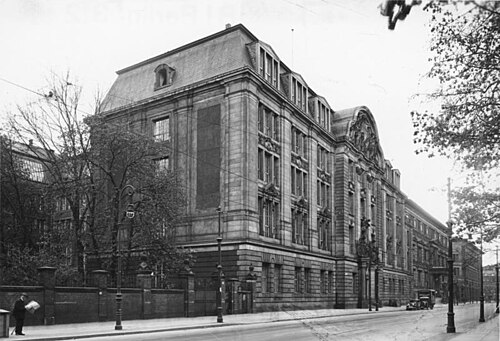
The Geheimes Staatspolizeiamt (Gestapo office) at Prinz-Albrecht-Straße 8, Berlin, 1933; the building was formerly a school of applied arts. Photographer not recorded. Bundesarchiv, Bild 183-R97512, via Wikimedia Commons. CC BY-SA 3.0 DE.

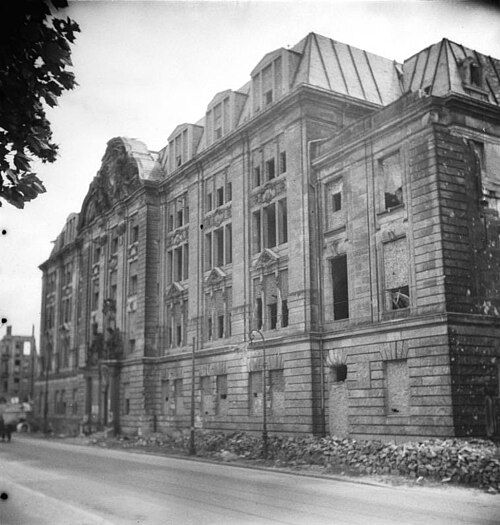
The destroyed Gestapo headquarters building, Prinz-Albrecht-Straße, Berlin, June 1949. Photo: Heinz Funck, Bundesarchiv, Bild 183-S85918, via Wikimedia Commons. CC BY-SA 3.0 DE.

A small, understaffed agency
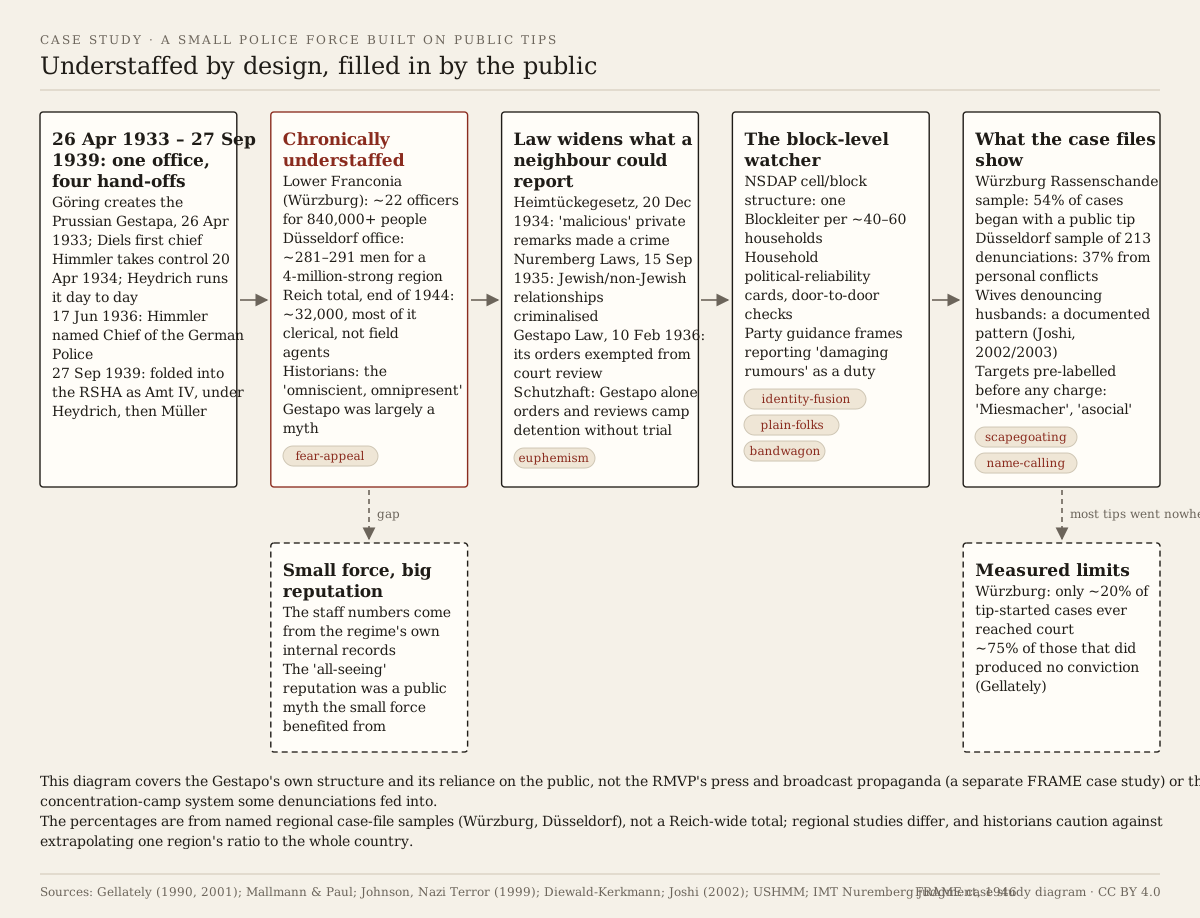
- Research by Klaus-Michael Mallmann and Gerhard Paul, and separately by Robert Gellately, established that the Gestapo's reach far exceeded its own numbers. The Gestapo office for Lower Franconia, covering Würzburg, had about 22 officers for a population of more than 840,000. The Düsseldorf office, covering the Lower Rhine, had roughly 281–291 officers for about 4 million people.
- By the end of 1944 the Gestapo's total strength Reich-wide was about 32,000 — figures presented at the Nuremberg trials break this down as roughly 3,000 administrative officers, 15,500 "executive" (investigating) officers and about 13,500 other employees, many of them clerical staff processing paperwork rather than agents doing surveillance.
- Mallmann and Paul's conclusion, echoed by Gellately and by Eric A. Johnson's case-file study of Cologne and Krefeld, is that a force this size could not have monitored the population it is remembered as having monitored. Its postwar reputation as omniscient and omnipresent rested less on its own manpower than on a steady inflow of information the public supplied on its own initiative, and on citizens' belief — cultivated but not verified — that the police already knew.
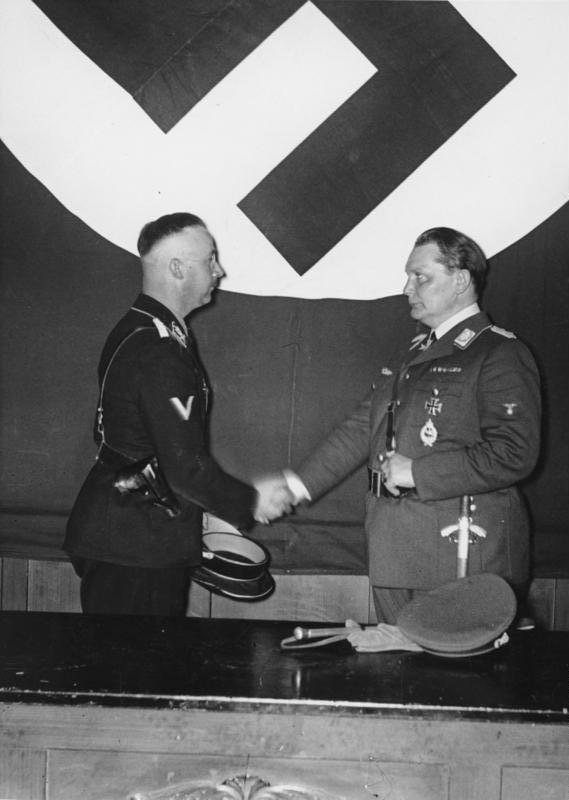
Göring hands control of the Prussian Gestapo to Himmler, Berlin, 20 April 1934 (Bundesarchiv caption: "Berlin, Hermann Göring ernennt Himmler zum Leiter der Gestapo"). Bundesarchiv, Bild 183-R96954, CC BY-SA 3.0 DE.
Law widens what counted as reportable
- 20 December 1934: the Heimtückegesetz ("Law against Treacherous Attacks on State and Party and for the Protection of the Party Uniform") criminalises "malicious" remarks capable of damaging the "welfare of the Reich" or the "prestige" of the government or party — extending the reach of the law into private conversation among family, friends and co-workers. Cases went to the Sondergerichte (special courts) set up in March 1933; the main way a violation came to the state's attention was a report from someone who had heard it.
- 15 September 1935: the Nuremberg Laws — the Law for the Protection of German Blood and German Honour and the Reich Citizenship Law — criminalise marriage and extramarital relations between Jews and non-Jewish Germans as "Rassenschande" ("racial defilement"), turning private relationships into a police matter that a neighbour, a landlord, a jealous spouse or a rival could report.
- Regional Gestapo case-file studies find that a large share of these prosecutions began with a member of the public, not with police-initiated surveillance. In a sample of Rassenschande cases from Würzburg, Gellately found that 54 percent began with an identifiable denunciation from the population at large.
The block-level watcher
- Under the NSDAP's own reorganisation of the early 1930s, the party's local structure ran Gau (region) to Kreis (district) to Ortsgruppe (local branch) to Zelle (cell) to Block, the smallest unit. A Blockleiter (block leader, popularly Blockwart, "block warden") was assigned to roughly 40 to 60 households, with duties described in the party's own published guidance for cell and block wardens (translated by Calvin University's German Propaganda Archive): distributing propaganda and collecting for party causes such as the Winter Relief drive, assessing households' political reliability through door-to-door contact, and reporting suspected dissent or "damaging rumours" up the party's chain, which fed information onward to the Gestapo. Some kept household cards (Haushaltskarten) tracking each family.
- Historians note the Blockleiter was widely disliked, precisely because the role made a party member's knock at the door — not a policeman's — the point where everyday life and the security apparatus met.
What the case files show about motive
- Not every denunciation was politically motivated. A study by Gisela Diewald-Kerkmann of 213 denunciations in Düsseldorf found about 37 percent arose from personal conflicts — a neighbour dispute, a business rivalry, a marriage breaking down — rather than ideological conviction.
- Historian Vandana Joshi's study of women as denouncers (Gender and Power in the Third Reich: Female Denouncers and the Gestapo, 1933–45, 2003; see also her 2002 Journal of Contemporary History article) documents wives reporting husbands, often in the course of marital breakdown, turning the Heimtückegesetz and related statutes into a resource in private disputes that had nothing to do with the state's own priorities.
How the tips were used, and how many led anywhere
- Gellately's Würzburg sample also shows the limits of the system from the state's own side: of cases that began with a public tip-off, only about 20 percent ever reached court, and roughly 75 percent of those that did failed to produce a conviction. Much of what the Gestapo received was unusable, exaggerated, or, on investigation, the product of personal spite rather than a real offence.
- Cases under the Heimtückegesetz went to the Sondergerichte; for many others, especially where no clean charge could be made to stick, the Gestapo used Schutzhaft to send people directly into a concentration camp without a trial.
How it ended
- The RSHA collapsed with the Nazi state in May 1945. At the International Military Tribunal at Nuremberg, the judgment of 30 September–1 October 1946 declared the Gestapo, together with the SD, a criminal organisation (excluding purely clerical or menial staff), citing their role in the deportation and forced-labour system that fed the concentration camps. Heinrich Müller's fate after the fall of Berlin has never been conclusively established; Heydrich had already been killed in 1942 in the operation later known as Operation Anthropoid.
How it works
- Fear appeal: the Gestapo's small size (about 22 officers for over 840,000 people around Würzburg; roughly 32,000 Reich-wide by late 1944, mostly clerical) never matched its reputation for omniscience. Historians read that gap as a deterrent effect the regime did not need a bigger police force to produce — belief that reporting was pointless because "they already know" did the state's watching for it.
- Identity fusion: block-level party guidance folded political reliability into ordinary neighbourliness, so that a household's loyalty and a Blockleiter's knowledge of "damaging rumours" were treated as inseparable from belonging to the Volksgemeinschaft (national community).
- Plain folks: the person checking on 40 to 60 households was not a policeman but a fellow party member from the neighbourhood — a shopkeeper, a colleague, someone already known — which let denunciation present itself as an ordinary community function rather than a state-security one.
- Bandwagon: household political-reliability cards and repeated door-to-door checks implied that observation and reporting were already the normal, expected behaviour of everyone on the street, not an exceptional act.
- Scapegoating: the Rassenschande provisions and "asocial" categories gave a denouncer a bounded, officially sanctioned target — a Jewish neighbour's relationship, a "work-shy" acquaintance — through which a personal grudge could be discharged as a public duty.
- Euphemism / doublespeak: Schutzhaft ("protective custody") described indefinite imprisonment without charge or trial, ordered and reviewed by the Gestapo alone.
- Name-calling: labels such as Miesmacher ("grumbler", used for people who spread pessimism about the war or the regime) and Volksschädling ("parasite of the people") did the accusatory work before any specific act was named or proven.
Colour. The law and the party's published duties for block wardens were white: issued openly, under the state's and the party's own name, in the Reichsgesetzblatt and the party press. The actual traffic that filled the Gestapo's files was closer to gray: individual citizens who were not state employees, often anonymous, supplied information the state then acted on without disclosing who had supplied it or how much of its apparent knowledge came from the public rather than its own investigation. The small size of the force itself was never advertised; its "all-seeing" reputation was left to grow on its own.
Then and now
Russia's 2022 invasion of Ukraine produced a wave of denunciations with a similar shape, this time running from students and colleagues rather than door-to-door wardens. Under Russia's wartime laws criminalising "discrediting" the armed forces (in force since March 2022), students recorded and reported teachers for anti-war remarks in class, parents complained to school administrators about teachers' comments, and colleagues reported colleagues, feeding both administrative and criminal cases. The human-rights group OVD-Info, which tracks the prosecutions, and Amnesty International both documented teachers dismissed, fined or charged after being reported by people who knew them personally rather than caught by any state monitoring system. As with the Gestapo, the state did not need to watch every classroom itself: it only needed a law wide enough to make a remark reportable, and a climate in which reporting it looked like the safe or loyal thing to do. FRAME's case study Alaj: the portal Iranian state media promoted for reporting 'traitors abroad' covers a related 2026 mechanism — a state-promoted online portal for citizens to report "traitors abroad" — showing the same basic device adapted to a website.
The differences matter. Russia's 2022 cases were prosecuted under national laws, not run through a police force with no judicial oversight and a legal power to imprison indefinitely without trial; the Gestapo's Schutzhaft had no 2022 equivalent in scale or unreviewability. But the underlying mechanism — a broadly worded law, publicised as protecting the national community, that makes an ordinary private remark into something a listener can safely convert into a report — is the same device in both cases.
Positions on the record
- The regime's own rationale. The NSDAP's published guidance for block and cell wardens (see Sources) presented their household visits and reporting duty as service to the community and to the Winter Relief programme, not as informing; the language available to the public did not use the word "denunciation." The Nuremberg Laws were presented as protecting "German blood" rather than as licensing personal revenge.
- Contemporaries. The Blockleiter was, by multiple historians' account, one of the more resented figures of the regime precisely because the household visit blurred welfare collection, propaganda distribution and surveillance in one person. The SD's own internal morale reports — the same reporting series used elsewhere in this archive (see The Reich Ministry of Public Enlightenment and Propaganda, 1933-1945) — recorded public irritation with over-zealous local officials, block wardens among them, even while enforcement continued.
- Later historians. Robert Gellately (The Gestapo and German Society: Enforcing Racial Policy 1933–1945, Oxford, 1990; Backing Hitler: Consent and Coercion in Nazi Germany, Oxford, 2001) and Eric A. Johnson (Nazi Terror: The Gestapo, Jews, and Ordinary Germans, Basic Books, 1999) argue from regional case files that denunciation, not stateside surveillance, drove much day-to-day enforcement — a finding that reframed the Gestapo from an all-seeing machine into a small agency the public kept supplied. Klaus-Michael Mallmann and Gerhard Paul's work across several regional studies is generally credited with establishing the staffing numbers behind that reframing. Gisela Diewald-Kerkmann and Vandana Joshi complicate the picture further: much of what looked like political vigilance was personal conflict wearing the law's clothes. Some historians caution that Gellately's and Johnson's regional samples (Würzburg, Cologne, Krefeld) should not be read as a single Reich-wide ratio; denunciation rates and motives varied by region, period and the offence charged.
- This archive's reading. Documented: the founding and command chain, the 1936 and 1939 institutional changes, the staffing figures from the regime's own end-of-war accounting, the Heimtückegesetz and Nuremberg Laws' text and dates, the Würzburg and Düsseldorf case-file percentages as reported by named historians, and the Nuremberg tribunal's 1946 verdict. Not shown: a single, reliable Reich-wide percentage of Gestapo cases that began with a denunciation (only regional samples exist, and they vary); how many of the denunciations that never reached court still cost the person reported their job, their neighbours' trust, or a period in custody short of a full Sondergericht case; and the exact balance, for any given denouncer, between ideological conviction, fear of being suspected of not reporting, and private motive — the surviving files usually cannot separate these.
Same-method test
Every twentieth-century police state, and some wartime liberal democracies, built some version of a citizen-tip apparatus.
- Soviet Union. Stalin-era propaganda built an explicit cult of the citizen informant: the case of Pavlik Morozov, a boy said to have reported his own father to Soviet authorities during collectivisation and to have been killed for it in September 1932, was made into a nationwide model of vigilance for Soviet schoolchildren — statues, songs, an opera and the title "Pioneer-Hero No. 1" followed, before post-Soviet research by journalists including Yuri Druzhnikov cast serious doubt on the official version of events. The wider NKVD terror of the 1930s similarly ran on a flood of citizen letters (donosy) alongside its own investigative machinery.
- Maoist China. The imperial-era baojia system of mutual household surveillance and collective responsibility had a functional descendant in the PRC's residents' committees, which combined welfare and dispute mediation with reporting suspicious behaviour up to the Public Security Bureau; the Campaign to Suppress Counterrevolutionaries (1950–53) relied on neighbours and colleagues to identify targets at mass accusation meetings.
- United States. In the First World War, the American Protective League, a private organisation of roughly 250,000 volunteers, worked semi-officially with the Justice Department's Bureau of Investigation (the FBI's predecessor) to gather and report information on suspected disloyalty and draft evasion; it also ran "slacker raids" that drew Congressional criticism, and it was wound down in 1919.
- United Kingdom. During the 1940 invasion scare, a House of Lords debate recorded "all over the country a sort of wave of denunciation by people of one another" — neighbours reporting neighbours as suspected fifth columnists or enemy sympathisers, feeding internments under Defence Regulation 18B.
The differences are the point as much as the parallel. Wartime U.S. and U.K. citizen-reporting waves were time-limited and fed into legal systems where an accused person could contest the charge in open court, and a Parliament or Congress criticised the excesses on the record (the Hansard debate quoted above is itself evidence of that pushback; the American Protective League was investigated and shut down). The wartime U.S. press was not free of state pressure in the same period: the Espionage Act (1917) and Sedition Act (1918) were used to prosecute dissenting publishers and speakers, including socialist leader Eugene Debs (ten-year sentence, 1918) and the magazine The Masses, whose second-class mailing privileges the Post Office revoked in 1917 — a narrower, court-based mechanism than the Gestapo's, but a real check on wartime dissent rather than none. The Gestapo's apparatus was permanent, backed by a law that put its own orders beyond judicial review, and could bypass a court altogether through Schutzhaft. The Soviet and Maoist cases sit closer to the German one: a one-party state, mass campaigns publicly celebrating the informer, and a police or party organ that could act on a report largely outside independent review.
How to spot it
- When an agency's reach looks far larger than any staff count could produce, ask who is actually doing the collecting. A reputation for omniscience is often cheaper to cultivate than the surveillance capacity it implies.
- Watch for a law broad enough that an ordinary private remark, relationship or complaint becomes chargeable. That is the mechanism that turns every acquaintance into a potential witness, independent of who is in power.
- Notice language that makes not reporting itself suspect — where silence is framed as complicity, reporting stops being a choice.
- Ask what happens to a report that turns out to be false, exaggerated or malicious. Where the state discounts and investigates bad tips, volume and quality both matter; where it does not, volume alone does the state's work, however poor the average tip.
- Separate an institution's documented capacity from its reputation. The Gestapo's case files, kept by the state itself, show the gap plainly: most tips went nowhere, yet the fear the agency produced did not depend on that fact being known.
Images
| Image | Source | Licence |
|---|---|---|
| Mechanism diagram (above) | Drawn for FRAME from this page's sourced facts (make_diagrams.py) |
CC BY 4.0, FRAME |
| Göring appoints Himmler head of the Gestapo, 20 April 1934 | Wikimedia Commons, Bundesarchiv, Bild 183-R96954 | CC BY-SA 3.0 DE |
| Gestapo headquarters, Prinz-Albrecht-Straße 8, Berlin, 1933 | Wikimedia Commons, Bundesarchiv, Bild 183-R97512 | CC BY-SA 3.0 DE |
| The destroyed Gestapo headquarters, June 1949 | Wikimedia Commons, Bundesarchiv, Bild 183-S85918, photo: Heinz Funck | CC BY-SA 3.0 DE |

Image gaps
- A Blockleiter armband or insignia graphic (File:Ort-Blockleiter armband.svg, a self-made CC BY-SA 4.0 illustration on Wikimedia Commons) was identified but likewise could not be downloaded before this page went out, for the same rate-limiting reason. This gap can be filled.
- A photograph illustrating the 2022–23 Russian teacher-denunciation cases. Not included: FRAME only uses Wikimedia Commons or Library of Congress images with a clear open licence, and no such image of this recent, contested subject was found within the research budget for this page.
- Nazi-era vigilance or denunciation-duty posters and the Blockleiter's own printed instruction sheets. Dropped: their copyright status is not clearly resolved, and FRAME hosts this category of material only when it is.
Sources
- USHMM Holocaust Encyclopedia: The Gestapo
- USHMM Holocaust Encyclopedia: The Reich Security Main Office (RSHA)
- USHMM Holocaust Encyclopedia: Reinhard Heydrich, In Depth
- USHMM Holocaust Encyclopedia: Glossary of Terms and Individuals in the Nazi Judicial System (Schutzhaft)
- USHMM Holocaust Encyclopedia: Arrests without Warrant or Judicial Review
- Avalon Project, Yale Law School: Nazi Conspiracy and Aggression, Vol. II, Ch. XV (the 1936 Gestapo Law and the police-state apparatus, as presented at Nuremberg)
- Topography of Terror Documentation Center: history of the site before 1945
- German Propaganda Archive (Calvin University), Randall Bytwerk (trans.): Duties of the Cell and Block Warden
- Cambridge Core / International Review of Social History: Klaus-Michael Mallmann and Gerhard Paul, "Social Penetration and Police Action: Collaboration Structures in the Repertory of Gestapo Activities"
- Robert Gellately, The Gestapo and German Society: Enforcing Racial Policy 1933–1945 (Oxford University Press, 1990)
- Robert Gellately, Backing Hitler: Consent and Coercion in Nazi Germany (Oxford University Press, 2001)
- Eric A. Johnson, Nazi Terror: The Gestapo, Jews, and Ordinary Germans (Basic Books, 1999)
- Gisela Diewald-Kerkmann, Politische Denunziation im NS-System: Eine Fallstudie zum Raum Lippe (Bonn, 1995)
- Vandana Joshi, "The 'Private' Became 'Public': Wives as Denouncers in the Third Reich", Journal of Contemporary History 37:3 (2002)
- H-Net review: Torrie on Joshi, Gender and Power in the Third Reich: Female Denouncers and the Gestapo (1933–45)
- OVD-Info: "The government's way or the highway": how Russian authorities persecute teachers with an anti-war stance
- OVD-Info: Told on by their pupils and persecuted for signing petitions
- Amnesty International, May 2022: Russia — educators fired, students indoctrinated
- The Moscow Times, 11 April 2022: Russian Schoolchildren, Teachers Arrested Amid Crackdown on Anti-War Dissent
- UK Parliament, Historic Hansard, House of Lords, 12 June 1940: "The Fifth Column: Position of the B.B.C."
- Cambridge Core / Journal of British Studies: "Defence Regulation 18B: Emergency Internment of Aliens and Political Dissenters in Great Britain During World War II"
- U.S. National Archives catalog: American Protective League (1917–1919)
- The Saturday Evening Post, 2022: "Neighborhood Narcs: The Story of the American Protective League"
- White House Historical Association: The American Protective League and White House Security During World War One
- Espionage Act of 1917 and Sedition Act of 1918: overview and Debs v. United States (1919), for the wartime prosecution and Post Office mailing-privilege revocations referenced above.
- History News Network: The Myth of Pavlik Morozov, Stalin's Poster Boy for Patriotism, Unravels
- Human Rights Watch, 1 May 2019: China's Algorithms of Repression — Reverse Engineering a Xinjiang Police Mass Surveillance App