Content note. This page quotes Mao Zedong's 1927 description of revolution as "an act of violence", and describes executions during the 1930 AB Corps purge and confiscations and reprisals against people labelled "local tyrants and evil gentry" and, from 1933, "landlords" and "rich peasants". The labels and the violence that followed them are quoted and described as evidence of method, not endorsed or excused by this archive.
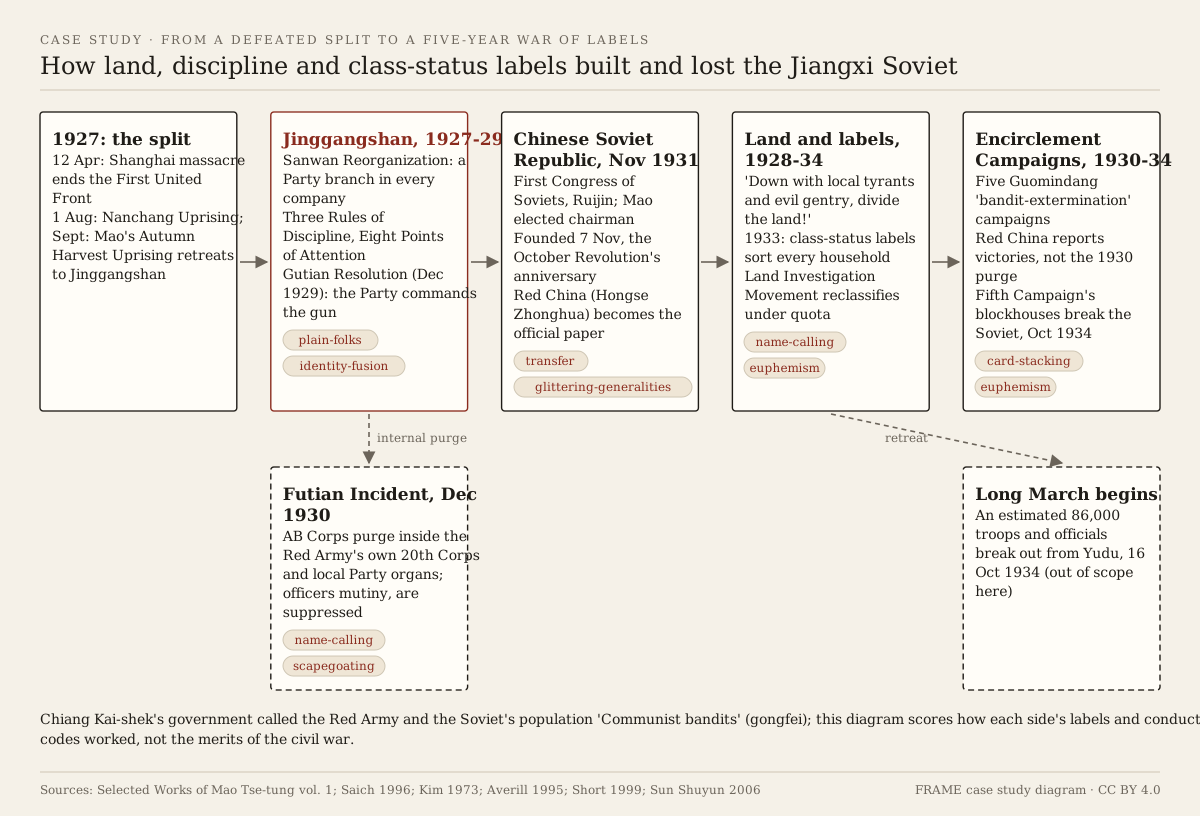
In one line: Between the 1927 split from the Guomindang and the October 1934 retreat that became the Long March, the Chinese Communist Party built peasant support in its rural base areas with land-confiscation slogans and a published discipline code for the Red Army, built party control over the army through a doctrine that fused military obedience with loyalty to the party line, built the Chinese Soviet Republic's legitimacy by borrowing the Russian Revolution's name, flag and calendar, and, especially from 1930, built and enforced a taxonomy of class-status labels that sorted villagers and cadres alike into those to be won over and those to be confiscated from, purged or killed.
What happened
- 12 April 1927. Chiang Kai-shek's Guomindang forces and allied Shanghai gangs kill Communist Party members and striking workers in the Shanghai Massacre; further killings of Communists follow in Guangzhou (Canton), Changsha and elsewhere through 1927. The First United Front between the Guomindang and the Communist Party, in place since 1923, collapses; by 15 July the Wuhan-based "left" Guomindang government under Wang Jingwei has also broken with the Communists.
- 1 August 1927. Communist-led units under He Long, Ye Ting, Zhu De and Zhou Enlai seize Nanchang, Jiangxi, in the party's first armed uprising. The Guomindang retakes the city within days and the rebel force retreats south, but 1 August is kept as the Red Army's (and later the People's Liberation Army's) founding date.
- September 1927. Mao Zedong leads the Autumn Harvest Uprising in Hunan; it is defeated within weeks. Mao takes the surviving force, a few hundred to about a thousand men, toward the Jinggangshan mountains on the Hunan-Jiangxi border.
- Late September-early October 1927: the Sanwan Reorganization. At Sanwan, Mao restructures the remaining troops: a Communist Party branch is set up in every company, with a party representative alongside the military commander at each level, and soldiers' committees are given a voice in unit affairs. This is the organisational root of the doctrine later stated as "the Party commands the gun."
- 1927-1928: the discipline code. At Jinggangshan, Mao sets out rules of conduct toward civilians, developed and restated over the following two years and eventually canonised as the Three Rules of Discipline (obey orders in all your actions; do not take a single needle or piece of thread from the masses; turn in everything captured) and the Eight Points of Attention (speak politely; pay fairly for what you buy; return everything you borrow; pay for anything you damage; do not hit or swear at people; do not damage crops; do not take liberties with women; do not ill-treat captives). The wording was not fixed in one document; it was revised through the Jinggangshan and Jiangxi years and reached the form quoted above only by the late 1930s-40s, but its content and purpose, distinguishing Red Army conduct from the requisitioning and looting associated with warlord and Guomindang troops, date from this period.
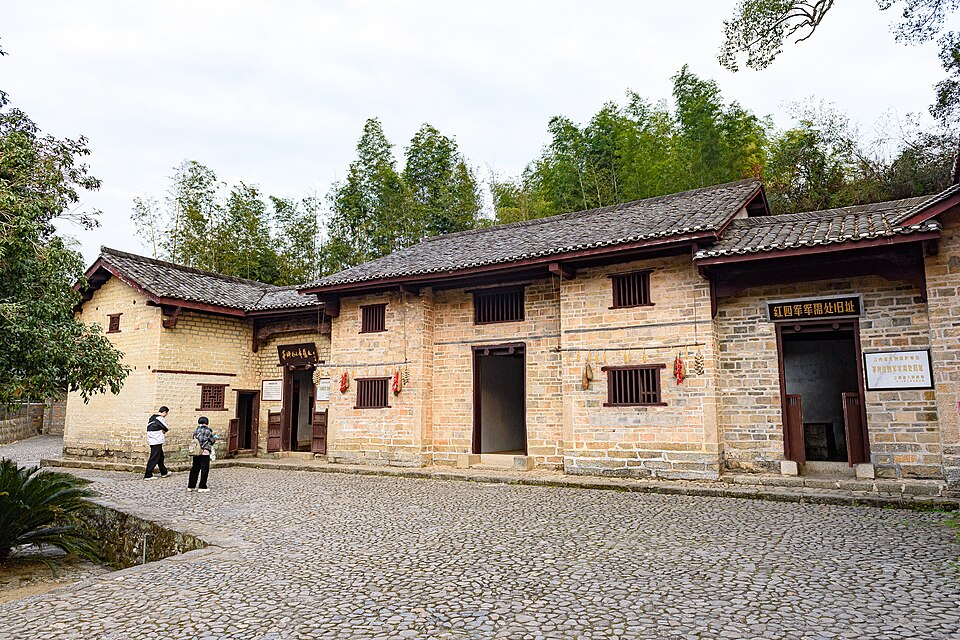
Former residence of Mao Zedong at Bajiaolou, Maoping, near Jinggangshan, Jiangxi, used from October 1927 to January 1929 according to the file description; signboards at the doors mark it as a preserved site. Photographed 23 January 2025 by N509FZ, via Wikimedia Commons. CC BY-SA 4.0. - April 1928. Zhu De and Chen Yi's remnant of the Nanchang force reaches Jinggangshan and merges with Mao's; the combined force becomes the Fourth Red Army ("the Zhu-Mao Red Army"). - December 1928: the Jinggangshan Land Law. The base area's first land law orders the confiscation of all land, not only landlords', for redistribution. It is the first Chinese Communist land law and the model the Central Soviet Area's later laws revise. - April 1929: the Xingguo Land Law. A revision, adopted after the base moved into southern Jiangxi, confiscates public land and land held by "local tyrants, evil gentry" (tuhao lieshen) and other identified class enemies rather than all land, exempting small holdings, in response to the earlier law's effect on middle peasants. - 7-12 December 1930: the Futian Incident. Mao's General Front Committee, hunting for members of the "AB Corps" (originally a small anti-Communist secret society the Guomindang had run in Jiangxi in 1926, the label was extended into a general charge of hidden counter-revolutionary infiltration), arrests and tortures officers of the Red Army's 20th Corps and local Jiangxi party and Soviet officials at Futian, extracting confessions under torture. Believing they would be next, a group of 20th Corps officers and local officials led by Liu Di free the prisoners, arrest the purge's investigators and briefly denounce Mao before Zhu De's and Peng Dehuai's forces suppress the mutiny. The wider AB Corps purge, of which Futian is the best-documented episode, ran through the Jiangxi and other Communist base areas into 1931; historians' death estimates for it range from several thousand to more than ten thousand, a range treated as contested below. - 7 November 1931: the First National Congress of Soviets. At Ruijin, Jiangxi, the congress proclaims the Chinese Soviet Republic (Zhonghua Suweiai Gongheguo), with a constitution, a red flag bearing a hammer and sickle, and "The Internationale" as its anthem. The date, 7 November on the Gregorian calendar, is the anniversary of the Russian October Revolution. Mao is elected chairman of the Central Executive Committee and of the Council of People's Commissars; Zhu De commands the Red Army. In December the government's official paper, Hongse Zhonghua (Red China), begins publication at Ruijin.
.jpg)
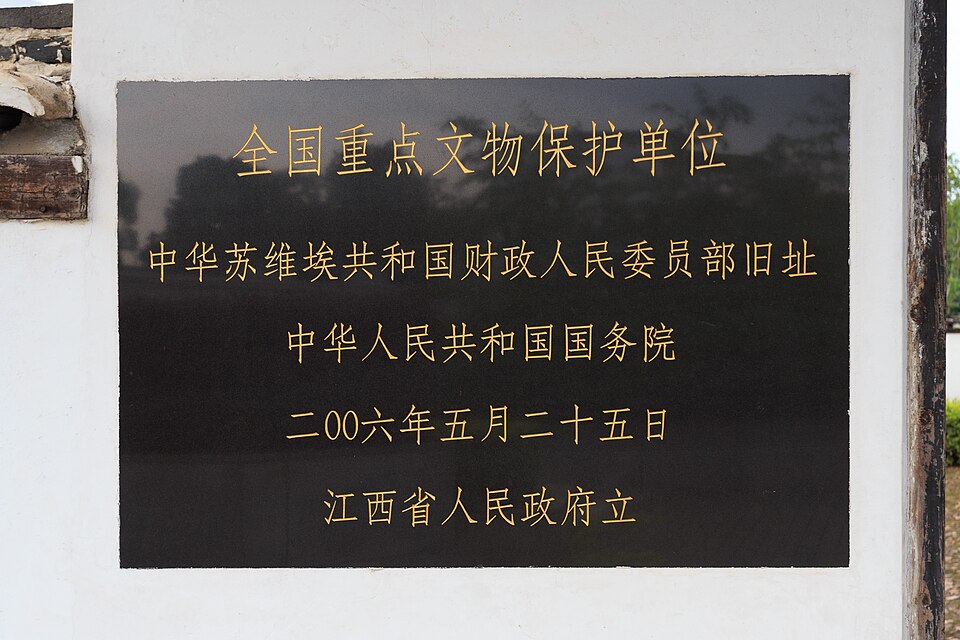
Protection plaque at the former office of the Finance People's Commissariat of the Chinese Soviet Republic, Shazhouba, Ruijin, Jiangxi. The plaque names the site as a national key cultural-relic protection unit and is dated 25 May 2006 (State Council of the People's Republic of China; erected by the Jiangxi provincial government). Photographed 30 May 2014 by Zhangzhugang, via Wikimedia Commons. CC BY-SA 3.0 (also GFDL). - 1930-1934: the Encirclement Campaigns. Chiang Kai-shek's government launches five "encirclement and suppression" (weijiao) campaigns against the Central Soviet Area, calling Red Army soldiers and the Soviet's population "Communist bandits" (gongfei). The Red Army under Zhu De and Mao repels the first (December 1930-January 1931), second (April-May 1931) and third (July-September 1931, cut short when Chiang withdrew troops after Japan's Mukden Incident) campaigns using mobile warfare, luring Guomindang columns into the Soviet's interior before concentrating force against them. The fourth campaign (1932-33) is also repelled. Through this period Mao is gradually removed from military command inside the party's own leadership, which by 1932-33 is dominated by the Shanghai-trained "Returned Students" faction around Bo Gu and Comintern military adviser Otto Braun (Li De). - 1933: class-status labels. Party directives, including Mao's "How to Differentiate the Classes in the Rural Areas" (1933), set out a standard taxonomy, landlord, rich peasant, middle peasant, poor peasant, worker, with stated criteria (chiefly whether and how much a household's income came from others' labour rather than its own) for sorting every rural household. The labels determine land allocation, tax and grain-requisition burdens, and standing in the Soviet's institutions. - June 1933-1934: the Land Investigation Movement (chazhian yundong). Mao calls for a drive to find households that had escaped correct classification, landlords and rich peasants who had gone unlabelled, or poor and middle peasants wrongly labelled the other way, and to seize the land and grain due under the class labels. Run under quotas amid the war with the Guomindang, the campaign is documented as coercive: local cadres reclassified households to meet targets, and reclassification could mean confiscation, loss of Soviet citizenship rights and, in the more violent local applications, arrest or worse. - October 1933-October 1934: the Fifth Campaign. Advised by German general Hans von Seeckt, Chiang's forces abandon deep thrusts for a slow "blockhouse strategy," ringing the Soviet with thousands of small fortifications and an economic blockade rather than seeking battle. The Central Committee's leadership under Bo Gu and Otto Braun answers with positional warfare rather than the earlier mobile tactics, and the Soviet's territory steadily shrinks through 1934. - 16 October 1934. An estimated 86,000 Red Army soldiers, officials and porters break out from Yudu, Jiangxi, beginning the retreat that within a year becomes known as the Long March; the remaining Central Soviet Area falls to Guomindang forces by the end of 1934. The Long March's own propaganda and myth-making lie beyond this page's scope; the base area the marchers eventually reached is covered in The Yan'an Rectification Movement: doctrine, self-criticism and the Rescue Campaign (1942-1945) and The Mao cult before the state: 'Mao Zedong Thought' and 'The East Is Red', 1943-1949, the war years that followed in Chinese wartime propaganda, 1937-1945: Chongqing, Yan'an and Wang Jingwei's Nanjing, and the postwar civil war and the land-reform campaigns that carried this page's class-status labels into areas the party had never governed in Propaganda of the Chinese Civil War, 1945-1949: land reform, surrender leaflets and the fall of the mainland and Land reform and the struggle session: how the CCP's class labels decided who kept their land, 1946-1952.

How it works
- Name-calling: "local tyrants and evil gentry" (tuhao lieshen) named a category, not a specific act, and the 1933-34 class-status labels (landlord, rich peasant) did the same: a household's label, not a documented deed, decided its treatment. The AB Corps purge extended the same move inward, turning "possible AB Corps member" into a label that made torture and confession-extraction the investigation.
- Scapegoating: land-confiscation propaganda placed rural poverty on landlords and gentry as a class. The Futian Incident scapegoated setbacks and dissent inside the Red Army and the party itself onto an alleged hidden network, so that a hunt for it, rather than the war with the Guomindang, briefly became the movement's own crisis.
- Glittering generalities: the Chinese Soviet Republic's 1931 constitution and congress proceedings promised a "workers' and peasants' democratic dictatorship," "Soviet democracy" and rights for the "toiling masses," virtue words that, like any government's, said less about what would happen to a given household than its class label did.
- Plain folks: the Three Rules of Discipline and Eight Points of Attention are a conduct code performed for a rural audience that had reason to fear any armed force: pay for what you take, speak politely, return what you borrow. Whatever its record in practice, the code's stated purpose was to make Red Army soldiers look and act unlike warlord and Guomindang troops who requisitioned and looted.
- Identity fusion: the Gutian Resolution's doctrine that "the Party commands the gun" fused military obedience to the party's current line; officers who argued for a military logic against the party's political one were accused of a "purely military viewpoint." During the Land Investigation Movement and the AB Corps purge, questioning a classification or an accusation could itself be read as evidence of the wrong class standing or hidden sympathy.
- Card stacking: Red China, the Soviet's official paper from December 1931, reported the repelled Encirclement Campaigns as vindication of the leadership without reporting the Futian Incident, the Land Investigation Movement's coercive quotas, or the party's own internal leadership struggles to the same public.
- Euphemism / doublespeak: "Land Investigation Movement" names a coercive, quota-driven reclassification and confiscation drive as an administrative inquiry. On the other side, "encirclement and suppression campaigns" (weijiao) and "bandit extermination" cast a civil war against an armed rival government as police action against banditry.
- Transfer: naming the new state the "Chinese Soviet Republic," dating its founding congress to the anniversary of the Russian October Revolution, and adopting a hammer-and-sickle flag and "The Internationale" as its anthem borrowed the prestige of the Bolshevik Revolution for a government that had not yet won a civil war or been recognised by any other state.
Then and now
North Korea's songbun system sorts the entire population into hereditary status categories (core, wavering, hostile, and finer subdivisions), determined largely by a family's actions and associations before and during the Korean War, and used since to decide access to party membership, housing, education, rationing and marriage prospects (Robert Collins, Marked for Life: Songbun, North Korea's Social Classification System, Committee for Human Rights in North Korea, 2012). The mechanism is the same one tagged Name-calling above: a status label, assigned by the state rather than earned by a specific act, decides how a person is treated.
The differences are large. The Jiangxi Soviet's class-status labels applied to a war-time base area of an estimated 2 to 3.5 million people for at most a few years before the Soviet fell in 1934, and reassignment during the Land Investigation Movement, however coercive, was a campaign with a start and an end. Songbun has applied to a state's entire population of roughly 26 million continuously since the 1950s-60s, is hereditary across generations, and has never been reversed or investigated by an independent body.
Positions on the record
- The Chinese Communist Party's position at the time. Mao's 1927 "Report on an Investigation of the Peasant Movement in Hunan" argued that the poor-peasant-led movement against "local tyrants and evil gentry" was a necessary and overdue "revolutionary upsurge," and defended its harshness in terms that are quoted below. The 1931 Chinese Soviet Republic constitution presented land confiscation, class-status categories and Soviet institutions as instruments of "genuine democracy" for workers and peasants against landlords, "capitalists," and the Guomindang. The Gutian Resolution presented party control of the army and the discipline code as the correction of a "purely military viewpoint" that had let the Red Army drift from its political tasks.
- The Guomindang's position at the time. Chiang Kai-shek's government treated the Communist bases as an illegal insurgency to be put down like banditry, hence "bandit-extermination" and "encirclement and suppression"; its own land and rural-reconstruction policy in Guomindang-held areas, though far less thoroughgoing, was framed as an answer to the same rural grievances the Communists organised around.
- What is documented. The dates and texts of the Sanwan Reorganization, the Jinggangshan and Xingguo Land Laws, the Gutian Resolution, the 1931 constitution and congress, the five Encirclement Campaigns, and the October 1934 breakout; the Futian Incident's arrests, torture and suppression of the mutiny; the Land Investigation Movement's use of quotas.
- What is contested. The death toll of the AB Corps purge across the Central Soviet Area. Stephen Averill's study of the Futian Incident and the wider purge (in Saich and van de Ven, eds., New Perspectives on the Chinese Communist Revolution, 1995) treats the numbers as poorly documented and disputes some of the political motives later attributed to Mao personally. Jung Chang and Jon Halliday's Mao: The Unknown Story (2005) gives much higher figures and a more personally culpable account than most academic historians accept; their book's evidence and conclusions have been disputed by China historians including Gregor Benton, Steve Tsang and others in published reviews. This page does not adopt a single death toll as established.
- Not ruled on here. Whether land confiscation and class-status categorisation were, on balance, justified by the rural conditions of 1920s-30s China, or whether the Guomindang's rural policy in areas it held was adequate to the same grievances. This page scores how the labels, the discipline code and the state's borrowed symbols were built and used, not the wider argument between the two governments.
Mao's own words on method, from the same 1927 report: "A revolution is not a dinner party, or writing an essay, or painting a picture, or doing embroidery; it cannot be so refined, so leisurely and gentle, so temperate, kind, courteous, restrained and magnanimous. A revolution is an insurrection, an act of violence by which one class overthrows another." The same report defends, without giving a specific casualty figure, a "brief reign of terror" against landlords and gentry as necessary to break their authority in the countryside. The passage is quoted as primary evidence of how the movement described its own methods, per the content note at the top of this page, not as this archive's assessment of them.
Same-method test
- The Soviet Union. "Kulak" (a supposedly rich peasant, defined loosely enough that local officials applied it to almost any peasant resisting collectivisation) did the same work as "landlord" and "rich peasant" in the Jiangxi taxonomy: a status label, not a specific act, triggering confiscation, deportation or worse during Soviet dekulakisation and collectivisation from 1929 to 1933. See "Liquidate the kulaks as a class": the propaganda campaign for collectivization (1929-1933), and Lynne Viola's The Unknown Gulag (2007) and Sheila Fitzpatrick's Stalin's Peasants (1994).
- The United States, a fair Western-democracy example. Continental Army orders under George Washington during the American Revolution, and his 1776 and 1777 directives against plundering civilians in New Jersey and Pennsylvania, aimed in part to distinguish the Continental Army's conduct from that of British and Hessian foraging parties and to win over a wary civilian population, the same use Plain folks describes above for the Three Rules and Eight Points (David Hackett Fischer, Washington's Crossing, Oxford University Press, 2004). The scale and mechanism of enforcement differed: Washington's army had courts-martial and a chain of command answerable to the Continental Congress, not a parallel party structure fused to the military as at Gutian.
- Vietnam. Ho Chi Minh's proclamation of the Democratic Republic of Vietnam at Ba Dinh Square on 2 September 1945 opens by quoting the American Declaration of Independence ("All men are created equal. They are endowed by their Creator with certain unalienable rights...") before turning to French colonial rule, a use of Transfer that borrows the prestige of a rival great power's founding document for a Communist-led state's own founding, just as the Chinese Soviet Republic borrowed the Bolshevik Revolution's calendar and symbols four years earlier.
- Where they differ. The scale of each case differs by orders of magnitude: Jiangxi's class-status labelling ran for a year or two in a war-time base area; Soviet dekulakisation deported and killed on a scale historians measure in the millions across the whole USSR; Washington's orders governed one army during one war and left no lasting institution; Ho's proclamation borrowed language, not a governing structure. The same tag names the same mechanism at very different scales and with very different consequences.
How to spot it
- Ask what act, on what date, a label refers to. "Local tyrants and evil gentry," "landlord," "rich peasant," "AB Corps member" and "kulak" name a status or a kind of person; a charge names a deed.
- Check who assigns the label and by what standard, and whether the standard (income from others' labour, land held, past associations) is public and checkable, or applied under a quota with no appeal.
- Look for a conduct code advertised to a watching population (pay for what you take, do not loot) and ask whether it was checkable and enforced, not only proclaimed.
- Ask what a new movement's or state's name, flag, anthem or founding date borrows from an earlier one, and whether it is claiming that precedent's legitimacy rather than earning its own.
- Watch for an internal hunt for hidden enemies (AB Corps, "wreckers," "spies") that runs alongside, and sometimes overtakes, the stated external fight; ask what evidence beyond a confession under duress was produced.
Images
| Image | Source | Licence |
|---|---|---|
| Mechanism diagram (above) | Drawn for FRAME from the sources below (make_diagrams_rtp_jiangxi.py) |
CC BY 4.0, FRAME |
| Former residence of Mao Zedong, Bajiaolou, Maoping, 2025 | Wikimedia Commons; photograph by N509FZ | CC BY-SA 4.0 |
| Protection plaque, Ruijin Shazhouba site, 2014 | Wikimedia Commons; photograph by Zhangzhugang | CC BY-SA 3.0 and GFDL |
Image gaps
- Members of the Bureau of the Central Committee of the Soviet Regions, Ruijin, Jiangxi (November 1931). Shows the Soviet's own leadership (Gu Zuolin, Ren Bishi, Zhu De, Deng Fa, Xiang Ying, Mao Zedong and Wang Jiaxiang, per the file page) at the moment this page covers. Commons tags it public domain in China and, by its URAA reasoning, in the United States, but the file's stated source is a Russian biography website, the author is unknown and the date of first publication is not documented, so the U.S. basis could not be confirmed here. Not hosted: commons.wikimedia.org/wiki/File:Members_of_the_Bureau_of_the_Central_Committee_of_the_Soviet_Regions_in_Ruijin,Jiangxi(1931).jpg.
- 1931 military parade marking the founding of the Chinese Soviet Republic, and the National Emblem of the Chinese Soviet Republic (a 2012 Commons vector recreation). Both carry an explicit Commons warning that, despite being public domain in China, they may not be public domain in the United States under the URAA. Not hosted: commons.wikimedia.org/wiki/File:1931_military_parade_of_formation_of_Chinese_Soviet_Republic.jpg; commons.wikimedia.org/wiki/File:National_Emblem_of_the_Chinese_Soviet_Republic.svg.
- The Jinggangshan or Xingguo Land Law, a Three Rules of Discipline wall slogan, or a Red China (Hongse Zhonghua) front page. No openly licensed digitisation of these specific 1928-34 documents was located from Commons or loc.gov. The Library of Congress's Chinese poster and periodical holdings begin in the 1930s-40s wartime and postwar periods (see Chinese wartime propaganda, 1937-1945: Chongqing, Yan'an and Wang Jingwei's Nanjing) and do not reach back to the Jiangxi Soviet's own printed material.
- Struggle sessions, confiscations, or the Futian Incident's executions. No openly licensed photograph of any of these was found; photographs of identifiable victims would also raise dignity concerns even if a licensed one existed.
.jpg)


Sources
- Mao Zedong, "Report on an Investigation of the Peasant Movement in Hunan" (March 1927), in Selected Works of Mao Tse-tung, vol. 1, Foreign Languages Press: marxists.org.
- Mao Zedong, "Why Is It That Red Political Power Can Exist in China?" (5 October 1928), Selected Works, vol. 1: marxists.org.
- Mao Zedong, "The Struggle in the Chingkang Mountains" (25 November 1928), Selected Works, vol. 1: marxists.org.
- Mao Zedong, "On Correcting Mistaken Ideas in the Party" (the Gutian Resolution, December 1929), Selected Works, vol. 1: marxists.org.
- Mao Zedong, "How to Differentiate the Classes in the Rural Areas" (1933), Selected Works, vol. 1: marxists.org.
- Tony Saich, ed., The Rise to Power of the Chinese Communist Party: Documents and Analysis (M. E. Sharpe, 1996), for the Chinese Soviet Republic's 1931 constitution and Central Committee land and class-status directives.
- Ilpyong J. Kim, The Politics of Chinese Communism: Kiangsi under the Soviets (University of California Press, 1973).
- Stephen C. Averill, "The Origins of the Futian Incident," in Tony Saich and Hans van de Ven, eds., New Perspectives on the Chinese Communist Revolution (M. E. Sharpe, 1995).
- Philip Short, Mao: A Life (Henry Holt, 1999).
- Alexander V. Pantsov with Steven I. Levine, Mao: The Real Story (Simon & Schuster, 2012).
- Jung Chang and Jon Halliday, Mao: The Unknown Story (Jonathan Cape, 2005), for the higher, disputed AB Corps casualty estimates discussed under "What is contested."
- Otto Braun, A Comintern Agent in China, 1932-1939, trans. Jeanne Moore (Stanford University Press, 1982), for the Fifth Campaign and the Bo Gu-Braun leadership's military line.
- Jonathan Fenby, Chiang Kai-shek: China's Generalissimo and the Nation He Lost (Carroll & Graf, 2003), for the Guomindang side of the Encirclement Campaigns.
- Hans J. van de Ven, War and Nationalism in China, 1925-1945 (RoutledgeCurzon, 2003).
- Sun Shuyun, The Long March: The True History of Communist China's Founding Myth (HarperCollins, 2006), for the October 1934 breakout and its numbers.
- Edgar Snow, Red Star over China (Gollancz, 1937), an early outside account (from 1936) of the Red Army's discipline code and the base areas, written just after this page's period ends.
- Lynne Viola, The Unknown Gulag: The Lost World of Stalin's Special Settlements (Oxford University Press, 2007), and Sheila Fitzpatrick, Stalin's Peasants: Resistance and Survival in the Russian Village after Collectivization (Oxford University Press, 1994), for the Soviet "kulak" comparison in the same-method test.
- David Hackett Fischer, Washington's Crossing (Oxford University Press, 2004), for the Continental Army comparison in the same-method test.
- Ho Chi Minh, "Declaration of Independence of the Democratic Republic of Vietnam" (2 September 1945): Vietnamese government English translation, Ministry of Foreign Affairs archive.
- Robert Collins, Marked for Life: Songbun, North Korea's Social Classification System (Committee for Human Rights in North Korea, 2012), for the "then and now" comparison.
- Wikimedia Commons file pages linked in the Images table and Image gaps above, read 28 September 2026.