Content note. This page quotes loyalty-oath language from the "two whatevers" editorial and describes a state-choreographed mourning ritual. Quoting that language is not an endorsement. The arrest and trial of the Gang of Four, the fuller repudiation of Cultural Revolution-era verdicts, and the CCP's 1981 history resolution are each covered in more depth on sibling FRAME case studies linked below; this page stays inside the September 1976 death, mourning and succession moment and the "two whatevers" formula it produced.
In one line: The Chinese state withheld news of Mao Zedong's 9 September 1976 death for sixteen hours, then staged a scripted week of national mourning that culminated in Hua Guofeng delivering the eulogy from the Tiananmen rostrum; Hua's camp then publicised a contested handwritten note, "with you in charge, I am at ease," and a February 1977 formula binding the party to uphold "whatever" Mao had decided — a doctrine of continuity so rigid it became, within about two years, the very thing Deng Xiaoping's camp organised to remove.
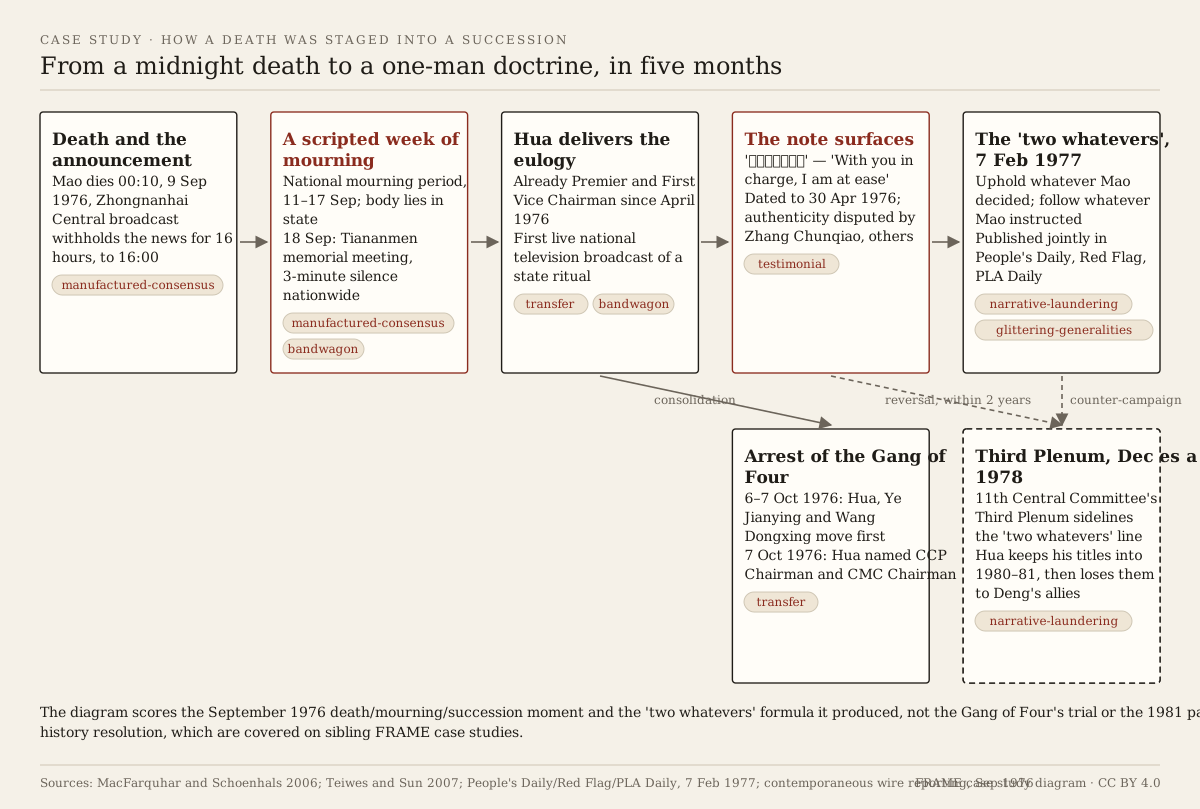
What happened
- 8 January 1976. Premier Zhou Enlai dies. His death, and the informal mourning for him that authorities suppress around the 5 April 1976 Tiananmen Incident, leaves the premiership open and hardens the factional contest over who follows Mao.
- 7 April 1976. Acting on the Politburo's resolution — reported the next day in the party press — Mao endorses stripping Deng Xiaoping of all his posts (he keeps his party membership) over the Tiananmen Incident, and Hua Guofeng, until then a relatively obscure former Hunan official who had risen through the Ministry of Public Security, is named First Vice Chairman of the CCP Central Committee and Premier of the State Council — the first time anyone but Mao had held the title of Vice Chairman with the clear implication of succession.
- 30 April 1976. Mao, his speech badly impaired by illness, meets New Zealand Prime Minister Robert Muldoon with Hua Guofeng present. Afterward, communicating in writing as he increasingly had to, Mao reportedly hands Hua three notes: "慢慢来,不要着急" ("Take your time, don't rush"), "照过去方针办" ("Act according to past principles"), and the phrase that would carry the most political weight, "你办事,我放心" ("With you in charge, I am at ease"). See "What is contested" below on the notes' authentication.
- 9 September 1976, 00:10. Mao Zedong dies at Zhongnanhai in Beijing, aged 82.
- 9 September 1976, 16:00. The Central People's Broadcasting Station and Xinhua formally announce the death nationwide — roughly sixteen hours after it occurred — together with a joint message issued in the name of the CCP Central Committee, the State Council, the Central Military Commission and the Standing Committee of the National People's Congress, declaring a national mourning period from 11 to 17 September.
- 11-17 September 1976. Mao's body lies in state at the Great Hall of the People as delegations file past; flags fly at half-mast; ordinary broadcasting and entertainment programming are suspended for the week.
- 18 September 1976. A state memorial meeting is held in Tiananmen Square. Hua Guofeng, already Premier and First Vice Chairman, delivers the eulogy from the Tiananmen rostrum. A three-minute nationwide silence is observed, marked by factory whistles, train and ship sirens, and the ceremony is broadcast live nationally — reported as the first time Chinese state television had carried such a ritual live. Press estimates commonly cited for the Tiananmen crowd run to roughly one million.
- Late 1976. Rather than honour a 1956 pledge, which Mao himself had signed, that senior leaders be cremated, the leadership decides to preserve Mao's body permanently. Construction begins in November 1976 on a mausoleum at the south end of Tiananmen Square; it opens on the first anniversary of Mao's death, 9 September 1977.
- 6-7 October 1976. Hua Guofeng, Marshal Ye Jianying and security chief Wang Dongxing move against the Gang of Four (Jiang Qing, Zhang Chunqiao, Yao Wenyuan and Wang Hongwen), arresting them at a Politburo meeting on 6 October. The Politburo confirms Hua as Chairman of the CCP Central Committee and Chairman of the Central Military Commission the next day, 7 October — giving him, simultaneously, the top posts in party, government and army, a combination only Mao himself had previously held. The arrest and its own propaganda campaign are covered in full on The Gang of Four: arrest, denunciation and a trial that closed the Cultural Revolution's books (1976-1981).
- Autumn 1976 onward. In the weeks around the arrest, Hua's supporters publicise the "with you in charge, I am at ease" note as Mao's personal authorization of the succession. Posters pairing Hua's portrait with Mao's, and public commentary describing Hua's hairstyle and manner as recalling Mao's own, circulate nationally through 1977 as part of what later scholarship calls Hua's own, smaller-scale cult of personality.
- 7 February 1977. The joint editorial "Study the Documents Well and Grasp the Key Link" (学好文件抓住纲) runs simultaneously in People's Daily, Red Flag and PLA Daily, stating what becomes known as the "two whatevers": "We will resolutely uphold whatever policy decisions Chairman Mao made, and unswervingly follow whatever instructions Chairman Mao gave" (凡是毛主席作出的决策,我们都坚决维护;凡是毛主席的指示,我们都始终不渝地遵循).
- 1977. From semi-eclipse, Deng Xiaoping writes to the Central Committee arguing that Mao Zedong Thought must be applied "accurately and completely" (完整准确地) rather than treated as an unrevisable checklist — an implicit but pointed rebuttal of the two whatevers, made before Deng had recovered his formal posts.
- July 1977. The Third Plenum of the 10th Central Committee restores Deng Xiaoping to his party, government and military positions.
- 11 May 1978. "Practice Is the Sole Criterion for Testing Truth" runs in Guangming Daily, reprinted within days in People's Daily and PLA Daily, opening the "truth criterion debate" that undercuts the two whatevers' underlying claim — that Mao's own word, rather than the test of practice, settles what policy should be.
- December 1978. The Third Plenum of the 11th Central Committee marks Deng's political ascendancy. Its communique moves the party toward "reform and opening" and away from the two-whatevers approach, without yet stripping Hua of his titles. This turn, and the fuller repudiation of Cultural Revolution-era verdicts that follows it, are covered on Boluan Fanzheng: how Deng Xiaoping's faction used a debate about truth to break Hua Guofeng's hold on power, 1977-1981.
- 1980-81. Hua Guofeng is replaced as Premier by Zhao Ziyang in September 1980 and as CCP Chairman by Hu Yaobang in June 1981; party documents of this period criticise the "two whatevers" by name. The CCP's own retrospective verdict on this whole period, including on Hua's formula, is the subject of The 1981 Resolution: how the Chinese Communist Party engineered a single verdict on Mao. Hua kept his Central Committee membership for two more decades and received a state funeral on his death in 2008 — an unusually mild landing, by the standard of CCP power struggles, for a leader stripped of his top posts.
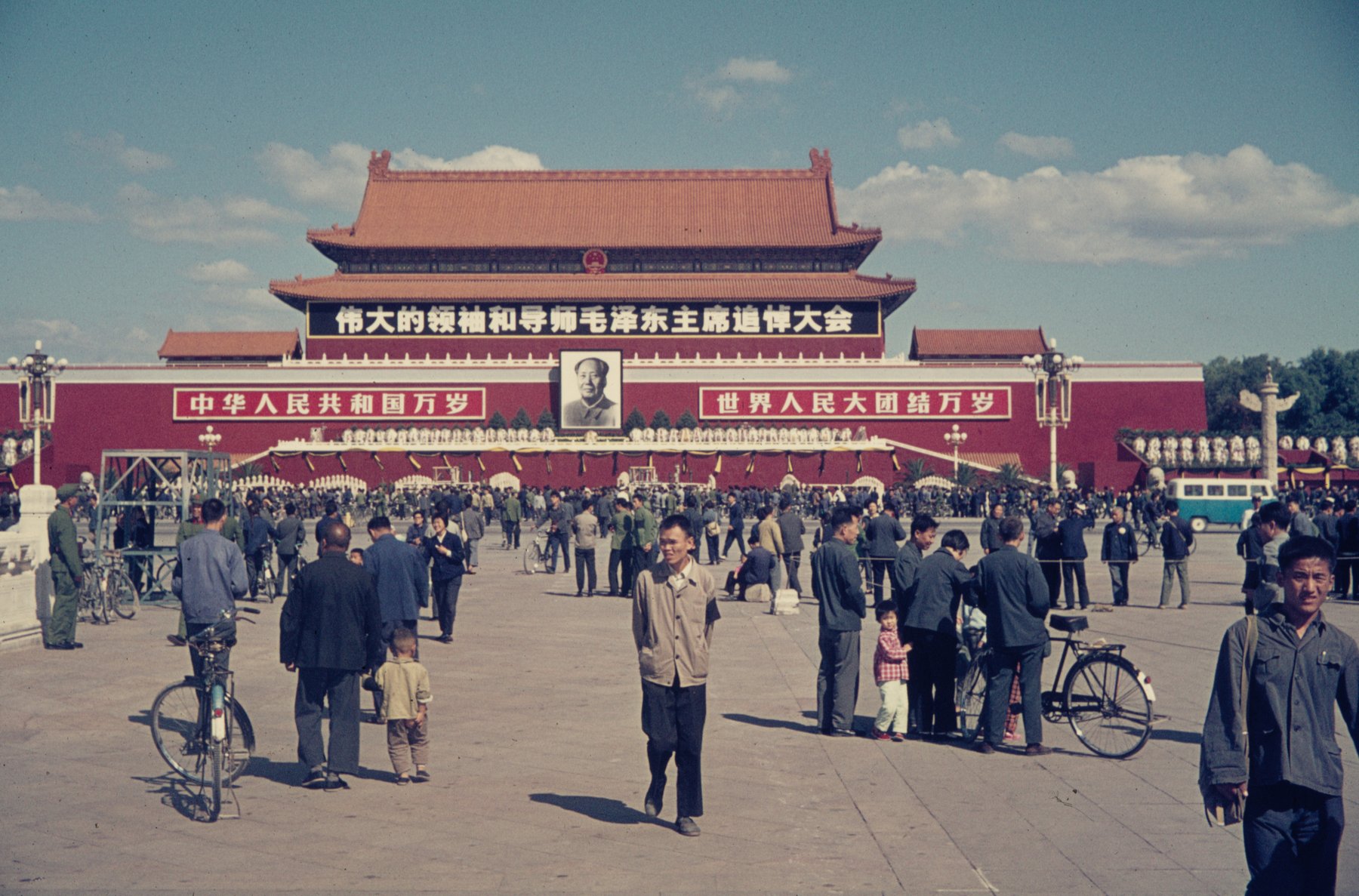
The Gate of Heavenly Peace still dressed for the mourning period a few days after the 18 September 1976 memorial meeting: the banner reads "伟大的领袖和导师毛泽东主席追悼大会" ("Memorial meeting for the great leader and teacher Chairman Mao Zedong"), flanked by "中华人民共和国万岁" ("Long live the People's Republic of China") and "世界人民大团结万岁" ("Long live the great unity of the world's people"). Photograph by Karl-Heinz Wellmann, September 1976, own work, CC BY-SA 4.0, via Wikimedia Commons.
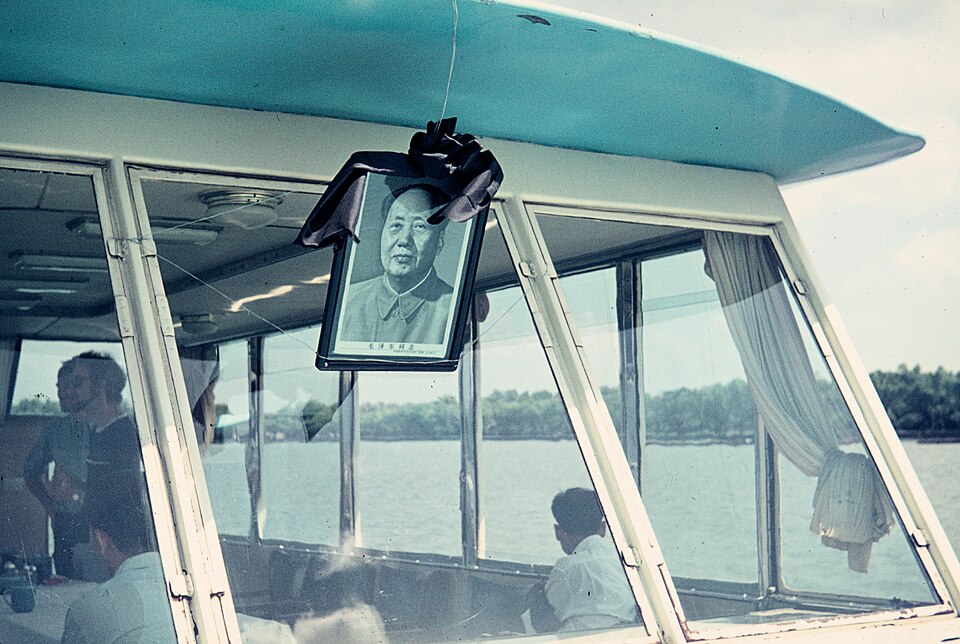
A framed portrait of Mao Zedong tied with a black mourning ribbon hangs in the window of a tour boat on West Lake, Hangzhou, September 1976, shortly after his death. Photograph by Karl-Heinz Wellmann, own work, CC BY-SA 4.0, via Wikimedia Commons; downscaled to 960 px wide.
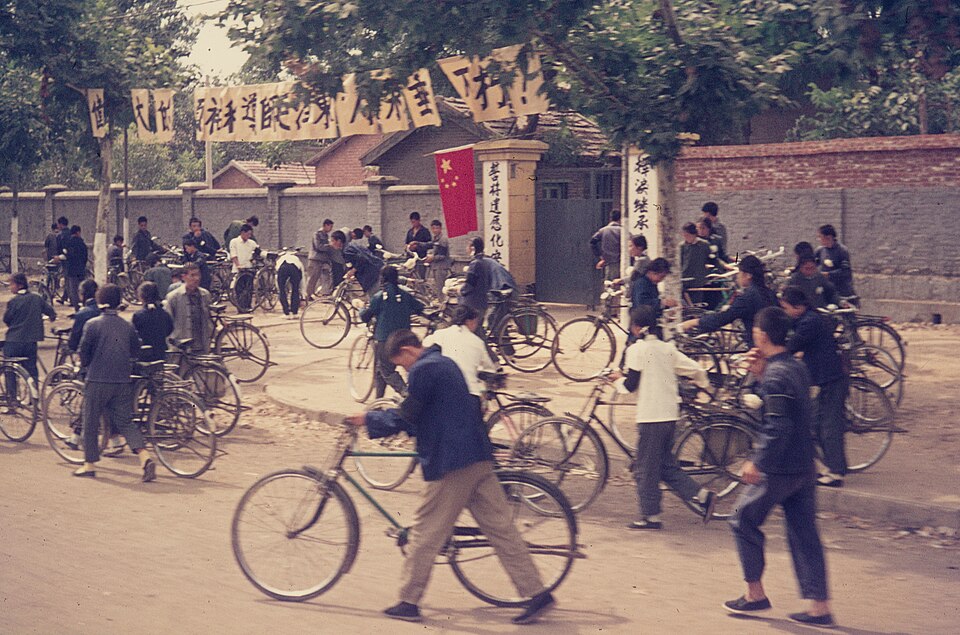
People with bicycles gathered outside a gateway flying the PRC flag and hung with banners, China, September 1976. The photographer's Commons description reads: "A few days after the death of Mao Zedong, employees of state-owned enterprises all over China (PRC) drive in large groups to central mourning ceremonies." The banner text is not legible at this size, so the picture is shown as a record of the gathering, not of what the banners say. Photograph by Karl-Heinz Wellmann, own work, CC BY-SA 4.0, via Wikimedia Commons; downscaled to 960 px wide.
How it works
- Testimonial: "With you in charge, I am at ease" is presented as Mao's own, personal, handwritten word — the strongest possible form of endorsement inside a system that had spent over a decade building Mao's individual authority into unquestionable doctrine (see The Mao cult before the state: 'Mao Zedong Thought' and 'The East Is Red', 1943-1949). Its force depends entirely on it being read as Mao's genuine, unprompted judgment rather than a claim made on his behalf by people who benefited from it being believed.
- Transfer: the "two whatevers" formula transfers Mao's own accumulated ideological authority wholesale onto whatever Hua Guofeng did in Mao's name, without requiring any specific argument for a specific decision. The choreography of the mourning ritual itself — the eulogy delivered from the same rostrum where Mao had reviewed Red Guard rallies a decade earlier, the portrait and banners on the Tiananmen gate — borrowed the same site's accumulated symbolic weight for Hua's introduction as chief mourner and successor.
- Narrative laundering: the two whatevers reframes an inherently political choice — freezing Cultural Revolution-era policy in place rather than revisiting any of it — as simple, uncontroversial loyalty to a dead leader. It forecloses the distinction between honouring Mao's memory and being unable to correct a single one of his decisions, a distinction the formula's own drafters had every reason to blur.
- Manufactured consensus: a sixteen-hour delay between Mao's death and its announcement gave the state time to script the response before word could spread informally; the mourning period that followed — obligatory work stoppages, suspended entertainment broadcasting, a synchronised three-minute silence marked by sirens nationwide — presented what was substantially compelled, uniform behaviour back to the country as its own spontaneous grief, and by extension as endorsement of whoever the ritual placed at its centre.
- Bandwagon: press estimates of roughly one million people at the Tiananmen memorial meeting, and reporting that treated near-universal national participation in the silence as simple fact, framed joining the mourning — and accepting its succession script — as what everyone else was already doing.
- Glittering generalities: "resolutely uphold" and "unswervingly follow" are loyalty words that assert total commitment without specifying which of Mao's many, sometimes contradictory, decisions and instructions were meant — a vagueness that let the phrase function as an oath of fidelity to Hua's continuity claim rather than as an argument for any specific policy.
Then and now
The same mechanism — a claimed posthumous mandate from a dead founder, used to install and then constrain a chosen successor — recurs in North Korea's transition from Kim Il Sung to Kim Jong Il, documented at greater length on FRAME's The Kim leader cult, the anti-US month and the leaflets sent back. Kim Il Sung died on 8 July 1994; North Korean state media declared a ten-day mourning period, and Kim Jong Il, who (unlike Hua) had already been the Workers' Party's formally designated successor for well over a decade, based the legitimacy of his rule on his father's accumulated "instructions" rather than on any new policy of his own — a mode of governing Korea scholars (Lankov, Myers) describe with the term yuhun tongchi (유훈통치), "rule by [posthumous] instruction." The mechanism matches Hua's two whatevers closely: continuity with a dead leader's word substitutes for a successor's own political argument.
The scale and durability differ sharply. Kim Jong Il's succession had been institutionally prepared for roughly two decades before Kim Il Sung's death, faced no rival with anything like Deng Xiaoping's stature and record, and was never dismantled — Kim Jong Il ruled until his own death in 2011, and the same continuity logic then passed to Kim Jong Un. Hua Guofeng's version of the same device was improvised in the weeks after an unplanned death, rested on a single contested note rather than decades of institutional preparation, and constrained its own author so badly that his own party removed it, and him, within about two years.
Positions on the record
- Hua Guofeng's camp, 1976-78. The note and the two-whatevers editorial together framed Hua's succession as Mao's own settled choice and continued adherence to Mao's line as the party's central duty; posters and press commentary through 1977 presented Hua as Mao's chosen heir in both policy and personal style.
- Deng Xiaoping's camp, 1977-78. Deng's 1977 letters argued for applying Mao Zedong Thought "accurately and completely" rather than as an unrevisable checklist; the May 1978 "practice is the sole criterion" campaign argued, without naming Hua directly at first, that testing policy against results — not against what Mao once said — was the correct standard.
- The CCP's later official position. Without repudiating Mao Zedong Thought itself (see The Mao cult before the state: 'Mao Zedong Thought' and 'The East Is Red', 1943-1949 on that separate, surviving doctrine), the party's later documents and the 1981 history resolution criticise the "two whatevers" by name as an error that delayed correcting Cultural Revolution-era injustices; the fuller text and context are covered on The 1981 Resolution: how the Chinese Communist Party engineered a single verdict on Mao.
- Scholarship. Roderick MacFarquhar and Michael Schoenhals, Mao's Last Revolution (Belknap Press of Harvard University Press, 2006), place the succession events of 1976 inside the fuller Cultural Revolution narrative. Frederick C. Teiwes and Warren Sun's The End of the Maoist Era: Chinese Politics During the Twilight of the Cultural Revolution, 1972-1976 (M.E. Sharpe, 2007) and their several subsequent studies of Hua Guofeng's leadership are the standard English-language account of the succession specifically, and treat Hua as a more independent political actor, with a more genuine (if short-lived) reform agenda of his own, than the "transitional placeholder" image that later, Deng-era historiography left of him.
- What is documented. The dates and sequence of Mao's death, the sixteen-hour delay before the public announcement, the national mourning period and the 18 September memorial meeting; the 7 April 1976 elevation of Hua and dismissal of Deng; the 6-7 October 1976 arrest of the Gang of Four and Hua's confirmation as Chairman of the party and the Central Military Commission; the exact date and wording of the 7 February 1977 "two whatevers" editorial; the 1977-78 sequence of Deng's rehabilitation, the truth-criterion debate and the December 1978 Third Plenum; Hua's 1980-81 replacement as Premier and Chairman.
- What is contested. The authenticity, exact wording and precise circumstances of "with you in charge, I am at ease" are not settled. According to accounts collected by historians of the period, Politburo member Qiao Guanhua reportedly noted that Hua produced only two other notes at the relevant meeting, prompting doubts about the third; Zhang Chunqiao, one of the arrested Gang of Four, is reported to have denied the phrase ever existed; and Jiang Qing, at her December 1980 trial, is reported to have acknowledged that some such note existed while disputing that the version publicised matched it in full. Historians additionally note, as a reason for caution rather than a verdict, that Mao's illness had left his handwriting and speech severely impaired by April 1976, complicating independent verification of any brief, undated note attributed to him from that period. This page treats the note's existence in some form as plausible but its exact wording and its status as Mao's considered, freely given endorsement as unresolved.
- Not ruled on here. Whether Hua Guofeng was, on the merits, a competent or well-intentioned leader — Teiwes and Sun's scholarship argues he had genuine reform instincts distinct from the "two whatevers" formula that came to define him — and the broader argument over the Cultural Revolution's legacy that the 1981 resolution and Boluan Fanzheng: how Deng Xiaoping's faction used a debate about truth to break Hua Guofeng's hold on power, 1977-1981 address at length. This page scores how the September 1976 death was staged and how the succession's legitimacy claim was built and then dismantled, not whether Deng's post-1978 policies were the right ones.
Same-method test
The same testimonial-plus-narrative-laundering test, applied evenhandedly, scores its mirror image in the Soviet Union's own succession crisis after Lenin's death, documented on FRAME's 'Trotskyism or Leninism': the press campaign that removed Trotsky from Soviet leadership (1924-1929) and The Lenin cult after 1924: an embalmed body, a mausoleum and a doctrine called "Leninism". Lenin's actual "Letter to the Congress" (dictated December 1922 - January 1923) named Stalin by name and recommended his removal as General Secretary — a real deathbed judgment that, unlike Mao's contested note, is not in doubt. But rather than being produced and publicised the way Hua's camp publicised "with you in charge, I am at ease," it was suppressed: read only to closed congress delegations in 1924, kept out of the published record for the rest of the decade, and its eventual leak abroad met with a Politburo-pressured denial from Trotsky rather than open debate. In its place, Stalin built his own legitimacy through the parallel device this page scores in Hua's case: Narrative laundering (his 1924 lecture-pamphlet The Foundations of Leninism positioned him as "Leninism's" authoritative interpreter) and Manufactured consensus (staged, lopsided party-cell resolutions presented as the rank and file's spontaneous verdict).
The outcomes differ starkly. Stalin's version of the mechanism took roughly five years to run its course and ended in Trotsky's expulsion, internal exile and deportation — and, eleven years further on, his assassination. Hua's version took about two years and ended in comparatively mild demotion: no purge, no arrest, no violence, and a state funeral for Hua himself in 2008. Both cases score the same techniques; the technique alone does not predict how far a losing side falls.
How to spot it
- Ask whether a leader's death was announced immediately or held back. A delay of hours gives the state time to script the emotional response before facts spread informally, and the length of that delay is itself part of the record.
- Watch for a claimed private note, letter or deathbed instruction — especially one whose original is never opened to independent, outside examination — being used to settle a succession question that would otherwise be openly contested.
- Check whether "loyalty to the old leader" language names a specific, checkable commitment or is built from an open-ended formula ("whatever… whatever…") flexible enough to be invoked to block any future change its authors dislike.
- Notice when synchronised, state-organised mass grief — sirens timed to the minute, obligatory silence, reported near-universal participation — is presented back to the public as organic support for whoever the ritual places at the centre of it.
- Ask what happens when the very formula that installed a successor collides with a real policy problem it cannot solve. A continuity doctrine rigid enough to freeze a country's politics is often abandoned, in the end, by exactly the people who built it, once it stops serving them.
Images
| Image | Source | Licence |
|---|---|---|
| Mechanism diagram (above) | Drawn for FRAME from the sources below (make_diagrams_fall_mao_death.py) |
CC BY 4.0, FRAME |
| Tiananmen Gate mourning display, September 1976 | Wikimedia Commons, photograph by Karl-Heinz Wellmann, own work | CC BY-SA 4.0 |
| Portrait of Mao with mourning ribbon on a tour boat, West Lake, Hangzhou, September 1976 | Wikimedia Commons, photograph by Karl-Heinz Wellmann, own work | CC BY-SA 4.0 |
| Crowd with bicycles outside a gateway, China, September 1976 | Wikimedia Commons, photograph by Karl-Heinz Wellmann, own work | CC BY-SA 4.0 |


Image gaps
- "With you in charge, I am at ease" as a facsimile of Mao's handwriting. A file exists on Wikimedia Commons (毛泽东手书"你办事,我放心".png) tagged "public domain," but its only credited source is a 2023 post on X (formerly Twitter), with no archival institution, publication or custody chain given, and the phrase is a 1976 PRC-origin document in any case — the same URAA (Uruguay Round Agreements Act) restoration concern already documented as a recurring gap on Big-character posters: how the opening labels of China's Cultural Revolution did the work of charges (1966-68) applies to a document from the same year and country. Identified and licence-checked; not hosted for lack of a reliable rights basis.
- Further mourning photographs from the same September 1976 Wikimedia Commons series. Two of Karl-Heinz Wellmann's photographs (China 1976-060 and 1976-067) are now embedded above. Three more (File:China 1976-071, 1976-072 and 1976-073 Mourning for Mao.jpg, all CC BY-SA 4.0, own work) were identified and licence-checked but not added, as the two chosen already show the workplace mourning gatherings and a portrait hung with a mourning ribbon.
- The Tiananmen memorial meeting itself (18 September 1976) and Hua Guofeng delivering the eulogy. No openly licensed photograph of the ceremony on the rostrum was found; period Xinhua photographs of the event are PRC-origin works whose U.S. copyright status is unclear for the same URAA reason as above.
- Hua Guofeng portraits from 1976-77. Commons file Hua_Guofeng_1970.jpg is tagged "public domain" with an "unknown author" and is credited only to a Chinese internet forum repost, not an archive; the same unclear-rights pattern applies, so it is not hosted here. A 1979 Hua Guofeng portrait from a Paris state visit (Bibliothèque de l'Hôtel de Ville, Paris, PD-France) exists on Commons but falls outside this page's 1976-78 scope and was not used.
- Posters pairing Hua Guofeng's and Mao's portraits ("With you in charge, I am at ease" as visual propaganda). Reproductions exist on chineseposters.net (cited above for context), but that site does not offer a clear open licence for reuse, and no equivalent openly licensed copy was found on Wikimedia Commons.
- The Mao Zedong Mausoleum's construction or 1977 opening. No openly licensed photograph from 1976-77 was found; modern photographs of the completed mausoleum exist under open licences on Commons but postdate this page's scope and were not used.
Sources
- Roderick MacFarquhar and Michael Schoenhals, Mao's Last Revolution (Belknap Press of Harvard University Press, 2006): publisher page.
- Frederick C. Teiwes and Warren Sun, The End of the Maoist Era: Chinese Politics During the Twilight of the Cultural Revolution, 1972-1976 (Armonk, NY: M.E. Sharpe, 2007): publisher page.
- Frederick Teiwes and Warren Sun, China Studies Centre working papers on Hua Guofeng and the 1976-78 succession, University of Sydney: July 2023 paper (PDF); February 2022 paper (PDF).
- "学好文件抓住纲" ("Study the Documents Well and Grasp the Key Link"), joint editorial, People's Daily, Red Flag and PLA Daily, 7 February 1977, source of the "two whatevers" formula.
- Hua Guofeng, memorial address at the state memorial meeting for Mao Zedong, Tiananmen Square, 18 September 1976: marxists.org.
- Deng Xiaoping, letters to the CCP Central Committee, 1977, arguing for an "accurate and complete" (完整准确地) application of Mao Zedong Thought against the "two whatevers," discussed in Teiwes and Sun (as above) and in standard accounts of Deng's 1977-78 rehabilitation.
- "实践是检验真理的唯一标准" ("Practice Is the Sole Criterion for Testing Truth"), Guangming Daily, 11 May 1978, reprinted in People's Daily and PLA Daily, opening the truth-criterion debate.
- Communist Party of China, Third Plenum of the 11th Central Committee, communique, December 1978.
- Communist Party of China, "Resolution on Certain Questions in the History of Our Party since the Founding of the People's Republic of China," 27 June 1981, on the party's later verdict on the "two whatevers": marxists.org; USC US-China Institute; fuller treatment on The 1981 Resolution: how the Chinese Communist Party engineered a single verdict on Mao.
- On the contested authenticity of "with you in charge, I am at ease," including Qiao Guanhua's reported doubts, Zhang Chunqiao's reported denial and Jiang Qing's December 1980 trial testimony: discussed in scholarship on the succession period, including Teiwes and Sun (as above); "With you in charge, I'm at ease" poster reproduction and background, Chineseposters.net and Chineseposters.net theme page.
- Karl-Heinz Wellmann, photograph "China 1976-026 Beijing," September 1976, own work, CC BY-SA 4.0, via Wikimedia Commons.
- Karl-Heinz Wellmann, further September 1976 mourning photographs, own work, CC BY-SA 4.0, via Wikimedia Commons: File:China 1976-060 Mourning for Mao.jpg, File:China 1976-067 Mourning for Mao.jpg, File:China 1976-072 Mourning for Mao.jpg, for the image-gap note above.
- 毛泽东手书"你办事,我放心".png, Wikimedia Commons, tagged public domain, credited only to an X (Twitter) post, for the image-gap note above: Wikimedia Commons.
- Andrei Lankov's and B. R. Myers's scholarship on North Korean succession and yuhun tongchi ("rule by instruction"), cited more fully on The Kim leader cult, the anti-US month and the leaflets sent back, for the "Then and now" comparison.
- FRAME case study, 'Trotskyism or Leninism': the press campaign that removed Trotsky from Soviet leadership (1924-1929), and FRAME case study, The Lenin cult after 1924: an embalmed body, a mausoleum and a doctrine called "Leninism", for the "Same-method test" comparison.
- FRAME case study, The Mao cult before the state: 'Mao Zedong Thought' and 'The East Is Red', 1943-1949, for the pre-1949 Mao cult this page's mourning ritual and succession claim both drew on.
- FRAME case study, The Gang of Four: arrest, denunciation and a trial that closed the Cultural Revolution's books (1976-1981), for the 6-7 October 1976 arrest and its own propaganda campaign.
- FRAME case study, Boluan Fanzheng: how Deng Xiaoping's faction used a debate about truth to break Hua Guofeng's hold on power, 1977-1981, for the 1978-81 unwinding of Cultural Revolution-era policy that the "two whatevers" formula had blocked.
- FRAME case study, The 1981 Resolution: how the Chinese Communist Party engineered a single verdict on Mao, for the CCP's own later verdict on this period.

