Content note. This case quotes atrocity claims about the 1950 Sinchon killings and the labels "U.S. imperialist brutes", "cannibals", "human scum" and "mongrel dogs". It shows a 1952 U.S. Army leaflet that draws Kim Il Sung as a cow. They are shown as evidence of the method, not as this archive's description of anyone.
In one line: from 1967 the DPRK built rules, the Ten Principles, that make loyalty to the leader the test of political life, and paired them with a yearly anti-US month centred on a massacre whose perpetrators and toll are disputed; the United States, South Korean governments and defector activists sent messages back by leaflet, loudspeaker and balloon, some using the same methods.
What happened
The leader cult
- 1945. Kim Il Sung returns with Soviet forces after the war years in a Soviet unit (Lankov, 2002; Suh, 1988). Official biographies credit him with defeating Japan almost single-handedly (Cumings, 1997, p. 160).
- 16 December 1967. After the purge of the Kapsan faction, Kim Il Sung announces the Monolithic Ideological System (Lim, 2015, p. 48).
- 1974. Kim Jong Il, the designated successor, issues the Ten Principles (Lim, 2015, p. 49). In translation they require members to "make absolute the authority of the Great Leader comrade Kim Il Sung", to follow "the principle of unconditional obedience", and to value "the political life we were given by the Great Leader" (Wikipedia, "Ten Principles").
- Badges and portraits. Kim Il Sung badges are mass-produced from November 1970 (Lankov, 2007, p. 7). Households must hang the leaders' portraits and adults wear the badge (Demick, 2009, p. 316). Lim calls the badge "an identity symbol showing that North Koreans belong to their leader" (Lim, 2015, p. 32).
- Birth story. Kim Jong Il's official biography places his birth on Mount Paektu on 16 February 1942 (Kim Jong Il: Brief History, 1998, p. 1). Scholars place it in 1941 in the Soviet Far East; Lim, using Kim Il Sung's war records, argues for the Voroshilov camp rather than Vyatskoye near Khabarovsk (Lim, 2009, pp. 9-10).
- Titles. Kim Il Sung holds titles such as "Sun", often self-awarded (Suh, 1988, p. 320); KCNA reports foreign leaders' praise, as in "Humankind Awards Many Titles to Kim Il Sung" (KCNA, 2012).
- 1994-2012. Kim Il Sung's residence becomes his mausoleum in 1995; Kim Jong Il's body is added and the building reopens as the Kumsusan Palace of the Sun in December 2012 (Wikipedia, "Kumsusan Palace of the Sun"). At Kim Jong Il's death KCNA reported ice cracking loudly on the crater lake of Mount Paektu (HuffPost UK, 2011).
- 2013-2024. The revised Ten Principles of 2013 name both men "eternal leaders" and "the Sun of Juche" (Wikipedia, "Ten Principles"; Daily NK, 2013). In 2024 Kim Jong Un's portrait hangs beside theirs at a party school and officials wear his badge (Wikipedia, "North Korean cult of personality", citing KCNA).
The anti-US frame
- Sinchon, autumn 1950. While UN forces held the area, many civilians were killed in and around Sinchon. The DPRK attributes the killings to U.S. troops, gives a toll of 35,383 and opened the Sinchon Museum of American War Atrocities in 1958 (Han, 2015; Kim, 2004). A 1998 KCNA dispatch describes children burned and pregnant women killed by "the U.S. imperialist brutes" and vows to "requite blood with blood" (KCNA, 1998).
- Other attributions. Kim Dong-choon, formerly of South Korea's Truth and Reconciliation Commission, attributes the killings to "right-wing security police and a youth group" (Kim, 2004, p. 536); Han Sunghoon to right-wing security units (Han, 2015). Cumings writes that the major part was carried out by Korean Christians who had fled south (Cumings, 1992). Lankov describes right-wing militias, the chiandae, taking revenge as UN forces advanced (Lankov, 2022). Retreating North Korean forces also killed civilians across the country that autumn (Tongil News, 2017).
- The yearly month. The "Month of Anti-US Joint Struggle" runs from 25 June, when the war began, to 27 July, the armistice date, with rallies and daily anti-US classes in army units (KCNA, 2003; RFA, 2022). In November 2014 Kim Jong Un toured the Sinchon Museum and, KCNA reported, called the U.S. troops of 1950 "cannibals" (AFP, 2014; Vice, 2014).
- 2018 pause. After the 12 June 2018 Singapore summit, the DPRK skipped the rally, which drew a reported 100,000 people in 2017 (Washington Post, 2018), and anti-US souvenirs left tourist shops (NK News, 2018). Observances were reported again in 2022 (RFA, 2022), with mass rallies in 2023 and 2025 (NBC News, 2023; Korea Times, 2025).
Messages sent back
- 1950-53. UN forces dropped an estimated 2.5 billion leaflets; North Korean forces about 30 million (Jung, 2014, p. 16). A U.S. loudspeaker company broadcast to front-line troops (Wikipedia, "Korean Demilitarized Zone loudspeakers").
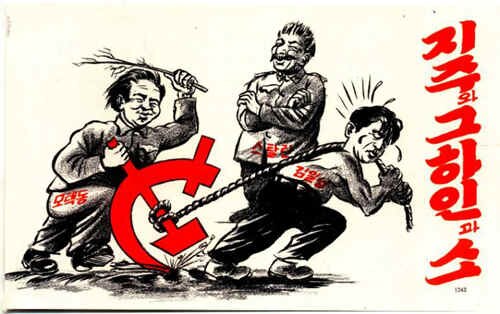
Leaflet 1242, "The landlord, his servant and the cow" (지주와 그 하인과 소), 1st Radio Broadcasting and Leaflet Group, U.S. Army, 1952. The figures are labelled Mao Zedong, Stalin and Kim Il Sung. Public domain (U.S. government work).
- Operation Moolah, April 1953. Gen. Mark W. Clark of the UN Command offers $50,000 for a delivered MiG-15 and $50,000 more to the first pilot. B-29s drop the leaflets over North Korean airfields in late April; Clark's broadcast on 27 April addresses pilots who wish to "free themselves from the Communist yoke" (Pease, 1992; Time, 1953). The leaflet's headline offers "The way to the Free World" (NARA leaflet 2508, Commons translation). In September 1953, after the armistice, Lt. No Kum-sok flies a MiG-15 south; he later said he had not known of the offer (No, 1996).
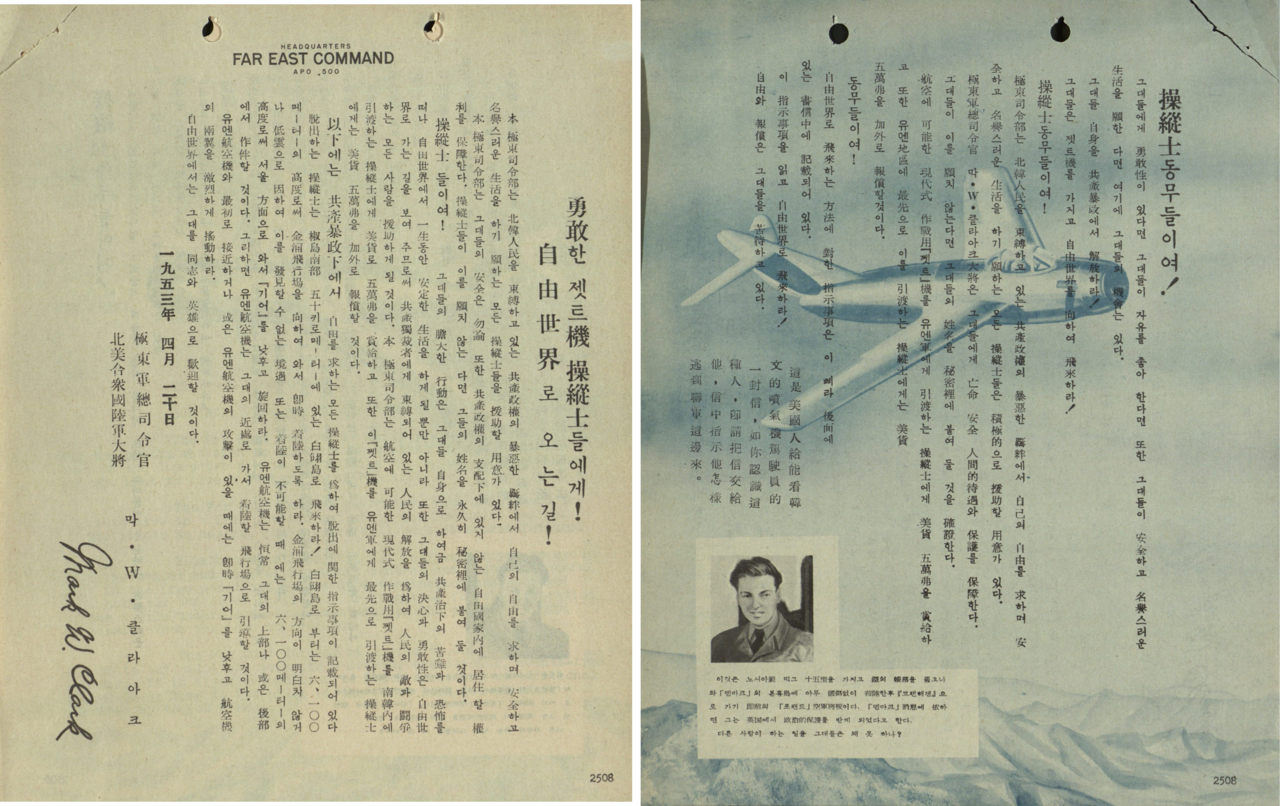
Operation Moolah leaflet 2508, 1st Radio Broadcasting and Leaflet Group, 8239th Army Unit, U.S. Army, dated 20 April 1953 on its face. National Archives at College Park, RG 407. Public domain (U.S. government work).
- DMZ loudspeakers. South Korea begins border broadcasts in 1963; both sides stop in 2004. The South broadcasts again in 2015-18 and from 9 June 2024, in answer to the trash balloons. Southern broadcasts carry news, weather, K-pop and a programme called The Voice of Freedom; northern speakers play noise (Wikipedia, "Korean Demilitarized Zone loudspeakers"). The Lee Jae-myung government halts them on 11 June 2025 and the North stops within a day (Washington Post/AP, 2025; RFA, 2025).
- Defector balloons. Defector and church groups, the largest Park Sang-hak's Fighters for a Free North Korea, send leaflets, dollar bills, radios and USB sticks. Jung finds the DPRK reacts most sharply to leaflets attacking its leaders; one read "Believe Jesus Christ instead of Kim Il Sung" (Jung, 2014, pp. 26-27).
- 2020. On 4 June Kim Yo Jong calls the senders "human scum" and "mongrel dogs" and holds Seoul responsible (NK News, 2020). On 16 June the DPRK blows up the inter-Korean liaison office in Kaesong (CNN, 2020). On 14 December South Korea's National Assembly makes leafleting punishable by up to three years in prison (Wikipedia, "Balloon propaganda campaigns in Korea").
- 26 September 2023. The Constitutional Court strikes the law down, 7-2, as an excessive restriction on free speech, on a petition including Park Sang-hak (AP, 2023; NK News, 2023).
- 2024. From 28 May the DPRK sends balloons of waste, soil and manure south, calling them a response to the leaflets; Kim Yo Jong calls them a "gift of sincerity" (Al Jazeera, 2024). By November South Korea's military has counted launches on 32 occasions (Korea Times, 2024).
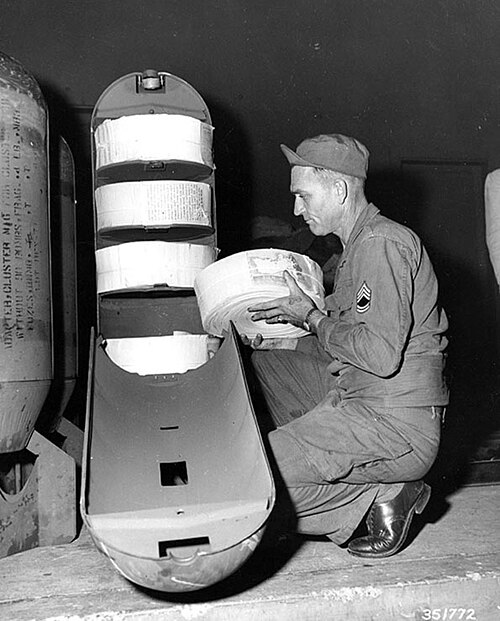
A cluster adapter holding 22,500 leaflets is loaded at the Far East Command printing plant, Yokohama, during the Korean War. U.S. Army photograph. Public domain (U.S. government work).
How it works
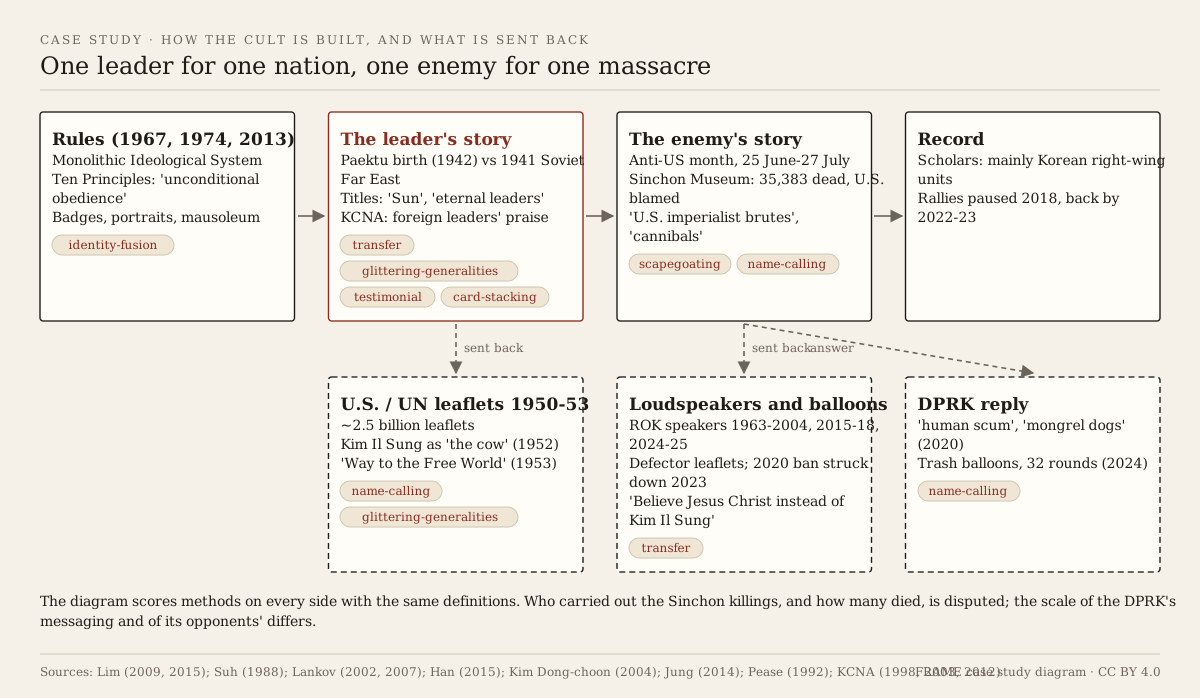
- Identity fusion: the Ten Principles treat "political life" as the leader's gift, repaid by "unconditional obedience", and the badge marks that citizens "belong to their leader". Doubting the leader becomes a break with the nation, not a question of fact.
- Transfer: the official Paektu birth borrows the standing of the peninsula's highest mountain, the setting of the partisan story, and KCNA's cracking ice extends it to nature. Against him, "Believe Jesus Christ instead of Kim Il Sung" borrows religious authority.
- Glittering generalities: "Sun of Juche" and "eternal leaders" stand in for a checkable record. The U.S. offer used the same kind of words, "the way to the Free World" and "the Communist yoke", and the South named its broadcast The Voice of Freedom.
- Testimonial: KCNA presents foreign leaders' titles and praise as proof of the leader's greatness.
- Card stacking: the official biographies keep the partisan victory and the Paektu birth and leave out the Soviet years, the Allied defeat of Japan and the records placing the birth in the Soviet Far East.
- Scapegoating: the museum and the anti-US month put the Sinchon killings on U.S. troops, while the scholars cited here attribute them mainly to Korean right-wing units. A single foreign culprit keeps the Korean perpetrators out of the story, which is Cumings' explanation of why the Koreans he interviewed blamed Americans.
- Name-calling: "U.S. imperialist brutes" (1998), "cannibals" (2014), "human scum" and "mongrel dogs" (2020); the 1952 U.S. leaflet casts Kim Il Sung as "the cow". The scale differs: the DPRK labels run through state media, schools and a yearly month over decades; the leaflet was one of many wartime U.S. leaflets.
Then and now
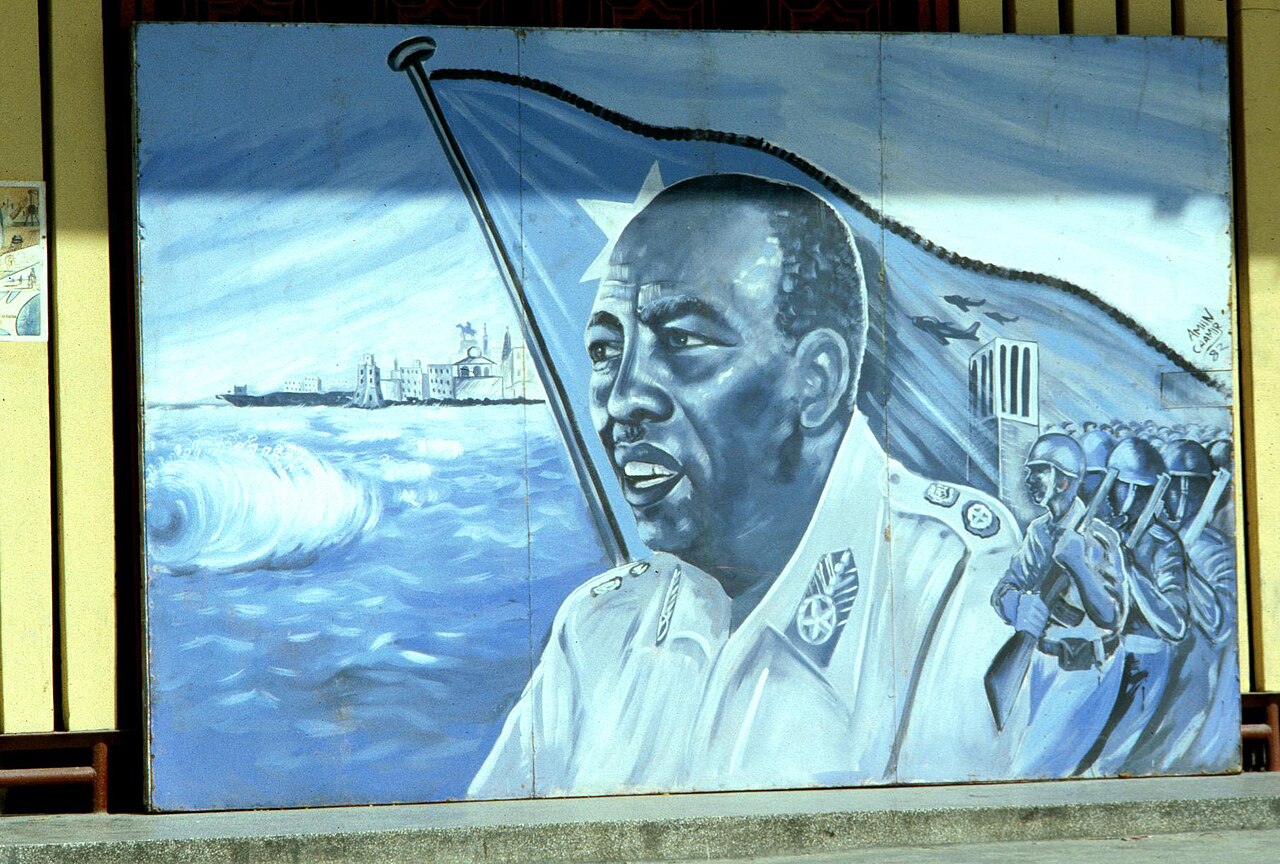
Barre Cult of Personality Mural, Somali Democratic Republic, Mogadishu, 1976. Herbert S. Lewis collection, University of Wisconsin Libraries. Public domain (CC0).
Siad Barre's government painted its leader into the Somali flag, the same move as the Ten Principles: the leader stands in for the nation. The difference is duration. Barre's cult ended with his fall in 1991; the Kim cult has passed through three generations.
The anti-US month has a mirror in the U.S. government's 1943 series This Is the Enemy, which reduced the Axis to one menacing figure. That was a wartime campaign against states the United States was fighting; the DPRK's month runs decades after the armistice ended the fighting (it is reported from at least 2003), with a pause in 2018.
Positions on the record
- DPRK government: Kim Il Sung and Kim Jong Il are the "eternal leaders"; the United States committed the Sinchon massacre; the 2024 balloons answered leaflets from the South.
- South Korean governments: positions changed by administration. The 2020 law was presented as protecting border residents and inter-Korean ties; the 2024 loudspeakers as a response to the balloons; the 2025 halt as a way to "restore trust" (RFA, 2025).
- Defector activists: Park Sang-hak says the leaflets break the information blockade (Higginbotham, 2014); border residents have opposed launches as a danger.
- What is documented: the 1967 system and the 1974 and 2013 Ten Principles; badges, portraits and the mausoleum; the annual month, its 2018 pause and later rallies; the 1950-53 leaflets and Operation Moolah; the loudspeaker history; the 2020 law and its 2023 annulment; the 2024 balloons. U.S. forces killed Korean civilians elsewhere: a 2001 U.S. Army review acknowledged that U.S. soldiers killed or injured an unknown number of refugees at No Gun Ri in July 1950 (Department of the Army, 2001).
- What is not shown / disputed: who carried out the Sinchon killings and how many died. The DPRK says U.S. troops and 35,383 dead; the scholars cited attribute the killings mainly to Korean right-wing units and do not confirm the toll. Kim Jong Il's exact birthplace is not settled. The effect of leaflets and loudspeakers is not measured.
Same-method test
The finding does not depend on the flag. The NSDAP's 1933 banner Ein Volk, ein Führer, ein Ja (One People, One Leader, One Yes) equated one people with one leader and is tagged identity-fusion the same way. The U.S. Army's "cow" leaflet and "Free World" appeal carry the same tags as the DPRK's labels and titles, and the gallery tags the CIA-funded Crusade for Freedom as transfer (Give Freedom to the Captive Nations! Fight Communism!, Freedom-Gram: Help Truth Fight Communism). Any state, of any bloc, that pins a contested wartime killing on a foreign army would get the same scapegoating tag.
How to spot it
- When a leader's birth or deeds are set in a sacred place, check them against records from outside the state that wrote them.
- When a museum names a single foreign culprit for a massacre, look for court, commission or scholarly work on who did the killing.
- Ask both sides' leaflets and broadcasts the same questions: what is labelled, what virtue word replaces a fact, whose authority is borrowed.
Images
| Image | Source | Licence |
|---|---|---|
| Mechanism diagram (above) | Drawn for FRAME from the sources below (make_diagrams.py) |
CC BY 4.0, FRAME |
| Leaflet 1242, "The landlord, his servant and the cow", 1952 | Wikimedia Commons, 1st Radio Broadcasting and Leaflet Group, U.S. Army | Public domain (U.S. government work) |
| Operation Moolah leaflet 2508, April 1953 | Wikimedia Commons, from NARA RG 407 | Public domain (U.S. government work) |
| Leaflet bomb loading, Yokohama | Wikimedia Commons, U.S. Army | Public domain (U.S. government work) |
| Barre cult of personality mural, 1976 | FRAME gallery | Public domain (CC0) |


Image gaps
- DPRK portraits, murals, posters, badges and the Kumsusan Palace. Not included. DPRK artworks are not safely public domain in the U.S., and North Korea has no freedom of panorama for artworks. Not fillable under this archive's licence rules.
- Anti-US month posters and the Sinchon Museum displays. Not included for the same reason. Not fillable.
- Defector leaflets and 2024 trash balloons. Photographs exist but none with a verified open licence was found in the time available. South Korean government photos released under KOGL Type 1 could fill this. Possibly fillable.
- South Korean DMZ loudspeakers. A Commons photo of a 1953 U.S. Army loudspeaker team exists but is only 320 px wide; no openly licensed photo of the modern speakers was found. Possibly fillable.
- North Korean wartime leaflets aimed at UN troops. Commons carries some, but their licence status in the U.S. was not checked in time. Possibly fillable.
Sources
- Lim Jae-cheon, Leader Symbols and Personality Cult in North Korea: The Leader State (London: Routledge, 2015), pp. 32, 48-49.
- Lim Jae-cheon, Kim Jong Il's Leadership of North Korea (London: Routledge, 2009), pp. 9-10.
- Suh Dae-sook, Kim Il Sung: The North Korean Leader (New York: Columbia University Press, 1988), p. 320.
- Andrei Lankov, From Stalin to Kim Il Sung: The Formation of North Korea, 1945-1960 (London: Hurst; New Brunswick: Rutgers University Press, 2002).
- Andrei Lankov, North of the DMZ: Essays on Daily Life in North Korea (Jefferson, NC: McFarland, 2007), p. 7.
- Bruce Cumings, Korea's Place in the Sun: A Modern History (New York: W. W. Norton, 1997), p. 160.
- Bruce Cumings, War and Television (London: Verso, 1992), as quoted in Adam Cathcart, "Notes on the Sinchon Massacre", 16 May 2015.
- B. R. Myers, The Cleanest Race: How North Koreans See Themselves and Why It Matters (New York: Melville House, 2010), background reading on the official culture.
- Barbara Demick, Nothing to Envy: Ordinary Lives in North Korea (New York: Spiegel & Grau, 2009), p. 316.
- Kim Jong Il: Brief History (Pyongyang: Foreign Languages Publishing House, 1998), p. 1.
- Sunghoon Han, "The Ongoing Korean War at the Sinch'ŏn Museum in North Korea", Cross-Currents 14 (March 2015), pp. 152-177
- Dong-Choon Kim, "Forgotten war, forgotten massacres: the Korean War (1950-1953) as licensed mass killings", Journal of Genocide Research 6, no. 4 (December 2004), p. 536.
- Tongil News, "좌익에 의한 민간인 학살사건(4): 인민군의 퇴각과 민간인 학살" (Civilian killings by the left, part 4: the People's Army's retreat), 31 January 2017.
- Andrei Lankov, "How North Korea turned a civil war conflict into anti-US propaganda", NK News, 8 July 2022
- KCNA, "Sinchon simmering with rage", 3 July 1998 (archived)
- KCNA, "Humankind Awards Many Titles to Kim Il Sung", 3 April 2012.
- KCNA, "Month of Anti-U.S. Joint Struggle marked", 16 July 2003 (GlobalSecurity mirror)
- Radio Free Asia, "North Korea military celebrates 'Anti-U.S. Joint Struggle Month'", 30 June 2022
- Vice, "'They Are Cannibals': Kim Jong-un Visits North Korea's US War Atrocities Museum", November 2014
- AFP via Yahoo News, "N. Korean leader tours museum of US 'cannibal' atrocities", November 2014
- HuffPost UK, "Ice Cracks, Birds Bow And Mountains Glow As 'Nature Mourns Kim Jong Il' State Media Reports", 22 December 2011
- Washington Post, "North Korea's 'anti-U.S. imperialism' rally will not be held this year", 25 June 2018
- NK News, "Anti-U.S. souvenirs disappear from tourist shops in North Korea: sources", June 2018
- NBC News, "Thousands of North Koreans march in anti-U.S. rallies as country marks Korean War anniversary", June 2023
- Korea Times, "N. Korea stages anti-US mass rallies on Korean War anniversary", 25 June 2025
- Daily NK, "NK Adds Kim Jong Il to 'Ten Principles'", 2013
- Jin-Heon Jung, Ballooning Evangelism: Psychological Warfare and Christianity in the Divided Korea, MMG Working Paper 14-07 (Göttingen: Max Planck Institute for the Study of Religious and Ethnic Diversity, 2014), pp. 16, 26-27.
- Adam Higginbotham, "The No-Tech Tactics of North Korea's Most Wanted Defector", Bloomberg Businessweek, 5 June 2014.
- Stephen E. Pease, Psywar: Psychological Warfare in Korea, 1950-1953 (Harrisburg, PA: Stackpole Books, 1992).
- "International: Fat Offer", Time, 1953, as quoted in English Wikipedia, "Operation Moolah".
- No Kum-sok with J. Roger Osterholm, A MiG-15 to Freedom (Jefferson, NC: McFarland, 1996).
- Command Report (1-30 April 1953), 1st Radio Broadcasting & Leaflet Group, 8239th Army Unit, Record Group 407, National Archives at College Park (leaflet 2508, via Wikimedia Commons).
- U.S. Department of the Army, Inspector General, No Gun Ri Review (Washington, DC, January 2001).
- Washington Post (AP), "South Korea halts loudspeaker broadcasts along border with rival North Korea", 11 June 2025
- Radio Free Asia, "North Korea halts loudspeaker border broadcasts day after South Korea's suspension", 11 June 2025; earlier version mirrored as "South Korea shuts off loudspeaker broadcasts to North in bid to 'restore trust'"
- NK News, "'Human scum, mongrel dog': North Korea's Kim Yo Jong talks dirty", June 2020
- CNN, "North Korea blows up liaison office in Kaesong used for talks with South", 16 June 2020
- AP via WSLS, "South Korea's Constitutional Court strikes down law banning anti-Pyongyang leafleting", 26 September 2023
- NK News, "North Korean defector-activists welcome ruling to overturn leaflet launch ban", September 2023
- Al Jazeera, "Why did North Korea launch rubbish-laden balloons into South Korea?", 4 June 2024
- Korea Times, "N. Korea sends about 40 trash-filled balloons toward S. Korea: JCS", November 2024
- English Wikipedia, "Ten Principles for the Establishment of a Monolithic Ideological System"
- English Wikipedia, "North Korean cult of personality"
- English Wikipedia, "Kumsusan Palace of the Sun"
- English Wikipedia, "Korean Demilitarized Zone loudspeakers"
- English Wikipedia, "Balloon propaganda campaigns in Korea"
- English Wikipedia, "Sinchon Massacre"