Content note. This page describes the deliberate destruction of civilian infrastructure — bridges, factories, power and water systems — in the last weeks of the Second World War in Europe, and the resulting loss of food, water and power for German civilians. It does not show graphic imagery. It also treats Albert Speer's own postwar account of his resistance to the decree critically, as a documented case of self-serving historical framing, rather than repeating it at face value.
In one line: on 19 March 1945, with the war plainly lost, Adolf Hitler ordered the destruction of all German transport, industrial and supply infrastructure that might be of any use to the advancing Allies — the logical endpoint of the "total war" rhetoric Joseph Goebbels had built since 1943 — and Reich Minister Albert Speer worked to block the order while privately keeping it running just enough to avoid open defiance, then built his post-war reputation, at Nuremberg and in his memoirs, on having "saved Germany" from it.
What happened
"Total war," 1943
- 18 February 1943. Less than three weeks after the surrender of the German Sixth Army at Stalingrad, Joseph Goebbels addresses an invited audience at the Berlin Sportpalast under a banner reading "Totaler Krieg – kürzester Krieg" ("Total war – shortest war"). He puts ten questions to the hall "as representatives of the nation," the fourth of which asks: "Wollt ihr den totalen Krieg? Wollt ihr ihn, wenn nötig, totaler und radikaler, als wir ihn uns heute überhaupt erst vorstellen können?" ("Do you want total war? If necessary, do you want it more total and radical than we can even imagine it today?"). The Bundesarchiv's own 1943 press caption for the event frames it as the German people's demand "for the great effort to force victory." See Totaler Krieg – kürzester Krieg (Total War – Shortest War): the Sportpalast rally of 18 February 1943 and The Reich Ministry of Public Enlightenment and Propaganda, 1933-1945 for the full speech and its place in the ministry's wartime output. The Nero Decree, two years later, is where that logic of total, unlimited commitment runs out of anything else to sacrifice.
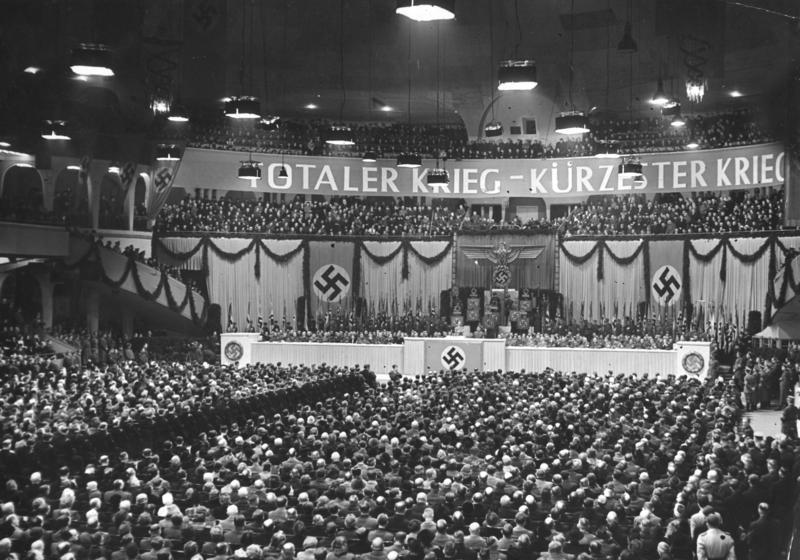
The Berlin Sportpalast during the "total war" speech, 18 February 1943. Bundesarchiv, Bild 183-J05235, photo: Schwahn, CC BY-SA 3.0 DE. Gallery entry: Totaler Krieg – kürzester Krieg (Total War – Shortest War): the Sportpalast rally of 18 February 1943.
The collapse, early 1945
- By March 1945, the war is being fought on German soil on both fronts: Soviet forces are on the Oder, and U.S. forces have seized a Rhine crossing at Remagen (7 March 1945). Wehrmacht engineers are already blowing bridges ahead of both advances as ordinary tactical practice — denying a river crossing to an advancing army is a standard wartime measure and predates and differs from what follows.
- 18 March 1945. Speer submits a memorandum to Hitler — the subject of a detailed 2003 study by historian Heinrich Schwendemann, whose title for that memo ("Drastic Measures to Defend the Reich at the Oder and the Rhine") signals it argued in the language of continuing the war, not primarily as a humanitarian plea for civilians. Speer's own later framing presented it as a warning that the German economy could hold out only another four to eight weeks and an argument against wholesale destruction of industry.
- 19 March 1945. Hitler issues the order later known as the Nero Decree — officially "Demolitions on Reich Territory" (Befehl betreffend Zerstörungsmaßnahmen im Reichsgebiet), nicknamed after the Roman emperor blamed for the burning of Rome. Its operative clause: "All military transport and communication facilities, industrial establishments and supply depots, as well as anything else of value within Reich territory, which could in any way be used by the enemy immediately or within the foreseeable future for the prosecution of the war, will be destroyed." Its preamble argues against half-measures: "It is a mistake to think that transport and communication facilities, industrial establishments and supply depots, which have not been destroyed, or have only been temporarily put out of action, can be used again for our own ends when the lost territory has been recovered." Unlike the tactical bridge demolitions already under way, the order covers civilian economic infrastructure with no immediate military use — factories, waterworks, power stations, food-supply depots — reaching past denying the enemy and into denying Germans themselves a future to return to.
- Hitler's private rationale, as later recorded by Speer. Speer's own postwar testimony — first through the British investigator H. R. Trevor-Roper's 1947 The Last Days of Hitler, and again in Speer's 1969 memoir — has Hitler telling him around this time that if the war was lost, the nation would also perish, and that there was no need to preserve even "the most primitive" means of survival, because "this nation has proved to be the weaker, and the future belongs solely to the stronger eastern nation." No independent transcript of this exchange exists; it is known only through Speer's own account, written and published by a man who had every reason, at trial and after, to present himself as the humane check on a nihilistic Hitler. It is nonetheless treated by historians, including Ian Kershaw, as consistent with other statements Hitler made in this period about a German people that had "failed" him.
- The civilian reality, March-May 1945. Regardless of how much of the decree was ultimately carried out, the war's final weeks brought a real collapse of civilian infrastructure across the contested regions of Germany, from Allied bombing, from the fighting itself, and from the demolitions that were carried out — bridges, rail lines, and in some places power and water systems. Historians of this period, notably Antony Beevor's Berlin: The Downfall 1945, describe German civilians in the affected areas losing electricity, running water and organised food distribution in these weeks, on top of the mass movement of refugees fleeing both fronts. The decree's own language addressed none of this; it spoke only of denying value to the enemy, not of what the same infrastructure's loss meant for the people who would still be living beside it once the fighting stopped.
- 23 March 1945. Speer meets three Gauleiters from the industrial Ruhr — Friedrich Karl Florian, Albert Hoffmann and Fritz Schlessmann — and urges them to ignore the decree. Florian alone argues for compliance.
- 29 March 1945. Speer submits a further written protest to Hitler. Around the same date, Hitler issues amending orders (further orders dated 30 March and 7 April 1945 are recorded in the German Federal Archives' own finding aids) that narrow and redistribute implementation authority among the Gauleiters and military commanders rather than leaving it solely with Speer's ministry — itself an admission that the original order, as written, was not simply being executed.
- Late March-April 1945. According to testimony later given at the Nuremberg trial by witnesses including Lieutenant Colonel von Poser (Speer's liaison officer to the army) and Kempf (chief of the Office for Raw Products in Speer's ministry), Speer worked to block implementation from inside: he arranged for stocks of explosives to be withdrawn from Gauleiters' control, halted further production of "industrial explosives," and held repeated conferences with military commanders specifically to prevent the demolition of bridges.
- 22-23 April 1945. In his last meeting with Hitler in the Berlin Führerbunker, Speer later said he told Hitler directly that he had disobeyed the destruction order. Accounts of Hitler's reaction differ sharply, and the differences are themselves part of the record: Speer's own version (via Trevor-Roper and his memoir) has Hitler angry but letting him leave unpunished; another account has Hitler listening in silence with no visible reaction; the historian Richard J. Evans has called parts of Speer's version of this scene "pure invention." No account but Speer's own exists for what was said.
- 30 April-8 May 1945. Hitler dies by suicide in the bunker on 30 April; Germany surrenders unconditionally on 7-8 May.
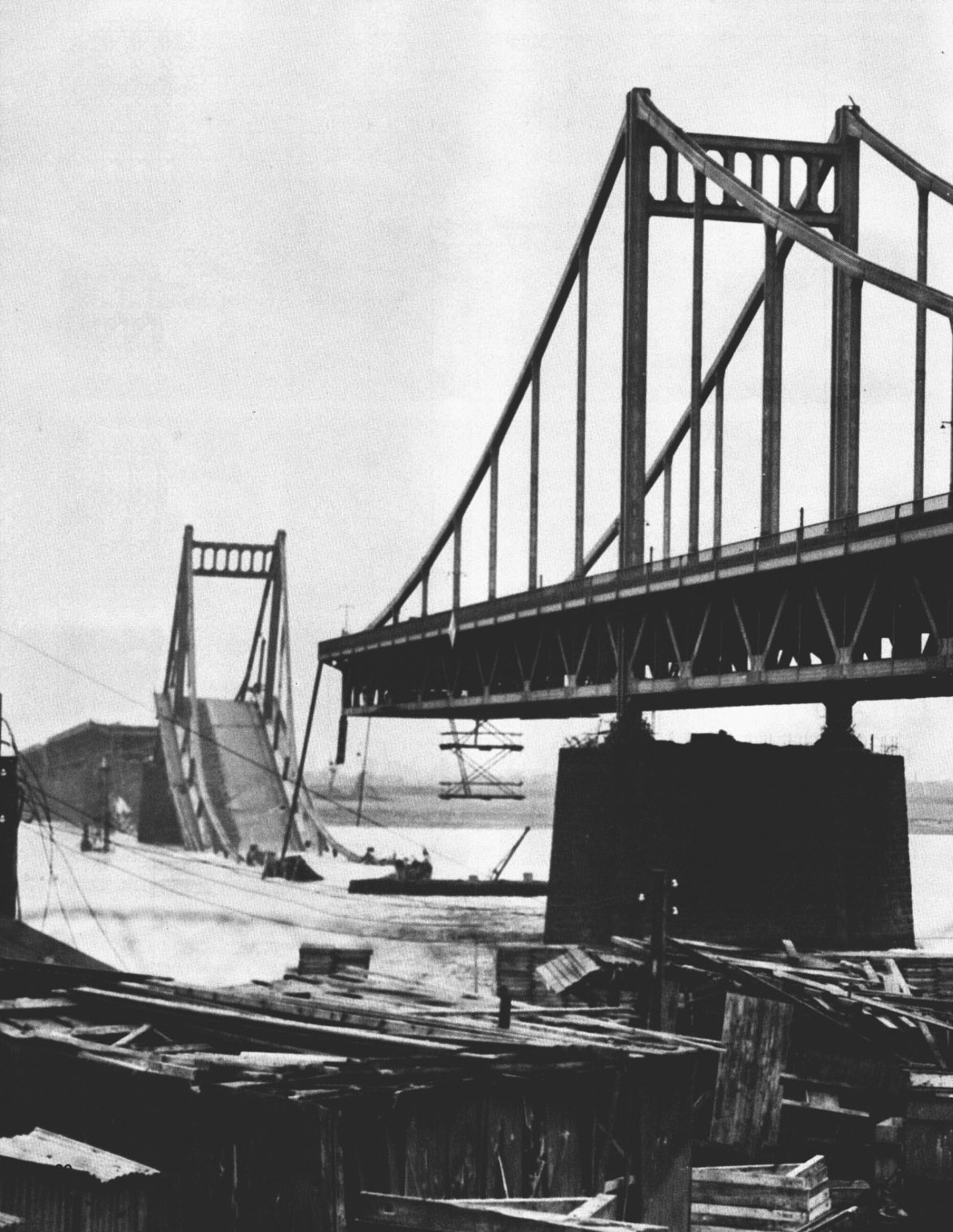
The Rhine bridge between Krefeld and Uerdingen, 1945. The Commons file page records that German troops demolished it on 4 March 1945, before the 19 March decree; it is shown as an example of the bridge demolition already under way. U.S. military photograph, published in U.S. Navy All Hands, August 1987, via Wikimedia Commons. Public domain (U.S. government work).

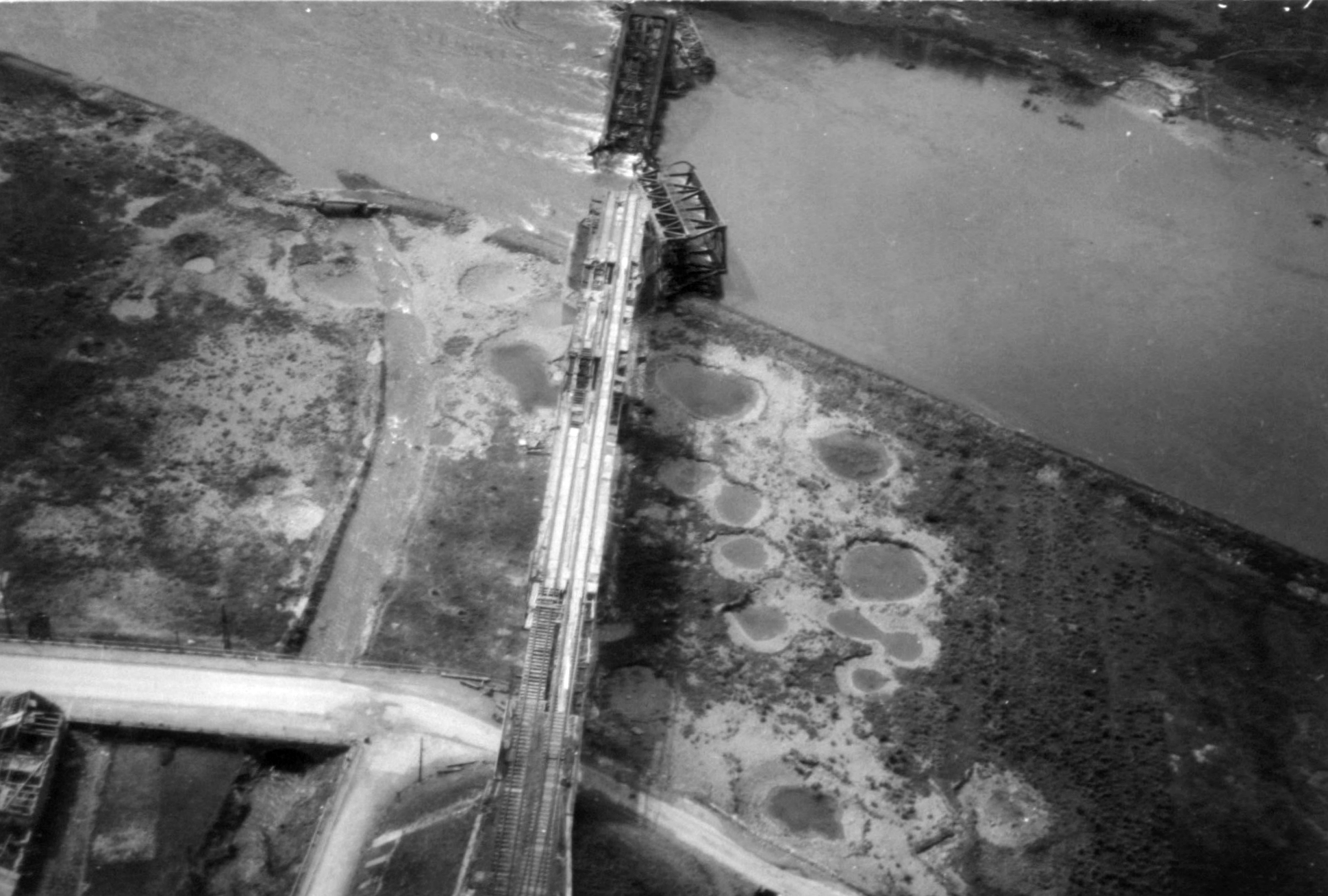
Aerial view of the destroyed railway bridge at Eller, Germany, 1945 (the file record does not say what destroyed it). U.S. Army Air Force photograph, National Archives (NAID 193769900), via Wikimedia Commons. Public domain (U.S. government work).
.jpg)
The record, 1945 onward
- November 1945-October 1946. At the Nuremberg trial, Speer's resistance to the Nero Decree became a central plank of his defence, presented as proof he had acted to spare the German people rather than serve the regime to the end. He was sentenced to twenty years' imprisonment — not death, the sentence given several other defendants — and later accounts describe his candour and apparent contrition, including on this point, as a factor that told in his favour with the judges.
- 1969. Speer publishes Erinnerungen (English: Inside the Third Reich, 1970), in which the Nero Decree episode is a central set-piece of his self-presentation as the technocrat who worked from within to limit the regime's worst excesses.
- 1995. Gitta Sereny's biography Albert Speer: His Battle with Truth documents, from extensive interviews and archival research, that Speer's account of what he knew and did — including about slave labour and the deportation of Jews, matters distinct from the Nero Decree itself — was demonstrably more selective than his public persona allowed. Later historians describe a broader "Speer myth," the postwar image of Speer as an apolitical, essentially decent technocrat, as substantially built by Speer himself and by writers who took his own account at face value; much of it, including the scale of his personal "armaments miracle," has not held up under later archival scrutiny.
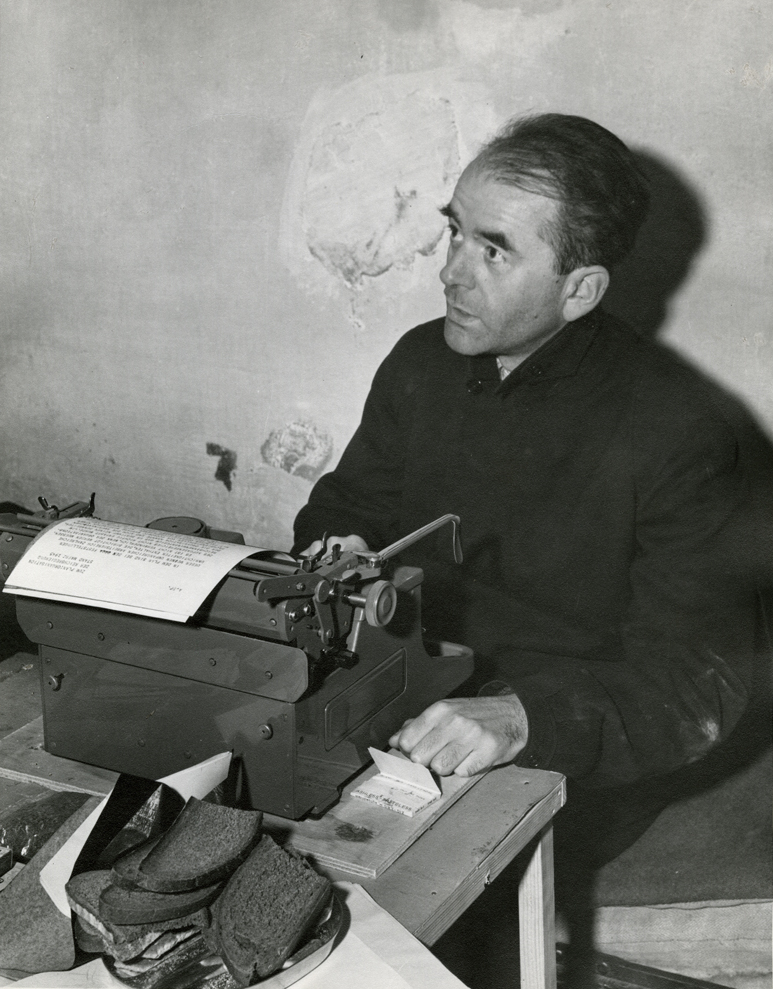
Albert Speer in his cell at Nuremberg, 24 November 1945. U.S. Army Signal Corps photograph, via Harvard Law School Library and Wikimedia Commons. Public domain (U.S. government work).

How it works
- Euphemism / doublespeak: the decree's own title, "Demolitions on Reich Territory," describes the mechanical act — buildings and infrastructure blown up — without naming what was actually being destroyed: the civilian population's own remaining means of feeding, watering, warming and transporting itself. "Total war" performed the same work at the level of the whole war effort: a phrase for unlimited commitment that never had to specify, in advance, that its logical endpoint was directed at Germans' own cities and supply lines rather than only at the enemy.
- Glittering generalities: the decree frames destruction as service to "our nation's struggle for existence," a virtue phrase that supplies no way to test whether destroying a specific power station or food depot actually weakened the advancing Allies more than it harmed the German civilians who would need that infrastructure within weeks, regardless of who occupied the territory.
- Identity fusion: Hitler's rationale, as Speer records it, collapses the fate of the German people into the fate of his own war — a nation that could not win did not deserve to survive, and "those who remain... are only the inferior ones." This is total war's logic taken past the point of defending the nation and into treating the nation's continued existence as conditional on the regime's own success, so that the regime's defeat becomes grounds to destroy the very thing "total war" had always claimed to be defending.
- Fear appeal: the decree's stated justification is that anything left standing "could in any way be used by the enemy," an open-ended, unfalsifiable threat that licenses destroying assets far from any actual front line or any concrete military use, on the grounds that the enemy might someday benefit from them.
- Card stacking: Speer's own account of these weeks, at Nuremberg and in his memoir, foregrounds his opposition to the Nero Decree and leaves comparatively little room for what else was true in the same months — that he had run the Reich's slave-labour-dependent war economy for over two years, and that Schwendemann's reading of the 18 March memorandum's own title suggests its immediate argument was about continuing to defend the Reich, not primarily about sparing civilian life. The Nero Decree resistance is real and independently documented; the frame Speer built around it, emphasised almost to the exclusion of the rest of his record, is the part historians have had to separate out.
- Testimonial: Speer's own word, given as a defendant seeking a lighter sentence and later as a memoirist seeking a legacy, became for decades the primary source for how this episode — and Speer's broader role — was understood. A named, senior official vouching for his own good conduct is exactly the pattern this technique names: the vouching was, for a long period, largely taken as ending the inquiry rather than as one contested account requiring independent verification, which is precisely what Sereny's 1995 biography set out to supply.
Then and now
Ordering the destruction of one's own retreating territory to deny it to an advancing enemy did not begin in 1945. On 3 July 1941, eleven days after the German invasion of the Soviet Union, Stalin's first public radio address to the Soviet people called for a scorched-earth response to the German advance: valuable property that could not be evacuated ahead of a retreat was to be destroyed rather than left for the invader, a policy historians of the Eastern Front (among them Richard Overy and Catherine Merridale) describe as broadly, if unevenly, carried out by retreating Soviet forces and partisans through 1941.
The mechanism is the same at the level of the order: a head of state, faced with an advancing enemy, orders infrastructure in the path of that advance destroyed rather than left intact. The logic behind it is not. Stalin's order was issued in the war's first weeks, aimed at denying an invading army resources on its way in, while the state that issued it intended, explicitly, to fight on and eventually recover the ground. Hitler's decree was issued in the war's last weeks, after the military situation was beyond salvage by any account available to him, and — on the rationale Speer records him giving — was not really about denying the Allies a battlefield advantage at all, but about ensuring that a nation Hitler judged unworthy of survival would not have a future to return to, win or lose. One is a defensive measure a state can survive having taken; the other, as Speer's own account of Hitler's words has it, treats the state's own destruction as the deliberate point.
Positions on the record
- The decree's own framing, March 1945. The text presents the destruction as compelled by military necessity: denying the enemy anything of value "immediately or within the foreseeable future." It does not address, in its surviving text, the civilian population's own need for the same infrastructure.
- Speer's framing, 1945-1969. At Nuremberg and in his memoir, Speer presented his resistance to the decree as evidence of conscience and of a deliberate effort to preserve Germany's postwar future, distinguishing himself from the regime's other leaders. This is the account most popular histories relied on for decades.
- Scholarship since 1995. Gitta Sereny's His Battle with Truth (1995) is the pivotal reassessment: without denying that Speer worked to block the decree's implementation, she documents that his broader postwar account of what he knew and admitted to was considerably more curated than the "good Nazi" image it produced. Heinrich Schwendemann's 2003 article on the 18 March memorandum argues, from the archival record, for reading it in its own contemporary terms — as an argument about how to keep defending the Reich — rather than solely through the humanitarian light Speer later cast on it. Ian Kershaw, in The End (2011), treats the decree's non-implementation as historically significant chiefly as the first clear, open sign that Hitler's authority over his own subordinates — Gauleiters and generals alike — was breaking down, a reading that centres the episode on the collapse of Nazi command structure rather than on Speer's personal virtue.
- What is documented. The text and date of the decree; Speer's 18 March memorandum and 29 March written protest; the 23 March meeting with the Ruhr Gauleiters; the Nuremberg trial testimony of von Poser, Kempf and Rohland describing Speer's withdrawal of explosives stocks and halting of explosives production; the amending orders of 30 March and 7 April narrowing implementation authority; Speer's twenty-year Nuremberg sentence.
- What is contested. The precise words and tenor of Hitler's exchanges with Speer, including the "the nation has proved to be the weaker" remark and the 22-23 April bunker confrontation, rest on Speer's own account and are disputed in their particulars by historians such as Richard Evans; how much destruction was actually averted by Speer's sabotage as against destruction avoided simply because the front moved too fast for orders to be carried out, or because individual Gauleiters and commanders made their own choices independent of Speer; and how far Speer's demonstrated resistance to this one order should be weighed against the fuller record of his role in the war economy, including forced and slave labour, that Sereny's work and later scholarship set alongside it.
- Not ruled on here. Whether Speer's twenty-year sentence, as opposed to execution, was the right outcome, and the wider historiographical argument over how much Speer personally knew of the Holocaust — both belong to a fuller accounting of Speer's career than this page, which is about the decree and its framing, attempts.
Same-method test
The same test — did wartime rhetoric convert the leadership's own approaching defeat into a virtue-language duty for the population to accept destruction or death rather than survival on any other terms — applies to Imperial Japan's home-front propaganda in the same war. FRAME's Imperial Japan's wartime propaganda at home: the Information Bureau, the neighbourhood associations and the war communiqués case study documents how, as the war turned against Japan from 1943, Imperial General Headquarters announced the loss of entire garrisons using the euphemism gyokusai ("shattering like a jewel," first used for the Attu garrison's destruction in May 1943) rather than naming it as annihilation, and how the 14-15 August 1945 imperial rescript ending the war told subjects to "endure the unendurable" without ever using the word "surrender." Euphemism / doublespeak and Glittering generalities score in both cases in exactly the same way: a virtue-laden or softened phrase stands in for the concrete fact of large-scale civilian and military death, asked of the population as the price of the leadership's own continued war aims.
The scale and the endpoint differ sharply. Japan's wartime rhetoric of national sacrifice culminated in plans (Ketsu-Go) for a last defense of the home islands that were never carried out, because the government surrendered before an invasion began; no Japanese equivalent of the Nero Decree — an actual, signed order to destroy the nation's own civilian infrastructure regardless of military use — was issued and enforced. The Nero Decree is not a rhetorical endpoint gestured at; it is total-war logic that reached an actual implementation order, complete with a chain of command, amending decrees and testified sabotage against it. Japan's gyokusai euphemism asked citizens to accept destruction that, in most cases already discussed on that page, had already happened to distant garrisons; Hitler's decree ordered destruction of infrastructure still standing, inside Germany itself, ahead of any enemy arrival.
How to spot it
- Ask whether a "total" commitment, once made, has a stated limit. Rhetoric that asks for unlimited sacrifice without ever specifying what would count as too much sacrifice is built to have no stopping point.
- Watch for a leader's fate and the nation's fate being treated as identical. When a regime's survival and the population's survival are presented as the same question, the regime's defeat can be redescribed as proof the population itself was unworthy — a step that licenses harming the very people the rhetoric claimed to serve.
- Check what a destructive order's title describes and what it omits. "Demolitions" names an act on objects; it does not name the people who depend on those objects, which is exactly the gap a euphemism is built to leave open.
- When a participant's own postwar account of resisting a documented atrocity or order becomes the primary source for how history remembers the episode, treat the resistance and the self-presentation as two separate claims. One can be independently documented (Speer's sabotage measures were) while the other (the full "good Nazi" narrative built on it) requires the same scrutiny as any other testimonial.
Images
| Image | Source | Licence |
|---|---|---|
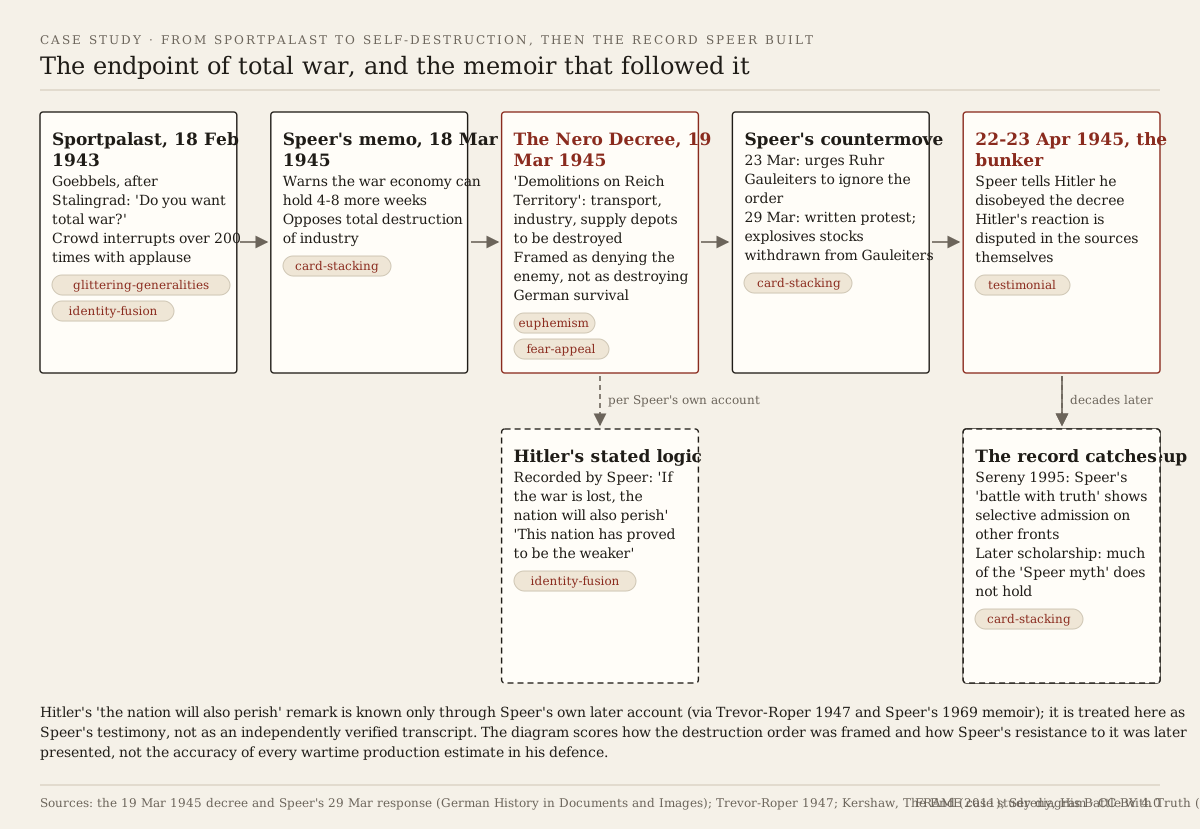
| Mechanism diagram (above) | Drawn for FRAME from this page's sourced facts (make_diagrams_fall_nero_decree.py) |
CC BY 4.0, FRAME |
| Berlin Sportpalast rally, 18 February 1943 | FRAME gallery, Totaler Krieg – kürzester Krieg (Total War – Shortest War): the Sportpalast rally of 18 February 1943 (Wikimedia Commons, Bundesarchiv, Bild 183-J05235, photo: Schwahn) | CC BY-SA 3.0 DE |
| Destroyed Krefeld-Uerdingen Rhine road bridge, 1945 (demolished 4 March 1945) | Wikimedia Commons, U.S. military photo, published in U.S. Navy All Hands magazine, August 1987 | Public domain (PD-USGov-Military) |
| Aerial view of the destroyed railway bridge at Eller, Germany, 1945 | Wikimedia Commons, U.S. Army Air Force photo, via the National Archives (NAID 193769900) | Public domain (PD-USGov-Military) |
| Albert Speer in his cell at Nuremberg, 24 November 1945 | Wikimedia Commons, U.S. Army Signal Corps, via Harvard Law School Library | Public domain (U.S. government work) |

Image gaps
- A scan of the Nero Decree document itself, or of Speer's 18 or 29 March memoranda. German History in Documents and Images (GHDI) hosts an English translation of both texts, but the site itself could not be reached from this build environment to confirm an openly licensed scan exists, and no image file was found on Wikimedia Commons. Identified; not hosted. Fillable.
- A photograph of Hitler and Speer together in early 1945. No openly licensed photograph from this specific period was found; most surviving photographs of the two together are from earlier, more triumphant years of the regime and would misrepresent the period this page covers.
- A photograph of a destroyed German power station, waterworks or food depot specifically (rather than a bridge or rail line). No openly licensed photograph naming this specific kind of infrastructure loss was found in the time available; bridge and rail destruction is well documented on Commons, this category less so.
- A Nuremberg courtroom photograph showing Speer testifying about the Nero Decree specifically. Nuremberg trial photographs are held by the National Archives and several are public domain, but none found in the time available is captioned closely enough to this specific testimony to use without overclaiming what it shows.
Sources
- German History in Documents and Images (GHDI), "Hitler's 'Scorched Earth' Decree (Nero Decree) (March 19, 1945) and Albert Speer's Response (March 29, 1945)": germanhistorydocs.org; mirrored at ghdi.ghi-dc.org.
- Heinrich Schwendemann, "'Drastic Measures to Defend the Reich at the Oder and the Rhine...': A Forgotten Memorandum of Albert Speer of 18 March 1945," Journal of Contemporary History 38:4 (2003): 597-614: SAGE Journals, doi:10.1177/00220094030384005.
- Ian Kershaw, The End: Hitler's Germany, 1944-45 (Penguin Press, 2011; published in the UK as The End: The Defiance and Destruction of Hitler's Germany, 1944-1945, Allen Lane, 2011).
- H. R. Trevor-Roper, The Last Days of Hitler (Macmillan, 1947), the earliest published source for Hitler's remarks to Speer about the nation's survival.
- Albert Speer, Erinnerungen (1969), published in English as Inside the Third Reich (Macmillan, 1970) — cited here as a primary source for Speer's own postwar self-presentation, read critically rather than at face value, consistent with the assessment below.
- Gitta Sereny, Albert Speer: His Battle with Truth (Alfred A. Knopf, 1995).
- International Military Tribunal, Nuremberg, trial transcript, testimony concerning Albert Speer's role in blocking demolitions (witnesses von Poser, Kempf and Rohland): Harvard Law School Library, Nuremberg Trials Project, nuremberg.law.harvard.edu; document analyst's report on the Speer defence documents: nuremberg.law.harvard.edu/reports/6.
- The National WWII Museum, "Sealing the Third Reich's Downfall: Adolf Hitler's 'Nero Decree'": nationalww2museum.org.
- "The Candor and Lies of Nazi Officer Albert Speer," Smithsonian Magazine: smithsonianmag.com, on the postwar "Speer myth" and its later reassessment.
- Antony Beevor, Berlin: The Downfall 1945 (Viking, 2002), for the civilian conditions in Germany's final weeks of the war referenced under "What happened."
- Richard Overy, Russia's War (Penguin, 1997), and Catherine Merridale, Ivan's War: Life and Death in the Red Army, 1939-1945 (Metropolitan Books, 2006), for the 3 July 1941 Soviet scorched-earth comparator under "Then and now."
- German History in Documents and Images, translation of Goebbels's 18 February 1943 Sportpalast speech, as cited on FRAME's The Reich Ministry of Public Enlightenment and Propaganda, 1933-1945 and Totaler Krieg – kürzester Krieg (Total War – Shortest War): the Sportpalast rally of 18 February 1943 pages.