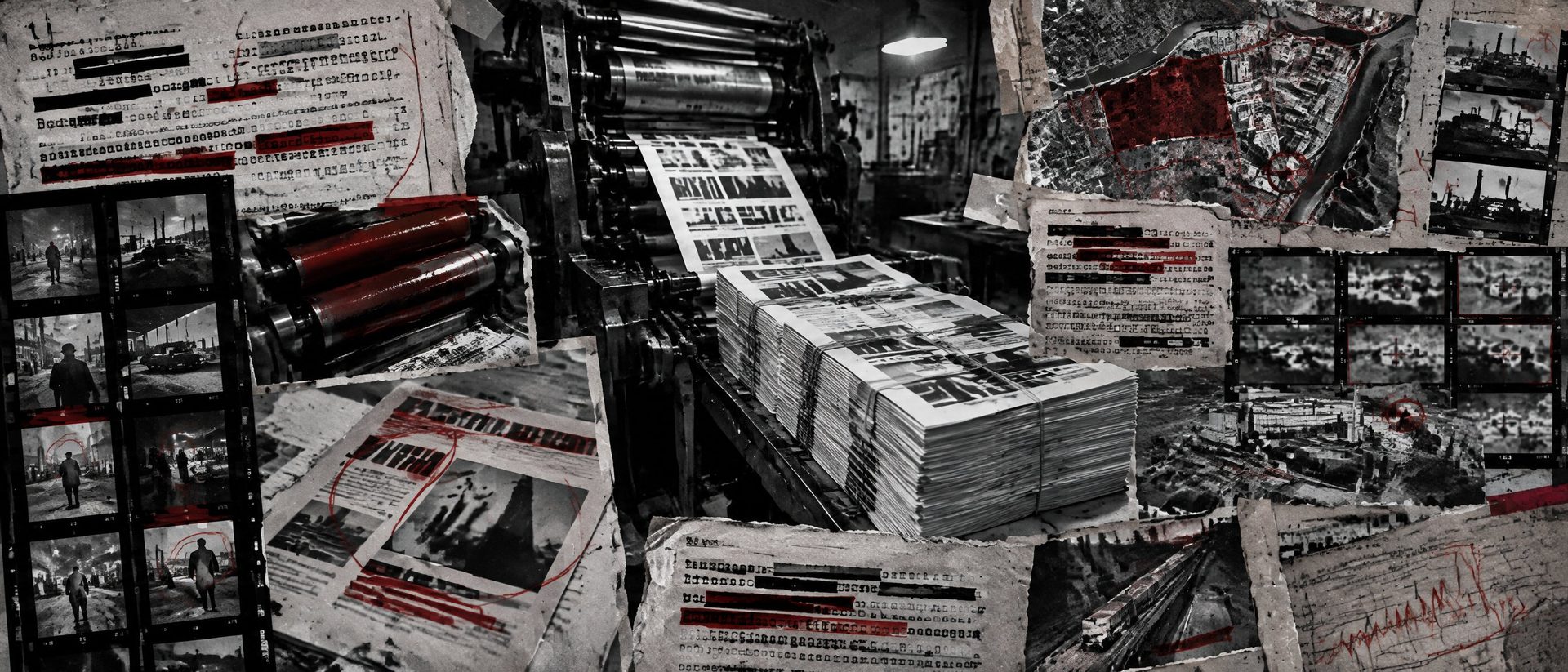
Content note: this page describes and shows antisemitic publications as they were printed, including a 1920 newspaper page from Henry Ford's Dearborn Independent and, in the gallery objects linked below, Nazi and other antisemitic press. It quotes the Protocols only in short phrases, to show how the text and its exposure worked. It does not reproduce the text.
In one line: a text presented as the minutes of a Jewish plan for world domination was a forgery, put together in Russia in the early 1900s with whole passages taken from a French satire of Napoleon III; it was shown to be a forgery by The Times in 1921 and by a Swiss court in 1935, and it has gone on being printed, believed and broadcast, by governments and private publishers, ever since.
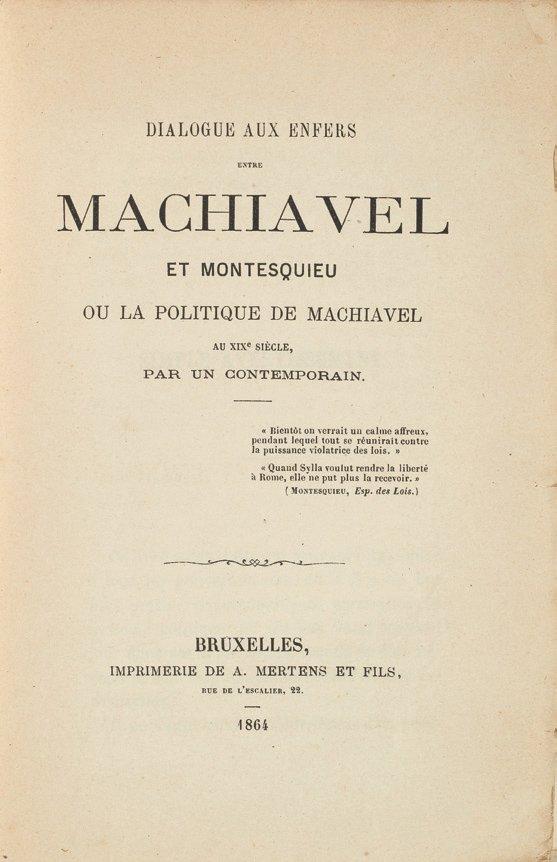
Cover of Maurice Joly, Dialogue aux enfers entre Machiavel et Montesquieu (Brussels, 1864), the book from which much of the Protocols was copied. Via Wikimedia Commons (cover from a Pierre Bergé et associés sale catalogue). Public domain.
What happened
- 1864. Maurice Joly, a Paris lawyer, publishes in Brussels a dialogue between Machiavelli and Montesquieu, a thinly veiled attack on Napoleon III's rule. Joly is tried in France and sentenced to 15 months. The book has nothing to do with Jews.
- 1868. Hermann Goedsche's novel Biarritz includes a scene of rabbis plotting at night in a Prague cemetery. It circulated in Russia as a pamphlet from 1872 and was, in some versions, presented as fact. It is one of several earlier works in the same line (Jacob Brafman in the 1860s, "Osman Bey" in 1873).
- 1902-1903. The Protocols is compiled. The text refers to the assassinations of 1900 and 1901, so it cannot be older than that. Who wrote it, where and when is disputed (see Positions below).
Show all 14Show fewer
- 28 August to 7 September 1903 (Old Style). The St Petersburg daily Znamya, edited by Pavel Krushevan, who had set off the Kishinev pogrom four months earlier, serialises it.
- 1905. The mystic and writer Sergei Nilus publishes it in full in his book Velikoe v malom i antikhrist (The Great in the Small and the Antichrist), presenting it as stolen minutes of the First Zionist Congress (Basel, 1897), a claim he later altered. In the same year, a secret investigation for Prime Minister Pyotr Stolypin concluded that the text had first appeared in Paris antisemitic circles around 1897-98, and Nicholas II reportedly ordered it confiscated, saying that a good cause cannot be defended by dirty means. Printings went on.
- October 1919. The Philadelphia Public Ledger prints excerpts as a Bolshevik "Red Bible".
- January 1920. The first English edition (Eyre & Spottiswoode, London) and a German edition appear. On 8 May 1920 The Times leader "The Jewish Peril, a Disturbing Pamphlet: Call for Inquiry" asks whether the text is genuine. Its editor Wickham Steed later withdrew his support.
- 22 May 1920 to 1922. Henry Ford's weekly Dearborn Independent begins a long series, "The International Jew", whose seventh instalment (10 July 1920) first cites the Protocols. The articles were collected in four volumes and translated into German. Ford himself did not write them; William J. Cameron did, with material gathered by Ernest Liebold.
- 16-18 August 1921. The Times publishes its Constantinople correspondent's reports showing that the Protocols are a paraphrase of Joly. (See "The exposure" below.)
- 1923-1925. Alfred Rosenberg's German commentary on the Protocols appears (1923). In Mein Kampf (1925) Hitler calls the text genuine and reads the Frankfurter Zeitung's complaint that it is a forgery as proof of its truth.
- 1927. After a libel suit by the lawyer Aaron Sapiro, Ford publishes a retraction and apology, and closes the Dearborn Independent in December. Whether he wrote or even signed the apology is disputed (Pool and Pool, 1978, say his signature was forged by an aide). In 1938 Ford receives the German Grand Cross of the Eagle.
- 29 October 1934 to 19 May 1935. The Bern trial: the Swiss Israelite Community Federation sues over a National Front pamphlet sold in Bern in June 1933. Judge Walter Meyer finds the Protocols a forgery and plagiarism. Two defendants are fined (Fr. 50 and Fr. 20). In 1937 the Bern appeals court acquits them on a legal point (that the statute covered obscene, not political, writings) without disturbing the finding that the text is a forgery.
- 1933-1945. The text is used in Nazi propaganda and, according to Binjamin Segel, in German classrooms. Historians differ on how much it contributed to the Holocaust; Norman Cohn's 1966 study called it a "warrant for genocide", and others weigh it as one strand among several.
- After 1945. Cairo editions appear (an Arab Christian translation in 1927-28, the first by a Muslim in 1951); Nasser's government is reported to have endorsed it. Roughly 50 Arabic political books of 1965-1967 are said to quote or draw on it. Iran's first edition appears in 1978. The 1988 Hamas charter cites it. In 2002 an Egyptian 30-part television series, Horseman Without a Horse, drew on it; a Syrian series, Ash-Shatat, was made in 2003. Hamas's 2017 policy document no longer mentions it. In the United States and Europe it kept being reprinted by private publishers (Milton William Cooper presented it as fact in Behold a Pale Horse, 1991; Walmart withdrew a copy from sale in 2004; a Greek Parliament member read from it in 2012). In Russia an Orenburg court declared one pamphlet extremist (2010) and the Protocols was placed on the federal extremist list (November 2012).
The exposure, in the press's own words
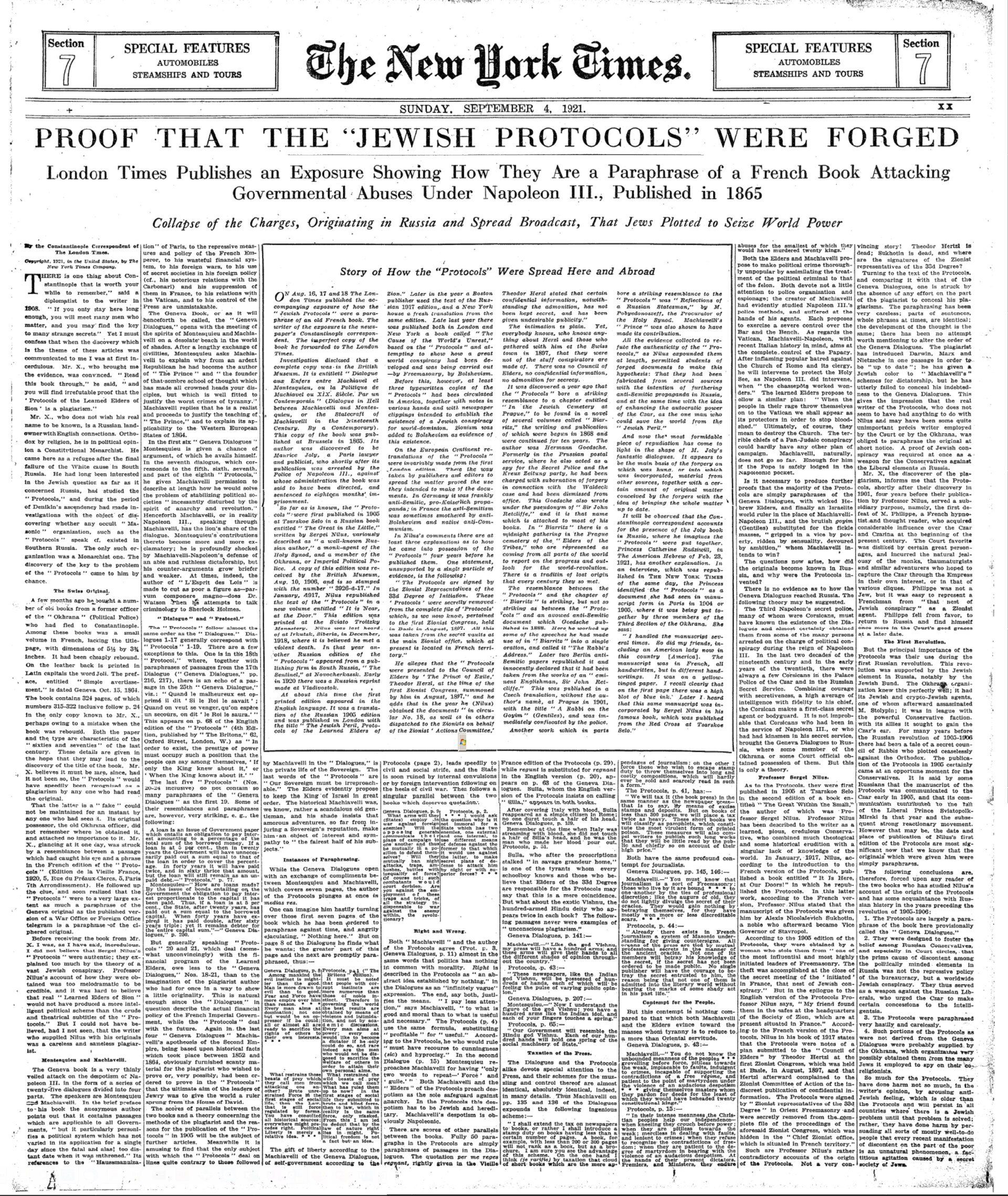
"Proof That the 'Jewish Protocols' Were Forged", front of Section 7, The New York Times, 4 September 1921, reprinting and summarising the London Times series by its Constantinople correspondent. Via Wikimedia Commons. Public domain (published in the United States before 1931).
Explain moreShow less
The New York Times reprint tells the story as the correspondent told it. He had been shown a small French book bought by a Russian landowner, "Mr. X", from a former officer of the Okhrana (the tsarist political police) who had fled to Constantinople. It was a copy of Joly's 1864 Dialogue, and its parallels with the Protocols were close enough that the correspondent set them side by side. The paper's own words give the argument: "The Protocols... follow almost the same order as the Dialogues." The Times correspondent was Philip Graves; the Russian informant was later identified by the historian Colin Holmes as Mikhail Raslovlev. The Protocols take their order from Joly's Dialogues, with the French emperor's despotism turned into the plan of a Jewish council.
One calculation counts about 160 plagiarised passages; identifiable Joly phrasing is about 4 per cent of the first half of the first edition and 12 per cent of the second half. Protocols 1-19 follow Dialogues 1-17 in order, with a few exceptions. That is a finding about the text. It says nothing by itself about who made the text or why, which is the contested part.
How it works
- Scapegoating: the Protocols assign unrelated disasters to one group, whatever the disaster: revolution, war, financial panic, press campaigns. A text whose "plan" explains everything cannot be checked against any one event, which is why it travelled from tsarist Russia to Weimar Germany, the United States and the modern Middle East with the villain unchanged and the grievance swapped.
- Big lie: three layers stack. The first is the forgery itself. The second is the provenance story (stolen minutes of an 1897 congress that no record shows) which changed from Nilus's 1905 version to later ones. The third is the reaction to exposure: in Mein Kampf the proof of forgery is read as proof of truth, because the "Jewish press" would of course deny it.
- Narrative laundering: a Russian pamphlet became a London "inquiry" (The Times, 8 May 1920), then a Detroit newspaper series read by hundreds of thousands, then a Berlin edition, a Cairo edition and a Tehran edition. Each stage borrowed the authority of the previous outlet; Ford's series is the clearest case, because a mass-circulation industrialist's paper gave the text a respectable address.
Show all 5Show fewer
- Fear appeal: the text is written as threat, with the unseen enemy already inside government, banking and the press.
- Sleeper effect: the forgery was exposed in 1921, 1935 and many times since, yet the text kept being printed and believed, which fits the pattern where a discredited source is forgotten while the claim stays.
Content note: Opening page of the antisemitic series 'The International Jew' in Henry Ford's Dearborn Independent, 22 May 1920, shown whole. This object is shown as it was published. Why 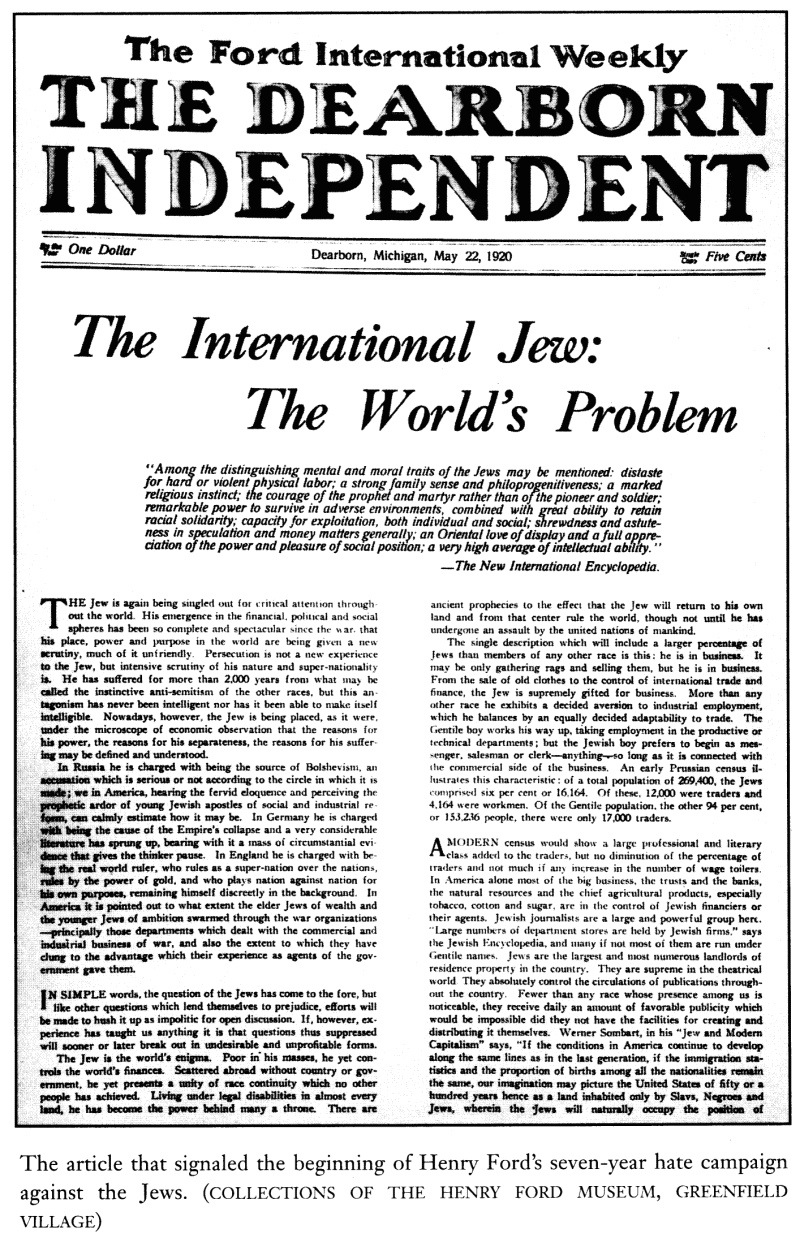
Explain moreShow less
"The International Jew: The World's Problem", The Dearborn Independent (Dearborn, Michigan), 22 May 1920, the opening of the series. Via Wikimedia Commons. Public domain (published in the United States before 1930).
Then and now
Der Stürmer, Nr. 30, July 1933: Der tote Jude , Nuremberg, July 1933.
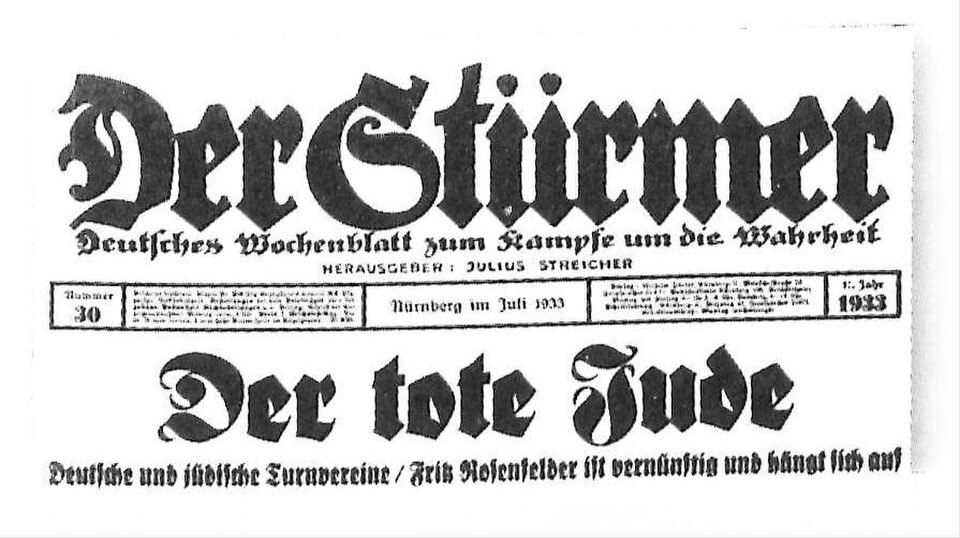
Der Stürmer, Nr. 30, July 1933: Der tote Jude, Nuremberg, July 1933. Content note in the gallery entry.
Nazi Germany carried the same scapegoating frame into a state press and onto exhibition walls. The gallery objects do not quote the Protocols; they show antisemitic imagery printed in the same years. The difference in power is the main point: in 1920 the Protocols was a book and a newspaper series, in 1933 and after the people who promoted it controlled the state. See Nazi propaganda before and during the Holocaust, 1933-1945 for the Nazi apparatus and Ausstellung »Der ewige Jude«: Schautafel »Jüdische Drückebergerei und Betriebsamkeit im Weltkrieg« for a 1938 exhibition panel.
Content note: Antisemitic cartoon depicting 'World Jewry' as an octopus (Star of David on its head) strangling a woman who personifies Palestine. This object is shown as it was published. Why 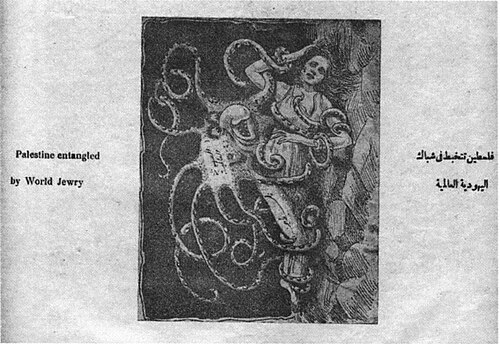
Palestine Entangled by World Jewry (Falastin newspaper cartoon), Jaffa, 1936. The gallery entry does not tie this cartoon to the Protocols; it is shown as a 1930s Arab newspaper using a "world Jewry" frame during the Mandate conflict.
The Protocols is not tied to one region or side. Its Russian origin, American mass printing, German state use and Arab and Iranian state-linked use sit in the record side by side. Arab and Iranian use came after 1945 and is documented as books, television and political documents, while the states and groups concerned have not all taken the same position (Hamas's 2017 document dropped its reference).
Positions on the record
5 items · Scholarly consensus: the Protocols is a forgery that borrows heavily from Joly. Courts…
- Scholarly consensus: the Protocols is a forgery that borrows heavily from Joly. Courts (Bern, 1935) and newspapers (The Times, 1921) reached that finding; so did the Swiss appeals court in 1937, while acquitting for a different reason. No archival source for the "minutes" has been found.
- Authorship is disputed. The Okhrana-in-Paris account (Rachkovsky's circle, around 1897-1903) was argued at the Bern trial largely on the testimony of Alexandre du Chayla, who reportedly received 4,000 Swiss francs; Michael Hagemeister found him unreliable. Princess Catherine Radziwill (1921) named Matvei Golovinski, working under Pyotr Rachkovsky, and the claim was repeated by Konrad Heiden (1944) and Mikhail Lepekhin (1999). Cesare De Michelis (1998; English 2004) places the text in Russia after the September 1902 Russian Zionist conference and doubts a direct Okhrana commission. Charles Ruud and Sergei Stepanov (1999) find little evidence for Okhrana involvement. In 2020 Lyubov Ulyanova-Bibikova reported a Moscow typescript with additions that match Georgy Butmi's handwriting. Not settled.
- Publishers and believers: Nilus, Ford's paper and later publishers presented it as genuine or as "true in substance". Ford, asked about the book by the New York World in February 1921, gave a short statement defending it as fitting "what is going on" without claiming its authenticity (see the Wikipedia article on the paper for the quote); he issued the 1927 retraction after the Sapiro suit. Hitler held it authentic (1925). Arab and Iranian publishers and broadcasters of the 1950s to 2000s presented it or drew on it as an account of Zionism.
- Courts and governments: the Bern court (1935), the Orenburg court (2010) and the Russian extremist list (2012) restrict or condemn it; Walmart withdrew a copy from sale in 2004; an Italian editor was convicted of libel in 2010 and the Court of Cassation overturned it in 2016.
- This archive's reading: documented are the Joly parallels, the 1921 and 1935 findings, the printed editions and the dated broadcasts above, and the harm to Jewish communities of each wave. Not shown by the record: a council, plan or minutes of the kind the text describes; and a settled answer on who wrote it.
Same-method test
A fabricated document about a hidden plan by any other group (a church, a party, a nation, a class) would be scored the same:…
A fabricated document about a hidden plan by any other group (a church, a party, a nation, a class) would be scored the same: Scapegoating, Big lie and Narrative laundering. The test is about the method, not the group: forged evidence of a single hidden hand behind unrelated events, a provenance story that cannot be checked, and a rebuttal that is treated as confirmation. Other forged or fabricated documents used against a rival state or group (see Wellington House and the Bryce Report: atrocity evidence, confirmed and unconfirmed (1914-1915) for a wartime atrocity report) fit parts of this pattern, and differ in target and scale. See Nazi propaganda before and during the Holocaust, 1933-1945 for the Nazi case and The Armenian genocide, 1915-1923: the wartime 'internal enemy' frame, the rival record, and a century of state denial for a denial case.
How to spot it
- Ask what the document is and who vouches for it. The Protocols gives no author, no meeting and no minutes, only a story of how it was obtained.
- Check for borrowed text. A passage taken from a satire on Napoleon III cannot be a record of a 1897 meeting.
- Note when disproof is reinterpreted as proof ("the press denies it").
Show all 5Show fewer
- Trace the chain of outlets: the same pamphlet may reach you via a respected paper or a famous name.
- Compare dates of exposure and republication; a text that returns after every exposure is being used, not discovered.
Sources and further reading
Images
4 items · Nilus's 1911 edition frontispiece and the German 1920 edition cover. Candidates on…
| Image | Source | Licence |
|---|---|---|
| Cover, Maurice Joly, Dialogue aux enfers, 1864 | Wikimedia Commons | Public domain (1864 book cover) |
| "Proof That the 'Jewish Protocols' Were Forged", The New York Times, 4 Sep 1921 | Wikimedia Commons | Public domain (U.S. publication before 1931) |
| "The International Jew", Dearborn Independent, 22 May 1920 | Wikimedia Commons | Public domain (U.S. publication before 1930) |
| Der Stürmer (1933); Falastin (1936) | FRAME gallery | See gallery entries |


Image gaps
- Nilus's 1911 edition frontispiece and the German 1920 edition cover. Candidates on Commons ("The Protocols of the Elders of Zion by Nilus (1912).jpg"; "Protokolle der Weisen von Zion (German edition, 1920).jpg") are tagged public domain but the downloads were blocked by rate limits during this run. Held; fillable.
- The Times of London pages of 16-18 August 1921. The Commons scan found is too small (315 px wide); the New York Times reprint is used instead. Fillable from a proper scan.
- Photographs of the Bern trial and of Ford or Graves. No verified openly licensed image was found. Held.
- An Arab, Iranian or Russian edition or broadcast frame. Not hosted; no verified licence checked. Held.
Sources
10 items · Maurice Joly, Dialogue aux enfers entre Machiavel et Montesquieu (Brussels, 1864).
- Maurice Joly, Dialogue aux enfers entre Machiavel et Montesquieu (Brussels, 1864).
- Philip Graves, articles in The Times (London), 16-18 August 1921, and "Proof That the 'Jewish Protocols' Were Forged", The New York Times, 4 September 1921 (reproduced above).
- Cesare G. De Michelis, The Non-Existent Manuscript: A Study of the Protocols of the Sages of Zion (University of Nebraska Press, 2004).
- Norman Cohn, Warrant for Genocide (London: Eyre & Spottiswoode, 1967).
- Binjamin W. Segel, A Lie and a Libel: The History of the Protocols of the Elders of Zion, ed. Richard S. Levy (University of Nebraska Press, 1995).
- Hadassa Ben-Itto, The Lie That Wouldn't Die: The Protocols of the Elders of Zion (London: Vallentine Mitchell, 2005).
- Stephen Eric Bronner, A Rumor about the Jews (St. Martin's Press, 2000).
- Michael Hagemeister, writings on the Protocols and the Bern trial; Charles A. Ruud and Sergei A. Stepanov, Fontanka 16 (Sutton, 1999).
- Leo P. Pool and Gail B. Pool, Henry Ford and the Dearborn Independent (see also the Wikipedia article on the paper); Berne Trial and The Protocols of the Elders of Zion (Wikipedia, used for dates and for the reported figures; check them against the books above).
- Adolf Hitler, Mein Kampf (1925), vol. 1, ch. 11; Bernard Lewis, Semites and Anti-Semites (1986), on Arab editions.