Content note. This page quotes antisemitic slurs, the masthead line of Der Stürmer, and Hitler's 1939 "prophecy" speech, and shows a 1933 boycott sign and a public Stürmerkasten display case with a caricature. They are quoted and shown as evidence, in the words the trial record and historians documented.
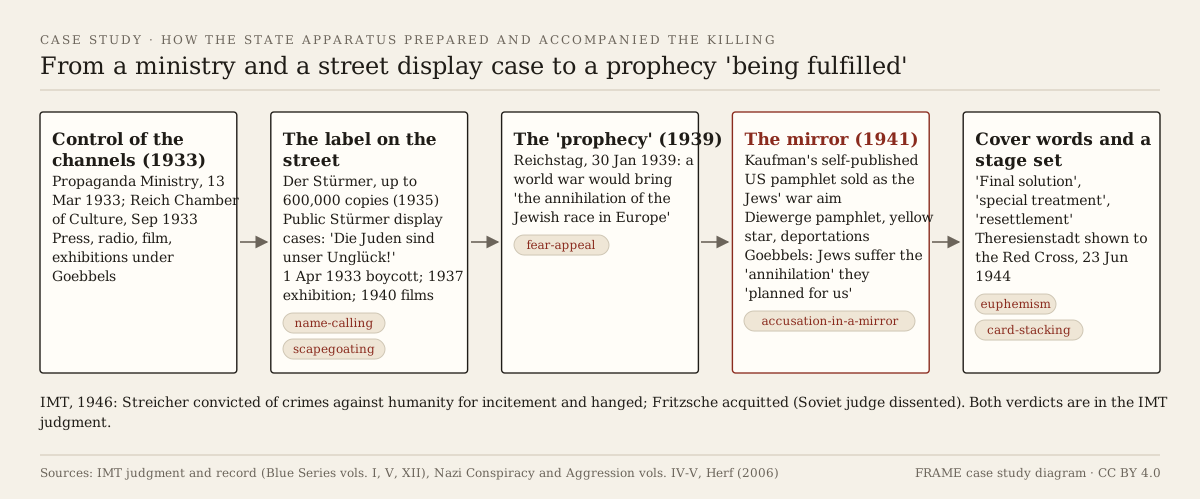
In one line: from 1933 a state ministry and a licensed press repeated one label for Jews for twelve years, in 1939 the head of government told the Reichstag that a war would end in "the annihilation of the Jewish race in Europe," in 1941 an obscure American pamphlet was inflated into proof that Jews planned to exterminate Germans first, the killing itself was named with cover words, and in 1944 a ghetto was staged for a Red Cross visit.
What happened
- 13 March 1933. Hitler's cabinet creates the Reich Ministry of Public Enlightenment and Propaganda (Reichsministerium für Volksaufklärung und Propaganda) and names Joseph Goebbels its head. The ministry takes over control of press, radio, film, theatre and publishing.
- 22 September 1933. The Reich Chamber of Culture (Reichskulturkammer) is established by law under Goebbels, with seven sub-chambers for press, radio, film, theatre, music, fine arts and literature. Membership is compulsory for professional work in each field, and the chambers' statutes exclude Jews (defined by the 1935 Nuremberg Laws) from membership, which in practice ends their ability to publish, broadcast, exhibit or perform.
- 1 April 1933. The NSDAP leadership orders a one-day boycott of Jewish-owned shops, law offices and medical practices. SA men stand outside stores with signs reading "Deutsche! Wehrt Euch! Kauft nicht bei Juden!" ("Germans! Defend yourselves! Don't buy from Jews!"), including outside the Wertheim department store on Leipziger Platz in Berlin, one of Germany's largest and best known Jewish-owned businesses. The boycott is patchily observed and lasts one day, but it opens a sustained economic campaign; Wertheim is forced into "Aryanization," the transfer of Jewish-owned businesses to non-Jewish owners, by 1937.
- From 1923, and continuously from 1933: Der Stürmer. Julius Streicher's weekly newspaper, founded in 1923 and now published with state protection, prints antisemitic caricatures (chiefly by Philipp Rupprecht, "Fips") and articles including invented accusations of ritual murder. Its masthead carries the line "Die Juden sind unser Unglück!" ("The Jews are our misfortune!"), a phrase Streicher borrowed from the nineteenth-century historian Heinrich von Treitschke. Circulation figures given by historians for the mid-1930s run as high as 500,000 to 600,000 copies. Town councils and local NSDAP branches install Stürmerkästen, glass-fronted display cases in public streets, so that the current issue can be read by anyone passing, whether or not they bought or subscribed to the paper.
Content note: Nazi antisemitic newspaper display case. This object is shown as it was published. Why 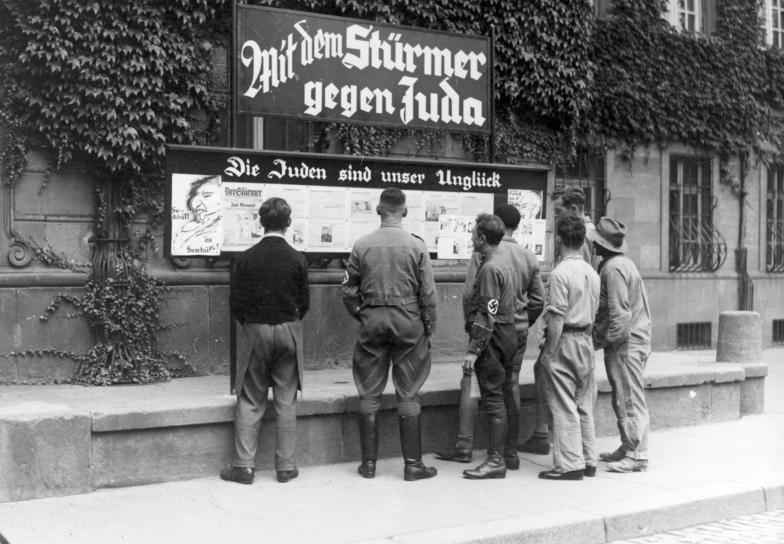
A public Der Stürmer display case ("Stürmerkasten") in Worms, 1935. The top board reads "Mit dem Stürmer gegen Juda" ("With the Stürmer against Judah"); the paper's own masthead line beneath the display reads "Die Juden sind unser Unglück" ("The Jews are our misfortune"). Bundesarchiv, Bild 133-075, CC BY-SA 3.0 DE. Shown because the case, not only the paper, put the label in front of anyone in the street.
- 1937, Der ewige Jude exhibition. "Der ewige Jude" ("The Eternal Jew"), a touring exhibition organised with Streicher's Franconia party apparatus, opens at the Bibliothek des Deutschen Museums in Munich in November 1937 and later travels to Vienna and Berlin. It presents Jews as a racial and cultural threat through photographs, charts and models. Attendance in Munich alone is put at several hundred thousand.
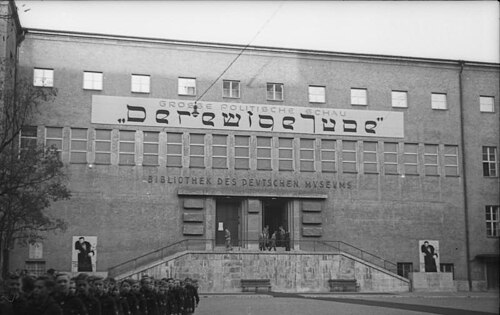
The "Große Politische Schau: Der ewige Jude" exhibition at the Bibliothek des Deutschen Museums, Munich, November 1937, with uniformed visitors assembling outside. Bundesarchiv, via Wikimedia Commons, CC BY-SA 3.0 DE.
- 1940. The Propaganda Ministry produces two feature-length films built on the same themes: Der ewige Jude, directed by Fritz Hippler, a purported documentary that intercuts footage of Jewish communities in occupied Poland with footage of rats, presenting Jews as a migratory, disease-bearing pest; and Jud Süß, directed by Veit Harlan, a costume drama loosely based on the eighteenth-century court financier Joseph Süß Oppenheimer, ending in his execution. Goebbels's diaries record him closely supervising both productions. SS units are recorded screening Jud Süß to troops assigned to police occupied territory and to camp guards.
- 30 January 1939, the Reichstag "prophecy." On the sixth anniversary of his taking power, Hitler tells the Reichstag: "Wenn es dem internationalen Finanzjudentum in und außerhalb Europas gelingen sollte, die Völker noch einmal in einen Weltkrieg zu stürzen, dann wird das Ergebnis nicht die Bolschewisierung der Erde und damit der Sieg des Judentums sein, sondern die Vernichtung der jüdischen Rasse in Europa!" ("Should international finance Jewry inside and outside Europe succeed in plunging the peoples into another world war, the result will not be the Bolshevisation of the earth and thus the victory of Jewry, but the annihilation of the Jewish race in Europe!"). Hitler and Goebbels return to this speech repeatedly during the war, at times misdating it to 1 September 1939, the day Germany invaded Poland, so that the war's outbreak appears to confirm the "prophecy."
- 1941, the Kaufman pamphlet. Theodore N. Kaufman, a private US citizen with no government position, self-publishes a pamphlet, Germany Must Perish!, proposing the sterilisation of the German population. It draws little notice in the United States. The German government's propaganda apparatus, through Wolfgang Diewerge's pamphlet Das Kriegsziel der Weltplutokratie ("The War Aim of World Plutocracy") and coverage in the controlled press, presents Kaufman's self-published pamphlet as an official Jewish and Allied plan to exterminate the German people, and repeats the claim through the war. Jeffrey Herf's The Jewish Enemy (2006) documents this campaign and its timing: the decree ordering Jews in Germany to wear a yellow star is issued 1 September 1941, and mass deportations from the Reich begin in October 1941. In a Das Reich article of 16 November 1941, titled "Die Juden sind schuld!" ("The Jews are guilty!"), Goebbels writes that the Jews are now experiencing "allmählich...die Vernichtung, die sie uns zugedacht hatten" ("gradually the annihilation they had intended for us"), pointing to the persecution then under way as the Jews' own doing.
- 20 January 1942, Wannsee. At a conference of state secretaries in Berlin, Reinhard Heydrich sets out plans for the "Endlösung der Judenfrage" ("Final Solution to the Jewish Question"). Internal orders and reports use "Sonderbehandlung" ("special treatment") for killing, and "Umsiedlung" or "Aussiedlung" ("resettlement," "evacuation") for deportation to killing centres.
- 23 June 1944, Theresienstadt. A delegation of the Danish government and the International Committee of the Red Cross visits Theresienstadt, a ghetto in occupied Czechoslovakia that German propaganda had described as a "model" settlement for elderly and prominent Jews. Before the visit the SS deports thousands of inmates to Auschwitz to relieve overcrowding, plants gardens, paints buildings, and stages a children's opera performance and a bank; the delegation's report was favourable. Afterward the SS produces a propaganda film, directed by the imprisoned Jewish actor and director Kurt Gerron under SS supervision, informally known as "Der Führer schenkt den Juden eine Stadt" ("The Führer Gives the Jews a City"). Gerron is deported to Auschwitz and killed in October 1944, before the film was finished.
- 10 August 1938, Nuremberg. On the order of Julius Streicher, the city's Gauleiter, given in June 1938, the Grand Synagogue of Nuremberg is expropriated and demolished. Officials call it a step to relieve "disruption of the cityscape." Demolition begins the same day as public speeches by Mayor Willy Liebel and Streicher. It precedes the Kristallnacht attacks on synagogues across Germany by three months.
Content note: Nazi official speaking before the demolition of a synagogue. This object is shown as it was published. Why 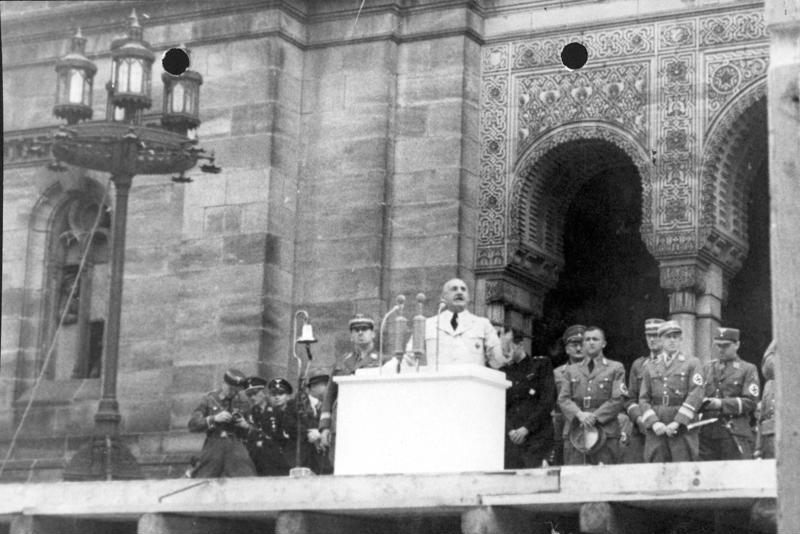
Julius Streicher addresses a crowd from a podium in front of the Grand Synagogue of Nuremberg on 10 August 1938, the day its demolition began on his order. Bundesarchiv, Bild 146-1995-012-00A, via Wikimedia Commons, CC BY-SA 3.0 DE.

- 1946, the Nuremberg verdicts. The International Military Tribunal convicts Julius Streicher of crimes against humanity for his incitement through Der Stürmer over more than a decade, stating that his writings "poisoned the minds of thousands of Germans" and "incited the German people to active persecution." He is hanged on 16 October 1946. The tribunal acquits Hans Fritzsche, head of the Propaganda Ministry's Radio Division, finding his role too junior to carry individual criminal responsibility; the Soviet judge, Iona Nikitchenko, dissents from that acquittal and from two others. A German denazification court later sentences Fritzsche separately to nine years' hard labour; he is released in 1950.
Content note: Nazi Party members posting an antisemitic boycott sign. This object is shown as it was published. Why 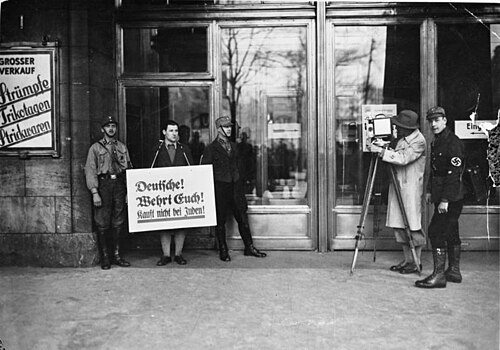
SA men post a sign reading "Deutsche! Wehrt Euch! Kauft nicht bei Juden!" ("Germans! Defend yourselves! Don't buy from Jews!") at a department store entrance in Berlin on the 1 April 1933 boycott day, while a cameraman films the scene for newsreel. Bundesarchiv, Bild 183-R70355, via Wikimedia Commons, CC BY-SA 3.0 DE.

How it works
- Name-calling: Der Stürmer's masthead line, repeated on every issue and every street display case for over a decade, reduced an entire people to one epithet, "our misfortune," ahead of any argument.
- Scapegoating: the boycott, the 1937 exhibition and the two 1940 films placed Germany's economic and social grievances, and later the war itself, on a single group bounded by ancestry rather than any act.
- Euphemism / doublespeak: "Final Solution," "special treatment," "resettlement" and "evacuation" let orders for deportation and murder pass through administrative channels, and past many of the people who wrote and read them, without naming the act. The same device ran smaller: calling the 1938 demolition of the Nuremberg synagogue a fix for "disruption of the cityscape" gave a targeted act of destruction, ordered by the city's own Gauleiter, the appearance of routine urban planning.
- Accusation in a mirror: the 1941 campaign around Kaufman's pamphlet took an obscure, unofficial document and presented it as proof of a Jewish extermination plan, at the same moment the regime marked Jews with the yellow star and began mass deportation. Goebbels's November 1941 article makes the mirror explicit, describing persecution then under way as Jews "gradually" suffering the "annihilation" he says they had intended for Germans.
- Card stacking: the Theresienstadt visit assembled a real bank, a real children's opera and freshly painted buildings for the delegation to see, after deporting the inmates whose presence would have contradicted the picture, and left everything the visit was built to hide off the itinerary.
The 30 January 1939 Reichstag speech does not carry a technique tag by itself: it is a documented public threat, quoted as the record shows it, and analysing exactly how it functioned (as a warning to foreign governments, as license to a domestic audience, or both) is a matter the cited historians still weigh; this page states what was said and when, without adjudicating that question.
Then and now
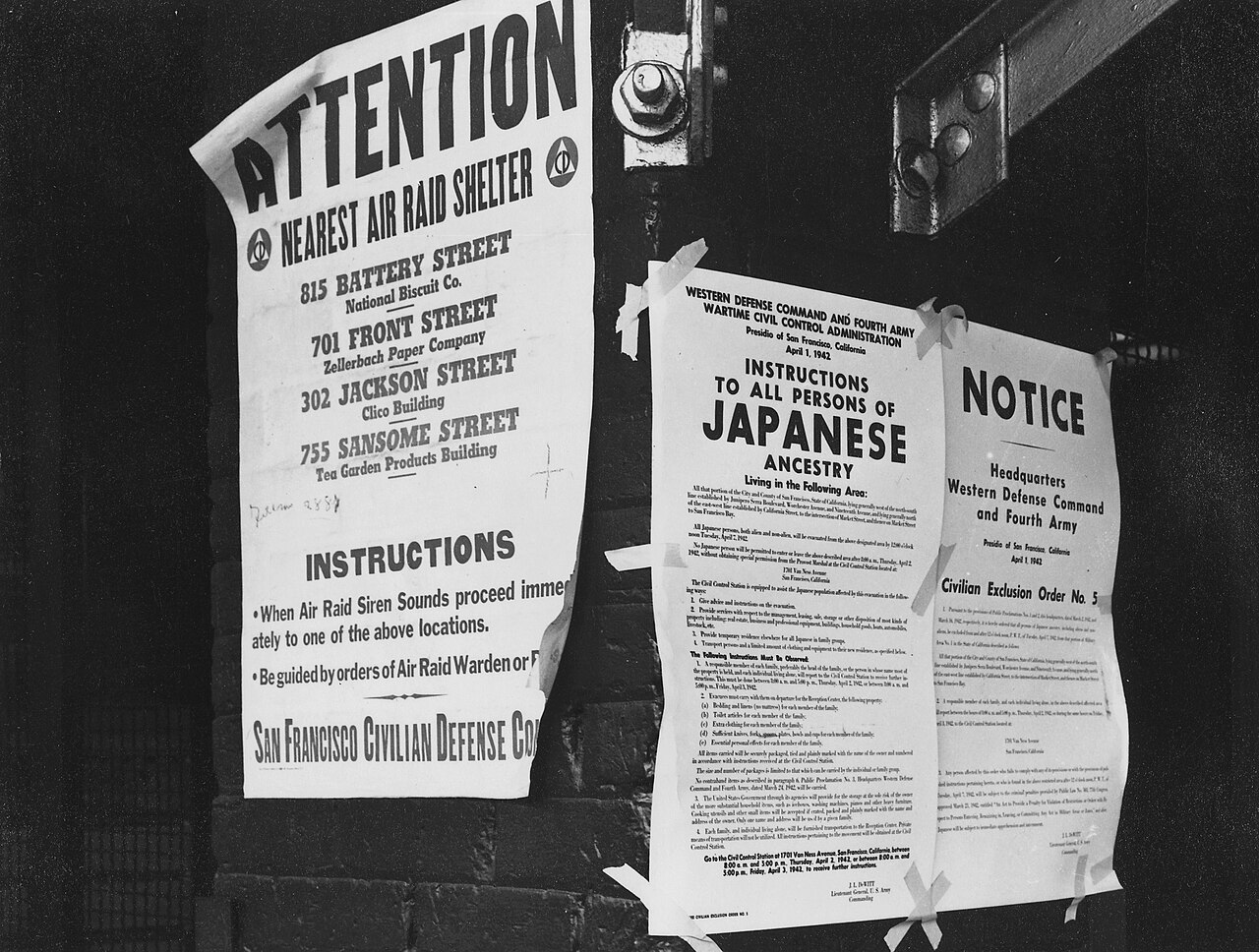
'Instructions to All Persons of Japanese Ancestry' (exclusion order posted in San Francisco), U.S. Army Western Defense Command, 1942. Public domain.
The vocabulary in both cases did the same job: it let an administration and its public describe forced removal, and in the German case mass murder, in words that named no such thing. "Evacuation" and "non-aliens" stood in for the forced removal of US citizens to camps; "resettlement" and "special treatment" stood in for deportation and murder. The scale, intent and outcome are not the same: the US camps did not kill their inmates, and the 1988 Civil Liberties Act found the policy driven by "race prejudice, war hysteria and a failure of political leadership," not by a plan of extermination. The device, replacing an act with a bloodless phrase so evaluation never meets the thing itself, is the same, and this page would score it the same in either country's own voice.
The 1990s Rwandan case study Kangura, Radio Rwanda and RTLM: Hutu Power propaganda before and during the genocide against the Tutsi, 1990-1994 documents accusation in a mirror on state radio; the Media Case judgment against Kangura's editor and RTLM's leaders drew a direct legal parallel to the Nuremberg conviction of Streicher for incitement through a licensed publication.
Positions on the record
- As stated by the propaganda itself. Der Stürmer and the 1937 exhibition presented Jews as a biological and economic threat to Germany. The 1939 Reichstag speech presented a future war as a Jewish-caused catastrophe for which Jews would bear the consequence. The 1941 campaign around the Kaufman pamphlet presented the persecution then under way as a defensive response to an alleged Jewish extermination plan.
- What the trial record found. The International Military Tribunal's 1946 judgment held Streicher criminally responsible for incitement to persecution and murder through Der Stürmer over many years, and sentenced him to death. It acquitted Fritzsche on individual responsibility grounds, over the dissent of the Soviet judge. Neither finding is disputed here; both are part of the same tribunal's record, reached by the same court under the same law.
- Not shown. This page does not attribute any single killing to any single article, broadcast or film. The historians cited on the Kaufman campaign (chiefly Herf) document the propaganda apparatus's use of the pamphlet; they do not claim the pamphlet itself, rather than the regime's own decisions, caused the deportations that followed it.
Same-method test
A government that took an obscure pamphlet by a private citizen of a country it was fighting, presented it through its own state media as that country's official plan to exterminate the government's own population, and did so in the same weeks it moved against a minority inside its own borders, would be scored the same way here, whatever flag it broadcast under. The 1990s Rwandan case above and the wartime Japanese-American exclusion orders each show one part of the same family of devices, the label and the euphemism, under different flags and to different ends.
How to spot it
- Watch for a slogan that outlives any single argument. A phrase repeated on every issue of a publication, or built into a masthead or building facade, is doing work a fact would have to earn each time.
- Check who benefits from the timing. The Kaufman pamphlet had existed for months before the propaganda campaign around it began; the campaign's timing lines up with the regime's own escalation, not with any new fact about the pamphlet.
- Read administrative language for what it does not name. "Resettlement," "special treatment" and "evacuation" are each a request to stop asking what happens next.
- A staged visit is not evidence. A single approved, prepared visit (Theresienstadt in 1944) is not independent verification; ask what happened immediately before it and what the visitors were not shown.
Images
| Image | Source | Licence |
|---|---|---|
| Mechanism diagram (above) | Drawn for FRAME from the sources below (make_diagrams_atrocity.py) |
CC BY 4.0, FRAME |
| Stürmerkasten display case, Worms, 1935 | Bundesarchiv, Bild 133-075, via Wikimedia Commons | CC BY-SA 3.0 DE |
| Der ewige Jude exhibition building, Munich, 1937 | Bundesarchiv, via Wikimedia Commons | CC BY-SA 3.0 DE |
| Boycott sign at a Berlin department store, 1 April 1933 | Bundesarchiv, Bild 183-R70355, via Wikimedia Commons | CC BY-SA 3.0 DE |
| Instructions to All Persons of Japanese Ancestry (1942) | FRAME gallery, NARA via Wikimedia Commons | Public domain |

Image gaps
- The Der ewige Jude exhibition photo's exact Bundesarchiv catalogue number. The building photo used above (via Commons) is confirmed CC BY-SA 3.0 DE, but its precise Bild number could not be confirmed against the source directly from this environment; several near-identical 1937 exhibition photos are on Commons under different numbers, so the exact one is not stated on the page. This does not affect the image's own confirmed licence.
- A Der Stürmer front page or caricature. No openly licensed scan was found; Commons hosts photographs of the paper being displayed and read (used above) rather than clean page scans, whose rights are unclear.
- The 30 January 1939 Reichstag speech. No openly licensed photograph of the session, or facsimile of the text as printed, was confirmed against a source directly. The speech is quoted from the standard German text and English translations used by Holocaust historians and documentation projects; a facsimile could be added if a public-domain or openly licensed copy is confirmed.
- The 1941 Kaufman pamphlet and the Diewerge reply pamphlet. Both are out of copyright by age in some jurisdictions but their US public-domain status was not confirmed from this environment, so neither is hosted here. Could be filled if their status is confirmed.
- Theresienstadt, June 1944. No openly licensed photograph or film still from the Red Cross visit or the 1944 film was found; the surviving film fragments are held by archives whose licensing was not reachable from this environment.
- The Nuremberg judgment against Streicher. The International Military Tribunal's own record is a public document, but no openly licensed page scan was found.
Sources
- Avalon Project, Yale Law School: International Military Tribunal, Judgment, "The Accused Streicher" and "The Accused Fritzsche"
- Trial of the Major War Criminals before the International Military Tribunal, vol. XII (Nuremberg, 1948), Streicher testimony and closing argument
- German Propaganda Archive, Calvin University: Der Stürmer and "Der ewige Jude" materials
- Jeffrey Herf, The Jewish Enemy: Nazi Propaganda during World War II and the Holocaust (Harvard University Press, 2006)
- United States Holocaust Memorial Museum, Holocaust Encyclopedia: "Nazi Propaganda" and "The Yellow Star"
- United States Holocaust Memorial Museum, Holocaust Encyclopedia: "The Reich Chamber of Culture"
- United States Holocaust Memorial Museum, Holocaust Encyclopedia: "Nazi Camps" and "Theresienstadt"
- United States Holocaust Memorial Museum, Holocaust Encyclopedia: "Boycott of Jewish Businesses"
- Yad Vashem: "Der Stürmer" and Holocaust Encyclopedia entries on the Wannsee Conference
- Randall Bytwerk, Julius Streicher: Nazi Editor of the Notorious Antisemitic Newspaper Der Stürmer (Cooper Square Press, 2001)
- Minutes of the Wannsee Conference, 20 January 1942, translation, Avalon Project
- 1988 Civil Liberties Act and the Commission on Wartime Relocation and Internment of Civilians, "Personal Justice Denied" (1983)
- ICTR, Prosecutor v. Nahimana, Barayagwiza and Ngeze, ICTR-99-52-T (3 December 2003), on the legal parallel to Streicher (see Kangura, Radio Rwanda and RTLM: Hutu Power propaganda before and during the genocide against the Tutsi, 1990-1994 for full citation)