Also called The Big Lie, Große Lüge, Grosse Luege
A falsehood so large that audiences assume no one would dare invent it, sustained by repetition and by attacking anyone who disputes it.
How to spot Big lie: the tell
A sweeping claim contradicted by the documentary record, kept alive by an apparatus rather than by new evidence.
What Big lie is not
A large claim that turns out to be well documented.
History and effect of Big lie propaganda
The phrase is the English form of die große Lüge. It first appears in Adolf Hitler's Mein Kampf (1925, vol. 1, ch. 10), where it is an accusation against others. Hitler wrote that "the Jews, with their unqualified capacity for falsehood," and their "fighting comrades, the Marxists," had blamed General Erich Ludendorff for Germany's defeat in 1918, and that in the big lie "there is always a certain force of credibility" (James Murphy's English translation). The passage assigns the method to Jews. That is an antisemitic charge, not a finding, and this page quotes it as the source of the term. Hitler's own party then ran a very large falsehood about Jews, described below.
Explain moreShow less
The sense most people use now, a method a propagandist adopts on purpose, comes from a 1943 report for the U.S. Office of Strategic Services by the psychoanalyst Walter Langer, published in 1972 as The Mind of Adolf Hitler. Its list of Hitler's propaganda rules includes "people will believe a big lie sooner than a little one". A line often credited to Joseph Goebbels, "If you tell a lie big enough and keep repeating it, people will eventually come to believe it," has no source. Randall Bytwerk of the German Propaganda Archive calls it a fabricated quotation. What Goebbels did write, on 12 January 1941 in "Churchill's Lie Factory", is the accusation: "The English follow the principle that when one lies, one should lie big, and stick to it." So the phrase began as a charge made against an opponent, and it is still used that way. The emotional effect on an audience is relief at a simple explanation, plus pressure not to be the person who doubts something "everyone" appears to accept.
Lineage: Hitler, Mein Kampf (1925); OSS psychological profile of Hitler (1943)
How Big lie propaganda works
Four parts recur. The claim is large and simple: a whole group, a whole election, a whole war has one cause. It is repeated across many channels until it feels familiar. It is protected by an apparatus such as party newspapers, school textbooks, exhibitions, ministries or organised supporters, which supply the repetition. And it comes with an answer to disbelief: those who dispute it are described as part of the plot or as liars themselves.
Explain moreShow less
The apparatus is what separates this technique from a single false statement. A person can be wrong once. The big lie persists after the contradicting record is public, because the structure that carries it does not depend on new evidence.
Why Big lie propaganda works
Repetition raises the sense that a statement is true. Hasher, Goldstein and Toppino (1977) found it for obscure statements, Fazio and colleagues (2015) found it even when people had relevant knowledge, and Pennycook, Cannon and Rand (2018) found it for fake news headlines. That is the repetition half of the technique and it is well replicated. The other half, Hitler's and Langer's claim that larger falsehoods are believed more readily than small ones, is not established by this research and is treated here as a propagandist's belief. People also favour accounts that fit their identity (motivated reasoning), and a retracted claim keeps influencing judgment when no replacement story is offered (Johnson and Seifert, 1994).
Big lie propaganda examples across eras and sides
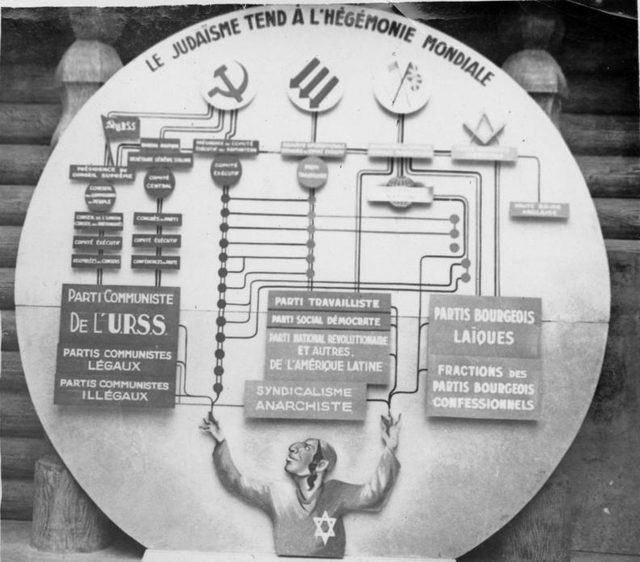
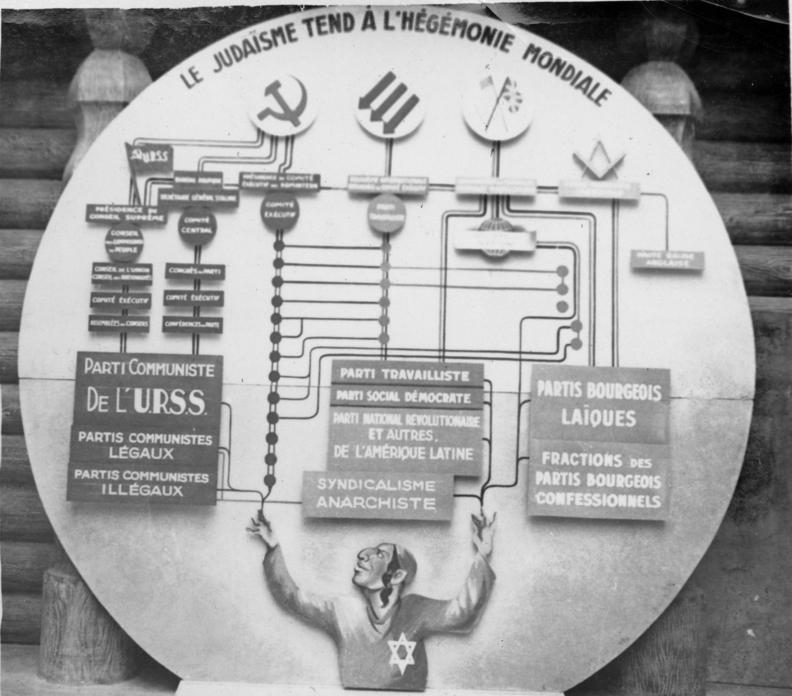
- Russia and Germany, 1903 to 1945: the Protocols of the Elders of Zion. The text appeared in the St. Petersburg newspaper Znamia in 1903 and as an appendix to Sergei Nilus's book in 1905, presenting itself as the minutes of a Jewish plan for world control. The Times of London showed in August 1921, through Philip Graves's comparison with Maurice Joly's 1864 satire, that it was plagiarised. A Swiss court at Bern in 1935 called it "ridiculous nonsense". The Nazi Party's publishing house issued 22 editions between 1919 and 1938, and Goebbels wrote in his diary, "I believe in the inner, but not the factual, truth of The Protocols" (U.S. Holocaust Memorial Museum). A panel at the 1942 Paris exhibition Le Bolchevisme contre l'Europe, under the title "Le judaïsme tend à l'hégémonie mondiale", drew lines from the Soviet party, Labour, Social Democrats and "Haute banque anglaise" to one cartoon figure.
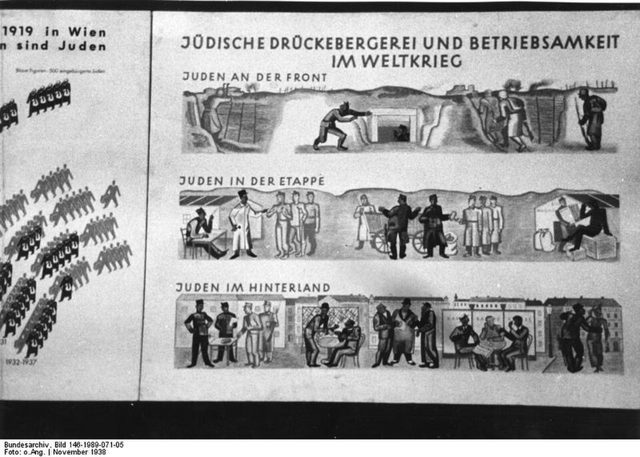
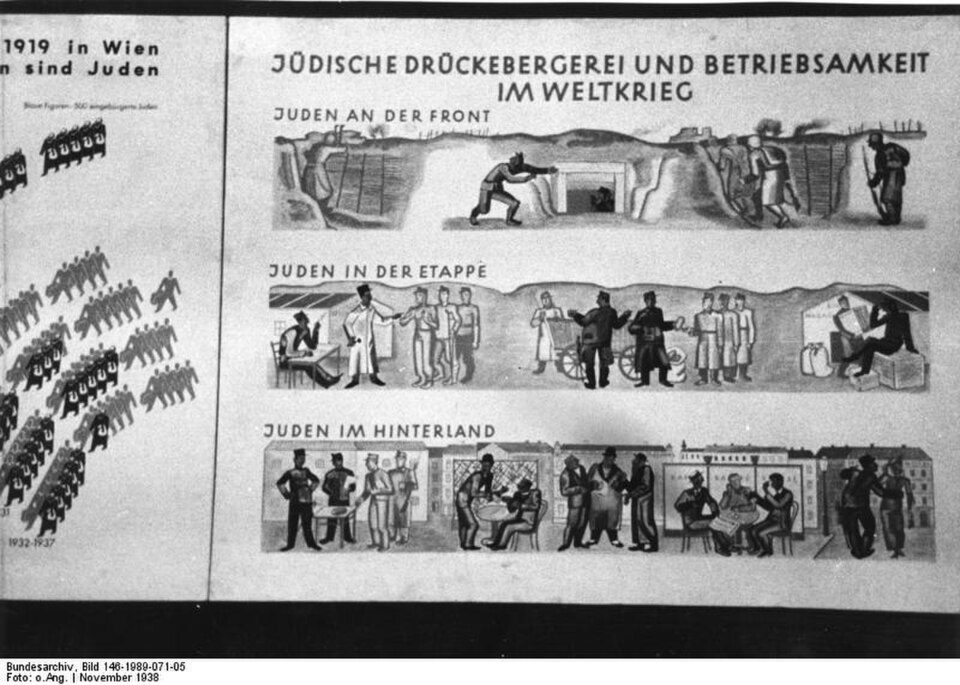
- Germany, 1918 to 1938: the stab in the back. The charge that Jews had avoided service and undermined the front was tested inside Germany. On 11 October 1916 the Prussian war ministry ordered a count of Jewish soldiers, and the results were never published, which let rumours continue (Deutsches Historisches Museum). About 100,000 Jewish soldiers fought for Germany, about 78,000 at the front, and about 12,000 were killed. The 1938 Berlin exhibition panel "Jüdische Drückebergerei und Betriebsamkeit im Weltkrieg" (Jewish shirking and profiteering in the World War) showed strips of Jews idle at the front and profiting at home. The claim was sustained by a state exhibition and a party press.
- United States, 1943. The OSS report is the case where a government turned the phrase from an accusation into a theory of Hitler's method. Its audience was a small wartime circle, not the public, and it described what the author thought the enemy did. The report is a source for the term, not evidence that the method works as described.
Show all 6Show fewer
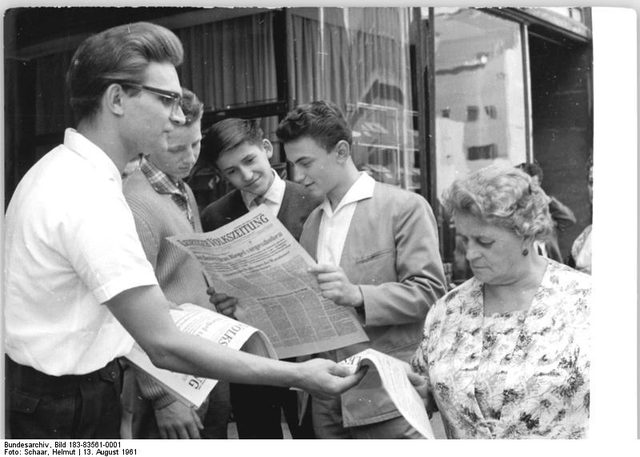
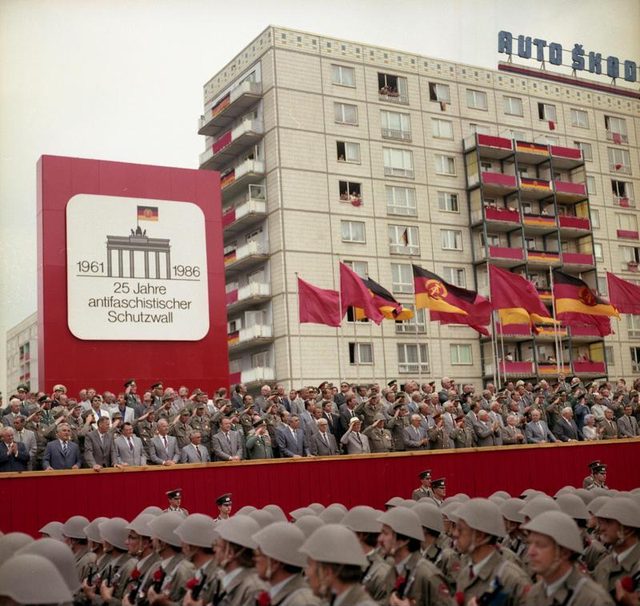
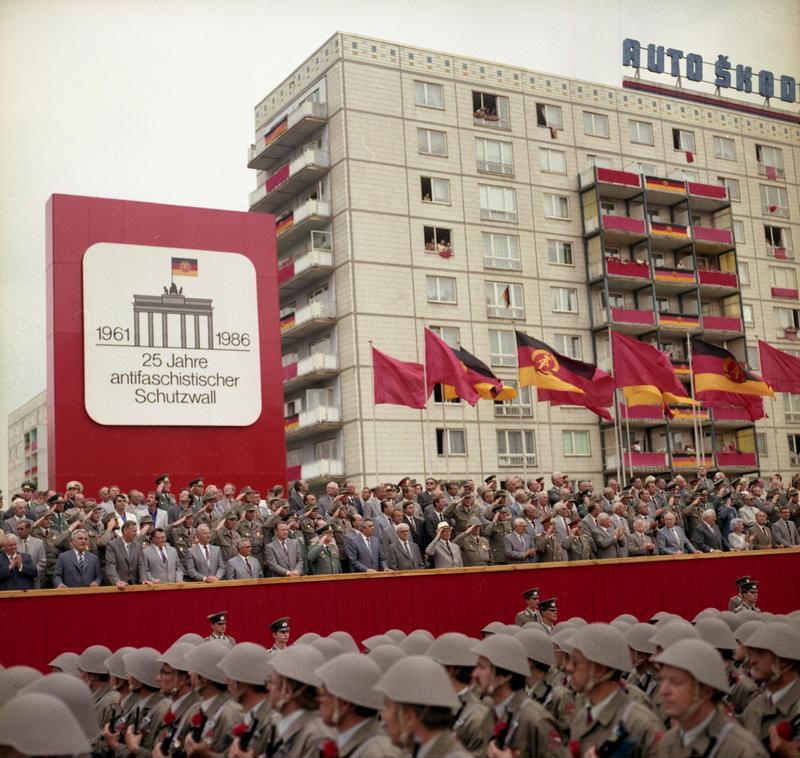
- East Germany, 1961 to 1989: the "anti-fascist protection rampart". On 15 June 1961 Walter Ulbricht told a press conference, "Niemand hat die Absicht, eine Mauer zu errichten" ("No one has the intention of erecting a wall"). The Wall went up on 13 August. Its official name was the Antifaschistischer Schutzwall, and the stated reason was defence against aggression from the West. About 3.5 million East Germans, around a fifth of the population, had left before it was built, and at least 140 people were killed at the border (Zentrum für Zeithistorische Forschung, via Wikipedia). A 1986 state parade in Berlin carried the board "25 Jahre antifaschistischer Schutzwall", and the Leipzig party paper's extra of 13 August 1961 called the closure "border-securing measures".
- United States, 1861 to 1919: the Lost Cause. The Mississippi declaration of causes for secession in January 1861 states, "Our position is thoroughly identified with the institution of slavery". After the war, writers including Alexander Stephens and Jefferson Davis argued that the war was about states' rights. Organisations such as the United Daughters of the Confederacy pushed textbooks that gave slavery no part, and by 1910 their literature dominated many classrooms (Wikipedia, citing Blight, Gallagher and Cox). Most historians today say secession was driven by slavery. The claim is contradicted by the secessionists' own documents and was carried by organisations.
- United States, 2020 to 2023: the stolen-election claim. After the November 2020 presidential election, then-President Donald Trump and allies said it had been stolen through fraud. On 1 December 2020 Attorney General William Barr told the Associated Press, "To date, we have not seen fraud on a scale that could have effected a different outcome in the election." On 18 April 2023 Fox News settled the Dominion Voting Systems defamation suit for $787.5 million, stating, "We acknowledge the Court's rulings finding certain claims about Dominion to be false." President Joe Biden used the label on 11 January 2022 in Atlanta: "the defeated former president and his supporters use the Big Lie about the 2020 election".
Explain moreShow less
The label is now used by every side, and each use is an accusation, not a finding. On 25 March 2019 Representative Mo Brooks told the House that Democrats and news organisations had "perpetrated the biggest political lie, con, scam, and fraud in American history" over claims of Trump campaign collusion with Russia, and he read a passage from Mein Kampf on the big lie. On 17 February 2024 China's Foreign Minister Wang Yi said at the Munich Security Conference of the genocide allegations about Xinjiang, "The so-called 'genocide' is such a big lie". The cases above differ greatly in scale: the Protocols and the Nazi state's use of them were part of a path to genocide, while the Lost Cause and the Wall justified policies of exclusion and confinement, and the 2020 claim concerned an election result that the Justice Department statement and the Dominion settlement cited above contradict.
Panel 'Le judaïsme tend à l'hégémonie mondiale' (Jewry tends toward world hegemony), exhibition 'Le Bolchevisme contre l'Europe', Paris, March 1942, organised by French collaborationist bodies with German occupation support. Bundesarchiv, Bild 183-2004-0211-500, via Wikimedia Commons. CC BY-SA 3.0 DE.
Display board from the exhibition 'Der ewige Jude' (The Eternal Jew), Berlin, November 1938, Reichspropagandaleitung der NSDAP. Bundesarchiv, Bild 146-1989-071-05, via Wikimedia Commons. CC BY-SA 3.0 DE. Shown as it was, with its antisemitic caricatures.
Kampfappell parade, Karl-Marx-Allee, East Berlin, 13 August 1986, with the board '25 Jahre antifaschistischer Schutzwall'. ADN-Zentralbild (GDR state news agency), photograph by Klaus Franke. Bundesarchiv, Bild 183-1986-0813-460, via Wikimedia Commons. CC BY-SA 3.0 DE.
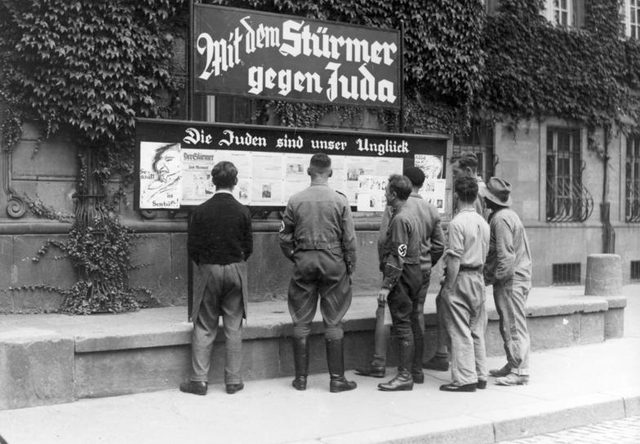
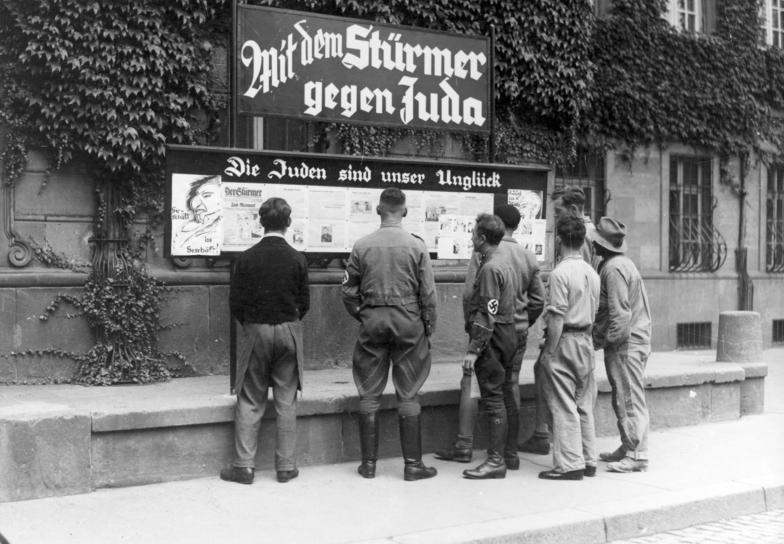
Der Stürmer display case, Worms, August 1935, headed 'Mit dem Stürmer gegen Juda' with the motto 'Die Juden sind unser Unglück'. Bundesarchiv, Bild 133-075, via Wikimedia Commons. CC BY-SA 3.0 DE. Shown as it was, with its antisemitic slogan.
How to spot Big lie propaganda
- Is the claim sweeping and simple, with one group, party or conspiracy as the cause of many unrelated events?
- Is there a documentary record (a census, a court ruling, an audit, the claimant's own earlier documents) that contradicts it, and does the record come from sources the claimant would be expected to trust?
- Does the claim survive the contradicting record, and what keeps it alive: new evidence, or the same newspapers, textbooks, exhibitions or supporters repeating it?
Show all 6Show fewer
- Is doubt answered with an accusation of conspiracy or lying instead of with evidence?
- Would the speaker accept the same test applied to a claim from their own side?
- Is the phrase "big lie" itself used as the argument, without naming the record?
Where Big lie propaganda ends: edge cases and legitimate persuasion
4 items · A claim can be enormous and true. Reports in 1942 that Nazi Germany was murdering…
- A claim can be enormous and true. Reports in 1942 that Nazi Germany was murdering Europe's Jews met disbelief in parts of the Western press because the scale seemed implausible (Lipstadt, Beyond Belief, 1986). The claim was documented, so it is the opposite of this technique. Size alone proves nothing either way.
- A wrong claim made once, or held honestly, is a mistake. This technique needs the apparatus and the contradicting record, not only error.
- Calling something "the big lie" is a separate rhetorical move. It asserts that a claim is false, that the speaker knows it, and, through the Nazi association, that the opponent works like Nazi propaganda. Each needs its own evidence. See Name-calling and Accusation in a mirror, whose test is documentary evidence that the accuser ran the method charged.
- A false claim aimed at a named target as a scapegoat is also Scapegoating. Many contradictory claims at once are Firehosing. A denial of what the audience itself saw is Gaslighting.
Sources and further reading
Sources
12 items · Hitler, Adolf. Mein Kampf , vol. 1, ch. 10 (1925); English translation by James Murphy…
- Hitler, Adolf. Mein Kampf, vol. 1, ch. 10 (1925); English translation by James Murphy (Hurst and Blackett, 1939). Passage summarised in Wikipedia, "Big lie" and Barry Popik, "If you are going to tell a lie, tell a big one".
- Langer, Walter C. A Psychological Analysis of Adolph Hitler: His Life and Legend. Office of Strategic Services, 1943, Cornell University Library; text at Jewish Virtual Library. Published as The Mind of Adolf Hitler, Basic Books, 1972.
- Bytwerk, Randall. "Goebbels Didn't Say It", German Propaganda Archive, Calvin University.
- Goebbels, Joseph. "Churchill's Lie Factory", 12 January 1941, translated by Randall Bytwerk, German Propaganda Archive.
- U.S. Holocaust Memorial Museum. "The Protocols of the Elders of Zion", Holocaust Encyclopedia; "The Times, August 17, 1921".
- Deutsches Historisches Museum. "Judenzählung 1916", LeMO.
- Wikipedia, "Berlin Wall" (Ulbricht, 15 June 1961; official name; departures 1949 to 1961; deaths, citing ZZF Potsdam).
- "A Declaration of the Immediate Causes which Induce and Justify the Secession of the State of Mississippi from the Federal Union", Avalon Project, Yale Law School; Wikipedia, "Lost Cause of the Confederacy".
- WBUR / Associated Press, 1 December 2020: Barr on election fraud; Good Morning America / ABC News, 18 April 2023: Fox and Dominion settlement.
- Biden, Joe. Remarks on election integrity, Atlanta, 11 January 2022, Roll Call Factba.se. Brooks, Mo. Remarks in the House of Representatives, 25 March 2019, Congressional Record 165(51). Wang Yi. Remarks at the Munich Security Conference, 17 February 2024, Ministry of Foreign Affairs of the PRC.
- Lipstadt, Deborah. Beyond Belief: The American Press and the Coming of the Holocaust, 1933-1945. Free Press, 1986.
- Hasher, Goldstein and Toppino (1977), Journal of Verbal Learning and Verbal Behavior 16(1); Fazio, Brashier, Payne and Marsh (2015), Journal of Experimental Psychology: General 144(5); Pennycook, Cannon and Rand (2018), Journal of Experimental Psychology: General 147(12); Johnson and Seifert (1994), Journal of Experimental Psychology: Learning, Memory, and Cognition 20(6).
Gaps. No case of a claim sustained by a U.S. government apparatus about its own conduct is included. Candidates such as the Gulf of Tonkin account of 4 August 1964 and the Iraq weapons claims of 2003 are in the archive under Card stacking, but they have not yet been tested here against this page's definition, so the page's only U.S. case is a campaign claim. A U.S. government case will be added when one is assessed against the same test. The Korean War germ-warfare charges were left out because the record is disputed (see The Korean War germ-warfare charges: commissions, confessions and the 1953 recall). The Mein Kampf wording is taken from the 1939 Murphy translation as quoted by secondary sources; the German original was not rechecked.
The science
Research on the psychology this technique relies on, from the Learn library:
Research on the psychology this technique relies on, from the Learn library:
- The big lie: where the term comes from and how it is used — The big lie: where the term comes from and how it is used
- Illusory truth effect — Illusory truth effect
- Continued influence effect — Continued influence effect
- Motivated reasoning — Motivated reasoning