In one line: East and West German television each ran a long-lived programme aimed at the other side of the Wall, and from 1996 Qatar, the United States, Russia and China each funded satellite news channels for foreign audiences; regulators, prosecutors and platforms later acted on some of them, and this page applies the same tests to all six.
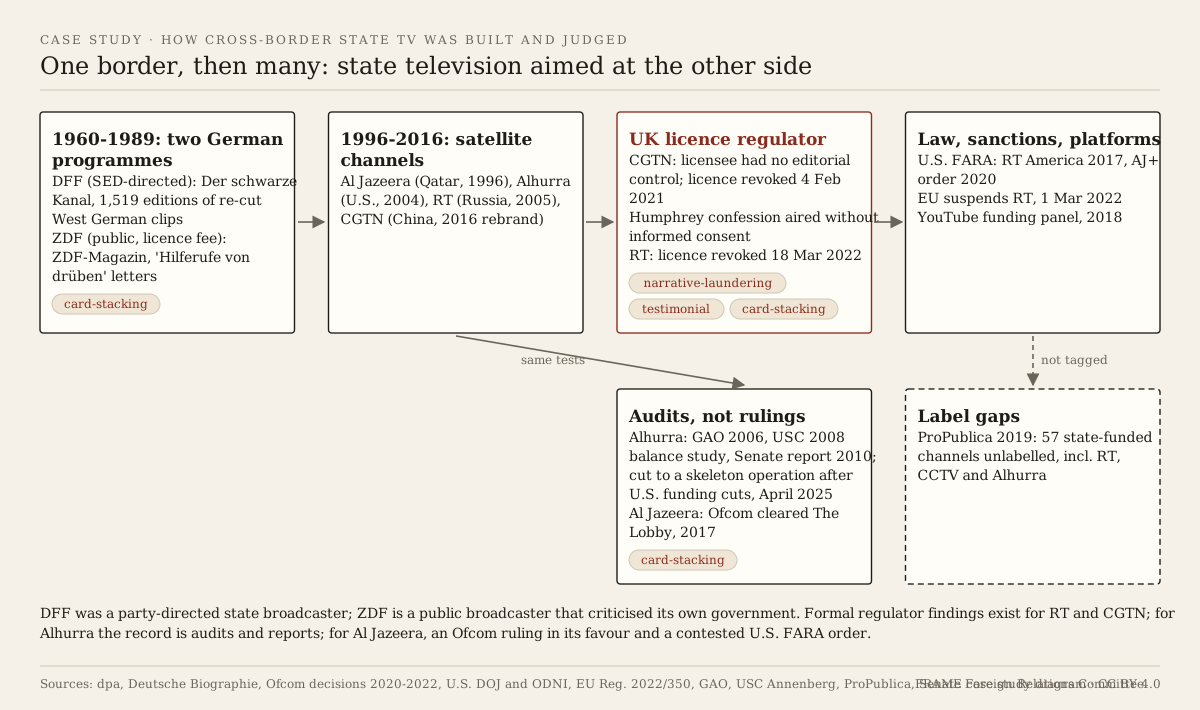
What happened
Part 1: the German TV duel (1960-1989)
- The two broadcasters were built differently. DFF (Deutscher Fernsehfunk, called Fernsehen der DDR from 1972) was the East German state broadcaster, with programming set under the direction of the ruling SED party (Gumbert 2014; Dittmar 2010). ZDF, founded by a treaty of the West German Länder and on air from 1963, is a public broadcaster funded mainly by the licence fee, not a government ministry. Its boards did include government and party representatives; in 2014 the Federal Constitutional Court capped state-affiliated members at one third (BVerfG, 1 BvF 1/11, 25 March 2014).
- The audience overlapped. West German television could be received across most of East Germany (Dittmar 2010).
- 21 March 1960. DFF airs the first Der schwarze Kanal ("The Black Channel"), presented by Karl-Eduard von Schnitzler. Each edition, about 20 minutes on Monday nights, was built from recorded extracts of recent West German programmes, re-edited with Schnitzler's commentary over them. Schnitzler, taken prisoner by the British during the Second World War, had worked for the BBC's German-language service and then for the British-run NWDR in Hamburg and Cologne, which dismissed him in 1947, before moving East (Tagesspiegel).
- Reception. A standing joke called him "Karl-Eduard von Schni-": viewers switched off before he finished his name. He was nicknamed "Sudel-Ede" (dpa via newsroom.de). No audience figures appear in the sources used here.
- 8 January 1969. ZDF launches ZDF-Magazin, presented by Gerhard Löwenthal, on Wednesday evenings; it ran weekly and, from October 1973, fortnightly (Fernsehlexikon). Löwenthal, a Berlin Jew taken with his father to Sachsenhausen concentration camp during the November 1938 pogrom and released soon after, had begun his broadcasting career in November 1945 at DIAS, the U.S.-run wire radio service in Berlin that became RIAS (Deutsche Biographie; Jüdische Allgemeine). The programme took an anti-communist line, concentrated on political persecution in communist-ruled Eastern Europe and criticised the Bonn government's Ostpolitik.
- Reception in the West. Löwenthal's critics in West Germany described him as a cold warrior (Jüdische Allgemeine, "Kalter Krieger vom ZDF"). In February 1976 the governing SPD began a boycott of interviews with ZDF-Magazin; parliamentary leader Herbert Wehner called Löwenthal an international troublemaker and Willy Brandt called him a "Schreibtischtäter" (desk-bound perpetrator) (Fernsehlexikon; Jüdische Allgemeine). Supporters of the new Ostpolitik saw the "Hilferufe" segment as endangering negotiations with East Berlin. When the programme quoted confidential documents on East-West negotiations, prosecutors opened an inquiry into breach of secrecy and searched journalists' homes and offices (Berliner Zeitung).
- 1975-1980: "Hilferufe von drüben" ("Cries for help from over there"). After the 1975 Helsinki Final Act, which East Germany also signed, set the participating states the aim to "facilitate freer movement and contacts", Löwenthal ran its wording on screen several times for East German viewers to copy down. Letters from East Germans describing political persecution followed; the segment read them on air, organised help and collected donations.
- 23 December 1987 and 30 March 1988. Löwenthal presents his last edition on reaching retirement age; Fritz Schenk presents the programme until its final edition on 30 March 1988, after 591 editions (Fernsehlexikon). Löwenthal died in 2002 (Deutsche Biographie).
- 30 October 1989. Ten days before the Wall opened, Der schwarze Kanal airs its last edition, the 1,519th, of which Schnitzler had presented about 1,300; he was given four minutes to say goodbye (German federal government chronicle; dpa via newsroom.de). Schnitzler died in 2001.
Part 2: satellite channels (1996-2025)
- 1 November 1996: Al Jazeera. Launched in Doha by the then Emir of Qatar, Hamad bin Khalifa Al Thani, with a start-up loan later turned into a grant, reported at about $137-150 million. Much of the staff came from BBC Arabic Television, which had closed that April (Miles 2005). Its motto is "The opinion and the other opinion".
- 14 February 2004: Alhurra. Arabic-language satellite channel run by Middle East Broadcasting Networks (MBN), a non-profit grantee fully funded by the U.S. government through the Broadcasting Board of Governors, later renamed the U.S. Agency for Global Media (USAGM). First-year funding was $62 million (USAGM).
- 2005: RT (Russia Today). English-language channel run by ANO TV-Novosti. The Russian government assigned 700 million roubles to launch it and 1.4 billion roubles for its first year, rising to 3.6 billion in 2008 (New Eastern Europe, 2012). In 2010 it launched an advertising campaign under the slogan "Question More".
- 31 December 2016: CGTN. China Central Television's international channels were rebranded China Global Television Network; the English channel had been called CCTV News.
- 2 February 2018: YouTube labels. YouTube began showing U.S. users a panel under videos from outlets receiving government or public funding, linking to Wikipedia. It appeared on PBS and the BBC as well as RT and Chinese state channels (CNN Money; TechCrunch). The Broadcasting Board of Governors (renamed USAGM later that year) objected to having its networks, such as Voice of America, grouped under one label with Chinese and Russian outlets; PBS called the label "vague and misleading".
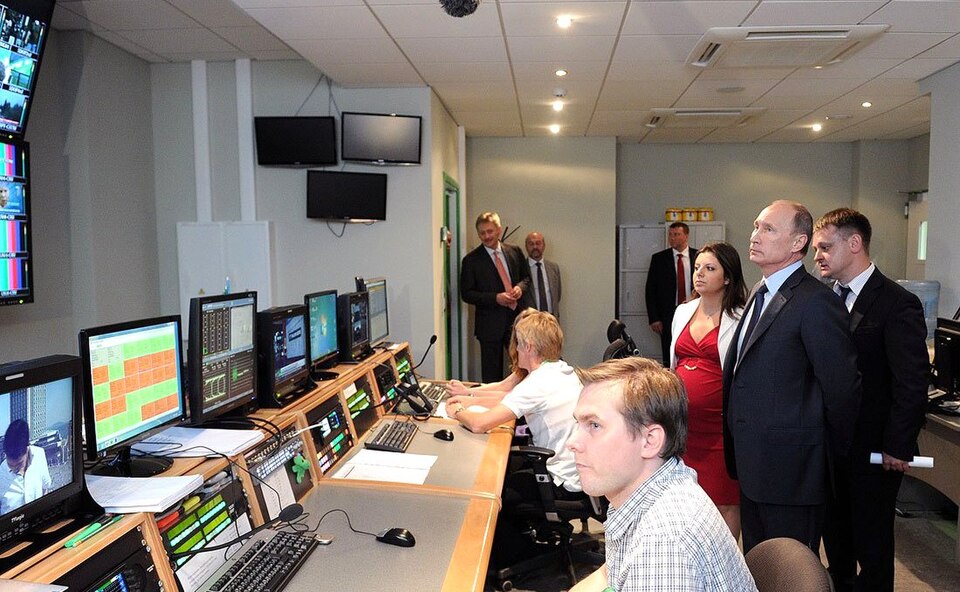
Russian President Vladimir Putin (right, in suit) in a production control room during a visit to the new RT (Russia Today) broadcasting centre, Moscow, 11 June 2013. Photo: kremlin.ru, CC BY 4.0, via Wikimedia Commons.
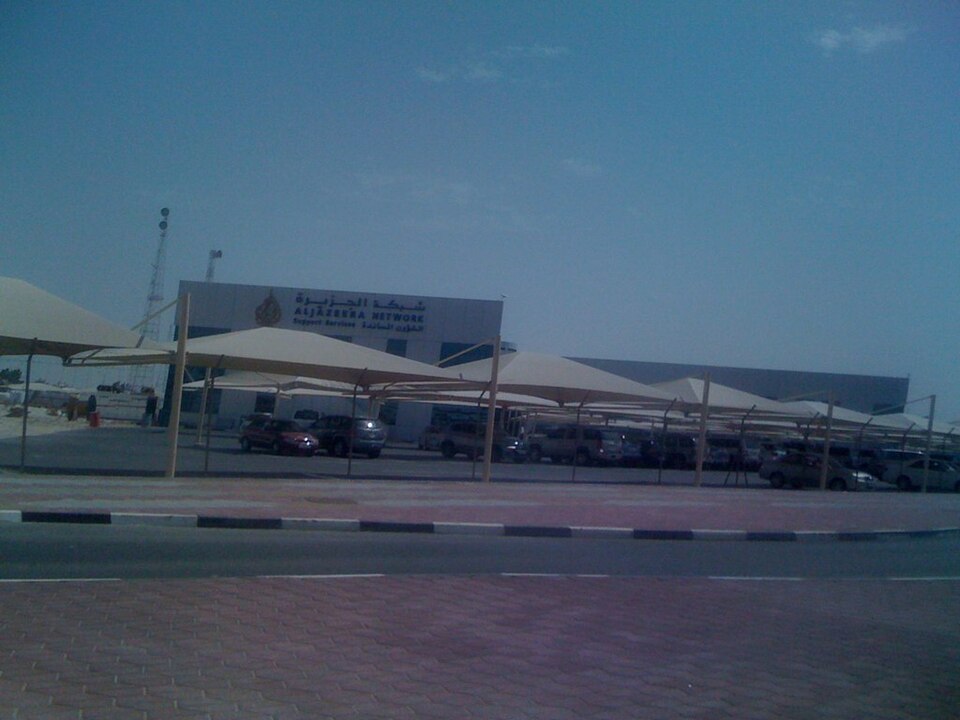
The Al Jazeera Network building signed "Support Services" in the Wadi Al Sail district of Doha, Qatar, 24 February 2010. Photo: Carlos Duarte do Nascimento (via Flickr user chesterbr), CC BY 2.0, via Wikimedia Commons; taken with a phone camera.
Part 3: findings by regulators, prosecutors, auditors and platforms
| Channel | Documented finding or action | By whom |
|---|---|---|
| RT | Assessed to be "the Kremlin's principal international propaganda outlet" in the January 2017 U.S. intelligence assessment (an assessment, not a regulatory ruling), which annexed a December 2012 Open Source Center report on RT | U.S. ODNI |
| RT | RT America's producer, T&R Productions, registers under FARA as agent of ANO TV-Novosti after a September 2017 request; filed 10 Nov, announced 13 Nov 2017 | U.S. Justice Department |
| RT | £200,000 fine (July 2019) for due-impartiality breaches in seven 2018 programmes; licence revoked 18 March 2022 with 29 investigations open, licensee found not "fit and proper" | Ofcom (UK) |
| RT | Broadcasting suspended across the EU, Regulation 2022/350, 1 March 2022 | Council of the EU |
| CGTN | Licence revoked 4 Feb 2021: licensee had no editorial control; proposed replacement disqualified as controlled by a body ultimately controlled by the Chinese Communist Party | Ofcom |
| CGTN | £225,000 in fines, 8 March 2021: £125,000 for five 2019 Hong Kong programmes that breached due impartiality, £100,000 over Peter Humphrey's broadcast confession | Ofcom |
| Al Jazeera | Complaints about The Lobby (2017), including antisemitism and bias, not upheld, 9 Oct 2017 | Ofcom |
| Al Jazeera | AJ+ told to register under FARA as acting "at the direction and control" of Qatar's leaders, 14 Sept 2020 | U.S. Justice Department |
| Alhurra | Management problems found (GAO-06-762, 2006); a USC study commissioned by the Broadcasting Board of Governors (2008), which the Board at first withheld, found stories "failed to present opposing views in over 60 percent" of cases | GAO; USC Annenberg |
| BBC World News | Barred from broadcasting in mainland China, 11 Feb 2021, for reports found to breach requirements that news be "true and impartial" (Xinhua's summary); one week after Ofcom revoked CGTN's licence | China's National Radio and Television Administration |
| Voice of America, RFE/RL | Designated "foreign agents" under a new media law, 5 Dec 2017, and required to label their content and report quarterly | Russian Justice Ministry |
| Alhurra | Found "little-watched and expensive", with a budget of about $90 million a year (2010) | U.S. Senate Foreign Relations Committee minority report |
- Peter Humphrey. CCTV News aired footage of the British investigator appearing to confess on China 24 (27 August 2013), after his arrest and before his trial, and appearing to apologise on News Hour (14 July 2014). Humphrey says he was drugged and caged when it was recorded. Ofcom upheld his fairness and privacy complaint in July 2020, finding no informed consent, and later upheld complaints by Gui Minhai and Simon Cheng.
- Al Jazeera and Qatar's diplomacy. A November 2009 U.S. embassy cable, published via WikiLeaks in December 2010, said Qatar would use the channel as "a bargaining tool to repair relationships with other countries", and expected its coverage of the United States to keep improving to the extent that its coverage was "made part of our bilateral discussion" (Haaretz). Al Jazeera called this "very far from the truth" and cited its editorial independence. In June 2017 Saudi Arabia, the UAE, Bahrain and Egypt listed its closure among 13 demands on Qatar; the UAE later said that demand was dropped.
- Alhurra's record. A 2008 ProPublica and CBS 60 Minutes investigation reported that about $500 million had been spent on Alhurra and Radio Sawa, that studies by the University of Maryland and Zogby International put the audience share of Alhurra and Sawa at no more than 2 percent, and that Alhurra had aired a December 2006 speech by Hezbollah leader Hassan Nasrallah live and reports from a Tehran Holocaust-denial conference, against its own rule against giving "terrorists" a platform. By the Broadcasting Board of Governors' own estimate, cited by the State Department inspector general, Alhurra and Radio Sawa together reached 25.7 million people in fiscal 2015; MBN broadcast to 22 countries (USAGM).
- November 2019: labels missing. ProPublica found 57 state-funded YouTube channels without the funding panel. YouTube labelled 35 after being told. Unlabelled channels included RT's German show 451 Degrees, CCTV entertainment channels, and eleven U.S. government-funded channels, among them Alhurra's, with 256,000 subscribers; YouTube later labelled the U.S. channels too.
- 4 September 2024. The U.S. Justice Department announces the indictment of two RT employees, Kostiantyn Kalashnikov and Elena Afanasyeva, on charges of conspiring to violate FARA and to launder money, alleging they paid nearly $10 million through a Tennessee company, Tenet Media, for videos by American online commentators without disclosing the Russian source of the money (U.S. Justice Department; NPR). The defendants have not been tried; these are charges, not findings.
- March to April 2025. An executive order cut USAGM to its statutory minimum; USAGM adviser Kari Lake told grantees they were "no longer worth funding". On 12 April 2025 MBN told about 500 Alhurra staff they were being laid off. AFP reported that the channel was ending its broadcasts; AP reported that it stayed on air with reruns and a staff of 30 to 50. MBN sued USAGM and won a preliminary injunction on 25 April 2025 (Democracy Forward). In a separate case brought by agency employees, a federal judge ruled in March 2026 that Lake's tenure leading USAGM was invalid (Axios).
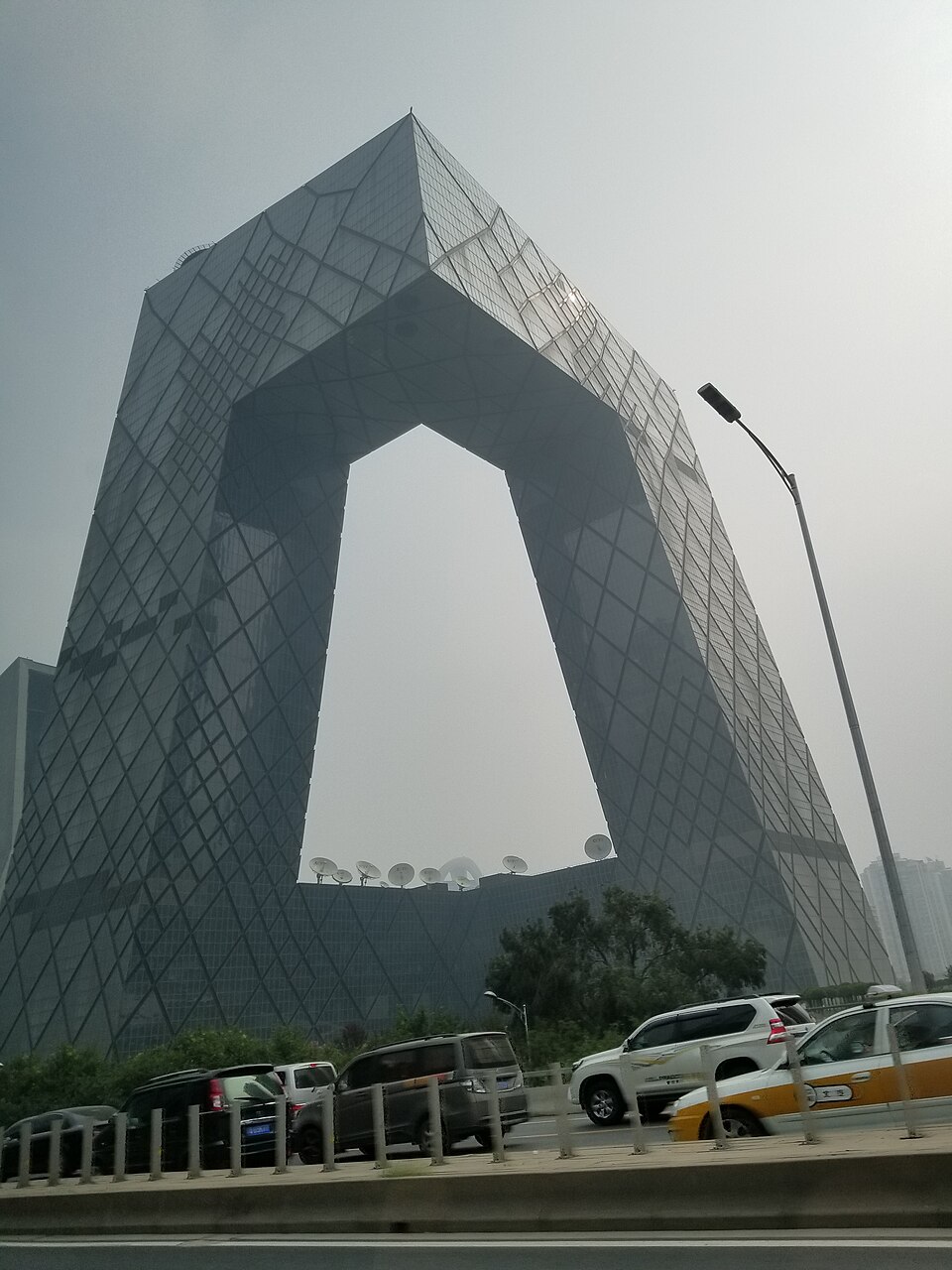
The CCTV Headquarters building, Beijing, of China Central Television, whose international channels were rebranded CGTN on 31 December 2016. Photo: SecretName101, 1 August 2017, CC BY-SA 4.0, via Wikimedia Commons.
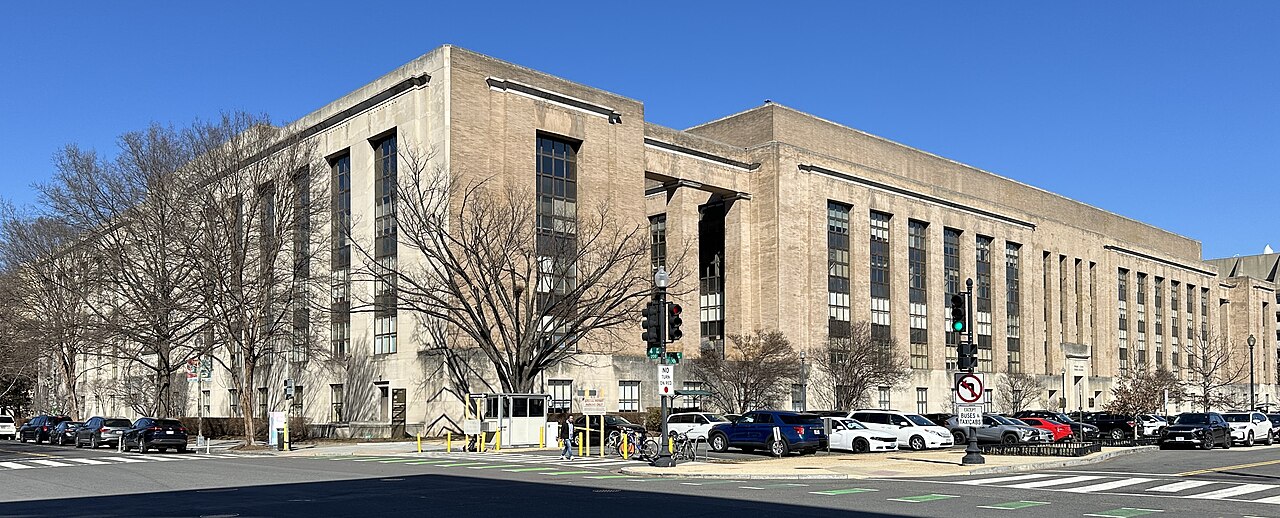
The Wilbur J. Cohen Federal Building, Washington, D.C., which has housed Voice of America and the U.S. Agency for Global Media headquarters since 1954. Photo: User APK, 10 March 2026, CC BY 4.0, via Wikimedia Commons.
How it works
- Card stacking: Der schwarze Kanal was built from another broadcaster's footage. Viewers saw only the extracts chosen and the order they were put in, with commentary laid over them, not the programme they came from. The sources document the format, not an audit of individual episodes. In the satellite era the same missing-counterexample pattern is what the documented impartiality findings measure: Ofcom's findings against RT and against five CGTN Hong Kong programmes, and the USC finding that Alhurra stories lacked opposing views in over 60 percent of cases. An impartiality finding measures what was left out; it does not by itself show intent.
- Testimonial: CCTV News put a detained man's own voice in front of viewers as confirmation of the charge before any trial. Ofcom found he had not given informed consent. The tag's carve-out matters here: the "Hilferufe von drüben" letters were first-person accounts from the people affected, sent by their own choice, which is the case the definition excludes.
- Narrative laundering: Ofcom found that CGTN's UK licence was held by Star China Media, a company that did not have editorial responsibility for what CGTN broadcast. The licensed surface and the body in editorial control were different, and the second, Ofcom found, was ultimately controlled by the Chinese Communist Party. A 2024 U.S. indictment alleges the same move for RT, with a U.S. company as the surface for RT money paying American commentators; that is an allegation not yet tried, so the tag rests on the Ofcom finding.
Considered and not tagged. Disclosure theater needs a disclosure that exists but does not travel with the content people see. YouTube's panel is a platform label, not a broadcaster's disclosure, and the documented problem (ProPublica 2019) is that it was missing on channels from Russia, China, Iran and the United States, not that viewers met labelled clips stripped of their label; no source here measures that. Whataboutism fits the common description of Der schwarze Kanal's rebuttal style, and a 2014 Washington Post analysis described Russian official and state-media reactions to the Ferguson protests as whataboutism, but no source found for this page documents a specific Der schwarze Kanal or RT segment answering a specific accusation with a different one, so it is not tagged. Neither tag is applied to any of the six outlets.
ZDF-Magazin was also weighed for Card stacking. Its critics' charge was one-sided selection: persecution cases from the East, and attacks on the government's Ostpolitik. Selecting which cases to report is not by itself card-stacking; the definition needs evidence that facts were omitted or ordered so that only one reading remains; no source found for this page audits its reports that way, so it is not tagged. Der schwarze Kanal is tagged on a narrower, documented feature of its format: viewers were shown excerpts cut from another broadcaster's programmes and re-ordered under new commentary. An episode-level audit of either programme could change either result.
Then and now
- One border against many. Both German programmes spoke the same language as their target audience, which could watch the other side's channel directly and compare. The satellite channels broadcast into many countries, in several languages, to audiences that mostly do not see the funder's domestic media.
- Who judged them. The sources here record no foreign regulator ruling on Der schwarze Kanal or ZDF-Magazin; each answered to its own system, and the gatekeeping differed: DFF's programming was set under the direction of the ruling party, while ZDF's boards included government and party representatives and ZDF-Magazin criticised the governing party's Ostpolitik, which answered with an interview boycott. In the satellite era UK licensing, U.S. registration law, EU sanctions, Chinese and Russian regulators and platform labels all judged channels funded by other states. Findings against RT and CGTN are formal regulatory decisions; for Alhurra they are audits, a congressional report and journalism; for Al Jazeera the formal rulings on record are the Ofcom Lobby decision in its favour and the Justice Department's AJ+ determination, which Al Jazeera condemned.
- Scale and outcome. RT and CGTN lost UK licences, and RT lost EU distribution, after actions by foreign governments and regulators. Alhurra's TV service was cut to a skeleton operation in 2025 because its own funder cut the money. Al Jazeera stayed on air after four neighbouring states demanded its closure in 2017; the UAE later said the demand was dropped.
Positions on the record
- The broadcasters' own words. RT: "Question More". Its editor-in-chief Margarita Simonyan said in a 2013 interview with Lenta.ru that "the information weapon, of course, is used in critical moments, and war is always a critical moment" (as quoted by the U.S. State Department). Al Jazeera: "The opinion and the other opinion", and it rejects the 2009 cable's account of state control. CGTN called Ofcom's revocation "politically motivated". MBN chief Jeffrey Gedmin said in 2025 that the region's media "thrive on a diet of anti-Americanism" and closing MBN would "open the field to American adversaries and Islamic extremists". Löwenthal's segment presented itself as help for persecuted people. No verified statement of purpose in Schnitzler's own words was found for this page.
- Governments and regulators. The U.S. Justice Department said "Americans have a right to know who is acting in the United States to influence the U.S. government or public on behalf of foreign principals" (Dana Boente, 2017). The EU regulation cited a "systematic, international campaign of media manipulation and distortion of facts".
- Critics of those responses. Media-law scholar Dirk Voorhoof called the EU ban "a step in the wrong direction"; others, writing in Verfassungsblog, defended it as a lawful measure against war propaganda. RT America's owner registered, by the Press Freedom Tracker's account, out of concern that refusing could lead to his arrest and the freezing of the company's assets. Al Jazeera said the AJ+ order appeared to be a precondition set by the UAE for normalising ties with Israel. YouTube's labels were criticised for grouping the BBC and PBS with state-controlled outlets.
- What is documented: the dates, formats, funders and findings listed above.
- What is not shown: audience figures for either German programme; any regulator finding against ZDF-Magazin or Der schwarze Kanal; the effect of any of these channels on what viewers believed; and whether Al Jazeera's coverage was directed by Qatar's government in any specific case, which the 2009 cable asserts and Al Jazeera denies.
Same-method test
If the U.S.-funded channel had been the one whose UK licence was held by a company with no editorial control, or had aired a detained foreigner's pre-trial confession without informed consent, it would receive the same tags here, and the Chinese channel would not. The same holds in reverse for Alhurra's documented balance finding: a Russian or Qatari channel with the same USC result would be tagged the same way.
How to spot it
- Check who holds the licence and who controls the editing. Ofcom's CGTN finding turned on the gap between them.
- When a programme shows another channel's footage, look for the full original before trusting the excerpt.
- Treat an on-air confession by someone in detention, before trial, as a statement made in custody, not as independent confirmation.
- Look for the funding label on the clip in front of you, not only on the channel's home page; ProPublica found it missing for outlets of several countries, the U.S. included.
- Keep the kind of finding in view: a regulator's decision, an audit, a leaked cable and a critic's opinion are different kinds of evidence.
Images
| Image | Source | Licence |
|---|---|---|
| Mechanism diagram (above) | Drawn for FRAME from the page's sourced facts (make_diagrams.py) |
CC BY 4.0, FRAME |
| Karl-Eduard von Schnitzler, 1956 | Wikimedia Commons | CC BY-SA 3.0 DE (Bundesarchiv) |
| Putin in an RT control room, 2013 | Wikimedia Commons, kremlin.ru | CC BY 4.0 (kremlin.ru) |
| Al Jazeera Network building, Doha, 2010 | Wikimedia Commons, Carlos Duarte do Nascimento | CC BY 2.0 |
| CCTV Headquarters, Beijing, 2017 | Wikimedia Commons, SecretName101 | CC BY-SA 4.0 |
| Wilbur J. Cohen Federal Building, Washington, 2026 | Wikimedia Commons, User APK | CC BY 4.0 |


.jpg)

Stills
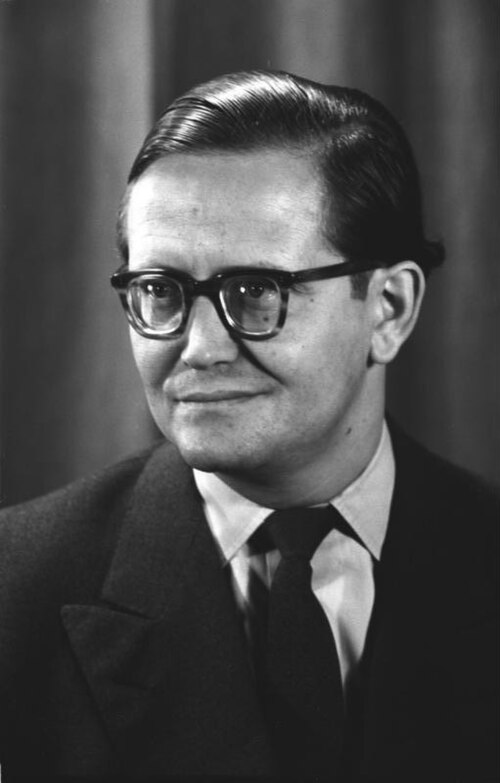
Karl-Eduard von Schnitzler in 1956, four years before Der schwarze Kanal began. Photo by Zimontkowski, Zentralbild. Bundesarchiv, Bild 183-41751-0001, CC BY-SA 3.0 DE.
Image gaps
- Stills from Der schwarze Kanal and ZDF-Magazin. The programmes are held by the Deutsches Rundfunkarchiv and ZDF and are copyrighted. Not fillable from the broadcasts themselves.
- A portrait of Gerhard Löwenthal. Schnitzler's 1956 Bundesarchiv portrait is hosted above; the Commons category for Löwenthal has four photographs but none could be identified and cleared, so none is hosted. Open.
- Alhurra and MBN. No openly licensed photo of the Alhurra newsroom or MBN's Springfield, Virginia headquarters was found; the Voice of America building stands in for U.S. international broadcasting.
- The YouTube "publicly funded" panel. A screenshot would show YouTube's interface and a broadcaster's copyrighted frame. Not fillable with an open licence.
- Ofcom decision documents. Ofcom publishes under its own terms; the site was unreachable from the build environment. Possibly fillable as a text excerpt rather than an image.
- Channel logos (RT, CGTN, Alhurra, Al Jazeera). Trademarks; not needed to show the method.
Sources
- Hugh Miles, Al-Jazeera: How Arab TV News Challenged the World (Abacus, 2005).
- Heather L. Gumbert, Envisioning Socialism: Television and the Cold War in the German Democratic Republic (University of Michigan Press, 2014).
- Claudia Dittmar, Feindliches Fernsehen: Das DDR-Fernsehen und seine Strategien im Umgang mit dem westdeutschen Fernsehen (transcript, 2010).
- Bundesverfassungsgericht, judgment of the First Senate of 25 March 2014, 1 BvF 1/11 and 1 BvF 4/11 (ZDF state treaty)
- dpa via newsroom.de: Kalter Krieg im "Schwarzen Kanal", und 1989 war Schluss
- Bundesregierung, Chronik der Deutschen Einheit, 30.10.1989: Aus für den Schwarzen Kanal
- schmusa.de: Der schwarze Kanal stellt seinen Sendebetrieb ein, 30.10.1989
- Tagesspiegel: Karl-Eduard von Schnitzler, unbeirrbarer und unbeirrter Dogmatiker
- Berliner Kurier: Wer Karl-Eduard von Schnitzler wirklich feuerte
- Deutsche Biographie: Löwenthal, Gerhard
- Jüdische Allgemeine: Kalter Krieger vom ZDF
- Fernsehlexikon: ZDF-Magazin
- Berliner Zeitung: Gerhard Löwenthal, als der Kalte Krieg in Rente ging
- CNN, 11 Feb 2021: BBC World News banned in China; The Diplomat, Feb 2021
- RFE/RL, 5 Dec 2017: Russia declares RFE/RL, VOA 'foreign agents'; Meduza, 5 Dec 2017
- Tagesspiegel: Missionar für die Einheit
- Wikipedia: Der schwarze Kanal and ZDF-Magazin (format and dates, cross-checked against the sources above)
- Ofcom: Ofcom revokes CGTN's licence to broadcast in the UK, 4 Feb 2021
- Ofcom Broadcast Bulletin 406, 6 July 2020: Complaint by Mr Peter Humphrey
- Ofcom sanction decision, Star China Media Ltd (fairness and privacy)
- Hong Kong Free Press, 8 March 2021: UK watchdog fines CGTN
- Press Gazette: Ofcom fines CGTN £225,000
- CGTN, 6 Feb 2021: The revoking of CGTN's license by Ofcom is politically motivated
- Broadband TV News, 26 July 2019: Ofcom fines RT £200,000
- Ofcom: Ofcom revokes RT's broadcast licence, 18 March 2022
- Press Gazette: Ofcom revokes RT UK broadcast licence
- Council Regulation (EU) 2022/350 of 1 March 2022
- Council of the EU press release, 2 March 2022
- Dirk Voorhoof, Inforrm: EU silences Russian state media, a step in the wrong direction
- Verfassungsblog: The EU's "Ban" of RT and Sputnik, a lawful measure against propaganda for war
- National Security Archive: ICA 2017-01D, Assessing Russian Activities and Intentions in Recent US Elections, 6 Jan 2017
- U.S. Justice Department: Production company registers under FARA as agent for the Russian government entity responsible for broadcasting RT, 13 Nov 2017
- U.S. Press Freedom Tracker: RT America compelled to register as foreign agent
- New Eastern Europe, 9 July 2012: The Propaganda Machine
- U.S. Justice Department, 4 Sept 2024: Two RT employees indicted for covertly funding and directing U.S. company
- NPR, 25 Sept 2024: Why Russia's broadcaster RT turned to covertly funding American pro-Trump influencers
- U.S. State Department: Faces of Kremlin Propaganda, Margarita Simonyan
- USAGM: Alhurra launched February 14, 2004
- USAGM: MBN network profile
- U.S. State Department Office of Inspector General, ISP-IB-17-09: Inspection of the BBG's Middle East Broadcasting Networks
- GAO-06-762: Management of Middle East Broadcasting Services Could Be Improved (2006)
- ProPublica: Lost in Translation, Alhurra, America's troubled effort to win Middle East hearts and minds (2008)
- ProPublica: Report calls Alhurra a failure (USC Annenberg study)
- ProPublica: Alhurra bleeding viewers, poll finds, but spending is up
- U.S. Senate Foreign Relations Committee print: U.S. International Broadcasting, Is Anybody Listening? (2010) and ProPublica summary
- The National, 17 March 2025: Trump administration ends financing for MBN
- France 24 / AFP, 13 April 2025: US-funded Arabic network ends broadcasts after Trump cuts
- AP via The Gazette, May 2025: In US retreat from global media, Arab language network is latest casualty
- Arab News: America's news channel for Middle East fires staff, goes off air
- Al-Monitor, May 2025: Hit by Trump cuts, journalists at Dubai-based US channel face uncertain future
- Democracy Forward: MBN sues USAGM and preliminary injunction granted
- Axios, 8 March 2026: Judge rules Kari Lake's tenure leading USAGM was invalid
- Haaretz, 6 Dec 2010: WikiLeaks, Qatar using Al-Jazeera as diplomatic tool
- Al Jazeera, 6 Dec 2010: Al Jazeera rejects leaked US claims
- CNN, 23 June 2017: Qatar told by Arab states to close Al Jazeera and Al Jazeera, 13 July 2017: UAE minister says demand to shut Al Jazeera dropped
- Ofcom Broadcast Bulletin 338, 9 Oct 2017 (The Lobby) and Press Gazette report
- U.S. Press Freedom Tracker: AJ+ ordered to register as foreign agent and Al Jazeera, 17 Sept 2020: Al Jazeera condemns AJ+ FARA registration order
- CNN Money, 2 Feb 2018: YouTube to start labeling videos posted by state-funded media
- TechCrunch, 2 Feb 2018: YouTube will now label state-funded news broadcasts
- Current, Feb 2018: PBS pushes back on YouTube plans for "government funded" label
- Forbes, 5 Feb 2018: A controversial YouTube news feature tackles state propaganda and Sesame Street
- ProPublica, Nov 2019: YouTube promised to label state-sponsored videos but doesn't always do so
- Washington Post, 20 Aug 2014: Ferguson, whataboutism and American soft power
- YouTube Help: Information panel providing publisher context