Content note. This page quotes labels used to condemn a real person ("Trotskyite", "special agent", "anti-Party clique") and describes coerced confessions, prolonged interrogation, and a killing. The labels and confessions are quoted as evidence of the method used against Wang Shiwei and others, not as this archive's judgment of anyone.
In one line: Between February 1942 and April 1945, at the Chinese Communist Party's wartime base in Yan'an, Mao Zedong's speeches on party style and art, the denunciation of the writer Wang Shiwei, and Kang Sheng's July 1943 "Rescue Campaign" against suspected spies built the small-group study, repeated self-examination and public-confession ritual that nearly every CCP mass campaign has reused since.
What happened
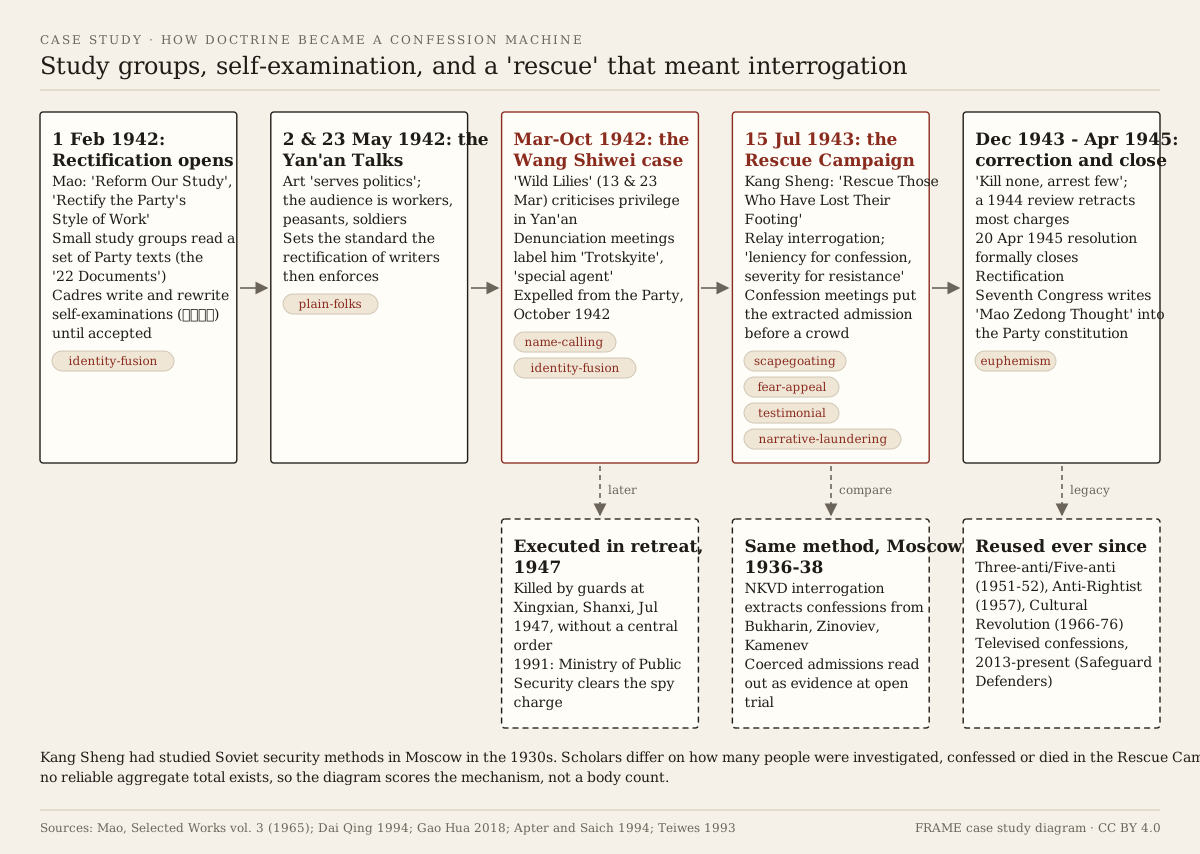
- 1 February 1942. At the opening of a new term at the Central Party School, Mao Zedong delivers "Reform Our Study" (改造我们的学习) and, the same day, "Rectify the Party's Style of Work" (整顿党的作风). The second speech names the campaign's three targets — subjectivism in study, sectarianism in Party relations, and a stilted, imported prose style — and makes "seeking truth from facts" (实事求是), a phrase drawn from classical Chinese historiography, its watchword. Cadres are organised into small study groups to read a set of Party and Soviet texts, later collected as the "22 Documents," and to write and rewrite personal "self-examinations" (反省笔记) of their own political history, revised until a group leader judges the confession sufficiently thorough.
- 8 February 1942. Mao's "Oppose Stereotyped Party Writing" (反对党八股) attacks empty, formulaic Party prose, comparing it to the rigid "eight-legged essay" (八股文) format of the imperial civil-service examinations.
- 13 and 23 March 1942. The writer Wang Shiwei publishes "Wild Lilies" (野百合花) in two instalments in the literary supplement of the Party's own newspaper, Liberation Daily (解放日报). It contrasts the tiers of food and clothing separating senior cadres from the sick and the ordinary rank and file, and argues that Yan'an's own "darkness" needs exposing as much as the enemy's. Wang and colleagues also post similar criticism on the wall-newspaper Light Cavalry (轻骑队) at the Central Research Institute, which drew large evening crowds, reportedly including Mao himself.
- 2 and 23 May 1942. Mao delivers the Talks at the Yan'an Forum on Literature and Art, setting the doctrine that literature and art must serve politics and address a "worker-peasant-soldier" audience. See Mao Zedong and the Chinese Communist Party, thought work and the mass line (1942-present) for the text and its later use; this page covers what the Rectification built around it.
- Late May-June 1942. Wang Shiwei becomes the campaign's central target. Denunciation meetings at the Central Research Institute, some running for several days, answer his criticism of privilege not with a reply to its content but with an investigation of his person: he is accused of leading a small "anti-Party clique" and, on the strength of a brief 1930 acquaintance in Shanghai with the Chinese Trotskyist Wang Fan-hsi, of being a "Trotskyite" (托派) himself.
- October 1942. Wang Shiwei is expelled from the Communist Party.
- 1 April 1943. The Central Committee adopts a decision on "cadre examination" (审查干部) that turns Rectification's self-examination machinery into a security-vetting process across the base area.
- 15 May 1943. The dissolution of the Communist International is announced. Inside Yan'an it feeds rumours that the Kuomintang, no longer under Comintern restraint, is preparing a new attack on the Communist base, sharpening the search for hidden agents.
- 15 July 1943. Kang Sheng, head of the Party's Central Social Affairs Department and familiar with Soviet security methods from years of study in Moscow, tells a mass rally in Yan'an to "Rescue Those Who Have Lost Their Footing" (抢救失足者), opening the "Rescue Campaign" (抢救运动, also translated "Salvation Campaign"). He presents large numbers of cadres and students — especially recent arrivals from Kuomintang-held cities — as concealed Kuomintang or Japanese "special agents" (特务). Confession meetings, isolation and relay interrogation follow through the rest of 1943, organised around the formula "leniency to those who confess, severity to those who resist" (坦白从宽,抗拒从严); a suspect who names others can shorten their own interrogation, producing chains of accusation that widen the campaign further.
- By late 1943, it is clear inside the leadership that most of the extracted "confessions" are false. Mao endorses a corrective policy summarised as "kill none, arrest few" (一个不杀,大部不抓), and a review process (甄别) through 1944 retracts the great majority of the espionage charges.
- 1944. At a meeting called to correct the campaign's excesses, Mao is recorded by several accounts as personally apologising to cadres who had been wrongly accused.
- 20 April 1945. The Seventh Enlarged Plenum of the Sixth Central Committee adopts the "Resolution on Certain Questions in the History of Our Party," criticising earlier "Left" errors, endorsing Mao's leadership, and formally closing Rectification. The Seventh Party Congress, opening three days later, writes "Mao Zedong Thought" into the Party constitution for the first time, in Liu Shaoqi's report "On the Party."
- March-July 1947. As Nationalist forces under Hu Zongnan advance on Yan'an and the Party evacuates, Wang Shiwei, still held in security custody, is executed by his guards at Xingxian county, Shanxi, in July 1947 — on the account of most historians, at a local security officer's initiative rather than under a central Party order.
- 1962. At the Seven Thousand Cadres Conference, Mao is recorded as saying Wang Shiwei should not have been killed, without reversing the underlying "Trotskyite" verdict.
- 1991. China's Ministry of Public Security formally clears Wang Shiwei of the "counter-revolutionary" charge, recognising he was not a Trotskyite or a spy. The finding received little publicity inside China.

Where the movement ran and where its migrant writers came from: Yan'an, and Beijing and Shanghai, named on this page. Drawn by FRAME from Natural Earth's public-domain outlines; it takes no position on borders.
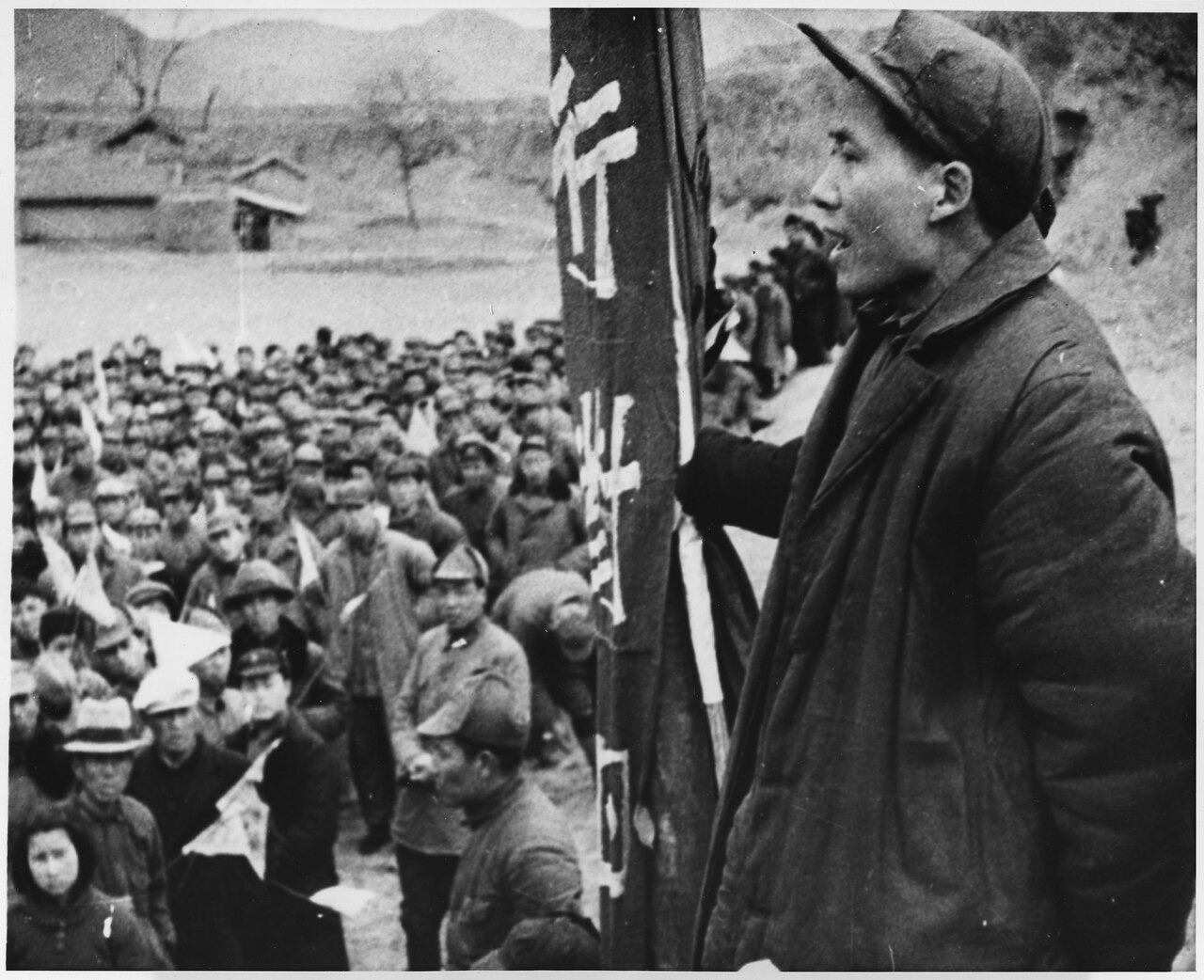
Mao Zedong addresses a mass meeting at Yan'an, 6 December 1944 — the kind of open-air rally through which Rectification and the Rescue Campaign reached the base's cadres and students. Photograph from the Franklin D. Roosevelt Presidential Library via the U.S. National Archives (NARA 196235); a U.S. federal government work, in the public domain. The banner's text is not legible in this scan.
How it works
- Identity fusion: the 1 February 1942 speeches and study-group method fused personal thought with political loyalty. A cadre was not asked to correct one stated error but to write, and rewrite, a self-examination of their whole political and personal history until the group judged it "thorough" — a process in which disagreeing with the group's verdict was itself read as evidence the confession was still insincere. Wang Shiwei's criticism of privilege was answered the same way: not with a reply to what "Wild Lilies" said, but with an inquiry into who he was, ending in the charge that a decade-old acquaintance made him a Trotskyite.
- Euphemism / doublespeak: Kang Sheng's campaign was named "Rescue Those Who Have Lost Their Footing," casting people who were about to be broken by interrogation as comrades to be saved rather than suspects to be forced into confession; "cadre examination" (审干) presented the same vetting as ordinary administrative review.
- Name-calling: "Trotskyite" and "special agent" functioned as verdicts that arrived before any specific act of espionage was shown. Wang Shiwei carried the first label to his death; the Rescue Campaign applied the second to a category of people — recent arrivals from Kuomintang cities — rather than to documented acts.
- Scapegoating: Kang Sheng's July 1943 speech assigned wartime hardship and a rumoured coming Kuomintang attack to a hidden population of enemy agents supposedly planted among the thousands of students and cadres who had travelled to Yan'an since 1937, explaining friction and shortage inside a blockaded base as infiltration rather than as conditions of the war.
- Fear appeal: the paired formula "leniency to those who confess, severity to those who resist" offered an immediate, stated cost for silence and a stated reward for producing a confession, with no independent check on whether the confession was accurate; interrogation continued, in relay, until one was produced.
- Testimonial: confession meetings put the extracted, first-person admission before an audience as proof of guilt, in the confessor's own words — the same device used at the Moscow show trials described below. The visible form of an admission stood in for an interrogation record the audience never saw.
- Narrative laundering: what reached the written record — a signed self-examination, a confession read out at a mass meeting, the minutes of a cadre-examination session — carried none of the isolation, sleep deprivation or relay interrogation that produced it. The coercion behind the document dropped out of the document.
- Plain folks: the Yan'an Talks directed writers, mostly educated migrants from Shanghai, Beijing and other cities, to "go down" among workers, peasants and soldiers, learn their language and take their "class stand." The New Yangge Movement that followed in 1943-44 restaged folk dance-opera forms, including "Brother and Sister Open the Wasteland" and, in 1945, "The White-Haired Girl," with revolutionary content — making closeness to peasant form itself a credential of political correctness for city-trained writers.
Then and now
The confession template Rectification built — isolation, a stated reward for admitting guilt, a public reading of the admission as proof — reappears in China's televised confessions of the 2010s and 2020s: detained lawyers, journalists, booksellers and foreign nationals reciting scripted admissions on state television before any trial. Safeguard Defenders' 2018 report Scripted and Staged documents dozens of such broadcasts and traces the practice's use of the same "confess and be treated leniently" logic.
The differences are large. The Rescue Campaign operated inside an isolated wartime base of tens of thousands of people, largely invisible to the outside world; its confessions circulated within the Party and were quietly retracted by 1944-45 once their falsity became clear internally. Today's televised confessions are produced individually, broadcast to a domestic audience of hundreds of millions and an international one, documented in real time by human-rights organisations and foreign governments, and have drawn formal diplomatic protest (for example after the 2018 broadcast involving the Swedish bookseller Gui Minhai) — a level of outside scrutiny the 1943 campaign never faced.
Positions on the record
- The Party's position at the time. Kang Sheng's 15 July 1943 speech and the campaign built around it presented the Rescue Campaign as protecting the revolution from real infiltration, and framed forced confession as an act of mercy toward comrades who had strayed rather than as coercion. The 1 April 1943 cadre-examination decision presented the same process as ordinary Party administration.
- The Party's later position. The 20 April 1945 resolution criticised earlier "Left" errors in Party history without singling out the Rescue Campaign's methods by name. Mao is recorded in 1962 as acknowledging that Wang Shiwei should not have been killed. In 1991 the Ministry of Public Security formally cleared Wang of the "counter-revolutionary" and Trotskyite charges. No Party document has published an aggregate accounting of how many people were coerced into false confessions during the Rescue Campaign.
- Scholarship. Gao Hua's How the Red Sun Rose (2000; English translation 2018) is the standard scholarly reconstruction of Rectification's politics and Mao's consolidation of authority through it. David Apter and Tony Saich's Revolutionary Discourse in Mao's Republic (1994) analyses the self-examination ritual as a "discourse community" that produced compliance through repeated confession rather than through argument. Dai Qing's Wang Shiwei and "Wild Lilies" (1994) reconstructs the case from Party archives and interviews. Frederick Teiwes situates Yan'an as the origin of a pattern of rectification-and-purge repeated in every subsequent CCP campaign.
- What is documented. The texts and dates of Mao's February and May 1942 speeches; the publication dates of "Wild Lilies"; Wang Shiwei's expulsion, 1947 execution and 1991 rehabilitation; Kang Sheng's 15 July 1943 speech and role; the "kill none, arrest few" corrective policy; the 20 April 1945 resolution and the Seventh Congress's adoption of "Mao Zedong Thought."
- What is contested. No reliable aggregate figure exists for how many people were investigated, confessed, or died (including by suicide under interrogation) during the Rescue Campaign; estimates in the secondary literature vary widely and are not independently verifiable. The precise chain of authorisation behind Wang Shiwei's 1947 execution — how far it was a local decision versus one tolerated or ordered from above — is argued differently by different historians.
- Not ruled on here. The substance of the internal CCP theoretical dispute between "dogmatism" (associated with Soviet-trained cadres) and Mao's own line, and whether any genuine Kuomintang or Japanese espionage existed at Yan'an, which is a separate question from how the Rescue Campaign identified its suspects. This page scores the confession mechanism, not that underlying political argument.
Same-method test
The same scoring applies to the Moscow show trials of 1936-1938, where NKVD interrogators used isolation, threats to family members, promises of leniency and relay questioning to extract confessions from Nikolai Bukharin, Grigory Zinoviev, Lev Kamenev and others, which prosecutor Andrei Vyshinsky then read into the record of open, foreign-observed trials as evidence of guilt. Robert Conquest's The Great Terror documents the method; Nikita Khrushchev's 1956 "Secret Speech" and the Soviet Union's own 1988 rehabilitation of Bukharin later confirmed the confessions were false. Coerced testimony that implicates further suspects, staged as a voluntary admission for an audience, is tagged Testimonial and Narrative laundering here regardless of which government ran the interrogation.
A milder, Western-democracy parallel is the United States' House Un-American Activities Committee (HUAC) and the broader McCarthy-era loyalty investigations of 1947-1954. "Friendly witnesses" who wished to clear themselves of suspicion were expected to confess past Communist Party membership and "name names" of others, in open session, as the price of continued employment; witnesses who refused, such as the Hollywood Ten, were prosecuted for contempt of Congress rather than for any specific act. The same reward-for-confession, cost-for-silence structure applies, which is Fear appeal and Testimonial on this scoring.
The scale and stakes were very different in each case. Yan'an's confessions were extracted under conditions that included documented physical coercion and produced at least one confirmed death, Wang Shiwei's, inside a one-party wartime base with no outside oversight; the campaign's own falsity rate was corrected only internally, years later. The Moscow trials' confessions led to the executions of Bukharin, Zinoviev, Kamenev and others in a one-party state under a functioning secret police, reversed only decades afterward. HUAC's confessions led to blacklisting, lost careers and, for a minority, prison for contempt of Congress, inside a system with a free press, opposition politicians and courts that kept sitting; the Senate censured Joseph McCarthy in December 1954, and HUAC itself was renamed in 1969 and abolished in 1975. Same mechanism; very different order of harm and very different capacity to correct it from outside.
How to spot it
- Ask what conditions produced the "confession": isolation, relay interrogation, or a stated reward for confessing and cost for silence make the content unreliable as evidence, however sincere it looks on the page or the screen.
- Check whether confessing lets a suspect name others to shorten their own ordeal. A mechanism that rewards implicating others produces a cascade of accusations, not an accurate count of wrongdoing.
- Look at how — and whether — the confessions were reviewed afterward. A swift internal retraction, or a high rate of later-overturned cases, is itself evidence of the mechanism's error rate, whether or not it is ever publicised.
- Watch for a campaign name that casts the target as being rescued, cured or saved rather than broken; the softer the name, the more useful it is to look at what actually happened inside the process.
- Ask whether criticising the method itself was treated as evidence of guilt. A process that cannot be questioned from inside also cannot correct itself from inside.
Images
| Image | Source | Licence |
|---|---|---|
| Mechanism diagram (above) | Drawn for FRAME from the sources below (make_diagrams_rtp_yanan.py) |
CC BY 4.0, FRAME |
| Mao Zedong addressing a crowd, Yan'an, 6 December 1944 | Wikimedia Commons, Franklin D. Roosevelt Presidential Library via U.S. National Archives (NARA 196235) | Public domain (U.S. federal government work) |
| Yan'an, Beijing and Shanghai (map) | Drawn for FRAME (make_yanan_maps.py) from Natural Earth |
CC BY 4.0, FRAME; basemap public domain |
Image gaps
- The U.S. Army "Dixie Mission" photograph of Colonel Barrett with Mao (Yan'an, 1944). It was hosted earlier and removed: Commons credits Barrett, who appears in the picture, so the photographer could not be verified and neither could its status as a U.S. government work. The mission arrived in July 1944, as the Rescue Campaign was already being wound down; its members left the first outside accounts of daily life at the wartime base.
- The Liberation Daily pages carrying "Wild Lilies" (13 and 23 March 1942) and the wall-newspaper Light Cavalry. No openly licensed scan was found. As a 1942 PRC-origin publication still under Chinese copyright on 1 January 1996, any surviving copy would carry the same URAA uncertainty as the items below, so none is hosted.
- Photographs of Wang Shiwei and Kang Sheng themselves. Wikimedia Commons holds a photograph of each (
File:Wang_shiwei.jpg, taken 1933;File:Kang_Sheng.jpg, dated 1960), both tagged public domain in China only, with the Commons page for each carrying the standard URAA warning that Chinese works still under copyright in their country of origin on 1 January 1996 may have had their U.S. copyright restored. Unclear U.S. status, so cited and linked rather than hosted: Wang Shiwei; Kang Sheng. - A photograph of the Yan'an Forum on Literature and Art itself, May 1942. Commons holds a group photograph in its "1942 black and white photographs in Yan'an" category; it is a PRC-origin 1942 photograph with the same unclear U.S. status, so it is not hosted here.
- Confession or struggle-meeting photographs from the Rescue Campaign. No openly licensed photograph was found, and none is known to survive in public archives; the campaign's interrogations were conducted as internal security work, not as a publicised spectacle.
- The Seventh Party Congress, April-June 1945. No openly licensed photograph of the congress hall was found from the environment used to build this page.


Sources
- Mao Zedong, "Reform Our Study" (改造我们的学习), 1 February 1942, in Selected Works of Mao Tse-tung, vol. 3 (Peking: Foreign Languages Press, 1965).
- Mao Zedong, "Rectify the Party's Style of Work" (整顿党的作风), 1 February 1942, in Selected Works, vol. 3.
- Mao Zedong, "Oppose Stereotyped Party Writing" (反对党八股), 8 February 1942, in Selected Works, vol. 3.
- Mao Zedong, "Talks at the Yenan Forum on Literature and Art", 2 and 23 May 1942, in Selected Works, vol. 3; see Mao Zedong and the Chinese Communist Party, thought work and the mass line (1942-present) for full treatment.
- Wang Shiwei, "Wild Lilies" (野百合花), Liberation Daily, 13 and 23 March 1942; translated in Dai Qing (below).
- Dai Qing, Wang Shiwei and "Wild Lilies": Rectification and Purges in the Chinese Communist Party, 1942-1944, ed. David E. Apter and Timothy Cheek (Armonk, NY: M. E. Sharpe, 1994).
- David E. Apter and Tony Saich, Revolutionary Discourse in Mao's Republic (Cambridge, MA: Harvard University Press, 1994).
- Gao Hua, How the Red Sun Rose: The Origin and Development of the Yan'an Rectification Movement, 1930-1945, trans. Stacy Mosher and Guo Jian (Hong Kong: Chinese University of Hong Kong Press, 2018; Chinese original 2000).
- Frederick C. Teiwes, Politics and Purges in China: Rectification and the Decline of Party Norms, 1950-1965, 2nd ed. (Armonk, NY: M. E. Sharpe, 1993).
- Wang Fan-hsi, Chinese Revolutionary: Memoirs 1919-1949, trans. Gregor Benton (Oxford: Oxford University Press, 1980), for Wang Shiwei's early 1930s Trotskyist-adjacent contact.
- Central Committee of the Communist Party of China, "Resolution on Certain Questions in the History of Our Party" (关于若干历史问题的决议), adopted 20 April 1945 by the Seventh Enlarged Plenum of the Sixth Central Committee.
- Liu Shaoqi, "On the Party", report to the Seventh National Congress of the Communist Party of China, 1945.
- Robert Conquest, The Great Terror: A Reassessment (Oxford: Oxford University Press, 1990 rev. ed.), for the Moscow show trials comparison.
- Nikita Khrushchev, "On the Cult of Personality and Its Consequences" (the "Secret Speech"), 25 February 1956, 20th Congress of the Communist Party of the Soviet Union.
- Ellen Schrecker, Many Are the Crimes: McCarthyism in America (Boston: Little, Brown, 1998), for the HUAC comparison.
- Safeguard Defenders, Scripted and Staged: Behind the Scenes of China's Forced TV Confessions (2018): safeguarddefenders.com.
- Franklin D. Roosevelt Presidential Library, U.S. National Archives and Records Administration, NARA 196235, "Mao Tse-Tung, leader of China's Communists, addresses some of his followers", 6 December 1944: Wikimedia Commons.
- David D. Barrett, Dixie Mission: The United States Army Observer Group in Yenan, 1944 (Berkeley: Center for Chinese Studies, University of California, 1970): photograph via Wikimedia Commons.
