Agression du Nord (Aggression of the North)
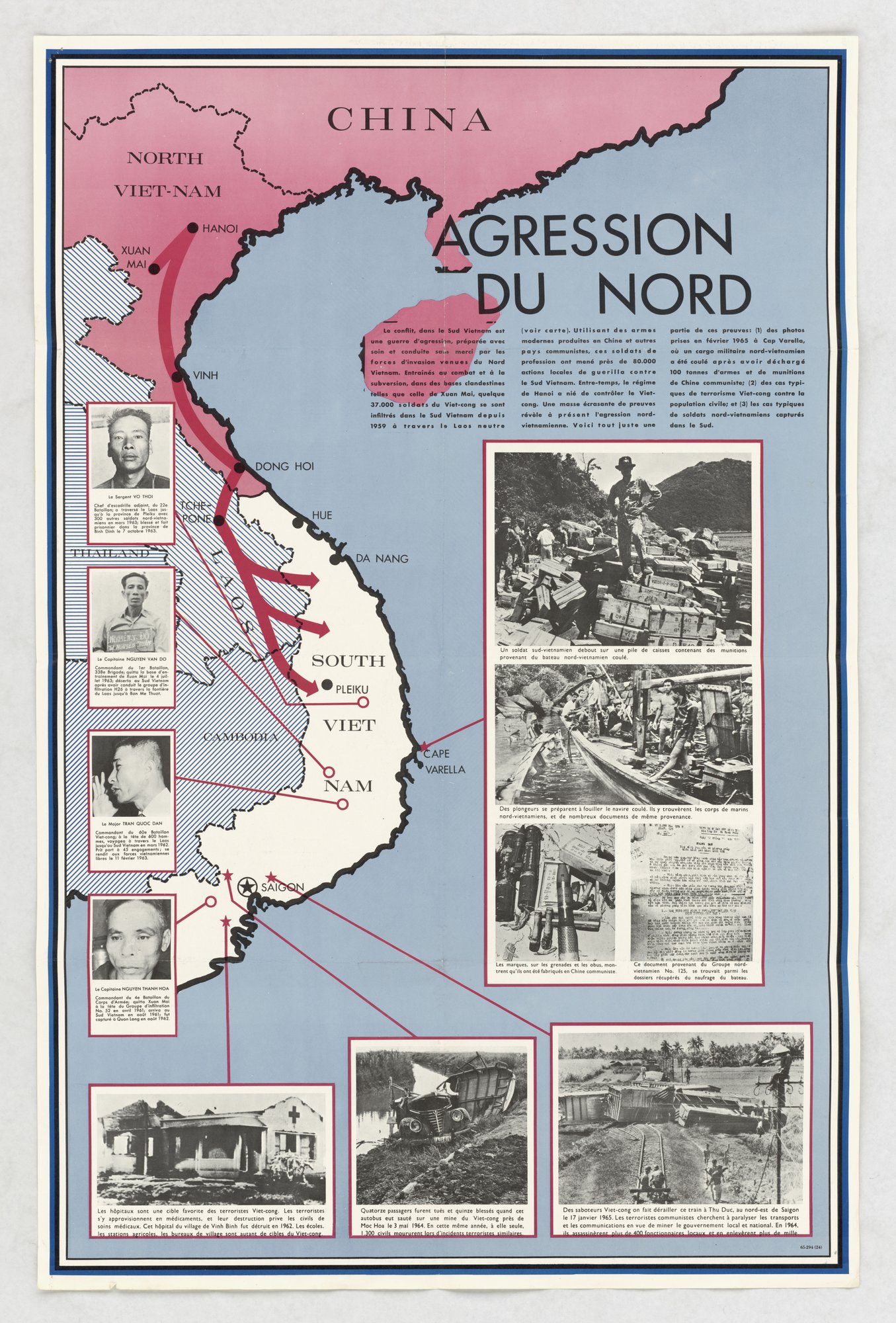
A French-language wall chart pairs a map with red arrows running from Hanoi and Xuan Mai through Laos into South Vietnam with the claim that about 37,000 Viet Cong infiltrated from the North since 1959. Photographs of a sunk cargo vessel and its Chinese-marked arms at Cape Varella, of a burned hospital, a bombed bus and a derailed train, and portrait cards of four captured North Vietnamese officers are offered as 'a part of the evidence'. The sheet assembles selected photographs, figures and named prisoners into one case that the war is an external invasion.
Propaganda techniques used in this poster
- Date
- 1965
- Period
- Cold War
- Made by
- Issuer not printed on the sheet; filed in the U.S. psychological warfare poster series
- Region
- North America
- Country
- United States
- Medium
- Poster
- Issuer type
- State
- Regime
- Johnson Administration
- Leader
- Lyndon B. Johnson
- Audience
- Foreign public
- Purpose
- Persuade or win support
- Themes
- War and the military, Security and surveillance
- Event
- Vietnam War
- Source
- Unidentified Source blurred: contractors, cutouts, buried disclosure
- Source
- U.S. National Archives (NARA), RG 306, Psychological Warfare Posters, Vietnam War (NAID 561393), retrieved October 3, 2026
- Rights
- NARA Unrestricted; hosted by owner decision
Issuer not printed; U.S. psychological warfare poster series. National Archives and Records Administration, 306-VP-010-4.
Text on the object
[Map labels: CHINA; NORTH VIET-NAM; HANOI; XUAN MAI; VINH; DONG HOI; TCHE-PONE; HUE; DA NANG; LAOS; THAILAND; CAMBODIA; SOUTH VIET NAM; PLEIKU; CAPE VARELLA; SAIGON]

AGRESSION DU NORD

Le conflit, dans le Sud Vietnam est une guerre d'agression, préparée avec soin et conduite sans merci par les forces d'invasion venues du Nord Vietnam. Entraînés au combat et à la subversion, dans des bases clandestines telles que celle de Xuan Mai, quelque 37.000 soldats du Viet-cong se sont infiltrés dans le Sud Vietnam depuis 1959 à travers le Laos neutre (voir carte). Utilisant des armes modernes produites en Chine et autres pays communistes, ces soldats de profession ont mené près de 80.000 actions locales de guérilla contre le Sud Vietnam. Entre-temps, le régime de Hanoi a nié de contrôler le Viet-cong. Une masse écrasante de preuves révèle à présent l'agression nord-vietnamienne. Voici tout juste une partie de ces preuves: (1) des photos prises en février 1965 à Cap Varella, où un cargo militaire nord-vietnamien a été coulé après avoir déchargé 100 tonnes d'armes et de munitions de Chine communiste; (2) des cas typiques de terrorisme Viet-cong contre la population civile; et (3) les cas typiques de soldats nord-vietnamiens capturés dans le Sud.

Le Sergent VO THOI - [partly illegible] 22e Bataillon; [illegible] le 7 octobre 1963.
Le Capitaine NGUYEN VAN DO - Commandant du 1er Bataillon, 338e Brigade; quitta la base d'entraînement de Xuan Mai le 4 juillet 1963; [partly illegible] groupe d'infiltration H26 à travers le Laos jusqu'à la frontière [illegible] Ban Me Thuot.
Le Major TRAN QUOC DAN - Commandant du 60e Bataillon Viet-cong; à la tête de 600 hommes, voyagea à travers le Laos jusqu'au Sud Vietnam en mars 1962. Prit part à 45 engagements; se rendit aux forces vietnamiennes libres le 11 février 1963.
Le Capitaine NGUYEN THANH HOA - Commandant du 4e Bataillon du Corps d'Armée; quitte Xuan Mai à la tête du Groupe d'infiltration No. 52 en avril 1961; arriva au Sud Vietnam en août 1961; fut capturé à Quan Long en août 1962.

Un soldat sud-vietnamien debout sur une pile de caisses contenant des munitions provenant du bateau nord-vietnamien coulé.
Des plongeurs se préparent à fouiller le navire coulé. Ils y trouvèrent les corps de marins nord-vietnamiens, et de nombreux documents de même provenance.
Les marques, sur les grenades et les obus, montrent qu'ils ont été fabriqués en Chine communiste.
Ce document provenant du Groupe nord-vietnamien No. 125, se trouvait parmi les dossiers récupérés du naufrage du bateau.

Les hôpitaux sont une cible favorite des terroristes Viet-cong. Les terroristes s'approvisionnent en médicaments, et leur destruction prive les civils de soins médicaux. Cet hôpital du village de Vinh Binh fut détruit en 1962. Les écoles, les stations agricoles, les bureaux de village sont autant de cibles du Viet-cong [text cut off at sheet edge].
Quatorze passagers furent tués et quinze blessés quand cet autobus eut sauté sur une mine du Viet-cong près de Moc Hoa le 3 mai 1964. En cette même année, à elle seule, 1.300 civils moururent lors d'incidents terroristes similaires.
Des saboteurs Viet-cong ont fait dérailler ce train à Thu Duc, au nord-est de Saigon le 17 janvier 1965. Les terroristes communistes cherchent à paralyser les transports et les communications en vue de miner le gouvernement local et national. En 1964, ils assassinèrent plus de 400 fonctionnaires locaux et en enlevèrent plus de mille [text cut off at sheet edge].

65-294 (24)
NORTHERN AGGRESSION

The conflict in South Vietnam is a war of aggression, carefully prepared and pitilessly conducted by invasion forces from North Vietnam. Trained in combat and subversion in clandestine bases such as the one at Xuan Mai, some 37,000 Viet Cong soldiers have infiltrated into South Vietnam since 1959 through neutral Laos (see map). Using modern weapons produced in China and other communist countries, these professional soldiers have carried out nearly 80,000 local guerrilla actions against South Vietnam. Meanwhile the Hanoi regime has denied controlling the Viet Cong. An overwhelming mass of evidence now reveals the North Vietnamese aggression. Here is just a part of this evidence: (1) photos taken in February 1965 at Cape Varella, where a North Vietnamese military cargo ship was sunk after unloading 100 tons of arms and munitions from Communist China; (2) typical cases of Viet Cong terrorism against the civilian population; and (3) typical cases of North Vietnamese soldiers captured in the South.

Sergeant VO THOI - [partly illegible] 22nd Battalion; [illegible] on 7 October 1963.
Captain NGUYEN VAN DO - Commander of the 1st Battalion, 338th Brigade; left the Xuan Mai training base on 4 July 1963; [partly illegible] infiltration group H26 through Laos to the frontier [illegible] Ban Me Thuot.
Major TRAN QUOC DAN - Commander of the 60th Viet Cong Battalion; at the head of 600 men, travelled through Laos to South Vietnam in March 1962. Took part in 45 engagements; surrendered to free Vietnamese forces on 11 February 1963.
Captain NGUYEN THANH HOA - Commander of the 4th Battalion of the Army Corps; left Xuan Mai at the head of Infiltration Group No. 52 in April 1961; arrived in South Vietnam in August 1961; was captured at Quan Long in August 1962.

A South Vietnamese soldier standing on a pile of crates containing ammunition from the sunk North Vietnamese boat.
Divers prepare to search the sunken vessel. They found the bodies of North Vietnamese sailors, and numerous documents of the same origin.
The markings on the grenades and shells show that they were made in Communist China.
This document from North Vietnamese Group No. 125 was among the files recovered from the wreck of the boat.

Hospitals are a favourite target of the Viet Cong terrorists. The terrorists obtain their medical supplies, and destroying them deprives civilians of medical care. This hospital in the village of Vinh Binh was destroyed in 1962. Schools, agricultural stations, village offices are so many Viet Cong targets [text cut off at sheet edge].
Fourteen passengers were killed and fifteen wounded when this bus ran over a Viet Cong mine near Moc Hoa on 3 May 1964. In that same year alone, 1,300 civilians died in similar terrorist incidents.
Viet Cong saboteurs derailed this train at Thu Duc, north-east of Saigon, on 17 January 1965. The communist terrorists seek to paralyse transport and communications in order to undermine local and national government. In 1964 they assassinated more than 400 local officials and kidnapped more than a thousand [text cut off at sheet edge].

65-294 (24)